Taanit 4a: Talmud study for Daf Yomi
Daf Yomi is the daily study of one Talmud folio. Explore 37 tractates with scans, Hebrew text, Sefaria English and AI-generated French translations where annotated.
Passage selection and English or AI-generated French translation are available where the scan has annotations. Daf Study is independent of Torah-Box and Sefaria.
Browse Taanit · תענית · All tractatesTaanit 4a text and translations
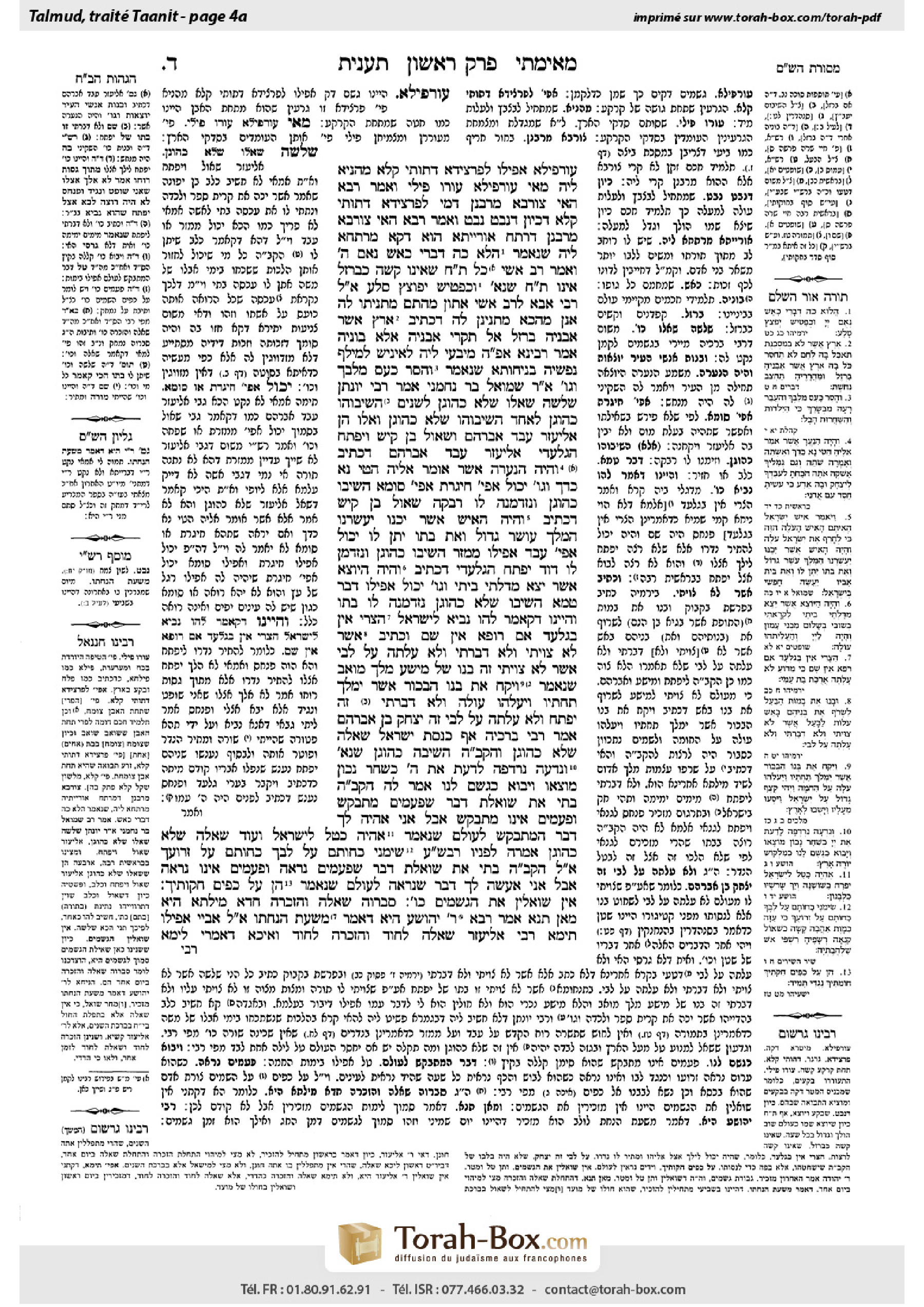
This page of Taanit includes the Aramaic text, an English translation and an AI-generated French translation, alongside the scan above.
תענית ד׳ א · Aramaic and Hebrew text
עוּרְפִּילָא — אֲפִילּוּ לְפַרְצִידָא דְּתוּתֵי קָלָא מַהְנְיָא לֵיהּ. מַאי עוּרְפִּילָא — עוּרוּ פִּילֵי. וְאָמַר רָבָא: הַאי צוּרְבָּא מֵרַבָּנַן דָּמֵי לְפַרְצִידָא דְּתוּתֵי קָלָא, דְּכֵיוָן דִּנְבַט — נְבַט.
וְאָמַר רָבָא: הַאי צוּרְבָּא מֵרַבָּנַן דְּרָתַח — אוֹרָיְיתָא הוּא דְקָא מַרְתְּחָא לֵיהּ, שֶׁנֶּאֱמַר: ״הֲלוֹא כֹה דְבָרִי כָּאֵשׁ נְאֻם ה׳״, וְאָמַר רַב אָשֵׁי: כׇּל תַּלְמִיד חָכָם שֶׁאֵינוֹ קָשֶׁה כַּבַּרְזֶל — אֵינוֹ תַּלְמִיד חָכָם, שֶׁנֶּאֱמַר: ״וּכְפַטִּישׁ יְפֹצֵץ סָלַע״.
אֲמַר לֵיהּ רַבִּי אַבָּא לְרַב אָשֵׁי: אַתּוּן, מֵהָתָם מַתְנִיתוּ לַהּ. אֲנַן, מֵהָכָא מַתְנֵינַן לַהּ, דִּכְתִיב: ״אֶרֶץ אֲשֶׁר אֲבָנֶיהָ בַרְזֶל״, אַל תִּקְרֵי ״אֲבָנֶיהָ״, אֶלָּא בּוֹנֶיהָ. אָמַר רָבִינָא: אֲפִילּוּ הָכִי, מִיבְּעֵי לֵיהּ לְאִינִישׁ לְמֵילַף נַפְשֵׁיהּ בְּנִיחוּתָא, שֶׁנֶּאֱמַר: ״וְהָסֵר כַּעַס מִלִּבֶּךָ וְגוֹ׳״.
אָמַר רַבִּי שְׁמוּאֵל בַּר נַחְמָנִי אָמַר רַבִּי יוֹנָתָן: שְׁלֹשָׁה שָׁאֲלוּ שֶׁלֹּא כַּהוֹגֶן, לִשְׁנַיִם הֱשִׁיבוּהוּ כַּהוֹגֶן, לְאֶחָד הֱשִׁיבוּהוּ שֶׁלֹּא כַּהוֹגֶן. וְאֵלּוּ הֵן: אֱלִיעֶזֶר עֶבֶד אַבְרָהָם, וְשָׁאוּל בֶּן קִישׁ, וְיִפְתָּח הַגִּלְעָדִי.
אֱלִיעֶזֶר עֶבֶד אַבְרָהָם — דִּכְתִיב: ״וְהָיָה הַנַּעֲרָה אֲשֶׁר אֹמַר אֵלֶיהָ הַטִּי נָא כַדֵּךְ וְגוֹ׳״, יָכוֹל אֲפִילּוּ חִיגֶּרֶת, אֲפִילּוּ סוֹמָא. הֵשִׁיבוּ כַּהוֹגֶן, וְנִזְדַּמְּנָה לוֹ רִבְקָה.
שָׁאוּל בֶּן קִישׁ — דִּכְתִיב: ״וְהָיָה הָאִישׁ אֲשֶׁר יַכֶּנּוּ יַעְשְׁרֶנּוּ הַמֶּלֶךְ עֹשֶׁר גָּדוֹל וְאֶת בִּתּוֹ יִתֶּן לוֹ״, יָכוֹל אֲפִילּוּ עֶבֶד, אֲפִילּוּ מַמְזֵר. הֵשִׁיבוּ כַּהוֹגֶן, וְנִזְדַּמֵּן לוֹ דָּוִד.
יִפְתַּח הַגִּלְעָדִי — דִּכְתִיב: ״וְהָיָה הַיּוֹצֵא אֲשֶׁר יֵצֵא מִדַּלְתֵי בֵיתִי וְגוֹ׳״, יָכוֹל אֲפִילּוּ דָּבָר טָמֵא. הֵשִׁיבוּ שֶׁלֹּא כַּהוֹגֶן, נִזְדַּמְּנָה לוֹ בִּתּוֹ.
וְהַיְינוּ דְּקָאָמַר לְהוּ נָבִיא לְיִשְׂרָאֵל: ״הַצֳרִי אֵין בְּגִלְעָד אִם רֹפֵא אֵין שָׁם״.
וּכְתִיב: ״אֲשֶׁר לֹא צִוִּיתִי וְלֹא דִבַּרְתִּי וְלֹא עָלְתָה עַל לִבִּי״,
״אֲשֶׁר לֹא צִוֵּיתִי״ — זֶה בְּנוֹ שֶׁל מֵישַׁע מֶלֶךְ מוֹאָב, שֶׁנֶּאֱמַר: ״וַיִּקַּח אֶת בְּנוֹ הַבְּכוֹר אֲשֶׁר יִמְלֹךְ תַּחְתָּיו וַיַּעֲלֵהוּ עֹלָה״; ״וְלֹא דִבַּרְתִּי״ — זֶה יִפְתָּח; ״וְלֹא עָלְתָה עַל לִבִּי״ — זֶה יִצְחָק בֶּן אַבְרָהָם.
אָמַר רַבִּי בֶּרֶכְיָה: אַף כְּנֶסֶת יִשְׂרָאֵל שָׁאֲלָה שֶׁלֹּא כַּהוֹגֶן, וְהַקָּדוֹשׁ בָּרוּךְ הוּא הֱשִׁיבָהּ כַּהוֹגֶן, שֶׁנֶּאֱמַר: ״וְנֵדְעָה נִרְדְּפָה לָדַעַת אֶת ה׳ כְּשַׁחַר נָכוֹן מֹצָאוֹ וְיָבוֹא כַגֶּשֶׁם לָנוּ״,
אָמַר לָהּ הַקָּדוֹשׁ בָּרוּךְ הוּא: בִּתִּי, אַתְּ שׁוֹאֶלֶת דָּבָר שֶׁפְּעָמִים מִתְבַּקֵּשׁ וּפְעָמִים אֵינוֹ מִתְבַּקֵּשׁ, אֲבָל אֲנִי אֶהְיֶה לָךְ דָּבָר הַמִּתְבַּקֵּשׁ לְעוֹלָם, שֶׁנֶּאֱמַר: ״אֶהְיֶה כַטַּל לְיִשְׂרָאֵל״.
וְעוֹד שָׁאֲלָה שֶׁלֹּא כַּהוֹגֶן, אָמְרָה לְפָנָיו: רִבּוֹנוֹ שֶׁל עוֹלָם! ״שִׂימֵנִי כַחוֹתָם עַל לִבֶּךָ כַּחוֹתָם עַל זְרוֹעֶךָ״, אָמַר לָהּ הַקָּדוֹשׁ בָּרוּךְ הוּא: בִּתִּי, אַתְּ שׁוֹאֶלֶת דָּבָר שֶׁפְּעָמִים נִרְאֶה וּפְעָמִים אֵינוֹ נִרְאֶה, אֲבָל אֲנִי אֶעֱשֶׂה לָךְ דָּבָר שֶׁנִּרְאֶה לְעוֹלָם, שֶׁנֶּאֱמַר: ״הֵן עַל כַּפַּיִם חַקֹּתִיךְ״.
אֵין שׁוֹאֲלִין אֶת הַגְּשָׁמִים כּוּ׳. סַבְרוּהָ: שְׁאֵלָה וְהַזְכָּרָה חֲדָא מִילְּתָא הִיא, מַאן תַּנָּא? אָמַר רָבָא: רַבִּי יְהוֹשֻׁעַ הִיא, דְּאָמַר מִשְּׁעַת הַנָּחָתוֹ.
אֲמַר לֵיהּ אַבָּיֵי: אֲפִילּוּ תֵּימָא רַבִּי אֱלִיעֶזֶר — שְׁאֵלָה לְחוּד, וְהַזְכָּרָה לְחוּד.
וְאִיכָּא דְאָמְרִי: לֵימָא
Taanit 4a · English translation
and drizzle [urpila] is even beneficial to a seed [partzida] under a clod of earth, as it can reach anywhere without causing any harm. The Gemara asks: What is the meaning of the word drizzle? The Gemara explains: It is a contraction of the phrase: Arise, furrows [uru pilei]. And the Gemara cites another saying in which Rava uses the same imagery. Rava said: This Torah scholar [tzurva] is like a seed under a clod of earth, as once he sprouts and begins to develop, he continues to sprout and his greatness increases.
§ And, incidentally, the Gemara relates that which Rava said: This Torah scholar who grows angry, it can be presumed that it is his Torah study that angers him. Therefore, he must be given the benefit of the doubt, as it is stated: “Is not my word like fire, says the Lord” (Jeremiah 23:29). And similarly, Rav Ashi said: Any Torah scholar who is not as hard as iron, but is indecisive and wavers, he is not a Torah scholar, as it is stated in the same verse: “And as a hammer that breaks rock in pieces” (Jeremiah 23:29).
Rabbi Abba said to Rav Ashi: You learned the proof for this idea from that verse there; we learned it from here, as it is written: “A land whose stones [avaneha] are iron” (Deuteronomy 8:9). Do not read this phrase as “whose stones [avaneha],” rather, read it as whose builders [boneha], since Torah scholars build the land spiritually and are as tough as iron. With regard to these statements praising the toughness of a Torah scholar, Ravina said: And even so, one is required to teach himself to act gently, as it is stated: “And remove anger from your heart, and put away evil from your flesh” (Ecclesiastes 11:10).
As a preamble to the statement of Rabbi Berekhya, below, the Gemara cites that which Rabbi Shmuel bar Naḥmani said that Rabbi Yonatan said: Three people entreated God in an unreasonable manner, i.e., in situations where their requests might have received an unfavorable answer. To two of them God responded reasonably, with a favorable response to their requests, and to one God responded unreasonably, i.e., unfavorably, in a manner befitting the unreasonable request. And they are: Eliezer, servant of Abraham; Saul, son of Kish; and Jephthah the Gileadite.
The Gemara clarifies each of these cases in turn: With regard to Eliezer, servant of Abraham, he made a request when he prayed beside the well, as it is written: “That the maiden to whom I shall say: Please let down your pitcher that I may drink; and she shall say: Drink, and I will also give your camels to drink; that she be the one whom you have appointed for your servant Isaac” (Genesis 24:14). Eliezer entreated God unreasonably, as his request allowed for the possibility that she might even be lame or even blind, and yet he had promised to take her to Isaac. Nevertheless, God responded to him reasonably and the eminently suitable Rebecca happened to come to him.
With regard to Saul, son of Kish, he made an offer when Goliath the Philistine challenged the Jews, as it is written: “And it shall be that the man who kills him, the king will enrich him with great riches, and will give him his daughter” (I Samuel 17:25). The man who killed Goliath might even have been a slave or a mamzer, one born from an incestuous or adulterous union, who would be unfit to marry his daughter. Nevertheless, God responded to him reasonably and David happened to come to him.
By contrast, there is the case of Jephthah the Gileadite. Upon leaving for battle he issued a statement, as it is written: “Then it shall be that whatever comes forth from the doors of my house to meet me when I return in peace…it shall be to the Lord and I will bring it up for a burnt-offering” (Judges 11:31). This might even have been an impure, non-kosher animal, which he had committed himself to sacrifice. In this instance, God responded to him unreasonably, and his daughter happened to come to him.
Regarding the incident of Jephthah, the Gemara remarks: And this is what the prophet said to the Jewish people: “Is there no balm in Gilead? Is there no physician there? Why then has the health of the daughter of my people not recovered?” (Jeremiah 8:22). This verse alludes to the fact that had he sought a means to do so, Jephthah could have had his vow annulled.
And it is written, with regard to human sacrifice: “And they have also built the high places of the Ba’al, to burn their sons in the fire for burnt offerings to Ba’al, which I did not command, and I did not speak, nor did it come into My heart” (Jeremiah 19:5).
The Gemara interprets each phrase of this verse: “Which I did not command,” this is referring to the son of Mesha, king of Moab. King Mesha sacrificed his son, as it is stated: “Then he took his firstborn son, who would reign after him, and he offered him as a burnt-offering” (II Kings 3:27). “And I did not speak,” this is referring to Jephthah, who sacrificed his daughter as an offering. “Nor did it come into my heart,” this is referring to Isaac, son of Abraham. Although God commanded Abraham to sacrifice Isaac, there was no intent in God’s heart that he should actually do so; it was merely a test.
§ In light of the above statement, the Gemara returns to the issue of rain. Rabbi Berekhya said: The Congregation of Israel also entreated God unreasonably, and yet the Holy One, Blessed be He, responded reasonably, as it is stated: “And let us know, eagerly strive to know the Lord. His going forth is sure as the morning, and He will come to us as the rain” (Hosea 6:3). They compared the revelation of God to the rain.
In response, the Holy One, Blessed be He, said to the Jewish people: My daughter, you request the manifestation of My Presence by comparing Me to a matter, rain, that is sometimes desired, but is sometimes undesired, e.g., during the summer. However, I will be to you like a matter that is always desired, dew, as it is stated: “I will be as the dew to Israel” (Hosea 14:6), since dew appears in all seasons and is invariably a blessing.
And the Congregation of Israel further entreated God unreasonably in another context, saying before Him: Master of the Universe: “Set me as a seal upon Your heart, as a seal upon Your arm” (Song of Songs 8:6). The Holy One, Blessed be He, said to her: My daughter, you ask that I be manifest to you in a matter that is sometimes visible and sometimes not visible, as the heart and arm are not covered. However, I will act so that I manifest Myself for you like a matter that is always visible, as it is stated: “Behold, I have engraved you on the palms of My hands, your walls are continually before me” (Isaiah 49:16).
§ The Gemara returns to the halakhot of the mishna: One requests rain only immediately preceding the rainy season. The Sages assumed that requesting and mentioning are one and the same thing, and consequently they asked: Who is the tanna who taught this halakha? The Gemara answers that Rava said: It is in accordance with the opinion of Rabbi Yehoshua, who said that one mentions rain from the time of putting down the lulav, i.e., the Eighth Day of Assembly, which is indeed near the rainy season.
Abaye said to him: Even if you say that it is in accordance with the opinion of Rabbi Eliezer, who holds that one mentions rain from the first day of the festival of Sukkot, this ruling of the mishna can be explained by distinguishing between the two terms: Requesting is a discrete concept and mentioning is another discrete concept. In other words, even according to the opinion of Rabbi Eliezer, one begins to request rain just before the rainy season, on the Eighth Day of Assembly, whereas one starts to mention rain already on the first day of Sukkot.
And some say a different version of this discussion: Let us say
Taanit 4a · Traduction française (IA)
Et la bruine [urpila] est même bénéfique à une graine [partzida] enfouie sous une motte de terre, car elle peut l’atteindre partout sans lui causer de dommage. La Guemara demande : Que signifie le mot « bruine » ? Elle explique qu’il s’agit d’une contraction de l’expression : « Levez-vous, sillons » [uru pilei]. La Guemara cite ensuite un autre propos dans lequel Rava emploie la même image. Rava dit : Ce talmid hakham [tzurva] est comme une graine enfouie sous une motte de terre : dès qu’il germe et commence à se développer, il continue de croître et sa grandeur augmente.
§ À ce propos, la Guemara rapporte les paroles de Rava : lorsqu’un talmid hakham se met en colère, on peut présumer que c’est son étude de la Torah qui le met en colère. Il faut donc lui accorder le bénéfice du doute, comme il est dit : « Ma parole n’est-elle pas comme un feu, dit l’Éternel ? » (Jérémie 23:29). De même, Rav Ashi dit : Un talmid hakham qui n’est pas dur comme le fer, mais qui est indécis et hésitant, n’est pas un talmid hakham, comme il est dit dans le même verset : « Et comme un marteau qui fracasse le roc » (Jérémie 23:29).
Rabbi Abba dit à Rav Ashi : Tu as tiré la preuve de cette idée de ce verset-là ; nous, nous la tirons d’ici, comme il est écrit : « Un pays dont les pierres [avaneha] sont de fer » (Deutéronome 8:9). Ne lis pas « dont les pierres [avaneha] », mais plutôt « dont les bâtisseurs [boneha] », car les sages de la Torah bâtissent spirituellement le pays et sont durs comme le fer. À propos de ces déclarations qui louent la fermeté d’un talmid hakham, Ravina dit : Malgré cela, il faut s’efforcer d’agir avec douceur, comme il est dit : « Écarte la colère de ton cœur et éloigne le mal de ta chair » (Ecclésiaste 11:10).
En préambule à la déclaration de Rabbi Berekhya rapportée plus loin, la Guemara cite ce que Rabbi Shmuel bar Naḥmani a dit au nom de Rabbi Yonatan : Trois personnes ont imploré Dieu de manière déraisonnable, c’est-à-dire dans des circonstances où leurs demandes auraient pu recevoir une réponse défavorable. Dieu a répondu raisonnablement à deux d’entre elles, en accédant à leurs demandes, et a répondu déraisonnablement à l’une, c’est-à-dire défavorablement, d’une manière qui convenait à sa demande déraisonnable. Ce sont Éliézer, serviteur d’Abraham ; Saül, fils de Kish ; et Jephté le Galaadite.
La Guemara examine chacun de ces cas à tour de rôle. Éliézer, serviteur d’Abraham, formula une demande en priant près du puits, comme il est écrit : « Que la jeune fille à qui je dirai : “Je t’en prie, incline ta cruche pour que je boive”, et qui me répondra : “Bois, et je donnerai aussi à boire à tes chameaux”, soit celle que Tu as destinée à Ton serviteur Isaac » (Genèse 24:14). Éliézer implora Dieu de manière déraisonnable, car sa demande permettait que la jeune fille soit boiteuse, voire aveugle, alors qu’il s’était engagé à l’emmener auprès d’Isaac. Néanmoins, Dieu lui répondit raisonnablement, et Rébecca, qui convenait parfaitement, se présenta à lui.
Saül, fils de Kish, fit une promesse lorsque Goliath le Philistin lança un défi aux Juifs, comme il est écrit : « L’homme qui le tuera, le roi l’enrichira de grandes richesses et lui donnera sa fille » (I Samuel 17:25). Or l’homme qui tuerait Goliath aurait même pu être un esclave ou un mamzer, né d’une union incestueuse ou adultère, et donc inapte à épouser sa fille. Néanmoins, Dieu lui répondit raisonnablement, et David se présenta à lui.
En revanche, il y a le cas de Jephté le Galaadite. En partant au combat, il fit une déclaration, comme il est écrit : « Alors, tout ce qui sortira des portes de ma maison à ma rencontre lorsque je reviendrai en paix… appartiendra à l’Éternel et je l’offrirai en holocauste » (Juges 11:31). Il aurait même pu s’agir d’un animal impur et non cacher, qu’il s’était engagé à sacrifier. Dans ce cas, Dieu lui répondit de manière déraisonnable, et sa fille se présenta à lui.
À propos de l’épisode de Jephté, la Guemara remarque : C’est ce que le prophète a dit au peuple juif : « N’y a-t-il pas de baume en Galaad ? N’y a-t-il pas de médecin là-bas ? Pourquoi donc la santé de la fille de mon peuple ne s’est-elle pas rétablie ? » (Jérémie 8:22). Ce verset fait allusion au fait que, s’il avait cherché un moyen de le faire, Jephté aurait pu obtenir l’annulation de son vœu.
Et il est écrit, au sujet des sacrifices humains : « Ils ont aussi bâti les hauts lieux de Baal, pour brûler leurs fils dans le feu en holocaustes à Baal, ce que je n’ai pas ordonné, ce dont je n’ai pas parlé et qui ne m’est pas venu à l’esprit » (Jérémie 19:5).
La Guemara interprète chacune des expressions de ce verset : « Ce que je n’ai pas ordonné » désigne le fils de Mésha, roi de Moab. Le roi Mésha sacrifia son fils, comme il est dit : « Il prit alors son fils aîné, qui devait régner après lui, et l’offrit en holocauste » (II Rois 3:27). « Ce dont je n’ai pas parlé » désigne Jephté, qui sacrifia sa fille. « Qui ne m’est pas venu à l’esprit » désigne Isaac, fils d’Abraham. Bien que Dieu ait ordonné à Abraham de sacrifier Isaac, Il n’avait pas l’intention qu’Abraham le fasse réellement : ce n’était qu’une épreuve.
§ À la lumière de la déclaration précédente, la Guemara revient à la question de la pluie. Rabbi Berekhya dit : La communauté d’Israël aussi a imploré Dieu de manière déraisonnable, et pourtant le Saint, béni soit-Il, lui a répondu raisonnablement, comme il est dit : « Connaissons, hâtons-nous de connaître l’Éternel. Son apparition est certaine comme l’aurore, et Il viendra vers nous comme la pluie » (Osée 6:3). La communauté d’Israël a comparé la révélation de Dieu à la pluie.
En réponse, le Saint, béni soit-Il, dit au peuple juif : Ma fille, tu demandes que Ma Présence se manifeste en Me comparant à une chose, la pluie, qui est parfois désirée et parfois indésirable, par exemple en été. Pourtant, Je serai pour toi comme une chose toujours désirée, la rosée, comme il est dit : « Je serai comme la rosée pour Israël » (Osée 14:6), car la rosée apparaît en toute saison et est toujours une bénédiction.
La communauté d’Israël implora encore Dieu de manière déraisonnable dans un autre contexte, en Lui disant : Maître de l’Univers, « Place-moi comme un sceau sur Ton cœur, comme un sceau sur Ton bras » (Cantique des Cantiques 8:6). Le Saint, béni soit-Il, lui dit : Ma fille, tu demandes que Je me manifeste à toi sous une forme parfois visible et parfois invisible, puisque le cœur et le bras ne sont pas couverts. Pourtant, Je ferai en sorte de me manifester à toi comme une chose toujours visible, comme il est dit : « Voici, Je t’ai gravée sur les paumes de Mes mains ; tes murailles sont constamment devant Moi » (Isaïe 49:16).
§ La Guemara revient aux halakhot de la Michna : On ne demande la pluie qu’à l’approche immédiate de la saison des pluies. Les Sages ont supposé que demander la pluie et la mentionner étaient une seule et même chose ; ils demandent donc : Quel est le tanna qui a enseigné cette halakha ? La Guemara répond que Rava a dit : Cette halakha est conforme à l’opinion de Rabbi Yehoshua, qui dit que l’on mentionne la pluie à partir du moment où l’on dépose le loulav, c’est-à-dire le huitième jour de la fête, qui est effectivement proche de la saison des pluies.
Abayé lui dit : Même si tu dis que cette halakha est conforme à l’opinion de Rabbi Éliézer, selon lequel on mentionne la pluie dès le premier jour de la fête de Souccot, on peut expliquer la règle de la Michna en distinguant les deux termes : demander la pluie est une notion distincte, et la mentionner en est une autre. Autrement dit, même selon l’opinion de Rabbi Éliézer, on commence à demander la pluie juste avant la saison des pluies, le huitième jour de la fête, tandis que l’on commence à mentionner la pluie dès le premier jour de Souccot.
Et certains rapportent une autre version de cette discussion : Supposons…
Traduction française générée par IA à partir de l’édition anglaise de Sefaria. Vérifie toujours un passage avec le texte source.
Text from Sefaria: William Davidson Edition - Vocalized Aramaic (CC BY NC); William Davidson Edition - English (CC BY NC).