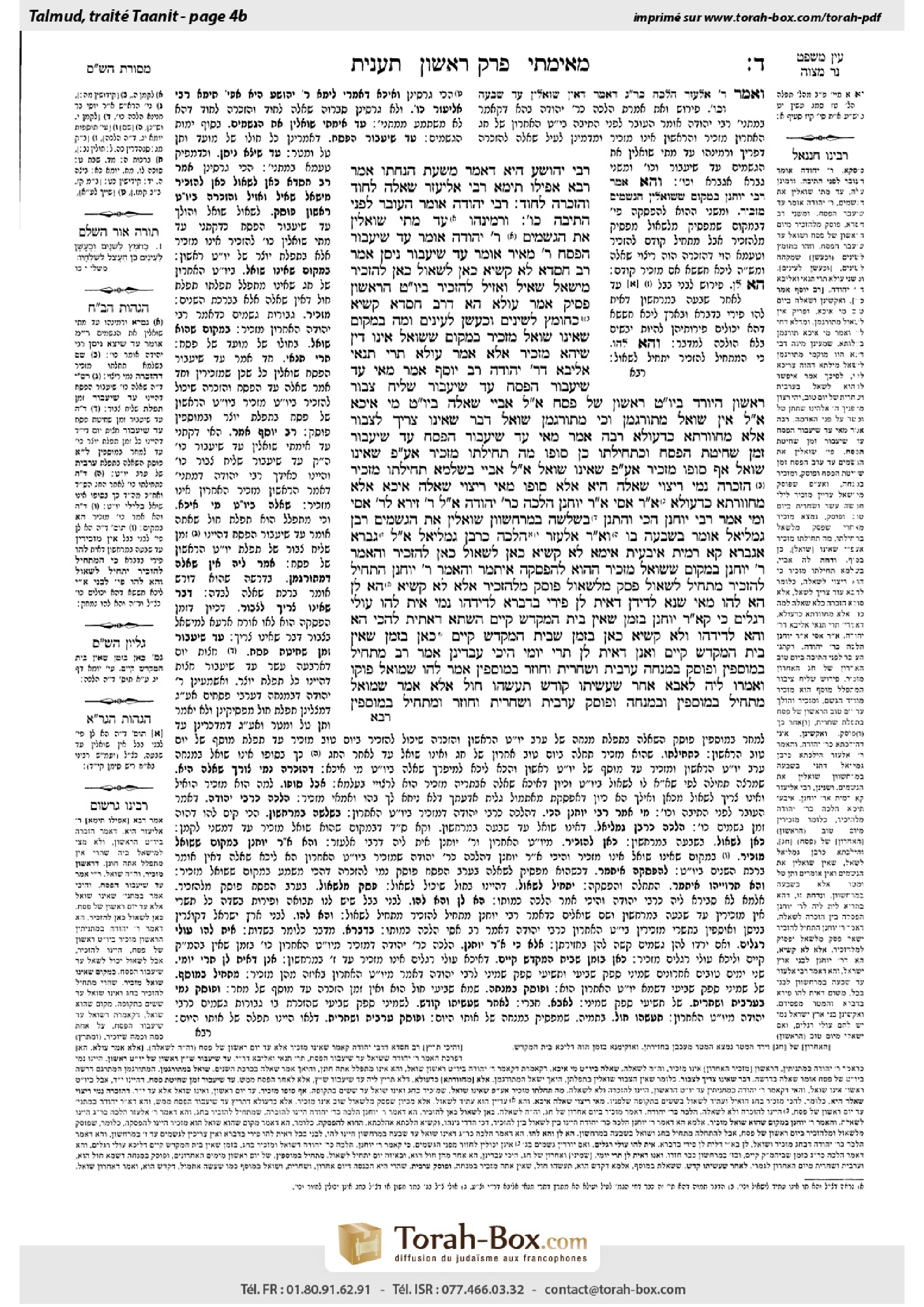
Taanit 4b: Talmud study for Daf Yomi
Daf Yomi is the daily study of one Talmud folio. Explore 37 tractates with scans, Hebrew text, Sefaria English and AI-generated French translations where annotated.
Passage selection and English or AI-generated French translation are available where the scan has annotations. Daf Study is independent of Torah-Box and Sefaria.
Browse Taanit · תענית · All tractatesTaanit 4b text and translations
This page of Taanit includes the Aramaic text, an English translation and an AI-generated French translation, alongside the scan above.
תענית ד׳ ב · Aramaic and Hebrew text
רַבִּי יְהוֹשֻׁעַ הִיא, דְּאָמַר מִשְּׁעַת הַנָּחָתוֹ?! אָמַר רָבָא: אֲפִילּוּ תֵּימָא רַבִּי אֱלִיעֶזֶר — שְׁאֵלָה לְחוּד, וְהַזְכָּרָה לְחוּד.
רַבִּי יְהוּדָה אוֹמֵר: הָעוֹבֵר לִפְנֵי הַתֵּיבָה כּוּ׳.
וּרְמִינְהוּ: עַד מָתַי שׁוֹאֲלִין אֶת הַגְּשָׁמִים, רַבִּי יְהוּדָה אוֹמֵר: עַד שֶׁיַּעֲבוֹר הַפֶּסַח, רַבִּי מֵאִיר אוֹמֵר: עַד שֶׁיַּעֲבוֹר נִיסָן.
אָמַר רַב חִסְדָּא, לָא קַשְׁיָא: כָּאן לִשְׁאוֹל, כָּאן לְהַזְכִּיר. מִישְׁאָל — שָׁאֵיל וְאָזֵיל, לְהַזְכִּיר — בְּיוֹם טוֹב הָרִאשׁוֹן פָּסֵיק.
אָמַר עוּלָּא: הָא דְּרַב חִסְדָּא קַשְׁיָא כַּחֹמֶץ לַשִּׁנַּיִם וְכֶעָשָׁן לָעֵינָיִם. וּמָה בִּמְקוֹם שֶׁאֵינוֹ שׁוֹאֵל — מַזְכִּיר, בִּמְקוֹם שֶׁשּׁוֹאֵל, אֵינוֹ דִּין שֶׁיְּהֵא מַזְכִּיר?
אֶלָּא אָמַר עוּלָּא: תְּרֵי תַנָּאֵי אַלִּיבָּא דְּרַבִּי יְהוּדָה.
רַב יוֹסֵף אָמַר: מַאי ״עַד שֶׁיַּעֲבוֹר הַפֶּסַח״ — עַד שֶׁיַּעֲבוֹר שְׁלִיחַ צִבּוּר רִאשׁוֹן הַיּוֹרֵד בְּיוֹם טוֹב רִאשׁוֹן שֶׁל פֶּסַח.
אֲמַר לֵיהּ אַבָּיֵי: שְׁאֵלָה בְּיוֹם טוֹב מִי אִיכָּא?
אֲמַר לֵיהּ: אִין שׁוֹאֵל מְתוּרְגְּמָן. וְכִי מְתוּרְגְּמָן שׁוֹאֵל דָּבָר שֶׁאֵינוֹ צָרִיךְ לַצִּבּוּר? אֶלָּא מְחַוַּורְתָּא, כִּדְעוּלָּא.
רַבָּה אָמַר: מַאי ״עַד שֶׁיַּעֲבוֹר הַפֶּסַח״ — עַד שֶׁיַּעֲבוֹר זְמַן שְׁחִיטַת הַפֶּסַח. וְכִתְחִילָּתוֹ כֵּן סוֹפוֹ: מָה תְּחִילָּתוֹ — מַזְכִּיר אַף עַל פִּי שֶׁאֵינוֹ שׁוֹאֵל, אַף סוֹפוֹ — מַזְכִּיר אַף עַל פִּי שֶׁאֵינוֹ שׁוֹאֵל.
אֲמַר לֵיהּ אַבָּיֵי: בִּשְׁלָמָא תְּחִילָּתוֹ מַזְכִּיר — הַזְכָּרָה נָמֵי רִיצּוּי שְׁאֵלָה הִיא, אֶלָּא סוֹפוֹ, מַאי רִיצּוּי שְׁאֵלָה אִיכָּא? אֶלָּא מְחַוַּורְתָּא כִּדְעוּלָּא.
אָמַר רַבִּי אַסִּי אָמַר רַבִּי יוֹחָנָן: הֲלָכָה כְּרַבִּי יְהוּדָה. אֲמַר לֵיהּ רַבִּי זֵירָא לְרַבִּי אַסִּי: וּמִי אָמַר רַבִּי יוֹחָנָן הָכִי? וְהָתְנַן: בִּשְׁלֹשָׁה בְּמַרְחֶשְׁווֹן שׁוֹאֲלִין אֶת הַגְּשָׁמִים, רַבָּן גַּמְלִיאֵל אוֹמֵר: בְּשִׁבְעָה בּוֹ. וְאָמַר רַבִּי אֶלְעָזָר: הֲלָכָה כְּרַבָּן גַּמְלִיאֵל!
אֲמַר לֵיהּ: גַּבְרָא אַגַּבְרָא קָא רָמֵית?! אִיבָּעֵית אֵימָא, לָא קַשְׁיָא: כָּאן לִשְׁאוֹל, כָּאן לְהַזְכִּיר.
וְהָאָמַר רַבִּי יוֹחָנָן: בִּמְקוֹם שֶׁשּׁוֹאֵל מַזְכִּיר! הָהוּא לְהַפְסָקָה אִיתְּמַר. וְהָאָמַר רַבִּי יוֹחָנָן: הִתְחִיל לְהַזְכִּיר — מַתְחִיל לִשְׁאוֹל, פָּסַק מִלִּשְׁאוֹל — פּוֹסֵק מִלְּהַזְכִּיר.
אֶלָּא, לָא קַשְׁיָא: הָא לַן, הָא לְהוּ. מַאי שְׁנָא לְדִידַן — דְּאִית לַן פֵּירֵי בְּדַבְרָא, לְדִידְהוּ נָמֵי אִית לְהוּ עוֹלֵי רְגָלִים!
כִּי קָאָמַר רַבִּי יוֹחָנָן, בִּזְמַן שֶׁאֵין בֵּית הַמִּקְדָּשׁ קַיָּים. הַשְׁתָּא דְּאָתֵית לְהָכִי — הָא וְהָא לְדִידְהוּ, וְלָא קַשְׁיָא: כָּאן בִּזְמַן שֶׁבֵּית הַמִּקְדָּשׁ קַיָּים, כָּאן בִּזְמַן שֶׁאֵין בֵּית הַמִּקְדָּשׁ קַיָּים.
וַאֲנַן דְּאִית לַן תְּרֵי יוֹמֵי, הֵיכִי עָבְדִינַן? אָמַר רַב: מַתְחִיל בְּמוּסָפִין, וּפוֹסֵק בְּמִנְחָה עַרְבִית וְשַׁחֲרִית, וְחוֹזֵר בְּמוּסָפִין.
אֲמַר לְהוּ שְׁמוּאֵל, פּוּקוּ וֶאֱמַרוּ לֵיהּ לְאַבָּא: אַחַר שֶׁעֲשִׂיתוֹ קוֹדֶשׁ תַּעֲשֵׂהוּ חוֹל? אֶלָּא אָמַר שְׁמוּאֵל: מַתְחִיל בְּמוּסָפִין וּבְמִנְחָה, וּפוֹסֵק עַרְבִית וְשַׁחֲרִית, וְחוֹזֵר וּמַתְחִיל בְּמוּסָפִין.
Taanit 4b · English translation
that our mishna is in accordance with the opinion of Rabbi Yehoshua, who said that one mentions rain from the time of putting the lulav down, from the Eighth Day of Assembly, and it is not in accordance with the opinion of Rabbi Eliezer. Rava said: Even if you say that the ruling of the mishna is in accordance with the opinion of Rabbi Eliezer, one can explain this by distinguishing between the terms: Requesting is a distinct notion and mentioning is another distinct notion, even according to the opinion of Rabbi Eliezer.
§ The mishna stated that Rabbi Yehuda says: With regard to the one who passes before the ark as prayer leader on the concluding Festival day of Sukkot, the Eighth Day of Assembly, the prayer leader of the additional prayer mentions rain, while the leader of the morning prayer does not. The reverse is the case at the conclusion of the period of mentioning rain, as the leader of the morning prayer mentions rain, while the one who leads the additional prayer does not.
And the Gemara raises a contradiction from a baraita (5a): Until when does one request rain? Rabbi Yehuda says: Until Passover has passed. Rabbi Meir says: Until the month of Nisan has passed. According to the baraita, Rabbi Yehuda holds that one prays for rain until the end of Passover, whereas the mishna states that Rabbi Yehuda’s opinion is that one prays for rain only until the beginning of the Festival.
Rav Ḥisda said: This is not difficult. The baraita here is referring to the request for rain, which continues until the end of Passover, whereas the mishna there rules that one is to mention rain only until the first Festival day. In other words, Rabbi Yehuda holds that one continues requesting rain until the end of Passover, but with regard to the mention of rain, already on the first day of the Festival one ceases to do so.
The Gemara raises a difficulty against this answer. Ulla said: That which Rav Ḥisda said is as difficult to accept “as vinegar to the teeth, and as smoke to the eyes” (Proverbs 10:26). He elaborates: If when one does not yet request rain, at the beginning of the rainy season, one nevertheless mentions rain; in a case when one requests rain, i.e., during Passover, according to this explanation, is it not right that one should also mention rain?
Rather, Ulla said an alternative resolution: In fact, two tanna’im expressed different rulings in accordance with the opinion of Rabbi Yehuda. According to one tanna, Rabbi Yehuda holds that one both mentions and requests rain during Passover, whereas according to the other tanna, Rabbi Yehuda holds that one neither mentions nor requests rain after the morning prayer of the first day of Passover.
The Gemara cites an additional resolution of the apparent contradiction. Rav Yosef said: What is the meaning of the phrase: Until Passover has passed [ya’avor]? It means: Until the first prayer leader who descends to pray has passed before the ark for the morning prayers on the first Festival day of Passover. According to this explanation, the mishna and baraita specify the same time period for the end of the mention and request for rain.
Abaye said to Rav Yosef: Is there a request for rain on a Festival? The request for rain is included in the ninth blessing of the Amida, the blessing of the years, which is not recited on Shabbat and Festivals. If the term Passover in the baraita is referring to the entire Festival, this includes the intermediate Festival days, during which the ninth blessing of the Amida is recited. However, according to your interpretation, the baraita refers only to the first day of the Festival, and yet the request for rain is not recited on this date.
The Gemara cites the response: Rav Yosef said to Abaye: Yes, the baraita is speaking of the first day of Passover. However, it does not refer to the request for rain recited in the Amida. Rather, the disseminator and translator of the Torah portion would recite a request for rain after the Festival prayers. The Gemara asks: But would a disseminator request a matter that the community does not need? As there is no need for rain on Passover, why would the disseminator recite a request for it? Rather, it is clear, as Ulla explained, there are two tannaitic versions of Rabbi Yehuda’s opinion.
Rabba said another explanation: What is the meaning of the phrase: Until Passover has passed? It means until after the time for the slaughter of the Paschal lamb has passed, the afternoon of the fourteenth of Nisan, i.e., until the beginning of Passover. And according to this opinion, the practice at the beginning of the time for praying for rain is like that of the end: Just as at the beginning of the rainy season one mentions rain although one does not request it, so too, at the end, on the first day of Passover, one mentions rain although one does not request it. The request for rain ends on the eve of Passover, while the mention of rain continues until the morning service the following day.
Abaye said to Rabba: Granted, at the beginning of the rainy season one mentions rain before requesting it, as mentioning rain is also an appeasement to God in advance of the forthcoming request. However, at the end of the season, what appeasement toward a request is there that would necessitate the mention of rain after one has ceased requesting it? The Gemara again concludes: Rather, it is clear as Ulla explained.
Rabbi Asi said that Rabbi Yoḥanan said: The halakha is in accordance with the opinion of Rabbi Yehuda. Rabbi Zeira said to Rabbi Asi: And did Rabbi Yoḥanan actually say that? But didn’t we learn in a mishna (6a): On the third of Marḥeshvan one starts to request rain. Rabban Gamliel says: One starts on the seventh of Marḥeshvan. And with regard to this mishna, Rabbi Elazar, Rabbi Yoḥanan’s preeminent student, said: The halakha is in accordance with the opinion of Rabban Gamliel.
Rabbi Asi said to Rabbi Zeira: Are you raising a contradiction from the statement of one man against the statement of another man? Although Rabbi Elazar was Rabbi Yoḥanan’s student, their opinions need not be consistent with one another. If you wish, say instead that this is not difficult, as Rabbi Elazar’s ruling here is referring to the request for rain, which begins on the seventh of Marḥeshvan, whereas Rabbi Yoḥanan’s ruling there is referring to the mention of rain, which begins on the Eighth Day of Assembly.
The Gemara asks: But didn’t Rabbi Yoḥanan say: At the same time when one requests rain, one mentions it. The Gemara answers: That ruling was stated only with regard to ceasing the request and mention of rain. Although Rabbi Yoḥanan maintains that one stops requesting and mentioning rain on the same date, he does not hold that one begins to do both at the same time. The Gemara objects: But didn’t Rabbi Yoḥanan explicitly say: When one begins to mention rain, one begins to request it; and when one ceases to request rain, one ceases to mention it. This clearly indicates that, in his opinion, there is no discrepancy between the dates when one begins reciting the two formulations.
The Gemara answers: Rather, it is not difficult. This statement, where Rabbi Elazar ruled in accordance with the opinion of Rabban Gamliel, is for us, who live in Babylonia and start to pray for rain later, whereas that statement of the mishna is for them, the residents of Eretz Yisrael. The Gemara asks: What is different with regard to us in Babylonia that we do not request rain immediately after Sukkot? The reason is that we still have fruit in the field. Therefore, we do not want rain to fall. However, they, the inhabitants of Eretz Yisrael, also have pilgrims who need to travel for a significant time to reach their homes after the Festival, and they do not want it to rain on them.
The Gemara answers: When Rabbi Yoḥanan said this ruling in the mishna, he was referring to the period when the Temple is not standing; therefore, in Eretz Yisrael, one can immediately request rain. The Gemara comments: Now that you have arrived at this answer, one can say that both this statement and that statement are for them, i.e., those in Eretz Yisrael. And yet, it is not difficult, as this statement here, that one waits before requesting rain, applies at the time when the Temple is standing, while the ruling there, that one requests rain right after the Festival, is referring to the time when the Temple is not standing.
The Gemara asks: And we in the Diaspora who have two Festival days, how do we act with regard to beginning the mention of rain, given the uncertainty concerning the Eighth Day of Assembly, which might in reality be the seventh day of Sukkot? The Gemara answers that Rav said: One begins to mention rain in the additional prayers of the eighth day, the first day of the Eighth Day of Assembly. And one temporarily ceases this practice on the afternoon prayer of the eighth day, continuing through the evening and morning prayers of the ninth day, the second day of the Eighth Day of Assembly. And finally one again resumes mentioning rain in the additional prayers of the ninth day, Simḥat Torah.
Shmuel said to those who reported Rav’s explanation to him: Go out and tell Abba, referring to Rav by his name, the following objection: After you have rendered the first day of the Eighth Day of Assembly sanctified, shall you defile it by treating it as though it is not a Festival day? Rather, Shmuel said (10a): One begins to mention rain in the additional prayers and also mentions it in the afternoon prayer of the eighth day, the first day of the Eighth Day of Assembly, and temporarily ceases this practice on the afternoon prayer of the eighth day, continuing through the evening and morning prayers of the ninth day, Simḥat Torah. And finally, one again resumes mentioning rain in the additional prayers of the ninth day, Simḥat Torah.
Taanit 4b · Traduction française (IA)
que notre Michna suit l’opinion de Rabbi Yehoshua, selon lequel on commence à mentionner la pluie dès qu’on dépose le loulav, c’est-à-dire à partir du huitième jour de l’Assemblée, et non celle de Rabbi Eliezer. Rava dit : Même si l’on affirme que la décision de la Michna suit l’opinion de Rabbi Eliezer, on peut l’expliquer en distinguant les termes : demander la pluie est une notion distincte de celle de la mentionner, même selon l’opinion de Rabbi Eliezer.
§ La Michna enseigne que Rabbi Yehuda dit : À Souccot, le jour de fête qui clôture la fête, le huitième jour de l’Assemblée, celui qui officie devant l’arche pour la prière supplémentaire mentionne la pluie, tandis que celui qui officie pour la prière du matin ne la mentionne pas. À la fin de la période où l’on mentionne la pluie, c’est l’inverse : celui qui officie pour la prière du matin la mentionne, tandis que celui qui officie pour la prière supplémentaire ne la mentionne pas.
La Guemara soulève une contradiction à partir d’une baraïta (5a) : Jusqu’à quand demande-t-on la pluie ? Rabbi Yehuda dit : Jusqu’à ce que Pessa’h soit passé. Rabbi Meir dit : Jusqu’à ce que le mois de Nissan soit passé. Selon la baraïta, Rabbi Yehuda estime que l’on prie pour la pluie jusqu’à la fin de Pessa’h, alors que, d’après la Michna, son opinion est que l’on prie pour la pluie seulement jusqu’au début de la fête.
Rav Ḥisda dit : Il n’y a pas de difficulté. La baraïta parle ici de la demande de pluie, qui se poursuit jusqu’à la fin de Pessa’h, tandis que la Michna, là-bas, statue que l’on ne mentionne la pluie que jusqu’au premier jour de fête. Autrement dit, Rabbi Yehuda estime que l’on continue à demander la pluie jusqu’à la fin de Pessa’h, mais que, pour ce qui est de la mention de la pluie, on cesse déjà de la faire le premier jour de fête.
La Guemara soulève une difficulté contre cette réponse. Ulla dit : Ce que Rav Ḥisda a dit est aussi difficile à accepter « que le vinaigre pour les dents et la fumée pour les yeux » (Proverbes 10,26). Il développe : Si, au début de la saison des pluies, alors qu’on ne demande pas encore la pluie, on la mentionne néanmoins, lorsqu’on la demande — c’est-à-dire pendant Pessa’h, selon cette explication — ne devrait-on pas, à plus forte raison, la mentionner aussi ?
Ulla propose plutôt une autre résolution : En réalité, deux tannaïm ont formulé des décisions différentes conformément à l’opinion de Rabbi Yehuda. Selon l’un, Rabbi Yehuda estime que l’on mentionne et demande la pluie pendant Pessa’h ; selon l’autre, Rabbi Yehuda estime que l’on ne mentionne ni ne demande la pluie après la prière du matin du premier jour de Pessa’h.
La Guemara cite une autre résolution de la contradiction apparente. Rav Yosef dit : Que signifie l’expression « jusqu’à ce que Pessa’h soit passé » [ya’avor] ? Elle signifie : jusqu’à ce que le premier officiant qui descend prier soit passé devant l’arche pour la prière du matin du premier jour de fête de Pessa’h. Selon cette explication, la Michna et la baraïta indiquent la même période pour la fin de la mention et de la demande de pluie.
Abaye dit à Rav Yosef : Demande-t-on la pluie un jour de fête ? La demande de pluie figure dans la neuvième bénédiction de l’Amida, la bénédiction des années, qui n’est pas récitée le Chabbat ni les jours de fête. Si, dans la baraïta, le terme Pessa’h désigne toute la fête, cela inclut les jours intermédiaires de fête, pendant lesquels on récite la neuvième bénédiction de l’Amida. Toutefois, selon ton interprétation, la baraïta ne concerne que le premier jour de fête, alors que l’on ne récite pas la demande de pluie à cette date.
La Guemara rapporte la réponse : Rav Yosef dit à Abaye : Oui, la baraïta parle du premier jour de Pessa’h. Cependant, elle ne fait pas référence à la demande de pluie récitée dans l’Amida. Le prédicateur qui traduisait la lecture de la Torah récitait plutôt une demande de pluie après les prières de la fête. La Guemara demande : Mais un prédicateur demanderait-il une chose dont la communauté n’a pas besoin ? Puisqu’il n’y a pas besoin de pluie à Pessa’h, pourquoi le prédicateur en réciterait-il la demande ? Il est donc clair, comme l’a expliqué Ulla, qu’il existe deux versions tannaitiques de l’opinion de Rabbi Yehuda.
Rabba donne une autre explication : Que signifie l’expression « jusqu’à ce que Pessa’h soit passé » ? Elle signifie jusqu’à ce que soit passé le moment où l’on égorge l’agneau pascal, l’après-midi du quatorze Nissan, c’est-à-dire jusqu’au début de Pessa’h. Selon cette opinion, la pratique au début de la période où l’on prie pour la pluie est analogue à celle de la fin : de même qu’au début de la saison des pluies, on mentionne la pluie sans la demander, de même, à la fin, le premier jour de Pessa’h, on la mentionne sans la demander. On cesse de demander la pluie la veille de Pessa’h, tandis que l’on continue à la mentionner jusqu’à la prière du matin du lendemain.
Abaye dit à Rabba : Il est compréhensible qu’au début de la saison des pluies on mentionne la pluie avant de la demander, car cette mention est aussi une manière d’apaiser Dieu en prévision de la demande à venir. Mais à la fin de la saison, quel apaisement en vue d’une demande justifierait que l’on mentionne la pluie après avoir cessé de la demander ? La Guemara conclut de nouveau : Il est donc clair que l’explication d’Ulla est la bonne.
Rabbi Asi dit au nom de Rabbi Yoḥanan : La halakha suit l’opinion de Rabbi Yehuda. Rabbi Zeira dit à Rabbi Asi : Rabbi Yoḥanan a-t-il vraiment dit cela ? N’avons-nous pas appris dans une Michna (6a) : Le trois Marḥeshvan, on commence à demander la pluie. Rabban Gamliel dit : On commence le sept Marḥeshvan. À propos de cette Michna, Rabbi Elazar, le principal disciple de Rabbi Yoḥanan, a dit : La halakha suit l’opinion de Rabban Gamliel.
Rabbi Asi dit à Rabbi Zeira : Opposes-tu la déclaration d’un homme à celle d’un autre homme ? Bien que Rabbi Elazar ait été le disciple de Rabbi Yoḥanan, leurs opinions ne sont pas nécessairement concordantes. On peut aussi dire que ce n’est pas difficile, car la décision de Rabbi Elazar concerne ici la demande de pluie, qui commence le sept Marḥeshvan, tandis que la décision de Rabbi Yoḥanan concerne là-bas la mention de la pluie, qui commence le huitième jour de l’Assemblée.
La Guemara demande : Mais Rabbi Yoḥanan n’a-t-il pas dit : Au moment où l’on demande la pluie, on la mentionne ? La Guemara répond : Cette décision ne concernait que la cessation de la demande et de la mention de la pluie. Bien que Rabbi Yoḥanan estime que l’on cesse de demander et de mentionner la pluie à la même date, il ne soutient pas que l’on commence à faire les deux en même temps. La Guemara objecte : Mais Rabbi Yoḥanan n’a-t-il pas explicitement dit : Quand on commence à mentionner la pluie, on commence à la demander ; et quand on cesse de demander la pluie, on cesse de la mentionner ? Cela indique clairement que, selon lui, les dates auxquelles on commence à réciter les deux formulations ne diffèrent pas.
La Guemara répond : Il n’y a donc pas de difficulté. Cette déclaration, selon laquelle Rabbi Elazar a statué conformément à l’opinion de Rabban Gamliel, s’adresse à nous, qui vivons en Babylonie et commençons à prier pour la pluie plus tard, tandis que cette déclaration de la Michna s’adresse à eux, les habitants d’Eretz Israël. La Guemara demande : En quoi notre situation, en Babylonie, diffère-t-elle, de sorte que nous ne demandons pas la pluie immédiatement après Souccot ? C’est parce qu’il y a encore des fruits dans les champs ; nous ne voulons donc pas qu’il pleuve. Mais eux, les habitants d’Eretz Israël, ont aussi des pèlerins qui doivent voyager longtemps pour rentrer chez eux après la fête, et ils ne veulent pas qu’il pleuve sur eux.
La Guemara répond : Lorsque Rabbi Yoḥanan a énoncé cette décision concernant la Michna, il parlait de la période où le Temple n’est pas debout ; par conséquent, en Eretz Israël, on peut immédiatement demander la pluie. La Guemara commente : Puisque nous sommes parvenus à cette réponse, on peut dire que ces deux déclarations s’adressent toutes deux aux habitants d’Eretz Israël. Pourtant, il n’y a pas de difficulté : cette déclaration-ci, selon laquelle on attend avant de demander la pluie, s’applique à l’époque où le Temple est debout, tandis que la décision rapportée là-bas, selon laquelle on demande la pluie immédiatement après la fête, concerne l’époque où le Temple n’est pas debout.
La Guemara demande : Et nous, en diaspora, où nous célébrons deux jours de fête, comment agissons-nous pour commencer à mentionner la pluie, compte tenu de l’incertitude concernant le huitième jour de l’Assemblée, qui pourrait en réalité être le septième jour de Souccot ? La Guemara répond que Rav dit : On commence à mentionner la pluie dans les prières supplémentaires du huitième jour, le premier jour du huitième jour de l’Assemblée. On interrompt provisoirement cette pratique à la prière de l’après-midi du huitième jour, et on ne mentionne donc pas la pluie dans les prières du soir et du matin du neuvième jour, le deuxième jour du huitième jour de l’Assemblée. Enfin, on reprend la mention de la pluie dans les prières supplémentaires du neuvième jour, Simḥat Torah.
Shmuel dit à ceux qui lui rapportèrent l’explication de Rav : Allez dire à Abba — désignant Rav par son nom — l’objection suivante : Après avoir sanctifié le premier jour du huitième jour de l’Assemblée, vas-tu le profaner en le traitant comme s’il n’était pas un jour de fête ? Shmuel dit plutôt (10a) : On commence à mentionner la pluie dans les prières supplémentaires et on la mentionne aussi dans la prière de l’après-midi du huitième jour, le premier jour du huitième jour de l’Assemblée. On interrompt provisoirement cette pratique à la prière de l’après-midi du huitième jour, et on ne mentionne donc pas la pluie dans les prières du soir et du matin du neuvième jour, Simḥat Torah. Enfin, on reprend la mention de la pluie dans les prières supplémentaires du neuvième jour, Simḥat Torah.
Traduction française générée par IA à partir de l’édition anglaise de Sefaria. Vérifie toujours un passage avec le texte source.
Text from Sefaria: William Davidson Edition - Vocalized Aramaic (CC BY NC); William Davidson Edition - English (CC BY NC).