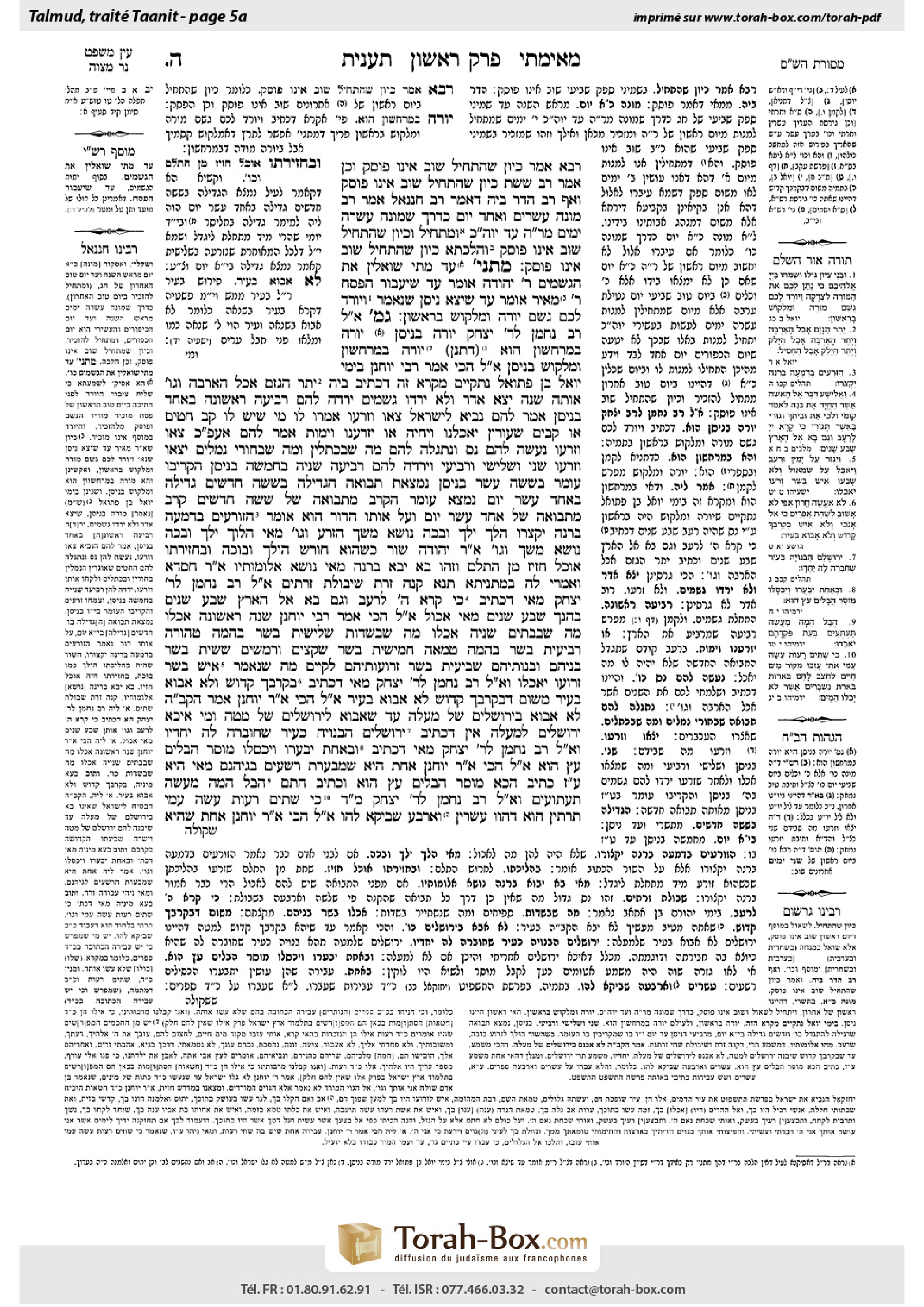
Taanit 5a: Talmud study for Daf Yomi
Daf Yomi is the daily study of one Talmud folio. Explore 37 tractates with scans, Hebrew text, Sefaria English and AI-generated French translations where annotated.
Passage selection and English or AI-generated French translation are available where the scan has annotations. Daf Study is independent of Torah-Box and Sefaria.
Browse Taanit · תענית · All tractatesTaanit 5a text and translations
This page of Taanit includes the Aramaic text, an English translation and an AI-generated French translation, alongside the scan above.
תענית ה׳ א · Aramaic and Hebrew text
רָבָא אָמַר: כֵּיוָן שֶׁהִתְחִיל, שׁוּב אֵינוֹ פּוֹסֵק. וְכֵן אָמַר רַב שֵׁשֶׁת: כֵּיוָן שֶׁהִתְחִיל, שׁוּב אֵינוֹ פּוֹסֵק.
וְאַף רַב הֲדַר בֵּיהּ. דְּאָמַר רַב חֲנַנְאֵל אָמַר רַב: מוֹנֶה עֶשְׂרִים וְאֶחָד יוֹם כְּדֶרֶךְ שֶׁמּוֹנֶה עֲשָׂרָה יָמִים מֵרֹאשׁ הַשָּׁנָה עַד יוֹם הַכִּפּוּרִים, וּמַתְחִיל, וְכֵיוָן שֶׁהִתְחִיל — שׁוּב אֵינוֹ פּוֹסֵק. וְהִלְכְתָא: כֵּיוָן שֶׁהִתְחִיל, שׁוּב אֵינוֹ פּוֹסֵק.
מַתְנִי׳ עַד מָתַי שׁוֹאֲלִין אֶת הַגְּשָׁמִים? רַבִּי יְהוּדָה אוֹמֵר: עַד שֶׁיַּעֲבוֹר הַפֶּסַח, רַבִּי מֵאִיר אוֹמֵר: עַד שֶׁיֵּצֵא נִיסָן, שֶׁנֶּאֱמַר: ״וַיּוֹרֶד לָכֶם גֶּשֶׁם מוֹרֶה וּמַלְקוֹשׁ בָּרִאשׁוֹן״.
גְּמָ׳ אֲמַר לֵיהּ רַב נַחְמָן לְרַבִּי יִצְחָק: יוֹרֶה בְּנִיסָן? יוֹרֶה בִּמְרַחְשְׁוָן הוּא! דִּתְנַן: יוֹרֶה בִּמְרַחְשְׁוָן וּמַלְקוֹשׁ בְּנִיסָן! אֲמַר לֵיהּ, הָכִי אָמַר רַבִּי יוֹחָנָן: בִּימֵי יוֹאֵל בֶּן פְּתוּאֵל נִתְקַיֵּים מִקְרָא זֶה דִּכְתִיב בֵּיהּ ״יֶתֶר הַגָּזָם אָכַל הָאַרְבֶּה וְגוֹ׳״. אוֹתָהּ שָׁנָה יָצָא אֲדָר וְלֹא יָרְדוּ גְּשָׁמִים, יָרְדָה לָהֶם רְבִיעָה רִאשׁוֹנָה בְּאֶחָד בְּנִיסָן.
אָמַר לָהֶם נָבִיא לְיִשְׂרָאֵל: צְאוּ וְזִרְעוּ! אָמְרוּ לוֹ: מִי שֶׁיֵּשׁ לוֹ קַב חִטִּים אוֹ קַבַּיִּם שְׂעוֹרִין — יֹאכְלֶנּוּ וְיִחְיֶה, אוֹ יִזְרָעֶנּוּ וְיָמוּת? אָמַר לָהֶם: אַף עַל פִּי כֵן צְאוּ וְזִרְעוּ. נַעֲשָׂה לָהֶם נֵס, וְנִתְגַּלָּה לָהֶם מַה שֶּׁבַּכְּתָלִין וּמַה שֶּׁבְּחוֹרֵי נְמָלִים.
יָצְאוּ וְזָרְעוּ שֵׁנִי וּשְׁלִישִׁי וּרְבִיעִי, וְיָרְדָה לָהֶם רְבִיעָה שְׁנִיָּה בַּחֲמִשָּׁה בְּנִיסָן. הִקְרִיבוּ עוֹמֶר בְּשִׁשָּׁה עָשָׂר בְּנִיסָן, נִמְצֵאת תְּבוּאָה הַגְּדֵילָה בְּשִׁשָּׁה חֳדָשִׁים, גְּדֵילָה בְּאַחַד עָשָׂר יוֹם. נִמְצָא עוֹמֶר הַקָּרֵב מִתְּבוּאָה שֶׁל שִׁשָּׁה חֳדָשִׁים, קָרֵב מִתְּבוּאָה שֶׁל אַחַד עָשָׂר יוֹם.
וְעַל אוֹתוֹ הַדּוֹר הוּא אוֹמֵר: ״הַזֹּרְעִים בְּדִמְעָה בְּרִנָּה יִקְצֹרוּ. הָלוֹךְ יֵלֵךְ וּבָכֹה נֹשֵׂא מֶשֶׁךְ הַזָּרַע וְגוֹ׳״. מַאי ״הָלוֹךְ יֵלֵךְ וּבָכֹה נֹשֵׂא מֶשֶׁךְ וְגוֹ׳״? אָמַר רַבִּי יְהוּדָה: שׁוֹר, כְּשֶׁהוּא חוֹרֵשׁ — הוֹלֵךְ וּבוֹכֶה, וּבַחֲזִירָתוֹ — אוֹכֵל חָזִיז מִן הַתֶּלֶם. וְזֶהוּ: ״בֹּא יָבֹא בְּרִנָּה״.
מַאי ״נֹשֵׂא אֲלֻמֹּתָיו״? אָמַר רַב חִסְדָּא, וְאָמְרִי לַהּ בְּמַתְנִיתָא תָּנָא: קָנֶה זֶרֶת, שִׁיבּוֹלֶת זִרְתַּיִם.
אֲמַר לֵיהּ רַב נַחְמָן לְרַבִּי יִצְחָק, מַאי דִּכְתִיב: ״כִּי קָרָא ה׳ לָרָעָב וְגַם בָּא אֶל הָאָרֶץ שֶׁבַע שָׁנִים״, בְּהָנָךְ שֶׁבַע שָׁנִים מַאי אֲכוּל?
אֲמַר לֵיהּ, הָכִי אָמַר רַבִּי יוֹחָנָן: שָׁנָה רִאשׁוֹנָה אָכְלוּ מַה שֶּׁבַּבָּתִּים, שְׁנִיָּה אָכְלוּ מַה שֶּׁבַּשָּׂדוֹת, שְׁלִישִׁית בְּשַׂר בְּהֵמָה טְהוֹרָה, רְבִיעִית בְּשַׂר בְּהֵמָה טְמֵאָה, חֲמִישִׁית בְּשַׂר שְׁקָצִים וּרְמָשִׂים, שִׁשִּׁית בְּשַׂר בְּנֵיהֶם וּבְנוֹתֵיהֶם, שְׁבִיעִית בְּשַׂר זְרוֹעוֹתֵיהֶם, לְקַיֵּים מַה שֶּׁנֶּאֱמַר: ״אִישׁ בְּשַׂר זְרֹעוֹ יֹאכֵלוּ״.
וַאֲמַר לֵיהּ רַב נַחְמָן לְרַבִּי יִצְחָק, מַאי דִּכְתִיב: ״בְּקִרְבְּךָ קָדוֹשׁ וְלֹא אָבוֹא בְּעִיר״, מִשּׁוּם דִּבְקִרְבְּךָ קָדוֹשׁ לֹא אָבוֹא בְּעִיר? אָמַר לֵיהּ: הָכִי אָמַר רַבִּי יוֹחָנָן, אָמַר הַקָּדוֹשׁ בָּרוּךְ הוּא: לֹא אָבוֹא בִּירוּשָׁלַיִם שֶׁל מַעְלָה עַד שֶׁאָבוֹא לִירוּשָׁלַיִם שֶׁל מַטָּה!
וּמִי אִיכָּא יְרוּשָׁלַיִם לְמַעְלָה? אִין, דִּכְתִיב: ״יְרוּשָׁלִַים הַבְּנוּיָה כְּעִיר שֶׁחֻבְּרָה לָּהּ יַחְדָּו״.
וַאֲמַר לֵיהּ רַבִּי נַחְמָן לְרַבִּי יִצְחָק, מַאי דִּכְתִיב: ״וּבְאַחַת יִבְעֲרוּ וְיִכְסָלוּ מוּסַר הֲבָלִים עֵץ הוּא״? אֲמַר לֵיהּ, הָכִי אָמַר רַבִּי יוֹחָנָן: אַחַת הִיא שֶׁמְּבַעֶרֶת רְשָׁעִים בְּגֵיהִנָּם, מַאי הִיא — עֲבוֹדָה זָרָה. כְּתִיב הָכָא: ״מוּסַר הֲבָלִים עֵץ הוּא״, וּכְתִיב הָתָם: ״הֶבֶל הֵמָּה מַעֲשֵׂה תַּעְתֻּעִים״.
וַאֲמַר לֵיהּ רַב נַחְמָן לְרַבִּי יִצְחָק, מַאי דִּכְתִיב: ״כִּי שְׁתַּיִם רָעוֹת עָשָׂה עַמִּי״, תַּרְתֵּין הוּא דַּהֲווֹ? עֶשְׂרִין וְאַרְבַּע שְׁבִיקָא לְהוּ? אֲמַר לֵיהּ, הָכִי אָמַר רַבִּי יוֹחָנָן: אַחַת שֶׁהִיא
Taanit 5a · English translation
Rava said an alternative suggestion: Once one has started to mention rain, he no longer stops, i.e., he continues the mention of rain consistently until the summer. And, so too, Rav Sheshet said: Once one has started to mention rain, he no longer stops. In other words, once one has begun to mention rain in his prayers in the additional prayer on the Eighth Day of Assembly, he continues to do so uninterrupted, even in the Diaspora.
The Gemara adds: And even Rav retracted his previously stated opinion, as Rav Ḥananel said that Rav said: One counts twenty-one days from Rosh HaShana, just as one counts ten days from Rosh HaShana until Yom Kippur. And after the twenty-one days, one starts to mention rain, and once one has started, he no longer stops. The Gemara concludes: And the halakha is in accordance with the opinion that once one has started to mention rain, he no longer stops.
MISHNA: Until when does one request rain? Rabbi Yehuda says: We request rain until Passover has passed. Rabbi Meir says: Until the month of Nisan has ended, as it is stated: “And He causes to come down for you the rain, the first rain and the last rain, in the first month” (Joel 2:23). Since the verse states that it rains in Nisan, the first month, this indicates that the entire month is considered part of the rainy season.
GEMARA: Rav Naḥman said to Rabbi Yitzḥak: Is the first rain in Nisan? The first rain is in Marḥeshvan, as we learned in a baraita: The first rain is in Marḥeshvan and the last rain is in Nisan. Rabbi Yitzḥak said to Rav Naḥman that Rabbi Yoḥanan said as follows: This verse was fulfilled in the days of the prophet Joel, son of Pethuel, in a year concerning which it is written: “That which the palmer-worm has left, the locust has eaten and that which the locust has left, the canker-worm has eaten; and that which the canker-worm has left, the caterpillar has eaten” (Joel 1:4), when no crops remained. In that year, the month of Adar ended and still no rain had fallen. The rain of the first rainy season fell for them on the first of Nisan.
After the first rain fell, the prophet said to the Jews: Go out and sow. They said to him: One who has one kav of wheat or two kav of barley left, should he eat them and live off them for a while or sow them and die? Given the improbability of the crops’ growth under these circumstances, it appears wasteful to plant them rather than consume that which remains. The prophet said to them: Nevertheless, go out and sow. A miracle occurred for them and they discovered wheat and barley seeds that were hidden in the walls and that were concealed in ant holes.
They went out and sowed on the second, third, and fourth days of Nisan, and the rain of the second rainy season fell for them on the fifth of Nisan. The crops grew so quickly that they were able to sacrifice the omer offering in its proper time, on the sixteenth of Nisan. Consequently, grain that normally grows in six months grew in eleven days, and consequently, the omer that is generally sacrificed from grain that grows in six months was sacrificed that year from grain that grew in eleven days.
And with regard to that generation the verse says: “They who sow in tears shall reap with songs of joy. Though he goes on his way weeping, who bears the measure of seed, he shall come home with joy, bearing his sheaves” (Psalms 126:6). The Gemara asks: What is the meaning of the expression: “Though he goes on his way weeping, who bears the measure of seed”? Rabbi Yehuda said: An ox, when it plowed at that time, it went on its way weeping and lamenting its labor; and yet upon its return, through the same furrow, it was able to eat the young shoots [ḥaziz] of crops that had already sprouted from the furrow. And this is the meaning of the phrase: “He shall come home with songs of joy.”
The Gemara further asks: What is the meaning of the expression: “Bearing his sheaves”? Rav Ḥisda said, and some say this was taught in a baraita: The stalk of that crop was one span, i.e., the distance between the thumb and the little finger, while the ear itself was two spans, i.e., the ears were twice as long as the stalk, whereas usually the stalk is three or four times longer than the ear.
§ Incidental to the interpretation of these verses, the Gemara cites a series of verses, starting with the topic of hunger, that also involve questions that Rav Naḥman posed to Rabbi Yitzḥak. Rav Naḥman said to Rabbi Yitzḥak: What is the meaning of that which is written: “For the Lord has called upon a famine and it shall also come upon the land seven years” (II Kings 8:1)? Specifically, in those seven years, what did they eat?
Rabbi Yitzḥak said to Rabbi Naḥman that Rabbi Yoḥanan said as follows: In the first year they ate that which was in their houses; in the second year they ate that which was in their fields; in the third year they ate the meat of their remaining kosher animals; in the fourth year they ate the meat of their remaining non-kosher animals; in the fifth year they ate the meat of repugnant creatures and creeping animals, i.e., any insects they found; in the sixth year they ate the flesh of their sons and their daughters; and in the seventh year they ate the flesh of their own arms, to fulfill that which is stated: “Each man shall eat the flesh of his own arm” (Isaiah 9:19).
And Rav Naḥman said to Rabbi Yitzḥak: What is the meaning of that which is written: “It is sacred in your midst, and I will not enter the city” (Hosea 11:9)? This verse is puzzling: Because it is sacred in your midst, will God not enter the city? Rabbi Yitzḥak said to Rav Naḥman that Rabbi Yoḥanan said the verse should be understood as follows: The Holy One, Blessed be He, said: I shall not enter Jerusalem above, in heaven, until I enter Jerusalem on earth down below at the time of the redemption, when it will be sacred in your midst.
The Gemara asks: And is there such a place as Jerusalem above? The Gemara answers: Yes, as it is written: “Jerusalem built up, a city unified together” (Psalms 122:3). The term unified indicates that there are two cities of Jerusalem, a heavenly one and an earthly one, which are bound together.
§ And Rav Naḥman said to Rabbi Yitzḥak: What is the meaning of that which is written: “And with one they are brutish and foolish, the teaching of their vanity is a stock” (Jeremiah 10:8)? Rabbi Yitzḥak said to Rabbi Naḥman that Rabbi Yoḥanan said as follows: There is one transgression that causes the wicked to burn in Gehenna. What is this transgression? Idol worship. This can be proven by a verbal analogy. It is written here: “The teaching of their vanity [hevel] is a stock,” and it is written there, with regard to idols: “They are vanity [hevel], a work of delusion” (Jeremiah 10:15).
And Rav Naḥman said to Rabbi Yitzḥak: What is the meaning of that which is written: “For my people have committed two evils” (Jeremiah 2:13)? Were there only two evils they performed? Were, then, the twenty-four violations listed in the book of Ezekiel abandoned, i.e., pardoned? Rabbi Yitzḥak said to Rav Naḥman that Rabbi Yoḥanan said as follows: They have violated one transgression that is
Taanit 5a · Traduction française (IA)
Rava proposa une autre suggestion : Dès lors qu’on a commencé à mentionner la pluie, on ne cesse plus de le faire ; autrement dit, on continue de la mentionner sans interruption jusqu’à l’été. Rav Chéchet dit de même : Dès lors qu’on a commencé à mentionner la pluie, on ne cesse plus de le faire. Autrement dit, dès qu’on a commencé à mentionner la pluie dans la prière supplémentaire du Huitième Jour de l’Assemblée, on continue de le faire sans interruption, même en Diaspora.
La Guemara ajoute : Rav lui-même est également revenu sur son opinion exprimée précédemment, car Rav Ḥananel a dit au nom de Rav : On compte vingt et un jours depuis Roch Hachana, tout comme on compte dix jours entre Roch Hachana et Yom Kippour. Après ces vingt et un jours, on commence à mentionner la pluie et, dès qu’on a commencé, on ne cesse plus de le faire. La Guemara conclut : La halakha suit l’opinion selon laquelle, dès qu’on a commencé à mentionner la pluie, on ne cesse plus de le faire.
MICHNA : Jusqu’à quand demande-t-on la pluie ? Rabbi Yehouda dit : Nous demandons la pluie jusqu’à ce que Pessa’h soit passé. Rabbi Meïr dit : Jusqu’à la fin du mois de Nissan, comme il est dit : « Et Il fera descendre pour vous la pluie, la première pluie et la dernière pluie, au premier mois » (Joël 2:23). Puisque le verset indique qu’il pleut en Nissan, le premier mois, cela montre que tout le mois est considéré comme faisant partie de la saison des pluies.
GUEMARA : Rav Naḥman dit à Rabbi Yitzḥak : La première pluie tombe-t-elle en Nissan ? La première pluie tombe en Marḥechvan, comme nous l’avons appris dans une baraïta : La première pluie tombe en Marḥechvan et la dernière en Nissan. Rabbi Yitzḥak répondit à Rav Naḥman que Rabbi Yoḥanan avait donné l’explication suivante : Ce verset s’accomplit à l’époque du prophète Joël, fils de Petouel, au cours d’une année dont il est écrit : « Ce qu’a laissé le gazam, la sauterelle l’a mangé ; ce qu’a laissé la sauterelle, le yelek l’a mangé ; et ce qu’a laissé le yelek, le ḥasil l’a mangé » (Joël 1:4), alors qu’il ne restait aucune récolte. Cette année-là, le mois d’Adar s’acheva sans qu’aucune pluie ne soit encore tombée. La pluie de la première saison pluvieuse tomba pour eux le premier jour de Nissan.
Après la première pluie, le prophète dit aux Juifs : « Sortez et semez. » Ils lui dirent : « Celui à qui il ne reste qu’un kav de blé ou deux kav d’orge doit-il les manger et vivre quelque temps, ou les semer et mourir ? » Comme il était peu probable que les cultures poussent dans ces circonstances, il semblait vain de les semer plutôt que de consommer ce qui leur restait. Le prophète leur dit : « Malgré tout, sortez et semez. » Un miracle se produisit pour eux : ils découvrirent des graines de blé et d’orge cachées dans les murs et dans des fourmilières.
Ils sortirent semer les deuxième, troisième et quatrième jours de Nissan, et la pluie de la deuxième saison pluvieuse tomba pour eux le cinquième jour de Nissan. Les cultures poussèrent si vite qu’ils purent offrir l’omer au moment voulu, le seizième jour de Nissan. Ainsi, le grain qui pousse normalement en six mois poussa en onze jours ; par conséquent, l’omer, généralement offert à partir de grain ayant poussé en six mois, fut cette année-là offert à partir de grain qui avait poussé en onze jours.
C’est à propos de cette génération que le verset dit : « Ceux qui sèment dans les larmes moissonneront dans la joie. Il s’en va en pleurant, portant la mesure de semence ; il revient avec joie, portant ses gerbes » (Psaumes 126:6). La Guemara demande : Que signifie l’expression « Il s’en va en pleurant, portant la mesure de semence » ? Rabbi Yehouda dit : À cette époque, le bœuf qui labourait s’en allait en pleurant et en se lamentant sur son travail ; pourtant, en revenant par le même sillon, il pouvait manger les jeunes pousses [ḥaziz] qui y avaient déjà germé. Tel est le sens de l’expression : « Il revient avec joie. »
La Guemara demande encore : Que signifie l’expression « portant ses gerbes » ? Rav Ḥisda dit — et certains disent que cela a été enseigné dans une baraïta — : La tige de cette récolte mesurait une palme, c’est-à-dire la distance entre le pouce et l’auriculaire, tandis que l’épi lui-même mesurait deux palmes ; autrement dit, les épis étaient deux fois plus longs que la tige, alors qu’habituellement la tige est trois ou quatre fois plus longue que l’épi.
§ À propos de l’interprétation de ces versets, la Guemara cite une série de versets, en commençant par le thème de la famine, qui donnent également lieu à des questions posées par Rav Naḥman à Rabbi Yitzḥak. Rav Naḥman dit à Rabbi Yitzḥak : Que signifie ce qui est écrit : « Car l’Éternel a appelé la famine, et elle est aussi venue sur le pays pour sept ans » (II Rois 8:1) ? Plus précisément, qu’ont-ils mangé pendant ces sept années ?
Rabbi Yitzḥak répondit à Rabbi Naḥman que Rabbi Yoḥanan avait donné l’explication suivante : La première année, ils mangèrent ce qu’ils avaient dans leurs maisons ; la deuxième année, ce qu’ils avaient dans leurs champs ; la troisième année, la viande de leurs animaux casher restants ; la quatrième année, la viande de leurs animaux non casher restants ; la cinquième année, la chair de créatures répugnantes et d’animaux rampants, c’est-à-dire tous les insectes qu’ils trouvaient ; la sixième année, la chair de leurs fils et de leurs filles ; et la septième année, la chair de leurs propres bras, accomplissant ainsi ce qui est dit : « Chacun mangera la chair de son propre bras » (Isaïe 9:19).
Rav Naḥman dit à Rabbi Yitzḥak : Que signifie ce qui est écrit : « Il est saint au milieu de toi, et Je n’entrerai pas dans la ville » (Osée 11:9) ? Ce verset est énigmatique : parce qu’Il est saint au milieu de toi, Dieu n’entrera-t-Il pas dans la ville ? Rabbi Yitzḥak répondit à Rav Naḥman que Rabbi Yoḥanan avait expliqué le verset ainsi : Le Saint, béni soit-Il, a dit : « Je n’entrerai pas dans la Jérusalem d’en haut, au ciel, avant d’entrer dans la Jérusalem d’en bas, sur terre, au moment de la rédemption, lorsqu’elle sera sainte au milieu de toi. »
La Guemara demande : Existe-t-il donc un lieu appelé Jérusalem d’en haut ? La Guemara répond : Oui, comme il est écrit : « Jérusalem, bâtie comme une ville unie, toute entière » (Psaumes 122:3). Le terme « unie » indique qu’il existe deux Jérusalem, l’une céleste et l’autre terrestre, liées l’une à l’autre.
§ Rav Naḥman dit à Rabbi Yitzḥak : Que signifie ce qui est écrit : « Ils sont tous ensemble stupides et insensés ; l’enseignement de leurs vanités est un morceau de bois » (Jérémie 10:8) ? Rabbi Yitzḥak répondit à Rav Naḥman que Rabbi Yoḥanan avait donné l’explication suivante : Il existe une transgression qui fait brûler les méchants dans la Géhenne. Quelle est cette transgression ? Le culte des idoles. On peut le démontrer par une analogie verbale : ici, il est écrit « l’enseignement de leurs vanités [hevel] est un morceau de bois », et là, au sujet des idoles, il est écrit : « Elles sont vanité [hevel], une œuvre de tromperie » (Jérémie 10:15).
Rav Naḥman dit à Rabbi Yitzḥak : Que signifie ce qui est écrit : « Car mon peuple a commis deux méfaits » (Jérémie 2:13) ? N’ont-ils commis que deux méfaits ? Les vingt-quatre transgressions énumérées dans le livre d’Ézéchiel ont-elles donc été abandonnées, c’est-à-dire pardonnées ? Rabbi Yitzḥak répondit à Rav Naḥman que Rabbi Yoḥanan avait donné l’explication suivante : Ils ont commis une transgression qui est
Traduction française générée par IA à partir de l’édition anglaise de Sefaria. Vérifie toujours un passage avec le texte source.
Text from Sefaria: William Davidson Edition - Vocalized Aramaic (CC BY NC); William Davidson Edition - English (CC BY NC).