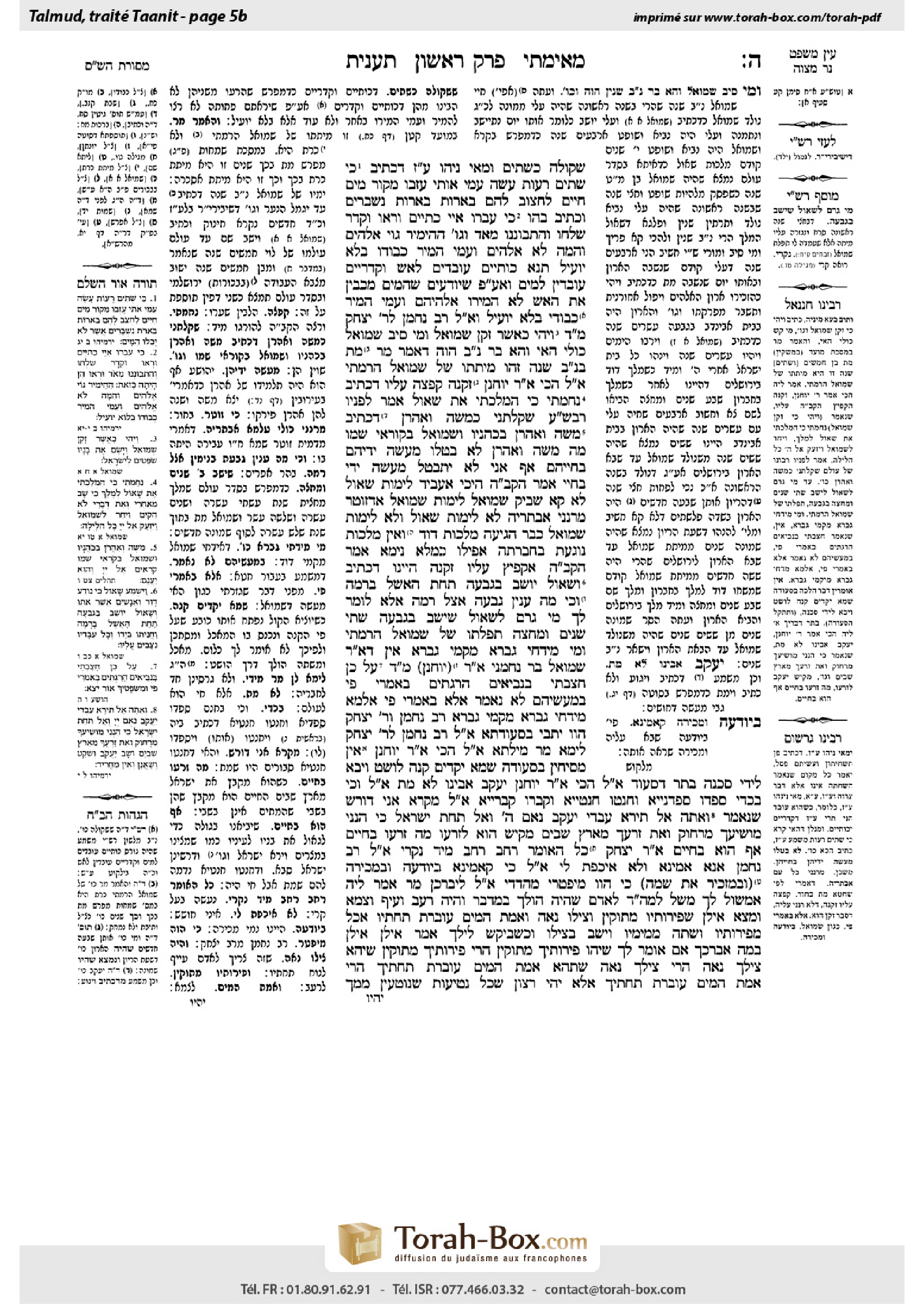
Taanit 5b: Talmud study for Daf Yomi
Daf Yomi is the daily study of one Talmud folio. Explore 37 tractates with scans, Hebrew text, Sefaria English and AI-generated French translations where annotated.
Passage selection and English or AI-generated French translation are available where the scan has annotations. Daf Study is independent of Torah-Box and Sefaria.
Browse Taanit · תענית · All tractatesTaanit 5b text and translations
This page of Taanit includes the Aramaic text, an English translation and an AI-generated French translation, alongside the scan above.
תענית ה׳ ב · Aramaic and Hebrew text
שְׁקוּלָה כִּשְׁתַּיִם, וּמַאי נִיהוּ — עֲבוֹדָה זָרָה, דִּכְתִיב: ״כִּי שְׁתַּיִם רָעוֹת עָשָׂה עַמִּי אֹתִי עָזְבוּ מְקוֹר מַיִם חַיִּים לַחְצֹב לָהֶם בֹּארוֹת בֹּארוֹת נִשְׁבָּרִים״, וּכְתִיב בְּהוּ: ״כִּי עִבְרוּ אִיֵּי כִתִּיִּים וּרְאוּ וְקֵדָר שִׁלְחוּ וְהִתְבּוֹנְנוּ מְאֹד וְגוֹ׳ הַהֵימִיר גּוֹי אֱלֹהִים וְהֵמָּה לֹא אֱלֹהִים וְעַמִּי הֵמִיר כְּבוֹדוֹ בְּלוֹא יוֹעִיל״.
תָּנָא: כּוּתִיִּים עוֹבְדִים לָאֵשׁ, וְקֵדָרִיִּים עוֹבְדִין לַמַּיִם, וְאַף עַל פִּי שֶׁיּוֹדְעִים שֶׁהַמַּיִם מְכַבִּין אֶת הָאֵשׁ — לֹא הֵמִירוּ אֱלֹהֵיהֶם, ״וְעַמִּי הֵמִיר כְּבוֹדוֹ בְּלוֹא יוֹעִיל״.
וַאֲמַר לֵיהּ רַב נַחְמָן לְרַבִּי יִצְחָק, מַאי דִּכְתִיב: ״וַיְהִי כַּאֲשֶׁר זָקֵן שְׁמוּאֵל״, וּמִי סִיב שְׁמוּאֵל כּוּלֵּי הַאי? וְהָא בַּר חֲמִישִּׁים וּשְׁתַּיִם הֲוָה, דְּאָמַר מָר: מֵת בַּחֲמִישִּׁים וּשְׁתַּיִם שָׁנָה, זֶהוּ מִיתָתוֹ שֶׁל שְׁמוּאֵל הָרָמָתִי.
אֲמַר לֵיהּ, הָכִי אָמַר רַבִּי יוֹחָנָן: זִקְנָה קָפְצָה עָלָיו, דִּכְתִיב: ״נִחַמְתִּי כִּי הִמְלַכְתִּי אֶת שָׁאוּל״. אָמַר לְפָנָיו: רִבּוֹנוֹ שֶׁל עוֹלָם! שְׁקַלְתַּנִי כְּמֹשֶׁה וְאַהֲרֹן, דִּכְתִיב: ״מֹשֶׁה וְאַהֲרֹן בְּכֹהֲנָיו וּשְׁמוּאֵל בְּקֹרְאֵי שְׁמוֹ״, מָה מֹשֶׁה וְאַהֲרֹן לֹא בָּטְלוּ מַעֲשֵׂה יְדֵיהֶם בְּחַיֵּיהֶם, אַף אֲנִי לֹא יִתְבַּטֵּל מַעֲשֵׂה יָדַי בְּחַיַּי.
אָמַר הַקָּדוֹשׁ בָּרוּךְ הוּא: הֵיכִי אֶעֱבֵיד? לֵימוּת שָׁאוּל — לָא קָא שָׁבֵיק שְׁמוּאֵל, לֵימוּת שְׁמוּאֵל אַדְּזוּטַר — מְרַנְּנִי אַבָּתְרֵיהּ. לָא לֵימוּת שָׁאוּל וְלָא לֵימוּת שְׁמוּאֵל — כְּבָר הִגִּיעָה מַלְכוּת דָּוִד, וְאֵין מַלְכוּת נוֹגַעַת בַּחֲבֶרְתָּהּ אֲפִילּוּ כִּמְלֹא נִימָא.
אָמַר הַקָּדוֹשׁ בָּרוּךְ הוּא: אַקְפִּיץ עָלָיו זִקְנָה. הַיְינוּ דִּכְתִיב: ״וְשָׁאוּל יוֹשֵׁב בַּגִּבְעָה תַּחַת הָאֶשֶׁל בָּרָמָה״, וְכִי מָה עִנְיַן גִּבְעָה אֵצֶל רָמָה? אֶלָּא לוֹמַר לְךָ: מִי גָּרַם לְשָׁאוּל שֶׁיָּשַׁב בַּגִּבְעָה שְׁתֵּי שָׁנִים וּמֶחֱצָה — תְּפִלָּתוֹ שֶׁל שְׁמוּאֵל הָרָמָתִי.
וּמִי מִידְּחֵי גַּבְרָא מִקַּמֵּי גַּבְרָא? אִין, דְּאָמַר רַבִּי שְׁמוּאֵל בַּר נַחְמָנִי אָמַר רַבִּי יוֹחָנָן: מַאי דִּכְתִיב: ״עַל כֵּן חָצַבְתִּי בַּנְּבִיאִים הֲרַגְתִּים בְּאִמְרֵי פִי״ — ״בְּמַעֲשֵׂיהֶם״ לֹא נֶאֱמַר, אֶלָּא ״בְּאִמְרֵי פִי״, אַלְמָא: מִידְּחֵי גַּבְרָא מִקַּמֵּי גַּבְרָא.
רַב נַחְמָן וְרַבִּי יִצְחָק הֲווֹ יָתְבִי בִּסְעוּדְתָּא. אֲמַר לֵיהּ רַב נַחְמָן לְרַבִּי יִצְחָק: לֵימָא מָר מִילְּתָא. אֲמַר לֵיהּ, הָכִי אָמַר רַבִּי יוֹחָנָן: אֵין מְסִיחִין בִּסְעוּדָה, שֶׁמָּא יַקְדִּים קָנֶה לְוֶשֶׁט וְיָבֹא לִידֵי סַכָּנָה.
בָּתַר דִּסְעוּד אֲמַר לֵיהּ, הָכִי אָמַר רַבִּי יוֹחָנָן: יַעֲקֹב אָבִינוּ לֹא מֵת. אֲמַר לֵיהּ: וְכִי בִּכְדִי סְפַדוּ סַפְדָּנַיָּא וַחֲנַטוּ חָנְטַיָּיא וּקְבַרוּ קַבָּרַיָּיא? אֲמַר לֵיהּ: מִקְרָא אֲנִי דּוֹרֵשׁ, שֶׁנֶּאֱמַר: ״וְאַתָּה אַל תִּירָא עַבְדִּי יַעֲקֹב נְאֻם ה׳ וְאַל תֵּחַת יִשְׂרָאֵל כִּי הִנְנִי מוֹשִׁיעֲךָ מֵרָחוֹק וְאֶת זַרְעֲךָ מֵאֶרֶץ שִׁבְיָם״, מַקִּישׁ הוּא לְזַרְעוֹ: מָה זַרְעוֹ בַּחַיִּים — אַף הוּא בַּחַיִּים.
אָמַר רַבִּי יִצְחָק: כׇּל הָאוֹמֵר ״רָחָב״ ״רָחָב״ מִיָּד נִקְרֵי. אֲמַר לֵיהּ רַב נַחְמָן: אֲנָא אָמֵינָא וְלָא אִיכְפַּת לִי! אֲמַר לֵיהּ: כִּי קָאָמֵינָא, בְּיוֹדְעָהּ וּבְמַכִּירָהּ.
כִּי הֲווֹ מִיפַּטְרִי מֵהֲדָדֵי, אֲמַר לֵיהּ: לִיבָרְכַן מָר! אֲמַר לֵיהּ: אֶמְשׁוֹל לְךָ מָשָׁל, לְמָה הַדָּבָר דּוֹמֶה? לְאָדָם שֶׁהָיָה הוֹלֵךְ בַּמִּדְבָּר וְהָיָה רָעֵב וְעָיֵף וְצָמֵא, וּמָצָא אִילָן שֶׁפֵּירוֹתָיו מְתוּקִין וְצִלּוֹ נָאֶה וְאַמַּת הַמַּיִם עוֹבֶרֶת תַּחְתָּיו. אָכַל מִפֵּירוֹתָיו, וְשָׁתָה מִמֵּימָיו, וְיָשַׁב בְּצִילּוֹ.
וּכְשֶׁבִּיקֵּשׁ לֵילֵךְ, אָמַר: אִילָן אִילָן, בַּמָּה אֲבָרֶכְךָ? אִם אוֹמַר לְךָ שֶׁיְּהוּ פֵּירוֹתֶיךָ מְתוּקִין — הֲרֵי פֵּירוֹתֶיךָ מְתוּקִין, שֶׁיְּהֵא צִילְּךָ נָאֶה — הֲרֵי צִילְּךָ נָאֶה, שֶׁתְּהֵא אַמַּת הַמַּיִם עוֹבֶרֶת תַּחְתֶּיךָ — הֲרֵי אַמַּת הַמַּיִם עוֹבֶרֶת תַּחְתֶּיךָ, אֶלָּא: יְהִי רָצוֹן שֶׁכׇּל נְטִיעוֹת שֶׁנּוֹטְעִין מִמְּךָ
Taanit 5b · English translation
equivalent to two. And what is this sin? Idol worship, as it is written: “For my people have committed two evils; they have forsaken Me, the fountain of living waters, to hew for themselves cisterns, broken cisterns” (Jeremiah 2:13), and it is written about the Jewish people: “For pass over the isles of the Kittim and see; and send to Kedar and observe carefully, and see if there has been such a thing. Has a nation exchanged its gods, although they are no gods? But My people has exchanged its glory for that which does not profit” (Jeremiah 2:10–11).
It is taught in a baraita with regard to this verse: Kittites, i.e., the people of the isles of Kittim, worship fire and the people of Kedar worship water, and even though they know that water extinguishes fire, nevertheless they have not exchanged their god: “But My people has exchanged its glory for that which does not profit.”
And Rav Naḥman said to Rabbi Yitzḥak: What is the meaning of that which is written: “And it came to pass when Samuel was old” (I Samuel 8:1)? And did Samuel really grow so old? But he was only fifty-two years old when he died, as the Master said in a baraita that deals with the Divine punishment of karet: One who dies at the age of fifty-two years is not considered to have suffered the premature death of karet, as this is the age of the death of Samuel of Rama. This shows that Samuel died at the relatively young age of fifty-two.
Rabbi Yitzḥak said to Rav Naḥman that Rabbi Yoḥanan said as follows: Old age sprang upon Samuel, which caused him to appear older than his actual age, as it is written: “I regret that I made Saul king” (I Samuel 15:11). Samuel said before God: Master of the Universe, You have considered me the equivalent of Moses and Aaron, as it is written: “Moses and Aaron among His priests, and Samuel among those who call upon His Name” (Psalms 99:6). Just as with regard to Moses and Aaron, their handiwork was not annulled in their lifetimes, so too, let my handiwork not be annulled in my lifetime. I anointed Saul; please do not annul his reign.
The Holy One, Blessed be He, said: What shall I do? Shall Saul die now? Samuel will not allow it, as he has petitioned that Saul should not die. Shall Samuel die young, with Saul passing away immediately afterward? The people will murmur about him, and wonder what transgression Samuel committed that caused his early demise. Shall neither Saul nor Samuel die? The time of David’s reign has already arrived, and one kingdom does not overlap with another and subtract from the time allotted to it even by a hairbreadth [nima].
Therefore, the Holy One, Blessed be He, said: I will spring old age upon him and everyone will think that Shmuel is elderly. This is the meaning of that which is written: “And Saul dwelled in Gibeah under the tamarisk tree in Rama” (I Samuel 22:6). What does Gibeah have to do with Rama; these are two separate places. Rather, the verse comes to tell you: Who caused Saul to dwell in Gibeah for two and a half years? The prayer of Samuel of Rama.
The Gemara asks: And is one man set aside before another man? In other words, is Samuel’s life set aside simply because the time for David’s reign has arrived? The Gemara answers: Yes, as Rabbi Shmuel bar Naḥmani said that Rabbi Yoḥanan said: What is the meaning of that which is written: “Therefore I have hewn by the prophets, I have slain them by the words of My mouth” (Hosea 6:5)? It is not stated: By their deeds, but rather: “By the words of My mouth,” i.e., God sometimes ends the life of an individual simply by virtue of His decree. Apparently, one man is indeed set aside before another man.
§ In continuation of Rav Naḥman’s questions of Rabbi Yitzḥak, the Gemara relates: Rav Naḥman and Rabbi Yitzḥak were sitting and eating together at a meal. Rav Naḥman said to Rabbi Yitzḥak: Let the Master say a matter, i.e., share a Torah idea with me. Rabbi Yitzḥak said to Rav Naḥman that Rabbi Yoḥanan said: One may not speak during a meal, lest the trachea will precede the esophagus. Food is meant to enter the esophagus, and when one speaks his trachea opens and the food might enter there. And therefore, one should not speak during a meal, as he might come into the danger of choking.
After they had eaten, Rabbi Yitzḥak said to Rav Naḥman that Rabbi Yoḥanan said as follows: Our patriarch Jacob did not die. Rav Naḥman asked him in surprise: And was it for naught that the eulogizers eulogized him and the embalmers embalmed him and the buriers buried him? Rabbi Yitzḥak replied to Rav Naḥman: I am interpreting a verse, as it is stated: “Therefore do not fear, Jacob My servant, says the Lord, neither be dismayed, Israel, for I will save you from afar, and your seed from the land of their captivity” (Jeremiah 30:10). This verse juxtaposes Jacob to his seed: Just as his seed is alive when redeemed, so too, Jacob himself is alive.
Rabbi Yitzḥak said: Anyone who says: Rahab Rahab, immediately experiences a seminal emission, due to the arousal of desire caused by Rahab’s great beauty. Rav Naḥman said to him: I say Rahab and it does not affect me. Rabbi Yitzḥak said to Rav Naḥman: When I said this I was specifically referring to a man who knew her and to one who recognized her. With regard to anyone who had met Rahab in person, the mere mention of her name would arouse his lust.
The Gemara relates: When they were taking leave of one another, Rav Naḥman said to Rabbi Yitzḥak: Master, give me a blessing. Rabbi Yitzḥak said to him: I will tell you a parable. To what is this matter comparable? It is comparable to one who was walking through a desert and who was hungry, tired, and thirsty. And he found a tree whose fruits were sweet and whose shade was pleasant, and a stream of water flowed beneath it. He ate from the fruits of the tree, drank from the water in the stream, and sat in the shade of the tree.
And when he wished to leave, he said: Tree, tree, with what shall I bless you? If I say to you that your fruits should be sweet, your fruits are already sweet; if I say that your shade should be pleasant, your shade is already pleasant; if I say that a stream of water should flow beneath you, a stream of water already flows beneath you. Rather, I will bless you as follows: May it be God’s will that all saplings which they plant from you
Taanit 5b · Traduction française (IA)
équivaut à deux. Et quel est ce péché ? Le culte des idoles, comme il est écrit : « Car mon peuple a commis deux méfaits : ils m’ont abandonné, moi, la source d’eau vive, pour se creuser des citernes, des citernes fissurées » (Jérémie 2,13). Et il est écrit au sujet du peuple juif : « Passez par les îles de Kittim et voyez ; envoyez à Qédar et observez attentivement ; voyez si une telle chose s’est jamais produite. Une nation a-t-elle changé ses dieux, alors qu’ils ne sont pas des dieux ? Mais mon peuple a échangé sa gloire contre ce qui ne profite pas » (Jérémie 2,10-11).
Une baraïta enseigne au sujet de ce verset : les habitants de Kittim, c’est-à-dire ceux des îles de Kittim, adorent le feu, et les habitants de Qédar adorent l’eau. Pourtant, bien qu’ils sachent que l’eau éteint le feu, ils n’ont pas changé de dieu : « Mais mon peuple a échangé sa gloire contre ce qui ne profite pas. »
Et Rav Naḥman dit à Rabbi Yitzḥak : Quel est le sens de ce qui est écrit : « Or, il arriva, lorsque Samuel fut vieux » (I Samuel 8,1) ? Samuel avait-il réellement vieilli à ce point ? Il n’avait pourtant que cinquante-deux ans lorsqu’il mourut, comme l’a enseigné le maître dans une baraïta traitant de la punition divine du karet : celui qui meurt à l’âge de cinquante-deux ans n’est pas considéré comme ayant subi la mort prématurée due au karet, car c’est l’âge auquel mourut Samuel de Rama. Cela montre que Samuel mourut relativement jeune, à cinquante-deux ans.
Rabbi Yitzḥak dit à Rav Naḥman que Rabbi Yoḥanan avait enseigné ceci : la vieillesse s’abattit sur Samuel, si bien qu’il paraissait plus âgé qu’il ne l’était réellement, comme il est écrit : « Je regrette d’avoir fait régner Saül » (I Samuel 15,11). Samuel dit devant Dieu : « Maître de l’Univers, tu m’as considéré comme l’égal de Moïse et d’Aaron, comme il est écrit : “Moïse et Aaron parmi ses prêtres, et Samuel parmi ceux qui invoquent son nom” (Psaumes 99,6). De même que l’œuvre de Moïse et d’Aaron ne fut pas annulée de leur vivant, que mon œuvre, elle aussi, ne soit pas annulée de mon vivant. J’ai oint Saül ; je t’en prie, ne mets pas fin à son règne. »
Le Saint, béni soit-Il, dit : « Que dois-je faire ? Saül doit-il mourir maintenant ? Samuel ne le permettra pas, puisqu’il a demandé que Saül ne meure pas. Samuel doit-il mourir jeune, puis Saül mourir aussitôt après ? Le peuple murmurerait à son sujet et se demanderait quelle faute Samuel a commise pour que sa mort survienne prématurément. Ni Saül ni Samuel ne doivent-ils mourir ? Le moment du règne de David est déjà arrivé, et un règne n’empiète pas sur un autre en lui retranchant le temps qui lui est imparti, même d’un cheveu [nima]. »
Le Saint, béni soit-Il, dit donc : « Je ferai s’abattre la vieillesse sur lui, et tout le monde pensera que Samuel est âgé. » C’est le sens de ce qui est écrit : « Saül demeurait à Guibéa, sous le tamaris de Rama » (I Samuel 22,6). Quel rapport Guibéa a-t-elle avec Rama ? Ce sont deux endroits distincts. Le verset vient plutôt t’apprendre ceci : qui fit demeurer Saül à Guibéa pendant deux ans et demi ? La prière de Samuel de Rama.
La Guemara demande : La vie d’un homme est-elle sacrifiée au profit de celle d’un autre ? Autrement dit, la vie de Samuel est-elle sacrifiée simplement parce que le moment du règne de David est arrivé ? La Guemara répond : Oui, comme Rabbi Shmuel bar Naḥmani a dit au nom de Rabbi Yoḥanan : Quel est le sens de ce qui est écrit : « C’est pourquoi je les ai taillés par les prophètes, je les ai tués par les paroles de ma bouche » (Osée 6,5) ? Il n’est pas écrit « par leurs actes », mais « par les paroles de ma bouche », c’est-à-dire que Dieu met parfois fin à la vie d’un individu par le seul effet de son décret. Il apparaît donc qu’un homme est bien sacrifié au profit d’un autre.
§ Dans la suite des questions de Rav Naḥman à Rabbi Yitzḥak, la Guemara rapporte : Rav Naḥman et Rabbi Yitzḥak étaient assis et mangeaient ensemble. Rav Naḥman dit à Rabbi Yitzḥak : « Que le maître me dise quelque chose », c’est-à-dire qu’il partage avec moi une idée de Torah. Rabbi Yitzḥak dit à Rav Naḥman que Rabbi Yoḥanan avait enseigné : « On ne doit pas parler pendant un repas, de peur que la trachée ne devance l’œsophage. » La nourriture doit entrer dans l’œsophage ; or, quand on parle, la trachée s’ouvre et la nourriture pourrait y pénétrer. On ne doit donc pas parler pendant un repas, car on risquerait de s’étouffer.
Après le repas, Rabbi Yitzḥak dit à Rav Naḥman que Rabbi Yoḥanan avait enseigné ceci : notre patriarche Jacob n’est pas mort. Rav Naḥman lui demanda, étonné : « Les personnes chargées des lamentations l’auraient-elles donc pleuré pour rien, les embaumeurs l’auraient-ils embaumé pour rien et ceux qui l’ont enterré l’auraient-ils enterré pour rien ? » Rabbi Yitzḥak lui répondit : « J’interprète un verset, comme il est dit : “Ne crains donc pas, Jacob, mon serviteur, dit l’Éternel, et ne sois pas effrayé, Israël, car je te sauverai de loin, ainsi que ta descendance du pays de sa captivité” (Jérémie 30,10). » Ce verset rapproche Jacob de sa descendance : de même que sa descendance est vivante au moment de sa délivrance, Jacob lui aussi est vivant.
Rabbi Yitzḥak dit : « Quiconque prononce le nom de Rahab, Rahab, a aussitôt une émission séminale, en raison du désir éveillé par la grande beauté de Rahab. » Rav Naḥman lui dit : « Je prononce le nom de Rahab et cela ne me fait rien. » Rabbi Yitzḥak lui répondit : « Quand j’ai dit cela, je parlais précisément d’un homme qui l’avait connue et d’un homme qui l’avait vue. » Quiconque avait rencontré Rahab en personne voyait son désir s’éveiller à la simple mention de son nom.
La Guemara rapporte : Au moment de se séparer, Rav Naḥman dit à Rabbi Yitzḥak : « Maître, donne-moi une bénédiction. » Rabbi Yitzḥak lui dit : « Je vais te raconter une parabole. » À quoi cette situation est-elle comparable ? À celle d’un homme qui traversait un désert, affamé, fatigué et assoiffé. Il trouva un arbre aux fruits doux et à l’ombre agréable, sous lequel coulait un ruisseau. Il mangea les fruits de l’arbre, but l’eau du ruisseau et s’assit à l’ombre de l’arbre.
Et, au moment de partir, il dit : « Arbre, arbre, comment te bénirai-je ? Si je te souhaite d’avoir des fruits doux, tes fruits sont déjà doux ; si je te souhaite une ombre agréable, ton ombre est déjà agréable ; si je te souhaite d’avoir un ruisseau qui coule sous toi, un ruisseau coule déjà sous toi. Je te bénirai plutôt ainsi : Puisse être la volonté de Dieu que tous les jeunes plants que l’on plantera à partir de toi
Traduction française générée par IA à partir de l’édition anglaise de Sefaria. Vérifie toujours un passage avec le texte source.
Text from Sefaria: William Davidson Edition - Vocalized Aramaic (CC BY NC); William Davidson Edition - English (CC BY NC).