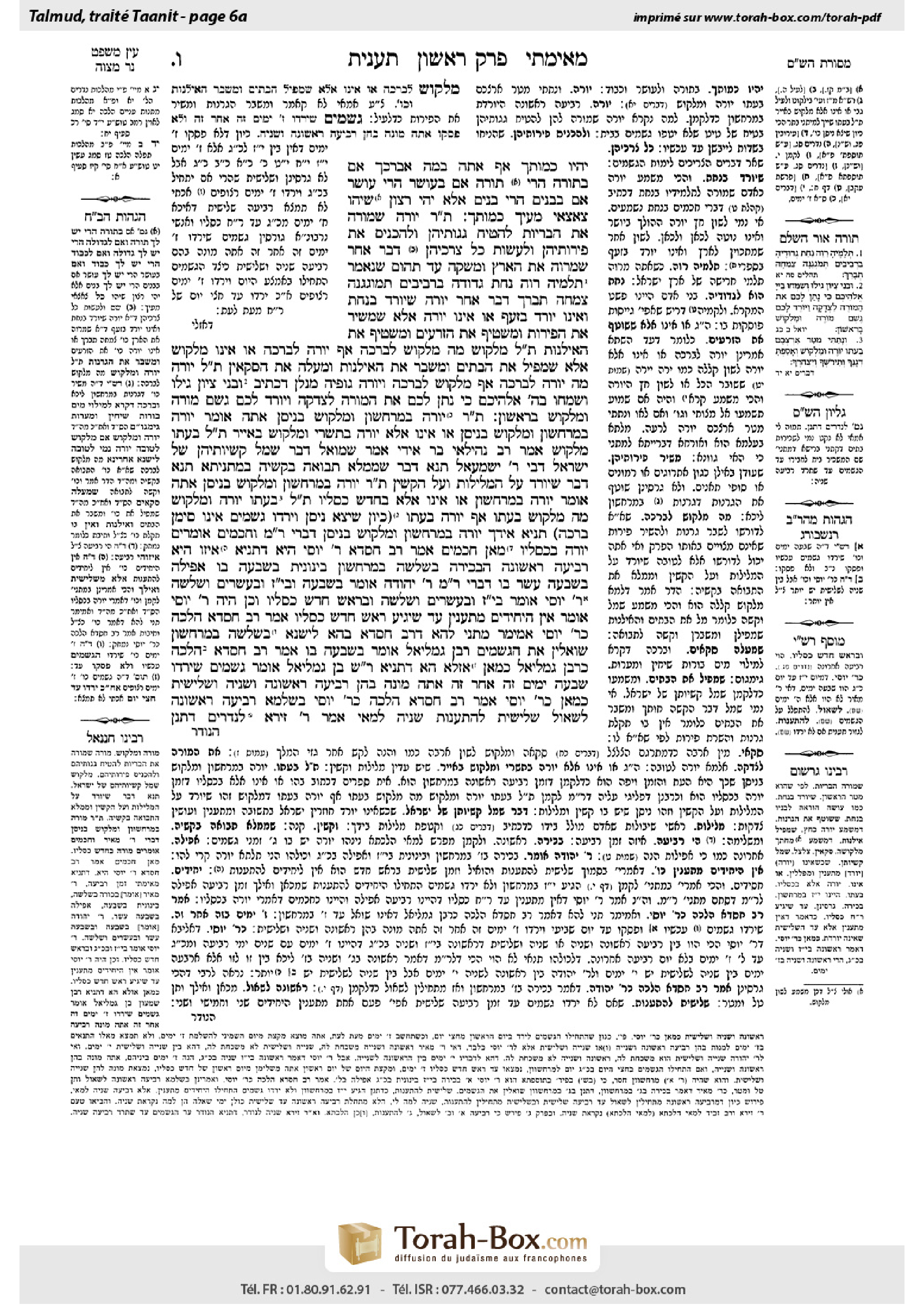
Taanit 6a: Talmud study for Daf Yomi
Daf Yomi is the daily study of one Talmud folio. Explore 37 tractates with scans, Hebrew text, Sefaria English and AI-generated French translations where annotated.
Passage selection and English or AI-generated French translation are available where the scan has annotations. Daf Study is independent of Torah-Box and Sefaria.
Browse Taanit · תענית · All tractatesTaanit 6a text and translations
This page of Taanit includes the Aramaic text, an English translation and an AI-generated French translation, alongside the scan above.
תענית ו׳ א · Aramaic and Hebrew text
יִהְיוּ כְּמוֹתְךָ. אַף אַתָּה, בַּמָּה אֲבָרֶכְךָ? אִם בְּתוֹרָה — הֲרֵי תּוֹרָה, אִם בְּעוֹשֶׁר — הֲרֵי עוֹשֶׁר, אִם בְּבָנִים — הֲרֵי בָּנִים, אֶלָּא: יְהִי רָצוֹן שֶׁיִּהְיוּ צֶאֱצָאֵי מֵעֶיךָ כְּמוֹתְךָ.
תָּנוּ רַבָּנַן: ״יוֹרֶה״ — שֶׁמּוֹרֶה אֶת הַבְּרִיּוֹת לְהָטִיחַ גַּגּוֹתֵיהֶן, וּלְהַכְנִיס אֶת פֵּירוֹתֵיהֶן, וְלַעֲשׂוֹת כׇּל צׇרְכֵיהֶן. דָּבָר אַחֵר: שֶׁמַּרְוֶה אֶת הָאָרֶץ וּמַשְׁקָהּ עַד תְּהוֹם, שֶׁנֶּאֱמַר: ״תְּלָמֶיהָ רַוֵּה נַחֵת גְּדוּדֶיהָ בִּרְבִיבִים תְּמֹגְגֶנָּה צִמְחָהּ תְּבָרֵךְ״. דָּבָר אַחֵר: ״יוֹרֶה״ — שֶׁיּוֹרֵד בְּנַחַת וְאֵינוֹ יוֹרֵד בְּזַעַף.
אוֹ אֵינוֹ ״יוֹרֶה״, אֶלָּא שֶׁמַּשִּׁיר אֶת הַפֵּירוֹת, וּמַשְׁטִיף אֶת הַזְּרָעִים, וּמַשְׁטִיף אֶת הָאִילָנוֹת — תַּלְמוּד לוֹמַר: ״מַלְקוֹשׁ״, מָה מַלְקוֹשׁ לִבְרָכָה — אַף יוֹרֶה לִבְרָכָה. אוֹ אֵינוֹ ״מַלְקוֹשׁ״, אֶלָּא שֶׁמַּפִּיל אֶת הַבָּתִּים, וּמְשַׁבֵּר אֶת הָאִילָנוֹת, וּמַעֲלֶה אֶת הַסַּקָּאִין — תַּלְמוּד לוֹמַר: ״יוֹרֶה״, מָה יוֹרֶה לִבְרָכָה — אַף מַלְקוֹשׁ לִבְרָכָה.
וְיוֹרֶה גּוּפֵיהּ מְנָלַן — דִּכְתִיב: ״וּבְנֵי צִיּוֹן גִּילוּ וְשִׂמְחוּ בַּה׳ אֱלֹהֵיכֶם כִּי נָתַן לָכֶם אֶת הַמּוֹרֶה לִצְדָקָה וַיּוֹרֶד לָכֶם גֶּשֶׁם מוֹרֶה וּמַלְקוֹשׁ בָּרִאשׁוֹן״.
תָּנוּ רַבָּנַן: יוֹרֶה בִּמְרַחְשְׁוָן, וּמַלְקוֹשׁ בְּנִיסָן. אַתָּה אוֹמֵר: יוֹרֶה בִּמְרַחְשְׁוָן וּמַלְקוֹשׁ בְּנִיסָן, אוֹ אֵינוֹ אֶלָּא יוֹרֶה בְּתִשְׁרִי וּמַלְקוֹשׁ בְּאִיָּיר? תַּלְמוּד לוֹמַר: ״בְּעִתּוֹ״.
״מַלְקוֹשׁ״ — אָמַר רַב נְהִילַאי בַּר אִידֵּי אָמַר שְׁמוּאֵל: דָּבָר שֶׁמָּל קַשְׁיוּתֵיהֶן שֶׁל יִשְׂרָאֵל. דְּבֵי רַבִּי יִשְׁמָעֵאל תָּנָא: דָּבָר שֶׁמְּמַלֵּא תְּבוּאָה בְּקַשֶּׁיהָ. בְּמַתְנִיתָא תָּנָא: דָּבָר שֶׁיּוֹרֵד עַל הַמְּלִילוֹת וְעַל הַקַּשִּׁין.
תָּנוּ רַבָּנַן: יוֹרֶה בִּמְרַחְשְׁוָן, וּמַלְקוֹשׁ בְּנִיסָן. אַתָּה אוֹמֵר יוֹרֶה בִּמְרַחְשְׁוָן, אוֹ אֵינוֹ אֶלָּא בְּחֹדֶשׁ כִּסְלֵיו? תַּלְמוּד לוֹמַר: ״בְּעִתּוֹ יוֹרֶה וּמַלְקוֹשׁ״, מָה מַלְקוֹשׁ בְּעִתּוֹ — אַף יוֹרֶה בְּעִתּוֹ, כֵּיוָן שֶׁיָּצָא נִיסָן וְיָרְדוּ גְּשָׁמִים אֵינוֹ סִימַן בְּרָכָה.
תַּנְיָא אִידַּךְ: יוֹרֶה בִּמְרַחְשְׁוָן וּמַלְקוֹשׁ בְּנִיסָן, דִּבְרֵי רַבִּי מֵאִיר. וַחֲכָמִים אוֹמְרִים: יוֹרֶה בְּכִסְלֵיו.
מַאן חֲכָמִים? אָמַר רַב חִסְדָּא: רַבִּי יוֹסֵי הִיא, דְּתַנְיָא: אֵיזוֹ הִיא רְבִיעָה רִאשׁוֹנָה? הַבְּכִירָה — בִּשְׁלֹשָׁה בִּמְרַחְשְׁוָן, בֵּינוֹנִית — בְּשִׁבְעָה בּוֹ, אֲפִילָה — בְּשִׁבְעָה עָשָׂר בּוֹ, דִּבְרֵי רַבִּי מֵאִיר. רַבִּי יְהוּדָה אוֹמֵר: בְּשִׁבְעָה, וּבְשִׁבְעָה עָשָׂר, וּבְעֶשְׂרִים וּשְׁלֹשָׁה.
רַבִּי יוֹסֵי אוֹמֵר: בְּשִׁבְעָה עָשָׂר, וּבְעֶשְׂרִים וּשְׁלֹשָׁה, וּבְרֹאשׁ חֹדֶשׁ כִּסְלֵיו. וְכֵן הָיָה רַבִּי יוֹסֵי אוֹמֵר: אֵין הַיְּחִידִים מִתְעַנִּין עַד שֶׁיַּגִּיעַ רֹאשׁ חֹדֶשׁ כִּסְלֵיו.
אָמַר רַב חִסְדָּא: הֲלָכָה כְּרַבִּי יוֹסֵי. אַמֵּימָר מַתְנֵי לְהָא דְּרַב חִסְדָּא בְּהָא לִישָּׁנָא: בִּשְׁלֹשָׁה בִּמְרַחְשְׁוָן שׁוֹאֲלִין אֶת הַגְּשָׁמִים, רַבָּן גַּמְלִיאֵל אוֹמֵר: בְּשִׁבְעָה בּוֹ, אָמַר רַב חִסְדָּא: הֲלָכָה כְּרַבָּן גַּמְלִיאֵל.
כְּמַאן אָזְלָא הָא דְּתַנְיָא, רַבָּן שִׁמְעוֹן בֶּן גַּמְלִיאֵל אוֹמֵר: גְּשָׁמִים שֶׁיָּרְדוּ שִׁבְעָה יָמִים זֶה אַחַר זֶה אַתָּה מוֹנֶה בָּהֶן רְבִיעָה רִאשׁוֹנָה וּשְׁנִיָּה וּשְׁלִישִׁית, כְּמַאן — כְּרַבִּי יוֹסֵי. אָמַר רַב חִסְדָּא: הֲלָכָה כְּרַבִּי יוֹסֵי.
בִּשְׁלָמָא רְבִיעָה רִאשׁוֹנָה — לִשְׁאוֹל. שְׁלִישִׁית — לְהִתְעַנּוֹת. שְׁנִיָּה, לְמַאי? אָמַר רַבִּי זֵירָא: לִנְדָרִים, דִּתְנַן:
Taanit 6a · English translation
be like you. So it is with you. With what shall I bless you? If I bless you with Torah, you already have Torah; if I bless you with wealth, you already have wealth; if I bless you with children, you already have children. Rather, may it be God’s will that your offspring shall be like you.
§ The Gemara returns to the topic of rain. The Sages taught in a baraita: The first rain [yoreh] is called by this name due to the fact that it instructs [moreh] people to plaster their roofs and to bring in their produce from the fields to their houses and to attend to all their needs in the field before more rain falls. Alternatively, yoreh is referring to the fact that it moistens [marve] the earth and waters it to the depths, as it is stated: “Watering [ravvei] its ridges abundantly, settling down its furrows, You make it soft with showers, You bless its growth” (Psalms 65:11). Alternatively, yoreh means that it falls gently and it does not fall vehemently.
Or perhaps that is not the case; rather, yoreh means that the rain causes the fruit to drop from the trees, washes the seeds away, and washes the trees away in a destructive manner. According to this interpretation, yoreh is related to yeriya, shooting. Therefore the verse states: “Last rain [malkosh]” (Deuteronomy 11:14); just as malkosh refers specifically to rains that are for a blessing, so too, yoreh is referring to rains that are for a blessing. Or perhaps that is not the case; rather, malkosh means that the rain falls so hard [kashe] and vehemently that it knocks down the houses, shatters the trees and brings up the locusts? Therefore, the verse states: “Yoreh,” from which it may be inferred that just as yoreh is for a blessing, so too, malkosh is for a blessing.
And with regard to yoreh itself, from where do we derive that it is referring to rain that falls for a blessing? As it is written: “You children of Zion, be glad and rejoice in the Lord your God, for He has given you the first rain [moreh] in His kindness, and He caused to come down for you the rain, the first rain [moreh] and the last rain [malkosh], in the first month” (Joel 2:23). This verse clearly states that yoreh, also referred to as moreh, fall due to God’s kindness, for a blessing.
The Gemara cites another baraita on the same topic. The Sages taught: The first rain falls in Marḥeshvan and the last rain in Nisan. Do you say that the first rain is in Marḥeshvan and the last rain in Nisan, or perhaps it is only that the first rain falls in Tishrei and the last rain in Iyyar? Therefore, the verse states: “I shall give the rain of your land in its due time” (Deuteronomy 11:14). Its due time is in Marḥeshvan, when rain is needed for the crops to sprout, and in Nisan, to complete the growth of the crops.
The Gemara clarifies the meaning of the word for the last rain [malkosh]. Rav Nehilai bar Idi said that Shmuel said: It is a matter that circumcises [mal] the stubbornness [kashyuteihen] of the Jewish people, i.e., it penetrates to the hearts of the Jewish people, as when rain does not fall in its time, they turn to God in repentance. The school of Rabbi Yishmael taught: The last rain is called malkosh because it is a matter that fills out [memalle] produce in its stalks [bekasheha]. Although the stalks already exist from earlier in the year, it is this rain that causes the grain within to swell and fill them. It was taught in a baraita: Malkosh is a matter that comes down on the ears [melilot] and on the stalks [kashin].
The Sages taught in a baraita: The first rain falls in Marḥeshvan and the last rain in Nisan. Do you say that the first rain is in Marḥeshvan, or perhaps it is only in the month of Kislev? The verse states: “I shall give the rain of your land in its due time, the first rain and the last rain” (Deuteronomy 11:14). Just as the last rain falls in its due time, so too, the first rain falls in its due time. And, as previously stated, once Nisan has ended and the rains subsequently fall, this is not a sign of a blessing, but a curse. Likewise, Marḥeshvan is the best time for the first rains to fall.
It is taught in another baraita: The first rain is in Marḥeshvan and the last rain is in Nisan. This is the statement of Rabbi Meir. And the Rabbis say: The time of the first rain is in Kislev.
The Gemara asks: Who are the Rabbis cited here? Rav Ḥisda said: It is the opinion of Rabbi Yosei, as it is taught in a baraita: When is the first rainfall? Each opinion cited in the baraita provides a range of dates for when this rainfall is expected. The earliest date on which the first rainfall might occur is on the third of Marḥeshvan, the intermediate time is on the seventh of the month, and the latest is on the seventeenth of the month. This is the statement of Rabbi Meir. Rabbi Yehuda says: The earliest that it might fall is on the seventh of Marḥeshvan, the intermediate date is on the seventeenth, and the latest is on the twenty-third.
Rabbi Yosei says: The earliest time for the first rain is on the seventeenth of Marḥeshvan, the intermediate date is on the twenty-third, and the latest is on the New Moon of Kislev. And, so too, Rabbi Yosei would say: The learned individuals who would start to fast for rain at an earlier time than the rest of the community do not start to fast due to a drought until the New Moon of Kislev. Until this date arrives it is not considered a drought, as the first rainfall could still fall in its proper time.
Rav Ḥisda said: The halakha is in accordance with the opinion of Rabbi Yosei. Ameimar would teach this ruling of Rav Ḥisda in the following language: On the third of Marḥeshvan one starts to request rain; Rabban Gamliel says: On the seventh. With regard to this statement, Rav Ḥisda said: The halakha is in accordance with the opinion of Rabban Gamliel.
The Gemara asks: In accordance with whose opinion is that which is taught in a baraita. Rabban Shimon ben Gamliel says: With regard to rains that fell on seven consecutive days, you count them as two separate rainfalls, either as the first and second rainfalls together, or as the second and third rainfalls together. In accordance with whose opinion is this statement? It is in accordance with the opinion of Rabbi Yosei, as he alone establishes a set interval of seven days between each of the rainfalls. Rav Ḥisda said: The halakha is in accordance with the opinion of Rabbi Yosei.
With regard to the mention of three rainfalls in the baraita, the Gemara asks: Granted, the time of the first rainfall is significant, as it is the date when one begins to request rain. Likewise, the time of the third rainfall is important, so that one knows when to begin to fast if no rain has fallen by then. However, for what reason is the second rainfall mentioned in the baraita? Rabbi Zeira said: The second rainfall is significant for the issue of vows, as we learned in a mishna:
Taanit 6a · Traduction française (IA)
soient comme toi. Il en va de même pour toi. Que pourrais-je te souhaiter ? Si je te souhaite la Torah, tu as déjà la Torah ; si je te souhaite la richesse, tu as déjà la richesse ; si je te souhaite des enfants, tu as déjà des enfants. Que la volonté de Dieu soit donc que ta descendance soit comme toi.
§ La Guemara revient au sujet de la pluie. Les Sages ont enseigné dans une baraïta : La première pluie [yoreh] porte ce nom parce qu’elle indique [moreh] aux gens qu’ils doivent enduire leurs toits, rentrer chez eux leurs récoltes des champs et s’occuper de tous leurs besoins dans les champs avant que d’autres pluies ne tombent. Autre explication : yoreh renvoie au fait qu’elle humidifie [marve] la terre et l’arrose en profondeur, comme il est dit : « Tu arroses abondamment [ravvei] ses sillons, tu nivelles ses mottes, tu l’amollis par les averses, tu bénis ses pousses » (Psaumes 65,11). Autre explication : yoreh signifie qu’elle tombe doucement et non avec violence.
Ou peut-être n’en est-il pas ainsi ; yoreh signifierait plutôt que la pluie fait tomber les fruits des arbres, emporte les semences et arrache les arbres de manière destructrice. Selon cette interprétation, yoreh est apparenté à yeriya, le tir. Le verset dit donc : « La pluie tardive [malkosh] » (Deutéronome 11,14) ; de même que malkosh désigne spécifiquement des pluies bénéfiques, yoreh désigne lui aussi des pluies bénéfiques. Ou peut-être n’en est-il pas ainsi ; malkosh signifierait plutôt que la pluie tombe si fort [kashe] et avec une telle violence qu’elle renverse les maisons, brise les arbres et fait remonter les sauterelles ? Le verset dit donc : « Yoreh », ce dont on peut déduire que, de même que yoreh est bénéfique, malkosh l’est aussi.
Et concernant yoreh lui-même, d’où déduisons-nous qu’il s’agit d’une pluie qui tombe pour le bien ? Car il est écrit : « Enfants de Sion, soyez dans l’allégresse et réjouissez-vous dans le Seigneur votre Dieu, car Il vous a donné la première pluie [moreh] avec bienveillance, et Il a fait descendre pour vous la pluie, la première pluie [moreh] et la pluie tardive [malkosh], au premier mois » (Joël 2,23). Ce verset dit clairement que yoreh, également appelé moreh, tombe par la bienveillance de Dieu et constitue une bénédiction.
La Guemara cite une autre baraïta sur le même sujet. Les Sages ont enseigné : La première pluie tombe en mar’hechvan et la pluie tardive en nissan. Dis-tu que la première pluie tombe en mar’hechvan et la pluie tardive en nissan, ou peut-être la première pluie ne tombe-t-elle qu’en tichri et la pluie tardive qu’en iyar ? Le verset dit donc : « Je donnerai la pluie de votre pays en son temps » (Deutéronome 11,14). Son temps est en mar’hechvan, lorsque la pluie est nécessaire à la germination des cultures, et en nissan, pour achever leur croissance.
La Guemara précise le sens du mot désignant la pluie tardive [malkosh]. Rav Nehilai bar Idi a dit au nom de Chmouel : C’est une chose qui tranche [mal] l’obstination [kashyuteihen] du peuple juif, c’est-à-dire qu’elle pénètre dans le cœur du peuple juif, car lorsque la pluie ne tombe pas en son temps, ils se tournent vers Dieu dans le repentir. L’école de Rabbi Yichmaël a enseigné : La pluie tardive est appelée malkosh parce que c’est une chose qui remplit [memalle] les épis [bekasheha]. Bien que les tiges soient déjà présentes depuis le début de l’année, c’est cette pluie qui fait gonfler le grain qu’elles portent et les remplit. Il a été enseigné dans une baraïta : Malkosh est une chose qui tombe sur les épis [melilot] et sur les tiges [kashin].
Les Sages ont enseigné dans une baraïta : La première pluie tombe en mar’hechvan et la pluie tardive en nissan. Dis-tu que la première pluie tombe en mar’hechvan, ou peut-être seulement au mois de kislev ? Le verset dit : « Je donnerai la pluie de votre pays en son temps, la première pluie et la pluie tardive » (Deutéronome 11,14). De même que la pluie tardive tombe en son temps, la première pluie tombe elle aussi en son temps. Et, comme cela a été indiqué précédemment, lorsque nissan est terminé et que les pluies tombent ensuite, ce n’est pas un signe de bénédiction, mais une malédiction. De même, mar’hechvan est la période la plus propice à la première pluie.
Il est enseigné dans une autre baraïta : La première pluie tombe en mar’hechvan et la pluie tardive en nissan. Telle est l’opinion de Rabbi Meïr. Et les Sages disent : La période de la première pluie est le mois de kislev.
La Guemara demande : Qui sont les Sages cités ici ? Rav Ḥisda a dit : C’est l’opinion de Rabbi Yossi, comme il est enseigné dans une baraïta : Quand tombe la première pluie ? Chaque opinion citée dans la baraïta donne une fourchette de dates auxquelles cette pluie est attendue. La date la plus précoce à laquelle la première pluie peut tomber est le trois mar’hechvan, la date intermédiaire est le sept du mois et la plus tardive, le dix-sept du mois. Telle est l’opinion de Rabbi Meïr. Rabbi Yehouda dit : La date la plus précoce à laquelle elle peut tomber est le sept mar’hechvan, la date intermédiaire est le dix-sept et la plus tardive, le vingt-trois.
Rabbi Yossi dit : La première pluie peut tomber au plus tôt le dix-sept mar’hechvan ; la date intermédiaire est le vingt-trois, et la plus tardive, la nouvelle lune de kislev. Et Rabbi Yossi disait aussi : Les érudits qui commencent à jeûner pour la pluie avant le reste de la communauté ne commencent à jeûner en raison de la sécheresse qu’à la nouvelle lune de kislev. Tant que cette date n’est pas arrivée, on ne considère pas qu’il y ait sécheresse, car la première pluie peut encore tomber en son temps.
Rav Ḥisda a dit : La halakha suit l’opinion de Rabbi Yossi. Ameimar enseignait cette décision de Rav Ḥisda sous la forme suivante : Le trois mar’hechvan, on commence à demander la pluie ; Rabban Gamliel dit : le sept. À propos de cette déclaration, Rav Ḥisda a dit : La halakha suit l’opinion de Rabban Gamliel.
La Guemara demande : Selon l’opinion de qui est l’enseignement suivant, rapporté dans une baraïta ? Rabban Chimon ben Gamliel dit : Si des pluies sont tombées pendant sept jours consécutifs, on les compte comme deux pluies distinctes, soit comme les première et deuxième pluies réunies, soit comme les deuxième et troisième pluies réunies. Selon l’opinion de qui est cette déclaration ? Elle suit l’opinion de Rabbi Yossi, car lui seul fixe un intervalle de sept jours entre chacune des pluies. Rav Ḥisda a dit : La halakha suit l’opinion de Rabbi Yossi.
À propos de la mention de trois pluies dans la baraïta, la Guemara demande : Il est compréhensible que la période de la première pluie soit importante, puisqu’elle marque la date à partir de laquelle on commence à demander la pluie. De même, la période de la troisième pluie est importante, afin de savoir quand commencer à jeûner si aucune pluie n’est tombée jusque-là. Mais pourquoi la baraïta mentionne-t-elle la deuxième pluie ? Rabbi Zeïra a dit : La deuxième pluie est importante pour la question des vœux, comme nous l’avons appris dans une Michna :
Traduction française générée par IA à partir de l’édition anglaise de Sefaria. Vérifie toujours un passage avec le texte source.
Text from Sefaria: William Davidson Edition - Vocalized Aramaic (CC BY NC); William Davidson Edition - English (CC BY NC).