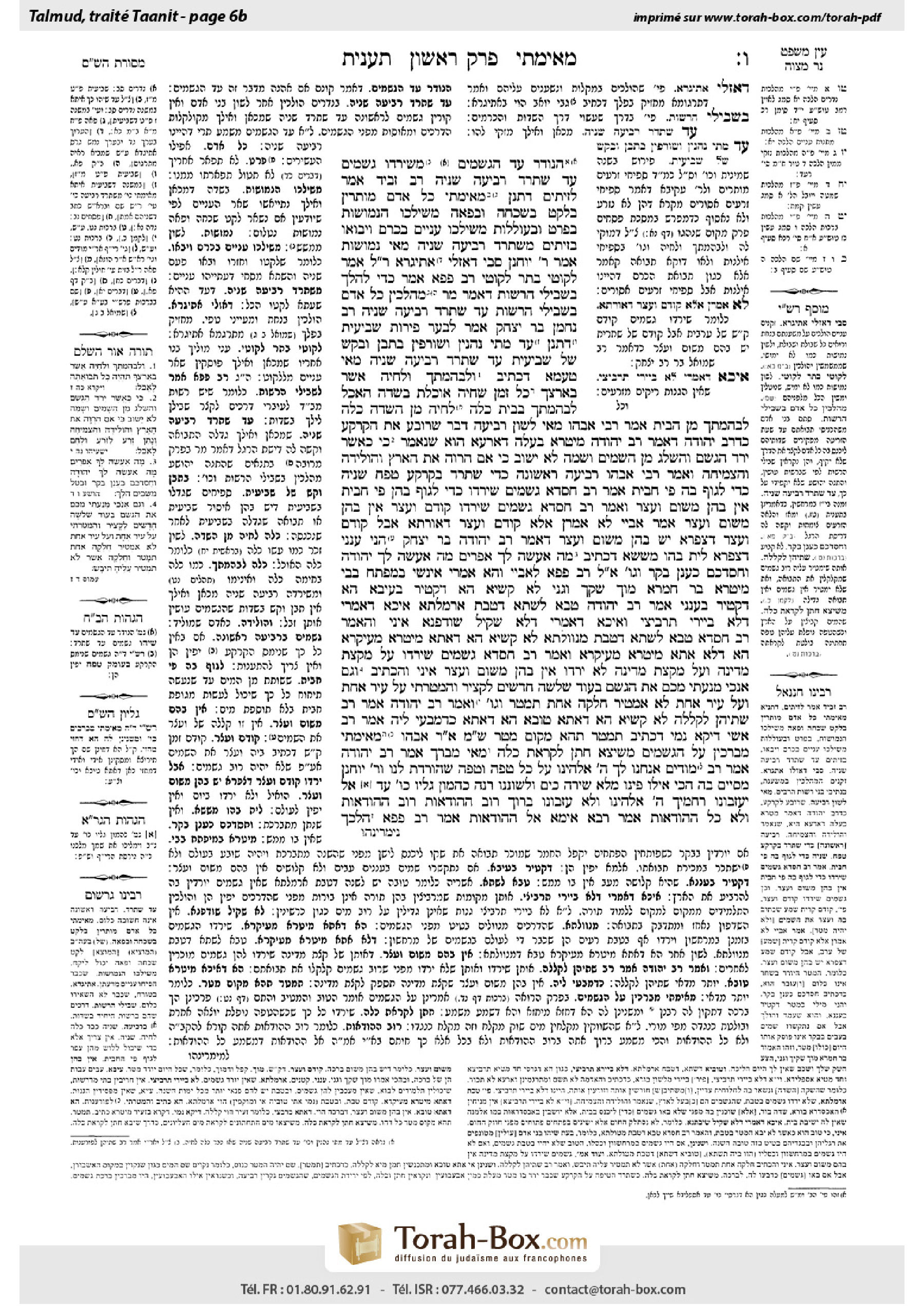
Taanit 6b: Talmud study for Daf Yomi
Daf Yomi is the daily study of one Talmud folio. Explore 37 tractates with scans, Hebrew text, Sefaria English and AI-generated French translations where annotated.
Passage selection and English or AI-generated French translation are available where the scan has annotations. Daf Study is independent of Torah-Box and Sefaria.
Browse Taanit · תענית · All tractatesTaanit 6b text and translations
This page of Taanit includes the Aramaic text, an English translation and an AI-generated French translation, alongside the scan above.
תענית ו׳ ב · Aramaic and Hebrew text
הַנּוֹדֵר עַד הַגְּשָׁמִים — מִשֶּׁיֵּרְדוּ גְּשָׁמִים עַד שֶׁתֵּרֵד רְבִיעָה שְׁנִיָּה.
רַב זְבִיד אָמַר: לְזֵיתִים. דִּתְנַן: מֵאֵימָתַי כׇּל אָדָם מוּתָּרִין בְּלֶקֶט בְּשִׁכְחָה וּבְפֵאָה — מִשֶּׁיֵּלְכוּ הַנָּמוֹשׁוֹת. בְּפֶרֶט וּבְעוֹלֵלוֹת — מִשֶּׁיֵּלְכוּ עֲנִיִּים בַּכֶּרֶם וְיָבוֹאוּ. בְּזֵיתִים — מִשֶּׁתֵּרֵד רְבִיעָה שְׁנִיָּה.
מַאי ״נָמוֹשׁוֹת״? אָמַר רַבִּי יוֹחָנָן: סָבֵי דְּאָזְלִי אַתִּיגְרָא. רֵישׁ לָקִישׁ אָמַר: לָקוֹטֵי בָּתַר לָקוֹטֵי.
רַב פָּפָּא אָמַר: כְּדֵי לְהַלֵּךְ בִּשְׁבִילֵי הָרְשׁוּת. דְּאָמַר מָר: מְהַלְּכִין כׇּל אָדָם בִּשְׁבִילֵי הָרְשׁוּת — עַד שֶׁתֵּרֵד רְבִיעָה שְׁנִיָּה.
רַב נַחְמָן בַּר יִצְחָק אָמַר: לְבַעֵר פֵּירוֹת שְׁבִיעִית. דִּתְנַן: עַד מָתַי נֶהֱנִין וְשׂוֹרְפִין בְּתֶבֶן וּבְקַשׁ שֶׁל שְׁבִיעִית — עַד שֶׁתֵּרֵד רְבִיעָה שְׁנִיָּה.
מַאי טַעְמָא? דִּכְתִיב: ״וְלִבְהֶמְתְּךָ וְלַחַיָּה אֲשֶׁר בְּאַרְצֶךָ״, כׇּל זְמַן שֶׁחַיָּה אוֹכֶלֶת בַּשָּׂדֶה — הַאֲכֵל לִבְהֶמְתֶּךָ בַּבַּיִת. כָּלָה לַחַיָּה מִן הַשָּׂדֶה — כַּלֵּה לִבְהֶמְתְּךָ מִן הַבַּיִת.
אָמַר רַבִּי אֲבָהוּ: מַאי לְשׁוֹן ״רְבִיעָה״ — דָּבָר שֶׁרוֹבֵעַ אֶת הַקַּרְקַע. כִּדְרַב יְהוּדָה, דְּאָמַר רַב יְהוּדָה: מִיטְרָא בַּעְלַהּ דְּאַרְעָא הוּא, שֶׁנֶּאֱמַר: ״כִּי כַּאֲשֶׁר יֵרֵד הַגֶּשֶׁם וְהַשֶּׁלֶג מִן הַשָּׁמַיִם וְשָׁמָּה לֹא יָשׁוּב כִּי אִם הִרְוָה אֶת הָאָרֶץ וְהוֹלִידָהּ וְהִצְמִיחָהּ״.
וְאָמַר רַבִּי אֲבָהוּ: רְבִיעָה רִאשׁוֹנָה — כְּדֵי שֶׁתֵּרֵד בַּקַּרְקַע טֶפַח. שְׁנִיָּה — כְּדֵי לָגוּף בָּהּ פִּי חָבִית. אָמַר רַב חִסְדָּא: גְּשָׁמִים שֶׁיָּרְדוּ כְּדֵי לָגוּף בָּהֶן פִּי חָבִית אֵין בָּהֶן מִשּׁוּם ״וְעָצַר״.
וְאָמַר רַב חִסְדָּא: גְּשָׁמִים שֶׁיָּרְדוּ קוֹדֶם ״וְעָצַר״, אֵין בָּהֶן מִשּׁוּם ״וְעָצַר״.
אָמַר אַבָּיֵי: לָא אֲמַרַן אֶלָּא קוֹדֶם ״וְעָצַר״ דְּאוּרְתָּא, אֲבָל קוֹדֶם ״וְעָצַר״ דְּצַפְרָא — יֵשׁ בָּהֶן מִשּׁוּם ״וְעָצַר״. דְּאָמַר רַב יְהוּדָה בַּר יִצְחָק: הָנֵי עֲנָנֵי דְּצַפְרָא לֵית בְּהוּ מְשָׁשָׁא, דִּכְתִיב: ״מָה אֶעֱשֶׂה לְּךָ אֶפְרַיִם מָה אֶעֱשֶׂה לְּךָ יְהוּדָה וְחַסְדְּכֶם כַּעֲנַן בֹּקֶר וְגוֹ׳״.
אֲמַר לֵיהּ רַב פָּפָּא לְאַבָּיֵי, וְהָא אָמְרִי אִינָשֵׁי: בְּמִפְתַּח בָּבֵי מִיטְרָא — בַּר חַמָּרָא מוּךְ שַׂקָּךְ וּגְנִי! לָא קַשְׁיָא: הָא דִּקְטִיר בְּעֵיבָא, הָא דִּקְטִיר בַּעֲנָנֵי.
אָמַר רַב יְהוּדָה: טָבָא לְשַׁתָּא דְּטֵבֵת אַרְמַלְתָּא. אִיכָּא דְאָמְרִי: דְּלָא בַּיְירִי תַּרְבִּיצֵי, וְאִיכָּא דְאָמְרִי: דְּלָא שְׁקִיל שׁוּדְפָנָא. אִינִי? וְהָאָמַר רַב חִסְדָּא: טָבָא לְשַׁתָּא דְּטֵבֵת מְנַוַּולְתָּא! לָא קַשְׁיָא: הָא דַּאֲתָא מִיטְרָא מֵעִיקָּרָא, הָא דְּלָא אֲתָא מִיטְרָא מֵעִיקָּרָא.
וְאָמַר רַב חִסְדָּא: גְּשָׁמִים שֶׁיָּרְדוּ עַל מִקְצָת מְדִינָה וְעַל מִקְצָת מְדִינָה לֹא יָרְדוּ — אֵין בָּהֶן מִשּׁוּם ״וְעָצַר״. אִינִי? וְהָכְתִיב: ״וְגַם אָנֹכִי מָנַעְתִּי מִכֶּם אֶת הַגֶּשֶׁם בְּעוֹד שְׁלֹשָׁה חֳדָשִׁים לַקָּצִיר וְהִמְטַרְתִּי עַל עִיר אֶחָת וְעַל עִיר אַחַת לֹא אַמְטִיר חֶלְקָה אַחַת תִּמָּטֵר וְגוֹ׳״, וְאָמַר רַב יְהוּדָה אָמַר רַב: שְׁתֵּיהֶן לִקְלָלָה!
לָא קַשְׁיָא: הָא דַּאֲתָא טוּבָא, הָא דַּאֲתָא כִּדְמִבְּעֵי לֵיהּ. אָמַר רַב אָשֵׁי: דַּיְקָא נָמֵי, דִּכְתִיב: ״תִּמָּטֵר״ — תְּהֵא מְקוֹם מָטָר. שְׁמַע מִינַּהּ.
אָמַר רַבִּי אֲבָהוּ: מֵאֵימָתַי מְבָרְכִין עַל הַגְּשָׁמִים — מִשֶּׁיֵּצֵא חָתָן לִקְרַאת כַּלָּה.
מַאי מְבָרֵךְ? אָמַר רַב יְהוּדָה אָמַר רַב: ״מוֹדִים אֲנַחְנוּ לָךְ ה׳ אֱלֹהֵינוּ עַל כׇּל טִפָּה וְטִפָּה שֶׁהוֹרַדְתָּ לָנוּ״. וְרַבִּי יוֹחָנָן מְסַיֵּים בַּהּ הָכִי: ״אִילּוּ פִינוּ מָלֵא שִׁירָה כַּיָּם וּלְשׁוֹנֵנוּ רִנָּה כַּהֲמוֹן גַּלָּיו כּוּ׳״, עַד ״אַל יַעְזְבוּנוּ רַחֲמֶיךָ ה׳ אֱלֹהֵינוּ וְלֹא עֲזָבוּנוּ, בָּרוּךְ רוֹב הַהוֹדָאוֹת״.
״רוֹב הַהוֹדָאוֹת״ וְלֹא ״כׇּל הַהוֹדָאוֹת״? אָמַר רָבָא, אֵימָא: ״אֵל הַהוֹדָאוֹת״. אָמַר רַב פָּפָּא: הִלְכָּךְ
Taanit 6b · English translation
In the case of one who vows to prohibit from himself a type of benefit until the rains, the vow is in effect from when the rains begin to fall until the second rainfall, as this is considered the time of the rains.
Rav Zevid said: The time of the second rainfall is also significant with regard to a halakha that deals with olives, as we learned in a mishna: From when is any person permitted to collect gleanings, forgotten sheaves, and pe’a, produce of the corners of a field, which may normally be taken only by the poor? Any individual is permitted to collect them only from when the searchers [namoshot], the last of the poor to arrive, have left the field. From when may anyone collect yield of the vineyard in the case of the single grapes and small, incompletely formed clusters of grapes, likewise reserved for the poor? From when the poor have left the vineyard and come back after the second time, an indication that they have collected all that they wish. From when may anyone collect yield of the trees in the case of forgotten olives? From when the second rainfall falls.
Incidentally, the Gemara asks: What is the meaning of the term for searchers, namoshot? Rabbi Yoḥanan said: It is referring to elders who walk with a staff [atigra]. Since they walk very slowly, they certainly see everything they wish to collect. Reish Lakish said: It is referring to the gleaners who come after all the gleaners, i.e., who arrive after two rounds of the poor have passed through the field.
Rav Pappa said that the time of the second rainfall is significant so that one can know until when it is permitted to walk on the permitted paths in fields. One may utilize certain paths on private property, provided no damage is caused to the field. As the Master said: Anyone may walk on the permitted paths until the second rainfall falls. One who walks on them at a later point in time is likely to trample the plowed field and damage its crops.
Rav Naḥman bar Yitzḥak said that the time of the second rainfall is significant for determining when to remove the produce of the Sabbatical Year from one’s possession. As we learned in a mishna: Until when may one derive benefit and burn the straw and the hay of the Sabbatical Year? Until the second rainfall falls.
The Gemara asks: What is the reason that one must remove the produce of the Sabbatical Year from one’s possession? The Gemara answers: As it is written with regard to the Sabbatical Year: “And for your cattle and for the beasts in your land all its increase shall be for food” (Leviticus 25:7). This verse indicates that as long as a beast, i.e., a non-domesticated animal, is able to find and eat produce in the field, you may feed your cattle, your domesticated animals, from that type of food in the house. However, when a given type of produce has ceased to be available to the beast in the field, cease providing it to your cattle in the house. After the time of the second rainfall there is no longer any straw or hay in the fields.
§ The Gemara returns to the subject of rain. Rabbi Abbahu said: What is the meaning of the term for rainfall, revia? It is referring to a matter that penetrates [rove’a], i.e., which causes the earth to bear fruit. This is in accordance with the opinion of Rav Yehuda, as Rav Yehuda said: Rain is the husband of the earth, as it is stated: “For as the rain comes down and the snow from heaven, and returns not there, except it waters the earth, and makes it give birth and sprout” (Isaiah 55:10). This verse indicates that rain fructifies the earth in the manner of a husband and wife.
And Rabbi Abbahu further said: For rainfall to be considered the first rainfall it must be sufficient to enter the ground and saturate it to a depth of one handbreadth. The second rainfall must be sufficient that the soil is moistened enough to seal the opening of a barrel with its mud. Rav Ḥisda said: Rains which fall and create sufficient mud to seal the opening of a barrel with them means that the year does not constitute a fulfillment of the verse: “And He will close up the heavens and there will be no rain” (Deuteronomy 11:17).
And Rav Ḥisda said: Rain that falls early in the day, prior to the recitation of Shema, which includes the verse: “And He will close up the heavens,” is enough to ensure that the hour does not constitute a fulfillment of the verse: “And He will close up the heavens,” even if no more rain falls at that time.
Abaye said: We said this only if the rain fell during the day, prior to the recitation of “and He will close up” of the evening Shema. However, if a small amount of rain falls prior to the recitation of “and He will close up” of the morning Shema, this rain could still constitute an expression of “and He will close up.” As Rav Yehuda bar Yitzḥak said: These morning clouds have no substance; they generally yield minimal or no rain. As it is written: “What can I do for you, Ephraim, what can I do for you, Judah, for your goodness is like a morning cloud” (Hosea 6:4). This verse indicates that morning clouds contain little benefit.
Rav Pappa said to Abaye: But people say the well-known maxim: When the gates, i.e., doors, are opened in the morning and there is rain, donkey-driver, fold your sack and go to sleep, as it is certain to rain all day, which will render the work of donkey-drivers infeasible. This shows that morning clouds are a sign that it will rain all day. The Gemara answers: This is not difficult. This statement of Rav Pappa is referring to when the sky is overcast with heavy clouds, from which rain will fall all day, whereas that statement of Rav Ḥisda is referring to a morning when the sky is overcast with light clouds which will not bring substantial rain.
§ Rav Yehuda said: It is good for the year when the month of Tevet is a widower, i.e., when it features no rainfall. The Gemara explains: Some say that this is so that the gardens [tarbitzei] should not be desolate, as too much rain damages vegetables. And some say: The reason is that it should not suffer blight caused by excessive rain. The Gemara asks: Is that so? But didn’t Rav Ḥisda say: It is good for the year when the month of Tevet is disgusting, i.e., muddy from rain. The Gemara answers: This is not difficult. This statement of Rav Yehuda is referring to a year when it rained initially, i.e., before Tevet, in which case rain during Tevet is not beneficial. That statement of Rav Ḥisda is referring to a year when it did not rain initially, before Tevet, and therefore rain during Tevet is beneficial.
And Rav Ḥisda also said: Rain that fell on one part of a country and did not fall on another part of the country does not constitute a fulfillment of the verse: “And He will close up the heavens.” The Gemara raises an objection: Is that so? But isn’t it written: “And I have also withheld the rain from you, when there were yet three months to the harvest; and I would cause it to rain upon one city, and caused it not to rain upon another city; one piece was rained upon, and the piece upon which it did not rain withered” (Amos 4:7). And Rav Yehuda said that Rav said: Both the area that receives rain and the area that does not receive rain are cursed. This statement indicates that rain that falls on only part of a country is a curse.
The Gemara answers: This is not difficult. This, Rav Yehuda’s statement, is referring to a case when excessive rain falls in one part of the country and causes damage; whereas that, Rav Ḥisda’s statement, is referring to a situation when the requisite amount of rain falls in one part of the country. In this case, it is not a sign of a curse, but is a blessing for that particular part of the country. Rav Ashi said: The language is also precise in the verse in Amos that deals with excessive rain in one place, as it is written: “Was rained upon,” which indicates that it shall be a place of rain, i.e., an area filled with rain and water. The Gemara concludes: Indeed, learn from it that this is the correct interpretation.
Rabbi Abbahu said: From when does one recite a blessing over rain? From when the groom goes out to meet the bride, that is, when there are puddles of water on the ground such that the water below, represented as the bride in this metaphor, is splashed from above by the raindrops, represented as the groom.
The Gemara asks: What blessing does one recite over rain? Rav Yehuda said that Rav said: We thank you, O Lord our God, for each and every drop that You have made fall for us. And Rabbi Yoḥanan concludes the blessing as follows: If our mouth were as full of song as the sea, and our tongue with singing like the multitude of its waves, etc. And one continues with the formula of the nishmat prayer recited on Shabbat morning, until: May Your mercy not forsake us, O Lord our God, and You have not forsaken us. Blessed are You, O Lord, to Whom abundant thanksgivings are offered.
The Gemara asks: Why does the blessing specify abundant thanksgivings and not all thanksgivings? Rava said: Emend the formula of the blessing and say: God of thanksgivings. Rav Pappa said: Therefore, as there are differences of opinion on this,
Taanit 6b · Traduction française (IA)
Dans le cas de celui qui fait vœu de s’interdire une certaine forme de jouissance jusqu’aux pluies, le vœu prend effet depuis le début des pluies jusqu’à la deuxième averse, car cette période est considérée comme le temps des pluies.
Rav Zevid dit : Le moment de la deuxième averse a également une importance pour une halakha concernant les olives, comme nous l’avons appris dans une Michna : À partir de quand toute personne est-elle autorisée à ramasser les glanures, les gerbes oubliées et la pe’a, c’est-à-dire les produits des coins d’un champ, que seuls les pauvres peuvent normalement prendre ? Toute personne n’est autorisée à les ramasser qu’à partir du moment où les chercheurs [namoshot], les derniers pauvres à arriver, ont quitté le champ. À partir de quand toute personne peut-elle ramasser dans la vigne les grains de raisin isolés et les petites grappes incomplètement formées, également réservés aux pauvres ? À partir du moment où les pauvres ont quitté la vigne et y sont revenus une deuxième fois, ce qui indique qu’ils ont ramassé tout ce qu’ils souhaitaient. À partir de quand toute personne peut-elle ramasser dans les arbres les olives oubliées ? À partir du moment où tombe la deuxième averse.
À ce propos, la Guemara demande : Que signifie le terme désignant les chercheurs, namoshot ? Rabbi Yoḥanan dit : Il s’agit de personnes âgées qui marchent avec un bâton [atigra]. Comme elles avancent très lentement, elles voient certainement tout ce qu’elles souhaitent ramasser. Reish Lakish dit : Il s’agit des glaneurs qui viennent après tous les autres glaneurs, c’est-à-dire qui arrivent après que deux groupes de pauvres ont traversé le champ.
Rav Pappa dit que le moment de la deuxième averse a de l’importance pour savoir jusqu’à quand il est permis d’emprunter les chemins autorisés dans les champs. On peut emprunter certains chemins sur une propriété privée, à condition de ne pas endommager le champ. Car le Maître a dit : Toute personne peut emprunter les chemins autorisés jusqu’à ce que tombe la deuxième averse. Celui qui les emprunte plus tard risque de piétiner le champ labouré et d’endommager ses cultures.
Rav Naḥman bar Yitzḥak dit que le moment de la deuxième averse a de l’importance pour déterminer quand retirer de ses biens les produits de l’année sabbatique. Comme nous l’avons appris dans une Michna : Jusqu’à quand peut-on tirer profit de la paille et du foin de l’année sabbatique et les brûler ? Jusqu’à ce que tombe la deuxième averse.
La Guemara demande : Pourquoi faut-il retirer de ses biens les produits de l’année sabbatique ? La Guemara répond : Car il est écrit au sujet de l’année sabbatique : « Et pour ton bétail et pour les animaux sauvages de ton pays, toute sa récolte servira de nourriture » (Lévitique 25:7). Ce verset indique que tant qu’un animal sauvage, c’est-à-dire un animal non domestique, peut trouver et manger des produits dans le champ, tu peux donner à manger à ton bétail, c’est-à-dire à tes animaux domestiques, de cette même sorte de nourriture à la maison. Mais lorsqu’une sorte de produit cesse d’être disponible dans le champ pour l’animal sauvage, cesse d’en donner à ton bétail à la maison. Après la deuxième averse, il ne reste plus de paille ni de foin dans les champs.
§ La Guemara revient au sujet de la pluie. Rabbi Abbahu dit : Que signifie le terme désignant la pluie, revia ? Il désigne une chose qui pénètre [rove’a], c’est-à-dire qui fait porter des fruits à la terre. Cela concorde avec l’opinion de Rav Yehuda, car Rav Yehuda a dit : La pluie est l’époux de la terre, comme il est dit : « Car, comme la pluie et la neige descendent du ciel et n’y retournent pas sans avoir abreuvé la terre, l’avoir fait enfanter et pousser » (Isaïe 55:10). Ce verset indique que la pluie féconde la terre à la manière d’un époux et d’une épouse.
Rabbi Abbahu a également dit : Pour qu’une pluie soit considérée comme la première averse, elle doit suffire à pénétrer le sol et à l’imbiber jusqu’à une profondeur d’un téfaḥ. La deuxième averse doit suffire à humidifier la terre au point que sa boue puisse boucher l’ouverture d’un tonneau. Rav Ḥisda dit : Des pluies qui tombent et produisent assez de boue pour boucher l’ouverture d’un tonneau signifient que l’année ne réalise pas le verset : « Il fermera les cieux et il n’y aura pas de pluie » (Deutéronome 11:17).
Rav Ḥisda a également dit : Une pluie qui tombe tôt dans la journée, avant la récitation du Chéma, qui comprend le verset « Il fermera les cieux », suffit à garantir que ce moment ne réalise pas le verset « Il fermera les cieux », même si aucune autre pluie ne tombe alors.
Abaye dit : Nous n’avons dit cela que si la pluie est tombée pendant la journée, avant la récitation du passage « et Il fermera » du Chéma du soir. Mais si une petite quantité de pluie tombe avant la récitation du passage « et Il fermera » du Chéma du matin, cette pluie pourrait encore constituer une réalisation de « et Il fermera ». Car Rav Yehuda bar Yitzḥak a dit : Ces nuages matinaux n’ont aucune consistance ; en général, ils donnent peu ou pas de pluie. Comme il est écrit : « Que puis-je faire pour toi, Éphraïm ? Que puis-je faire pour toi, Juda ? Votre bonté est comme un nuage du matin » (Osée 6:4). Ce verset indique que les nuages matinaux apportent peu de bienfaits.
Rav Pappa dit à Abaye : Pourtant, les gens disent ce dicton bien connu : « Quand les portes, c’est-à-dire les portes des maisons, s’ouvrent le matin et qu’il pleut, conducteur d’âne, plie ton sac et va dormir », car il est certain qu’il pleuvra toute la journée, ce qui rendra le travail des conducteurs d’ânes impossible. Cela montre que les nuages matinaux annoncent qu’il pleuvra toute la journée. La Guemara répond : Il n’y a pas de difficulté. La déclaration de Rav Pappa concerne le cas où le ciel est couvert de nuages épais, qui donneront de la pluie toute la journée, tandis que celle de Rav Ḥisda concerne un matin où le ciel est couvert de nuages légers, qui n’apporteront pas de pluie abondante.
§ Rav Yehuda a dit : L’année est bonne lorsque le mois de Tevet est veuf, c’est-à-dire lorsqu’il ne comporte aucune pluie. La Guemara explique : Certains disent que c’est afin que les jardins [tarbitzei] ne soient pas dévastés, car trop de pluie endommage les légumes. D’autres disent que la raison est que les cultures ne soient pas atteintes par le mildiou causé par un excès de pluie. La Guemara demande : Est-ce bien le cas ? Rav Ḥisda n’a-t-il pas dit : L’année est bonne lorsque le mois de Tevet est répugnant, c’est-à-dire boueux à cause de la pluie ? La Guemara répond : Il n’y a pas de difficulté. La déclaration de Rav Yehuda concerne une année où il a plu au début, c’est-à-dire avant Tevet, auquel cas la pluie pendant Tevet n’est pas bénéfique. Celle de Rav Ḥisda concerne une année où il n’a pas plu au début, avant Tevet ; la pluie pendant Tevet est donc bénéfique.
Rav Ḥisda a également dit : Une pluie qui tombe dans une partie du pays et pas dans une autre ne constitue pas une réalisation du verset : « Il fermera les cieux. » La Guemara soulève une objection : Est-ce bien le cas ? N’est-il pas écrit : « Je vous ai aussi refusé la pluie alors qu’il restait encore trois mois avant la récolte ; je faisais pleuvoir sur une ville et ne faisais pas pleuvoir sur une autre ; une parcelle était arrosée par la pluie, et la parcelle sur laquelle il ne pleuvait pas se desséchait » (Amos 4:7) ? Et Rav Yehuda a dit au nom de Rav : La région qui reçoit la pluie comme celle qui ne la reçoit pas sont toutes deux maudites. Cette déclaration indique qu’une pluie qui ne tombe que sur une partie du pays est une malédiction.
La Guemara répond : Il n’y a pas de difficulté. La déclaration de Rav Yehuda concerne le cas où une pluie excessive tombe dans une partie du pays et cause des dégâts, tandis que celle de Rav Ḥisda concerne une situation où la quantité de pluie nécessaire tombe dans une partie du pays. Dans ce cas, ce n’est pas un signe de malédiction, mais une bénédiction pour cette partie du pays. Rav Ashi dit : La formulation du verset d’Amos, qui traite d’une pluie excessive en un lieu, est également précise, car il est écrit : « était arrosée par la pluie », ce qui indique que cet endroit est un lieu de pluie, c’est-à-dire une région remplie de pluie et d’eau. La Guemara conclut : En effet, apprends de là que telle est l’interprétation correcte.
Rabbi Abbahu dit : À partir de quand récite-t-on une bénédiction pour la pluie ? À partir du moment où le marié sort à la rencontre de la mariée, c’est-à-dire lorsque des flaques d’eau se forment sur le sol, de sorte que l’eau d’en bas, représentée par la mariée dans cette métaphore, est éclaboussée d’en haut par les gouttes de pluie, représentées par le marié.
La Guemara demande : Quelle bénédiction récite-t-on pour la pluie ? Rav Yehuda a dit au nom de Rav : « Nous Te remercions, Seigneur notre Dieu, pour chacune des gouttes que Tu as fait tomber pour nous. » Rabbi Yoḥanan conclut la bénédiction ainsi : « Si notre bouche était remplie de chants comme la mer, et notre langue de chants comme la multitude de ses vagues, etc. » Puis on poursuit avec la formule de la prière de Nishmat, récitée le Chabbat matin, jusqu’à : « Que Ta miséricorde ne nous abandonne pas, Seigneur notre Dieu, et Tu ne nous as pas abandonnés. Béni sois-Tu, Seigneur, à qui sont offertes d’abondantes actions de grâce. »
La Guemara demande : Pourquoi la bénédiction parle-t-elle d’abondantes actions de grâce, et non de toutes les actions de grâce ? Rava dit : Corrige la formule de la bénédiction et dis : « Dieu des actions de grâce. » Rav Pappa dit : Par conséquent, puisqu’il existe des avis divergents sur cette question,
Traduction française générée par IA à partir de l’édition anglaise de Sefaria. Vérifie toujours un passage avec le texte source.
Text from Sefaria: William Davidson Edition - Vocalized Aramaic (CC BY NC); William Davidson Edition - English (CC BY NC).