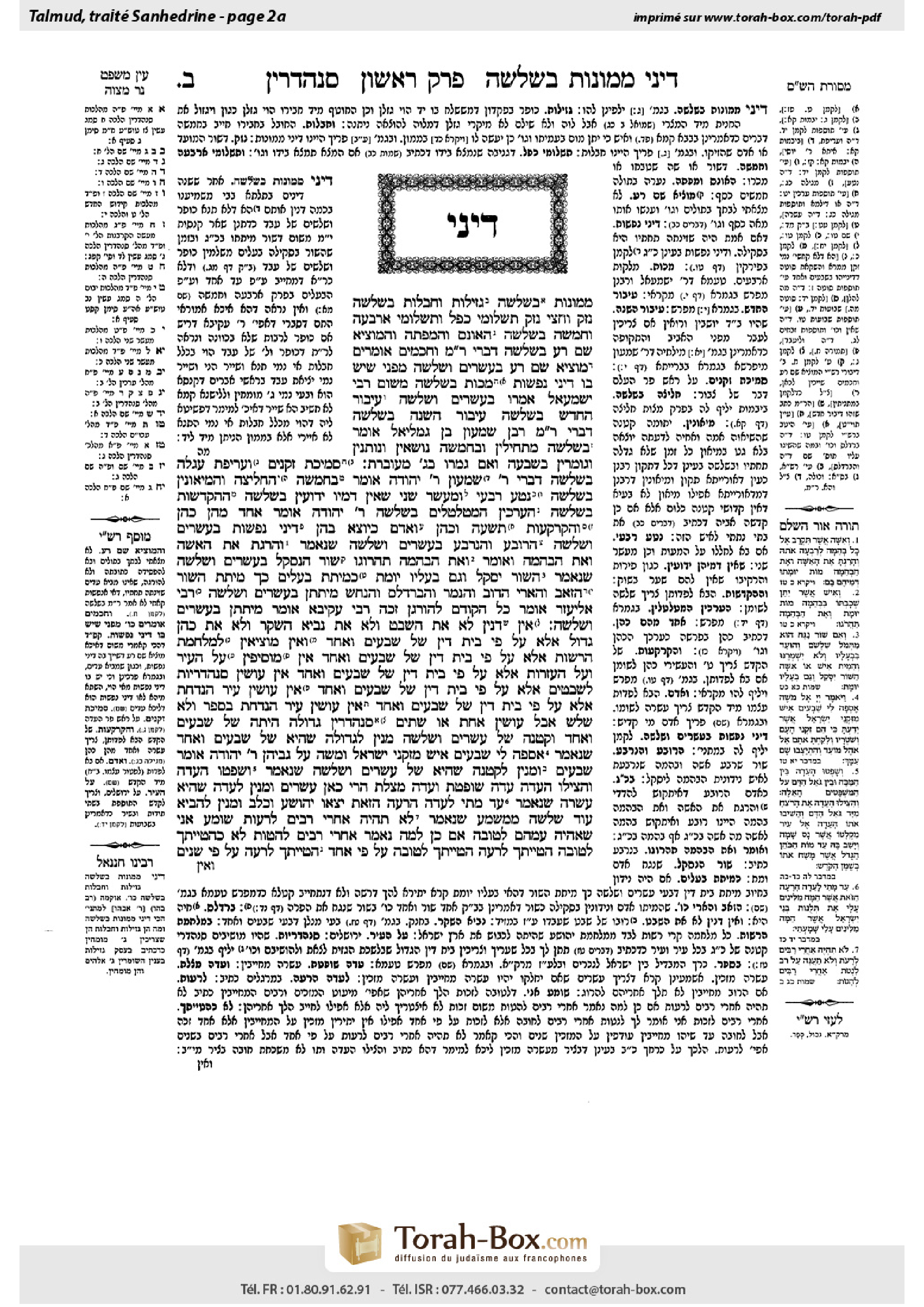
Sanhedrin 2a: Talmud study for Daf Yomi
Daf Yomi is the daily study of one Talmud folio. Explore 37 tractates with scans, Hebrew text, Sefaria English and AI-generated French translations where annotated.
Passage selection and English or AI-generated French translation are available where the scan has annotations. Daf Study is independent of Torah-Box and Sefaria.
Browse Sanhedrin · סנהדרין · All tractatesSanhedrin 2a text and translations
This page of Sanhedrin includes the Aramaic text, an English translation and an AI-generated French translation, alongside the scan above.
סנהדרין ב׳ א · Aramaic and Hebrew text
מַתְנִי׳ דִּינֵי מָמוֹנוֹת – בִּשְׁלֹשָׁה, גְּזֵילוֹת וַחֲבָלוֹת – בִּשְׁלֹשָׁה, נֶזֶק וַחֲצִי נֶזֶק, תַּשְׁלוּמֵי כֶפֶל וְתַשְׁלוּמֵי אַרְבָּעָה וַחֲמִשָּׁה – בִּשְׁלֹשָׁה.
הָאוֹנֵס וְהַמְפַתֶּה וְהַמּוֹצִיא שֵׁם רַע – בִּשְׁלֹשָׁה, דִּבְרֵי רַבִּי מֵאִיר.
וַחֲכָמִים אוֹמְרִים: מוֹצִיא שֵׁם רַע – בְּעֶשְׂרִים וּשְׁלֹשָׁה, מִפְּנֵי שֶׁיֵּשׁ בּוֹ דִּינֵי נְפָשׁוֹת.
מַכּוֹת בִּשְׁלֹשָׁה. מִשּׁוּם רַבִּי יִשְׁמָעֵאל אָמְרוּ: בְּעֶשְׂרִים וּשְׁלֹשָׁה.
עִיבּוּר הַחֹדֶשׁ – בִּשְׁלֹשָׁה. עִיבּוּר הַשָּׁנָה – בִּשְׁלֹשָׁה, דִּבְרֵי רַבִּי מֵאִיר. רַבָּן שִׁמְעוֹן בֶּן גַּמְלִיאֵל אוֹמֵר: בִּשְׁלֹשָׁה מַתְחִילִין, וּבַחֲמִשָּׁה נוֹשְׂאִין וְנוֹתְנִין, וְגוֹמְרִין בְּשִׁבְעָה. וְאִם גָּמְרוּ בִּשְׁלֹשָׁה – מְעוּבֶּרֶת.
סְמִיכַת זְקֵנִים וַעֲרִיפַת עֶגְלָה – בִּשְׁלֹשָׁה, דִּבְרֵי רַבִּי שִׁמְעוֹן. רַבִּי יְהוּדָה אוֹמֵר: בַּחֲמִשָּׁה. הַחֲלִיצָה וְהַמֵּיאוּנִין – בִּשְׁלֹשָׁה.
נֶטַע רְבָעִי וּמַעֲשֵׂר שֵׁנִי שֶׁאֵין דָּמָיו יְדוּעִין – בִּשְׁלֹשָׁה. הַהֶקְדֵּשׁוֹת – בִּשְׁלֹשָׁה. הָעֲרָכִין הַמִּטַּלְטְלִים – בִּשְׁלֹשָׁה. רַבִּי יְהוּדָה אוֹמֵר: אֶחָד מֵהֶן כֹּהֵן.
וְהַקַּרְקָעוֹת – תִּשְׁעָה וְכֹהֵן. וְאָדָם – כַּיּוֹצֵא בָּהֶן.
דִּינֵי נְפָשׁוֹת – בְּעֶשְׂרִים וּשְׁלֹשָׁה. הָרוֹבֵעַ וְהַנִּרְבָּע – בְּעֶשְׂרִים וּשְׁלֹשָׁה, שֶׁנֶּאֱמַר: ״וְהָרַגְתָּ אֶת הָאִשָּׁה וְאֶת הַבְּהֵמָה״, וְאוֹמֵר: ״וְאֶת הַבְּהֵמָה תַּהֲרֹגוּ״.
שׁוֹר הַנִּסְקָל – בְּעֶשְׂרִים וּשְׁלֹשָׁה, שֶׁנֶּאֱמַר: ״הַשּׁוֹר יִסָּקֵל וְגַם בְּעָלָיו יוּמָת״. כְּמִיתַת בְּעָלִים כָּךְ מִיתַת הַשּׁוֹר. הַזְּאֵב וְהָאֲרִי, הַדּוֹב וְהַנָּמֵר וְהַבַּרְדְּלָס וְהַנָּחָשׁ – מִיתָתָן בְּעֶשְׂרִים וּשְׁלֹשָׁה. רַבִּי אֱלִיעֶזֶר אוֹמֵר: כׇּל הַקּוֹדֵם לְהוֹרְגָן זָכָה. רַבִּי עֲקִיבָא אוֹמֵר: מִיתָתָן בְּעֶשְׂרִים וּשְׁלֹשָׁה.
אֵין דָּנִין לֹא אֶת הַשֵּׁבֶט, וְלֹא אֶת נְבִיא הַשֶּׁקֶר, וְלֹא אֶת כֹּהֵן גָּדוֹל, אֶלָּא עַל פִּי בֵּית דִּין שֶׁל שִׁבְעִים וְאֶחָד. וְאֵין מוֹצִיאִין לְמִלְחֶמֶת הָרְשׁוּת אֶלָּא עַל פִּי בֵּית דִּין שֶׁל שִׁבְעִים וְאֶחָד. אֵין מוֹסִיפִין עַל הָעִיר וְעַל הָעֲזָרוֹת אֶלָּא עַל פִּי בֵּית דִּין שֶׁל שִׁבְעִים וְאֶחָד. אֵין עוֹשִׂין סַנְהֶדְרָיוֹת לַשְּׁבָטִים אֶלָּא עַל פִּי בֵּית דִּין שֶׁל שִׁבְעִים וְאֶחָד.
אֵין עוֹשִׂין עִיר הַנִּדַּחַת, אֶלָּא עַל פִּי בֵּית דִּין שֶׁל שִׁבְעִים וְאֶחָד. אֵין עוֹשִׂין עִיר הַנִּדַּחַת בַּסְּפָר, וְלֹא שָׁלֹשׁ, אֲבָל עוֹשִׂין אַחַת אוֹ שְׁתַּיִם.
סַנְהֶדְרִין גְּדוֹלָה הָיְתָה שֶׁל שִׁבְעִים וְאֶחָד, וּקְטַנָּה שֶׁל עֶשְׂרִים וּשְׁלֹשָׁה. מִנַּיִן לַגְּדוֹלָה שֶׁהִיא שֶׁל שִׁבְעִים וְאֶחָד? שֶׁנֶּאֱמַר: ״אֶסְפָה לִּי שִׁבְעִים אִישׁ מִזִּקְנֵי יִשְׂרָאֵל״, וּמֹשֶׁה עַל גַּבֵּיהֶן. רַבִּי יְהוּדָה אוֹמֵר: שִׁבְעִים.
וּמִנַּיִן לַקְּטַנָּה שֶׁהִיא שֶׁל עֶשְׂרִים וּשְׁלֹשָׁה? שֶׁנֶּאֱמַר: ״וְשָׁפְטוּ הָעֵדָה״, ״וְהִצִּילוּ הָעֵדָה״. עֵדָה שׁוֹפֶטֶת וְעֵדָה מַצֶּלֶת – הֲרֵי כָּאן עֶשְׂרִים.
וּמִנַּיִן לְעֵדָה שֶׁהִיא עֲשָׂרָה? שֶׁנֶּאֱמַר: ״עַד מָתַי לָעֵדָה הָרָעָה הַזֹּאת״, יָצְאוּ יְהוֹשֻׁעַ וְכָלֵב.
וּמִנַּיִן לְהָבִיא עוֹד שְׁלֹשָׁה? מִמַּשְׁמַע שֶׁנֶּאֱמַר ״לֹא תִהְיֶה אַחֲרֵי רַבִּים לְרָעֹת״ שׁוֹמֵעַ אֲנִי שֶׁאֶהְיֶה עִמָּהֶם לְטוֹבָה. אִם כֵּן, לָמָּה נֶאֱמַר ״אַחֲרֵי רַבִּים לְהַטֹּת״? לֹא כְּהַטָּיָיתְךָ לְטוֹבָה הַטָּיָיתְךָ לְרָעָה. הַטָּיָיתְךָ לְטוֹבָה – עַל פִּי אֶחָד, הַטָּיָיתְךָ לְרָעָה – עַל פִּי שְׁנַיִם.
Sanhedrin 2a · English translation
MISHNA: Cases concerning monetary law are adjudicated by three judges. Cases concerning robbery and personal injury are adjudicated by three judges. Cases concerning damage that one is responsible for because he or his property caused the damage are adjudicated by three judges as well. Likewise, cases concerning payment for half the damage, which is paid in the event that an ox whose owner has not been warned that it gored more than two times gores another animal (see Exodus 21:35); cases concerning payment of double the principal by a thief who was caught stealing (see Exodus 22:3); and cases concerning payment of four or five times the principal by a thief who slaughtered or sold a stolen ox or a lamb (see Exodus 21:37) are all adjudicated by three judges.
Cases concerning one who rapes or one who seduces a virgin girl, and must therefore pay the girl’s father fifty silver shekels (see Deuteronomy 22:29, Exodus 22:15); and cases concerning a defamer who falsely asserts that his wife was not a virgin when she married him, and brings false witnesses who testify that she committed adultery while betrothed to him and who must therefore pay the girl’s father one hundred silver shekels as well as receive lashes (see Deuteronomy 22:13–19): All of these are adjudicated by three judges; this is the statement of Rabbi Meir.
And the Rabbis say: Cases concerning a defamer are adjudicated by a court of twenty-three judges, which is the type of court authorized to judge cases of capital law, because this case includes the possibility of becoming a case of capital law. The husband brings witnesses that his wife committed adultery. If she is found guilty, she is liable to receive the death penalty. This punishment applies to the witnesses if they are exposed as conspiring witnesses.
Cases concerning the violation of prohibitions that render one liable to receive lashes are adjudicated by three judges. The Sages stated in the name of Rabbi Yishmael: Cases concerning lashes are adjudicated by twenty-three judges.
The intercalation of the month is performed by a panel of three judges. The intercalation of the year, meaning the decision to add an extra month to the year when necessary, is also decided by a panel of three judges; this is the statement of Rabbi Meir. Rabban Shimon ben Gamliel says: The deliberations begin with three judges, and they debate the matter with five judges, and they conclude the matter with seven judges, due to the significance of the decision. And Rabban Shimon ben Gamliel concedes that if they concluded the matter with only three judges, the intercalation is valid and it is a leap year.
Both the laying of hands by the Sages and the breaking of the heifer’s neck in a case where a person was found murdered and it is not known who killed him (see Deuteronomy 21:1–9) are performed in front of a panel of three judges; this is the statement of Rabbi Shimon. Rabbi Yehuda says: These rituals are performed in front of five judges. Both ḥalitza, the ritual through which the yavam, a surviving brother of a married man who died without sons, frees the yevama, the widow, of her levirate bond in a case where the yavam does not wish to marry the yevama (see Deuteronomy 25:5–10), and the refusal of a girl before reaching majority to remain married to the man to whom her mother or brother married her off, are performed before a court of three judges.
The halakha concerning fruit of a fourth-year sapling and second-tithe produce is that they are to be brought to Jerusalem and eaten there. If this is impractical, the produce can be redeemed and the redemption money brought to Jerusalem, where it is used to purchase food and drink. Valuation of fruit of a fourth-year sapling or second-tithe produce in cases where their value is not known is performed by three judges. The valuation of consecrated property for purposes of redemption is performed by three judges, and the valuations that are movable property (see Leviticus 27:1–8) are performed by three judges. Rabbi Yehuda says: One of the three judges must be a priest.
And the valuation of consecrated land is performed by nine judges and, in addition, one priest. And the valuation of a person for the purpose of a vow is performed in a similar manner to that of land.
§ Cases of capital law are judged by twenty-three judges. An animal that copulated with a person and an animal that was the object of bestiality are judged by twenty-three judges, as it is stated: “And if a woman approaches any animal to lie with it, you shall kill the woman and the animal” (Leviticus 20:16), and it states: “And if a man lies with an animal, he shall be put to death and you shall kill the animal” (Leviticus 20:15). In cases of bestiality, the verse juxtaposes the execution of the animal to the execution of the person, and therefore the case of the animal is adjudicated in the same way as cases of capital law.
Similarly, an ox that is to be stoned because it killed a person is judged by twenty-three judges, as it is stated: “But if the ox was wont to gore in time past, and warning has been given to its owner, but he did not guard it and it kills a man or a woman the ox shall be stoned and also its owner shall be put to death” (Exodus 21:29). From this verse it is derived that just as the manner of the death of the owner, so is the manner of the death of the ox. The same halakha applies in the case of a wolf or a lion, a bear or a leopard, or a cheetah, or a snake that killed a person: Their death is decreed by twenty-three judges. Rabbi Eliezer says these dangerous animals do not need to be brought to court; rather, anyone who kills them first merits the performance of a mitzva. Rabbi Akiva says: Their death is decreed by twenty-three judges.
§ The court judges cases involving an entire tribe that sinned, or a false prophet (see Deuteronomy 18:20–22), or a High Priest who transgressed a prohibition that carries a possible death sentence, only on the basis of a court of seventy-one judges, i.e., the Great Sanhedrin. And the king may bring the nation out to an optional war, i.e., a war that was not mandated by the Torah and is not a war of defense, only on the basis of a court of seventy-one judges. They may extend the city of Jerusalem or the courtyards of the Temple only on the basis of a court of seventy-one judges. And they may appoint a lesser Sanhedrin of twenty-three judges for the tribes only on the basis of a court of seventy-one judges.
A city may be designated as an idolatrous city, i.e., a city whose residents all practice idolatry, and therefore according to Torah law all the residents must be killed and the city must be destroyed (see Deuteronomy 13:13–19), only in accordance with the ruling of a court of seventy-one judges. Additionally, the court may not designate a city as an idolatrous city if it is on the frontier, close to the borders of Eretz Yisrael, and three adjoining cities may not be designated as idolatrous cities. But the court may designate one city, or two adjoining cities, as idolatrous cities.
§ With regard to the number of judges in the different courts the mishna presents a halakhic midrash: The Great Sanhedrin was composed of seventy-one judges, and a lesser Sanhedrin was composed of twenty-three. From where is it derived that the Great Sanhedrin was composed of seventy-one judges? As it is stated: “Gather Me seventy men of the Elders of Israel, whom you know to be the Elders of the people and officers over them, and bring them into the Tent of Meeting, and they shall stand there with you” (Numbers 11:16), and together with Moses at the head of this body, there are a total of seventy-one. Rabbi Yehuda says: Moses was indeed at the head of the body, but he is not counted as part of the group. Consequently, a future Great Sanhedrin modeled after these Elders is to be composed of seventy judges.
And from where is it derived that a lesser Sanhedrin is composed of twenty-three judges? As it is stated: “And the congregation shall judge between the assailant and the avenger…and the congregation shall save the manslayer from the hands of the avenger” (Numbers 35:24–25). Therefore, there must be a congregation, which consists of at least ten judges, that judges the accused and attempts to convict him, and there must be a congregation, also consisting of at least ten judges, which attempts to save the accused by finding him innocent. Together, there are twenty judges here.
Before proceeding to derive the requirement for the final three judges, the mishna clarifies: And from where is it derived that a congregation consists of at least ten men? As it is stated concerning the spies: “How long shall I bear with this evil congregation that keep complaining about me?” (Numbers 14:27) There were twelve spies; excluding Joshua and Caleb, who did not complain, there would be ten men who are called: A congregation. Accordingly, the verses describing a congregation that attempts to convict the accused and a congregation that attempts to acquit him together add up to twenty judges.
And from where is it derived to bring three more judges to the court? From the implication of that which is stated: “You shall not follow a multitude to convict” (Exodus 23:2), I would derive that I may not convict a person on the basis of a majority but I should follow the majority to exonerate. If so, why is it stated in the same verse: “To incline after a multitude,” from which it can be understood that the majority is followed in all cases? In order to resolve the apparent contradiction it must be explained: Your inclination after the majority to exonerate is not like your inclination after the majority to convict. Your inclination after the majority to exonerate can result in a verdict by a majority of one judge. But your inclination after the majority to convict a transgressor must be by a more decisive majority of at least two. Therefore, the court must have at least twenty-two judges.
Sanhedrin 2a · Traduction française (IA)
MICHNA : Les affaires de droit pécuniaire sont jugées par trois juges. Les affaires de vol et de dommages corporels sont jugées par trois juges. Les affaires concernant les dommages dont une personne est responsable parce qu’elle-même ou ses biens les ont causés sont également jugées par trois juges. De même, les affaires concernant le paiement de la moitié des dommages, dû lorsqu’un bœuf dont le propriétaire n’a pas été averti qu’il avait encorné plus de deux fois encorne un autre animal (voir Exode 21,35) ; celles concernant le paiement du double du principal par un voleur pris en flagrant délit (voir Exode 22,3) ; et celles concernant le paiement de quatre ou cinq fois le principal par un voleur qui a abattu ou vendu un bœuf ou un agneau volé (voir Exode 21,37) sont toutes jugées par trois juges.
Les affaires concernant celui qui viole ou séduit une jeune fille vierge et doit, par conséquent, verser au père de celle-ci cinquante sicles d’argent (voir Deutéronome 22,29 ; Exode 22,15), ainsi que celles concernant un diffamateur qui prétend faussement que sa femme n’était pas vierge lorsqu’il l’a épousée et produit de faux témoins attestant qu’elle a commis l’adultère alors qu’elle lui était fiancée — il doit, par conséquent, verser au père de la jeune fille cent sicles d’argent et recevoir également la flagellation (voir Deutéronome 22,13-19) — sont toutes jugées par trois juges ; telle est la déclaration de Rabbi Meïr.
Et les Sages disent : les affaires concernant un diffamateur sont jugées par un tribunal de vingt-trois juges, c’est-à-dire un tribunal habilité à juger les affaires de droit criminel, car cette affaire peut devenir une affaire de droit criminel. Le mari produit des témoins attestant que sa femme a commis l’adultère. Si elle est reconnue coupable, elle est passible de la peine capitale. Cette peine s’applique aux témoins s’il est établi qu’ils ont conspiré.
Les affaires concernant les infractions à des interdits passibles de la flagellation sont jugées par trois juges. Les Sages ont rapporté au nom de Rabbi Yishmaël : les affaires de flagellation sont jugées par vingt-trois juges.
L’intercalation du mois est décidée par un collège de trois juges. L’intercalation de l’année, c’est-à-dire la décision d’ajouter un mois à l’année lorsque cela est nécessaire, est également décidée par un collège de trois juges ; telle est la déclaration de Rabbi Meïr. Rabban Shimon ben Gamliel dit : Les délibérations commencent à trois juges ; ils examinent la question à cinq, puis la tranchent à sept, en raison de l’importance de la décision. Rabban Shimon ben Gamliel reconnaît que si la décision a été prise par seulement trois juges, l’intercalation est valide et l’année est bissextile.
La semikha accomplie par les Sages et la nuque brisée de la génisse, dans le cas où une personne a été retrouvée assassinée sans que l’on sache qui l’a tuée (voir Deutéronome 21,1-9), se pratiquent toutes deux devant un collège de trois juges ; telle est la déclaration de Rabbi Shimon. Rabbi Yehouda dit : ces rites se pratiquent devant cinq juges. La ḥalitsa, le rite par lequel le yavam, frère survivant d’un homme marié mort sans fils, libère la yevama, la veuve, de son lien léviratique lorsque le yavam ne souhaite pas l’épouser (voir Deutéronome 25,5-10), ainsi que le refus d’une jeune fille, avant d’avoir atteint la majorité, de rester mariée à l’homme auquel sa mère ou son frère l’a mariée, ont lieu devant un tribunal de trois juges.
La halakha concernant les fruits d’un arbre de quatrième année et les produits de la seconde dîme veut qu’ils soient apportés à Jérusalem et consommés sur place. Si cela est difficile, les produits peuvent être rachetés, et l’argent du rachat apporté à Jérusalem pour acheter de la nourriture et des boissons. L’estimation des fruits d’un arbre de quatrième année ou des produits de la seconde dîme, lorsque leur valeur est inconnue, est effectuée par trois juges. L’estimation des biens consacrés en vue de leur rachat est effectuée par trois juges, de même que celle des biens mobiliers (voir Lévitique 27,1-8). Rabbi Yehouda dit : l’un des trois juges doit être un prêtre.
L’estimation des terres consacrées est effectuée par neuf juges, auxquels s’ajoute un prêtre. L’estimation d’une personne dans le cadre d’un vœu se fait de la même manière que celle d’un terrain.
§ Les affaires de droit criminel sont jugées par vingt-trois juges. Un animal qui s’est accouplé avec une personne et un animal qui a été l’objet d’un acte de bestialité sont jugés par vingt-trois juges, comme il est dit : « Si une femme s’approche d’un animal pour s’accoupler avec lui, tu tueras la femme et l’animal » (Lévitique 20,16), et il est dit : « Si un homme s’accouple avec un animal, il sera mis à mort et vous tuerez l’animal » (Lévitique 20,15). Dans les cas de bestialité, le verset juxtapose l’exécution de l’animal à celle de la personne ; l’affaire concernant l’animal est donc jugée de la même manière que les affaires de droit criminel.
De même, un bœuf qui doit être lapidé parce qu’il a tué une personne est jugé par vingt-trois juges, comme il est dit : « Mais si le bœuf avait auparavant l’habitude d’encorner, que son propriétaire en ait été averti, mais qu’il ne l’ait pas gardé et qu’il ait tué un homme ou une femme, le bœuf sera lapidé et son propriétaire sera également mis à mort » (Exode 21,29). On déduit de ce verset que le bœuf est mis à mort de la même manière que son propriétaire. La même halakha s’applique au loup, au lion, à l’ours, au léopard, au guépard ou au serpent qui a tué une personne : leur mise à mort est prononcée par vingt-trois juges. Rabbi Eliezer dit que ces animaux dangereux n’ont pas besoin d’être traduits devant un tribunal ; celui qui les tue le premier mérite plutôt d’accomplir une mitsva. Rabbi Akiva dit : leur mise à mort est prononcée par vingt-trois juges.
§ Le tribunal ne juge les affaires concernant une tribu entière qui a péché, un faux prophète (voir Deutéronome 18,20-22) ou un Grand Prêtre qui a transgressé un interdit passible de la peine de mort qu’avec un tribunal de soixante et onze juges, c’est-à-dire le Grand Sanhédrin. Le roi ne peut conduire le peuple à une guerre facultative — c’est-à-dire une guerre qui n’est pas imposée par la Torah et qui n’est pas une guerre de défense — qu’avec l’autorisation d’un tribunal de soixante et onze juges. Ils ne peuvent agrandir la ville de Jérusalem ni les cours du Temple qu’avec l’autorisation d’un tribunal de soixante et onze juges. Ils ne peuvent nommer un Sanhédrin inférieur de vingt-trois juges pour les tribus qu’avec l’autorisation d’un tribunal de soixante et onze juges.
Une ville ne peut être déclarée ville idolâtre — c’est-à-dire une ville dont tous les habitants pratiquent l’idolâtrie et dont, selon la loi de la Torah, tous les habitants doivent donc être tués et la ville détruite (voir Deutéronome 13,13-19) — que sur décision d’un tribunal de soixante et onze juges. En outre, le tribunal ne peut déclarer ville idolâtre une ville située à la frontière, près des limites d’Eretz Israël, et trois villes contiguës ne peuvent pas être déclarées villes idolâtres. En revanche, le tribunal peut déclarer idolâtre une ville ou deux villes contiguës.
§ À propos du nombre de juges dans les différents tribunaux, la Michna présente une interprétation midrashique halakhique : le Grand Sanhédrin était composé de soixante et onze juges et un Sanhédrin inférieur, de vingt-trois. D’où déduit-on que le Grand Sanhédrin était composé de soixante et onze juges ? Comme il est dit : « Rassemble-moi soixante-dix hommes parmi les anciens d’Israël, dont tu sais qu’ils sont les anciens du peuple et ses officiers, et conduis-les à la Tente d’assignation ; ils se tiendront là avec toi » (Nombres 11,16). Avec Moïse à la tête de cette assemblée, ils sont au total soixante et onze. Rabbi Yehouda dit : Moïse était effectivement à la tête de l’assemblée, mais il n’est pas compté parmi ses membres. Par conséquent, un futur Grand Sanhédrin, constitué à l’image de ces anciens, doit être composé de soixante-dix juges.
Et d’où déduit-on qu’un Sanhédrin inférieur est composé de vingt-trois juges ? Comme il est dit : « L’assemblée jugera entre l’agresseur et le vengeur […] et l’assemblée sauvera le meurtrier de la main du vengeur » (Nombres 35,24-25). Il doit donc y avoir une assemblée, composée d’au moins dix juges, qui juge l’accusé et tente de le déclarer coupable, et une autre assemblée, également composée d’au moins dix juges, qui tente de sauver l’accusé en le déclarant innocent. Cela fait vingt juges au total.
Avant de poursuivre pour déduire l’exigence des trois juges supplémentaires, la Michna précise : d’où déduit-on qu’une assemblée se compose d’au moins dix hommes ? Comme il est dit au sujet des explorateurs : « Jusques à quand supporterai-je cette méchante assemblée qui ne cesse de se plaindre de moi ? » (Nombres 14,27). Il y avait douze explorateurs ; si l’on exclut Josué et Caleb, qui ne se sont pas plaints, il reste dix hommes qualifiés d’« assemblée ». Ainsi, les versets décrivant une assemblée qui cherche à déclarer l’accusé coupable et une assemblée qui cherche à l’acquitter totalisent vingt juges.
Et d’où déduit-on qu’il faut ajouter trois juges au tribunal ? De ce qu’implique le verset : « Tu ne suivras pas la multitude pour condamner » (Exode 23,2), on pourrait déduire qu’on ne peut condamner une personne à la majorité, mais qu’il faut suivre la majorité pour l’innocenter. Dans ce cas, pourquoi le même verset dit-il : « Pour te ranger à l’avis de la multitude », ce dont on peut comprendre qu’il faut suivre la majorité dans tous les cas ? Pour résoudre cette apparente contradiction, il faut expliquer que la majorité à laquelle on se range pour acquitter n’est pas la même que celle à laquelle on se range pour condamner. Pour acquitter, la majorité peut faire pencher la décision d’une seule voix. Mais pour condamner un transgresseur, la majorité doit être plus nette, d’au moins deux voix. Le tribunal doit donc compter au moins vingt-deux juges.
Traduction française générée par IA à partir de l’édition anglaise de Sefaria. Vérifie toujours un passage avec le texte source.
Text from Sefaria: William Davidson Edition - Vocalized Aramaic (CC BY NC); William Davidson Edition - English (CC BY NC).