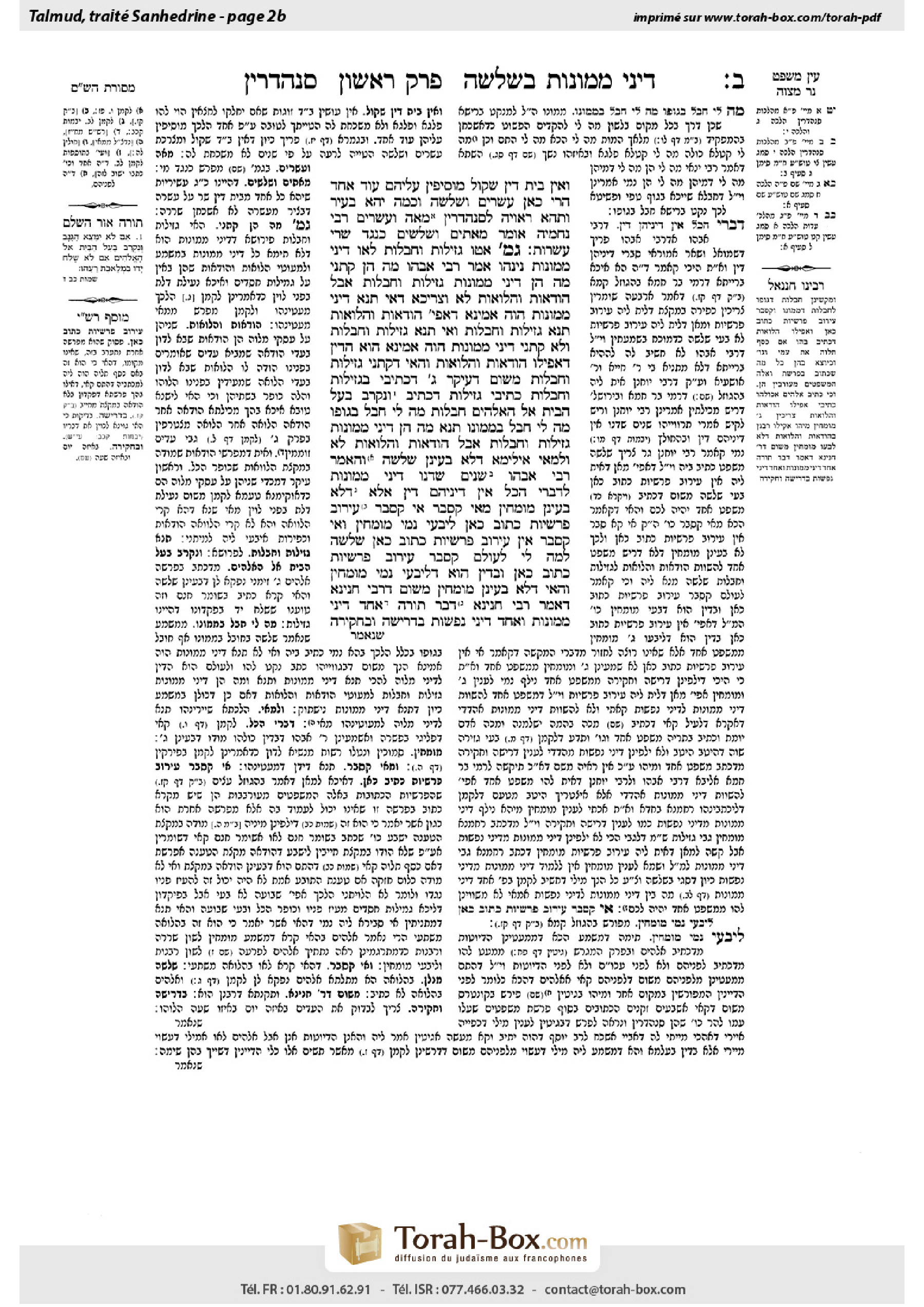
Sanhedrin 2b: Talmud study for Daf Yomi
Daf Yomi is the daily study of one Talmud folio. Explore 37 tractates with scans, Hebrew text, Sefaria English and AI-generated French translations where annotated.
Passage selection and English or AI-generated French translation are available where the scan has annotations. Daf Study is independent of Torah-Box and Sefaria.
Browse Sanhedrin · סנהדרין · All tractatesSanhedrin 2b text and translations
This page of Sanhedrin includes the Aramaic text, an English translation and an AI-generated French translation, alongside the scan above.
סנהדרין ב׳ ב · Aramaic and Hebrew text
וְאֵין בֵּית דִּין שָׁקוּל, מוֹסִיפִין עֲלֵיהֶם עוֹד אֶחָד. הֲרֵי כָּאן עֶשְׂרִים וּשְׁלֹשָׁה.
וְכַמָּה יְהֵא בָּעִיר וּתְהֵא רְאוּיָה לְסַנְהֶדְרִין? מֵאָה וְעֶשְׂרִים. רַבִּי נְחֶמְיָה אוֹמֵר: מָאתַיִם וּשְׁלֹשִׁים, כְּנֶגֶד שָׂרֵי עֲשָׂרוֹת.
גְּמָ׳ אַטּוּ גְּזֵילוֹת וְחַבָּלוֹת לָאו דִּינֵי מָמוֹנוֹת נִינְהוּ? אָמַר רַבִּי אֲבָהוּ: מָה הֵן קָתָנֵי, מָה הֵן דִּינֵי מָמוֹנוֹת? גְּזֵילוֹת וְחַבָּלוֹת. אֲבָל הוֹדָאוֹת וְהַלְוָאוֹת – לָא.
וּצְרִיכָא, דְּאִי תְּנָא דִּינֵי מָמוֹנוֹת – הֲוָה אָמֵינָא דַּאֲפִילּוּ הוֹדָאוֹת וְהַלְוָאוֹת. תְּנָא גְּזֵילוֹת וַחֲבָלוֹת. וְאִי תְּנָא גְּזֵילוֹת וַחֲבָלוֹת, וְלָא קָתָנֵי דִּינֵי מָמוֹנוֹת – הֲוָה אָמֵינָא הוּא הַדִּין דַּאֲפִילּוּ הוֹדָאוֹת וְהַלְוָאוֹת. וְהַאי דְּקָתָנֵי גְּזֵילוֹת וַחֲבָלוֹת – מִשּׁוּם דְּעִיקַּר שְׁלֹשָׁה דִּכְתִיבִי, בִּגְזֵילוֹת וַחֲבָלוֹת כְּתִיבִי.
גְּזֵילוֹת, דִּכְתִיב: ״וְנִקְרַב בַּעַל הַבַּיִת אֶל הָאֱלֹהִים״. חֲבָלוֹת – מָה לִי חָבַל בְּגוּפוֹ, מָה לִי חָבַל בְּמָמוֹנוֹ! תְּנָא: מָה הֵן דִּינֵי מָמוֹנוֹת? גְּזֵילוֹת וַחֲבָלוֹת. אֲבָל הוֹדָאוֹת וְהַלְוָאוֹת – לֹא.
וּלְמַאי? אִילֵּימָא דְּלָא בָּעֵינַן שְׁלֹשָׁה, וְהָאָמַר רַבִּי אֲבָהוּ: שְׁנַיִם שֶׁדָּנוּ דִּינֵי מָמוֹנוֹת, לְדִבְרֵי הַכֹּל אֵין דִּינֵיהֶם דִּין.
אֶלָּא: דְּלָא בָּעֵינַן מוּמְחִין.
מַאי קָסָבַר? אִי קָסָבַר עֵירוּב פָּרָשִׁיּוֹת כָּתוּב כָּאן, לִיבְעֵי נָמֵי מוּמְחִין. וְאִי קָסָבַר אֵין עֵירוּב פָּרָשִׁיּוֹת כָּתוּב כָּאן, שְׁלֹשָׁה לְמָה לִי?
לְעוֹלָם קָסָבַר: עֵירוּב פָּרָשִׁיּוֹת כָּתוּב כָּאן, וּבְדִין הוּא דְּלִיבְעֵי נָמֵי מוּמְחִין. וְהַאי דְּלָא בָּעֵינַן מוּמְחִין – מִשּׁוּם דְּרַבִּי חֲנִינָא, דְּאָמַר רַבִּי חֲנִינָא: דְּבַר תּוֹרָה, אֶחָד דִּינֵי מָמוֹנוֹת וְאֶחָד דִּינֵי נְפָשׁוֹת בִּדְרִישָׁה וּבַחֲקִירָה,
Sanhedrin 2b · English translation
And since there is a principle that a court may not be composed of an even number of judges, as such a court may be unable to reach a decision, therefore they add another one to them, and there are twenty-three judges here.
And how many men must be in the city for it to be eligible for a lesser Sanhedrin? One hundred and twenty. Rabbi Neḥemya says: Two hundred and thirty, corresponding to the ministers of tens, as outlined by Moses and Yitro in the wilderness (Exodus, chapter 18). That is to say, each member of the Sanhedrin can be viewed as a judge with responsibility for ten residents. If there are not enough men in the city to enable this calculation, it would not be honorable to appoint a Sanhedrin, as their members will each preside over less than the minimum of ten residents.
GEMARA: The mishna states that cases of monetary law are adjudicated by three judges, and that cases of robbery and personal injury must also be adjudicated by three judges. The Gemara asks: Is that to say that cases of robbery and personal injury are not cases of monetary law? Obviously they are; why did the mishna delineate them separately? Rabbi Abbahu says: The mishna teaches this clause employing the style: What are these, meaning that the expression: Cases of monetary law, is a description of a category, followed by the specification. Accordingly, the mishna should be read as follows: What are these cases of monetary law that are adjudicated by three judges? Cases of robbery and personal injury. But cases of admissions, where one party admits that he owes another money, and cases of loans that were not repaid are not included in this halakha.
And this specification is necessary, as had the tanna taught only that cases of monetary law are adjudicated by three judges, I would say that this applies even to cases of admissions and loans. Therefore, to avoid this misunderstanding, he taught: Cases of robbery and personal injury, in order to clarify that only they are included in the halakha. And had he taught only cases of robbery and personal injury and had not taught cases of monetary law, I would say that the same is true even with regard to admissions and loans, that they are adjudicated in the same manner. And I would understand this fact, that the mishna teaches specifically cases of robbery and personal injury, by saying that these are mere examples and that the mishna mentions them because in the primary cases in which the requirement for three judges is written in the Torah, it is written with regard to cases of robbery and personal injury.
The Gemara explains this assertion. With regard to cases of robbery, as it is written with regard to a bailee who accepted a deposit from another and then claims that it was stolen: “The owner of the house shall come near the court [ha’elohim], to see whether he has not put his hand upon his neighbor’s property” (Exodus 22:7). And with regard to cases of personal injury, they are adjudicated in the same manner as cases of robbery, because what difference is there to me if another injured one’s body and what difference is there to me if another injured one’s property? Therefore, in order to clarify that the halakha applies only to cases of robbery and injury, the tanna taught: What are these cases of monetary law? Cases of robbery and personal injury. But this halakha does not apply with regard to cases of admissions and loans.
The Gemara asks: And with regard to which halakha are cases of admissions and loans unlike cases of robbery and injury? If we say that we do not need a court of three judges to adjudicate such cases, but doesn’t Rabbi Abbahu say: With regard to a court of two judges that adjudicated cases of monetary law of any type, which would include cases of admissions and loans, everyone agrees that their judgment is not a valid judgment, as a court with fewer than three judges is invalid?
The Gemara answers: This is not the difference between the categories; rather, the difference is that for cases of admissions and loans we do not require expert, ordained judges who have studied extensively and received permission to judge; any three laymen can serve as a court for these types of cases. The mishna singled out cases of robbery and personal injury in order to indicate that for those cases expert judges are necessary.
The Gemara clarifies: What does the tanna hold? If he holds that a merging of Torah portions is written here, then he should also require expert judges for cases of admissions and loans. The passage from which the halakha requiring three judges is derived (Exodus 22:6–8) discusses several different halakhot. According to the understanding that these portions should be considered as merged, they are interpreted to indicate equivalence between those halakhot. And if he holds that there is no merging of Torah portions written here, meaning that the halakhot are to be derived only from verses that discuss them directly, then why do I need three judges for admissions and loans? The requirement for three judges is derived from the repetition of the word elohim three times in the context of cases of robbery and personal injury.
The Gemara answers: Actually, the tanna holds that a merging of Torah portions is written here, and by right he should have required expert judges to judge cases of admissions and loans as well. And this fact, i.e., that we do not require expert judges for these cases, is due to the reasoning of Rabbi Ḥanina, as Rabbi Ḥanina says: By Torah law, both cases of monetary law and cases of capital law require inquiry and interrogation of witnesses in order to conclusively determine the time, place, and circumstance of the incident, with the purpose of finding any possible contradiction in the witnesses’ testimony.
Sanhedrin 2b · Traduction française (IA)
Et puisqu’il existe un principe selon lequel un tribunal ne peut être composé d’un nombre pair de juges, car il pourrait alors être incapable de parvenir à une décision, on leur adjoint donc un juge, ce qui porte ici leur nombre à vingt-trois.
Combien d’hommes la ville doit-elle compter pour pouvoir accueillir un petit Sanhédrin ? Cent vingt. Rabbi Neḥemya dit : Deux cent trente, correspondant aux chefs de dizaines institués par Moïse et Yitro dans le désert (Exode, chapitre 18). Autrement dit, chaque membre du Sanhédrin peut être considéré comme un juge responsable de dix habitants. Si la ville ne compte pas assez d’hommes pour permettre ce calcul, il ne serait pas honorable d’y établir un Sanhédrin, car chacun de ses membres serait alors responsable de moins que le minimum de dix habitants.
GUEMARA : La Michna enseigne que les affaires de droit pécuniaire sont jugées par trois juges, et que les affaires de vol et de préjudice corporel doivent elles aussi être jugées par trois juges. La Guemara demande : Cela signifie-t-il que les affaires de vol et de préjudice corporel ne relèvent pas du droit pécuniaire ? De toute évidence, elles en relèvent ; pourquoi la Michna les a-t-elle énumérées séparément ? Rabbi Abbahou dit : La Michna formule cette clause sous la forme « Quelles sont-elles ? », c’est-à-dire que l’expression « affaires de droit pécuniaire » désigne une catégorie, qui est ensuite précisée. Il faut donc lire la Michna ainsi : Quelles sont ces affaires de droit pécuniaire qui sont jugées par trois juges ? Les affaires de vol et de préjudice corporel. En revanche, les affaires d’aveu, où une partie reconnaît devoir de l’argent à une autre, ainsi que les affaires de prêts non remboursés, ne sont pas incluses dans cette halakha.
Cette précision est nécessaire, car si le tanna avait seulement enseigné que les affaires de droit pécuniaire sont jugées par trois juges, j’aurais dit que cela s’applique aussi aux affaires d’aveu et de prêts. Pour éviter ce malentendu, il a donc enseigné : « Les affaires de vol et de préjudice corporel », afin de préciser que seules celles-ci sont incluses dans cette halakha. Et s’il avait seulement enseigné les affaires de vol et de préjudice corporel, sans mentionner les affaires de droit pécuniaire, j’aurais dit qu’il en va de même pour les affaires d’aveu et de prêts, qui seraient jugées de la même manière. J’aurais alors compris que la Michna mentionne spécifiquement les affaires de vol et de préjudice corporel parce qu’elles ne sont que des exemples : la Michna les cite parce que les cas principaux où l’obligation de recourir à trois juges est écrite dans la Torah concernent le vol et le préjudice corporel.
La Guemara explique cette affirmation. En ce qui concerne les affaires de vol, il est écrit à propos d’un gardien qui a reçu un dépôt d’autrui et affirme ensuite que celui-ci a été volé : « Le maître de la maison s’approchera des juges [ha’elohim], pour voir s’il n’a pas porté la main sur le bien de son prochain » (Exode 22,7). Quant aux affaires de préjudice corporel, elles sont jugées de la même manière que les affaires de vol, car quelle différence y a-t-il pour moi entre le fait qu’une personne ait blessé le corps d’autrui et le fait qu’elle ait endommagé ses biens ? Ainsi, pour préciser que cette halakha ne s’applique qu’aux affaires de vol et de préjudice corporel, le tanna a enseigné : « Quelles sont ces affaires de droit pécuniaire ? Les affaires de vol et de préjudice corporel. » Mais cette halakha ne s’applique pas aux affaires d’aveu et de prêts.
La Guemara demande : En quoi les affaires d’aveu et de prêts diffèrent-elles des affaires de vol et de préjudice ? Si nous disons qu’un tribunal de trois juges n’est pas nécessaire pour juger de telles affaires, Rabbi Abbahou ne dit-il pas : Lorsqu’un tribunal de deux juges a jugé une affaire de droit pécuniaire, quelle qu’elle soit — ce qui inclut les affaires d’aveu et de prêts — tous s’accordent à dire que son jugement n’est pas valide, puisqu’un tribunal composé de moins de trois juges est invalide ?
La Guemara répond : Ce n’est pas là la différence entre les catégories. La différence est plutôt que, pour les affaires d’aveu et de prêts, on n’exige pas de juges experts, ordonnés, ayant étudié de manière approfondie et reçu l’autorisation de juger ; trois profanes quelconques peuvent constituer un tribunal pour ces types d’affaires. La Michna a distingué les affaires de vol et de préjudice corporel afin d’indiquer que, pour celles-ci, des juges experts sont nécessaires.
La Guemara précise : Quelle est la position du tanna ? S’il estime qu’il y a ici un rapprochement entre les passages de la Torah, il devrait aussi exiger des juges experts pour les affaires d’aveu et de prêts. Le passage dont on déduit la halakha exigeant trois juges (Exode 22,6-8) traite de plusieurs halakhot différentes. Selon l’interprétation qui considère ces passages comme rapprochés, on les interprète de manière à établir une équivalence entre ces halakhot. Et s’il estime qu’il n’y a ici aucun rapprochement entre les passages de la Torah, c’est-à-dire que les halakhot doivent être déduites uniquement des versets qui les traitent directement, pourquoi faudrait-il trois juges pour les affaires d’aveu et de prêts ? L’obligation de recourir à trois juges est déduite de la répétition trois fois du mot elohim dans le contexte des affaires de vol et de préjudice corporel.
La Guemara répond : En réalité, le tanna estime qu’il y a ici un rapprochement entre les passages de la Torah et, à juste titre, il aurait dû exiger aussi des juges experts pour juger les affaires d’aveu et de prêts. Si ces affaires ne nécessitent pas de juges experts, c’est en raison du raisonnement de Rabbi Ḥanina, car Rabbi Ḥanina dit : Selon la loi de la Torah, tant les affaires de droit pécuniaire que les affaires de droit pénal exigent un examen et un contre-interrogatoire des témoins afin de déterminer avec certitude le moment, le lieu et les circonstances de l’incident, dans le but de déceler toute contradiction possible dans leurs témoignages.
Traduction française générée par IA à partir de l’édition anglaise de Sefaria. Vérifie toujours un passage avec le texte source.
Text from Sefaria: William Davidson Edition - Vocalized Aramaic (CC BY NC); William Davidson Edition - English (CC BY NC).