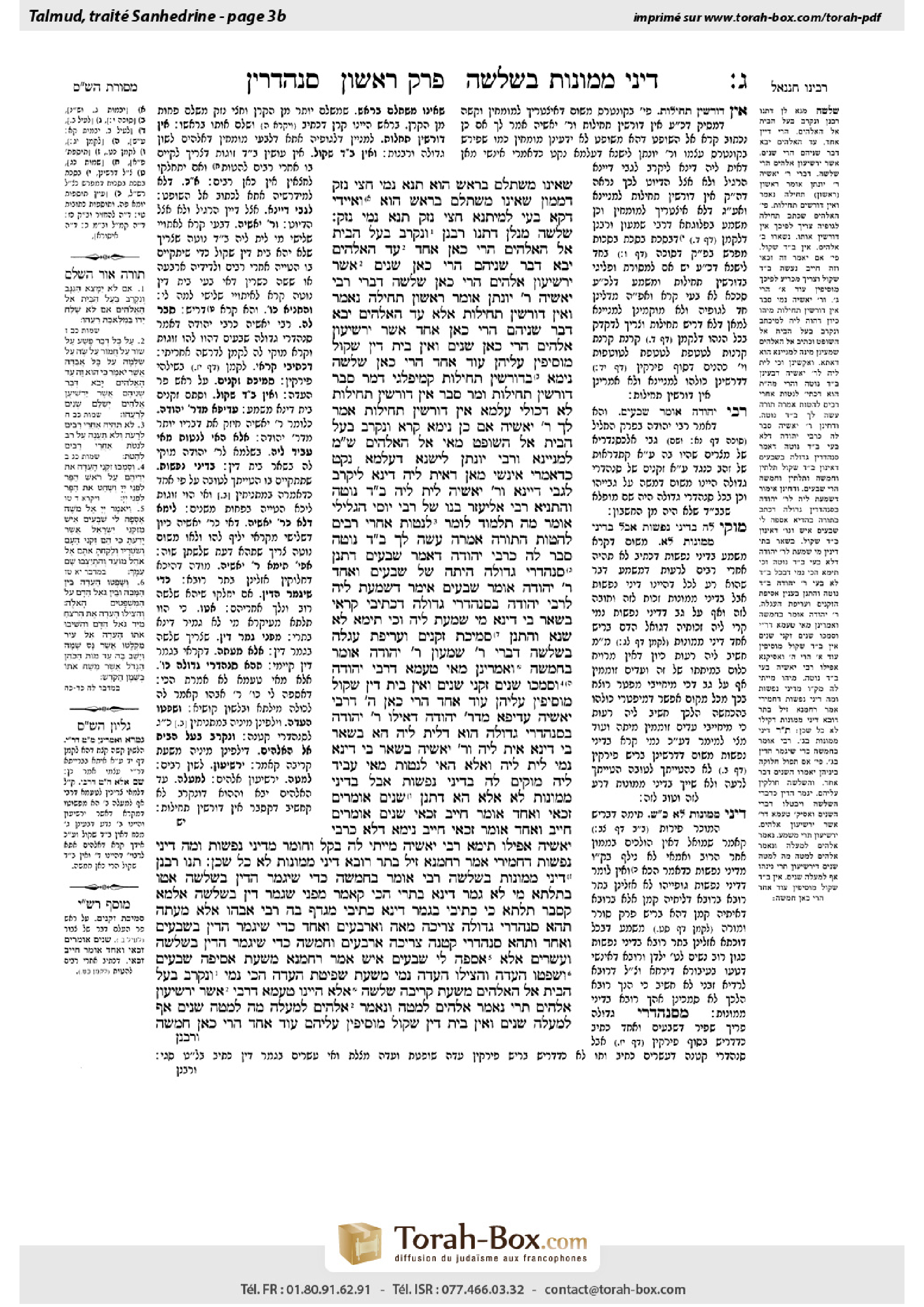
Sanhedrin 3b: Talmud study for Daf Yomi
Daf Yomi is the daily study of one Talmud folio. Explore 37 tractates with scans, Hebrew text, Sefaria English and AI-generated French translations where annotated.
Passage selection and English or AI-generated French translation are available where the scan has annotations. Daf Study is independent of Torah-Box and Sefaria.
Browse Sanhedrin · סנהדרין · All tractatesSanhedrin 3b text and translations
This page of Sanhedrin includes the Aramaic text, an English translation and an AI-generated French translation, alongside the scan above.
סנהדרין ג׳ ב · Aramaic and Hebrew text
שֶׁאֵינוֹ מִשְׁתַּלֵּם בְּרֹאשׁ הוּא, תְּנָא נָמֵי חֲצִי נֶזֶק, דְּמָמוֹן שֶׁאֵינוֹ מִשְׁתַּלֵּם בְּרֹאשׁ הוּא. וְאַיְּידֵי דְּקָא בָּעֵי לְמִיתְנֵא חֲצִי נֵזֶק, תְּנָא נָמֵי נֵזֶק.
שְׁלֹשָׁה מְנָלַן? דְּתָנוּ רַבָּנַן: ״וְנִקְרַב בַּעַל הַבַּיִת אֶל הָאֱלֹהִים״ – הֲרֵי כָּאן אֶחָד, ״עַד הָאֱלֹהִים יָבֹא דְּבַר שְׁנֵיהֶם״ – הֲרֵי כָּאן שְׁנַיִם, ״אֲשֶׁר יַרְשִׁיעֻן אֱלֹהִים״ – הֲרֵי כָּאן שְׁלֹשָׁה, דִּבְרֵי רַבִּי יֹאשִׁיָּה.
רַבִּי יוֹנָתָן אוֹמֵר: רִאשׁוֹן תְּחִילָּה נֶאֱמַר, וְאֵין דּוֹרְשִׁין תְּחִילּוֹת. אֶלָּא ״עַד הָאֱלֹהִים יָבֹא דְּבַר שְׁנֵיהֶם״ – הֲרֵי כָּאן אֶחָד, ״אֲשֶׁר יַרְשִׁיעֻן אֱלֹהִים״ – הֲרֵי כָּאן שְׁנַיִם, וְאֵין בֵּית דִּין שָׁקוּל. מוֹסִיפִין עֲלֵיהֶן עוֹד אֶחָד – הֲרֵי כָּאן שְׁלֹשָׁה.
נֵימָא בְּדוֹרְשִׁין תְּחִילּוֹת קָמִיפַּלְגִי? דְּמָר סָבַר: דּוֹרְשִׁין תְּחִילּוֹת, וּמַר סָבַר: אֵין דּוֹרְשִׁין תְּחִילּוֹת. לָא, דְּכוּלֵּי עָלְמָא אֵין דּוֹרְשִׁין תְּחִילּוֹת. אָמַר לָךְ רַבִּי יֹאשִׁיָּה: אִם כֵּן, נֵימָא קְרָא ״וְנִקְרַב בַּעַל הַבַּיִת אֶל הַשּׁוֹפֵט״. מַאי ״אֶל הָאֱלֹהִים״? שְׁמַע מִינַּהּ לְמִנְיָינָא.
וְרַבִּי יוֹנָתָן, לִישָּׁנָא דְּעָלְמָא נְקַט, כִּדְאָמְרִי אִינָשֵׁי: מַאן דְּאִית לֵיהּ דִּינָא – לִיקְרַב לְגַבֵּי דַּיָּינָא.
וְרַבִּי יֹאשִׁיָּה לֵית לֵיהּ בֵּית דִּין נוֹטֶה? וְהָתַנְיָא: רַבִּי אֱלִיעֶזֶר בְּנוֹ שֶׁל רַבִּי יוֹסֵי הַגְּלִילִי אוֹמֵר, מָה תַּלְמוּד לוֹמַר ״לִנְטֹת אַחֲרֵי רַבִּים לְהַטֹּת״? הַתּוֹרָה אָמְרָה: עֲשֵׂה לְךָ בֵּית דִּין נוֹטֶה.
סָבַר לַהּ כְּרַבִּי יְהוּדָה, דְּאָמַר: שִׁבְעִים. דִּתְנַן: סַנְהֶדְרִי גְּדוֹלָה הָיְתָה שֶׁל שִׁבְעִים וְאֶחָד, רַבִּי יְהוּדָה אוֹמֵר: שִׁבְעִים.
אֵימַר דְּשָׁמְעַתְּ לֵיהּ לְרַבִּי יְהוּדָה בְּסַנְהֶדְרִי גְּדוֹלָה, דִּכְתִיבִי קְרָאֵי. בִּשְׁאָר בֵּי דִינָא מִי שָׁמְעַתְּ לֵיהּ?
וְכִי תֵּימָא: לָא שְׁנָא, וְהָתְנַן: סְמִיכַת זְקֵנִים וַעֲרִיפַת עֶגְלָה בִּשְׁלֹשָׁה, דִּבְרֵי רַבִּי שִׁמְעוֹן. רַבִּי יְהוּדָה אוֹמֵר: בַּחֲמִשָּׁה.
וְאָמְרִינַן: מַאי טַעְמָא דְּרַבִּי יְהוּדָה? ״וְסָמְכוּ״ – שְׁנַיִם, ״זִקְנֵי״ – שְׁנַיִם, וְאֵין בֵּית דִּין שָׁקוּל, מוֹסִיפִין עֲלֵיהֶן עוֹד אֶחָד, הֲרֵי כָּאן חֲמִשָּׁה.
דְּרַבִּי יֹאשִׁיָּה עֲדִיפָא מִדְּרַבִּי יְהוּדָה, דְּאִילּוּ רַבִּי יְהוּדָה בְּסַנְהֶדְרִי גְּדוֹלָה הוּא דְּלֵית לֵיהּ, הָא בִּשְׁאָר בֵּי דִינָא אִית לֵיהּ. וְרַבִּי יֹאשִׁיָּה בִּשְׁאָר בֵּי דִינָא נָמֵי לֵית לֵיהּ. וְאֶלָּא הַאי ״לִנְטֹת״ מַאי עָבֵיד לֵיהּ? מוֹקֵים לֵהּ בְּדִינֵי נְפָשׁוֹת.
אֲבָל בְּדִינֵי מָמוֹנוֹת – לָא? אֶלָּא הָא דִּתְנַן: שְׁנַיִם אוֹמְרִים זַכַּאי וְאֶחָד אוֹמֵר חַיָּיב – זַכַּאי, שְׁנַיִם אוֹמְרִים חַיָּיב וְאֶחָד אוֹמֵר זַכַּאי – חַיָּיב. נֵימָא דְּלָא כְּרַבִּי יֹאשִׁיָּה?
אֲפִילּוּ תֵּימָא רַבִּי יֹאשִׁיָּה, מַיְיתֵי לַהּ בְּקַל וָחוֹמֶר מִדִּינֵי נְפָשׁוֹת: וּמָה דִּינֵי נְפָשׁוֹת דַּחֲמִירִי, אָמַר רַחֲמָנָא ״זִיל בָּתַר רוּבָּא״, דִּינֵי מָמוֹנוֹת לֹא כׇּל שֶׁכֵּן?
תָּנוּ רַבָּנַן: דִּינֵי מָמוֹנוֹת בִּשְׁלֹשָׁה, רַבִּי אוֹמֵר: בַּחֲמִשָּׁה, כְּדֵי שֶׁיִּגָּמֵר הַדִּין בִּשְׁלֹשָׁה. אַטּוּ בִּתְלָתָא מִי לָא גָּמַר דִינָא בִּתְרֵי? הָכִי קָאָמַר: מִפְּנֵי שֶׁגְּמַר דִּין בִּשְׁלֹשָׁה. אַלְמָא קָסָבַר: תְּלָתָא כִּי כְּתִיבִי – בִּגְמַר דִינָא כְּתִיבִי.
מְגַדֵּף בַּהּ רַבִּי אֲבָהוּ: אֶלָּא מֵעַתָּה, תְּהֵא סַנְהֶדְרִי גְּדוֹלָה צְרִיכָה מֵאָה וְאַרְבָּעִים וְאֶחָד, כְּדֵי שֶׁיִּגָּמֵר הַדִּין בְּשִׁבְעִים וְאֶחָד? וּתְהֵא סַנְהֶדְרִי קְטַנָּה צְרִיכָה אַרְבָּעִים וַחֲמִשָּׁה, כְּדֵי שֶׁיִּגָּמֵר הַדִּין בִּשְׁלֹשָׁה וְעֶשְׂרִים?
אֶלָּא ״אֶסְפָה לִּי שִׁבְעִים אִישׁ״ אָמַר רַחֲמָנָא, מִשְּׁעַת אֲסִיפָה שִׁבְעִים. ״וְשָׁפְטוּ הָעֵדָה וְהִצִּילוּ הָעֵדָה״ נָמֵי, מִשְּׁעַת שְׁפִיטַת הָעֵדָה. הָכִי נָמֵי: ״וְנִקְרַב בַּעַל הַבַּיִת אֶל הָאֱלֹהִים״, מִשְּׁעַת קְרִיבָה שְׁלֹשָׁה.
אֶלָּא, הַיְינוּ טַעְמָא דְּרַבִּי: ״אֲשֶׁר יַרְשִׁיעֻן אֱלֹהִים״ – תְּרֵי. נֶאֱמַר ״אֱלֹהִים״ לְמַטָּה וְנֶאֱמַר ״אֱלֹהִים״ לְמַעְלָה. מָה לְמַטָּה שְׁנַיִם, אַף לְמַעְלָה שְׁנַיִם. וְאֵין בֵּית דִּין שָׁקוּל – מוֹסִיפִין עֲלֵיהֶם עוֹד אֶחָד. הֲרֵי כָּאן חֲמִשָּׁה.
Sanhedrin 3b · English translation
that is not paid according to its value, meaning that the payment is not equal to the cost of the damage but is actually more than that amount, he also taught the halakha with regard to payment of half the cost of the damage, which is also money that is not paid according to its value, as he pays less than the full cost of the damage. And since he needs to teach the halakha with regard to payment of half the cost of the damage, he also taught the halakha with regard to payment of the full cost of the damage.
§ The Gemara asks: From where do we derive the fundamental requirement for three judges? The Gemara answers: This is as the Sages taught: The verse states: “The owner of the house shall come near the court, to see whether he has not put his hand upon his neighbor’s property” (Exodus 22:7), so there is one judge here. The following verse states: “The cause of both parties shall come before the court,” so there are two judges here. And that verse concludes: “He whom the court shall condemn shall pay double to his neighbor,” so there are three judges here, corresponding to the three mentions of the term “the court.” This is the statement of Rabbi Yoshiya.
Rabbi Yonatan says: The first instance of the term “the court” is stated first as part of the primary text of the passage, and it is necessary for conveying the straightforward meaning of the verse. And one does not derive tallies for halakhic matters by counting the first mention of a term. Rabbi Yonatan holds that when a tally is derived from the number of instances a certain word appears in the Torah, the first instance is not included in the tally, as it is necessary to teach the mitzva itself; the tally may be counted only from subsequent mentions. Rather, this is how it is derived: “The cause of both parties shall come before the court,” there is one judge here, and the continuation of the verse: “He whom the court shall condemn” teaches that there are two judges here. And since a court may not be composed of an even number of judges, they must add an additional one to them, so there are three judges here.
Let us say that Rabbi Yoshiya and Rabbi Yonatan disagree with regard to whether one derives tallies for halakhic matters from the first mention of a term in the Torah. As one Sage, Rabbi Yoshiya, holds that one derives tallies from the first mention of the term in the Torah, and one Sage, Rabbi Yonatan, holds that one does not derive tallies from the first mention of the term. The Gemara rejects this suggestion: No, actually everyone holds that one does not derive tallies from the first mention of the term, but in this case there is a separate source for the derivation, as Rabbi Yoshiya could have said to you: If it is true that no halakha is derived from the first mention, let the verse say: The owner of the house shall come near to the judge [hashofet]. What, then, is the significance of the unique expression: “To the court [haelohim]”? Conclude from it that the term elohim was chosen to count toward the tally.
The Gemara asks: And how would Rabbi Yonatan respond to this analysis? The Gemara answers: He would say that the verse employed the common language of the world, as people say: One who has a case, a claim against another, should approach the regular judge, the one who generally judges cases and can be referred to by the term elohim. Consequently, no unique halakha can be derived from this first usage.
But doesn’t Rabbi Yoshiya accept the principle that a court must be composed of an odd number of judges? And isn’t it taught in a baraita: Rabbi Eliezer, son of Rabbi Yosei HaGelili, says: What is the meaning when the verse states: “To incline after a multitude to pervert justice” (Exodus 23:2)? The meaning is that the Torah is saying to you: Make for yourself a court that is composed of an odd number of judges, that will perforce incline in one direction, so that there will always be a majority that can be followed.
The Gemara answers: Rabbi Yoshiya does not accept this halakha but instead holds in accordance with the opinion of Rabbi Yehuda, who says: A Great Sanhedrin is composed of seventy judges. As we learned in the mishna: The Great Sanhedrin was composed of seventy-one judges, and Rabbi Yehuda says: It is composed of seventy judges. Clearly, Rabbi Yehuda does not accept the principle that a court must be composed of an odd number of judges.
The Gemara asks: Say that you heard that Rabbi Yehuda said this halakha with regard to the Great Sanhedrin, about which specific verses are written, and he derives from these verses that the Great Sanhedrin must be composed of exactly seventy judges. Have you heard him say with regard to the rest of the courts, those whose composition is not explicitly addressed in the Torah, that these courts can also be composed of an even number of judges?
And if you would say: There is no difference; Rabbi Yehuda does not differentiate between the Great Sanhedrin and lower courts, but didn’t we learn in the mishna: The laying of hands by the Sages and the breaking of the heifer’s neck are performed in front of a panel of three judges; this is the statement of Rabbi Shimon. Rabbi Yehuda says: These rituals are performed in front of five judges.
And we say with regard to this halakha: What is the reasoning of Rabbi Yehuda? The verse states: “And the Elders of the congregation shall lay their hands upon the head of the bullock” (Leviticus 4:15). The term: “Shall lay their hands,” which is in the plural, indicates that there are two, and the word “Elders,” which is also plural, indicates another two, meaning a total of four. And since a court may not be composed of an even number of judges, we add another one to them, and there are five judges here. Consequently, Rabbi Yehuda does accept the halakha that a court may not be composed of an even number of judges.
The Gemara answers: It can be explained that Rabbi Yoshiya holds in accordance with the opinion of Rabbi Yehuda but goes further than he does. This is because Rabbi Yehuda does not accept the principle that a court must be composed of an odd number of judges in connection with a Great Sanhedrin, but with regard to other courts he does accept it. And Rabbi Yoshiya also does not accept it with regard to other courts. The Gemara asks: And what does he do with this verse: “To incline after a multitude to pervert justice”? The Gemara answers: Rabbi Yoshiya interprets it in relation to cases of capital law. In such cases he agrees that the court must be composed of an odd number of judges, in order that it will be possible to exonerate the accused on the basis of a majority of one judge.
The Gemara asks: But does Rabbi Yoshiya not accept the requirement for an odd number of judges with regard to cases of monetary law? But there is that which we learned in a mishna (29a): If two judges say the defendant is exempt from payment and one says he is liable, he is exempt; if two say he is liable and one says he is exempt, he is liable. Let us say that this mishna is not in accordance with the opinion of Rabbi Yoshiya, as Rabbi Yoshiya does not accept the requirement for an odd number of judges concerning cases of monetary law, and therefore perhaps he holds that the verdict must be agreed upon unanimously by all the judges.
The Gemara rejects this possibility: You may even say that the mishna is in accordance with the opinion of Rabbi Yoshiya. Although he does not accept the requirement for an odd number of judges in cases of monetary law, he does allow for a decision on the basis of a majority. He derives this principle based on an a fortiori inference from cases of capital law: If concerning cases of capital law, which are strict, the Merciful One states in the Torah: Follow the majority, and does not require a unanimous ruling, concerning cases of monetary law, which are more lenient, is it not all the more so clear that a majority ruling is sufficient?
§ The Sages taught: Cases concerning monetary law are adjudicated by three judges. Rabbi Yehuda HaNasi says: They are adjudicated by five judges, so that a verdict can be issued with three judges. The Gemara asks: Is that to say that with a court of three judges a verdict cannot be issued by two judges? The Gemara answers: This is what Rabbi Yehuda HaNasi is saying: Cases of monetary law are adjudicated by five judges, due to the fact that a verdict must be issued by three. In other words, according to Rabbi Yehuda HaNasi the judges who form the majority that decides the verdict must themselves be eligible to constitute a court. Evidently, Rabbi Yehuda HaNasi holds that when the requirement for three judges is written in the Torah, it is written with regard to the number of judges necessary to issue the verdict.
Rabbi Abbahu would ridicule [megaddef ] this suggestion. If that is so, then the Great Sanhedrin would need to consist of 141 judges, so that the verdict can be issued by seventy-one, and a lesser Sanhedrin would need to consist of forty-five judges, so that the verdict can be issued by twenty-three. But these assertions contradict the halakha as derived from the verses.
Rather, the Merciful One states: “Gather Me seventy men of the Elders of Israel” (Numbers 11:16), and this means that from the time of gathering, there must be seventy. Likewise, the verse states: “And the congregation shall judge…and the congregation shall save” (Numbers 35:24–25), from which it is derived that cases of capital law are adjudicated by twenty-three judges, and this also means that from the time that the congregation judges there must be twenty-three. Similarly, with regard to a case of monetary law, the verse states: “The owner of the house shall come near to the court” (Exodus 22:7), and this means from the time of coming near to judge the cases there must be three judges. Consequently, there is no requirement that the verdict be decided by a majority who could themselves form a court.
Therefore, the previous explanation must be rejected. Rather, this is the reasoning of Rabbi Yehuda HaNasi: It is stated in the next verse: “He whom the court shall condemn” (Exodus 22:8) in the plural, which means there must be two judges. Consequently, it is stated: “The court,” in the verse below and it is stated: “The court,” in the verse above. Just as below it is referring to two judges, as the word: “Shall condemn,” is written in the plural, so too above it is referring to two judges, making a total of four. And since a court may not be composed of an even number of judges, they add another one to them, so there are five judges here.
Sanhedrin 3b · Traduction française (IA)
qui n’est pas versé selon sa valeur, c’est-à-dire que le paiement n’est pas égal au coût du dommage, mais lui est en réalité supérieur ; il a également enseigné la halakha concernant le paiement de la moitié du coût du dommage, qui est lui aussi un paiement qui ne correspond pas à sa valeur, puisqu’il verse moins que le coût total du dommage. Et puisqu’il devait enseigner la halakha concernant le paiement de la moitié du coût du dommage, il a également enseigné la halakha concernant le paiement du coût total du dommage.
§ La Guemara demande : D’où déduit-on l’exigence fondamentale de trois juges ? La Guemara répond : C’est ainsi que les Sages ont enseigné : le verset dit : « Le maître de maison s’approchera du tribunal, pour voir s’il n’a pas porté la main sur le bien de son prochain » (Exode 22, 7), il y a donc ici un juge. Le verset suivant dit : « La cause des deux parties sera portée devant le tribunal », il y a donc ici deux juges. Et ce verset se conclut ainsi : « Celui que le tribunal condamnera paiera le double à son prochain », il y a donc ici trois juges, correspondant aux trois occurrences du terme « tribunal ». Telle est l’opinion de Rabbi Yoshiya.
Rabbi Yonatan dit : La première occurrence du terme « tribunal » apparaît d’abord dans le texte principal du passage et est nécessaire pour transmettre le sens littéral du verset. Or, on ne déduit pas de décomptes pour les questions de halakha en comptant la première occurrence d’un terme. Selon Rabbi Yonatan, lorsqu’on déduit un décompte du nombre d’occurrences d’un certain mot dans la Torah, la première occurrence n’est pas incluse, car elle est nécessaire pour enseigner la mitsva elle-même ; le décompte ne peut commencer qu’avec les occurrences suivantes. Voici plutôt comment on le déduit : « La cause des deux parties sera portée devant le tribunal » : il y a ici un juge ; et la suite du verset, « Celui que le tribunal condamnera », enseigne qu’il y a ici deux juges. Et comme un tribunal ne peut être composé d’un nombre pair de juges, il faut en ajouter un autre, ce qui fait ici trois juges.
Disons que Rabbi Yoshiya et Rabbi Yonatan sont en désaccord sur la question de savoir si l’on déduit des décomptes pour les questions de halakha à partir de la première occurrence d’un terme dans la Torah. En effet, un Sage, Rabbi Yoshiya, estime que l’on déduit des décomptes à partir de la première occurrence du terme dans la Torah, tandis qu’un autre Sage, Rabbi Yonatan, estime que l’on n’en déduit pas à partir de la première occurrence. La Guemara rejette cette proposition : Non, en réalité, tous estiment qu’on ne déduit pas de décomptes à partir de la première occurrence du terme ; mais, dans ce cas, une source distincte permet cette déduction, car Rabbi Yoshiya pourrait te dire : S’il est vrai qu’aucune halakha ne se déduit de la première occurrence, que le verset dise : « Le maître de maison s’approchera du juge [hashofet] ». Quelle est donc la signification de l’expression particulière « du tribunal [haelohim] » ? Conclus-en que le terme elohim a été choisi pour entrer dans le décompte.
La Guemara demande : Et comment Rabbi Yonatan répondrait-il à cette analyse ? La Guemara répond : Il dirait que le verset emploie le langage courant, comme disent les gens : Celui qui a une affaire, une réclamation contre un autre, doit s’adresser au juge ordinaire, celui qui juge généralement les affaires et que l’on peut désigner par le terme elohim. Par conséquent, on ne peut déduire aucune halakha particulière de cette première occurrence.
Mais Rabbi Yoshiya n’accepte-t-il pas le principe selon lequel un tribunal doit être composé d’un nombre impair de juges ? N’est-il pas enseigné dans une baraïta : Rabbi Eliezer, fils de Rabbi Yosei HaGelili, dit : Que signifie le verset : « Pour suivre la majorité et pervertir le droit » (Exode 23, 2) ? Cela signifie que la Torah te dit : Constitue pour toi un tribunal composé d’un nombre impair de juges, qui devra nécessairement pencher d’un côté, de sorte qu’il y aura toujours une majorité que l’on pourra suivre.
La Guemara répond : Rabbi Yoshiya n’accepte pas cette halakha ; il suit plutôt l’opinion de Rabbi Yehuda, qui dit que le Grand Sanhédrin est composé de soixante-dix juges. Car nous avons appris dans la Michna : Le Grand Sanhédrin était composé de soixante et onze juges, et Rabbi Yehuda dit : Il est composé de soixante-dix juges. Il est donc clair que Rabbi Yehuda n’accepte pas le principe selon lequel un tribunal doit être composé d’un nombre impair de juges.
La Guemara demande : Disons que tu as entendu Rabbi Yehuda énoncer cette halakha à propos du Grand Sanhédrin, au sujet duquel des versets précis sont écrits et dont il déduit que le Grand Sanhédrin doit être composé exactement de soixante-dix juges. L’as-tu entendu dire, à propos des autres tribunaux, dont la composition n’est pas explicitement abordée dans la Torah, qu’eux aussi peuvent être composés d’un nombre pair de juges ?
Et si tu dis qu’il n’y a pas de différence, que Rabbi Yehuda ne distingue pas le Grand Sanhédrin des tribunaux inférieurs, n’avons-nous pas appris dans la Michna : L’imposition des mains par les Anciens et la brisure de la nuque de la génisse se font devant un tribunal de trois juges ; telle est l’opinion de Rabbi Shimon. Rabbi Yehuda dit : Ces rites se font devant cinq juges.
Et nous disons à propos de cette halakha : Quel est le raisonnement de Rabbi Yehuda ? Le verset dit : « Les Anciens de l’assemblée poseront leurs mains sur la tête du taureau » (Lévitique 4, 15). L’expression « poseront leurs mains », au pluriel, indique qu’ils sont deux ; et le mot « Anciens », lui aussi au pluriel, en indique deux autres, soit quatre en tout. Et comme un tribunal ne peut être composé d’un nombre pair de juges, on leur en ajoute un autre, ce qui fait ici cinq juges. Par conséquent, Rabbi Yehuda accepte bien la halakha selon laquelle un tribunal ne peut être composé d’un nombre pair de juges.
La Guemara répond : On peut expliquer que Rabbi Yoshiya suit l’opinion de Rabbi Yehuda, mais va plus loin que lui. En effet, Rabbi Yehuda n’accepte pas le principe selon lequel un tribunal doit être composé d’un nombre impair de juges dans le cas du Grand Sanhédrin, mais il l’accepte pour les autres tribunaux. Rabbi Yoshiya, lui non plus, ne l’accepte pas pour les autres tribunaux. La Guemara demande : Que fait-il alors de ce verset : « Pour suivre la majorité et pervertir le droit » ? La Guemara répond : Rabbi Yoshiya l’interprète à propos des affaires passibles de la peine capitale. Dans ces affaires, il convient que le tribunal soit composé d’un nombre impair de juges, afin qu’il soit possible d’acquitter l’accusé à la majorité d’une voix.
La Guemara demande : Mais Rabbi Yoshiya n’accepte-t-il pas l’exigence d’un nombre impair de juges pour les affaires pécuniaires ? Pourtant, nous avons appris dans une Michna (29a) : Si deux juges déclarent le défendeur quitte de tout paiement et qu’un juge le déclare redevable, il est quitte ; si deux juges le déclarent redevable et qu’un juge le déclare quitte, il est redevable. Disons que cette Michna ne suit pas l’opinion de Rabbi Yoshiya, car Rabbi Yoshiya n’accepte pas l’exigence d’un nombre impair de juges dans les affaires pécuniaires et estime donc peut-être que le verdict doit être adopté à l’unanimité de tous les juges.
La Guemara rejette cette possibilité : On peut même dire que la Michna suit l’opinion de Rabbi Yoshiya. Bien qu’il n’accepte pas l’exigence d’un nombre impair de juges dans les affaires pécuniaires, il autorise une décision prise à la majorité. Il déduit ce principe par un raisonnement a fortiori à partir des affaires passibles de la peine capitale : si, dans les affaires passibles de la peine capitale, qui sont rigoureuses, le Miséricordieux dit dans la Torah : « Suis la majorité », et n’exige pas une décision unanime, à plus forte raison une décision majoritaire suffit-elle dans les affaires pécuniaires, qui sont moins rigoureuses.
§ Les Sages ont enseigné : Les affaires pécuniaires sont jugées par trois juges. Rabbi Yehuda HaNasi dit : Elles sont jugées par cinq juges, afin qu’un verdict puisse être rendu par trois juges. La Guemara demande : Veut-on dire qu’avec un tribunal de trois juges, un verdict ne peut pas être rendu par deux juges ? La Guemara répond : Voici ce que dit Rabbi Yehuda HaNasi : Les affaires pécuniaires sont jugées par cinq juges, parce qu’un verdict doit être rendu par trois. En d’autres termes, selon Rabbi Yehuda HaNasi, les juges qui constituent la majorité décidant du verdict doivent eux-mêmes être habilités à constituer un tribunal. Il apparaît que Rabbi Yehuda HaNasi estime que, lorsque l’exigence de trois juges est écrite dans la Torah, elle concerne le nombre de juges nécessaires pour rendre le verdict.
Rabbi Abbahu ridiculisait [megaddef ] cette proposition. Si tel était le cas, le Grand Sanhédrin devrait être composé de 141 juges, afin que le verdict puisse être rendu par soixante et onze ; et un Sanhédrin inférieur devrait être composé de quarante-cinq juges, afin que le verdict puisse être rendu par vingt-trois. Mais ces affirmations contredisent la halakha déduite des versets.
Le Miséricordieux dit plutôt : « Rassemble-moi soixante-dix hommes parmi les Anciens d’Israël » (Nombres 11, 16), ce qui signifie qu’à partir du rassemblement, il doit y en avoir soixante-dix. De même, le verset dit : « L’assemblée jugera… et l’assemblée sauvera » (Nombres 35, 24-25), d’où l’on déduit que les affaires passibles de la peine capitale sont jugées par vingt-trois juges ; cela signifie également qu’à partir du moment où l’assemblée juge, il doit y en avoir vingt-trois. De même, à propos d’une affaire pécuniaire, le verset dit : « Le maître de maison s’approchera du tribunal » (Exode 22, 7), ce qui signifie qu’à partir du moment où l’on s’approche pour juger ces affaires, il doit y avoir trois juges. Par conséquent, il n’est pas exigé que le verdict soit décidé par une majorité de juges qui pourraient eux-mêmes constituer un tribunal.
Il faut donc rejeter l’explication précédente. Voici plutôt le raisonnement de Rabbi Yehuda HaNasi : Le verset suivant dit au pluriel : « Celui que le tribunal condamnera » (Exode 22, 8), ce qui signifie qu’il faut deux juges. Par conséquent, l’expression « le tribunal » est employée dans le verset ci-dessous et l’expression « le tribunal » dans le verset ci-dessus. De même que, dans le verset ci-dessous, elle désigne deux juges, puisque le mot « condamnera » est écrit au pluriel, de même, dans le verset ci-dessus, elle désigne deux juges, ce qui fait quatre en tout. Et comme un tribunal ne peut être composé d’un nombre pair de juges, on leur en ajoute un autre, ce qui fait ici cinq juges.
Traduction française générée par IA à partir de l’édition anglaise de Sefaria. Vérifie toujours un passage avec le texte source.
Text from Sefaria: William Davidson Edition - Vocalized Aramaic (CC BY NC); William Davidson Edition - English (CC BY NC).