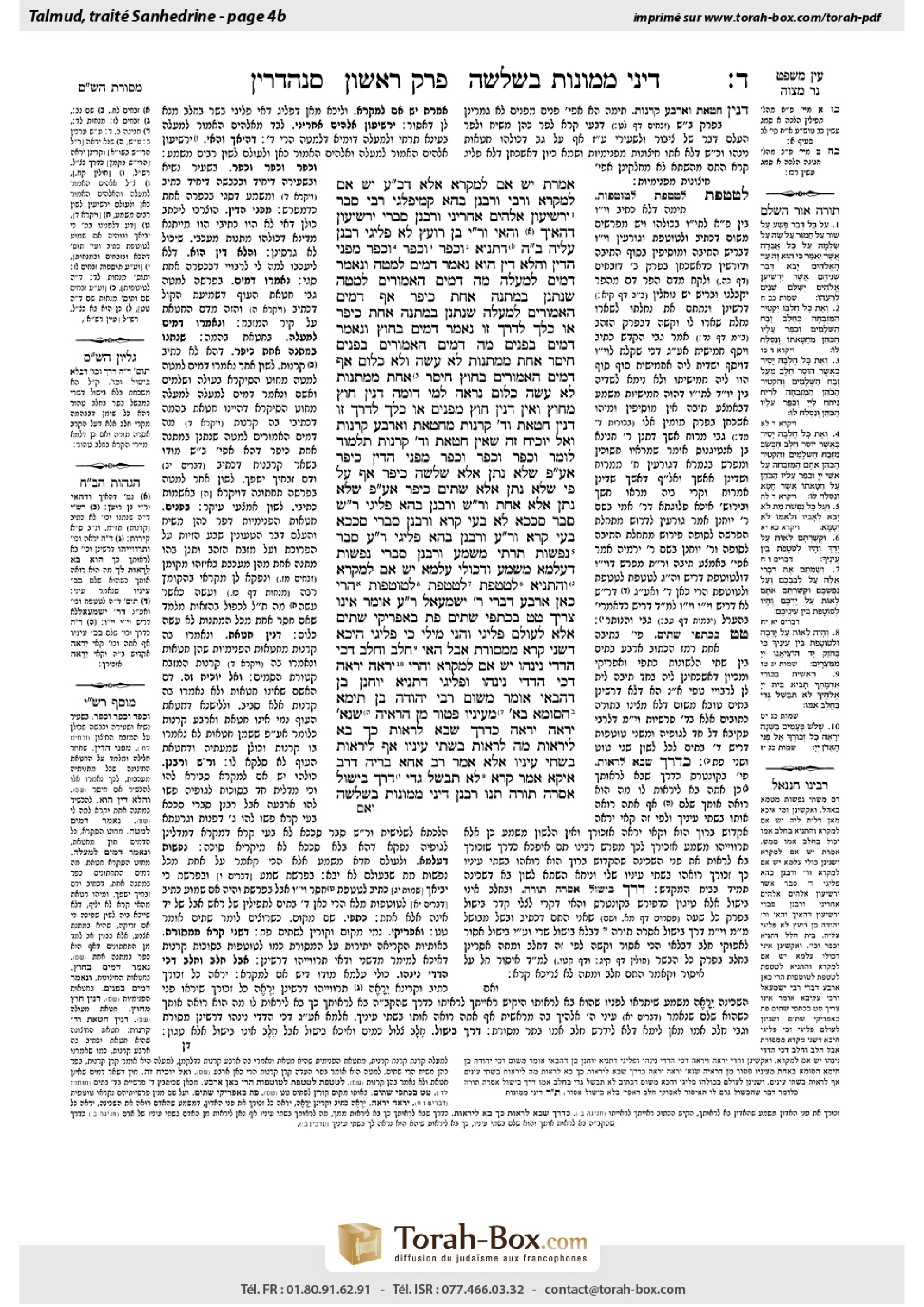
Sanhedrin 4b: Talmud study for Daf Yomi
Daf Yomi is the daily study of one Talmud folio. Explore 37 tractates with scans, Hebrew text, Sefaria English and AI-generated French translations where annotated.
Passage selection and English or AI-generated French translation are available where the scan has annotations. Daf Study is independent of Torah-Box and Sefaria.
Browse Sanhedrin · סנהדרין · All tractatesSanhedrin 4b text and translations
This page of Sanhedrin includes the Aramaic text, an English translation and an AI-generated French translation, alongside the scan above.
סנהדרין ד׳ ב · Aramaic and Hebrew text
אָמַרְתָּ: יֵשׁ אֵם לַמִּקְרָא.
אֶלָּא, דְּכוּלֵּי עָלְמָא יֵשׁ אֵם לַמִּקְרָא, וְרַבִּי וְרַבָּנַן בְּהָא קָמִיפַּלְגִי: רַבִּי סָבַר ״יַרְשִׁיעֻן אֱלֹהִים״ – אַחֲרִינֵי, וְרַבָּנַן סָבְרִי ״יַרְשִׁיעֻן״ – דְּהַאיְךְ וְהַאי.
וְרַבִּי יְהוּדָה בֶּן רוֹעֵץ, לָא פְּלִיגִי רַבָּנַן עֲלֵיהּ.
בֵּית הִלֵּל, דְּתַנְיָא: ״וְכִפֶּר״, ״וְכִפֶּר״, ״וְכִפֶּר״ – מִפְּנֵי הַדִּין.
וַהֲלֹא דִין הוּא: נֶאֱמַר דָּמִים לְמַטָּה, וְנֶאֱמַר דָּמִים לְמַעְלָה. מָה דָּמִים הָאֲמוּרִים לְמַטָּה – שֶׁנְּתָנָן בְּמַתָּנָה אַחַת כִּיפֵּר, אַף דָּמִים הָאֲמוּרִים לְמַעְלָה – שֶׁנְּתָנָן בְּמַתָּנָה אַחַת כִּיפֵּר.
אוֹ כְּלָךְ לְדֶרֶךְ זוֹ: נֶאֱמַר דָּמִים בַּחוּץ, וְנֶאֱמַר דָּמִים בִּפְנִים. מָה דָּמִים הָאֲמוּרִים בִּפְנִים – חִיסֵּר אַחַת מִמַּתָּנוֹת לֹא עָשָׂה וְלֹא כְּלוּם, אַף דָּמִים הָאֲמוּרִים בַּחוּץ – חִיסֵּר אַחַת מִמַּתָּנוֹת לֹא עָשָׂה כְּלוּם.
נִרְאֶה לְמִי דּוֹמֶה? דָּנִין חוּץ מִחוּץ, וְאֵין דָּנִין חוּץ מִפְּנִים.
אוֹ כְּלָךְ לְדֶרֶךְ זוֹ: דָּנִין חַטָּאת וְאַרְבַּע קְרָנוֹת, מֵחַטָּאת וְאַרְבַּע קְרָנוֹת, וְאַל יוֹכִיחַ זֶה, שֶׁאֵין חַטָּאת וְאַרְבַּע קְרָנוֹת.
תַּלְמוּד לוֹמַר: ״וְכִפֶּר״, ״וְכִפֶּר״, ״וְכִפֶּר״ – מִפְּנֵי הַדִּין. ״כִּיפֵּר״ – אַף עַל פִּי שֶׁלֹּא נָתַן אֶלָּא שְׁלֹשָׁה, ״כִּיפֵּר״ – אַף עַל פִּי שֶׁלֹּא נָתַן אֶלָּא שְׁתַּיִם, ״כִּיפֵּר״ – אַף עַל פִּי שֶׁלֹּא נָתַן אֶלָּא אַחַת.
וְרַבִּי שִׁמְעוֹן וְרַבָּנַן בְּהָא פְּלִיגִי: רַבִּי שִׁמְעוֹן סָבַר, סְכָכָא לָא בָּעֵי קְרָא. וְרַבָּנַן סָבְרִי, סְכָכָא בָּעֵי קְרָא.
וְרַבִּי עֲקִיבָא וְרַבָּנַן, בְּהָא פְּלִיגִי: רַבִּי עֲקִיבָא סָבַר ״נְפָשֹׁת״ – תַּרְתֵּי מַשְׁמַע, וְרַבָּנַן סָבְרִי ״נְפָשֹׁת״ – דְּעָלְמָא מַשְׁמַע.
וּדְכוּלֵּי עָלְמָא יֵשׁ אֵם לַמִּקְרָא? וְהָתַנְיָא: ״לְטוֹטֶפֶת״, ״לְטֹטֶפֶת״, ״לְטוֹטָפוֹת״ – הֲרֵי כָּאן אַרְבַּע, דִּבְרֵי רַבִּי יִשְׁמָעֵאל.
רַבִּי עֲקִיבָא אוֹמֵר: אֵינוֹ צָרִיךְ, טַט בְּכַתְפִּי שְׁתַּיִם, פַּת בְּאַפְרִיקִי שְׁתַּיִם.
אֶלָּא, לְעוֹלָם פְּלִיגִי. וְהָנֵי מִילֵּי כִּי פְּלִיגִי – הֵיכָא דְּשָׁנֵי קְרָא מִמָּסוֹרֶת. אֲבָל הַאי ״חֵלֶב״ וַ״חֲלֵב״ דְּכִי הֲדָדֵי נִינְהוּ, יֵשׁ אֵם לַמִּקְרָא.
וַהֲרֵי ״יִרְאֶה״ ״יֵרָאֶה״ דְּכִי הֲדָדֵי נִינְהוּ, וּפְלִיגִי? דְּתַנְיָא: יוֹחָנָן בֶּן דַּהֲבַאי אוֹמֵר מִשּׁוּם רַבִּי יְהוּדָה בֶּן תֵּימָא: הַסּוֹמֵא בְּאַחַת מֵעֵינָיו – פָּטוּר מִן הָרְאִיָּה, שֶׁנֶּאֱמַר ״יִרְאֶה״ ״יֵרָאֶה״ – כְּדֶרֶךְ שֶׁבָּא לִרְאוֹת כָּךְ בָּא לֵירָאוֹת. מָה לִרְאוֹת בִּשְׁתֵּי עֵינָיו, אַף לֵירָאוֹת בִּשְׁתֵּי עֵינָיו.
אֶלָּא אָמַר רַב אַחָא בְּרֵיהּ דְּרַב אִיקָא: אָמַר קְרָא ״לֹא תְבַשֵּׁל גְּדִי״, דֶּרֶךְ בִּישּׁוּל אָסְרָה תּוֹרָה.
תָּנוּ רַבָּנַן: דִּינֵי מָמוֹנוֹת בִּשְׁלֹשָׁה,
Sanhedrin 4b · English translation
You therefore say in response: The vocalization of the Torah is authoritative, and the verse prohibits cooking the young goat in its mother’s milk.
Rather, everyone agrees that the vocalization of the Torah is authoritative. But in actuality, Rabbi Yehuda HaNasi and the Rabbis disagree with regard to this: Rabbi Yehuda HaNasi holds that the phrase “the court shall condemn” is referring to other judges, in addition to the three that were derived from the earlier verse, leading to a total of five, whereas the Rabbis hold that the term “shall condemn” means these judges, i.e., those who have already been mentioned, and therefore there are only three.
And with regard to Rabbi Yehuda ben Roetz, who applied the principle: The vocalization of the Torah is authoritative, to the question of the duration of the ritual impurity of a woman who gave birth to a female, it can be explained that the Rabbis do not disagree with him, as everyone agrees that the vocalization of the Torah is authoritative.
With regard to Beit Hillel, who hold that a single presentation of blood is sufficient to atone even when bringing a sin-offering, this is not because they hold the traditional consonantal text is authoritative. Rather, their opinion is as it is taught in a baraita: The verse states with regard to the sin-offering brought by a ruler: “And the priest shall make atonement for him” (Leviticus 4:26), and with regard to a sin-offering of a goat brought by an ordinary person: “And the priest shall make atonement for him” (Leviticus 4:31), and with regard to a sin-offering of a lamb brought by an ordinary person: “And the priest shall make atonement for him” (Leviticus 4:35), repeating this term three times. This repetition is due to the following logical inference:
Could this halakha not be derived through an a fortiori inference? There is stated a term of blood below, in the verse written with regard to a bird brought as a sin-offering (see Leviticus 5:9), and there is stated a term of blood above, in the verse written with regard to an animal brought as a sin-offering (see Leviticus 4:25, 31, 35). Just as with regard to the blood that is stated below, when it is presented with one presentation it has effected atonement, so too with regard to the blood that is stated above, when it is presented with one presentation it has effected atonement.
Or perhaps go this way, offering a different explanation: There is stated a term of blood in the verse written with regard to the external altar, i.e., in the verse written with regard to a sin-offering of an ordinary person that is brought on the external altar in the courtyard (see Leviticus 4:25), and there is stated a term of blood in the verse written with regard to the inner altar, i.e., with regard to a sin-offering of the community or the High Priest, the blood of which is sprinkled on the incense altar inside the Sanctuary (see Leviticus 4:7, 18). Just as with regard to the blood that was stated concerning the inner altar, i.e., if one of the presentations is lacking it has not accomplished anything and the offering is not valid, so too, with regard to the blood that was stated concerning the external altar, if one of the presentations is lacking it has accomplished nothing.
The Gemara analyzes the two possibilities: Let us see to which of the two comparisons this is more similar. It can be claimed: We derive a halakha stated with regard to the external altar from a halakha stated with regard to the external altar, but we do not derive a halakha stated with regard to the external altar from a halakha stated with regard to the inner altar.
Or go this way: We derive a halakha stated with regard to a sin-offering whose blood is to be sprinkled on the four corners of the altar from the halakha stated with regard to a sin-offering whose blood is to be sprinkled on the four corners of the altar, and this sin-offering consisting of a bird, which is not a sin-offering of the type whose blood is to be sprinkled on the four corners of the altar, cannot prove that the halakha is similar with regard to a sin-offering whose blood is to be sprinkled on the four corners of the altar.
Since there are two legitimate inferences, the halakha cannot be decided through a logical inference. Therefore, the verse states: “And the priest shall make atonement,” “And the priest shall make atonement,” “And the priest shall make atonement,” three times, due to the logical inference. The verses are interpreted as follows: “The priest shall make atonement,” even though he presented only three presentations, and then a second verse repeats: “The priest shall make atonement,” even though he presented only two presentations, and then a third verse repeats: “The priest shall make atonement,” even though he presented only one presentation. This interpretation is the source of Beit Hillel’s opinion.
And concerning Rabbi Shimon and the Rabbis, who disagreed with regard to the number of walls required in a sukka, it is with regard to this that they disagree: Rabbi Shimon holds that the basic requirement of placing roofing [sekhakha] on the sukka does not need a verse to teach that it is required, as it is implied by the word sukka. Consequently, the word sukkot appears two times in the text beyond the initial mitzva, teaching a requirement for four walls, and there is a halakha transmitted to Moses from Sinai that reduces the minimum size of one of the walls to a handbreadth. And the Rabbis hold that the requirement of placing roofing does need a verse. Therefore, one of the four derivations is used to teach that requirement, and only three walls remain, one of which is reduced to a handbreadth.
And with regard to Rabbi Akiva and the Rabbis, who disagreed about the issue of a quarter-log of blood that emanated from two corpses, it is with regard to this that they disagree: Rabbi Akiva holds that “bodies” in plural indicates two. Consequently, a quarter-log of blood that emanated from two corpses also renders one impure. And the Rabbis hold that “bodies” in plural indicates a general halakha, and no derivation can be made with regard to blood that emanated from two corpses. Both opinions, however, agree that the vocalized text of the Torah is authoritative.
The Gemara asks: And does everyone actually hold that the vocalization of the Torah is authoritative? But isn’t it taught in a baraita: With regard to the number of compartments in the phylacteries of the head, the verse states: “It shall be for a sign upon your hand, and for totafot between your eyes” (Exodus 13:16), with the word totafot spelled deficient, without a second vav, in a way that can be read as singular; and again: “They shall be for totafot between your eyes” (Deuteronomy 6:8), spelled as a singular word; and again: “They shall be for totafot between your eyes” (11:18), this time spelled plene, with a second vav, in a manner that must be plural? There are four mentions of totafot here, as the third one is written in the plural and therefore counts as two. Consequently, it is derived that the phylacteries of the head must have four compartments. This is the statement of Rabbi Yishmael.
Rabbi Akiva says: There is no need for this proof, as the requirement of four compartments can be derived from the word totafot itself: The word tat in the language of the Katfei means two, and the word pat in the language of Afriki also means two, and therefore totafot can be understood as a compound word meaning: Four. The baraita therefore indicates that Rabbi Yishmael holds that not the vocalization but rather the tradition of the manner in which the verses in the Torah are written is authoritative.
Rather, the explanation that everyone holds that the vocalization of the Torah is authoritative must be rejected, and it must be explained that the Sages actually do disagree whether it is the vocalization of the Torah or the tradition of the manner in which the verses in the Torah are written that is authoritative. And in order to explain the unresolved problem with regard to the baraita about the prohibition of cooking a young goat in its mother’s milk, the explanation is that this statement, that they disagree as to whether the vocalization or the tradition is authoritative, applies where the vocalization of the word differs from the tradition of the manner in which the word is written. But in this case the words milk [ḥalev] and fat [ḥelev] are written in an identical manner, as there is no difference in the writing at all, only in the way they are vocalized. Therefore, all agree that the vocalization of the Torah is authoritative.
The Gemara asks: But the words: “Shall see” and “shall appear” are written in an identical matter, and nevertheless the Sages disagree about which reading is authoritative. As it is taught in a baraita: Yoḥanan ben Dahavai says in the name of Rabbi Yehuda ben Teima: One who is blind in one of his eyes is exempt from the mitzva of appearance, i.e., the obligation to appear in the Temple and to sacrifice an offering on the three pilgrimage Festivals, as it is stated: “Three times in the year all your males shall appear [yera’eh] before the Lord God” (Exodus 23:17). According to the way in which the verse is written, without vocalization, it can be read as yireh, meaning: Shall see, instead of yera’eh, meaning: Shall appear. This teaches that in the same manner that one comes to see, so he comes to appear, i.e., to be seen: Just as the usual way to see is with both of one’s eyes, so too, the obligation to appear applies only to one who comes with the sight of both his eyes.
It is therefore apparent that even when there is no difference in the way the words are written, some say that the tradition, not the vocalization, is authoritative. Rather, Rav Aḥa, son of Rav Ika, said: The reason all agree that there is a prohibition to cook a young goat in its mother’s milk and not in its mother’s fat is that the verse states: “You shall not cook a young goat” (Exodus 23:19). The verse teaches that the action the Torah prohibited is in the manner of cooking, which is generally done in a liquid such as milk and not in a solid substance such as fat.
§ The Sages taught in a baraita: Cases of monetary law are adjudicated by three judges.
Sanhedrin 4b · Traduction française (IA)
Tu réponds donc ainsi : la vocalisation de la Torah fait autorité, et le verset interdit de cuire le chevreau dans le lait de sa mère.
Mais tous conviennent que la vocalisation de la Torah fait autorité. En réalité, Rabbi Yehouda HaNassi et les Rabbins sont en désaccord sur ce point : Rabbi Yehouda HaNassi estime que l’expression « le tribunal condamnera » désigne d’autres juges, en plus des trois déduits du verset précédent, ce qui porte le total à cinq ; les Rabbins, eux, estiment que le terme « condamnera » désigne ces juges, c’est-à-dire ceux qui ont déjà été mentionnés, et qu’ils ne sont donc que trois.
Quant à Rabbi Yehouda ben Roets, qui a appliqué le principe selon lequel la vocalisation de la Torah fait autorité à la question de la durée de l’impureté rituelle d’une femme ayant donné naissance à une fille, on peut expliquer que les Rabbins ne sont pas en désaccord avec lui, puisque tous conviennent que la vocalisation de la Torah fait autorité.
Quant à Beit Hillel, qui estime qu’une seule aspersion de sang suffit pour obtenir l’expiation même lorsqu’on apporte un sacrifice expiatoire, ce n’est pas parce qu’ils estiment que le texte consonantique traditionnel fait autorité. Leur opinion repose plutôt sur ce qui est enseigné dans une baraïta : au sujet du sacrifice expiatoire apporté par un dirigeant, le verset dit : « Le prêtre fera expiation pour lui » (Lévitique 4, 26) ; au sujet du sacrifice expiatoire d’un bouc apporté par un particulier, il dit : « Le prêtre fera expiation pour lui » (Lévitique 4, 31) ; et au sujet du sacrifice expiatoire d’un agneau apporté par un particulier, il dit : « Le prêtre fera expiation pour lui » (Lévitique 4, 35). Cette expression est donc répétée trois fois. Cette répétition s’explique par le raisonnement logique suivant :
Cette halakha ne pourrait-elle pas être déduite par un raisonnement a fortiori ? Le terme « sang » apparaît plus loin, dans le verset relatif à un oiseau offert en sacrifice expiatoire (voir Lévitique 5, 9), et le terme « sang » apparaît plus haut, dans les versets relatifs à un animal offert en sacrifice expiatoire (voir Lévitique 4, 25, 31 et 35). De même que, pour le sang mentionné plus loin, une seule aspersion suffit à obtenir l’expiation, de même, pour le sang mentionné plus haut, une seule aspersion suffit à obtenir l’expiation.
Ou peut-être faut-il raisonner ainsi, en proposant une autre explication : le terme « sang » apparaît dans le verset relatif à l’autel extérieur, c’est-à-dire dans le verset relatif au sacrifice expiatoire d’un particulier offert sur l’autel extérieur, dans la cour (voir Lévitique 4, 25), et le terme « sang » apparaît dans le verset relatif à l’autel intérieur, c’est-à-dire à propos du sacrifice expiatoire de la communauté ou du grand prêtre, dont le sang est aspergé sur l’autel des encens, à l’intérieur du Sanctuaire (voir Lévitique 4, 7 et 18). De même que, pour le sang mentionné à propos de l’autel intérieur, si l’une des aspersions manque, cela ne produit aucun effet et le sacrifice n’est pas valide, de même, pour le sang mentionné à propos de l’autel extérieur, si l’une des aspersions manque, cela ne produit aucun effet.
La Guemara examine les deux possibilités : voyons à laquelle des deux comparaisons cela ressemble davantage. On peut soutenir que nous déduisons une halakha relative à l’autel extérieur d’une halakha relative à l’autel extérieur, mais que nous ne déduisons pas une halakha relative à l’autel extérieur d’une halakha relative à l’autel intérieur.
Ou raisonnons ainsi : nous déduisons la halakha relative à un sacrifice expiatoire dont le sang doit être aspergé sur les quatre cornes de l’autel de la halakha relative à un sacrifice expiatoire dont le sang doit être aspergé sur les quatre cornes de l’autel ; et ce sacrifice expiatoire, qui est un oiseau et non un sacrifice expiatoire dont le sang doit être aspergé sur les quatre cornes de l’autel, ne peut servir à démontrer que la halakha est similaire pour un sacrifice expiatoire dont le sang doit être aspergé sur les quatre cornes de l’autel.
Puisqu’il existe deux déductions valables, la halakha ne peut pas être tranchée au moyen d’un raisonnement logique. Le verset répète donc trois fois, en réponse à ce raisonnement logique : « Le prêtre fera expiation », « Le prêtre fera expiation », « Le prêtre fera expiation ». Les versets s’interprètent ainsi : « Le prêtre fera expiation », même s’il n’a effectué que trois aspersions ; puis un deuxième verset répète : « Le prêtre fera expiation », même s’il n’a effectué que deux aspersions ; enfin, un troisième verset répète : « Le prêtre fera expiation », même s’il n’a effectué qu’une seule aspersion. Cette interprétation est la source de l’opinion de Beit Hillel.
Quant à Rabbi Shimon et aux Rabbins, qui sont en désaccord sur le nombre de parois requis pour une soukka, leur désaccord porte sur le point suivant : Rabbi Shimon estime que l’exigence de poser une couverture [sekhakha] sur la soukka n’a pas besoin d’être enseignée par un verset, car elle est impliquée par le mot soukka. Par conséquent, le mot soukkot apparaît deux fois dans le texte, en plus de la mitsva initiale, enseignant l’exigence de quatre parois ; et une halakha transmise à Moïse au Sinaï réduit à une largeur d’un téfa’h la taille minimale de l’une des parois. Les Rabbins, eux, estiment que l’exigence de poser une couverture doit être enseignée par un verset. L’une des quatre déductions sert donc à enseigner cette exigence, et il ne reste que trois parois, dont l’une est réduite à la largeur d’un téfa’h.
Quant à Rabbi Akiva et aux Rabbins, qui sont en désaccord au sujet d’un quart de log de sang provenant de deux cadavres, leur désaccord porte sur le point suivant : Rabbi Akiva estime que le pluriel « corps » désigne deux corps. Par conséquent, un quart de log de sang provenant de deux cadavres rend également impur. Les Rabbins, eux, estiment que le pluriel « corps » énonce une règle générale, et qu’on ne peut en déduire quoi que ce soit au sujet du sang provenant de deux cadavres. Toutefois, les deux opinions conviennent que le texte vocalisé de la Torah fait autorité.
La Guemara demande : tous estiment-ils réellement que la vocalisation de la Torah fait autorité ? N’est-il pas enseigné dans une baraïta : au sujet du nombre de compartiments des téfilines de la tête, le verset dit : « Ce sera un signe sur ta main et des totafot entre tes yeux » (Exode 13, 16), le mot totafot étant écrit de façon défective, sans deuxième vav, de manière à pouvoir se lire au singulier ; puis : « Ils seront des totafot entre tes yeux » (Deutéronome 6, 8), également écrit au singulier ; et encore : « Ils seront des totafot entre tes yeux » (11, 18), cette fois écrit de façon pleine, avec un deuxième vav, de sorte qu’il doit se lire au pluriel ? Le mot totafot est mentionné quatre fois ici, car la troisième occurrence est écrite au pluriel et compte donc pour deux. On en déduit que les téfilines de la tête doivent comporter quatre compartiments. Telle est la déclaration de Rabbi Yishmaël.
Rabbi Akiva dit : il n’est pas nécessaire d’apporter cette preuve, car l’exigence de quatre compartiments peut être déduite du mot totafot lui-même : le mot tat, dans la langue des Katfei, signifie deux, et le mot pat, dans la langue d’Afriki, signifie également deux ; totafot peut donc s’entendre comme un mot composé signifiant « quatre ». La baraïta indique donc que Rabbi Yishmaël estime que ce n’est pas la vocalisation, mais la tradition concernant la manière dont les versets de la Torah sont écrits, qui fait autorité.
Il faut donc rejeter l’explication selon laquelle tous estiment que la vocalisation de la Torah fait autorité, et expliquer que les Sages sont en réalité en désaccord sur la question de savoir si c’est la vocalisation de la Torah ou la tradition concernant la manière dont les versets de la Torah sont écrits qui fait autorité. Pour résoudre la difficulté qui demeure au sujet de la baraïta sur l’interdiction de cuire le chevreau dans le lait de sa mère, on explique que cette déclaration — selon laquelle ils sont en désaccord sur le point de savoir si la vocalisation ou la tradition fait autorité — s’applique lorsque la vocalisation du mot diffère de la tradition concernant la manière dont il est écrit. Mais, dans ce cas, les mots « lait » [ḥalev] et « graisse » [ḥelev] s’écrivent de manière identique : leur écriture ne diffère en rien, seule leur vocalisation change. Tous conviennent donc que la vocalisation de la Torah fait autorité.
La Guemara demande : mais les mots « verra » et « apparaîtra » s’écrivent de manière identique, et pourtant les Sages sont en désaccord sur la lecture qui fait autorité. En effet, il est enseigné dans une baraïta : Yoḥanan ben Dahavai dit au nom de Rabbi Yehuda ben Teima : celui qui est aveugle d’un œil est dispensé de la mitsva de comparution, c’est-à-dire de l’obligation de se présenter au Temple et d’y offrir un sacrifice lors des trois fêtes de pèlerinage, comme il est dit : « Trois fois par an, tous tes mâles apparaîtront [yera’eh] devant le Seigneur Dieu » (Exode 23, 17). Selon la manière dont le verset est écrit, sans vocalisation, on peut le lire yireh, qui signifie « verra », au lieu de yera’eh, qui signifie « apparaîtra ». Cela enseigne que de même qu’on vient pour voir, on vient aussi pour apparaître, c’est-à-dire pour être vu : de même que, d’ordinaire, on voit avec ses deux yeux, de même, l’obligation de comparution ne s’applique qu’à celui qui vient avec la vue de ses deux yeux.
Il apparaît donc que, même lorsque l’écriture des mots ne diffère pas, certains estiment que c’est la tradition, et non la vocalisation, qui fait autorité. Rav Aḥa, fils de Rav Ika, dit plutôt : si tous conviennent qu’il est interdit de cuire un chevreau dans le lait de sa mère, mais non dans la graisse de sa mère, c’est parce que le verset dit : « Tu ne cuiras pas un chevreau » (Exode 23, 19). Le verset enseigne que l’action interdite par la Torah est la cuisson, qui se fait généralement dans un liquide tel que le lait, et non dans une substance solide telle que la graisse.
§ Les Sages ont enseigné dans une baraïta : les affaires de droit pécuniaire sont jugées par trois juges.
Traduction française générée par IA à partir de l’édition anglaise de Sefaria. Vérifie toujours un passage avec le texte source.
Text from Sefaria: William Davidson Edition - Vocalized Aramaic (CC BY NC); William Davidson Edition - English (CC BY NC).