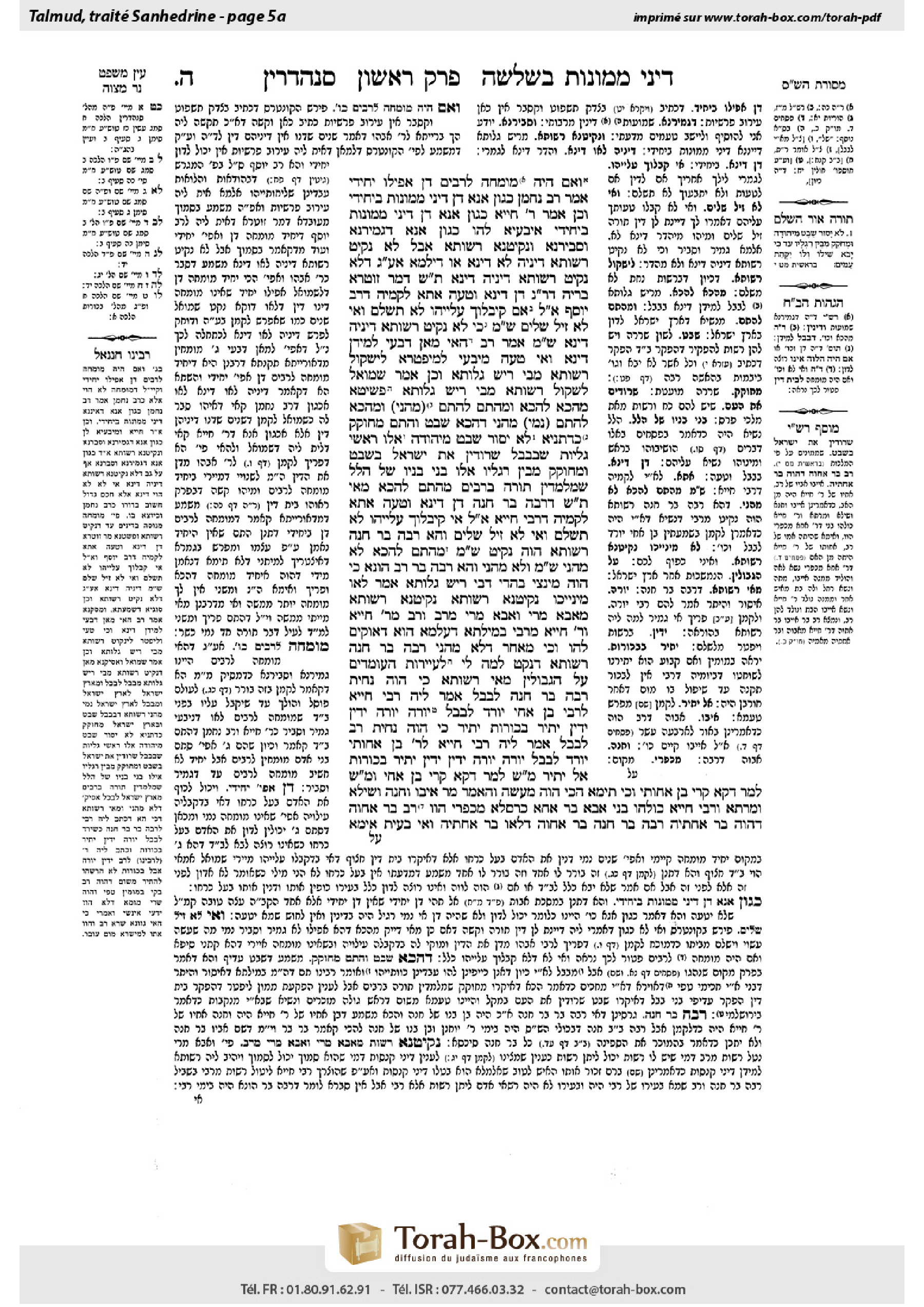
Sanhedrin 5a: Talmud study for Daf Yomi
Daf Yomi is the daily study of one Talmud folio. Explore 37 tractates with scans, Hebrew text, Sefaria English and AI-generated French translations where annotated.
Passage selection and English or AI-generated French translation are available where the scan has annotations. Daf Study is independent of Torah-Box and Sefaria.
Browse Sanhedrin · סנהדרין · All tractatesSanhedrin 5a text and translations
This page of Sanhedrin includes the Aramaic text, an English translation and an AI-generated French translation, alongside the scan above.
סנהדרין ה׳ א · Aramaic and Hebrew text
וְאִם הָיָה מוּמְחֶה לְרַבִּים, דָּן אֲפִילּוּ יְחִידִי. אָמַר רַב נַחְמָן: כְּגוֹן אֲנָא דָּן דִּינֵי מָמוֹנוֹת בִּיחִידִי. וְכֵן אָמַר רַבִּי חִיָּיא: כְּגוֹן אֲנָא דָּן דִּינֵי מָמוֹנוֹת בִּיחִידִי.
אִיבַּעְיָא לְהוּ: כְּגוֹן אֲנָא דִּגְמִירְנָא וּסְבִירְנָא וּנְקִיטְנָא רְשׁוּתָא, אֲבָל לָא נְקִיט רְשׁוּתָא – דִּינֵיהּ לָא דִּינָא? אוֹ דִילְמָא: אַף עַל גַּב דְּלָא נָקֵיט רְשׁוּתָא – דִּינֵיהּ דִּינָא?
תָּא שְׁמַע: דְּמָר זוּטְרָא בְּרֵיהּ דְּרַב נַחְמָן דָּן דִּינָא וּטְעָה, אֲתָא לְקַמֵּיהּ דְּרַב יוֹסֵף. אָמַר לוֹ: אִם קִיבְּלוּךְ עֲלַיְיהוּ – לָא תְּשַׁלֵּם, וְאִי לָא – זִיל שַׁלֵּים. שְׁמַע מִינַּהּ: כִּי לָא נָקֵיט רְשׁוּתָא – דִּינֵיהּ דִּינָא. שְׁמַע מִינַּהּ.
אָמַר רַב: הַאי מַאן דְּבָעֵי לְמֵידַן דִּינָא, וְאִי טְעָה מִיבְעֵי לְמִיפְּטַר – לִישְׁקוֹל רְשׁוּתָא מִבֵּי רֵישׁ גָּלוּתָא. וְכֵן אָמַר שְׁמוּאֵל: לִשְׁקוֹל רְשׁוּתָא מִבֵּי רֵישׁ גָּלוּתָא.
פְּשִׁיטָא: מֵהָכָא לְהָכָא, וּמֵהָתָם לְהָתָם – מַהֲנֵי. וּמֵהָכָא לְהָתָם נָמֵי מַהֲנֵי, דְּהָכָא שֵׁבֶט וְהָתָם מְחוֹקֵק.
כִּדְתַנְיָא: ״לֹא יָסוּר שֵׁבֶט מִיהוּדָה״ – אֵלּוּ רָאשֵׁי גָלִיּוֹת שֶׁבְּבָבֶל, שֶׁרוֹדִין אֶת יִשְׂרָאֵל בְּשֵׁבֶט. ״וּמְחֹקֵק מִבֵּין רַגְלָיו״ – אֵלּוּ בְּנֵי בָּנָיו שֶׁל הִלֵּל, שֶׁמְּלַמְּדִין תּוֹרָה בָּרַבִּים.
מֵהָתָם לְהָכָא מַאי? תָּא שְׁמַע: דְּרַבָּה בַּר חָנָה דָּן דִּינָא וּטְעָה. אֲתָא לְקַמֵּיהּ דְּרַבִּי חִיָּיא. אֲמַר לֵיהּ: אִי קִיבְּלוּךְ עֲלַיְיהוּ – לָא תְּשַׁלֵּם, וְאִי לָא – זִיל שַׁלֵּים. וְהָא רַבָּה בַּר חָנָה רְשׁוּתָא הֲוָה נְקִיט! שְׁמַע מִינַּהּ: מֵהָתָם לְהָכָא לָא מַהֲנֵי. שְׁמַע מִינַּהּ.
וְלָא מַהֲנֵי? וְהָא רַבָּה בַּר רַב הוּנָא, כִּי הֲוָה מִינְּצֵי בַּהֲדֵי דְּבֵי רֵישׁ גָּלוּתָא, אָמַר: לָאו מִינַּיְיכוּ נְקִיטְנָא רְשׁוּתָא, נְקִיטְנָא רְשׁוּתָא מֵאַבָּא מָרִי, וְאַבָּא מָרִי מֵרַב, וְרַב מֵרַבִּי חִיָּיא, וְרַבִּי חִיָּיא מֵרַבִּי! בְּמִילְּתָא דְעָלְמָא הוּא דְּאוֹקֵים לְהוּ.
וְכִי מֵאַחַר דְּלָא מַהֲנֵי, רַבָּה בַּר חָנָה רְשׁוּתָא דִּנְקַט לְמָה לִי? לָעֲיָירוֹת הָעוֹמְדִים עַל הַגְּבוּלִין.
מַאי רְשׁוּתָא? כִּי הֲוָה נָחֵית רַבָּה בַּר חָנָה לְבָבֶל, אֲמַר לֵיהּ רַבִּי חִיָּיא לְרַבִּי: בֶּן אָחִי יוֹרֵד לְבָבֶל. ״יוֹרֶה?״ ״יוֹרֶה!״, ״יָדִין?״ ״יָדִין!״, ״יַתִּיר בְּכוֹרוֹת?״ ״יַתִּיר!״.
כִּי הֲוָה נָחֵית רַב לְבָבֶל, אֲמַר לֵיהּ רַבִּי חִיָּיא לְרַבִּי: בֶּן אֲחוֹתִי יוֹרֵד לְבָבֶל. ״יוֹרֶה?״ ״יוֹרֶה!״, ״יָדִין?״ ״יָדִין!״, ״יַתִּיר בְּכוֹרוֹת?״ ״אַל יַתִּיר!״.
מַאי שְׁנָא לְמָר דְּקָא קָרֵי ״בֶּן אָחִי״, וּמַאי שְׁנָא לְמָר דְּקָא קָרֵי ״בֶּן אֲחוֹתִי״? וְכִי תֵּימָא הָכִי הֲוָה מַעֲשֶׂה, וְהָאָמַר מָר: אַיְּבוּ וְחַנָּה וְשֵׁילָא וּמָרְתָא וְרַבִּי חִיָּיא כּוּלְּהוּ בְּנֵי אַבָּא בַּר אַחָא כַּרְסַלָּא מִכַּפְרִי הֲווֹ? רַב בַּר אֲחוּהּ דַּהֲוָה בַּר אֲחָתֵיהּ, רַבָּה בַּר חָנָה בַּר אֲחוּהּ דְּלָאו בַּר אֲחָתֵיהּ.
וְאִי בָּעֵית אֵימָא:
Sanhedrin 5a · English translation
But if one was a judge accepted as an expert for the public, then he may judge cases even as the lone judge. Rav Naḥman said: One such as I may judge cases of monetary law as the lone judge. And similarly, Rabbi Ḥiyya said: One such as I may judge cases of monetary law as the lone judge.
A dilemma was raised before the Sages: What is the meaning of: Such as I, in the statements of these Rabbis? Did they intend to say: Such as I, in that I have studied and have the skills to extrapolate and derive new rulings on the basis of earlier decisions, and have also received permission to judge as the lone judge? But accordingly, if one has not received permission to judge as the lone judge, his judgment is not a valid judgment? Or perhaps this is not the correct reading of the statements, and the halakha is that even though he did not receive permission to judge as the lone judge, his judgment is nevertheless a valid judgment?
The Gemara suggests: Come and hear a solution to this dilemma from the following case: Mar Zutra, son of Rav Naḥman, once adjudicated a certain case and erred in his ruling. Upon recognizing his error, he came before Rav Yosef to ask what he should do. Rav Yosef said to him: If the litigants accepted you upon themselves as the lone judge, and both had agreed that they would accept your ruling, you are not liable to pay restitution to the party who lost the case due to your erroneous ruling. But if they did not accept you on themselves, but were rather compelled to be judged before you, you must go and pay restitution. And learn from it that even in a case where one did not receive permission to judge as the lone judge, his ruling is a valid judgment. The Gemara affirms: Learn from it that this is the case.
§ Rav says: One who wants to adjudicate a case and wants to be exempt from payment of restitution if he errs in his judgment must receive permission from the Exilarch to judge cases. And similarly, Shmuel says: In such a case he must receive permission from the Exilarch. Once he receives permission, even an erroneous decision carries halakhic force and therefore it is as if he did not err.
Since the Gemara mentioned the importance of a judge receiving authorization from the Exilarch, it now discusses the scope of this authority. It is obvious that from here to here, meaning relying on permission granted by the Exilarch in Babylonia in order to adjudicate cases within Babylonia, and from there to there, relying on permission granted by the Nasi in Eretz Yisrael in order to adjudicate cases within Eretz Yisrael, the authorization is effective. And it is also obvious that from here to there, relying on permission granted by the Exilarch to adjudicate cases within Eretz Yisrael, it is also effective, as the authority of the Exilarch is greater than that of the Nasi. This is so since the Exilarch here in Babylonia may be termed a scepter, i.e., a ruler with actual power of governance, and the Nasi there in Eretz Yisrael is only a staff, i.e., a legislator with limited power.
This is as it is taught in a baraita: The verse states: “The scepter shall not depart from Judah nor the ruler’s staff from between his feet until Shiloh comes” (Genesis 49:10). The term “Shiloh” is understood as a reference to the Messiah, and therefore the verse is interpreted as delineating the authority of Jewish rulers during the exile, before the Messiah comes. “The scepter shall not depart from Judah”; these are the Exilarchs in Babylonia, who are empowered by the government and consequently subjugate the Jewish people as with a scepter. “Nor the ruler’s staff from between his feet”; These are the grandchildren of Hillel the Elder who hold the position of Nasi and teach Torah in public, but do not have authority to actually enforce their judgments.
If one has permission from there, from the Nasi, and wants to adjudicate cases here in Babylonia, what is the halakha? The Gemara suggests: Come and hear an incident that occurred: Rabba bar Ḥana adjudicated a case in Babylonia and erred. He came before Rabbi Ḥiyya to ask what he should do. Rabbi Ḥiyya said to him: If the litigants accepted you upon themselves, you are not liable to pay restitution to the party who unjustly lost the case, but if not, go and pay. But Rabba bar Ḥana received permission from the Nasi in Eretz Yisrael; therefore, learn from this incident that permission from there to adjudicate cases here is not effective. The Gemara affirms: Learn from it that this is the case.
The Gemara asks: And is this permission not effective? But when Rabba bar Rav Huna was involved in a dispute with the members of the house of the Exilarch he said: It is not from you that I received permission to judge cases. I received permission from my father, my master, i.e., Rav Huna, and my father, my master, received permission from Rav, and Rav from Rabbi Ḥiyya, and Rabbi Ḥiyya from Rabbi Yehuda HaNasi in Eretz Yisrael. Therefore, it seems that permission received in Eretz Yisrael is in fact effective in Babylonia. The Gemara rejects this proof: He was merely standing up to them with words alone, but there was no halakhic validity to his statement.
The Gemara asks: But since permission to judge received in Eretz Yisrael is not effective in Babylonia, why did Rabba bar Ḥana need to receive permission when he left for Babylonia? What was the value of that permission? The Gemara answers: The permission is effective for the cities that stand on the borders of Babylonia, which are not entirely in the jurisdiction of Babylonia, so permission from Eretz Yisrael is effective there.
§ What is the specific nature of this permission? The Gemara relates: When Rabba bar Ḥana descended to Babylonia, his uncle Rabbi Ḥiyya said to Rabbi Yehuda HaNasi: My brother’s son is descending to Babylonia. May he teach people and issue rulings with regard to what is prohibited and what is permitted? Rabbi Yehuda HaNasi said to him: He may teach. Rabbi Ḥiyya then asked: May he also adjudicate cases of monetary law, and be absolved from payment if he errs? Rabbi Yehuda HaNasi said to him: He may adjudicate. Rabbi Ḥiyya continued: May he declare a firstborn animal permitted? The male firstborn of a kosher animal may not be eaten, as it is supposed to be offered in the Temple. But if it acquires a permanent blemish it is unfit for an offering, and it may be eaten. Rabbi Yehuda HaNasi said to him: He may declare such an animal permitted.
Similarly, when Rav, who was also Rabbi Ḥiyya’s nephew, descended to Babylonia, Rabbi Ḥiyya said to Rabbi Yehuda HaNasi: My sister’s son is descending to Babylonia. May he teach people and issue rulings with regard to what is prohibited and what is permitted? Rabbi Yehuda HaNasi said to him: He may teach. Rabbi Ḥiyya then asked: May he also adjudicate cases of monetary law, and be absolved from payment if he errs? Rabbi Yehuda HaNasi responded: He may adjudicate. Rabbi Ḥiyya continued: May he declare a firstborn animal permitted? Rabbi Yehuda HaNasi said to him: He may not declare such an animal permitted.
This incident raises several questions, which the Gemara asks in sequence. What is different concerning this Sage, Rabba bar Ḥana, that Rabbi Ḥiyya called him: My brother’s son, and what is different concerning that Sage, Rav, that Rabbi Ḥiyya called him: My sister’s son? And if you would say that this was the situation: Rabba bar Ḥana was his brother’s son and Rav was his sister’s son, but doesn’t the Master say: Aivu, Rav’s father, and Ḥana, the father of Rabba bar Ḥana, and Sheila, and Marta, and Rabbi Ḥiyya, were all sons of Abba bar Aḥa Karsala from Kafrei? Consequently, Rav would also be Rabbi Ḥiyya’s brother’s son. The Gemara answers: Rav was his brother’s son who was also his sister’s son, as Rabbi Ḥiyya’s half-brother married Rabbi Ḥiyya’s half-sister; while Rabba bar Ḥana was his brother’s son who was not his sister’s son. Therefore, he referred to Rav in a manner that emphasized the additional relationship.
And if you wish, say instead that he called him: My sister’s son, for a different reason:
Sanhedrin 5a · Traduction française (IA)
Mais si quelqu’un était un juge reconnu comme expert par le public, il pouvait juger les affaires même comme juge unique. Rav Naḥman dit : Quelqu’un comme moi peut juger seul les affaires de droit pécuniaire. De même, Rabbi Ḥiyya dit : Quelqu’un comme moi peut juger seul les affaires de droit pécuniaire.
Une question fut posée aux Sages : Que signifie l’expression « quelqu’un comme moi » dans les propos de ces rabbins ? Voulaient-ils dire : « Quelqu’un comme moi, qui ai étudié, suis capable de déduire et d’établir de nouvelles décisions à partir de décisions antérieures, et ai également reçu l’autorisation de juger seul » ? Mais alors, si quelqu’un n’a pas reçu l’autorisation de juger seul, son jugement n’est-il pas valide ? Ou bien cette interprétation de leurs propos n’est-elle pas correcte, et la halakha est-elle que, même s’il n’a pas reçu l’autorisation de juger seul, son jugement est néanmoins valide ?
La Guemara propose : Viens et entends une réponse à cette question à partir du cas suivant. Mar Zutra, fils de Rav Naḥman, jugea un jour une affaire et se trompa dans sa décision. Lorsqu’il s’en aperçut, il se présenta devant Rav Yosef pour lui demander ce qu’il devait faire. Rav Yosef lui dit : Si les parties en litige t’ont accepté comme juge unique et ont toutes deux convenu d’accepter ta décision, tu n’es pas tenu d’indemniser la partie qui a perdu l’affaire à cause de ta décision erronée. Mais si elles ne t’ont pas accepté et ont été contraintes de comparaître devant toi, va et indemnise la partie lésée. Apprends-en que, même si quelqu’un n’a pas reçu l’autorisation de juger seul, sa décision constitue un jugement valide. La Guemara confirme : Apprends-en que c’est bien le cas.
§ Rav dit : Celui qui veut juger une affaire et être dispensé d’indemniser la partie lésée s’il se trompe dans son jugement doit recevoir l’autorisation de l’Exilarque pour juger. De même, Shmuel dit : Dans un tel cas, il doit recevoir l’autorisation de l’Exilarque. Une fois cette autorisation reçue, même une décision erronée a force de halakha ; c’est donc comme s’il ne s’était pas trompé.
Puisque la Guemara a mentionné l’importance, pour un juge, de recevoir l’autorisation de l’Exilarque, elle examine maintenant la portée de cette autorité. Il est évident que l’autorisation est valable « d’ici à ici », c’est-à-dire lorsqu’on s’appuie sur l’autorisation accordée par l’Exilarque en Babylonie pour juger des affaires en Babylonie, et « de là à là », lorsqu’on s’appuie sur l’autorisation accordée par le Nassi en terre d’Israël pour juger des affaires en terre d’Israël. Il est également évident que l’autorisation est valable « d’ici à là », c’est-à-dire lorsqu’on s’appuie sur l’autorisation accordée par l’Exilarque pour juger des affaires en terre d’Israël, puisque l’autorité de l’Exilarque est supérieure à celle du Nassi. En effet, l’Exilarque, ici en Babylonie, peut être qualifié de sceptre, c’est-à-dire de dirigeant doté d’un véritable pouvoir de gouvernement, tandis que le Nassi, là-bas en terre d’Israël, n’est qu’un bâton, c’est-à-dire un législateur dont le pouvoir est limité.
C’est ce qui est enseigné dans une baraïta : le verset dit : « Le sceptre ne s’écartera pas de Juda, ni le bâton du législateur d’entre ses pieds, jusqu’à ce que Shilo vienne » (Genèse 49, 10). Le terme « Shilo » est compris comme une référence au Messie ; le verset est donc interprété comme définissant l’autorité des dirigeants juifs durant l’exil, avant la venue du Messie. « Le sceptre ne s’écartera pas de Juda » : ce sont les Exilarques de Babylonie, auxquels le gouvernement confère des pouvoirs et qui, par conséquent, soumettent le peuple juif comme avec un sceptre. « Ni le bâton du législateur d’entre ses pieds » : ce sont les petits-fils de Hillel l’Ancien, qui occupent la fonction de Nassi et enseignent publiquement la Torah, mais n’ont pas le pouvoir de faire effectivement appliquer leurs jugements.
Si quelqu’un a reçu l’autorisation de là-bas, du Nassi, et veut juger des affaires ici, en Babylonie, quelle est la halakha ? La Guemara propose : Viens et entends le récit d’un événement. Rabba bar Ḥana jugea une affaire en Babylonie et se trompa. Il se présenta devant Rabbi Ḥiyya pour lui demander ce qu’il devait faire. Rabbi Ḥiyya lui dit : Si les parties en litige t’ont accepté, tu n’es pas tenu d’indemniser celle qui a injustement perdu l’affaire ; sinon, va et indemnise-la. Mais Rabba bar Ḥana avait reçu l’autorisation du Nassi en terre d’Israël. Apprends donc de cet événement qu’une autorisation reçue de là-bas pour juger ici n’est pas valable. La Guemara confirme : Apprends-en que c’est bien le cas.
La Guemara demande : Cette autorisation n’est-elle donc pas valable ? Pourtant, lorsque Rabba bar Rav Huna eut un différend avec les membres de la maison de l’Exilarque, il leur dit : « Ce n’est pas de vous que j’ai reçu l’autorisation de juger. Je l’ai reçue de mon père, mon maître, Rav Huna ; mon père, mon maître, l’a reçue de Rav ; Rav, de Rabbi Ḥiyya ; et Rabbi Ḥiyya, de Rabbi Yehuda HaNassi, en terre d’Israël. » Il semble donc qu’une autorisation reçue en terre d’Israël soit effectivement valable en Babylonie. La Guemara rejette cette preuve : il leur tenait simplement tête par ses paroles, mais sa déclaration n’avait aucune validité halakhique.
La Guemara demande : Mais puisque l’autorisation de juger reçue en terre d’Israël n’est pas valable en Babylonie, pourquoi Rabba bar Ḥana avait-il besoin d’en recevoir une lorsqu’il partit pour la Babylonie ? À quoi lui servait cette autorisation ? La Guemara répond : Elle est valable pour les villes situées aux frontières de la Babylonie, qui ne relèvent pas entièrement de la juridiction babylonienne ; l’autorisation reçue en terre d’Israël y est donc valable.
§ Quelle est la nature précise de cette autorisation ? La Guemara rapporte : Lorsque Rabba bar Ḥana descendit en Babylonie, son oncle Rabbi Ḥiyya dit à Rabbi Yehuda HaNassi : « Le fils de mon frère descend en Babylonie. Peut-il enseigner aux gens et rendre des décisions concernant ce qui est interdit et ce qui est permis ? » Rabbi Yehuda HaNassi lui dit : « Il peut enseigner. » Rabbi Ḥiyya demanda ensuite : « Peut-il aussi juger des affaires de droit pécuniaire et être dispensé d’indemniser la partie lésée s’il se trompe ? » Rabbi Yehuda HaNassi lui dit : « Il peut juger. » Rabbi Ḥiyya poursuivit : « Peut-il déclarer permis un animal premier-né ? » Le premier-né mâle d’un animal cachère ne peut pas être consommé, car il est censé être offert au Temple. Mais s’il acquiert un défaut permanent, il est impropre à être offert et peut être consommé. Rabbi Yehuda HaNassi lui dit : « Il peut déclarer un tel animal permis. »
De même, lorsque Rav, qui était aussi le neveu de Rabbi Ḥiyya, descendit en Babylonie, Rabbi Ḥiyya dit à Rabbi Yehuda HaNassi : « Le fils de ma sœur descend en Babylonie. Peut-il enseigner aux gens et rendre des décisions concernant ce qui est interdit et ce qui est permis ? » Rabbi Yehuda HaNassi lui dit : « Il peut enseigner. » Rabbi Ḥiyya demanda ensuite : « Peut-il aussi juger des affaires de droit pécuniaire et être dispensé d’indemniser la partie lésée s’il se trompe ? » Rabbi Yehuda HaNassi répondit : « Il peut juger. » Rabbi Ḥiyya poursuivit : « Peut-il déclarer permis un animal premier-né ? » Rabbi Yehuda HaNassi lui dit : « Il ne peut pas déclarer un tel animal permis. »
Cet événement soulève plusieurs questions, que la Guemara pose successivement. Qu’y a-t-il de particulier chez ce sage, Rabba bar Ḥana, pour que Rabbi Ḥiyya l’ait appelé « le fils de mon frère », et qu’y a-t-il de particulier chez cet autre sage, Rav, pour que Rabbi Ḥiyya l’ait appelé « le fils de ma sœur » ? Et si l’on disait que Rabba bar Ḥana était le fils de son frère et Rav le fils de sa sœur, le Maître ne dit-il pas qu’Aivu, le père de Rav, Ḥana, le père de Rabba bar Ḥana, Sheila, Marta et Rabbi Ḥiyya étaient tous les fils d’Abba bar Aḥa Karsala de Kafrei ? Par conséquent, Rav aussi aurait été le fils du frère de Rabbi Ḥiyya. La Guemara répond : Rav était le fils de son frère et aussi celui de sa sœur, car le demi-frère de Rabbi Ḥiyya avait épousé sa demi-sœur ; Rabba bar Ḥana, en revanche, était le fils de son frère, mais pas celui de sa sœur. C’est pourquoi il désigna Rav d’une manière qui soulignait ce lien de parenté supplémentaire.
Et si tu veux, dis plutôt qu’il l’appela « le fils de ma sœur » pour une autre raison :
Traduction française générée par IA à partir de l’édition anglaise de Sefaria. Vérifie toujours un passage avec le texte source.
Text from Sefaria: William Davidson Edition - Vocalized Aramaic (CC BY NC); William Davidson Edition - English (CC BY NC).