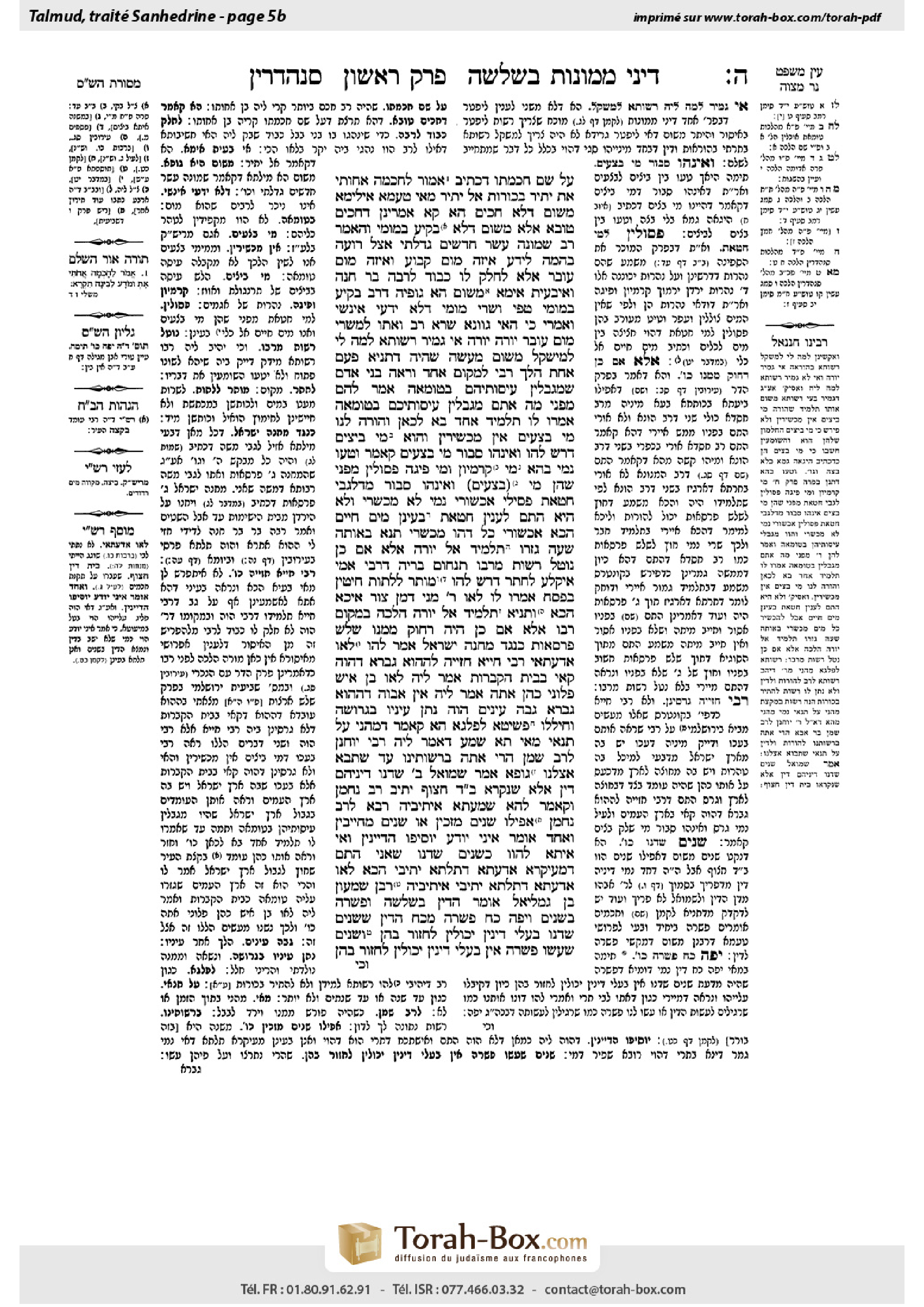
Sanhedrin 5b: Talmud study for Daf Yomi
Daf Yomi is the daily study of one Talmud folio. Explore 37 tractates with scans, Hebrew text, Sefaria English and AI-generated French translations where annotated.
Passage selection and English or AI-generated French translation are available where the scan has annotations. Daf Study is independent of Torah-Box and Sefaria.
Browse Sanhedrin · סנהדרין · All tractatesSanhedrin 5b text and translations
This page of Sanhedrin includes the Aramaic text, an English translation and an AI-generated French translation, alongside the scan above.
סנהדרין ה׳ ב · Aramaic and Hebrew text
עַל שֵׁם חׇכְמָתוֹ, דִּכְתִיב: ״אֱמֹר לַחׇכְמָה אֲחֹתִי אָתְּ״.
יַתִּיר בְּכוֹרוֹת? אַל יַתִּיר. מַאי טַעְמָא? אִילֵּימָא מִשּׁוּם דְּלָא חַכִּים, הָא קָא אָמְרִינַן דְּחַכִּים טוּבָא! אֶלָּא מִשּׁוּם דְּלָא בְּקִיעַ בְּמוּמֵי.
וְהָאָמַר רַב: שְׁמוֹנָה עָשָׂר חֳדָשִׁים גָּדַלְתִּי אֵצֶל רוֹעֵה בְהֵמָה, לֵידַע אֵיזֶה מוּם קָבוּעַ וְאֵיזֶה מוּם עוֹבֵר? אֶלָּא, לְחַלֵּק לוֹ כָּבוֹד לְרַבָּה בַּר חָנָה.
וְאִיבָּעֵית אֵימָא: מִשּׁוּם הָא גּוּפֵיהּ, דְּרַב בְּקִיעַ בְּמוּמֵי טְפֵי, וְשָׁרֵי מוּמֵי דְּלָא יָדְעִי אִינָשֵׁי. וְאָמְרִי: ״כִּי הַאי גַוְונָא שְׁרָא רַב״, וְאָתוּ לְמִשְׁרֵי מוּם עוֹבֵר.
יוֹרֶה, יוֹרֶה. אִי גְּמִיר, רְשׁוּתָא לְמָה לִי לְמִישְׁקַל? מִשּׁוּם מַעֲשֶׂה שֶׁהָיָה.
דְּתַנְיָא: פַּעַם אַחַת הָלַךְ רַבִּי לְמָקוֹם אֶחָד, וְרָאָה בְּנֵי אָדָם שֶׁמְּגַבְּלִין עִיסּוֹתֵיהֶם בְּטוּמְאָה. אָמַר לָהֶם: מִפְּנֵי מָה אַתֶּם מְגַבְּלִין עִיסּוֹתֵיכֶם בְּטוּמְאָה? אָמְרוּ לוֹ: תַּלְמִיד אֶחָד בָּא לְכָאן וְהוֹרָה לָנוּ: מֵי בְצָעִים אֵין מַכְשִׁירִין. וְהוּא מֵי בֵיצִים דְּרַשׁ לְהוּ, וְאִינְהוּ סְבוּר מֵי בְצָעִים קָאָמַר.
וְטָעוּ נָמֵי בְּהָא: מֵי קֵרַמְיוֹן וּמֵי פֵיגָה פְּסוּלִין, מִפְּנֵי שֶׁהֵן מֵי בְצָעִים. וְאִינְהוּ סְבוּר: מִדִּלְגַבֵּי חַטָּאת פְּסִילִי – אַכְשׁוֹרֵי נָמֵי לָא מַכְשְׁרִי. וְלָא הִיא: הָתָם, לְעִנְיַן חַטָּאת, בָּעֵינַן מַיִם חַיִּים; הָכָא, אַכְשׁוֹרֵי כָּל דְּהוּ מַכְשְׁרִי.
תָּנָא, בְּאוֹתָהּ שָׁעָה גָּזְרוּ: תַּלְמִיד אַל יוֹרֶה אֶלָּא אִם כֵּן נוֹטֵל רְשׁוּת מֵרַבּוֹ.
תַּנְחוּם בְּרֵיהּ דְּרַבִּי אַמֵּי אִיקְּלַע לְחֶתֶר. דְּרַשׁ לְהוּ: מוּתָּר לִלְתּוֹת חִיטִּין בַּפֶּסַח. אָמְרוּ לוֹ: לָאו רַבִּי מַנִּי דְּמִן צוּר אִיכָּא הָכָא? וְתַנְיָא: תַּלְמִיד אַל יוֹרֶה הֲלָכָה בִּמְקוֹם רַבּוֹ, אֶלָּא אִם כֵּן הָיָה רָחוֹק מִמֶּנּוּ שָׁלֹשׁ פַּרְסָאוֹת כְּנֶגֶד מַחֲנֵה יִשְׂרָאֵל. אָמַר לְהוּ: לָאו אַדַּעְתַּאי.
רַבִּי חִיָּיא חַזְיֵיהּ לְהָהוּא גַּבְרָא דַּהֲוָה קָאֵי בְּבֵית הַקְּבָרוֹת. אֲמַר לֵיהּ: לָאו בֶּן אִישׁ פְּלוֹנִי כֹּהֵן אַתָּה? אָמַר לֵיהּ: אִין. אֲבוּהּ דְּהָהוּא גַּבְרָא גְּבַהּ עֵינַיִם הֲוָה, נָתַן עֵינָיו בִּגְרוּשָׁה וְחִילְּלוֹ.
פְּשִׁיטָא, לְפַלְגָא – הָא קָאָמַר דְּמַהֲנֵי. עַל תְּנַאי מַאי? תָּא שְׁמַע, דַּאֲמַר לֵיהּ רַבִּי יוֹחָנָן לְרַב שֶׁמֶן: הֲרֵי אַתָּה בִּרְשׁוּתֵנוּ עַד שֶׁתָּבֹא אֶצְלֵנוּ.
גּוּפָא, אָמַר שְׁמוּאֵל: שְׁנַיִם שֶׁדָּנוּ – דִּינֵיהֶם דִּין, אֶלָּא שֶׁנִּקְרָא בֵּית דִּין חָצוּף. יָתֵיב רַב נַחְמָן וְקָאָמַר לְהָא שְׁמַעְתָּא. אֵיתִיבֵיהּ רָבָא לְרַב נַחְמָן: אֲפִילּוּ שְׁנַיִם מְזַכִּין אוֹ שְׁנַיִם מְחַיְּיבִין וְאֶחָד אוֹמֵר אֵינִי יוֹדֵעַ – יוֹסִיפוּ הַדַּיָּינִין. וְאִי אִיתָא, לִהְווֹ כִּשְׁנַיִם שֶׁדָּנוּ!
שָׁאנֵי הָתָם, דְּמֵעִיקָּרָא אַדַּעְתָּא דִּתְלָתָא יְתִיבִי. הָכָא, לָאו אַדַּעְתָּא דִּתְלָתָא יְתֵיבִי.
אֵיתִיבֵיהּ, רַבָּן שִׁמְעוֹן בֶּן גַּמְלִיאֵל אוֹמֵר: הַדִּין בִּשְׁלֹשָׁה, וּפְשָׁרָה בִּשְׁנַיִם. וְיָפֶה כֹּחַ פְּשָׁרָה מִכֹּחַ הַדִּין, שֶׁשְּׁנַיִם שֶׁדָּנוּ – בַּעֲלֵי דִינִין יְכוֹלִין לַחֲזוֹר בָּהֶן, וּשְׁנַיִם שֶׁעָשׂוּ פְּשָׁרָה – אֵין בַּעֲלֵי דִינִין יְכוֹלִין לַחֲזוֹר בָּהֶן.
Sanhedrin 5b · English translation
It was due to his extraordinary wisdom, as it is written: “Say to wisdom: You are my sister” (Proverbs 7:4). Therefore, calling him: My sister’s son, was an indication of his great wisdom.
The Gemara had related that Rabbi Ḥiyya asked Rabbi Yehuda HaNasi: May Rav declare a firstborn animal permitted, and that Rabbi Yehuda HaNasi had responded: He may not declare such an animal permitted. The Gemara asks: What is the reason that he denied him this permission? If we say that it was because Rav was not sufficiently wise and learned, but that is difficult, as we already said that he was exceedingly wise. Rather, it must be that it was because, although he was quite knowledgeable about the halakha, he was not an expert with regard to blemishes, meaning that he lacked the practical expertise to apply the halakha to actual cases.
The Gemara rejects this answer. But didn’t Rav say: I apprenticed with a shepherd for eighteen months in order to be able to know which blemish is a permanent blemish, and which is a temporary blemish? Evidently, he had a high level of practical expertise in this matter. The Gemara explains: Rather, it was in order to bestow honor upon Rabba bar Ḥana. Rabbi Yehuda HaNasi wanted to ensure that Rabba bar Ḥana would be treated with respect, so he made sure that there was an area of halakha with regard to which the people would not be able to consult with Rav and would need to consult with Rabba bar Ḥana instead.
And if you wish, say instead: It is due to this fact itself: Since Rav was a great expert with regard to blemishes, he would permit blemishes that average people do not know about. And as a result, they would erroneously say with regard to a different blemish: In a case like this Rav declared the animal permitted, and in this way they would come to erroneously permit an animal with a temporary blemish, believing it to be identical to the blemish that Rav had declared permitted. Due to this concern, Rav was denied the authority to declare firstborn animals permitted on the basis of a blemish.
With regard to the permission granted to Rabba bar Ḥana and Rav, the Gemara had related that Rabbi Ḥiyya asked Rabbi Yehuda HaNasi: May he teach people and issue rulings concerning what is prohibited and what is permitted? And Rabbi Yehuda HaNasi responded: He may teach. The Gemara asks: If he had studied and mastered the relevant halakhot, why do I need him to receive permission? The need for formal authority is understandable when it comes to serving on a court to judge cases of monetary law, but any knowledgeable person should be qualified to answer questions about ritual law. The Gemara explains: The need for such permission is due to an incident that took place.
As it is taught in a baraita: Rabbi Yehuda HaNasi once went to a certain place, and he saw people there kneading dough while they were in a state of ritual impurity, and they believed that nevertheless, the dough remained ritually pure. Rabbi Yehuda HaNasi said to them: For what reason are you kneading your dough in a state of ritual impurity? They said to him: A certain Torah scholar came here and taught us that water from swamps [mei betza’im] does not render food susceptible to contract ritual impurity. Therefore, they would take water from swamps and knead dough with it, in the mistaken belief that such dough would not be susceptible to ritual impurity. But in reality, what he taught them was that water of eggs [mei beitzim], i.e., the albumin of eggs, does not render food susceptible to impurity, as it is not considered water. But they thought he said: Water from swamps.
And the residents of that same place erred also with regard to this: It was taught in a mishna (Para 8:10): The waters of the Keramiyyon River and the waters of the Piga River are not fit for mixing with ashes of the red heifer to use as water of purification, since they are water from swamps. And they erroneously thought: Since this water is not fit for use as water of purification, this means it is not considered water, and therefore it also does not render food susceptible to contracting impurity. But it is not so, as there, with regard to water of purification, we need: “Running water” (see Numbers 19:17), and water from swamps is not running water. But here, with regard to rendering food susceptible to impurity, any water renders food susceptible.
It was taught: At that time, when Rabbi Yehuda HaNasi discovered the consequences resulting from a Torah scholar who was not precise with his terminology, the Sages decreed: A Torah scholar may not teach halakha unless he receives permission from his teacher to do so. The teacher should not grant him this permission if he does not know how to express himself in a clear manner.
Concerning a similar matter, the Gemara relates: Tanḥum, son of Rabbi Ami, arrived at a place called Ḥatar, and he taught them: It is permitted to wash wheat in a small amount of water in order to make it easier to peel during the grinding process on Passover, and there is no concern that perhaps it will become leavened. They said to him: Isn’t Rabbi Mani from Tyre here i.e., near our location? And it is taught in a baraita: A Torah scholar may not teach halakha in the vicinity of his teacher, unless he is distant from the teacher by at least three parasangs [parsaot], corresponding to the size of the camp of Israel. In the encampment in the wilderness no one else judged cases, as all the Jewish people brought their cases to Moses (see Exodus 33:7). Tanḥum, son of Rabbi Ami, said to them: It did not enter my mind that Rabbi Mani was in the vicinity.
The Gemara relates: Rabbi Ḥiyya saw a certain man standing in a cemetery. He said to him: Are you not the son of so-and-so the priest? As it is prohibited for priests to come into contact with the dead (see Leviticus 21:1–4), Rabbi Ḥiyya was surprised to see a priest standing in a cemetery. The man said to him: Yes, but that man’s, meaning his own, father was a man with raised eyes who would desire things that he saw, even if they were forbidden. He set his eyes upon a divorcée and married her despite the Torah prohibition against such a union (see Leviticus 21:7), and thereby disqualified the offspring of that union from the sanctity of priesthood. As the son of a priest and a divorcée, the man had the status of a ḥalal and was therefore not obligated to abide by the restrictions specific to priests.
Continuing the discussion about receiving permission to teach halakha, the Gemara discusses the extent of this authority. It is obvious that one’s teacher can grant partial permission, meaning permission to rule on certain types of cases but not others, as it has been said above that doing so is effective. But what is the halakha with regard to granting such permission conditionally? Is it possible to grant permission limited to a certain period of time, or limited to a certain location? The Gemara suggests: Come and hear the solution to this matter from what Rabbi Yoḥanan said to Rav Shemen: You have our permission to instruct and to adjudicate until you return to us. This statement proves that it is possible to grant permission limited to a specific period of time.
§ Earlier, the Gemara discussed the possibility of a court consisting of only two judges adjudicating a case. Concerning the matter itself, Shmuel says: With regard to two judges who adjudicated a case, their judgment is a valid judgment, but they are called an impudent court. Rav Naḥman sat and said this halakha. Rava raised an objection to Rav Naḥman from a mishna (29a): In a case where three judges are adjudicating a case, even if two judges deem the defendant exempt from payment or two judges deem him liable to pay, and one says: I do not know, the judges must add another judge, since the one who abstained has removed himself from the court, and there are not enough judges. And if it is so as Shmuel says, they should be viewed as two judges who adjudicated the case, and there would be no need to add another judge, as a judgment passed by two judges is valid.
Rav Naḥman answered him: It is different there, as they convened from the outset with the knowledge that they are three and intended to judge the case with three judges. Therefore, if one abstains, they must add another to complete the quorum. But here they did not convene with the knowledge that they are three, but rather intended to adjudicate the case as a court of two judges.
Rava raised an objection to Rav Naḥman from a baraita: Rabban Shimon ben Gamliel says: Cases of monetary law are adjudicated by three judges, and mediation leading to compromise can be performed by two mediators. And the power of compromise is greater than the power of adjudication, as if two judges adjudicated a case, the litigants are able to withdraw from the case and demand a court with a complete quorum. But if two mediated a compromise, the litigants may not withdraw.
Sanhedrin 5b · Traduction française (IA)
C’était en raison de sa sagesse exceptionnelle, comme il est écrit : « Dis à la sagesse : Tu es ma sœur » (Proverbes 7:4). Ainsi, l’appeler « fils de ma sœur » indiquait sa grande sagesse.
La Guemara avait rapporté que Rabbi Ḥiyya avait demandé à Rabbi Yehuda HaNasi : « Rav peut-il déclarer un animal premier-né permis ? » Rabbi Yehuda HaNasi avait répondu : « Il ne peut pas déclarer un tel animal permis. » La Guemara demande : Pourquoi lui a-t-il refusé cette autorisation ? Si l’on dit que c’était parce que Rav n’était pas suffisamment sage et instruit, cela pose une difficulté, car nous avons déjà dit qu’il était extrêmement sage. Il faut donc plutôt dire que, bien qu’il connût parfaitement la halakha, il n’était pas expert en matière de défauts, c’est-à-dire qu’il ne possédait pas l’expertise pratique nécessaire pour appliquer la halakha à des cas concrets.
La Guemara rejette cette réponse. Mais Rav n’a-t-il pas dit : « J’ai été apprenti auprès d’un berger pendant dix-huit mois afin de savoir quel défaut est permanent et quel défaut est temporaire » ? Il est donc manifeste qu’il possédait une grande expertise pratique en la matière. La Guemara explique : C’était plutôt afin d’honorer Rabba bar Ḥana. Rabbi Yehuda HaNasi voulait s’assurer que Rabba bar Ḥana serait traité avec respect ; il veilla donc à ce qu’il y ait un domaine de halakha sur lequel les gens ne pourraient pas consulter Rav et devraient plutôt consulter Rabba bar Ḥana.
Et si tu le souhaites, dis plutôt que c’était précisément pour cette raison : puisque Rav était très expert en matière de défauts, il aurait autorisé des animaux présentant des défauts que les gens ordinaires ne connaissent pas. Par conséquent, à propos d’un autre défaut, ils auraient pu dire par erreur : « Dans un cas comme celui-ci, Rav a déclaré l’animal permis », et ainsi en venir à autoriser à tort un animal présentant un défaut temporaire, croyant qu’il s’agissait du même défaut que celui que Rav avait déclaré permis. Pour éviter cette erreur, Rav ne reçut pas l’autorité de déclarer permis un animal premier-né en raison d’un défaut.
Au sujet de l’autorisation accordée à Rabba bar Ḥana et à Rav, la Guemara avait rapporté que Rabbi Ḥiyya avait demandé à Rabbi Yehuda HaNasi : « Peut-il enseigner aux gens et rendre des décisions sur ce qui est interdit et ce qui est permis ? » Rabbi Yehuda HaNasi avait répondu : « Il peut enseigner. » La Guemara demande : S’il a étudié et maîtrisé les halakhot concernées, pourquoi doit-il recevoir une autorisation ? La nécessité d’une autorité formelle se comprend lorsqu’il s’agit de siéger dans un tribunal pour juger des affaires de droit pécuniaire, mais toute personne instruite devrait être qualifiée pour répondre aux questions de loi rituelle. La Guemara explique : Cette autorisation est nécessaire en raison d’un événement qui s’est produit.
Comme il est enseigné dans une baraïta : Rabbi Yehuda HaNasi se rendit un jour dans un certain lieu et y vit des gens pétrir de la pâte alors qu’ils étaient en état d’impureté rituelle, persuadés que la pâte demeurait malgré tout pure. Rabbi Yehuda HaNasi leur dit : « Pourquoi pétrissez-vous votre pâte alors que vous êtes en état d’impureté rituelle ? » Ils lui répondirent : « Un certain érudit de la Torah est venu ici et nous a enseigné que l’eau des marécages [mei betza’im] ne rend pas les aliments susceptibles de contracter l’impureté rituelle. » Ils prenaient donc de l’eau des marécages pour pétrir la pâte, croyant à tort qu’une telle pâte ne serait pas susceptible de contracter l’impureté rituelle. En réalité, ce qu’il leur avait enseigné, c’est que l’eau des œufs [mei beitzim], c’est-à-dire le blanc des œufs, ne rend pas les aliments susceptibles de contracter l’impureté, car elle n’est pas considérée comme de l’eau. Mais eux avaient cru qu’il avait dit : « L’eau des marécages. »
Les habitants de ce même lieu se trompèrent aussi à ce sujet : il est enseigné dans une Michna (Para 8:10) que les eaux du fleuve Keramiyyon et celles du fleuve Piga ne conviennent pas pour être mélangées aux cendres de la vache rousse afin de servir d’eau de purification, puisqu’il s’agit d’eaux de marécage. Ils pensèrent à tort : « Puisque cette eau ne convient pas pour servir d’eau de purification, cela signifie qu’elle n’est pas considérée comme de l’eau ; elle ne rend donc pas non plus les aliments susceptibles de contracter l’impureté. » Mais il n’en est pas ainsi : dans le cas de l’eau de purification, il faut de « l’eau vive » (voir Nombres 19:17), et l’eau des marécages n’est pas de l’eau vive. En revanche, pour rendre les aliments susceptibles de contracter l’impureté, n’importe quelle eau les rend susceptibles.
Il a été enseigné : À cette époque, lorsque Rabbi Yehuda HaNasi découvrit les conséquences de l’imprécision terminologique d’un érudit de la Torah, les Sages décrétèrent qu’un érudit de la Torah ne peut enseigner la halakha sans avoir reçu l’autorisation de son maître. Le maître ne doit pas lui accorder cette autorisation s’il ne sait pas s’exprimer clairement.
À propos d’une question similaire, la Guemara rapporte : Tanḥum, fils de Rabbi Ami, arriva dans un lieu appelé Ḥatar et leur enseigna qu’il est permis de laver le blé dans une petite quantité d’eau afin de faciliter son épluchage au cours de la mouture, à Pessaḥ, et qu’il n’y a pas lieu de craindre qu’il fermente. Ils lui dirent : « Rabbi Mani de Tyr n’est-il pas ici, c’est-à-dire près de chez nous ? » Or, il est enseigné dans une baraïta qu’un érudit de la Torah ne peut enseigner la halakha dans le voisinage de son maître, à moins d’en être éloigné d’au moins trois parasanges [parsaot], ce qui correspond à l’étendue du campement d’Israël. Dans le campement du désert, personne d’autre ne jugeait les affaires, car tout le peuple juif présentait ses affaires à Moïse (voir Exode 33:7). Tanḥum, fils de Rabbi Ami, leur répondit : « Je n’avais pas pensé que Rabbi Mani se trouvait dans les environs. »
La Guemara rapporte : Rabbi Ḥiyya vit un homme se tenir dans un cimetière. Il lui dit : « N’es-tu pas le fils d’un tel, le prêtre ? » Les prêtres ayant l’interdiction d’entrer en contact avec les morts (voir Lévitique 21:1–4), Rabbi Ḥiyya fut surpris de voir un prêtre dans un cimetière. L’homme lui répondit : « Oui, mais mon père était un homme aux yeux baladeurs, qui convoitait ce qu’il voyait, même si cela lui était interdit. » Il posa les yeux sur une femme divorcée et l’épousa, malgré l’interdiction de la Torah écrite concernant une telle union (voir Lévitique 21:7), disqualifiant ainsi les enfants issus de cette union du statut de sainteté sacerdotale. Fils d’un prêtre et d’une femme divorcée, cet homme avait le statut de ḥalal et n’était donc pas tenu de respecter les restrictions propres aux prêtres.
Poursuivant la discussion sur l’autorisation d’enseigner la halakha, la Guemara examine l’étendue de cette autorité. Il est évident qu’un maître peut accorder une autorisation partielle, c’est-à-dire permettre de rendre des décisions sur certains types d’affaires mais pas sur d’autres, puisqu’il a été dit plus haut qu’une telle autorisation est valable. Mais quelle est la halakha concernant l’octroi d’une autorisation sous condition ? Peut-on accorder une autorisation limitée à une période précise ou à un lieu donné ? La Guemara propose : « Viens et entends » la réponse à cette question dans les paroles de Rabbi Yoḥanan à Rav Shemen : « Nous t’accordons l’autorisation d’enseigner et de juger jusqu’à ton retour auprès de nous. » Cette déclaration prouve qu’il est possible d’accorder une autorisation limitée à une période déterminée.
§ Plus tôt, la Guemara a examiné la possibilité qu’un tribunal composé de seulement deux juges juge une affaire. À propos de cette question, Shmuel dit : « Si deux juges ont jugé une affaire, leur jugement est valable, mais on appelle cela un tribunal effronté. » Rav Naḥman était assis et énonçait cette halakha. Rava souleva contre Rav Naḥman une objection tirée d’une Michna (29a) : Lorsqu’une affaire est jugée par trois juges, même si deux juges déclarent l’accusé quitte de tout paiement ou si deux juges le déclarent tenu de payer, et qu’un troisième dit : « Je ne sais pas », les juges doivent en ajouter un autre, car celui qui s’est abstenu s’est retiré du tribunal et il n’y a plus assez de juges. Or, s’il en est ainsi, comme le dit Shmuel, on devrait les considérer comme deux juges ayant jugé l’affaire ; il ne serait donc pas nécessaire d’ajouter un autre juge, puisque le jugement rendu par deux juges est valable.
Rav Naḥman lui répondit : Le cas de la Michna est différent, car ils se sont réunis dès le départ en sachant qu’ils étaient trois et avec l’intention de juger l’affaire à trois. Par conséquent, si l’un d’eux s’abstient, ils doivent en ajouter un autre pour compléter le quorum. Ici, en revanche, ils ne se sont pas réunis en sachant qu’ils étaient trois ; ils avaient plutôt l’intention de juger l’affaire en tant que tribunal de deux juges.
Rava souleva contre Rav Naḥman une objection tirée d’une baraïta : Rabban Shimon ben Gamliel dit : « Les affaires de droit pécuniaire sont jugées par trois juges, tandis qu’un compromis peut être négocié par deux médiateurs. » Le pouvoir du compromis est supérieur à celui du jugement, car si deux juges ont jugé une affaire, les parties peuvent se retirer de la procédure et exiger un tribunal ayant son quorum complet. Mais si deux médiateurs ont négocié un compromis, les parties ne peuvent pas se retirer.
Traduction française générée par IA à partir de l’édition anglaise de Sefaria. Vérifie toujours un passage avec le texte source.
Text from Sefaria: William Davidson Edition - Vocalized Aramaic (CC BY NC); William Davidson Edition - English (CC BY NC).