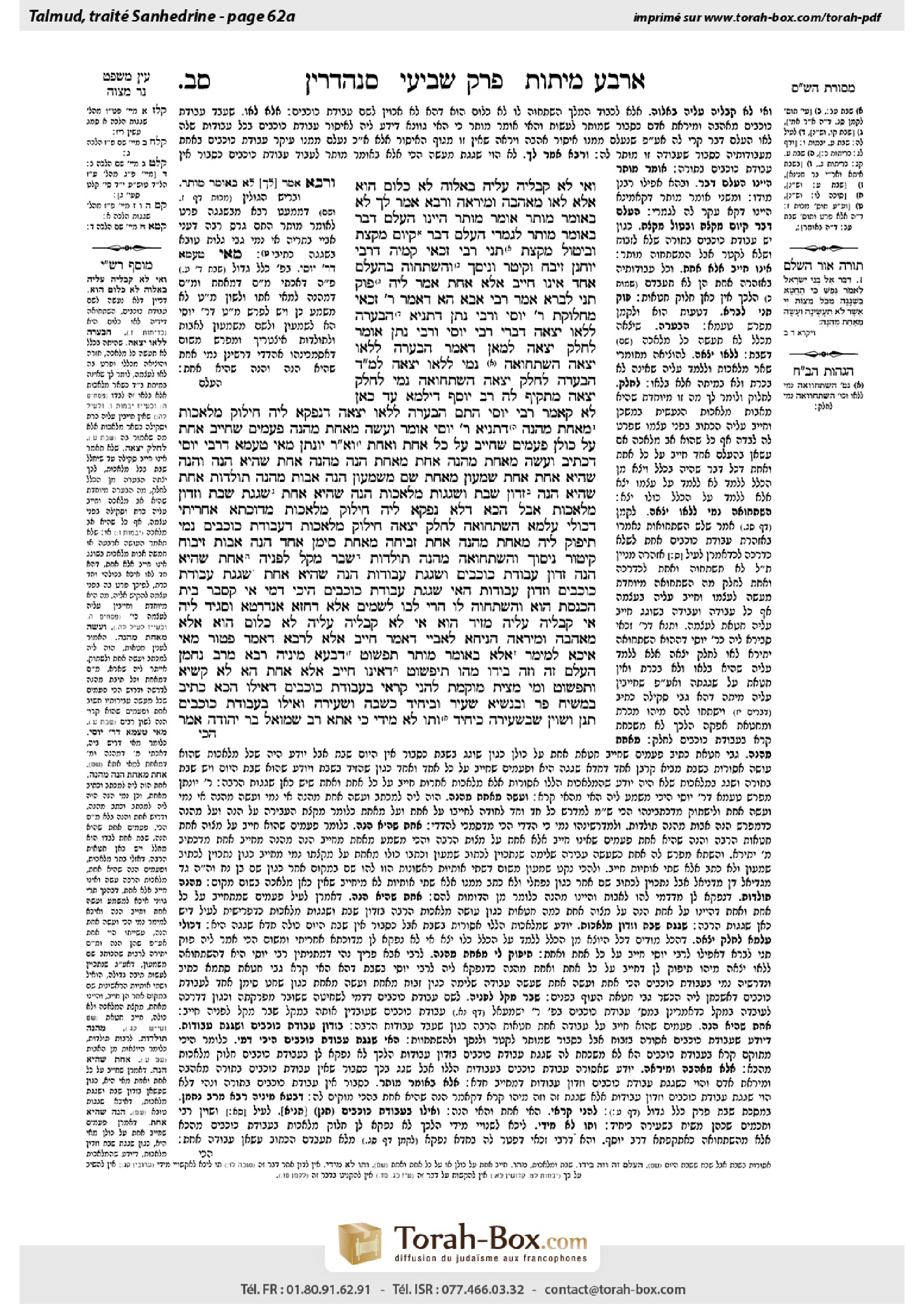
Sanhedrin 62a: Talmud study for Daf Yomi
Daf Yomi is the daily study of one Talmud folio. Explore 37 tractates with scans, Hebrew text, Sefaria English and AI-generated French translations where annotated.
Passage selection and English or AI-generated French translation are available where the scan has annotations. Daf Study is independent of Torah-Box and Sefaria.
Browse Sanhedrin · סנהדרין · All tractatesSanhedrin 62a text and translations
This page of Sanhedrin includes the Aramaic text, an English translation and an AI-generated French translation, alongside the scan above.
סנהדרין ס״ב א · Aramaic and Hebrew text
וְאִי לָא קַבְּלֵיהּ עֲלֵיהּ בֶּאֱלוֹהַּ – לָא כְּלוּם הוּא. אֶלָּא לָאו, מֵאַהֲבָה וּמִיִּרְאָה?
וְרָבָא אָמַר לָךְ: לָא, בְּאוֹמֵר מוּתָּר.
אוֹמֵר מוּתָּר, הַיְינוּ הֶעְלֵם דָּבָר!
בְּאוֹמֵר מוּתָּר לִגְמָרֵי. הֶעְלֵם דָּבָר – קִיּוּם מִקְצָת וּבִיטּוּל מִקְצָת.
תָּנֵי רַבִּי זַכַּאי קַמֵּיהּ דְּרַבִּי יוֹחָנָן: זִיבַּח, וְקִיטֵּר, וְנִיסֵּךְ, וְהִשְׁתַּחֲוָה בְּהֶעְלֵם אֶחָד – אֵינוֹ חַיָּיב אֶלָּא אַחַת.
אֲמַר לֵיהּ: פּוֹק תְּנִי לְבָרָא.
אָמַר רַבִּי אַבָּא: הָא דְּאָמַר רַבִּי זַכַּאי מַחְלוֹקֶת רַבִּי יוֹסֵי וְרַבִּי נָתָן, דְּתַנְיָא: הַבְעָרָה לְלָאו יָצָאת, דִּבְרֵי רַבִּי יוֹסֵי.
וְרַבִּי נָתָן אוֹמֵר: לְחַלֵּק יָצָאת.
לְמַאן דְּאָמַר הַבְעָרָה לְלָאו יָצָאת, הִשְׁתַּחֲוָאָה נָמֵי לְלָאו יָצָאת.
לְמַאן דְּאָמַר הַבְעָרָה לְחַלֵּק יָצָאת, הִשְׁתַּחֲוָאָה נָמֵי לְחַלֵּק יָצָאת.
מַתְקֵיף לַהּ רַב יוֹסֵף: דִּילְמָא עַד כָּאן לָא קָאָמַר רַבִּי יוֹסֵי הָתָם הַבְעָרָה לְלָאו יָצָאת, דְּנָפְקָא לֵיהּ חִילּוּק מְלָאכוֹת מֵ״אַחַת מֵהֵנָּה״?
דְּתַנְיָא: רַבִּי יוֹסֵי אוֹמֵר, ״וְעָשָׂה מֵאַחַת מֵהֵנָּה״ – פְּעָמִים שֶׁחַיָּיב אַחַת עַל כּוּלָּן, פְּעָמִים שֶׁחַיָּיב עַל כׇּל אַחַת וְאַחַת.
וְאָמַר רַבִּי יוֹנָתָן: מַאי טַעְמָא דְּרַבִּי יוֹסֵי? דִּכְתִיב ״וְעָשָׂה מֵאַחַת מֵהֵנָּה״. ״אַחַת״, ״מֵאַחַת״. ״הֵנָּה״, ״מֵהֵנָּה״. אַחַת שֶׁהִיא הֵנָּה, וְהֵנָּה שֶׁהִיא אַחַת.
״אַחַת״ – ״שִׁמְעוֹן״, ״מֵאַחַת״ – ״שֵׁם״ מִ״שִּׁמְעוֹן״.
״הֵנָּה״ – אָבוֹת, ״מֵהֵנָּה״ – תּוֹלָדוֹת. ״אַחַת״ שֶׁהִיא ״הֵנָּה״: זְדוֹן שַׁבָּת וְשִׁגְגַת מְלָאכוֹת. ״הֵנָּה״ שֶׁהִיא ״אַחַת״: שִׁגְגַת שַׁבָּת וּזְדוֹן מְלָאכוֹת.
אֲבָל הָכָא, דְּלָא נָפְקָא לֵיהּ חִילּוּק מְלָאכוֹת מִדּוּכְתָּא אַחֲרִיתִי, דְּכוּלֵּי עָלְמָא הִשְׁתַּחֲוָאָה לְחַלֵּק יָצָאת.
חִילּוּק מְלָאכוֹת דַּעֲבוֹדָה זָרָה נָמֵי תִּיפּוֹק לֵיהּ מֵ״אַחַת מֵהֵנָּה״? ״אַחַת״ – זְבִיחָה, ״מֵאַחַת״ – סִימָן אֶחָד.
״הֵנָּה״ – אָבוֹת: זִיבּוּחַ, קִיטּוּר, נִיסּוּךְ, וְהִשְׁתַּחֲוָאָה. ״מֵהֵנָּה״ – תּוֹלָדוֹת: שָׁבַר מַקֵּל לְפָנֶיהָ.
״אַחַת״ שֶׁהִיא ״הֵנָּה״: זְדוֹן עֲבוֹדָה זָרָה וְשִׁגְגַת עֲבוֹדוֹת. ״הֵנָּה״ שֶׁהִיא ״אַחַת״: שִׁגְגַת עֲבוֹדָה זָרָה וּזְדוֹן עֲבוֹדוֹת.
הַאי שִׁגְגַת עֲבוֹדָה זָרָה, הֵיכִי דָּמֵי? אִי קָסָבַר בֵּית הַכְּנֶסֶת הוּא וְהִשְׁתַּחֲוָה לוֹ, הֲרֵי לִבּוֹ לַשָּׁמַיִם.
אֶלָּא דַּחֲזָא אִנְדְּרָטָא וּסְגֵיד לֵיהּ. אִי קַבְּלֵיהּ עֲלֵיהּ – מֵזִיד הוּא, אִי לָא קַבְּלֵיהּ עֲלֵיהּ – לָא כְּלוּם הוּא.
אֶלָּא מֵאַהֲבָה וּמִיִּרְאָה. הָנִיחָא לְאַבַּיֵּי, דְּאָמַר חַיָּיב; אֶלָּא לְרָבָא, דְּאָמַר פָּטוּר, מַאי אִיכָּא לְמֵימַר?
אֶלָּא בְּאוֹמֵר ״מוּתָּר״. תִּפְשׁוֹט דִּבְעָא מִינֵּיהּ רָבָא מֵרַב נַחְמָן: הֶעְלֵם זֶה וָזֶה בְּיָדוֹ, מַהוּ?
תִּיפְשׁוֹט, דְּאֵינוֹ חַיָּיב אֶלָּא אַחַת. הָא לָא קַשְׁיָא, וְתִפְשׁוֹט.
וּמִי מָצֵית מוֹקְמַתְּ לְהָנֵי קְרָאֵי בַּעֲבוֹדָה זָרָה? דְּאִילּוּ הָכָא, כְּתִיב: בְּמָשִׁיחַ – פַּר, וּבְנָשִׂיא – שָׂעִיר, וּבְיָחִיד – כִּשְׂבָּה וּשְׂעִירָה.
וְאִילּוּ בַּעֲבוֹדָה זָרָה תְּנַן: וְשָׁוִין שֶׁבִּשְׂעִירָה כְּיָחִיד.
וְתוּ לָא מִידֵּי.
כִּי אֲתָא רַב שְׁמוּאֵל בַּר יְהוּדָה, אָמַר:
Sanhedrin 62a · English translation
And if he did not accept that person upon himself as a god, but rather bowed to the statue in order to honor the person, e.g., the king, what he did is nothing. Rather, is the baraita not referring to a case where the High Priest unwittingly worshipped an idol due to love or due to fear of someone? This proves that this is also considered idol worship.
And Rava could have said to you in response: No, the baraita is not referring to this case, but to a case where the High Priest says to himself that idol worship is permitted.
The Gemara challenges: If the baraita is referring to a case where the High Priest says to himself that idol worship is permitted, this is a case of a lapse of awareness concerning the fundamental halakhot of idol worship, in which case the Rabbis concede that the High Priest is obligated to bring an offering. Therefore, what is the difference between the opinion of Rabbi Yehuda HaNasi and that of the Sages?
The Gemara answers: It is a case where he says to himself that idol worship is entirely permitted, whereas the case of a lapse of awareness in which the Rabbis concede to the opinion of Rabbi Yehuda HaNasi is a case of upholding part of the prohibition and negating another part of it, i.e., a case where the High Priest recognizes that idol worship is prohibited but mistakenly assumes that certain idolatrous activities are permitted.
§ Rabbi Zakkai taught the following baraita before Rabbi Yoḥanan: If one sacrificed an animal as an idolatrous offering, and burned incense as an idolatrous offering, and poured a libation to an idol, and bowed to an idol, all in the course of one lapse of awareness, forgetting that these actions were prohibited, he is obligated to bring only one sin-offering; he is not obligated to bring an offering for each and every act of idol worship.
Rabbi Yoḥanan said to him: Go out and teach it outside; i.e., such a baraita must not be taught in the study hall, as the halakha is that one is obligated to bring an offering for each and every act of idol worship.
Rabbi Abba says: That which Rabbi Zakkai says is subject to a tannaitic dispute between Rabbi Yosei and Rabbi Natan, as it is taught in a baraita: The prohibition against kindling a fire on Shabbat was singled out from the general category of labor prohibited on Shabbat, and it is written explicitly in the Torah in the verse: “You shall not kindle fire in all your dwelling places on the day of Shabbat” (Exodus 35:3). This was done to teach that the prohibition against kindling a fire on Shabbat is unlike other prohibited labors, as it is an ordinary prohibition, for which one is not liable to be killed by stoning. This is the statement of Rabbi Yosei.
And Rabbi Natan says: Kindling a fire is like any other labor prohibited on Shabbat, and it was singled out to divide the prohibited labors of Shabbat. In other words, by stating one prohibited labor separately, the Torah teaches that each labor performed on Shabbat constitutes its own separate prohibition. Consequently, one who unwittingly violates several categories of labor is obligated to bring a sin-offering for each and every act of prohibited labor.
Rabbi Abba concludes: According to the one who says that of all the labors that are prohibited on Shabbat, kindling a fire on Shabbat was singled out to be mentioned in the Torah to teach that it is an ordinary prohibition, then bowing, in the category of idol worship, which is mentioned explicitly in the verse: “You shall not bow to them nor worship them” (Exodus 20:5), was also singled out to teach that it is an ordinary prohibition, which is not punishable by stoning.
Whereas, according to the one who says that kindling a fire was singled out to divide the prohibited labors of Shabbat, bowing was also singled out to divide the rites of idol worship, i.e., to teach that one who unwittingly performs several forms of idol worship is obligated to bring a sin-offering for each and every act of idol worship. Therefore, the baraita taught by Rabbi Zakkai, which states that such a person is obligated to bring only one sin-offering, is in accordance with the former opinion, i.e., the opinion of Rabbi Yosei.
Rav Yosef objects to this: Perhaps Rabbi Yosei says there, with regard to the halakhot of Shabbat, that kindling a fire was singled out to teach that it is an ordinary prohibition only because he derives the division of labors on Shabbat, i.e., that one is obligated to bring an offering for each category of labor that he violated, from a different verse, namely: “From one of them” (Leviticus 4:2).
As it is taught in a baraita that Rabbi Yosei says with regard to the verse: “If any one shall sin through error, in any of the things which the Lord has commanded not to be done, and performs from one of them” (Leviticus 4:2), that there are times when one is liable to bring one sin-offering for all of his transgressions together, and there are times when one is liable to bring a sin-offering for each and every transgression.
And Rabbi Yonatan says: What is the reason for the opinion of Rabbi Yosei? As it is written: “And performs from one of them,” and Rabbi Yosei interprets the verse as follows: The word “one” is qualified, as the verse states: “From one.” Likewise, the word “them” is qualified, as the verse states: “Of them.” Rabbi Yosei derives that there are cases of one transgression that, with regard to punishment, is them, i.e., many. And there are cases of them, i.e., several transgressions, that, with regard to punishment, are one.
Rabbi Yonatan delineates the implementation of this principle with regard to the halakhot of Shabbat: “One” complete violation is, e.g., a case where one wrote a whole word as he intended, such as the name Shimon. The term “from one” is referring to a case where one performed only part of a complete act of labor, e.g., he wrote only some of the letters of a word, such as shin mem, from the name Shimon. These two letters spell the word shem. In such a case, one is obligated to bring an offering for his transgression of writing two letters, shin and mem, even though he did not complete his intended act of writing the entire name of Shimon.
Rabbi Yonatan continues: “Them” is referring to the primary categories of labor. The term “of them” includes the subcategories of labor. The cases of one transgression that with regard to punishment is them, i.e., it is counted as many transgressions, are those involving intention, i.e., awareness, on the part of the transgressor that it was Shabbat and unawareness on the part of the transgressor that the acts of labor that he was performing are prohibited on Shabbat. One who transgresses in this way is obligated to bring a sin-offering for each and every category of labor that he engages in. The cases of them, several transgressions, that with regard to punishment are one are those involving unawareness on the part of the transgressor that it was Shabbat and intention, i.e., awareness, that the acts of labor that he was performing are prohibited on Shabbat. One who transgresses in this way is obligated to bring only one sin-offering.
Rav Yosef concludes his objection to Rabbi Abba’s comparison between the status of the prohibition against kindling a fire on Shabbat and the status of the prohibition against bowing to an idol: The fact that Rabbi Yosei derives that kindling a fire on Shabbat is not punishable by death can be attributed to the fact that he derives from a different verse that one who violates several categories of labor is obligated to bring a sin-offering for each and every category of labor that he engages in. But here, with regard to idol worship, where he does not derive the division of labors, i.e., the division of categories of idol worship, from another place, perhaps everyone agrees that bowing was singled out to divide the prohibition of idol worship into different categories and bowing to an idol is punishable by death just like other forms of worship.
The Gemara asks according to both opinions, that of Rav Abba and that of Rav Yosef: Why not derive the division of labors with regard to idol worship, too, from the same verse from which Rabbi Yosei derives the division of labors with regard to Shabbat, namely: “From one of them”? Since this verse is not referring to the halakhot of Shabbat in particular, it can be interpreted with regard to idol worship in the same manner that it is interpreted with regard to Shabbat: The word “one” is referring to one complete, prohibited act of worship, such as sacrificing an animal as an idolatrous offering. The term “from one” is referring to one who performs part of an act of worship, e.g., one who did not finish slaughtering the offering, as he severed only one of the organs, i.e., the windpipe and gullet, that must be severed in ritual slaughter.
The word “them” is referring to the primary categories of idol worship that are derived from the manner in which God is worshipped in the Temple, namely, sacrificing an animal as an offering, burning incense, pouring a libation, and bowing. The term “of them” is referring to the subcategories of idol worship, e.g., one who broke a stick before an idol that is worshipped in such a manner. Breaking a stick is a subcategory of sacrificing, as an animal’s neck is broken when it is slaughtered.
The principle of one transgression that with regard to punishment is them, i.e., many, can be applied to a case of intention, i.e., awareness, on the part of the transgressor that idol worship is prohibited, and unawareness that the particular rites of worship that he was performing are prohibited. The principle of them, several transgressions, that with regard to punishment are one can be applied to a case of unawareness with regard to the prohibition of idol worship, i.e., the transgressor was unaware that idol worship is prohibited or that he was worshipping an idol, and intention, i.e., awareness, that the rites that he was performing are prohibited.
The Gemara responds to the suggestion that the division of categories of idol worship can be derived from this verse: What are the circumstances of unawareness with regard to idol worship? If the transgressor thought that a certain building was a synagogue and bowed to it, and he then realized that it is a house of idol worship, he is certainly exempt, as his heart was directed toward Heaven.
Rather, it must be a case where the transgressor saw a statue [andarta] of a person and bowed to it. This case must also be clarified: If he accepted that person upon himself as a god, he is an intentional transgressor and is liable to receive the death penalty, not to bring an offering. If he did not accept him upon himself as a god, but rather bowed to the statue in order to honor the person, what he did is nothing.
Rather, it is clearly a case where one worshipped an idol due to love or due to fear of someone, and he was unaware that this is prohibited. This works out well according to Abaye, who says that one who engages in idol worship due to love or fear is liable; accordingly, one who does so unwittingly must bring an offering. But according to Rava, who says that one who does so is exempt, what can be said?
Rather, according to Rava, unawareness with regard to idol worship can be explained as referring to a case where the transgressor says to himself that idol worship is permitted in general. If so, one can resolve the dilemma that Rava raised before Rav Naḥman: What is the halakha if one who violated Shabbat has a lapse of awareness of both this, i.e., that it was Shabbat, and that, i.e., that the particular labor that he performed is prohibited on Shabbat?
Rava’s dilemma had been left unresolved. If the phrase “and performs from one of them” is interpreted as referring to a case where one engages in idol worship thinking that it is permitted to do so, one can resolve that the transgressor is obligated to bring only one sin-offering for all of his acts of idol worship, according to this interpretation of the verse. The fact that Rava’s dilemma had been left unresolved therefore serves as a challenge to this interpretation. The Gemara refutes this challenge: This is not difficult; indeed, resolve the dilemma from here.
The Gemara asks: But can you interpret these verses, namely, “and performs from one of them,” with regard to idol worship at all? As here, in Leviticus, chapter 4, where this verse is written, it is written with regard to an anointed priest, i.e., the High Priest, stating that if he sinned unwittingly he brings a bull as a sin-offering, and with regard to a king who sinned unwittingly it is stated that he brings a goat as a sin-offering, and with regard to an ordinary individual it is stated that he brings a female lamb or a female goat.
Whereas with regard to idol worship we learned in a baraita (61b): And they agree that a High Priest who unwittingly engages in idol worship brings a female goat as a sin-offering, as does an ordinary individual. Clearly, then, the halakhot of unwitting idol worship are derived from a different source, i.e., Numbers, chapter 15.
The Gemara concludes: And there is nothing more to be discussed. The suggestion to derive a division of categories with regard to idol worship from the phrase in the verse “and performs from one of them” is groundless, and Rav Yosef’s objection to Rabbi Abba’s opinion is justified.
§ When Rav Shmuel bar Yehuda came from Eretz Yisrael to Babylonia, he said:
Sanhedrin 62a · Traduction française (IA)
Et s’il n’avait pas accepté cette personne comme dieu, mais s’était incliné devant la statue pour lui rendre hommage, par exemple au roi, son acte n’a aucune valeur. La baraïta ne parle-t-elle donc pas d’un cas où le grand prêtre a adoré une idole par inadvertance, par amour ou par crainte de quelqu’un ? Cela prouve que cela aussi est considéré comme un culte idolâtre.
Et Rava aurait pu te répondre : Non, la baraïta ne parle pas de ce cas, mais d’un cas où le grand prêtre se dit que le culte idolâtre est permis.
La Guemara objecte : Si la baraïta parle d’un cas où le grand prêtre se dit que le culte idolâtre est permis, il s’agit d’une méconnaissance des principes fondamentaux des halakhot du culte idolâtre. Dans ce cas, les Sages reconnaissent que le grand prêtre est tenu d’apporter un sacrifice. Quelle est donc la différence entre l’opinion de Rabbi Yehouda HaNassi et celle des Sages ?
La Guemara répond : Il s’agit d’un cas où il se dit que le culte idolâtre est entièrement permis, tandis que le cas de méconnaissance dans lequel les Sages se rallient à l’opinion de Rabbi Yehouda HaNassi est celui où l’on reconnaît une partie de l’interdit et où l’on en nie une autre, c’est-à-dire le cas où le grand prêtre sait que le culte idolâtre est interdit, mais suppose à tort que certaines pratiques idolâtres sont permises.
§ Rabbi Zakkaï enseigna la baraïta suivante devant Rabbi Yoḥanan : Si quelqu’un a sacrifié un animal comme offrande idolâtre, brûlé de l’encens comme offrande idolâtre, versé une libation à une idole et s’est incliné devant une idole, le tout au cours d’une seule méconnaissance, ayant oublié que ces actes étaient interdits, il est tenu d’apporter un seul sacrifice expiatoire ; il n’est pas tenu d’apporter un sacrifice pour chacun de ses actes de culte idolâtre.
Rabbi Yoḥanan lui dit : Va enseigner cela à l’extérieur ; autrement dit, une telle baraïta ne doit pas être enseignée à la maison d’étude, car la halakha veut que l’on soit tenu d’apporter un sacrifice pour chacun de ses actes de culte idolâtre.
Rav Abba dit : Ce que dit Rabbi Zakkaï fait l’objet d’une controverse entre Rabbi Yossei et Rabbi Natan, deux tannaïm, comme il est enseigné dans une baraïta : L’interdiction d’allumer un feu pendant Chabbat a été distinguée de la catégorie générale des travaux interdits pendant Chabbat et est explicitement formulée dans la Torah, dans le verset : « Vous n’allumerez pas de feu dans aucune de vos demeures le jour du Chabbat » (Exode 35:3). Cela a été fait pour enseigner que l’interdiction d’allumer un feu pendant Chabbat diffère des autres interdictions relatives aux travaux, car c’est une interdiction ordinaire, dont la violation n’est pas passible de lapidation. Telle est l’opinion de Rabbi Yossei.
Et Rabbi Natan dit : Allumer un feu est comme tout autre travail interdit pendant Chabbat, et cette interdiction a été distinguée afin de séparer les travaux interdits pendant Chabbat. Autrement dit, en énonçant séparément l’un des travaux interdits, la Torah enseigne que chaque travail accompli pendant Chabbat constitue une interdiction distincte. Par conséquent, celui qui enfreint involontairement plusieurs catégories de travaux est tenu d’apporter un sacrifice expiatoire pour chacun des travaux interdits qu’il a accomplis.
Rav Abba conclut : Selon celui qui dit que, parmi tous les travaux interdits pendant Chabbat, l’allumage d’un feu a été mentionné séparément dans la Torah pour enseigner qu’il s’agit d’une interdiction ordinaire, l’inclinaison, dans le domaine du culte idolâtre, a également été mentionnée séparément dans le verset : « Tu ne te prosterneras pas devant eux et tu ne les serviras pas » (Exode 20:5), afin d’enseigner qu’il s’agit d’une interdiction ordinaire, qui n’est pas passible de lapidation.
En revanche, selon celui qui dit que l’allumage d’un feu a été distingué afin de séparer les travaux interdits pendant Chabbat, l’inclinaison a également été distinguée afin de séparer les rites du culte idolâtre, c’est-à-dire pour enseigner que celui qui accomplit involontairement plusieurs formes de culte idolâtre est tenu d’apporter un sacrifice expiatoire pour chacun de ses actes de culte idolâtre. Par conséquent, la baraïta enseignée par Rabbi Zakkaï, selon laquelle une telle personne n’est tenue d’apporter qu’un seul sacrifice expiatoire, suit la première opinion, celle de Rabbi Yossei.
Rav Yossef objecte : Peut-être Rabbi Yossei dit-il là, à propos des halakhot de Chabbat, que l’allumage d’un feu a été distingué pour enseigner qu’il s’agit d’une interdiction ordinaire uniquement parce qu’il déduit d’un autre verset la division des travaux de Chabbat, c’est-à-dire l’obligation d’apporter un sacrifice pour chaque catégorie de travaux enfreinte, à savoir : « De l’un d’eux » (Lévitique 4:2).
Car il est enseigné dans une baraïta que Rabbi Yossei dit, à propos du verset : « Si quelqu’un pèche par inadvertance en faisant l’une des choses que le Seigneur a commandé de ne pas faire, et en accomplit une » (Lévitique 4:2), qu’il est des cas où l’on est tenu d’apporter un seul sacrifice expiatoire pour l’ensemble de ses transgressions, et d’autres où l’on est tenu d’apporter un sacrifice expiatoire pour chacune d’elles.
Et Rabbi Yonatan dit : Quelle est la raison de l’opinion de Rabbi Yossei ? Le verset dit : « Et en accomplit une » ; Rabbi Yossei l’interprète ainsi : le mot « une » est nuancé par les mots « de l’une », et de même, le mot « elles » est nuancé par le mot « des ». Rabbi Yossei en déduit qu’il existe des cas où une seule transgression compte, du point de vue de la peine, comme plusieurs. Et il existe des cas où plusieurs transgressions comptent, du point de vue de la peine, comme une seule.
Rabbi Yonatan précise l’application de ce principe aux halakhot de Chabbat : « Une » transgression complète est, par exemple, le cas où quelqu’un a écrit un mot entier comme il en avait l’intention, tel le nom Shimon. L’expression « de l’une » désigne le cas où quelqu’un n’a accompli qu’une partie d’un travail complet, par exemple s’il n’a écrit que quelques lettres d’un mot, telles que shin et mem, tirées du nom Shimon. Ces deux lettres forment le mot shem. Dans un tel cas, il est tenu d’apporter un sacrifice pour avoir transgressé en écrivant les deux lettres shin et mem, même s’il n’a pas achevé son projet d’écrire le nom entier de Shimon.
Rabbi Yonatan poursuit : « Elles » désigne les catégories principales de travaux. L’expression « des » inclut les sous-catégories de travaux. Les cas où une seule transgression compte, du point de vue de la peine, comme plusieurs concernent une personne qui savait que c’était Chabbat, mais ignorait que les travaux qu’elle accomplissait étaient interdits pendant Chabbat. Celui qui transgresse de cette manière est tenu d’apporter un sacrifice expiatoire pour chacune des catégories de travaux auxquelles il s’est livré. Les cas où plusieurs transgressions comptent, du point de vue de la peine, comme une seule concernent une personne qui ignorait que c’était Chabbat, mais savait que les travaux qu’elle accomplissait étaient interdits pendant Chabbat. Celui qui transgresse de cette manière n’est tenu d’apporter qu’un seul sacrifice expiatoire.
Rav Yossef conclut son objection à la comparaison établie par Rav Abba entre le statut de l’interdiction d’allumer un feu pendant Chabbat et celui de l’interdiction de s’incliner devant une idole : le fait que Rabbi Yossei déduise que l’allumage d’un feu pendant Chabbat n’est pas passible de mort peut s’expliquer par le fait qu’il déduit d’un autre verset que celui qui enfreint plusieurs catégories de travaux est tenu d’apporter un sacrifice expiatoire pour chacune d’elles. Mais ici, concernant le culte idolâtre, puisqu’il ne déduit pas d’ailleurs la division des travaux, c’est-à-dire celle des catégories du culte idolâtre, peut-être tous conviennent-ils que l’inclinaison a été distinguée afin de diviser l’interdiction du culte idolâtre en différentes catégories, et que s’incliner devant une idole est passible de mort, comme les autres formes de culte.
La Guemara demande, selon les deux opinions, celle de Rav Abba et celle de Rav Yossef : Pourquoi ne pas déduire également la division des catégories du culte idolâtre du même verset dont Rabbi Yossei déduit la division des travaux concernant Chabbat, à savoir : « De l’un d’eux » ? Puisque ce verset ne concerne pas spécifiquement les halakhot de Chabbat, on peut l’interpréter à propos du culte idolâtre de la même manière qu’à propos de Chabbat : le mot « une » désigne un acte de culte interdit complet, tel que le sacrifice d’un animal comme offrande idolâtre. L’expression « de l’une » désigne celui qui n’accomplit qu’une partie d’un acte de culte, par exemple celui qui n’a pas achevé l’égorgement de l’offrande, puisqu’il n’a sectionné qu’un seul des organes — la trachée et l’œsophage — qui doivent être sectionnés lors de l’abattage rituel.
Le mot « elles » désigne les catégories principales du culte idolâtre, déduites de la manière dont Dieu est servi dans le Temple, à savoir le sacrifice d’un animal comme offrande, la combustion de l’encens, le versement d’une libation et l’inclinaison. L’expression « des » désigne les sous-catégories du culte idolâtre, par exemple le fait de briser un bâton devant une idole à laquelle on rend un culte de cette manière. Briser un bâton est une sous-catégorie du sacrifice, car le cou d’un animal est brisé lorsqu’on l’égorge.
Le principe selon lequel une seule transgression compte, du point de vue de la peine, comme plusieurs peut s’appliquer au cas où le transgresseur savait que le culte idolâtre était interdit, mais ignorait que les rites particuliers qu’il accomplissait étaient interdits. Le principe selon lequel plusieurs transgressions comptent, du point de vue de la peine, comme une seule peut s’appliquer au cas où le transgresseur ignorait l’interdiction du culte idolâtre, c’est-à-dire qu’il ignorait que le culte idolâtre était interdit ou qu’il rendait un culte à une idole, mais savait que les rites qu’il accomplissait étaient interdits.
La Guemara répond à la suggestion selon laquelle la division des catégories du culte idolâtre peut être déduite de ce verset : en quoi consiste la méconnaissance concernant le culte idolâtre ? Si le transgresseur pensait qu’un bâtiment était une synagogue et s’est incliné devant lui, puis s’est rendu compte qu’il s’agissait d’un lieu de culte idolâtre, il est certainement exempt, car son cœur était tourné vers le Ciel.
Il faut plutôt qu’il s’agisse d’un cas où le transgresseur a vu une statue [andarta] représentant une personne et s’est incliné devant elle. Ce cas aussi doit être clarifié : s’il a accepté cette personne comme dieu, il a transgressé intentionnellement et est passible de la peine de mort, et non tenu d’apporter un sacrifice. S’il ne l’a pas acceptée comme dieu, mais s’est incliné devant la statue pour rendre hommage à cette personne, son acte n’a aucune valeur.
Il faut plutôt clairement qu’il s’agisse d’un cas où quelqu’un a adoré une idole par amour ou par crainte de quelqu’un, sans savoir que cela était interdit. Cela convient bien selon Abaye, qui dit que celui qui adore une idole par amour ou par crainte est passible ; par conséquent, celui qui agit ainsi par inadvertance doit apporter un sacrifice. Mais selon Rava, qui dit qu’une telle personne est exemptée, que peut-on répondre ?
Selon Rava, il faut plutôt expliquer que la méconnaissance concernant le culte idolâtre désigne le cas où le transgresseur se dit que le culte idolâtre est permis de manière générale. Si tel est le cas, on peut résoudre la question que Rava avait posée à Rav Naḥman : quelle est la halakha lorsqu’une personne qui a enfreint Chabbat ignorait à la fois ceci, c’est-à-dire que c’était Chabbat, et cela, c’est-à-dire que le travail particulier qu’elle a accompli est interdit pendant Chabbat ?
La question de Rava était restée sans réponse. Si l’expression « et en accomplit une » est interprétée comme désignant le cas où quelqu’un pratique le culte idolâtre en pensant qu’il est permis de le faire, on peut conclure, selon cette interprétation du verset, que le transgresseur est tenu d’apporter un seul sacrifice expiatoire pour tous ses actes de culte idolâtre. Le fait que la question de Rava soit restée sans réponse constitue donc une objection à cette interprétation. La Guemara réfute cette objection : Il n’y a pas de difficulté ; en effet, il faut résoudre la question à partir d’ici.
La Guemara demande : Mais peut-on interpréter ces versets, à savoir « et en accomplit une », à propos du culte idolâtre ? Car ici, au chapitre 4 du Lévitique, où figure ce verset, il est question d’un prêtre oint, c’est-à-dire du grand prêtre : s’il a péché par inadvertance, il apporte un taureau comme sacrifice expiatoire. À propos d’un roi qui a péché par inadvertance, il est dit qu’il apporte un bouc comme sacrifice expiatoire ; et à propos d’un particulier, qu’il apporte une agnelle ou une chèvre.
En revanche, à propos du culte idolâtre, nous avons appris dans une baraïta (61b) : Ils conviennent qu’un grand prêtre qui adore une idole par inadvertance apporte une chèvre comme sacrifice expiatoire, comme un particulier. Il est donc clair que les halakhot relatives au culte idolâtre commis par inadvertance sont déduites d’une autre source, à savoir le chapitre 15 des Nombres.
La Guemara conclut : Il n’y a plus rien à dire. La proposition de déduire la division des catégories du culte idolâtre de l’expression du verset « et en accomplit une » est sans fondement, et l’objection de Rav Yossef à l’opinion de Rav Abba est justifiée.
§ Lorsque Rav Shmuel bar Yehuda vint d’Eretz Israël en Babylonie, il dit :
Traduction française générée par IA à partir de l’édition anglaise de Sefaria. Vérifie toujours un passage avec le texte source.
Text from Sefaria: William Davidson Edition - Vocalized Aramaic (CC BY NC); William Davidson Edition - English (CC BY NC).