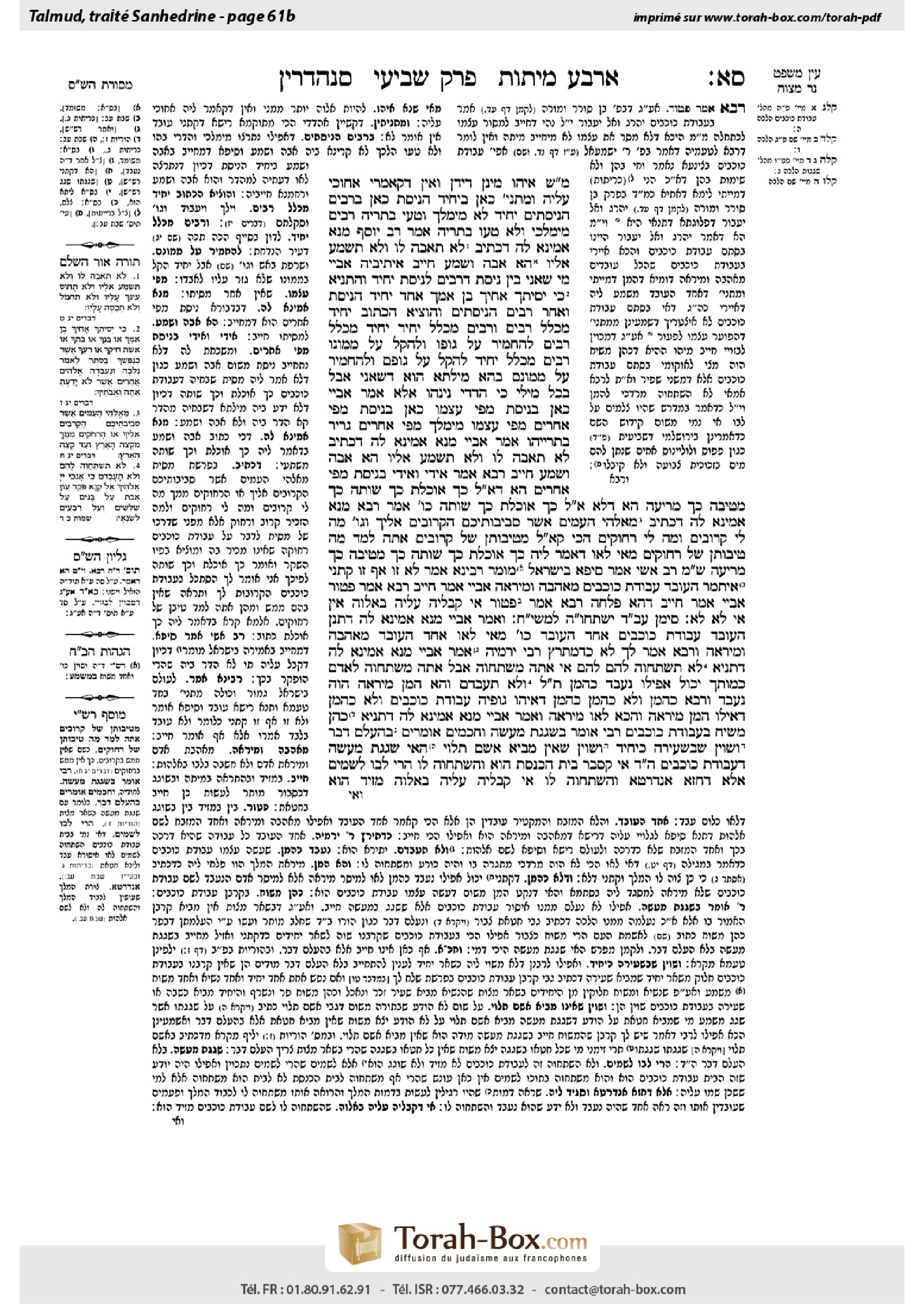
Sanhedrin 61b: Talmud study for Daf Yomi
Daf Yomi is the daily study of one Talmud folio. Explore 37 tractates with scans, Hebrew text, Sefaria English and AI-generated French translations where annotated.
Passage selection and English or AI-generated French translation are available where the scan has annotations. Daf Study is independent of Torah-Box and Sefaria.
Browse Sanhedrin · סנהדרין · All tractatesSanhedrin 61b text and translations
This page of Sanhedrin includes the Aramaic text, an English translation and an AI-generated French translation, alongside the scan above.
סנהדרין ס״א ב · Aramaic and Hebrew text
מַאי שְׁנָא אִיהוּ מִינַּן דִּידַן? וְ״אִין״ דְּקָאָמְרִי, אַחוֹכֵי עֲלֵיהּ.
וּמַתְנְיָתִין: כָּאן בְּיָחִיד הַנִּיסָּת, כָּאן בְּרַבִּים הַנִּיסָּתִים. יָחִיד – לָא מִימְּלַךְ, וְטָעֵי בָּתְרֵיהּ; רַבִּים – מִימַּלְכִי, וְלָא טָעוּ בָּתְרֵיהּ.
אָמַר רַב יוֹסֵף: מְנָא אָמֵינָא לַהּ? דִּכְתִיב ״לֹא תֹאבֶה לוֹ וְלֹא תִשְׁמַע אֵלָיו״. הָא אָבָה וְשָׁמַע – חַיָּיב.
אֵיתִיבֵיהּ אַבָּיֵי: מִי שָׁאנֵי בֵּין נִיסָּת דְּרַבִּים לְנִיסָּת יָחִיד? וְהָתַנְיָא: ״כִּי יְסִיתְךָ אָחִיךָ בֶן אִמֶּךָ״ – אֶחָד יָחִיד הַנִּיסָּת וְאֶחָד רַבִּים הַנִּיסָּתִים, וְהוֹצִיא הַכָּתוּב יָחִיד מִכְּלַל רַבִּים וְרַבִּים מִכְּלַל יָחִיד.
יָחִיד מִכְּלַל רַבִּים, לְהַחְמִיר עַל גּוּפוֹ וּלְהָקֵל עַל מָמוֹנוֹ.
רַבִּים מִכְּלַל יָחִיד, לְהָקֵל עַל גּוּפָם וּלְהַחְמִיר עַל מָמוֹנָם.
בְּהָא מִילְּתָא הוּא דְּשָׁאנֵי, אֲבָל בְּכֹל מִילֵּי כִּי הֲדָדֵי נִינְהוּ.
אֶלָּא אָמַר אַבָּיֵי: כָּאן – בְּנִיסָּת מִפִּי עַצְמוֹ, כָּאן – בְּנִיסָּת מִפִּי אֲחֵרִים. מִפִּי עַצְמוֹ – מִימְּלֵךְ, מִפִּי אֲחֵרִים – גְּרִיר בָּתְרַיְיהוּ.
אָמַר אַבָּיֵי: מְנָא אָמֵינָא לַהּ? דִּכְתִיב: ״לֹא תֹאבֶה לוֹ וְלֹא תִשְׁמַע אֵלָיו״. הָא אָבָה וְשָׁמַע – חַיָּיב.
רָבָא אָמַר: אִידֵּי וְאִידֵּי בְּנִיסָּת מִפִּי אֲחֵרִים, הָא דַּאֲמַר לֵיהּ ״כָּךְ אוֹכֶלֶת״, ״כָּךְ שׁוֹתָה״, ״כָּךְ מְטִיבָה״, ״כָּךְ מְרֵיעָה״, הָא דְּלָא אֲמַר לֵיהּ ״כָּךְ אוֹכֶלֶת״, ״כָּךְ שׁוֹתָה״ כּוּ׳.
אָמַר רָבָא: מְנָא אָמֵינָא לַהּ? דִּכְתִיב: ״מֵאֱלֹהֵי הָעַמִּים אֲשֶׁר סְבִיבֹתֵיכֶם הַקְּרֹבִים אֵלֶיךָ וְגוֹ׳״. מָה לִי קְרוֹבִים וּמָה לִי רְחוֹקִים? הֲכִי קָאָמַר לָךְ: מִטִּיבוּתָן שֶׁל קְרוֹבִים אַתָּה לָמֵד מָה טִיבוּתָן שֶׁל רְחוֹקִים.
מַאי לָאו דַּאֲמַר לֵיהּ: כָּךְ אוֹכֶלֶת, כָּךְ שׁוֹתֶה, כָּךְ מִטִּיבָהּ, כָּךְ מְרֵיעָה? שְׁמַע מִינַּהּ.
רַב אָשֵׁי אָמַר: סֵיפָא בְּיִשְׂרָאֵל מְשׁוּמָּד.
רָבִינָא אָמַר: לָא זוֹ אַף זוֹ קָתָנֵי.
אִיתְּמַר: הָעוֹבֵד עֲבוֹדָה זָרָה מֵאַהֲבָה וּמִיִּרְאָה, אַבָּיֵי אָמַר: חַיָּיב, רָבָא אָמַר: פָּטוּר.
אַבָּיֵי אֲמַר: חַיָּיב, דְּהָא פַּלְחַהּ. רָבָא אָמַר: פָּטוּר, אִי קַבְּלַיהּ עֲלֵיהּ בֶּאֱלוֹהַּ – אִין, אִי לָא – לָא.
סִימָן: עֶבֶד יִשְׁתַּחֲוֶה לְמָשִׁיחַ.
וְאָמַר אַבָּיֵי: מְנָא אָמֵינָא לַהּ? דִּתְנַן: הָעוֹבֵד עֲבוֹדָה זָרָה, אֶחָד הָעוֹבֵד כּוּ׳. מַאי לָאו אֶחָד הָעוֹבֵד מֵאַהֲבָה וּמִיִּרְאָה?
וְרָבָא אָמַר לָךְ: לָא, כְּדִמְתָרֵץ רַבִּי יִרְמְיָה.
אָמַר אַבָּיֵי: מְנָא אָמֵינָא לַהּ? דְּתַנְיָא: ״לֹא תִשְׁתַּחֲוֶה לָהֶם״ – לָהֶם אִי אַתָּה מִשְׁתַּחֲוֶה, אֲבָל אַתָּה מִשְׁתַּחֲוֶה לְאָדָם כְּמוֹתְךָ. יָכוֹל אֲפִילּוּ נֶעֱבָד כְּהָמָן? תַּלְמוּד לוֹמַר: ״וְלֹא תָעׇבְדֵם״. וְהָא הָמָן מִיִּרְאָה הֲוָה נֶעֱבָד!
וְרָבָא: כְּהָמָן וְלֹא כְּהָמָן. כְּהָמָן – דְּאִיהוּ גּוּפֵיהּ עֲבוֹדָה זָרָה, וְלֹא כְּהָמָן – דְּאִילּוּ הָמָן מִיִּרְאָה, וְהָכָא לָאו מִיִּרְאָה.
וְאָמַר אַבָּיֵי: מְנָא אָמֵינָא לַהּ? דְּתַנְיָא: כֹּהֵן מָשִׁיחַ בַּעֲבוֹדָה זָרָה, רַבִּי אוֹמֵר: בְּשִׁגְגַת מַעֲשֶׂה, וַחֲכָמִים אוֹמְרִים: בְּהֶעְלֵם דָּבָר.
וְשָׁוִין, שֶׁבִּשְׂעִירָה כְּיָחִיד. וְשָׁוִין, שֶׁאֵין מֵבִיא אָשָׁם תָּלוּי.
הַאי שִׁגְגַת מַעֲשֶׂה דַּעֲבוֹדָה זָרָה, הֵיכִי דָּמֵי? אִי קָסָבַר בֵּית הַכְּנֶסֶת הוּא וְהִשְׁתַּחֲוָה לוֹ, הֲרֵי לִבּוֹ לַשָּׁמַיִם! אֶלָּא דַּחֲזָא אִנְדְּרָטָא וְהִשְׁתַּחֲוָה לוֹ.
אִי קַבְּלֵיהּ עֲלֵיהּ בֶּאֱלוֹהַּ – מֵזִיד הוּא.
Sanhedrin 61b · English translation
In what way is he different from us? The suggestion to worship him is nonsense. And the fact that they say to him: Yes, is because they ridicule him.
And the contradiction between the mishnayot can be resolved as follows: There, where the mishna states that one is liable for speech alone, the reference is to an individual who was incited; here, where the mishna indicates that one is not liable for speech alone, it is referring to a case of an incited multitude of people. The Gemara explains: An individual who was incited does not typically change his mind, and he goes astray after idol worship. Therefore, once he agrees to the suggestion to worship an idol, he has fully accepted the idol upon himself as a god and is liable. By contrast, a multitude of people are apt to change their minds, and consequently they do not go astray after idol worship.
Rav Yosef said: From where do I say that the halakha that one is liable for merely stating that he will worship an idol is referring to an individual who was incited? As it is written with regard to one who incites people to engage in idol worship: “You shall not approve of him, nor listen to him” (Deuteronomy 13:9), which indicates that if one approved of and listened to the inciter, stating his intention to engage in idol worship, he is liable even if he does not actually worship an idol.
Abaye raised an objection to Rav Yosef’s opinion: Is there a difference in halakha between the cases of an incited multitude of people and an individual who was incited? But isn’t it taught in a baraita with regard to the verse: “If your brother, the son of your mother, or your son, or your daughter, or the wife of your bosom, or your neighbor who is like your own soul, incites you secretly, saying: Let us go and serve other gods” (Deuteronomy 13:7), that both an individual who was incited and an incited multitude of people are included in this halakha, but the verse singles out the individual from the category of the multitude, and another verse singles out the multitude from the category of the individual.
The Torah states separately the halakhot of an individual who is incited to engage in idol worship and of an entire city that is subverted to engage in idol worship in order to distinguish between the two cases, as follows: An individual who was incited is singled out from the category of a subverted multitude of people in order to render the punishment to an individual’s body more stringent. The individual is executed by stoning, whereas the residents of an idolatrous city are executed by decapitation. And an individual was singled out to render the treatment of the property of an individual who was incited more lenient, as it is not destroyed like that of the residents of an idolatrous city.
Additionally, the Torah singles out the subverted multitude of people from the category of an individual who was incited in order to render the punishment given to the bodies of the residents of an idolatrous city, decapitation, more lenient than that given to an individual who was incited, and to render the treatment of their property more stringent, as the city and the property of its residents are burned.
Abaye concluded his objection to Rav Yosef’s opinion: It can be inferred from the baraita that only with regard to this matter, i.e., the halakhot mentioned in the baraita, is the halakha of an individual who was incited different than that of an incited multitude of people, but with regard to all other halakhic matters they are the same. Therefore, a distinction cannot be made between them with regard to the halakha in the case of a verbal commitment to idol worship.
Rather, Abaye said that the contradiction between the mishnayot is to be resolved as follows: Here, where the mishna indicates that one is liable only for actual worship, the reference is to one who is incited by himself, i.e., no one incited him to idol worship and he made the decision on his own. Whereas there, in the mishna that deems one liable for stating that he will worship an idol, the reference is to one who is incited by others. The reason for the difference is that one who makes the decision on his own is apt to change his mind, whereas one who is incited by others is drawn after them and is unlikely to change his mind.
Abaye said: From where do I say that this distinction is correct? As it is written: “You shall not approve of him, nor listen to him” (Deuteronomy 13:9), referring to another individual who tried to incite him, and the verse indicates that if one approved of and listened to the inciter, he is liable even for the approval alone.
Rava says: Both this mishna and that mishna are referring to one incited by others, and they should be differentiated as follows: That mishna, which deems one liable for merely expressing approval, is referring to a case where the inciter described the qualities of the idol and said to him: It eats like this; it drinks like this; it does good for its worshippers like this; and it harms those who do not worship it like this. In this case, expressing approval verbally suffices to render one liable, as he was evidently convinced by the description. This mishna, which indicates that one is not liable for speech alone, is referring to a case where the inciter did not say to him: It eats like this; it, drinks like this, it does good for its worshippers like this; and it harms those who do not worship it like this.
Rava said: From where do I say that this distinction is correct? As it is written: “Let us go and worship other gods…from the gods of the peoples that surround you, the ones near to you or the ones far from you” (Deuteronomy 13:7–8). What difference is there to me whether they are near, and what difference is there to me whether they are far? Why would the distance affect the prohibition? Rather, this is what the Torah is saying to you: Do not be tempted to listen to the inciter, as from the nature of the objects of idol worship that are near you, which you recognize to be false, you can derive what the nature is of the ones that are far from you. Therefore, if you are told that there is an idol in a distant land that is real, realize that it is a lie.
It is from this interpretation that Rava derives his halakhic distinction: What, is it not referring to a case where the inciter described to another the qualities of the idol and said to him: It eats like this; it drinks like this; it does good for its worshippers like this; and it harms those who do not worship it like this? Conclude from it that only in such a case is the incited person liable for stating his approval.
Rav Ashi says that there is a different resolution to the contradiction between the mishnayot: The latter clause of the mishna (67a), which deems one liable for speech alone, is referring to an apostate Jew; since he is already an apostate, his stated commitment to idol worship is certainly final. Consequently, he is liable. By contrast, a regular Jew is not liable for speech alone.
Ravina says that there is no contradiction; rather, the tanna teaches the mishna employing the style: Not only this but also that. In other words, the tanna first teaches the elementary halakha that one who worships an idol is liable, and afterward it teaches the more novel halakha that even one who merely says that he will engage in idol worship is immediately liable.
§ It was stated that amora’im engaged in a dispute concerning the following matter: In the case of one who worships idols due to his love of another who requested that he bow before the statue, or due to fear of someone coercing him to do so, but not due to faith in that idol, what is the halakha? Abaye says: He is liable. Rava says: He is exempt.
The Gemara explains: Abaye says he is liable because he worshipped it. Rava says he is exempt, as the criterion for becoming liable for idol worship is as follows: If one sincerely accepted the idol upon himself as a god, yes, he is liable; but if he did not accept it sincerely, he is not liable.
Abaye attempts to cite several proofs, whose mnemonic is: A slave will bow to the anointed.
And Abaye said: From where do I say that one who worships idols due to love or fear is liable? As we learned in the mishna: One who worships idols is executed by stoning. This includes one who worships an idol, and one who slaughters an animal as an idolatrous offering, and one who burns incense as an idolatrous offering. What is added by the mishna by stating twice: One who worships? Is it not to include the case of one who worships idols due to love or due to fear, in addition to the case of one who worships idols out of faith? Evidently, in this case as well, the worshipper is liable.
And Rava could have said to you in response that the term: One who worships, should not be understood as Abaye suggests but rather as Rabbi Yirmeya explains it, namely, that one who worships an idol in its standard manner of worship is liable, and one who sacrifices an idolatrous offering is liable even if that is not the standard manner of worship of that particular idol.
Abaye attempts to cite another proof for his opinion. He said: From where do I say that one who worships idols due to love or fear is liable? As it is taught in a baraita with regard to the verse: “You shall not bow to them nor worship them” (Exodus 20:5): “To them,” to idols, you may not bow, but you may bow to a person like yourself; bowing to a person is merely the acceptance of authority. One might have thought that it is permitted to bow even to a person who is worshipped like a god, like Haman; therefore, the verse states: “Nor worship them,” i.e., any form of pagan worship is prohibited. Abaye concludes: And wasn’t Haman worshipped due to fear, and not because the people considered him a god? Evidently, one who engages in idol worship due to fear is liable.
And Rava explains this baraita as follows: One might have thought that it is permitted to bow even to a person like Haman in one regard, but not like Haman in all aspects. It is referring to one like Haman in that Haman himself was an object of idol worship, as he claimed he was a god, and one who worships a person out of belief in his divinity is liable. But the reference is to one who is not like Haman in all aspects, as while Haman was worshipped due to fear, and one who engages in idol worship due to fear is not liable, here the reference is to one who worships a person not due to fear, but because he believes in that person’s divinity.
And Abaye furthermore said: From where do I say my opinion? As it is taught in a baraita: If an anointed priest, i.e., the High Priest, unwittingly engaged in idol worship, Rabbi Yehuda HaNasi says: He brings an offering for the unwitting act. And the Rabbis say: A High Priest does not bring an offering for an unwitting act of idol worship unless it was due to a lapse of awareness concerning the fundamental halakhot of idol worship, i.e., he thought that this action was halakhically permitted.
And they agree that a High Priest brings a female goat as his offering to atone for his act of idol worship, as does an ordinary individual, and not a bull, as a High Priest brings as a sin-offering for other sins. And they agree that a High Priest does not bring a provisional guilt-offering, which is ordinarily brought by one who is uncertain as to whether he committed a sin that requires him to bring a sin-offering. In such a case, he is exempt.
Abaye infers: What are the circumstances of the High Priest’s unwitting act of idol worship that is not due to a lack of awareness of the fundamental halakhot of idol worship? If the High Priest thought that a certain building was a synagogue and bowed to it, and he then realized that it is a house of idol worship, why should he be obligated to bring an offering, even according to the opinion of Rabbi Yehuda HaNasi? Since his heart was directed toward Heaven, it is not even an unwitting transgression. Rather, it is a case where the High Priest saw the statue of a person and bowed to it.
This case must also be clarified: If he accepted that person upon himself as a god, he is an intentional transgressor, and he is liable to receive the death penalty and not to bring an offering.
Sanhedrin 61b · Traduction française (IA)
En quoi est-il différent de nous ? L’idée de le servir est absurde. S’ils lui répondent : « Oui », c’est parce qu’ils se moquent de lui.
La contradiction entre les Michnayot peut être résolue ainsi : là où la Michna enseigne qu’on est passible pour les paroles seules, il s’agit d’un individu qui a été incité ; ici, où la Michna indique qu’on n’est pas passible pour les paroles seules, il s’agit d’une multitude de personnes qui ont été incitées. La Guemara explique : un individu qui a été incité ne change généralement pas d’avis et s’égare en suivant le culte idolâtre. Par conséquent, dès qu’il accepte la proposition de servir une idole, il l’a pleinement acceptée comme dieu et est passible. En revanche, une multitude de personnes est susceptible de changer d’avis et ne s’égare donc pas en suivant le culte idolâtre.
Rav Yossef dit : D’où déduis-je que la halakha selon laquelle on est passible pour avoir simplement déclaré qu’on servira une idole concerne un individu qui a été incité ? Car il est écrit au sujet de celui qui incite des gens à pratiquer le culte idolâtre : « Tu ne lui donneras pas ton assentiment et tu ne l’écouteras pas » (Deutéronome 13, 9). Cela indique que si quelqu’un donne son assentiment à l’incitateur et l’écoute, déclarant son intention de pratiquer le culte idolâtre, il est passible même s’il ne sert pas réellement une idole.
Abayé objecta à l’opinion de Rav Yossef : Y a-t-il une différence de halakha entre le cas d’une multitude de personnes qui ont été incitées et celui d’un individu qui a été incité ? Pourtant, une baraïta enseigne au sujet du verset : « Si ton frère, fils de ta mère, ou ton fils, ou ta fille, ou la femme que tu chéris, ou ton prochain qui est comme ton âme, t’incite en secret en disant : “Allons servir d’autres dieux” » (Deutéronome 13, 7), que cette halakha concerne aussi bien un individu qui a été incité qu’une multitude de personnes qui ont été incitées ; mais le verset distingue l’individu de la catégorie de la multitude, et un autre verset distingue la multitude de la catégorie de l’individu.
La Torah énonce séparément les halakhot concernant un individu qui a été incité à pratiquer le culte idolâtre et celles concernant une ville entière qui a été entraînée à pratiquer le culte idolâtre, afin de distinguer les deux cas comme suit : l’individu qui a été incité est distingué de la catégorie d’une multitude entraînée afin d’alourdir la peine infligée à son corps. L’individu est exécuté par lapidation, tandis que les habitants d’une ville idolâtre sont exécutés par décapitation. L’individu est également distingué afin d’alléger le traitement de ses biens, puisqu’ils ne sont pas détruits comme ceux des habitants d’une ville idolâtre.
En outre, la Torah distingue la multitude entraînée de la catégorie d’un individu qui a été incité afin d’alléger la peine infligée au corps des habitants d’une ville idolâtre — la décapitation — par rapport à celle infligée à un individu qui a été incité, et afin d’alourdir le traitement de leurs biens, car la ville et les biens de ses habitants sont brûlés.
Abayé acheva son objection à l’opinion de Rav Yossef : on peut déduire de la baraïta que ce n’est que sur ce point, c’est-à-dire pour les halakhot mentionnées dans la baraïta, que la halakha concernant un individu qui a été incité diffère de celle concernant une multitude de personnes qui ont été incitées ; pour toutes les autres questions de halakha, les deux cas sont identiques. On ne peut donc pas établir de distinction entre eux concernant la halakha relative à un engagement verbal à pratiquer le culte idolâtre.
Abayé dit plutôt que la contradiction entre les Michnayot se résout ainsi : ici, là où la Michna indique qu’on n’est passible que pour un acte de culte effectif, il s’agit d’une personne qui s’incite elle-même, c’est-à-dire que personne ne l’a incitée au culte idolâtre et qu’elle a pris sa décision de son propre chef. Là, en revanche, dans la Michna qui rend passible celui qui déclare qu’il servira une idole, il s’agit d’une personne incitée par d’autres. La différence s’explique par le fait que celui qui prend sa décision de son propre chef est susceptible de changer d’avis, tandis que celui qui est incité par d’autres se laisse entraîner par elles et risque peu de changer d’avis.
Abayé dit : D’où déduis-je que cette distinction est juste ? Car il est écrit : « Tu ne lui donneras pas ton assentiment et tu ne l’écouteras pas » (Deutéronome 13, 9), à propos d’une autre personne qui a tenté de l’inciter. Le verset indique que si quelqu’un donne son assentiment à l’incitateur et l’écoute, il est passible pour le seul fait d’avoir donné son assentiment.
Rava dit : Cette Michna comme l’autre concernent toutes deux une personne incitée par d’autres, et il faut les distinguer ainsi : cette Michna, qui rend passible celui qui exprime simplement son assentiment, concerne un cas où l’incitateur a décrit les qualités de l’idole et lui a dit : « Elle mange ainsi ; elle boit ainsi ; elle fait du bien à ceux qui la servent de cette façon ; et elle fait du mal à ceux qui ne la servent pas de cette façon. » Dans ce cas, le seul fait d’exprimer verbalement son assentiment suffit à rendre la personne passible, car elle a manifestement été convaincue par cette description. Cette Michna, qui indique qu’on n’est pas passible pour les paroles seules, concerne un cas où l’incitateur ne lui a pas dit : « Elle mange ainsi ; elle boit ainsi ; elle fait du bien à ceux qui la servent de cette façon ; et elle fait du mal à ceux qui ne la servent pas de cette façon. »
Rava dit : D’où déduis-je que cette distinction est juste ? Car il est écrit : « Allons servir d’autres dieux… parmi les dieux des peuples qui vous entourent, ceux qui sont proches de vous ou ceux qui sont éloignés de vous » (Deutéronome 13, 7-8). En quoi cela m’importe-t-il qu’ils soient proches, et en quoi cela m’importe-t-il qu’ils soient éloignés ? Pourquoi la distance aurait-elle une incidence sur l’interdiction ? La Torah vous enseigne plutôt ceci : ne vous laissez pas tenter par les paroles de l’incitateur, car la nature des objets du culte idolâtre qui sont près de vous, que vous savez être faux, vous permet de déduire celle des objets qui sont loin de vous. Ainsi, si l’on vous dit qu’il existe une véritable idole dans un pays lointain, comprenez que c’est un mensonge.
C’est de cette interprétation que Rava tire sa distinction halakhique : ne s’agit-il pas d’un cas où l’incitateur a décrit à quelqu’un les qualités de l’idole et lui a dit : « Elle mange ainsi ; elle boit ainsi ; elle fait du bien à ceux qui la servent de cette façon ; et elle fait du mal à ceux qui ne la servent pas de cette façon » ? On en déduit que ce n’est que dans un tel cas que la personne incitée est passible pour avoir exprimé son assentiment.
Rav Achi propose une autre résolution à la contradiction entre les Michnayot : la dernière partie de la Michna (67a), qui rend passible pour les paroles seules, concerne un Juif apostat ; puisqu’il est déjà apostat, son engagement déclaré à pratiquer le culte idolâtre est certainement définitif. Il est donc passible. En revanche, un Juif ordinaire n’est pas passible pour les paroles seules.
Ravina dit qu’il n’y a pas de contradiction ; le tanna enseigne plutôt la Michna selon la formule : « non seulement ceci, mais aussi cela ». Autrement dit, le tanna enseigne d’abord la halakha élémentaire selon laquelle celui qui sert une idole est passible, puis il enseigne la halakha plus novatrice selon laquelle celui qui dit simplement qu’il pratiquera le culte idolâtre est immédiatement passible.
§ Il a été rapporté que des amoraïm ont débattu de la question suivante : dans le cas de quelqu’un qui sert une idole par amour pour une autre personne qui lui a demandé de se prosterner devant la statue, ou par crainte de quelqu’un qui le contraint à le faire, mais non par foi en cette idole, quelle est la halakha ? Abayé dit : Il est passible. Rava dit : Il est exempt.
La Guemara explique : Abayé dit qu’il est passible parce qu’il a servi l’idole. Rava dit qu’il est exempt, car le critère de la responsabilité pour le culte idolâtre est le suivant : si quelqu’un a sincèrement accepté l’idole comme dieu, alors il est passible ; mais s’il ne l’a pas acceptée sincèrement, il n’est pas passible.
Abayé tente d’apporter plusieurs preuves, dont le moyen mnémotechnique est : Un esclave se prosternera devant l’oint.
Abayé dit : D’où déduis-je que celui qui sert une idole par amour ou par crainte est passible ? Car nous avons appris dans la Michna : celui qui sert une idole est exécuté par lapidation. Cela inclut celui qui sert une idole, celui qui abat un animal en offrande idolâtre et celui qui brûle de l’encens en offrande idolâtre. Qu’ajoute la Michna en répétant : « Celui qui sert » ? N’est-ce pas pour inclure le cas de celui qui sert une idole par amour ou par crainte, en plus du cas de celui qui la sert par foi ? Il est donc évident que, dans ce cas également, celui qui la sert est passible.
Rava aurait pu te répondre que l’expression « celui qui sert » ne doit pas être comprise comme le suggère Abayé, mais plutôt comme l’explique Rabbi Yirmeya : celui qui sert une idole selon son mode de culte habituel est passible, tandis que celui qui offre un sacrifice idolâtre est passible même si ce n’est pas le mode de culte habituel de cette idole particulière.
Abayé tente d’apporter une autre preuve à son opinion. Il dit : D’où déduis-je que celui qui sert une idole par amour ou par crainte est passible ? Car une baraïta enseigne au sujet du verset : « Tu ne te prosterneras pas devant elles et tu ne les serviras pas » (Exode 20, 5) : « Devant elles », c’est-à-dire devant les idoles, tu ne peux pas te prosterner, mais tu peux te prosterner devant une personne comme toi ; se prosterner devant une personne n’est qu’une marque de soumission à l’autorité. On aurait pu penser qu’il est permis de se prosterner même devant une personne que l’on sert comme un dieu, comme Haman ; le verset précise donc : « et tu ne les serviras pas », c’est-à-dire que toute forme de culte païen est interdite. Abayé conclut : Haman n’était-il pas servi par crainte, et non parce que les gens le considéraient comme un dieu ? Il est donc évident que celui qui pratique le culte idolâtre par crainte est passible.
Rava explique cette baraïta ainsi : on aurait pu penser qu’il est permis de se prosterner devant une personne comme Haman à un égard, mais pas à tous égards. Il s’agit d’une personne comme Haman en ce que Haman lui-même était un objet de culte idolâtre, puisqu’il prétendait être un dieu ; or, celui qui sert une personne parce qu’il croit à sa divinité est passible. Mais il ne s’agit pas d’une personne semblable à Haman à tous égards : tandis qu’Haman était servi par crainte, et que celui qui pratique le culte idolâtre par crainte n’est pas passible, le cas visé ici est celui qui sert une personne non par crainte, mais parce qu’il croit à sa divinité.
Abayé dit encore : D’où déduis-je mon opinion ? Car une baraïta enseigne : si un prêtre oint, c’est-à-dire le Grand Prêtre, a pratiqué le culte idolâtre par inadvertance, Rabbi Yehouda HaNassi dit : Il apporte un sacrifice pour cette faute involontaire. Les Sages disent : un Grand Prêtre n’apporte pas de sacrifice pour avoir pratiqué le culte idolâtre par inadvertance, à moins que cela ne soit dû à une méconnaissance des principes fondamentaux des halakhot du culte idolâtre, c’est-à-dire qu’il ait pensé que cet acte était permis selon la halakha.
Ils conviennent qu’un Grand Prêtre apporte une chèvre comme sacrifice pour expier son acte de culte idolâtre, comme le ferait un particulier, et non un taureau, tel celui qu’un Grand Prêtre apporte comme sacrifice expiatoire pour d’autres péchés. Ils conviennent également qu’un Grand Prêtre n’apporte pas de sacrifice de culpabilité provisoire, que l’on apporte habituellement lorsqu’on ne sait pas avec certitude si l’on a commis un péché exigeant un sacrifice expiatoire. Dans un tel cas, il est exempt.
Abayé déduit : dans quelles circonstances l’acte involontaire de culte idolâtre du Grand Prêtre ne serait-il pas dû à une méconnaissance des principes fondamentaux du culte idolâtre ? Si le Grand Prêtre a pensé qu’un certain bâtiment était une synagogue et s’est prosterné devant lui, puis s’est rendu compte qu’il s’agissait d’un lieu de culte idolâtre, pourquoi serait-il tenu d’apporter un sacrifice, même selon l’opinion de Rabbi Yehouda HaNassi ? Puisque son cœur était tourné vers le Ciel, il ne s’agit même pas d’une transgression involontaire. Il s’agit plutôt du cas où le Grand Prêtre a vu la statue d’une personne et s’est prosterné devant elle.
Il faut également clarifier ce cas : s’il a accepté cette personne comme dieu, il a transgressé intentionnellement et est passible de la peine de mort, et non tenu d’apporter un sacrifice.
Traduction française générée par IA à partir de l’édition anglaise de Sefaria. Vérifie toujours un passage avec le texte source.
Text from Sefaria: William Davidson Edition - Vocalized Aramaic (CC BY NC); William Davidson Edition - English (CC BY NC).