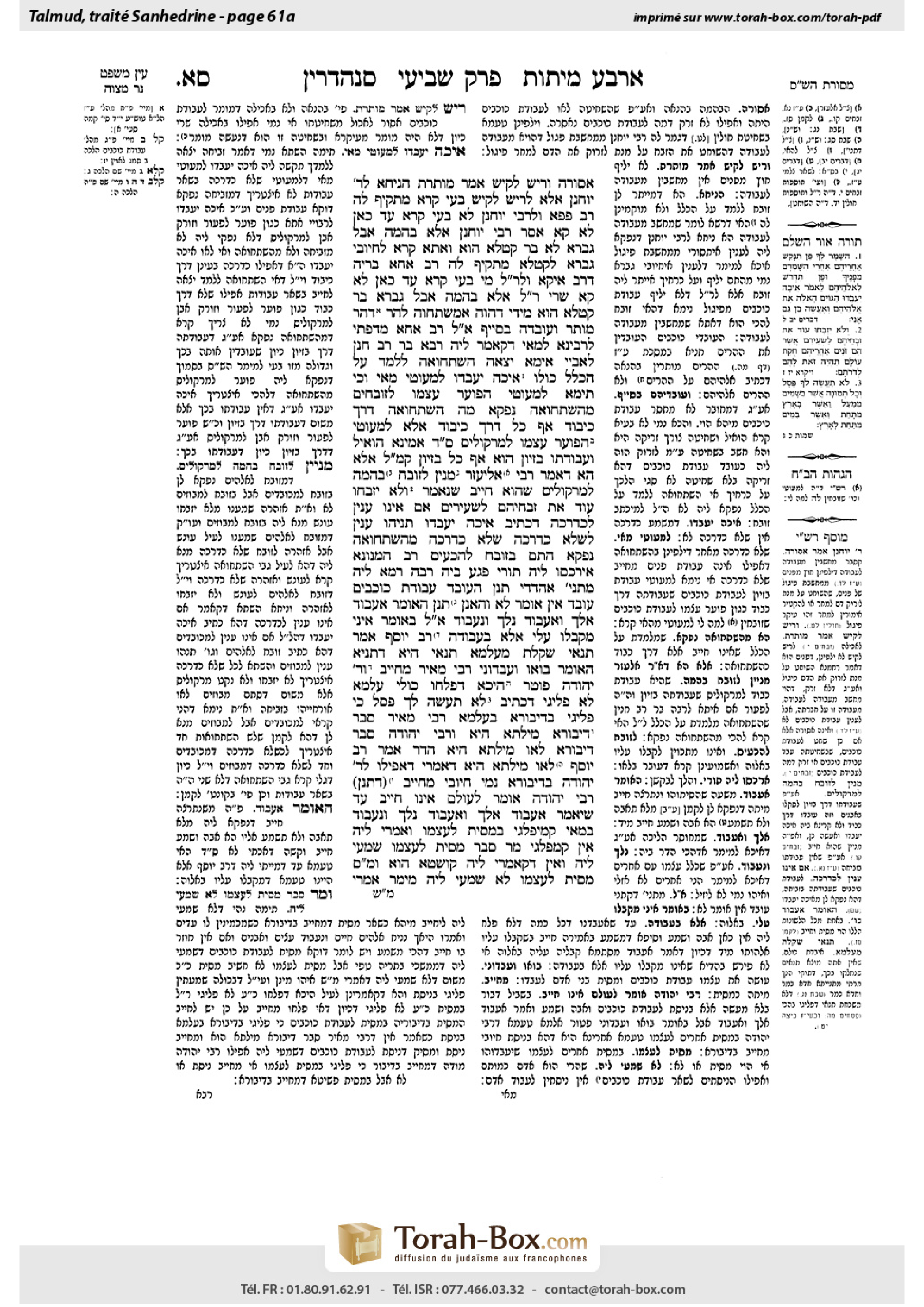
Sanhedrin 61a: Talmud study for Daf Yomi
Daf Yomi is the daily study of one Talmud folio. Explore 37 tractates with scans, Hebrew text, Sefaria English and AI-generated French translations where annotated.
Passage selection and English or AI-generated French translation are available where the scan has annotations. Daf Study is independent of Torah-Box and Sefaria.
Browse Sanhedrin · סנהדרין · All tractatesSanhedrin 61a text and translations
This page of Sanhedrin includes the Aramaic text, an English translation and an AI-generated French translation, alongside the scan above.
סנהדרין ס״א א · Aramaic and Hebrew text
אֲסוּרָה, וְרֵישׁ לָקִישׁ אָמַר: מוּתֶּרֶת.
הָנִיחָא לְרַבִּי יוֹחָנָן, אֶלָּא לְרֵישׁ לָקִישׁ בָּעֵי קְרָא.
מַתְקֵיף לַהּ רַב פָּפָּא: וּלְרַבִּי יוֹחָנָן לָא בָּעֵי קְרָא? עַד כָּאן לָא קָא אָסַר רַבִּי יוֹחָנָן אֶלָּא בְּהֵמָה, אֲבָל גַּבְרָא לָא בַּר קְטָלָא הוּא! וַאֲתָא קְרָא לְחַיּוֹבֵי גַּבְרָא לִקְטָלָא.
מַתְקֵיף לַהּ רַב אַחָא בְּרֵיהּ דְּרַב אִיקָא: וּלְרֵישׁ לָקִישׁ, מִי בָּעֵי קְרָא? עַד כָּאן לָא קָא שָׁרֵי רֵישׁ לָקִישׁ אֶלָּא בְּהֵמָה, אֲבָל גַּבְרָא בַּר קְטָלָא הוּא! מִידֵּי דְּהָוֵה אַמִּשְׁתַּחֲוֶה לְהַר, דְּהַר מוּתָּר וְעוֹבְדוֹ בְּסַיִיף.
אֲמַר לֵיהּ רַב אַחָא מִדִּפְתִּי לְרָבִינָא: לְמַאי דְּקָאָמַר לֵיהּ רָבָא בַּר רַב חָנָן לְאַבָּיֵי, אֵימָא יָצְאָה הִשְׁתַּחֲוָאָה לְלַמֵּד עַל הַכְּלָל כּוּלּוֹ, ״אֵיכָה יַעַבְדוּ״ לְמַעוֹטֵי מַאי?
וְכִי תֵּימָא: לְמַעוֹטֵי הַפּוֹעֵר עַצְמוֹ לְזוֹבְחִים? מֵהִשְׁתַּחֲוָאָה נָפְקָא! מָה הִשְׁתַּחֲוָאָה דֶּרֶךְ כִּיבּוּד, אַף כֹּל דֶּרֶךְ כִּיבּוּד.
אֶלָּא, לְמַעוֹטֵי הַפּוֹעֵר עַצְמוֹ לְמַרְקוּלִיס. סָלְקָא דַּעְתָּךְ אָמֵינָא: הוֹאִיל וַעֲבוֹדָתוֹ בִּזָּיוֹן הוּא, אַף כֹּל בִּזָּיוֹן? קָא מַשְׁמַע לַן.
אֶלָּא הָא דְּאָמַר רַבִּי אֱלִיעֶזֶר: מִנַּיִן לַזּוֹבֵחַ בְּהֵמָה לְמַרְקוּלִיס שֶׁהוּא חַיָּיב? שֶׁנֶּאֱמַר: ״וְלֹא יִזְבְּחוּ עוֹד אֶת זִבְחֵיהֶם לַשְּׂעִירִם״.
אִם אֵינוֹ עִנְיָן לִכְדַרְכָּהּ, דִּכְתִיב ״אֵיכָה יַעַבְדוּ״, תְּנֵיהוּ עִנְיָן לְשֶׁלֹּא כְּדַרְכָּהּ.
שֶׁלֹּא כְּדַרְכָּהּ, מֵהִשְׁתַּחֲוָאָה נָפְקָא.
הָתָם, בְּזוֹבֵחַ לְהַכְעִיס.
רַב הַמְנוּנָא אִירְכַסוּ לֵיהּ תּוֹרֵי. פְּגַע בֵּיהּ רַבָּה, רְמָא לֵיהּ מַתְנְיָתִין אַהֲדָדֵי: תְּנַן ״הָעוֹבֵד עֲבוֹדָה זָרָה״ – עוֹבֵד אִין, אוֹמֵר לָא. וְהָאֲנַן תְּנַן: ״הָאוֹמֵר ׳אֶעֱבוֹד׳, ׳אֵלֵךְ וְאֶעֱבוֹד׳, ׳נֵלֵךְ וְנַעֲבוֹד׳״?
אֲמַר לֵיהּ: בְּאוֹמֵר ״אֵינִי מְקַבְּלוֹ עָלַי אֶלָּא בַּעֲבוֹדָה״.
רַב יוֹסֵף אָמַר: תַּנָּאֵי שָׁקְלַתְּ מֵעָלְמָא? תַּנָּאֵי הִיא, דְּתַנְיָא: הָאוֹמֵר ״בּוֹאוּ וְעִבְדוּנִי״ – רַבִּי מֵאִיר מְחַיֵּיב, וְרַבִּי יְהוּדָה פּוֹטֵר.
הֵיכָא דִּפְלַחוּ כּוּלֵּי עָלְמָא – לָא פְּלִיגִי, דִּכְתִיב: ״לֹא תַעֲשֶׂה לְךָ פֶסֶל״. כִּי פְּלִיגִי – בְּדִיבּוּרָא בְּעָלְמָא. רַבִּי מֵאִיר סָבַר: דִּיבּוּרָא מִילְּתָא הִיא, וְרַבִּי יְהוּדָה סָבַר: דִּיבּוּרָא לָאו מִילְּתָא הִיא.
הֲדַר אָמַר רַב יוֹסֵף: לָאו מִילְּתָא הִיא דַּאֲמַרִי, דַּאֲפִילּוּ לְרַבִּי יְהוּדָה בְּדִיבּוּרָא נָמֵי חַיּוֹבֵי מְחַיֵּיב. דִּתְנַן, רַבִּי יְהוּדָה אוֹמֵר: לְעוֹלָם אֵינוֹ חַיָּיב עַד שֶׁיֹּאמַר ״אֶעֱבוֹד״, ״אֵלֵךְ וְאֶעֱבוֹד״, ״נֵלֵךְ וְנַעֲבוֹד״.
בְּמַאי קָמִיפַּלְגִי? בְּמֵסִית לְעַצְמוֹ וְאָמְרִי לֵיהּ ״אִין״ קָמִיפַּלְגִי. מָר סָבַר, מֵסִית לְעַצְמוֹ – שָׁמְעִי לֵיהּ, וְ״אִין״ דְּקָאָמְרִי לֵיהּ קוּשְׁטָא הוּא; וּמָר סָבַר, מֵסִית לְעַצְמוֹ – לָא שָׁמְעִי לֵיהּ, מֵימָר אָמְרִי:
Sanhedrin 61a · English translation
Deriving benefit from the animal is prohibited, as it is considered an offering of idol worship, even if its blood was not ultimately sprinkled for idol worship or its forbidden fat burned for that purpose. And Reish Lakish says: Deriving benefit from the animal is permitted.
Rava bar Rav Ḥanan concludes his analysis: According to Rabbi Yoḥanan, who derives this halakha from another source, this statement in the baraita works out well. The verse that mentions the slaughter of an animal in idol worship apparently teaches a principle, as it is superfluous with regard to the halakha of slaughter itself, as stated in the baraita. But according to Reish Lakish, who does not derive from any verse that one can have intention from one rite to another rite, one needs this verse to derive precisely this halakha, that one can have intention from one rite to another rite. Consequently, the verse is not superfluous, and it cannot be assumed that it teaches a principle with regard to the forms of idol worship that are punishable by death.
Rav Pappa objects to this: And according to Rabbi Yoḥanan, does one not need a verse to teach the halakha in a case of intention from one rite to another rite? Rabbi Yoḥanan initially only prohibits deriving benefit from the animal; but if not for this verse, the man who slaughtered the animal would not be liable to receive the death penalty. And therefore the verse comes to render the man liable to receive the death penalty. Therefore this verse is not superfluous according to Rabbi Yoḥanan either.
Rav Aḥa, son of Rav Ika, objects to Rava bar Rav Ḥanan’s challenge to the derivation in the baraita: And even according to Reish Lakish, does one need a verse to teach that the one who slaughtered the animal is liable? Reish Lakish only permits one to derive benefit from the animal; but the man is certainly liable to receive the death penalty. This is just as the halakha is in the case of one who bows to a mountain, as deriving benefit from the mountain is permitted, but nevertheless the one who worshipped it is liable to be executed by the sword. Therefore, the verse that states that one who slaughters an offering in idol worship is liable to be executed is superfluous with regard to the issue of intention from one rite to another.
Rav Aḥa of Difti said to Ravina: According to what Rava bar Rav Ḥanan said to Abaye, that there is room to say that bowing was singled out in the verse to teach, with regard to the entire category, that any honorable form of worship carries the death penalty, there is a difficulty. With regard to the verse: “Take heed to yourself that you not be ensnared to follow them…saying, how do these nations serve their gods, so I will do likewise” (Deuteronomy 12:30), which indicates that one is liable for worshipping an idol in the manner that the gentiles worship it, this is stated to exclude what?
And if you would say that this verse is stated to exclude one who defecates before an idol that is worshipped by sacrificing offerings, it is not necessary to derive this halakha from this verse, as it is derived from the halakha of bowing to an idol, as follows: Just as bowing is an honorable form of worship and is punishable by death, so too, any honorable form of worship is punishable by death when performed as idol worship, which excludes an offensive act such as defecating. Therefore, the halakha that one is not liable for defecating before an idol can be derived from bowing.
Rather, this verse is stated to exclude one who defecates before the idol called Mercury, which is not its typical manner of worship. It might enter your mind to say that since the standard manner of worship of Mercury, namely, throwing stones at it, is in any event an act of degradation, so too, one who performs any act of degradation as worship of Mercury should be liable. Therefore, the verse teaches us that one is liable only for worshiping Mercury in its standard manner of worship.
The Gemara raises an objection: But Rava bar Rav Ḥanan’s interpretation of the verses appears to contradict that which Rabbi Eliezer says: From where is it derived that one who sacrifices an animal to Mercury is liable? As it is stated: “And they shall no longer sacrifice their sacrifices to the satyrs” (Leviticus 17:7).
Rabbi Eliezer explains: If the verse is not needed for the matter of one who worships an idol in its typical manner, i.e., one who sacrifices an animal as an offering to an idol that is worshipped by sacrificing offerings, as the halakha in this case is already written in the aforementioned verse: “How do these nations serve their gods, so I will do likewise,” apply it to the matter of one who worships an idol not in its typical manner, by sacrificing an offering to an idol that is not typically worshipped by sacrificing offerings. Therefore, one who sacrifices an offering to Mercury is liable, even though that is not its typical form of worship.
According to Rava bar Rav Ḥanan, by contrast, it is derived that one is liable for worshipping an idol in any honorable manner, even not in its typical manner of worship, from the halakha of bowing.
The Gemara answers: There, in the verse mentioned by Rabbi Eliezer, the reference is to one who sacrifices an offering to Mercury not as a form of worship, but rather in order to express insolence toward the Torah prohibition against sacrificing an offering to an idol. It is derived from the verse that this too is a transgression of the prohibition and renders one liable for the death penalty.
§ The Gemara relates: Rav Hamnuna lost his oxen and went to search for them. Rabba met him and raised a contradiction between two mishnayot. We learned in the mishna that one who worships idols is liable. By inference, one who worships idols, yes, he is liable, but one who merely says that he will worship idols is not liable. But didn’t we learn in another mishna (67a): One who says: I will worship an idol, or: I will go and worship an idol, or: Let us go and worship an idol, is liable, just as one who actually worships an idol is liable. Evidently, one is liable for merely stating his intention to engage in idol worship.
Rav Hamnuna said to him: The mishna here is referring to one who states: I intend to accept this idol upon myself as a god only through worship. Consequently, he is liable only when he actually worships it. One who intends to accept the idol as a god immediately is liable even before he actually worships it.
Rav Yosef said: This answer is unnecessary; have you removed the tanna’im from the world? It is a dispute between tanna’im, as it is taught in a baraita: In the case of one who says: I am a god; come and worship me, Rabbi Meir deems him liable for incitement to idol worship, and Rabbi Yehuda deems him exempt.
The Gemara explains: In a case where those to whom the inciter spoke subsequently worshiped him, everyone agrees that the inciter is liable, as it is written: “You shall not make yourself a graven image” (Exodus 20:4), which is interpreted to include a case where one establishes himself as a god. When they disagree is in a case where the incident ended in mere speech. Rabbi Meir holds that speech is a significant matter, and therefore the inciter is liable for incitement, and Rabbi Yehuda holds that speech is nothing. Therefore, the contradiction between the mishnayot can be resolved by attributing each mishna to a different tanna.
Rav Yosef then said after reconsidering the matter: What I said is not correct, as even according to Rabbi Yehuda, one is deemed liable for speech as well. As we learned in a baraita that Rabbi Yehuda says: Actually, one is not liable unless he says: I will worship, or: I will go and worship, or: Let us go and worship. Evidently, Rabbi Yehuda holds that one is liable even for speech alone, not only for actual worship.
Accordingly, with regard to what principle do Rabbi Meir and Rabbi Yehuda disagree? They disagree with regard to the case of one who incites others to worship him, and the others say to him: Yes, we will worship you. One Sage, Rabbi Meir, holds that when one incites others to worship him, they are apt to listen to him, and the response: Yes, that they say to him, is sincere. And one Sage, Rabbi Yehuda, holds when one incites others to worship him, they are not apt to listen to him, as they say to themselves:
Sanhedrin 61a · Traduction française (IA)
Il est interdit de tirer profit de l’animal, car il est considéré comme une offrande consacrée au culte idolâtre, même si son sang n’a finalement pas été aspergé à cette fin et si sa graisse interdite n’a pas été brûlée à cette fin. Et Reish Lakish dit : il est permis d’en tirer profit.
Rava bar Rav Ḥanan conclut son analyse : selon Rabbi Yoḥanan, qui déduit cette halakha d’une autre source, cette déclaration de la baraïta s’explique bien. Le verset qui mentionne l’abattage d’un animal dans le cadre du culte idolâtre semble enseigner un principe, puisqu’il est superflu concernant la halakha de l’abattage lui-même, comme l’indique la baraïta. Mais selon Reish Lakish, qui ne déduit d’aucun verset qu’on peut avoir l’intention de passer d’un rite à un autre, ce verset est nécessaire précisément pour déduire cette halakha : on peut avoir l’intention de passer d’un rite à un autre. Par conséquent, le verset n’est pas superflu, et on ne peut pas supposer qu’il enseigne un principe concernant les formes de culte idolâtre passibles de la peine de mort.
Rav Pappa objecte : Mais selon Rabbi Yoḥanan, n’a-t-on pas besoin d’un verset pour enseigner la halakha dans le cas où l’intention porte sur un rite différent ? Rabbi Yoḥanan interdit d’abord de tirer profit de l’animal ; toutefois, sans ce verset, l’homme qui l’a abattu ne serait pas passible de la peine de mort. Le verset vient donc rendre cet homme passible de la peine de mort. Par conséquent, selon Rabbi Yoḥanan également, ce verset n’est pas superflu.
Rav Aḥa, fils de Rav Ika, objecte à la critique de Rava bar Rav Ḥanan contre la déduction de la baraïta : Même selon Reish Lakish, a-t-on besoin d’un verset pour enseigner que celui qui a abattu l’animal est passible ? Reish Lakish permet seulement de tirer profit de l’animal ; quant à l’homme, il est certainement passible de la peine de mort. Il en va de même pour celui qui se prosterne devant une montagne : il est permis de tirer profit de la montagne, mais celui qui lui a rendu un culte est néanmoins passible de l’exécution par le glaive. Par conséquent, le verset qui dit que celui qui abat une offrande dans le cadre du culte idolâtre est passible de l’exécution est superflu concernant l’intention de passer d’un rite à un autre.
Rav Aḥa de Difti dit à Ravina : Selon ce que Rava bar Rav Ḥanan a dit à Abaye, à savoir qu’on peut soutenir que la prosternation a été distinguée dans le verset afin d’enseigner, pour toute la catégorie, que toute forme de culte accomplie de manière honorable entraîne la peine de mort, une difficulté se pose. Que vient exclure le verset : « Prends garde à toi, de peur que tu ne te laisses entraîner à les suivre… en disant : “Comment ces nations servent-elles leurs dieux ? Je ferai de même” » (Deutéronome 12:30), qui indique qu’on est passible lorsqu’on rend un culte à une idole de la manière dont les nations la servent ?
Et si tu dis que ce verset vient exclure celui qui défèque devant une idole à laquelle on rend un culte en lui offrant des sacrifices, il n’est pas nécessaire de déduire cette halakha de ce verset, car elle se déduit de la halakha de la prosternation devant une idole, comme suit : de même que la prosternation est une forme de culte honorable et entraîne la peine de mort, toute forme de culte honorable entraîne également la peine de mort lorsqu’elle est accomplie dans le cadre du culte idolâtre, ce qui exclut un acte offensant tel que déféquer. Par conséquent, la halakha selon laquelle celui qui défèque devant une idole n’est pas passible se déduit de la prosternation.
Ce verset vient plutôt exclure celui qui défèque devant l’idole appelée Mercure, car ce n’est pas sa manière habituelle d’être adorée. On pourrait penser que, puisque la manière habituelle d’adorer Mercure — lui jeter des pierres — est de toute façon un acte dégradant, quiconque accomplit un acte dégradant quelconque pour adorer Mercure devrait également être passible. Le verset nous enseigne donc qu’on est passible uniquement lorsqu’on adore Mercure de sa manière habituelle.
La Guemara soulève une objection : Mais l’interprétation des versets par Rava bar Rav Ḥanan semble contredire ce que dit Rabbi Eliezer : d’où déduit-on que celui qui sacrifie un animal à Mercure est passible ? Car il est dit : « Ils ne sacrifieront plus leurs sacrifices aux satyres » (Lévitique 17:7).
Rabbi Eliezer explique : si le verset n’est pas nécessaire pour le cas de celui qui adore une idole de sa manière habituelle, c’est-à-dire celui qui offre un animal en sacrifice à une idole adorée par des sacrifices — puisque la halakha dans ce cas est déjà écrite dans le verset susmentionné : « Comment ces nations servent-elles leurs dieux ? Je ferai de même » —, applique-le au cas de celui qui adore une idole d’une manière qui n’est pas habituelle, en offrant un sacrifice à une idole qui n’est pas habituellement adorée par des sacrifices. Par conséquent, celui qui offre un sacrifice à Mercure est passible, même si ce n’est pas sa manière habituelle d’être adorée.
En revanche, selon Rava bar Rav Ḥanan, on déduit de la halakha de la prosternation qu’on est passible lorsqu’on adore une idole de toute manière honorable, même si ce n’est pas sa manière habituelle d’être adorée.
La Guemara répond : Là, dans le verset mentionné par Rabbi Eliezer, il s’agit de celui qui offre un sacrifice à Mercure non pas pour l’adorer, mais pour exprimer son mépris de l’interdiction de la Torah d’offrir un sacrifice à une idole. On déduit du verset que cela constitue également une transgression de l’interdiction et rend cette personne passible de la peine de mort.
§ La Guemara rapporte : Rav Hamnuna perdit ses bœufs et partit à leur recherche. Rabba le rencontra et lui opposa deux Michnayot. Nous avons appris dans la Michna que celui qui adore des idoles est passible. Il s’ensuit que celui qui adore des idoles, oui, est passible, mais que celui qui dit simplement qu’il va adorer des idoles ne l’est pas. Pourtant, n’avons-nous pas appris dans une autre Michna (67a) : celui qui dit : « Je vais adorer une idole », ou : « Je vais aller adorer une idole », ou : « Allons adorer une idole », est passible, tout comme celui qui adore effectivement une idole. Il apparaît donc qu’on est passible pour avoir simplement exprimé son intention de se livrer au culte idolâtre.
Rav Hamnuna lui dit : Ici, la Michna parle de celui qui déclare : « J’ai l’intention de reconnaître cette idole comme mon dieu uniquement en lui rendant un culte. » Par conséquent, il n’est passible que lorsqu’il lui rend effectivement un culte. Celui qui a l’intention de reconnaître immédiatement l’idole comme son dieu est passible même avant de lui rendre effectivement un culte.
Rav Yosef dit : Cette réponse est inutile ; as-tu donc éliminé les tannaïm du monde ? Il s’agit d’un désaccord entre tannaïm, comme il est enseigné dans une baraïta : dans le cas de celui qui dit : « Je suis un dieu ; venez m’adorer », Rabbi Meir le déclare passible d’incitation au culte idolâtre, tandis que Rabbi Yehuda le déclare exempt.
La Guemara explique : dans le cas où ceux auxquels l’incitateur s’est adressé l’ont ensuite adoré, tous conviennent que l’incitateur est passible, comme il est écrit : « Tu ne te feras pas d’image sculptée » (Exode 20:4), ce qui est interprété comme incluant le cas où quelqu’un se constitue lui-même en dieu. Leur désaccord porte sur le cas où l’incident s’est limité à de simples paroles. Rabbi Meir considère que les paroles ont une portée réelle et que l’incitateur est donc passible d’incitation ; Rabbi Yehuda considère que les paroles ne comptent pas. La contradiction entre les Michnayot peut donc être résolue en attribuant chacune à un tanna différent.
Rav Yosef reprit alors la parole après avoir réexaminé la question : ce que j’ai dit n’est pas exact, car même selon Rabbi Yehuda, on est également passible pour de simples paroles. Nous avons appris dans une baraïta que Rabbi Yehuda dit : en réalité, on n’est pas passible à moins de dire : « J’adorerai », ou : « J’irai adorer », ou : « Allons adorer ». Il apparaît donc que, selon Rabbi Yehuda, on est passible pour de simples paroles, et pas seulement pour un culte effectivement rendu.
Par conséquent, sur quel principe Rabbi Meir et Rabbi Yehuda sont-ils en désaccord ? Ils sont en désaccord au sujet du cas de celui qui incite d’autres personnes à l’adorer, et celles-ci lui répondent : « Oui, nous t’adorerons. » Un Sage, Rabbi Meir, considère que lorsqu’une personne en incite d’autres à l’adorer, elles sont susceptibles de l’écouter et que leur réponse — le oui qu’elles lui adressent — est sincère. L’autre Sage, Rabbi Yehuda, considère que lorsqu’une personne incite d’autres personnes à l’adorer, elles ne sont pas susceptibles de l’écouter, car elles se disent à elles-mêmes :
Traduction française générée par IA à partir de l’édition anglaise de Sefaria. Vérifie toujours un passage avec le texte source.
Text from Sefaria: William Davidson Edition - Vocalized Aramaic (CC BY NC); William Davidson Edition - English (CC BY NC).