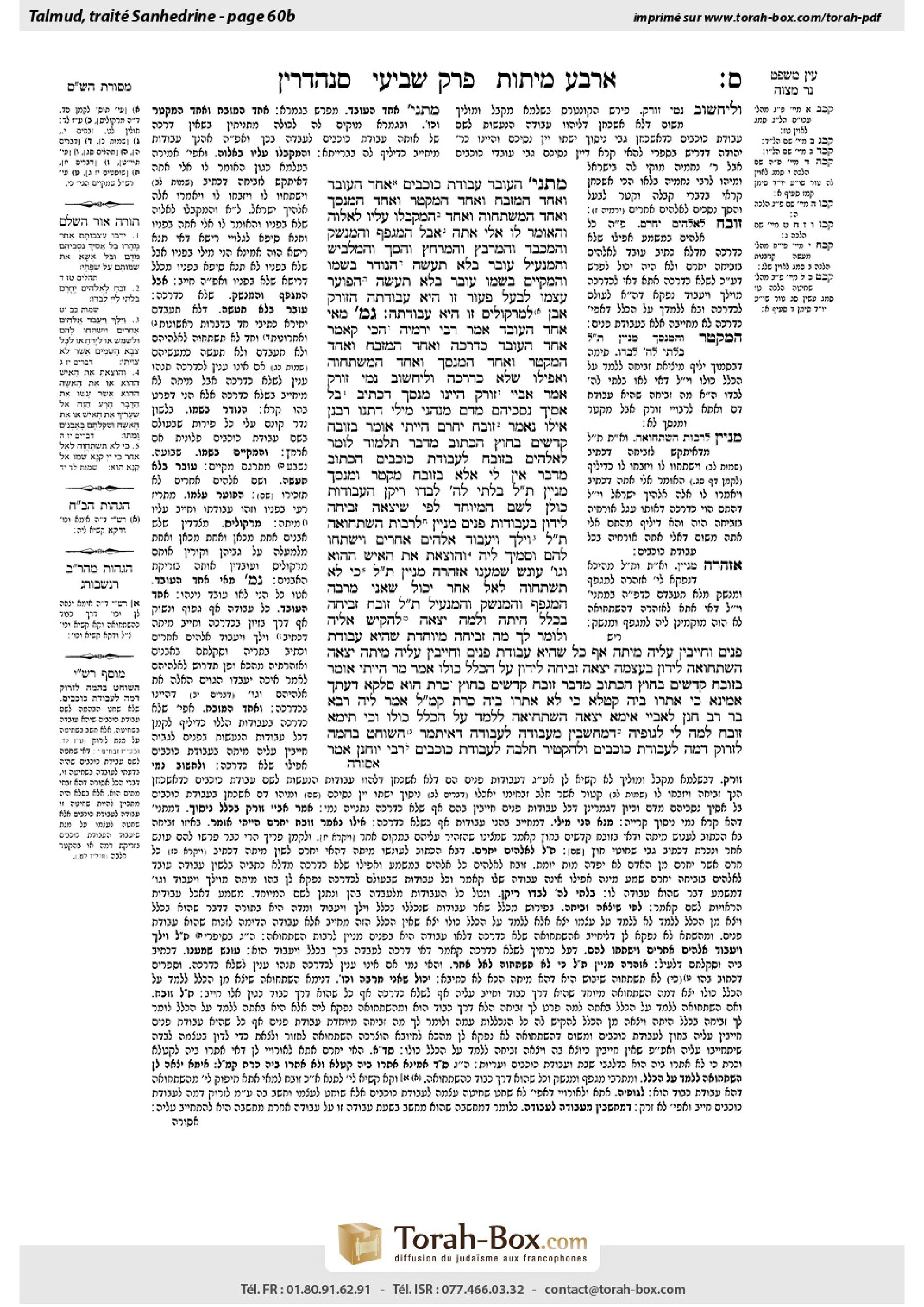
Sanhedrin 60b: Talmud study for Daf Yomi
Daf Yomi is the daily study of one Talmud folio. Explore 37 tractates with scans, Hebrew text, Sefaria English and AI-generated French translations where annotated.
Passage selection and English or AI-generated French translation are available where the scan has annotations. Daf Study is independent of Torah-Box and Sefaria.
Browse Sanhedrin · סנהדרין · All tractatesSanhedrin 60b text and translations
This page of Sanhedrin includes the Aramaic text, an English translation and an AI-generated French translation, alongside the scan above.
סנהדרין ס׳ ב · Aramaic and Hebrew text
מַתְנִי׳ הָעוֹבֵד עֲבוֹדָה זָרָה: אֶחָד הָעוֹבֵד, וְאֶחָד הַמְזַבֵּחַ, וְאֶחָד הַמְקַטֵּר, וְאֶחָד הַמְנַסֵּךְ, וְאֶחָד הַמִּשְׁתַּחֲוֶה, וְאֶחָד הַמְקַבְּלוֹ עָלָיו לֶאֱלוֹהַּ, וְהָאוֹמֵר לוֹ ״אֵלִי אַתָּה״.
אֲבָל הַמְגַפֵּף, וְהַמְנַשֵּׁק, וְהַמְכַבֵּד, וְהַמְרַבֵּץ, וְהַמְרַחֵץ, וְהַסָּךְ, וְהַמַּלְבִּישׁ, וְהַמַּנְעִיל – עוֹבֵר בְּלֹא תַעֲשֶׂה. הַנּוֹדֵר בִּשְׁמוֹ, וְהַמְקַיֵּים בִּשְׁמוֹ – עוֹבֵר בְּלֹא תַעֲשֶׂה.
הַפּוֹעֵר עַצְמוֹ לְבַעַל פְּעוֹר – זוֹ הִיא עֲבוֹדָתָהּ. הַזּוֹרֵק אֶבֶן לְמַרְקוּלִיס – זוֹ הִיא עֲבוֹדָתָהּ.
גְּמָ׳ מַאי ״אֶחָד הָעוֹבֵד״?
אָמַר רַבִּי יִרְמְיָה: הָכִי קָאָמַר, אֶחָד הָעוֹבֵד כְּדַרְכָּהּ, וְאֶחָד הַמְזַבֵּחַ, וְאֶחָד הַמְקַטֵּר, וְאֶחָד הַמְנַסֵּךְ, וְאֶחָד הַמִּשְׁתַּחֲוֶה, וַאֲפִילּוּ שֶׁלֹּא כְּדַרְכָּהּ.
וְלִיחְשׁוֹב נָמֵי זוֹרֵק? אָמַר אַבָּיֵי: זוֹרֵק הַיְינוּ מְנַסֵּךְ, דִּכְתִיב ״בַּל אַסִּיךְ נִסְכֵּיהֶם מִדָּם״.
מְנָהָנֵי מִילֵּי?
דְּתָנוּ רַבָּנַן: אִילּוּ נֶאֱמַר ״זֹבֵחַ יׇחֳרָם״, הָיִיתִי אוֹמֵר בְּזוֹבֵחַ קֳדָשִׁים בַּחוּץ הַכָּתוּב מְדַבֵּר. תַּלְמוּד לוֹמַר ״לָאֱלֹהִים״ – בְּזוֹבֵחַ לַעֲבוֹדָה זָרָה הַכָּתוּב מְדַבֵּר.
אֵין לִי אֶלָּא בְּזוֹבֵחַ, מְקַטֵּר וּמְנַסֵּךְ מִנַּיִין? תַּלְמוּד לוֹמַר: ״בִּלְתִּי לַה׳ לְבַדּוֹ״. רִיקֵּן הָעֲבוֹדוֹת כּוּלָּן לַשֵּׁם הַמְיוּחָד.
לְפִי שֶׁיָּצְאָה זְבִיחָה לִידּוֹן בַּעֲבוֹדוֹת פְּנִים, מִנַּיִין לְרַבּוֹת הִשְׁתַּחֲוָאָה?
תַּלְמוּד לוֹמַר: ״וַיֵּלֶךְ וַיַּעֲבֹד אֱלֹהִים אֲחֵרִים וַיִּשְׁתַּחוּ לָהֶם״, וּסְמִיךְ לֵיהּ: ״וְהוֹצֵאתָ אֶת הָאִישׁ הַהוּא וְגוֹ׳״.
עוֹנֶשׁ שָׁמַעְנוּ, אַזְהָרָה מִנַּיִין? תַּלְמוּד לוֹמַר: ״כִּי לֹא תִשְׁתַּחֲוֶה לְאֵל אַחֵר״.
יָכוֹל שֶׁאֲנִי מְרַבֶּה הַמְגַפֵּף וְהַמְנַשֵּׁק וְהַמַּנְעִיל? תַּלְמוּד לוֹמַר ״זֹבֵחַ״.
זְבִיחָה בַּכְּלָל הָיְתָה, וְלָמָּה יָצְאָה? לְהַקִּישׁ אֵלֶיהָ וְלוֹמַר לָךְ: מָה זְבִיחָה מְיוּחֶדֶת שֶׁהִיא עֲבוֹדַת פְּנִים וְחַיָּיבִין עָלֶיהָ מִיתָה, אַף כֹּל שֶׁהִיא עֲבוֹדַת פְּנִים וְחַיָּיבִין עָלֶיהָ מִיתָה.
יָצְאָה הִשְׁתַּחֲוָאָה לִידּוֹן בְּעַצְמָהּ, יָצְאָה זְבִיחָה לִידּוֹן עַל הַכְּלָל כּוּלּוֹ.
אָמַר מָר: הָיִיתִי אוֹמֵר בְּזוֹבֵחַ קֳדָשִׁים בַּחוּץ הַכָּתוּב מְדַבֵּר. זוֹבֵחַ קֳדָשִׁים בַּחוּץ כָּרֵת הוּא!
סָלְקָא דַּעְתָּךְ אָמֵינָא: כִּי אַתְרוֹ בֵּיהּ – קְטָלָא, כִּי לָא אַתְרוֹ בֵּיהּ – כָּרֵת. קָא מַשְׁמַע לַן.
אֲמַר לֵיהּ רָבָא בַּר רַב חָנָן לְאַבָּיֵי: אֵימָא, יָצְאָה הִשְׁתַּחֲוָאָה לְלַמֵּד עַל הַכְּלָל כּוּלּוֹ.
וְכִי תֵּימָא: זוֹבֵחַ לְמָה לִי? לְגוּפֵיהּ, דִּמְחַשְּׁבִין מֵעֲבוֹדָה לַעֲבוֹדָה.
דְּאִיתְּמַר: הַשּׁוֹחֵט בְּהֵמָה לִזְרוֹק דָּמָהּ לַעֲבוֹדָה זָרָה וּלְהַקְטִיר חֶלְבָּהּ לַעֲבוֹדָה זָרָה, רַבִּי יוֹחָנָן אָמַר:
Sanhedrin 60b · English translation
MISHNA: One who worships idols is executed by stoning. This includes one who worships an idol, and one who slaughters an animal as an idolatrous offering, and one who burns incense as an idolatrous offering, and one who pours a libation in idol worship, and one who bows to an idol, and one who declares that he accepts an idol upon himself as a god, and one who says to an idol: You are my god.
But with regard to one who hugs an idol, or one who kisses it, or one who cleans it, or one who sprays water before it, or one who washes it, or one who rubs it with oil, or one who dresses it, or one who puts its shoes on it, he transgresses a prohibition but is not liable to receive capital punishment. With regard to one who vows in an idol’s name and one who affirms his statement by an oath in its name, he transgresses a prohibition.
One who defecates before the idol known as Ba’al-Peor is liable to receive capital punishment, even though defecating is a degrading act, as that is its form of worship. Likewise, one who throws a stone at Mercury is liable to receive capital punishment, as that is its form of worship.
GEMARA: What is added in the mishna by stating the phrase: One who worships? Since worship is the general description of all the actions detailed in the mishna, why is this phrase necessary?
Rabbi Yirmeya says that this is what the mishna is saying: One who worships an idol in its typical manner of worship is liable to be executed; and furthermore, one who slaughters an animal as an idolatrous offering, and one who burns incense, and one who pours a libation, and the one who bows to an idol are all liable to be executed, and this applies even if this manner of worship is not the idol’s typical manner of worship. Even if the idol in question is not typically worshipped in these ways, these specific acts are still considered idol worship because these are the ways in which God is worshipped in the Temple.
The Gemara suggests: And let the mishna also count sprinkling the blood of an offering, which is also one of the sacrificial rites in the Temple. Abaye says: Sprinkling the blood of an offering is the same as pouring a libation, since they are essentially one sacrificial rite, as it is written: “I will not pour their libations of blood” (Psalms 16:4), indicating that sprinkling the blood of an offering is also referred to as offering a libation.
§ The Gemara asks with regard to the halakha that one is liable for worshipping an idol in these manners even if they are not the way the idol is typically worshipped: From where are these matters derived?
The Gemara answers: As the Sages taught in a baraita with regard to the verse: “One who sacrifices to the gods shall be utterly destroyed, except to the Lord alone” (Exodus 22:19): If it were stated: One who sacrifices shall be utterly destroyed, I would have said that the verse speaks of one who slaughters a sacrificial animal outside the Temple courtyard, referring to a severe transgression that is stated elsewhere in the Torah. Therefore, the verse states: “To the gods,” indicating that the verse speaks of one who slaughters an offering to an idol.
The baraita asks: From here I know only the halakha of one who slaughters an offering to an idol. From where is it derived that one who burns incense or pours a libation is also liable to receive the death penalty? The baraita answers that the verse states: “Except to the Lord alone”; the verse emptied out, i.e., designated, all the sacrificial rites to the ineffable name of God, indicating that one who performs any of these rites in idol worship is liable.
The baraita asks: Since slaughter is singled out from all of the forms of worship to be mentioned in this verse in order to derive from it that with regard to all the sacrificial rites performed inside the Temple, one who performs them in idol worship is liable to receive capital punishment, from where is it derived that this halakha includes bowing down to an idol, which is not a sacrificial rite?
The baraita answers that the verse states: “And has gone and served other gods and bowed to them” (Deuteronomy 17:3), and a verse near it states: “Then you shall bring forth that man or that woman who has done this evil thing to your gates, the man or the woman, and you shall stone them with stones and they shall die” (Deuteronomy 17:5). It is derived from the juxtaposition of these two verses that one who bows down to an idol is liable to be executed.
The baraita asks: We have heard the punishment for bowing down to an idol, but from where is the prohibition against doing so derived? The baraita answers that the verse states: “For you shall bow to no other god” (Exodus 34:14).
One might have thought that I should include among those liable to receive capital punishment one who hugs an idol, or one who kisses it, or one who puts its shoes on it as well. Therefore, the verse states: “One who sacrifices shall be utterly destroyed,” referring to the act of slaughtering an offering in idol worship.
The baraita explains: The slaughter of an offering was included in the general category of the prohibited forms of idol worship, and why was it singled out to be mentioned in this verse? It was singled out to compare a matter to it and say to you: Just as slaughter is notable in that it is a sacrificial rite performed inside the Temple, and those who perform this rite for the purpose of idol worship are liable to receive the death penalty for it, so too, any form of worship that is a sacrificial rite performed inside the Temple is prohibited when performed for idol worship, and transgressors are liable to receive the death penalty for it.
Therefore, the act of bowing to an idol is singled out to be mentioned in a separate verse to derive the death penalty for that action itself, despite the fact that it is not a sacrificial rite performed in the Temple, whereas the slaughter of an offering is singled out to be mentioned in order to derive from it the principle with regard to the entire category, namely, that generally one is not liable to receive capital punishment for a form of worship that is not performed in the Temple.
The Gemara proceeds to clarify the baraita. The Master said in the baraita: I would have said that the verse speaks of one who slaughters a sacrificial animal outside the Temple courtyard. The Gemara asks: The punishment for one who slaughters a sacrificial animal outside the Temple courtyard is karet, not capital punishment, as it is stated: “Each and every man…who offers a burnt-offering or sacrifice, and does not bring it to the entrance of the Tent of Meeting to sacrifice it to the Lord, even that man shall be cut off from his people” (Leviticus 17:8–9). Therefore, how can the baraita suggest that a verse that mentions capital punishment could be referring to this transgression?
The Gemara answers: It might enter your mind to say that in a case when the witnesses warned the transgressor not to slaughter the offering outside the Temple he is liable to receive the death penalty, but in a case when they did not warn him he is liable to receive karet. Therefore, the baraita teaches us that one who slaughters an offering outside the Temple is not liable to receive the death penalty even if he was warned.
The baraita states that the principle concerning the forms of idol worship that are punishable by execution is derived from the verse that mentions slaughtering an animal as an idolatrous offering, whereas bowing to an idol is mentioned in the verse as an exception. Rava bar Rav Ḥanan said to Abaye: Say that bowing is singled out to be mentioned to teach, with regard to the entire category, that any honorable form of worship, when performed for the sake of idol worship, carries the death penalty, not only sacrificial rites performed in the Temple.
And if you would say that if so, why do I need slaughter to be mentioned in the verse specifically, one can say that mentioning slaughter is necessary for the matter of slaughter itself, i.e., to teach that one can have intention from one sacrificial rite to another sacrificial rite. In other words, slaughtering an animal with idolatrous intent is punishable by death even if the intention of the transgressor pertains not to the slaughter itself but to another part of the sacrificial process.
As it was stated that with regard to one who slaughters an animal in order to sprinkle its blood in idol worship or to burn its fat in idol worship, Rabbi Yoḥanan says:
Sanhedrin 60b · Traduction française (IA)
MICHNA : Celui qui adore des idoles est exécuté par lapidation. Cela inclut celui qui adore une idole, celui qui égorge un animal en offrande idolâtre, celui qui brûle de l’encens en offrande idolâtre, celui qui verse une libation dans le cadre du culte idolâtre, celui qui se prosterne devant une idole, celui qui déclare accepter une idole comme dieu et celui qui dit à une idole : « Tu es mon dieu. »
Mais celui qui enlace une idole, l’embrasse, la nettoie, répand de l’eau devant elle, la lave, la frotte avec de l’huile, l’habille ou lui met ses chaussures transgresse un interdit, mais n’est pas passible de la peine capitale. Celui qui fait un vœu au nom d’une idole et celui qui confirme ses propos par un serment en son nom transgressent un interdit.
Celui qui défèque devant l’idole appelée Ba’al-Peor est passible de la peine capitale, bien que déféquer soit un acte dégradant, car telle est la forme de son culte. De même, celui qui jette une pierre à Mercure est passible de la peine capitale, car telle est la forme de son culte.
GUEMARA : Que vient ajouter la Michna en disant : « Celui qui adore » ? Puisque l’adoration est la catégorie générale à laquelle appartiennent toutes les actions détaillées dans la Michna, pourquoi cette expression est-elle nécessaire ?
Rabbi Yirmeya dit que voici ce que signifie la Michna : celui qui adore une idole selon son mode habituel de culte est passible d’exécution ; en outre, celui qui égorge un animal en offrande idolâtre, celui qui brûle de l’encens, celui qui verse une libation et celui qui se prosterne devant une idole sont tous passibles d’exécution, même si ce mode de culte n’est pas le mode habituel de l’idole. Même si l’idole en question n’est généralement pas adorée de ces façons, ces actes précis sont néanmoins considérés comme un culte idolâtre, car ce sont les façons dont on sert Dieu dans le Temple.
La Guemara suggère : Que la Michna mentionne aussi l’aspersion du sang d’une offrande, qui est également l’un des rites sacrificiels du Temple. Abaye dit : L’aspersion du sang d’une offrande équivaut à verser une libation, car il s’agit essentiellement d’un même rite sacrificiel, comme il est écrit : « Je ne verserai pas leurs libations de sang » (Psaumes 16, 4), ce qui indique que l’aspersion du sang d’une offrande est également appelée offrande d’une libation.
§ La Guemara pose une question au sujet de la halakha selon laquelle on est passible même lorsque l’on adore une idole selon des modes qui ne sont pas ceux de son culte habituel : de quelle source ces règles sont-elles déduites ?
La Guemara répond : Les Sages ont enseigné dans une baraïta à propos du verset : « Celui qui sacrifie aux dieux sera voué à la destruction, sauf au Seigneur seul » (Exode 22, 19) : s’il était écrit : « Celui qui sacrifie sera voué à la destruction », j’aurais dit que le verset parle de celui qui égorge un animal sacrificiel hors de l’enceinte du Temple, c’est-à-dire qu’il renvoie à une transgression grave mentionnée ailleurs dans la Torah. Le verset dit donc : « Aux dieux », ce qui indique qu’il parle de celui qui égorge une offrande pour une idole.
La baraïta demande : De là, je ne connais que la halakha concernant celui qui égorge une offrande pour une idole. D’où déduit-on que celui qui brûle de l’encens ou verse une libation est également passible de la peine capitale ? La baraïta répond que le verset dit : « Sauf au Seigneur seul » ; le verset a réservé, c’est-à-dire désigné, tous les rites sacrificiels au Nom ineffable de Dieu, ce qui indique que celui qui accomplit l’un de ces rites dans le cadre du culte idolâtre est passible de la peine capitale.
La baraïta demande : Puisque l’égorgement a été distingué parmi toutes les formes de culte mentionnées dans ce verset afin d’en déduire que, pour tous les rites sacrificiels accomplis à l’intérieur du Temple, celui qui les accomplit dans le cadre du culte idolâtre est passible de la peine capitale, d’où déduit-on que cette halakha inclut la prosternation devant une idole, qui n’est pas un rite sacrificiel ?
La baraïta répond que le verset dit : « Il est allé servir d’autres dieux et s’est prosterné devant eux » (Deutéronome 17, 3), et qu’un verset proche dit : « Alors vous ferez sortir aux portes cet homme ou cette femme qui a commis cette mauvaise action, l’homme ou la femme, et vous les lapiderez, et ils mourront » (Deutéronome 17, 5). On déduit du rapprochement de ces deux versets que celui qui se prosterne devant une idole est passible d’exécution.
La baraïta demande : Nous avons appris la peine encourue pour s’être prosterné devant une idole, mais d’où déduit-on l’interdit de le faire ? La baraïta répond que le verset dit : « Car tu ne te prosterneras devant aucun autre dieu » (Exode 34, 14).
On aurait pu penser qu’il fallait aussi inclure parmi ceux qui sont passibles de la peine capitale celui qui enlace une idole, l’embrasse ou lui met ses chaussures. Le verset dit donc : « Celui qui sacrifie sera voué à la destruction », ce qui renvoie à l’acte d’égorger une offrande dans le cadre du culte idolâtre.
La baraïta explique : L’égorgement d’une offrande était inclus dans la catégorie générale des formes interdites de culte idolâtre. Pourquoi a-t-il été distingué et mentionné dans ce verset ? Il l’a été afin de comparer un cas à celui-ci et de t’enseigner ceci : de même que l’égorgement se caractérise par le fait d’être un rite sacrificiel accompli à l’intérieur du Temple, et que ceux qui accomplissent ce rite dans le dessein de pratiquer un culte idolâtre sont passibles de la peine capitale, de même toute forme de culte qui est un rite sacrificiel accompli à l’intérieur du Temple est interdite lorsqu’elle est accomplie dans le cadre du culte idolâtre, et ceux qui la transgressent sont passibles de la peine capitale.
Par conséquent, l’acte de se prosterner devant une idole a été distingué et mentionné dans un verset séparé afin de déduire la peine capitale pour cet acte même, bien qu’il ne soit pas un rite sacrificiel accompli dans le Temple ; en revanche, l’égorgement d’une offrande a été distingué afin d’en déduire le principe applicable à toute la catégorie, à savoir qu’en règle générale, on n’est pas passible de la peine capitale pour une forme de culte qui n’est pas accomplie dans le Temple.
La Guemara poursuit l’explication de la baraïta. Le Maître a dit dans la baraïta : « J’aurais dit que le verset parle de celui qui égorge un animal sacrificiel hors de l’enceinte du Temple. » La Guemara demande : La peine encourue par celui qui égorge un animal sacrificiel hors de l’enceinte du Temple est le retranchement, et non la peine capitale, comme il est dit : « Tout homme […] qui offre un holocauste ou un sacrifice, sans l’amener à l’entrée de la Tente d’assignation pour l’offrir au Seigneur, cet homme sera retranché de son peuple » (Lévitique 17, 8-9). Comment la baraïta peut-elle donc suggérer qu’un verset mentionnant la peine capitale pourrait renvoyer à cette transgression ?
La Guemara répond : On aurait pu penser que, si les témoins avaient averti le transgresseur de ne pas égorger l’offrande hors du Temple, il serait passible de la peine capitale, mais que, s’ils ne l’avaient pas averti, il serait passible du retranchement. La baraïta nous enseigne donc que celui qui égorge une offrande hors du Temple n’est pas passible de la peine capitale, même s’il a été averti.
La baraïta affirme que le principe relatif aux formes de culte idolâtre passibles d’exécution est déduit du verset qui mentionne l’égorgement d’un animal en offrande idolâtre, tandis que la prosternation devant une idole est mentionnée dans le verset comme une exception. Rava bar Rav Ḥanan dit à Abaye : Dis plutôt que la prosternation a été distinguée afin d’enseigner, pour toute la catégorie, que toute forme honorable de culte, lorsqu’elle est accomplie dans le dessein d’adorer une idole, entraîne la peine capitale, et pas seulement les rites sacrificiels accomplis dans le Temple.
Et si tu dis que, dans ce cas, pourquoi fallait-il précisément mentionner l’égorgement dans le verset, on peut répondre que cette mention est nécessaire pour l’égorgement lui-même, c’est-à-dire pour enseigner qu’on peut avoir une intention portant sur un rite sacrificiel en vue d’un autre rite sacrificiel. Autrement dit, égorger un animal avec une intention idolâtre est passible de la peine capitale, même si l’intention du transgresseur ne porte pas sur l’égorgement lui-même, mais sur une autre étape du processus sacrificiel.
En effet, il a été dit que, concernant celui qui égorge un animal afin d’en asperger le sang dans le cadre du culte idolâtre ou d’en brûler la graisse dans le cadre du culte idolâtre, Rabbi Yoḥanan dit :
Traduction française générée par IA à partir de l’édition anglaise de Sefaria. Vérifie toujours un passage avec le texte source.
Text from Sefaria: William Davidson Edition - Vocalized Aramaic (CC BY NC); William Davidson Edition - English (CC BY NC).