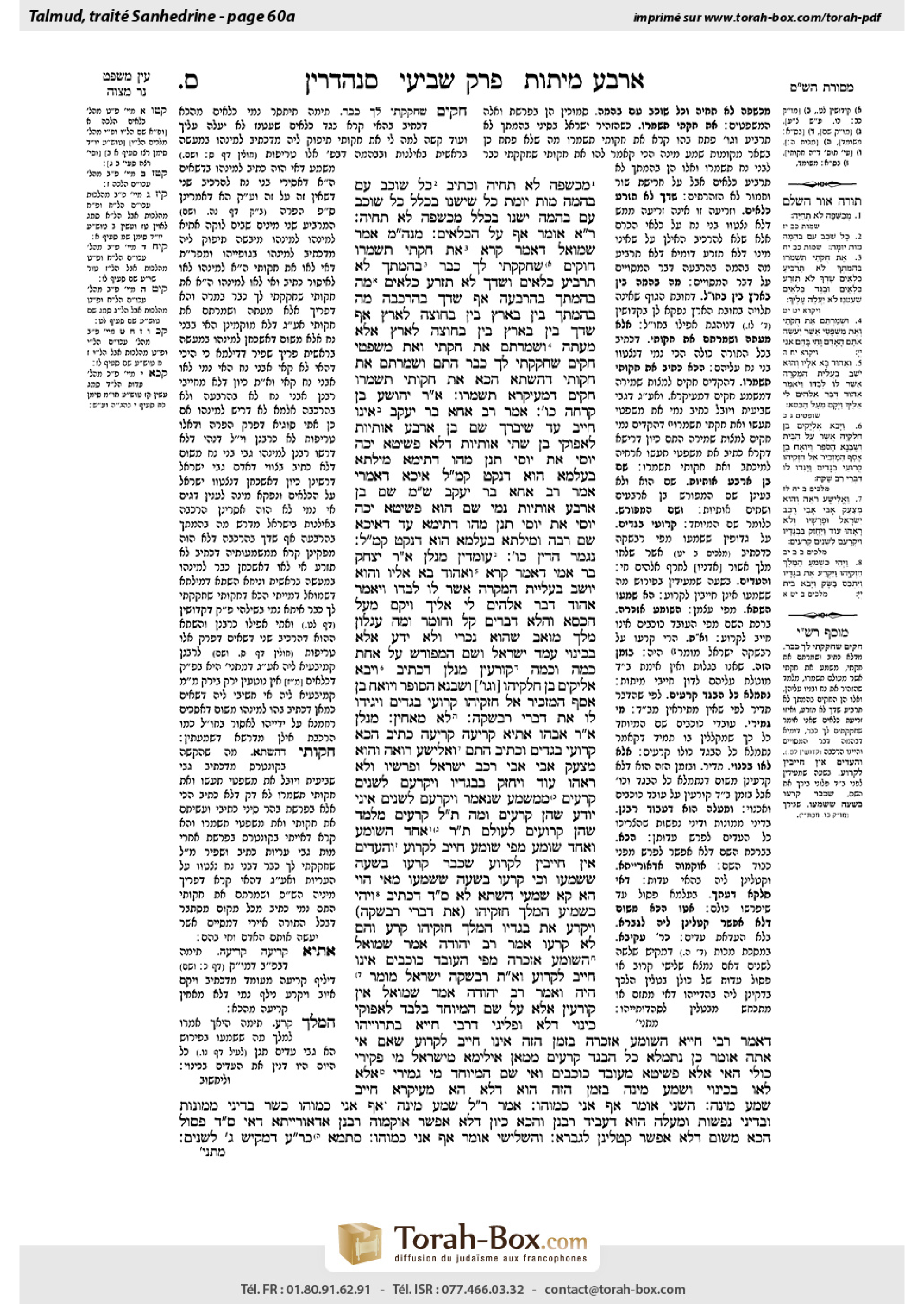
Sanhedrin 60a: Talmud study for Daf Yomi
Daf Yomi is the daily study of one Talmud folio. Explore 37 tractates with scans, Hebrew text, Sefaria English and AI-generated French translations where annotated.
Passage selection and English or AI-generated French translation are available where the scan has annotations. Daf Study is independent of Torah-Box and Sefaria.
Browse Sanhedrin · סנהדרין · All tractatesSanhedrin 60a text and translations
This page of Sanhedrin includes the Aramaic text, an English translation and an AI-generated French translation, alongside the scan above.
סנהדרין ס׳ א · Aramaic and Hebrew text
״מְכַשֵּׁפָה לֹא תְחַיֶּה״, וּכְתִיב: ״כׇּל שֹׁכֵב עִם בְּהֵמָה מוֹת יוּמָת״. כֹּל שֶׁיֶּשְׁנוֹ בִּכְלַל ״כׇּל שֹׁכֵב עִם בְּהֵמָה״ – יֶשְׁנוֹ בִּכְלַל ״מְכַשֵּׁפָה לֹא תְחַיֶּה״.
רַבִּי אֶלְעָזָר אוֹמֵר: אַף עַל הַכִּלְאַיִם. מְנָא הָנֵי מִילֵּי? אָמַר שְׁמוּאֵל, דְּאָמַר קְרָא: ״אֵת חֻקֹּתַי תִּשְׁמֹרוּ״ – חוּקִּים שֶׁחָקַקְתִּי לְךָ כְּבָר: ״בְּהֶמְתְּךָ לֹא תַרְבִּיעַ כִּלְאַיִם שָׂדְךָ לֹא תִזְרַע כִּלְאָיִם״.
מָה בְּהֶמְתְּךָ בְּהַרְבָּעָה, אַף שָׂדְךָ בְּהַרְכָּבָה. מָה בְּהֶמְתְּךָ בֵּין בָּאָרֶץ בֵּין בְּחוּצָה לָאָרֶץ, אַף שָׂדְךָ בֵּין בָּאָרֶץ בֵּין בְּחוּצָה לָאָרֶץ.
אֶלָּא מֵעַתָּה: ״וּשְׁמַרְתֶּם אֶת חֻקֹּתַי וְאֶת מִשְׁפָּטַי״ – חֻקִּים שֶׁחָקַקְתִּי לְךָ כְּבָר?
הָתָם – ״וּשְׁמַרְתֶּם אֶת חֻקֹּתַי״ דְּהַשְׁתָּא. הָכָא – ״אֶת חֻקֹּתַי תִּשְׁמֹרוּ״, חֻקִּים דְּמֵעִיקָּרָא תִּשְׁמֹרוּ.
אָמַר רַבִּי יְהוֹשֻׁעַ בֶּן קׇרְחָה כּוּ׳.
אָמַר רַב אַחָא בַּר יַעֲקֹב: אֵינוֹ חַיָּיב עַד שֶׁיְּבָרֵךְ שֵׁם בֶּן אַרְבַּע אוֹתִיּוֹת, לְאַפּוֹקֵי בֶּן שְׁתֵּי אוֹתִיּוֹת דְּלָא.
פְּשִׁיטָא! ״יַכֶּה יוֹסִי אֶת יוֹסִי״ תְּנַן! מַהוּ דְּתֵימָא: מִילְּתָא בְּעָלְמָא הוּא דְּנָקֵט, קָא מַשְׁמַע לַן.
אִיכָּא דְּאָמְרִי: אָמַר רַב אַחָא בַּר יַעֲקֹב, שְׁמַע מִינַּהּ: שֵׁם בֶּן אַרְבַּע אוֹתִיּוֹת נָמֵי שֵׁם הוּא.
פְּשִׁיטָא! ״יַכֶּה יוֹסִי אֶת יוֹסִי״ תְּנַן! מַהוּ דְּתֵימָא: עַד דְּאִיכָּא שֵׁם רַבָּה, וּמִילְּתָא בְּעָלְמָא הוּא דְּנָקֵט – קָא מַשְׁמַע לַן.
נִגְמַר הַדִּין כּוּ׳.
עוֹמְדִין – מְנָלַן? אָמַר רַבִּי יִצְחָק בַּר אַמֵּי: דְּאָמַר קְרָא, ״וְאֵהוּד בָּא אֵלָיו וְהוּא יֹשֵׁב בַּעֲלִיַּת הַמְּקֵרָה אֲשֶׁר לוֹ לְבַדּוֹ וַיֹּאמֶר אֵהוּד דְּבַר אֱלֹהִים לִי אֵלֶיךָ וַיָּקׇם מֵעַל הַכִּסֵּא״. וַהֲלֹא דְּבָרִים קַל וָחוֹמֶר? וּמָה עֶגְלוֹן מֶלֶךְ מוֹאָב שֶׁהוּא גּוֹי וְלֹא יָדַע אֶלָּא בְּכִינּוּי – עָמַד, יִשְׂרָאֵל וְשֵׁם הַמְפוֹרָשׁ – עַל אַחַת כַּמָּה וְכַמָּה!
קוֹרְעִין – מְנָלַן? דִּכְתִיב: ״וַיָּבֹא אֶלְיָקִים בֶּן חִלְקִיָּהוּ [וְגוֹ׳] וְשֶׁבְנָא הַסֹּפֵר וְיוֹאָח בֶּן אָסָף הַמַּזְכִּיר אֶל חִזְקִיָּהוּ קְרוּעֵי בְגָדִים וַיַּגִּידוּ לוֹ אֵת דִּבְרֵי רַבְשָׁקֵה״.
וְלֹא מְאַחִין – מְנָלַן?
אָמַר רַבִּי אֲבָהוּ: אָתְיָא קְרִיעָה קְרִיעָה, כְּתִיב הָכָא ״קְרוּעֵי בְגָדִים״, וּכְתִיב הָתָם ״וֶאֱלִישָׁע רֹאֶה וְהוּא מְצַעֵק אָבִי אָבִי רֶכֶב יִשְׂרָאֵל וּפָרָשָׁיו וְלֹא רָאָהוּ עוֹד וַיַּחֲזֵק בִּבְגָדָיו וַיִּקְרָעֵם לִשְׁנַיִם קְרָעִים״. מִמַּשְׁמַע שֶׁנֶּאֱמַר ״וַיִּקְרָעֵם לִשְׁנַיִם״, אֵינִי יוֹדֵעַ שֶׁהֵן קְרָעִים? וּמָה תַּלְמוּד לוֹמַר ״קְרָעִים״? מְלַמֵּד שֶׁהֵן קְרוּעִים לְעוֹלָם.
תָּנוּ רַבָּנַן: אֶחָד הַשּׁוֹמֵעַ, וְאֶחָד שׁוֹמֵעַ מִפִּי שׁוֹמֵעַ – חַיָּיב לִקְרוֹעַ. וְהָעֵדִים אֵין חַיָּיבִין לִקְרוֹעַ, שֶׁכְּבָר קָרְעוּ בְּשָׁעָה שֶׁשָּׁמְעוּ.
וְכִי קָרְעוּ בְּשָׁעָה שֶׁשָּׁמְעוּ, מַאי הָוֵי? הָא קָא שָׁמְעִי הַשְׁתָּא! לָא סָלְקָא דַּעְתָּךְ, דִּכְתִיב: ״וַיְהִי כִּשְׁמֹעַ הַמֶּלֶךְ חִזְקִיָּהוּ אֶת דִּבְרֵי רַבְשָׁקֵה וַיִּקְרַע אֶת בְּגָדָיו״. הַמֶּלֶךְ חִזְקִיָּהוּ קָרַע, וְהֵם לֹא קָרְעוּ.
אָמַר רַב יְהוּדָה אָמַר שְׁמוּאֵל: הַשּׁוֹמֵעַ אַזְכָּרָה מִפִּי הַגּוֹי אֵינוֹ חַיָּיב לִקְרוֹעַ. וְאִם תֹּאמַר: רַבְשָׁקֵה – יִשְׂרָאֵל מוּמָר הָיָה.
וְאָמַר רַב יְהוּדָה אָמַר שְׁמוּאֵל: אֵין קוֹרְעִין אֶלָּא עַל שֵׁם הַמְיוּחָד בִּלְבַד, לְאַפּוֹקֵי כִּינּוּי דְּלָא.
וּפְלִיגִי דְּרַבִּי חִיָּיא בְּתַרְוַיְיהוּ, דְּאָמַר רַבִּי חִיָּיא: הַשּׁוֹמֵעַ אַזְכָּרָה בִּזְמַן הַזֶּה אֵינוֹ חַיָּיב לִקְרוֹעַ, שֶׁאִם אִי אַתָּה אוֹמֵר כֵּן – נִתְמַלֵּא כׇּל הַבֶּגֶד קְרָעִים.
מִמַּאן? אִילֵימָא מִיִּשְׂרָאֵל, מִי פְּקִירִי כּוּלֵּי הַאי? אֶלָּא פְּשִׁיטָא, מִגּוֹי. וְאִי שֵׁם הַמְיוּחָד, מִי גְּמִירִי? אֶלָּא לָאו, בְּכִינּוּי.
וּשְׁמַע מִינַּהּ: בִּזְמַן הַזֶּה הוּא דְּלָא, הָא מֵעִיקָּרָא – חַיָּיב. שְׁמַע מִינַּהּ.
הַשֵּׁנִי אוֹמֵר: ״אַף אֲנִי כָּמוֹהוּ״. אָמַר רֵישׁ לָקִישׁ: שְׁמַע מִינַּהּ, ״אַף אֲנִי כָּמוֹהוּ״ כָּשֵׁר בְּדִינֵי מָמוֹנוֹת וּבְדִינֵי נְפָשׁוֹת, וּמַעֲלָה הוּא דַּעֲבוּד רַבָּנַן. וְהָכָא, כֵּיוָן דְּלָא אֶפְשָׁר, אוֹקְמוּהָ רַבָּנַן אַדְּאוֹרָיְיתָא.
דְּאִי סָלְקָא דַעְתָּךְ פָּסוּל, הָכָא, מִשּׁוּם דְּלָא אֶפְשָׁר, קָטְלִינַן לְגַבְרָא?
וְהַשְּׁלִישִׁי אוֹמֵר: ״אַף אֲנִי כָּמוֹהוּ״. סְתָמָא כְּרַבִּי עֲקִיבָא, דְּמַקֵּישׁ שְׁלֹשָׁה לִשְׁנַיִם.
Sanhedrin 60a · English translation
“You shall not allow a witch to live” (Exodus 22:17), and it is written in the following verse: “Whoever lies with an animal shall be put to death” (Exodus 22:18). It is derived from here that anyone who is included in the prohibition of: “Whoever lies with an animal,” including gentiles, is included in the command: “You shall not allow a witch to live.”
The baraita teaches that Rabbi Elazar says that descendants of Noah were also commanded about the prohibition of diverse kinds. The Gemara asks: From where are these matters derived? Shmuel says: They are derived from that which the verse states: “My statutes you shall keep. You shall not breed your animal with a diverse kind; you shall not sow your field with two kinds of seed” (Leviticus 19:19). God is saying: Keep the statutes that I have already instituted for you, i.e., mitzvot that were already given to the descendants of Noah, namely, “you shall not breed your animal with a diverse kind; you shall not sow your field with two kinds of seed.”
The Gemara derives the details of this prohibition from the verse: Just as the Noahide prohibition concerning your animal applies with regard to breeding animals of different species, and not with regard to plowing with animals of two different species working together, which is prohibited only for Jews, so too, the Noahide prohibition in your field applies with regard to grafting one species onto another, which is equivalent to breeding, but it is not prohibited for gentiles to sow different seeds together. Furthermore, just as the Noahide prohibition against breeding your animal applies both in Eretz Yisrael and outside Eretz Yisrael, so too, the Noahide prohibition against grafting diverse kinds in your field applies both in Eretz Yisrael and outside Eretz Yisrael.
The Gemara asks: If that is so, that the term “My statutes” is understood as referring to mitzvot that were already given to the descendants of Noah, then the verse: “You shall therefore keep My statutes and My ordinances” (Leviticus 18:5), referring to the entire Torah, should also obligate the descendants of Noah, as it would be referring to: Statutes that I have already instituted for you.
The Gemara answers: There the verse states: “You shall therefore keep My statutes,” indicating only those statutes that I am giving you now, whereas here, in the verse concerning diverse kinds, the wording is “My statutes you shall keep,” meaning statutes that obligate you from the outset you shall keep in the future.
§ After clarifying the halakhot of the descendants of Noah, the Gemara returns to the halakhot stated in the mishna with regard to one who blasphemes. It is stated in the mishna that Rabbi Yehoshua ben Korḥa said that during a blasphemer’s trial, the judges ask the witnesses to use an appellation for the name of God so that they do not utter a curse of God’s name. Specifically, they would use the sentence: Let Yosei smite Yosei, as the name Yosei has four letters in Hebrew, like the Tetragrammaton.
Rav Aḥa bar Ya’akov says: The blasphemer is not liable unless he blesses, i.e., curses, the Tetragrammaton, the four-letter name of God, which is to the exclusion of one who curses the two-letter name of God, spelled yod heh, who is not liable.
The Gemara asks: Isn’t that obvious? We learned in the mishna that the expression used in court is let Yosei smite Yosei, which indicates a four-letter name. The Gemara answers: Lest you say that the tanna mentions this statement as a mere example but does not intend that the witnesses use the four-letter name in particular, Rav Aḥa bar Ya’akov teaches us that one is liable only for cursing the Tetragrammaton.
There are those who say that Rav Aḥa bar Ya’akov says as follows: Conclude from the mishna that the Tetragrammaton is also a name for which one is liable, and he is liable not only for cursing the forty-two-letter name of God.
The Gemara asks: Isn’t that obvious? We learned in the mishna that the expression used in court is let Yosei smite Yosei. The Gemara answers: Lest you say that one is not liable unless there is a grand name that he curses, i.e., the forty-two-letter name, and the tanna mentions this statement as a mere example, Rav Aḥa bar Ya’akov teaches us that one is liable even for cursing the Tetragrammaton, and the name Yosei is mentioned specifically.
§ The mishna teaches: When the judgment is over, and judges need to hear the exact wording of the curse so they can sentence the defendant, the eldest of the witnesses repeats the curse, and the judges rise and make a tear in their clothing.
The Gemara asks: From where do we derive that the judges must stand? Rabbi Yitzḥak bar Ami says: It is derived from that which the verse states about Eglon: “And Ehud came to him, and he was sitting by himself alone in his cool upper chamber. And Ehud said: I have a message from God [Elohim] to you. And he arose out of his seat” (Judges 3:20). And are these matters not inferred a fortiori? And if Eglon, king of Moab, who was a gentile and knew the name of God only by an appellation, stood in honor, all the more so must a Jew stand if he hears the ineffable name.
The mishna teaches that upon hearing the curse the judges each make a tear in their garments. The Gemara asks: From where do we derive this? The Gemara answers that it is derived from that which is written: “Then came Eliakim, son of Hilkiah, who was over the household, and Shebna the scribe, and Joah, son of Asaph, the recorder, to Hezekiah with torn garments, and they told him Rabshakeh’s statement” (II Kings 18:37). Apparently, since they heard the blasphemous statement of Rabshakeh they were obligated to make a tear in their garments.
It is furthermore stated that the judges do not ever fully stitch the tear together again. The Gemara asks: From where do we derive this?
Rabbi Abbahu says: It is derived by means of a verbal analogy between the tearing stated in this regard and the tearing stated with regard to Elijah’s ascendance to heaven. It is written here, with regard to those who heard Rabshakeh’s blasphemy: “With torn garments,” and it is written there: “And Elisha saw it, and he cried: My father, my father, the chariots of Israel and its horsemen. And he saw him no more, and he grabbed hold of his clothes and tore them into two pieces” (II Kings 2:12). From the meaning of that which is stated: “And tore them into two,” do I not know that they are pieces? And why must the verse state: “Pieces”? This teaches that they remain torn forever; they may never be fully stitched back together, but only partially sewn.
The Sages taught: Both one who hears the curse himself and one who hears it from the one who heard it are obligated to make a tear in their garments. But the witnesses are not obligated to make a tear when they testify, as they already made a tear when they heard it from the blasphemer himself.
The Gemara asks: And if they made a tear when they heard the curse, what of it? Aren’t they also hearing the curse now? The Gemara answers: It should not enter your mind that they are obligated to make a tear a second time, as it is written: “And it came to pass, when King Hezekiah heard the statement of Rabshakeh, that he tore his clothes” (II Kings 19:1). It can be inferred that King Hezekiah tore his clothes, but those who reported the blasphemy did not tear their clothes a second time.
§ Rav Yehuda says that Shmuel says: One who hears a mention of God’s name in a blasphemous manner from a gentile is not obligated to make a tear in his garments. And if you object and say that those who heard the blasphemy of Rabshakeh made a tear even though he was a gentile, that is not correct, as Rabshakeh was an apostate Jew.
And Rav Yehuda says that Shmuel says: One makes a tear only for hearing a curse of the ineffable name of God, to the exclusion of hearing a curse of an appellation for the name of God, for which one does not make a tear.
The Gemara notes: And Shmuel disagrees with Rav Ḥiyya with regard to two matters. As Rabbi Ḥiyya says: One who hears a mention of God’s name in a blasphemous context nowadays is not obligated to make a tear, as if you do not say so, the entire garment will be full of tears.
The Gemara clarifies: From whom does one hear these mentions of God’s name about which Rabbi Ḥiyya says that one’s entire garment would be full of tears? If we say that he hears from it a Jew, are Jews irreverent to such an extent that they demean the name of God? Rather, it is obvious that Rabbi Ḥiyya is referring to hearing it from a gentile. And if you say that the reference is to cursing the ineffable name, have the gentiles learned it? They have no knowledge of his name. Rather, is it not referring to cursing by an appellation of God’s name?
And conclude from it that it is specifically nowadays that, according to Rav Ḥiyya, one is not obligated to make a tear in his garment when hearing the curse of a gentile and when hearing a curse of God that referred to God with an appellation, but initially, when the fundamental halakha was practiced, one was obligated to make a tear in these cases, contrary to the opinion of Shmuel. The Gemara affirms: Indeed, conclude from it that this is so.
§ The mishna teaches that after the eldest witness states the exact wording of the curse, the second witness does not repeat it, but he says: I too heard as he did. Reish Lakish says: Conclude from it that saying: I too heard as he did, is valid testimony by Torah law, both in cases of monetary law and in cases of capital law. And the requirement that every witness must relate his testimony separately is a higher standard that the Sages instituted, and here, since it is not possible to fulfill this requirement, as it is not appropriate for a blasphemous statement to be repeated several times, the Sages established the matter according to Torah law and did not require that every witness repeat the curse.
As if it enters your mind that saying: I too heard as he did, is not valid testimony by Torah law, here, in the case of blasphemy, would we execute the man without full testimony because it is not possible to allow the repetition of blasphemy? Clearly, such testimony is valid by Torah law.
The mishna teaches: And the third witness says: I too heard as he did. The Gemara comments: The unattributed tanna of the mishna holds in accordance with the opinion of Rabbi Akiva, who compares three witnesses to two. Rabbi Akiva maintains that just as in a case where there are two witnesses, the disqualification of one disqualifies all of the testimony, so too, even if there are three witnesses, and one of the three is disqualified, all of the testimony is disqualified. Similarly, here too he holds that if there are three witnesses, each of them must testify concerning the curse.
Sanhedrin 60a · Traduction française (IA)
« Tu ne laisseras pas vivre une sorcière » (Exode 22:17), et le verset suivant dit : « Quiconque couche avec un animal sera mis à mort » (Exode 22:18). On en déduit que quiconque est inclus dans l’interdiction « Quiconque couche avec un animal », y compris les non-Juifs, est également inclus dans l’ordre « Tu ne laisseras pas vivre une sorcière ».
La baraïta enseigne que Rabbi Elazar affirme que les descendants de Noé ont eux aussi reçu l’interdiction des mélanges d’espèces. La Guemara demande : D’où déduit-on ces règles ? Chemouel dit : On les déduit de ce que le verset énonce : « Vous observerez mes lois. Tu ne feras pas accoupler ton animal avec une espèce différente ; tu n’ensemenceras pas ton champ de deux espèces de semences » (Lévitique 19:19). Dieu dit : « Observez les lois que j’ai déjà instituées pour vous », c’est-à-dire les mitsvot déjà données aux descendants de Noé, à savoir : « Tu ne feras pas accoupler ton animal avec une espèce différente ; tu n’ensemenceras pas ton champ de deux espèces de semences ».
La Guemara déduit du verset les détails de cette interdiction : de même que l’interdiction noahide concernant ton animal s’applique à l’accouplement d’animaux d’espèces différentes, mais non au labour avec des animaux de deux espèces différentes travaillant ensemble — pratique interdite seulement aux Juifs —, de même l’interdiction noahide concernant ton champ s’applique à la greffe d’une espèce sur une autre, qui équivaut à un accouplement, mais il n’est pas interdit aux non-Juifs de semer ensemble des graines différentes. En outre, de même que l’interdiction noahide d’accoupler ton animal s’applique aussi bien en Eretz Israël qu’en dehors d’Eretz Israël, de même l’interdiction noahide de greffer des espèces différentes dans ton champ s’applique aussi bien en Eretz Israël qu’en dehors d’Eretz Israël.
La Guemara demande : Si tel est le cas, si l’expression « mes lois » désigne les mitsvot déjà données aux descendants de Noé, alors le verset « Vous observerez donc mes lois et mes ordonnances » (Lévitique 18:5), qui concerne toute la Torah, devrait lui aussi obliger les descendants de Noé, puisqu’il ferait référence aux lois que j’ai déjà instituées pour vous.
La Guemara répond : Là, le verset dit : « Vous observerez donc mes lois », ce qui indique qu’il s’agit uniquement des lois que je vous donne maintenant ; tandis qu’ici, dans le verset concernant les mélanges d’espèces, la formulation est : « Vous observerez mes lois », c’est-à-dire : vous observerez désormais les lois qui vous obligent depuis l’origine.
§ Après avoir clarifié les halakhot concernant les descendants de Noé, la Guemara revient aux halakhot énoncées dans la Michna au sujet de celui qui blasphème. La Michna rapporte que Rabbi Yehochoua ben Korḥa a dit que, pendant le procès d’un blasphémateur, les juges demandent aux témoins d’employer une appellation du nom de Dieu, afin qu’ils ne prononcent pas eux-mêmes une malédiction visant le nom de Dieu. Ils utilisaient précisément la phrase : « Que Yosseï frappe Yosseï », car le nom Yosseï comporte quatre lettres en hébreu, comme le Tétragramme.
Rav Aḥa bar Yaakov dit : Le blasphémateur n’est passible que s’il bénit, c’est-à-dire maudit, le Tétragramme, le nom de Dieu composé de quatre lettres ; cela exclut celui qui maudit le nom de Dieu composé de deux lettres, écrit yod hé, qui n’est pas passible.
La Guemara demande : N’est-ce pas évident ? Nous avons appris dans la Michna que l’expression employée au tribunal est : « Que Yosseï frappe Yosseï », ce qui indique un nom de quatre lettres. La Guemara répond : De peur que tu ne dises que le tanna ne cite cette phrase qu’à titre d’exemple, sans vouloir dire que les témoins doivent précisément employer le nom de quatre lettres, Rav Aḥa bar Yaakov nous enseigne qu’on n’est passible que pour avoir maudit le Tétragramme.
Certains disent que Rav Aḥa bar Yaakov s’exprime ainsi : Déduis de la Michna que le Tétragramme est lui aussi un nom dont la malédiction rend passible, et qu’on n’est pas passible uniquement pour avoir maudit le nom de Dieu composé de quarante-deux lettres.
La Guemara demande : N’est-ce pas évident ? Nous avons appris dans la Michna que l’expression employée au tribunal est : « Que Yosseï frappe Yosseï ». La Guemara répond : De peur que tu ne dises qu’on n’est passible que si l’on maudit un grand nom, c’est-à-dire le nom de quarante-deux lettres, et que le tanna ne cite cette phrase qu’à titre d’exemple, Rav Aḥa bar Yaakov nous enseigne qu’on est passible même pour avoir maudit le Tétragramme, et que le nom Yosseï est cité à dessein.
§ La Michna enseigne : Lorsque le jugement est terminé et que les juges doivent entendre les termes exacts de la malédiction afin de pouvoir condamner l’accusé, le plus âgé des témoins répète la malédiction, puis les juges se lèvent et déchirent leurs vêtements.
La Guemara demande : D’où déduit-on que les juges doivent se tenir debout ? Rabbi Yitsḥak bar Ami dit : On le déduit de ce que le verset dit au sujet d’Eglon : « Ehud vint auprès de lui, alors qu’il était assis seul dans sa chambre fraîche, à l’étage supérieur. Ehud dit : J’ai un message de Dieu [Elohim] pour toi. Et il se leva de son siège » (Juges 3:20). N’est-ce pas une déduction a fortiori ? Si Eglon, roi de Moav, qui était non-Juif et ne connaissait le nom de Dieu que sous une appellation, s’est levé par respect, à plus forte raison un Juif doit-il se lever s’il entend le nom ineffable.
La Michna enseigne qu’en entendant la malédiction, les juges déchirent chacun leurs vêtements. La Guemara demande : D’où déduit-on cela ? Elle répond qu’on le déduit de ce qui est écrit : « Éliakim, fils de Hilqiya, qui était maître du palais, Chevna le scribe, et Yoah, fils d’Asaph, le secrétaire, vinrent auprès d’Ézéchias, les vêtements déchirés, et lui rapportèrent les paroles de Rabchaqé » (II Rois 18:37). Il apparaît donc que, puisqu’ils avaient entendu les paroles blasphématoires de Rabchaqé, ils étaient tenus de déchirer leurs vêtements.
Il est également dit que les juges ne recousent jamais complètement la déchirure. La Guemara demande : D’où déduit-on cela ?
Rabbi Abbahou dit : On le déduit par une analogie verbale entre la déchirure mentionnée ici et celle mentionnée à propos de l’ascension d’Élie au ciel. Ici, à propos de ceux qui ont entendu le blasphème de Rabchaqé, il est écrit : « les vêtements déchirés » ; et là, il est écrit : « Élicha le vit et s’écria : Mon père, mon père ! Char d’Israël et ses cavaliers ! Et il ne le vit plus ; alors il saisit ses vêtements et les déchira en deux morceaux » (II Rois 2:12). Le sens de l’expression « il les déchira en deux » ne m’apprend-il pas déjà qu’il s’agit de morceaux ? Pourquoi le verset doit-il préciser : « morceaux » ? Cela enseigne qu’ils restent déchirés à jamais : on ne peut jamais les recoudre complètement, mais seulement en partie.
Les Sages ont enseigné : Celui qui entend lui-même la malédiction et celui qui l’entend de la bouche de celui qui l’a entendue sont tous deux tenus de déchirer leurs vêtements. Mais les témoins ne sont pas tenus de les déchirer lorsqu’ils témoignent, car ils les ont déjà déchirés en entendant la malédiction de la bouche du blasphémateur lui-même.
La Guemara demande : Et s’ils ont déchiré leurs vêtements en entendant la malédiction, qu’importe ? Ne l’entendent-ils pas également maintenant ? La Guemara répond : Ne pense pas qu’ils soient tenus de déchirer leurs vêtements une seconde fois, car il est écrit : « Lorsque le roi Ézéchias entendit les paroles de Rabchaqé, il déchira ses vêtements » (II Rois 19:1). On peut en déduire que le roi Ézéchias déchira ses vêtements, mais que ceux qui lui rapportèrent le blasphème ne les déchirèrent pas une seconde fois.
§ Rav Yehouda dit au nom de Chemouel : Celui qui entend un non-Juif mentionner le nom de Dieu de manière blasphématoire n’est pas tenu de déchirer ses vêtements. Si tu objectes que ceux qui ont entendu le blasphème de Rabchaqé ont déchiré leurs vêtements alors qu’il était non-Juif, ce n’est pas exact, car Rabchaqé était un Juif apostat.
Rav Yehouda dit au nom de Chemouel : On ne déchire ses vêtements qu’en entendant une malédiction visant le nom ineffable de Dieu ; cela exclut celui qui entend une malédiction visant une appellation du nom de Dieu, pour laquelle on ne déchire pas ses vêtements.
La Guemara fait remarquer que Chemouel est en désaccord avec Rav Ḥiyya sur deux points. Rabbi Ḥiyya dit en effet : De nos jours, celui qui entend une mention du nom de Dieu dans un contexte blasphématoire n’est pas tenu de déchirer ses vêtements, car sinon, le vêtement entier serait rempli de déchirures.
La Guemara précise : De qui entend-on ces mentions du nom de Dieu, au sujet desquelles Rabbi Ḥiyya dit que le vêtement entier serait rempli de déchirures ? Si nous disons qu’il les entend d’un Juif, les Juifs sont-ils à ce point irrévérencieux qu’ils profanent le nom de Dieu ? Il est donc évident que Rabbi Ḥiyya parle de celui qui les entend d’un non-Juif. Et si tu dis qu’il s’agit d’une malédiction du nom ineffable, les non-Juifs l’ont-ils appris ? Ils ne connaissent pas son nom. N’est-ce donc pas plutôt une malédiction employant une appellation du nom de Dieu ?
Déduis-en que c’est précisément de nos jours, selon Rav Ḥiyya, qu’on n’est pas tenu de déchirer son vêtement lorsqu’on entend un non-Juif maudire Dieu, ni lorsqu’on entend une malédiction qui désigne Dieu par une appellation ; mais qu’à l’origine, lorsque la halakha fondamentale était appliquée, on était tenu de déchirer ses vêtements dans ces cas, contrairement à l’avis de Chemouel. La Guemara confirme : En effet, déduis-en qu’il en est ainsi.
§ La Michna enseigne qu’après que le témoin le plus âgé a rapporté les termes exacts de la malédiction, le deuxième témoin ne les répète pas, mais dit : « Moi aussi, je l’ai entendu comme lui. » Rech Lakich dit : Déduis-en que dire « Moi aussi, je l’ai entendu comme lui » constitue un témoignage valable selon la Torah, tant dans les affaires pécuniaires que dans les affaires capitales. L’exigence selon laquelle chaque témoin doit rapporter séparément son témoignage est une norme plus stricte instituée par les Sages ; et ici, puisqu’il est impossible de satisfaire à cette exigence, car il ne convient pas de répéter plusieurs fois des paroles blasphématoires, les Sages ont retenu la règle de la Torah et n’ont pas exigé que chaque témoin répète la malédiction.
Car si tu envisages que dire « Moi aussi, je l’ai entendu comme lui » ne constitue pas un témoignage valable selon la Torah, ici, dans le cas du blasphème, exécuterait-on l’homme sans témoignage complet sous prétexte qu’il est impossible de laisser répéter le blasphème ? Il est clair qu’un tel témoignage est valable selon la Torah.
La Michna enseigne : Et le troisième témoin dit : « Moi aussi, je l’ai entendu comme lui. » La Guemara fait remarquer que le tanna anonyme de la Michna suit l’opinion de Rabbi Akiva, qui assimile trois témoins à deux. Rabbi Akiva soutient que, de même que dans le cas de deux témoins, l’invalidation de l’un invalide l’ensemble du témoignage, de même, même lorsqu’il y a trois témoins, si l’un des trois est invalidé, l’ensemble du témoignage l’est. De la même façon, ici aussi, il estime que si trois témoins sont présents, chacun doit témoigner au sujet de la malédiction.
Traduction française générée par IA à partir de l’édition anglaise de Sefaria. Vérifie toujours un passage avec le texte source.
Text from Sefaria: William Davidson Edition - Vocalized Aramaic (CC BY NC); William Davidson Edition - English (CC BY NC).