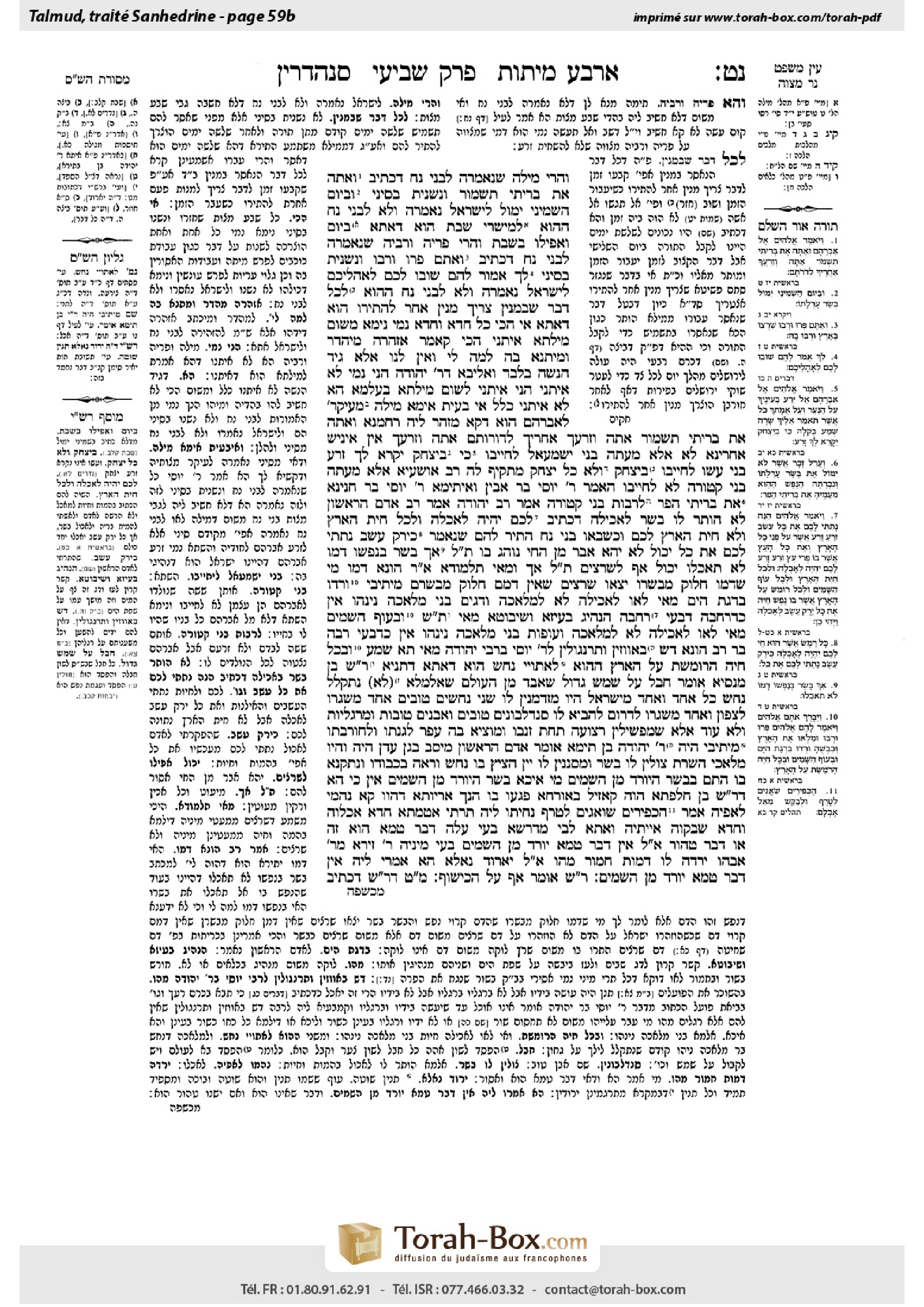
Sanhedrin 59b: Talmud study for Daf Yomi
Daf Yomi is the daily study of one Talmud folio. Explore 37 tractates with scans, Hebrew text, Sefaria English and AI-generated French translations where annotated.
Passage selection and English or AI-generated French translation are available where the scan has annotations. Daf Study is independent of Torah-Box and Sefaria.
Browse Sanhedrin · סנהדרין · All tractatesSanhedrin 59b text and translations
This page of Sanhedrin includes the Aramaic text, an English translation and an AI-generated French translation, alongside the scan above.
סנהדרין נ״ט ב · Aramaic and Hebrew text
וַהֲרֵי מִילָה, שֶׁנֶּאֶמְרָה לִבְנֵי נֹחַ, דִּכְתִיב: ״וְאַתָּה אֶת בְּרִיתִי תִשְׁמֹר״, וְנִשְׁנֵית בְּסִינַי: ״וּבַיּוֹם הַשְּׁמִינִי יִמּוֹל״ – לְיִשְׂרָאֵל נֶאֶמְרָה וְלֹא לִבְנֵי נֹחַ.
הָהוּא לְמִישְׁרֵי שַׁבָּת הוּא דַּאֲתָא, ״בַּיּוֹם״ – וַאֲפִילּוּ בְּשַׁבָּת.
וַהֲרֵי פְּרִיָּה וּרְבִיָּה, שֶׁנֶּאֶמְרָה לִבְנֵי נֹחַ, דִּכְתִיב: ״וְאַתֶּם פְּרוּ וּרְבוּ״, וְנִשְׁנֵית בְּסִינַי: ״לֵךְ אֱמֹר לָהֶם שׁוּבוּ לָכֶם לְאׇהֳלֵיכֶם״ – לְיִשְׂרָאֵל נֶאֶמְרָה וְלֹא לִבְנֵי נֹחַ!
הָהוּא, לְכׇל דָּבָר שֶׁבְּמִנְיָן צָרִיךְ מִנְיָן אַחֵר לְהַתִּירוֹ הוּא דַּאֲתָא.
אִי הָכִי, כֹּל חֲדָא וַחֲדָא נָמֵי נֵימָא מִשּׁוּם מִילְּתָא אִיתְּנַי?
הָכִי קָאָמַר: אַזְהָרָה מִיהְדָּר וּמִיתְנָא בַּהּ, לְמָה לִי?
וְאֵין לָנוּ אֶלָּא גִּיד הַנָּשֶׁה בִּלְבַד, וְאַלִּיבָּא דְּרַבִּי יְהוּדָה. הָנֵי נָמֵי לָא אִיתְּנַי.
הָנֵי אִיתְּנַי לְשׁוּם מִילְּתָא בְּעָלְמָא, הָא לָא אִיתְּנַי כְּלָל.
אִי בָּעֵית אֵימָא: מִילָה מֵעִיקָּרָא לְאַבְרָהָם הוּא דְּקָא מַזְהַר לֵיהּ רַחֲמָנָא, ״וְאַתָּה אֶת בְּרִיתִי תִשְׁמֹר אַתָּה וְזַרְעֲךָ אַחֲרֶיךָ לְדֹרֹתָם״. ״אַתָּה וְזַרְעֲךָ״ – אִין, אִינִישׁ אַחֲרִינָא – לָא.
אֶלָּא מֵעַתָּה, בְּנֵי יִשְׁמָעֵאל לִחַיְּיבוּ? ״כִּי בְיִצְחָק יִקָּרֵא לְךָ זָרַע״.
בְּנֵי עֵשָׂו לִחַיְּיבוּ. ״בְּיִצְחָק״ – וְלֹא כׇּל יִצְחָק.
מַתְקֵיף לַהּ רַב אוֹשַׁעְיָא: אֶלָּא מֵעַתָּה, בְּנֵי קְטוּרָה לָא לִחַיְּיבוּ? הָאָמַר רַבִּי יוֹסֵי בַּר אָבִין, וְאִיתֵּימָא רַבִּי יוֹסֵי בַּר חֲנִינָא: ״אֶת בְּרִיתִי הֵפַר״ – לְרַבּוֹת בְּנֵי קְטוּרָה.
אָמַר רַב יְהוּדָה אָמַר רַב: אָדָם הָרִאשׁוֹן לֹא הוּתַּר לוֹ בָּשָׂר לַאֲכִילָה, דִּכְתִיב: ״לָכֶם יִהְיֶה לְאׇכְלָה וּלְכׇל חַיַּת הָאָרֶץ״, וְלֹא חַיַּת הָאָרֶץ לָכֶם.
וּכְשֶׁבָּאוּ בְּנֵי נֹחַ, הִתִּיר לָהֶם, שֶׁנֶּאֱמַר: ״כְּיֶרֶק עֵשֶׂב נָתַתִּי לָכֶם אֶת כֹּל״. יָכוֹל לֹא יְהֵא אֵבֶר מִן הַחַי נוֹהֵג בּוֹ? תַּלְמוּד לוֹמַר: ״אַךְ בָּשָׂר בְּנַפְשׁוֹ דָמוֹ לֹא תֹאכֵלוּ״. יָכוֹל אַף לִשְׁרָצִים? תַּלְמוּד לוֹמַר: ״אַךְ״.
וּמַאי תַּלְמוּדָא? אָמַר רַב הוּנָא: ״דָּמוֹ״ – מִי שֶׁדָּמוֹ חָלוּק מִבְּשָׂרוֹ, יָצְאוּ שְׁרָצִים שֶׁאֵין דָּמָם חָלוּק מִבְּשֶׁרָם.
מֵיתִיבִי: ״וּרְדוּ בִּדְגַת הַיָּם״, מַאי לָאו, לַאֲכִילָה? לֹא, לִמְלָאכָה.
וְדָגִים בְּנֵי מְלָאכָה נִינְהוּ? אִין, כִּדְרַחֲבָה. דְּבָעֵי רַחֲבָה: הִנְהִיג בְּעִיזָּא וְשִׁיבּוּטָא – מַאי?
תָּא שְׁמַע: ״וּבְעוֹף הַשָּׁמַיִם״, מַאי לָאו, לַאֲכִילָה? לָא, לִמְלָאכָה.
וְעוֹפוֹת בְּנֵי מְלָאכָה נִינְהוּ? אִין, כִּדְבָעֵי רַבָּה בַּר רַב הוּנָא: דָּשׁ בַּאֲוָוזִין וְתַרְנְגוֹלִין לְרַבִּי יוֹסֵי בְּרַבִּי יְהוּדָה מַאי?
תָּא שְׁמַע: ״וּבְכׇל חַיָּה הָרֹמֶשֶׂת עַל הָאָרֶץ״. הָהוּא לְאֵתוֹיֵי נָחָשׁ הוּא דַּאֲתָא.
דְּתַנְיָא, רַבִּי שִׁמְעוֹן בֶּן מְנַסְיָא אוֹמֵר: חֲבָל עַל שַׁמָּשׁ גָּדוֹל שֶׁאָבַד מִן הָעוֹלָם, שֶׁאִלְמָלֵא לֹא נִתְקַלֵּל נָחָשׁ, כׇּל אֶחָד וְאֶחָד מִיִּשְׂרָאֵל הָיוּ מִזְדַּמְּנִין לוֹ שְׁנֵי נְחָשִׁים טוֹבִים – אֶחָד מְשַׁגְּרוֹ לַצָּפוֹן וְאֶחָד מְשַׁגְּרוֹ לַדָּרוֹם, לְהָבִיא לוֹ סַנְדַּלְבּוֹנִים טוֹבִים וַאֲבָנִים טוֹבוֹת וּמַרְגָּלִיּוֹת. וְלֹא עוֹד, אֶלָּא שֶׁמַּפְשִׁילִין רְצוּעָה תַּחַת זְנָבוֹ וּמוֹצִיא בָּהּ עָפָר לְגִנָּתוֹ וּלְחוּרְבָּתוֹ.
מֵיתִיבִי, הָיָה רַבִּי יְהוּדָה בֶּן תֵּימָא אוֹמֵר: אָדָם הָרִאשׁוֹן מֵיסֵב בְּגַן עֵדֶן הָיָה, וְהָיוּ מַלְאֲכֵי הַשָּׁרֵת צוֹלִין לוֹ בָּשָׂר וּמְסַנְּנִין לוֹ יַיִן. הֵצִיץ בּוֹ נָחָשׁ וְרָאָה בִּכְבוֹדוֹ, וְנִתְקַנֵּא בּוֹ. הָתָם בְּבָשָׂר הַיּוֹרֵד מִן הַשָּׁמַיִם.
מִי אִיכָּא בָּשָׂר הַיּוֹרֵד מִן הַשָּׁמַיִם? אִין, כִּי הָא דְּרַבִּי שִׁמְעוֹן בֶּן חֲלַפְתָּא הֲוָה קָאָזֵיל בְּאוֹרְחָא, פְּגַעוּ בֵּיהּ הָנָךְ אַרְיָוָתָא דַּהֲווֹ קָא נָהֲמִי לְאַפֵּיהּ. אֲמַר: ״הַכְּפִירִים שֹׁאֲגִים לַטָּרֶף״. נְחִיתוּ לֵיהּ תַּרְתֵּי אַטְמָתָא. חֲדָא אַכְלוּהָ וַחֲדָא שַׁבְקוּהָ. אַיְתְיַהּ וַאֲתָא לְבֵי מִדְרְשָׁא, בָּעֵי עֲלַהּ: דָּבָר טָמֵא הוּא זֶה אוֹ דָּבָר טָהוֹר? אֲמַרוּ לֵיהּ: אֵין דָּבָר טָמֵא יוֹרֵד מִן הַשָּׁמַיִם.
בָּעֵי מִינֵּיהּ רַבִּי זֵירָא מֵרַבִּי אֲבָהוּ: יָרְדָה לוֹ דְּמוּת חֲמוֹר, מַהוּ? אֲמַר לֵיהּ: יָארוּד נָאלָא! הָא אָמְרִי לֵיהּ: אֵין דָּבָר טָמֵא יוֹרֵד מִן הַשָּׁמַיִם.
רַבִּי שִׁמְעוֹן אוֹמֵר: אַף עַל הַכִּישּׁוּף. מַאי טַעְמֵיהּ דְּרַבִּי שִׁמְעוֹן? דִּכְתִיב:
Sanhedrin 59b · English translation
The Gemara asks: But isn’t there the mitzva of circumcision, which was stated with regard to descendants of Noah, i.e., Abraham and his descendants, who had the status of descendants of Noah at that time? As it is written that God said to Abraham with regard to the mitzva of circumcision: “And as for you, you shall keep My covenant, you and your offspring after you, throughout their generations” (Genesis 17:9). And it was repeated at Sinai for the Jewish people: “And on the eighth day the flesh of his foreskin shall be circumcised” (Leviticus 12:3), and nevertheless it was stated for the Jewish people alone and not for the descendants of Noah.
The Gemara answers: That verse stated at Sinai is not necessary for the mitzva itself, but rather it comes to permit circumcision on Shabbat. It is derived from the phrase “on the eighth day” that circumcision must always be performed on the eight day, and this is the halakha even if it falls on Shabbat. Therefore the mitzva is not considered to have been repeated at Mount Sinai.
The Gemara asks: But isn’t there the mitzva of procreation, which was stated with regard to the descendants of Noah? As it is written: “And you, be fruitful and multiply, swarm in the land and multiply in it” (Genesis 9:7). And it was repeated at Sinai, in the verse: “Go say to them: Return to your tents” (Deuteronomy 5:27), when the Jewish men were commanded to resume conjugal relations with their wives after having been commanded to separate from them in preparation for the giving of the Torah. Nevertheless, the mitzva of procreation was stated for the Jewish people and not for the descendants of Noah.
The Gemara answers: That verse stated at Sinai is not necessary for the mitzva itself, but rather it comes to teach another halakha: That any matter that was prohibited by an official vote of the Sanhedrin requires another vote to permit it. Even if a rabbinic prohibition is no longer relevant, it is not automatically canceled, but rather a special ruling is required to cancel it. This is derived from the fact that it was necessary for God to issue a declaration (Deuteronomy 5:26) specifically canceling the prohibition that had been issued before the giving of the Torah.
The Gemara asks: If so, let us say with regard to each and every one of the seven Noahide mitzvot that it was repeated because of an additional matter the Torah teaches, and the descendants of Noah are exempt from them all.
The Gemara answers that this is what Rabbi Yosei, son of Rabbi Ḥanina, is saying: After stating a prohibition with regard to the descendants of Noah, why do I need the Torah to then repeat the prohibition itself for the Jewish people? If the only purpose is to teach an additional halakha, it is unnecessary to repeat it in the form of a prohibition, e.g., “You shall not murder…you shall not commit adultery” (Exodus 20:13). Therefore, it is derived from the fact that the entire prohibition is repeated, and not just the new details, that it applies both to Jews and to descendants of Noah.
It is stated in the baraita: And we have only the prohibition against eating the sciatic nerve to which this classification applies, and this is according to the opinion of Rabbi Yehuda. The Gemara asks: But these aforementioned mitzvot also, procreation and circumcision, were not repeated at Sinai in order to teach that they apply to the descendants of Noah as well as to the Jewish people, but rather were mentioned for other purposes, and therefore, they apply only to the Jewish people, similar to the prohibition against eating the sciatic nerve.
The Gemara answers: These mitzvot were repeated for the sake of teaching some other matter. By contrast, this prohibition of eating the sciatic nerve was not repeated at all; it is mentioned only in Genesis. Therefore, circumcision and procreation are not included in the category of mitzvot that were given to the descendants of Noah and were not repeated at Sinai.
If you wish, say that there is another explanation for the fact that the mitzva of circumcision does not apply to the descendants of Noah despite the fact that it was repeated for the Jewish people: From the outset, it was Abraham, and not all the descendants of Noah, that the Merciful One commanded to perform this mitzva; as He said to him: “And as for you, you shall keep My covenant, you and your offspring after you, throughout their generations” (Genesis 17:9). The Gemara infers: “You and your offspring,” yes; another person, no.
The Gemara challenges: If that is so, the descendants of Ishmael should also be obligated to observe circumcision, as they are also the offspring of Abraham. The Gemara explains: The verse states: “For through Isaac, offspring shall be called yours” (Genesis 21:12), which means that Ishmael’s descendants are not called the offspring of Abraham.
The Gemara challenges: Granted, Ishmael’s descendants are not considered the offspring of Abraham, but at least the descendants of Esau, Isaac’s son, should be obligated to observe circumcision. The Gemara explains: Since the term: “Through Isaac [beYitzḥak],” also means: Of Isaac, it is derived that the mitzva applies to only some of Isaac’s offspring, but not all the descendants of Isaac. This serves to exclude the descendants of Esau.
Rav Oshaya objects to this: If that is so, the descendants of Keturah, Abraham’s second wife, should not be obligated to observe circumcision. The Gemara answers: Rabbi Yosei bar Avin says, and some say that it is Rabbi Yosei bar Ḥanina who says that the verse: “And the uncircumcised male who is not circumcised in the flesh of his foreskin, that soul shall be cut off from his people; he has broken My covenant” (Genesis 17:14) is stated to include the descendants of Keturah in the obligation to observe circumcision.
§ Rav Yehuda says that Rav says: Meat was not permitted to Adam, the first man, for consumption, as it is written: “And God said: Behold, I have given you every herb that brings forth seed, which is upon the face of all the earth, and every tree, in which is the fruit of a tree that gives forth seed; for you it shall be for food, and for every animal of the earth, and for every fowl of the air, and for everything that creeps upon the earth, in which there is a living soul, every green herb for food. And it was so” (Genesis 1:29–30). It is derived God told Adam: Eating vegetation is permitted to people and animals, but eating the animals of the earth is not permitted to you.
But when the children of Noah came, God permitted them to eat meat; as it is stated: “Every moving thing that lives shall be for food for you; as the green herb I have given you all” (Genesis 9:3). One might have thought that accordingly, even the prohibition against eating a limb from a living animal does not apply to the descendants of Noah; therefore the verse states: “Only flesh with its life, which is its blood, you shall not eat” (Genesis 9:4). One might have thought that the prohibition against eating a limb from a living animal applies even to creeping animals; therefore the verse states “only,” a term used for exclusion, indicating that creeping animals are not included.
The Gemara asks: And what is the derivation? What is the proof that it is creeping animals that are excluded from this prohibition and not another type of animal? Rav Huna says: The term “its blood” indicates that the prohibition pertains to animals whose blood is halakhically considered separate from their flesh. This excludes creeping animals, whose blood is not considered separate from their flesh.
The Gemara raises an objection to the assertion that eating meat was prohibited to Adam, from the verse: “And have dominion over the fish of the sea, and over the fowl of the air, and over every living thing that creeps upon the land” (Genesis 1:28). What, is it not stated with regard to consumption, i.e., doesn’t this verse mean that people may eat the meat of animals? The Gemara answers: No, the verse is referring to using animals for labor.
The Gemara asks: But are fish capable of performing labor? The Gemara answers: Yes, they are capable, in accordance with the statement of Raḥava; as Raḥava asked the following question: If one drove a wagon to which a goat and a shibbuta fish were harnessed together, what is the halakha? Has he violated the prohibition of diverse kinds, in the same way that one does when plowing with an ox and a donkey together? In any event, Raḥava’s question indicates that there is a way, albeit far-fetched, for a fish to perform labor.
Come and hear a proof that it was permitted for Adam to eat meat, from the phrase in the aforementioned verse: “And have dominion…and over the fowl of the air.” What, is it not stated with regard to consumption? The Gemara answers: No, it is referring to labor.
The Gemara asks: But are birds capable of performing labor? The Gemara answers: Yes, they are capable, as Rabba bar Rav Huna raises a dilemma: If one threshed with geese and chickens, what is the halakha according to the opinion of Rabbi Yosei, son of Rabbi Yehuda? Rabbi Yosei, son of Rabbi Yehuda, derives from the verse: “You shall not muzzle an ox when it treads” (Deuteronomy 25:4), that a laborer in a field is entitled to eat from the produce during his work only if his work involves both his hands and his feet, like an ox, which treads with its forelegs as well as its hind legs. Rabba bar Rav Huna raises a dilemma as to whether the prohibition against muzzling an animal while it is being used for labor in the field applies to geese and chickens, which have only two feet. In any event, it is indicated in that dilemma that birds can perform labor.
Come and hear a proof from the phrase: “And have dominion…and over every living thing that creeps upon the land.” Creeping animals certainly cannot be used for labor. Apparently, the verse is referring to eating them. The Gemara answers: That phrase comes to include the snake, which was capable of performing labor when it was created.
As it is taught in a baraita that Rabbi Shimon ben Menasya says: Woe over a great attendant that has been lost to the world; as had the snake not been cursed that it should go on its belly, there would have been two fine snakes at the disposal of each and every one of the Jewish people. One he would send to the north, and the other one he would send to the south, to bring him precious sandalbonim, a type of precious stone, and other precious stones and pearls. Moreover, he would attach a strap under his snake’s tail like a harness to an animal, and use it to take dirt out to his garden and to rebuild his ruin, as he does with other animals. This demonstrates that the snake was capable of performing labor.
The Gemara raises an objection from a baraita to the assertion that eating meat was prohibited to Adam: Rabbi Yehuda ben Teima would say: Adam, the first man, would dine in the Garden of Eden, and the ministering angels would roast meat for him and strain wine for him. The snake glanced at him and saw his glory, and was jealous of him, and for that reason the snake incited him to sin and caused his banishment from the Garden. According to this, evidently Adam would eat meat. The Gemara answers: There the reference is to meat that descended from heaven, which was created by a miracle and was not the meat of animals at all.
The Gemara asks: Is there such a thing as meat that descends from heaven? The Gemara answers: Yes, it is like this incident: As Rabbi Shimon ben Ḥalafta was walking along the way, he encountered those lions that were roaring at him, intending to eat him. He said: “The young lions roar after their prey, and seek their food from God” (Psalms 104:21), and they deserve to receive food. Two thighs of an animal descended from heaven for him. The lions ate one of these thighs, and they left the other one. He took it and entered the study hall, and inquired about it: Is this thigh a kosher item or a non-kosher item? The Sages said to him: Certainly it is kosher, as a non-kosher item does not descend from heaven.
In connection to that story, it is related that Rabbi Zeira asked Rabbi Abbahu: If the likeness of a donkey had descended for him, what would the halakha have been? Would it have been permitted? Rabbi Abbahu said to him: Foolish bird [yarud nala]. The Sages already said to him that a non-kosher item does not descend from heaven; therefore, it must be kosher.
§ In the baraita that lists the Noahide mitzvot (56a), it is stated that Rabbi Shimon says that the descendants of Noah were also commanded concerning the prohibition against engaging in sorcery. The Gemara asks: What is the reasoning behind the opinion of Rabbi Shimon? The Gemara answers: As it is written:
Sanhedrin 59b · Traduction française (IA)
La Guemara demande : Mais la circoncision n’est-elle pas une mitsva énoncée à l’égard des descendants de Noé, c’est-à-dire Abraham et ses descendants, qui avaient alors le statut de descendants de Noé ? Car il est écrit que Dieu dit à Abraham au sujet de la mitsva de la circoncision : « Quant à toi, tu garderas mon alliance, toi et ta descendance après toi, de génération en génération » (Genèse 17, 9). Elle fut également répétée au Sinaï pour le peuple juif : « Le huitième jour, on circoncira la chair de son prépuce » (Lévitique 12, 3). Pourtant, elle fut énoncée pour le seul peuple juif, et non pour les descendants de Noé.
La Guemara répond : Ce verset énoncé au Sinaï n’est pas nécessaire pour la mitsva elle-même ; il vient plutôt autoriser la circoncision le Chabbat. On déduit de l’expression « le huitième jour » que la circoncision doit toujours être pratiquée le huitième jour, même si celui-ci tombe un Chabbat. La mitsva n’est donc pas considérée comme ayant été répétée au mont Sinaï.
La Guemara demande : Mais la procréation n’est-elle pas une mitsva énoncée à l’égard des descendants de Noé ? Car il est écrit : « Quant à vous, soyez féconds et multipliez-vous, remplissez la terre et multipliez-vous en elle » (Genèse 9, 7). Elle fut répétée au Sinaï dans le verset : « Va leur dire : Retournez à vos tentes » (Deutéronome 5, 27), lorsque les hommes juifs reçurent l’ordre de reprendre les relations conjugales avec leurs épouses, après avoir reçu celui de s’en séparer en préparation au don de la Torah. Pourtant, la mitsva de procréation fut énoncée pour le peuple juif, et non pour les descendants de Noé.
La Guemara répond : Ce verset énoncé au Sinaï n’est pas nécessaire pour la mitsva elle-même ; il vient plutôt enseigner une autre halakha : toute question qui a fait l’objet d’une décision officielle du Sanhédrin exige une nouvelle décision pour être autorisée. Même si une interdiction rabbinique n’est plus pertinente, elle n’est pas automatiquement annulée ; une décision particulière est nécessaire pour l’abroger. On le déduit du fait que Dieu dut prononcer une déclaration (Deutéronome 5, 26) annulant précisément l’interdiction qui avait été décrétée avant le don de la Torah.
La Guemara demande : Si c’est le cas, disons que chacune des sept mitsvot noachides a été répétée en raison d’un enseignement supplémentaire de la Torah, et que les descendants de Noé en sont tous exemptés.
La Guemara répond que voici ce que dit Rabbi Yossei, fils de Rabbi Ḥanina : Après avoir énoncé une interdiction à l’égard des descendants de Noé, pourquoi la Torah doit-elle ensuite répéter l’interdiction elle-même pour le peuple juif ? Si son seul but est d’enseigner une halakha supplémentaire, il n’est pas nécessaire de la répéter sous la forme d’une interdiction, par exemple : « Tu ne tueras pas… tu ne commettras pas d’adultère » (Exode 20, 13). On déduit donc du fait que l’interdiction entière est répétée, et pas seulement les nouveaux détails, qu’elle s’applique à la fois aux Juifs et aux descendants de Noé.
Il est dit dans la baraïta : Nous n’avons que l’interdiction de consommer le nerf sciatique à laquelle cette classification s’applique, et cela selon l’opinion de Rabbi Yehouda. La Guemara demande : Mais les mitsvot mentionnées précédemment, la procréation et la circoncision, n’ont-elles pas non plus été répétées au Sinaï pour enseigner qu’elles s’appliquent aussi bien aux descendants de Noé qu’au peuple juif ? Elles y furent plutôt mentionnées à d’autres fins et ne s’appliquent donc qu’au peuple juif, comme l’interdiction de consommer le nerf sciatique.
La Guemara répond : Ces mitsvot furent répétées afin d’enseigner un autre sujet. En revanche, l’interdiction de consommer le nerf sciatique ne fut pas répétée du tout ; elle n’est mentionnée que dans la Genèse. La circoncision et la procréation ne relèvent donc pas de la catégorie des mitsvot données aux descendants de Noé et non répétées au Sinaï.
Si tu veux, dis qu’il existe une autre explication au fait que la mitsva de la circoncision ne s’applique pas aux descendants de Noé, bien qu’elle ait été répétée pour le peuple juif : dès le départ, c’est Abraham, et non l’ensemble des descendants de Noé, que le Miséricordieux a ordonné d’accomplir cette mitsva, comme Il lui a dit : « Quant à toi, tu garderas mon alliance, toi et ta descendance après toi, de génération en génération » (Genèse 17, 9). La Guemara déduit : « Toi et ta descendance », oui ; une autre personne, non.
La Guemara objecte : Si c’est ainsi, les descendants d’Ismaël devraient eux aussi être tenus d’observer la circoncision, puisqu’ils sont également la descendance d’Abraham. La Guemara explique : Le verset dit : « C’est par Isaac que ta descendance sera appelée » (Genèse 21, 12), ce qui signifie que les descendants d’Ismaël ne sont pas considérés comme la descendance d’Abraham.
La Guemara objecte : Soit, les descendants d’Ismaël ne sont pas considérés comme la descendance d’Abraham, mais les descendants d’Ésaü, fils d’Isaac, devraient au moins être tenus d’observer la circoncision. La Guemara explique : Puisque l’expression « par Isaac [beYitzḥak] » signifie aussi « d’Isaac », on en déduit que la mitsva ne s’applique qu’à une partie de la descendance d’Isaac, et non à tous ses descendants. Cela exclut les descendants d’Ésaü.
Rav Oshaya objecte : Si c’est ainsi, les descendants de Ketoura, la seconde épouse d’Abraham, ne devraient pas être tenus d’observer la circoncision. La Guemara répond : Rabbi Yosei bar Avin dit — et certains disent que c’est Rabbi Yosei bar Ḥanina qui le dit — que le verset : « Le mâle incirconcis, qui n’aura pas été circoncis dans la chair de son prépuce, cette âme sera retranchée de son peuple ; il a rompu mon alliance » (Genèse 17, 14), est énoncé pour inclure les descendants de Ketoura dans l’obligation d’observer la circoncision.
§ Rav Yehouda dit au nom de Rav : La viande n’était pas autorisée à la consommation pour Adam, le premier homme, comme il est écrit : « Dieu dit : Voici, je vous donne toute herbe portant une semence, qui est sur toute la surface de la terre, et tout arbre qui porte des fruits contenant une semence ; ce sera votre nourriture. À tout animal de la terre, à tout oiseau du ciel et à tout ce qui rampe sur la terre, tout ce qui a une âme vivante, je donne toute herbe verte en nourriture. Il en fut ainsi » (Genèse 1, 29-30). On en déduit que Dieu dit à Adam : la consommation des végétaux est autorisée aux humains et aux animaux, mais la consommation des animaux de la terre ne vous est pas autorisée.
Mais lorsque vinrent les enfants de Noé, Dieu leur permit de consommer de la viande, comme il est dit : « Tout ce qui se meut et qui vit vous servira de nourriture ; comme l’herbe verte, je vous donne tout » (Genèse 9, 3). On aurait pu penser qu’en conséquence, l’interdiction de consommer un membre prélevé sur un animal vivant ne s’applique pas non plus aux descendants de Noé. Le verset dit donc : « Seulement, vous ne mangerez pas la chair avec sa vie, c’est-à-dire son sang » (Genèse 9, 4). On aurait pu penser que l’interdiction de consommer un membre prélevé sur un animal vivant s’applique même aux animaux rampants. Le verset dit donc « seulement », terme d’exclusion, indiquant que les animaux rampants ne sont pas concernés.
La Guemara demande : Et quelle est la déduction ? Quelle preuve montre que ce sont les animaux rampants qui sont exclus de cette interdiction, et non une autre catégorie d’animaux ? Rav Houna dit : L’expression « son sang » indique que l’interdiction concerne les animaux dont le sang est considéré, selon la halakha, comme distinct de leur chair. Cela exclut les animaux rampants, dont le sang n’est pas considéré comme distinct de leur chair.
La Guemara soulève, à partir du verset, une objection à l’affirmation selon laquelle la consommation de viande était interdite à Adam : « Dominez les poissons de la mer, les oiseaux du ciel et tout être vivant qui rampe sur la terre » (Genèse 1, 28). N’est-il pas question ici de consommation, c’est-à-dire le verset ne signifie-t-il pas que les humains peuvent manger la viande des animaux ? La Guemara répond : Non, le verset se rapporte à l’utilisation des animaux pour le travail.
La Guemara demande : Mais les poissons sont-ils capables d’effectuer un travail ? La Guemara répond : Oui, ils le sont, conformément à la déclaration de Raḥava. En effet, Raḥava a posé la question suivante : Si quelqu’un conduisait une charrette à laquelle seraient attelés ensemble une chèvre et un poisson shibbuta, quelle serait la halakha ? A-t-il enfreint l’interdiction des mélanges d’espèces, comme lorsqu’on laboure avec un bœuf et un âne ensemble ? Quoi qu’il en soit, la question de Raḥava indique qu’il existe un moyen, même invraisemblable, pour qu’un poisson effectue un travail.
Viens et écoute une preuve qu’Adam était autorisé à consommer de la viande, à partir de l’expression du verset cité plus haut : « Dominez […] les oiseaux du ciel. » N’est-il pas question de consommation ? La Guemara répond : Non, il s’agit du travail.
La Guemara demande : Mais les oiseaux sont-ils capables d’effectuer un travail ? La Guemara répond : Oui, ils le sont, comme le montre le dilemme soulevé par Rabba bar Rav Houna : si quelqu’un battait le grain avec des oies et des poules, quelle serait la halakha selon l’opinion de Rabbi Yossei, fils de Rabbi Yehouda ? Rabbi Yossei, fils de Rabbi Yehouda, déduit du verset : « Tu ne muselleras pas un bœuf pendant qu’il foule le grain » (Deutéronome 25, 4), qu’un ouvrier travaillant dans un champ n’a le droit de manger des produits pendant son travail que si celui-ci mobilise à la fois ses mains et ses pieds, comme le bœuf, qui foule le grain avec ses pattes avant comme avec ses pattes arrière. Rabba bar Rav Houna soulève un dilemme : l’interdiction de museler un animal pendant qu’il est employé aux travaux des champs s’applique-t-elle aux oies et aux poules, qui n’ont que deux pattes ? En tout cas, ce dilemme indique que les oiseaux peuvent effectuer un travail.
Viens et écoute une preuve à partir de l’expression : « Dominez […] tout être vivant qui rampe sur la terre. » Les animaux rampants ne peuvent certainement pas être utilisés pour le travail. Le verset se rapporte donc apparemment à leur consommation. La Guemara répond : Cette expression vient inclure le serpent, qui était capable d’effectuer un travail au moment de sa création.
Comme il est enseigné dans une baraïta, Rabbi Shimon ben Menasya dit : Malheur à ce grand serviteur que le monde a perdu ! Car si le serpent n’avait pas été maudit et condamné à ramper sur le ventre, chacun des Juifs aurait disposé de deux beaux serpents. Il en aurait envoyé un au nord et l’autre au sud, pour lui rapporter de précieux sandalbonim, une sorte de pierre précieuse, ainsi que d’autres pierres précieuses et des perles. De plus, il aurait fixé sous la queue de son serpent une sangle semblable au harnais d’un animal, et l’aurait utilisé pour transporter de la terre jusqu’à son jardin et reconstruire sa ruine, comme il le fait avec les autres animaux. Cela démontre que le serpent était capable d’effectuer un travail.
La Guemara soulève, à partir d’une baraïta, une objection à l’affirmation selon laquelle la consommation de viande était interdite à Adam : Rabbi Yehuda ben Teima disait : Adam, le premier homme, prenait ses repas dans le jardin d’Éden, et les anges de service lui faisaient rôtir de la viande et lui servaient du vin filtré. Le serpent le regarda, vit sa gloire et fut jaloux de lui ; c’est pour cette raison qu’il l’incita à pécher et provoqua son expulsion du jardin. Selon ce passage, Adam mangeait donc de la viande. La Guemara répond : Il s’agit là d’une viande descendue du ciel, créée par miracle et qui n’était pas du tout la viande d’animaux.
La Guemara demande : Existe-t-il donc de la viande qui descend du ciel ? La Guemara répond : Oui, comme dans l’incident suivant. Alors que Rabbi Shimon ben Ḥalafta marchait sur la route, il rencontra des lions qui rugissaient contre lui, dans l’intention de le dévorer. Il dit : « Les jeunes lions rugissent après leur proie et réclament à Dieu leur nourriture » (Psaumes 104, 21), et ils méritent de recevoir de la nourriture. Deux cuisses d’un animal descendirent du ciel pour lui. Les lions en mangèrent une et laissèrent l’autre. Il la prit, entra dans la maison d’étude et s’enquit à son sujet : Cette cuisse est-elle un aliment cachère ou non cachère ? Les Sages lui répondirent : Elle est certainement cachère, car un aliment non cachère ne descend pas du ciel.
À propos de cette histoire, il est rapporté que Rabbi Zeira demanda à Rabbi Abbahou : Si une forme d’âne était descendue pour lui, quelle aurait été la halakha ? Cela aurait-il été permis ? Rabbi Abbahou lui dit : Oiseau stupide [yarud nala]. Les Sages lui ont déjà dit qu’un aliment non cachère ne descend pas du ciel ; il doit donc être cachère.
§ Dans la baraïta qui énumère les mitsvot noachides (56a), il est dit que Rabbi Shimon affirme que les descendants de Noé reçurent également l’ordre de respecter l’interdiction de pratiquer la sorcellerie. La Guemara demande : Quel est le raisonnement qui sous-tend l’opinion de Rabbi Shimon ? La Guemara répond : Comme il est écrit :
Traduction française générée par IA à partir de l’édition anglaise de Sefaria. Vérifie toujours un passage avec le texte source.
Text from Sefaria: William Davidson Edition - Vocalized Aramaic (CC BY NC); William Davidson Edition - English (CC BY NC).