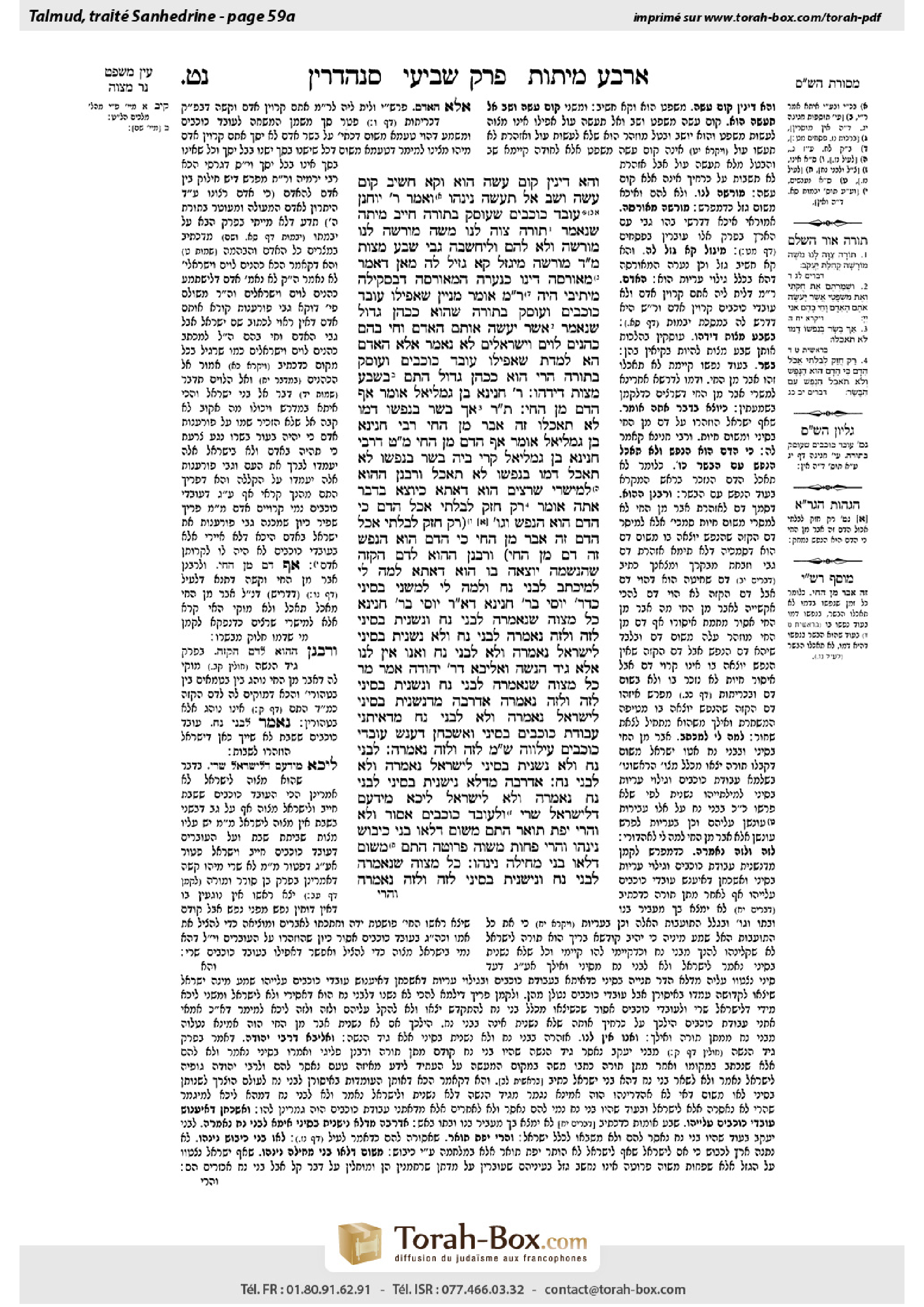
Sanhedrin 59a: Talmud study for Daf Yomi
Daf Yomi is the daily study of one Talmud folio. Explore 37 tractates with scans, Hebrew text, Sefaria English and AI-generated French translations where annotated.
Passage selection and English or AI-generated French translation are available where the scan has annotations. Daf Study is independent of Torah-Box and Sefaria.
Browse Sanhedrin · סנהדרין · All tractatesSanhedrin 59a text and translations
This page of Sanhedrin includes the Aramaic text, an English translation and an AI-generated French translation, alongside the scan above.
סנהדרין נ״ט א · Aramaic and Hebrew text
וְהָא דִּינִין קוּם עֲשֵׂה הוּא, וְקָא חָשֵׁיב? קוּם עֲשֵׂה וְשֵׁב אַל תַּעֲשֶׂה נִינְהוּ.
וְאָמַר רַבִּי יוֹחָנָן: גּוֹי שֶׁעוֹסֵק בַּתּוֹרָה חַיָּיב מִיתָה, שֶׁנֶּאֱמַר: ״תּוֹרָה צִוָּה לָנוּ מֹשֶׁה מוֹרָשָׁה״, לָנוּ מוֹרָשָׁה וְלֹא לָהֶם.
וְלִיחְשְׁבַהּ גַּבֵּי שֶׁבַע מִצְוֹת? מַאן דְּאָמַר ״מוֹרָשָׁה״ – מִיגְזָל קָא גָזֵיל לַהּ. מַאן דְּאָמַר ״מְאוֹרָסָה״ – דִּינוֹ כְּנַעֲרָה הַמְאוֹרָסָה, דְּבִסְקִילָה.
מֵיתִיבִי, הָיָה רַבִּי מֵאִיר אוֹמֵר: מִנַּיִין שֶׁאֲפִילּוּ גּוֹי וְעוֹסֵק בַּתּוֹרָה שֶׁהוּא כְּכֹהֵן גָּדוֹל? שֶׁנֶּאֱמַר: ״אֲשֶׁר יַעֲשֶׂה אֹתָם הָאָדָם וָחַי בָּהֶם״. ״כֹּהֲנִים לְוִיִּים וְיִשְׂרְאֵלִים״ לֹא נֶאֱמַר, אֶלָּא ״הָאָדָם״. הָא לָמַדְתָּ שֶׁאֲפִילּוּ גּוֹי וְעוֹסֵק בַּתּוֹרָה הֲרֵי הוּא כְּכֹהֵן גָּדוֹל.
הָתָם, בְּשֶׁבַע מִצְוֹת דִּידְהוּ.
רַבִּי חֲנִינָא בֶּן גַּמְלִיאֵל אוֹמֵר: אַף הַדָּם מִן הַחַי. תָּנוּ רַבָּנַן: ״אַךְ בָּשָׂר בְּנַפְשׁוֹ דָמוֹ לֹא תֹאכֵלוּ״ – זֶה אֵבֶר מִן הַחַי. רַבִּי חֲנִינָא בֶּן גַּמְלִיאֵל אוֹמֵר: אַף הַדָּם מִן הַחַי.
מַאי טַעְמָא דְּרַבִּי חֲנִינָא בֶּן גַּמְלִיאֵל? קְרִי בֵּיהּ: ״בָּשָׂר בְּנַפְשׁוֹ לֹא תֹּאכֵל״, ״דָּמוֹ בְּנַפְשׁוֹ לֹא תֹּאכֵל״. וְרַבָּנַן? הַהוּא לְמִישְׁרֵי שְׁרָצִים הוּא דַּאֲתָא.
כְּיוֹצֵא בַּדָּבָר אַתָּה אוֹמֵר: ״רַק חֲזַק לְבִלְתִּי אֲכֹל הַדָּם כִּי הַדָּם הוּא הַנָּפֶשׁ וְגוֹ׳״. ״רַק חֲזַק לְבִלְתִּי אֲכֹל הַדָּם״ – זֶה אֵבֶר מִן הַחַי, ״כִּי הַדָּם הוּא הַנָּפֶשׁ״ – זֶה דָּם מִן הַחַי.
וְרַבָּנַן, הַהוּא לְדַם הַקָּזָה שֶׁהַנְּשָׁמָה יוֹצְאָה בּוֹ הוּא דַּאֲתָא.
לְמָה לִי לְמִיכְתַּב לִבְנֵי נֹחַ, וּלְמָה לִי לְמִשְׁנֵי בְּסִינַי?
כִּדְרַבִּי יוֹסֵי בְּרַבִּי חֲנִינָא, דְּאָמַר רַבִּי יוֹסֵי בְּרַבִּי חֲנִינָא: כׇּל מִצְוָה שֶׁנֶּאֶמְרָה לִבְנֵי נֹחַ וְנִשְׁנֵית בְּסִינַי – לָזֶה וְלָזֶה נֶאֶמְרָה.
לִבְנֵי נֹחַ, וְלֹא נִשְׁנֵית בְּסִינַי – לְיִשְׂרָאֵל נֶאֶמְרָה וְלֹא לִבְנֵי נֹחַ. וְאָנוּ אֵין לָנוּ אֶלָּא גִּיד הַנָּשֶׁה, וְאַלִּיבָּא דְּרַבִּי יְהוּדָה.
אָמַר מָר: כׇּל מִצְוָה שֶׁנֶּאֶמְרָה לִבְנֵי נֹחַ וְנִשְׁנֵית בְּסִינַי, לָזֶה וְלָזֶה נֶאֶמְרָה. אַדְּרַבָּה, מִדְּנִשְׁנֵית בְּסִינַי – לְיִשְׂרָאֵל נֶאֶמְרָה וְלֹא לִבְנֵי נֹחַ!
מִדְּאִיתְּנַי עֲבוֹדָה זָרָה בְּסִינַי, וְאַשְׁכְּחַן דַּעֲנַשׁ גּוֹיִם עִילָּוַוהּ, שְׁמַע מִינַּהּ: לָזֶה וְלָזֶה נֶאֶמְרָה.
לִבְנֵי נֹחַ, וְלֹא נִשְׁנֵית בְּסִינַי – לְיִשְׂרָאֵל נֶאֶמְרָה וְלֹא לִבְנֵי נֹחַ. אַדְּרַבָּה, מִדְּלֹא נִישְׁנֵית בְּסִינַי – לִבְנֵי נֹחַ נֶאֶמְרָה וְלָא לְיִשְׂרָאֵל! לֵיכָּא מִידַּעַם דִּלְיִשְׂרָאֵל שְׁרֵי וּלְגוֹי אֲסִיר.
וְלָא? וַהֲרֵי יְפַת תּוֹאַר! הָתָם, מִשּׁוּם דְּלָאו בְּנֵי כִיבּוּשׁ נִינְהוּ.
וַהֲרֵי פָּחוֹת מִשָּׁוֶה פְּרוּטָה! הָתָם, מִשּׁוּם דְּלָאו בְּנֵי מְחִילָה נִינְהוּ.
כׇּל מִצְוָה שֶׁנֶּאֶמְרָה לִבְנֵי נֹחַ וְנִישְׁנֵית בְּסִינַי, לָזֶה וְלָזֶה נֶאֶמְרָה.
Sanhedrin 59a · English translation
The Gemara challenges: But the mitzva of establishing courts of judgment is a mitzva to stand up and take action, and nevertheless he counts it among the seven mitzvot. The Gemara answers: This mitzva contains a requirement to stand up and take action, i.e., the obligation to establish courts and carry out justice, and it also contains a requirement to sit and refrain from action, i.e., the prohibition against doing injustice.
And Rabbi Yoḥanan says: A gentile who engages in Torah study is liable to receive the death penalty; as it is stated: “Moses commanded us a law [torah], an inheritance of the congregation of Jacob” (Deuteronomy 33:4), indicating that it is an inheritance for us, and not for them.
The Gemara challenges: But if so, let the tanna count this prohibition among the seven Noahide mitzvot. The Gemara explains: According to the one who says that the verse is referring to the Torah as an inheritance, this prohibition is included in the prohibition of robbery, as a gentile who studies Torah robs the Jewish people of it. According to the one who says that the verse is referring to the Torah as betrothed, as the spelling of the Hebrew word for betrothed [me’orasa], is similar to that of the word for inheritance [morasha], the punishment of a gentile who studies Torah is like that of one who engages in intercourse with a betrothed young woman, which is execution by stoning.
The Gemara raises an objection to Rabbi Yoḥanan’s statement from a baraita: Rabbi Meir would say: From where is it derived that even a gentile who engages in Torah study is considered like a High Priest? It is derived from that which is stated: “You shall therefore keep My statutes and My ordinances, which if a man does he shall live by them” (Leviticus 18:5). The phrase: Which if priests, Levites, and Israelites do they shall live by them, is not stated, but rather: “A man,” which indicates mankind in general. You have therefore learned that even a gentile who engages in Torah study is considered like a High Priest.
The Gemara answers: There, in the baraita, the reference is to a gentile who engages in the study of their seven mitzvot. It is a mitzva for a gentile to study the halakhot that pertain to the seven Noahide mitzvot, and when he does so he is highly regarded.
§ The baraita that lists the Noahide mitzvot (56a) teaches that Rabbi Ḥanina ben Gamliel says: The descendants of Noah are also commanded concerning the prohibition against consuming the blood from a living animal. The Sages taught in a baraita: With regard to the verse: “Only flesh with its life, which is its blood, you shall not eat” (Genesis 9:4), this is the prohibition against eating a limb from a living animal. Rabbi Ḥanina ben Gamliel says: The blood from a living animal is also prohibited in this verse.
The Gemara asks: What is the reasoning behind the opinion of Rabbi Ḥanina ben Gamliel? The Gemara answers: He reads into the verse: Flesh with its life you shall not eat; blood with its life you shall not eat. The Gemara asks: And how do the Rabbis explain the mention of blood in this verse? After all, in their opinion, blood from a living animal is not forbidden. The Gemara answers: That comes to permit eating limbs from living creeping animals. The verse indicates that the prohibition does not apply to creeping animals, whose blood is not considered separate from their flesh (see 59b).
The baraita continues: Similarly, you can say that according to the opinion of Rabbi Ḥanina, blood from a living animal is also forbidden to the Jewish people in particular; as it is stated: “Only be steadfast in not eating blood, as the blood is the life, and you shall not eat the life with the flesh” (Deuteronomy 12:23). With regard to the statements: “Only be steadfast in not eating blood,” this is a limb from a living animal; “as the blood is the life,” this is blood from a living animal.
The Gemara asks: And how do the Rabbis, who hold that there is no specific prohibition with regard to blood from a living animal, interpret this verse? The Gemara answers: That verse comes to teach the prohibition against consuming blood spilled in the process of bloodletting, as this is blood through which the soul departs (see Karetot 20b).
The Gemara asks: According to Rabbi Ḥanina ben Gamliel, why do I need the Torah to write this halakha with regard to descendants of Noah, and why do I need the Torah to repeat it at Sinai with regard to Jews? Aren’t Jews also descendants of Noah?
The Gemara answers that it is to be understood in accordance with the opinion of Rabbi Yosei, son of Rabbi Ḥanina; as Rabbi Yosei, son of Rabbi Ḥanina, says: Any mitzva that was first stated with regard to the descendants of Noah and was repeated at Sinai was stated for this group and for that group, i.e., it applies to both gentiles and Jews.
But a mitzva that was stated with regard to the descendants of Noah and was not repeated at Sinai among the mitzvot given to the Jewish people was stated for the Jewish people and not for the descendants of Noah. And we have only the prohibition against eating the sciatic nerve to which this classification applies, and this is according to the opinion of Rabbi Yehuda, who holds that the verse: “Therefore the children of Israel do not eat the sciatic nerve, which is on the hollow of the thigh, until this day” (Genesis 32:32), is referring to the sons of Jacob, who were commanded to observe this prohibition even though they had the status of descendants of Noah.
§ The Master said in a baraita: Any mitzva that was stated with regard to the descendants of Noah and was repeated at Sinai was stated for this group and for that group. The Gemara raises an objection: On the contrary, from the fact that it was repeated at Sinai, clearly it can be derived that it was stated for the Jewish people and not for the descendants of Noah, as if it pertains to the descendants of Noah as well, why repeat it at Sinai? Aren’t the Jewish people also descendants of Noah?
The Gemara answers: From the fact that the prohibition of idol worship was repeated at Sinai, and we find that God punished gentiles for it, conclude from it that any mitzva that was repeated at Sinai was stated for this group and for that group, and not only for the Jewish people.
It is further stated in the baraita that a mitzva that was stated with regard to the descendants of Noah and was not repeated at Sinai was stated for the Jewish people and not for the descendants of Noah. The Gemara raises an objection: On the contrary, from the fact that it was not repeated at Sinai, clearly it can be derived that it was stated for the descendants of Noah and not for the Jewish people. The Gemara answers: There is nothing that is permitted to a Jew and forbidden to a gentile.
The Gemara asks: And is there not? But isn’t there the permission for a Jew to take a married beautiful woman, who was taken as a prisoner of war, to be his wife? For a gentile to do so is forbidden. The Gemara answers: There, the reason gentiles are prohibited from doing so is because they are not authorized to conquer. It is not permitted for gentiles to wage wars of conquest, and the halakha of marrying a beautiful woman is stated only with regard to a war of conquest. Therefore the fact that a beautiful woman who is a prisoner of war is permitted only to a Jew and not to a gentile does not indicate that gentiles have a higher degree of sanctity.
The Gemara asks: But isn’t stealing less than the value of one peruta prohibited to a gentile and permitted to a Jew? The Gemara answers: There it is because gentiles are not apt to grant forgiveness of debts, even of less than the value of one peruta. Therefore, for a gentile to take even such a minuscule amount is considered robbery. Jews normally forgive such small amounts.
It is stated in the baraita that any mitzva that was stated with regard to the descendants of Noah and was repeated at Sinai was stated both for this group and for that group.
Sanhedrin 59a · Traduction française (IA)
La Guemara objecte : Mais la mitsva d’établir des tribunaux est une mitsva qui exige de se lever et d’agir ; pourtant, il la compte parmi les sept mitsvot. La Guemara répond : Cette mitsva comporte une obligation d’agir, à savoir l’obligation d’établir des tribunaux et de rendre la justice, mais aussi une obligation de s’abstenir d’agir, à savoir l’interdiction de commettre une injustice.
Et Rabbi Yoḥanan dit : Un non-Juif qui s’adonne à l’étude de la Torah est passible de la peine de mort, comme il est dit : « Moïse nous a ordonné une loi [torah], héritage de l’assemblée de Jacob » (Deutéronome 33:4), ce qui indique qu’elle est notre héritage, et non le leur.
La Guemara objecte : Si tel est le cas, que le tanna compte cette interdiction parmi les sept mitsvot noachides. La Guemara explique : Selon celui qui dit que le verset présente la Torah comme un héritage, cette interdiction est incluse dans l’interdiction du vol, car un non-Juif qui étudie la Torah la dérobe au peuple juif. Selon celui qui dit que le verset présente la Torah comme une fiancée, puisque l’orthographe du mot hébreu signifiant « fiancée » [me’orasa] ressemble à celle du mot signifiant « héritage » [morasha], le châtiment d’un non-Juif qui étudie la Torah est semblable à celui de celui qui a des relations sexuelles avec une jeune fille fiancée : la lapidation.
La Guemara soulève une objection à l’affirmation de Rabbi Yoḥanan à partir d’une baraïta : Rabbi Meïr disait : D’où déduit-on que même un non-Juif qui s’adonne à l’étude de la Torah est considéré comme un grand prêtre ? On le déduit de ce qui est dit : « Vous observerez donc mes lois et mes règles, que l’homme mettra en pratique et par lesquelles il vivra » (Lévitique 18:5). Il n’est pas dit : « Que les prêtres, les lévites et les Israélites mettront en pratique et par lesquelles ils vivront », mais plutôt : « l’homme », ce qui désigne l’humanité en général. On apprend donc que même un non-Juif qui s’adonne à l’étude de la Torah est considéré comme un grand prêtre.
La Guemara répond : Là, dans la baraïta, il s’agit d’un non-Juif qui étudie les sept mitsvot qui lui incombent. C’est une mitsva pour un non-Juif d’étudier les halakhot relatives aux sept mitsvot noachides ; lorsqu’il le fait, il est hautement estimé.
§ La baraïta qui énumère les mitsvot noachides (56a) enseigne que Rabbi Ḥanina ben Gamliel dit : Les descendants de Noé sont également soumis à l’interdiction de consommer le sang d’un animal vivant. Les Sages ont enseigné dans une baraïta : À propos du verset « Seulement, vous ne mangerez pas la chair avec sa vie, c’est-à-dire son sang » (Genèse 9:4), il s’agit de l’interdiction de manger un membre prélevé sur un animal vivant. Rabbi Ḥanina ben Gamliel dit : Ce verset interdit également le sang d’un animal vivant.
La Guemara demande : Quel est le raisonnement de Rabbi Ḥanina ben Gamliel ? La Guemara répond : Il interprète ainsi le verset : « Vous ne mangerez pas la chair avec sa vie » ; « vous ne mangerez pas le sang avec sa vie ». La Guemara demande : Et comment les Rabbins expliquent-ils la mention du sang dans ce verset ? Après tout, selon eux, le sang d’un animal vivant n’est pas interdit. La Guemara répond : Cette mention vient autoriser la consommation de membres prélevés sur des animaux rampants vivants. Le verset indique que l’interdiction ne s’applique pas aux animaux rampants, dont le sang n’est pas considéré comme distinct de la chair (voir 59b).
La baraïta poursuit : De même, on peut dire que, selon Rabbi Ḥanina, le sang d’un animal vivant est également interdit spécifiquement au peuple juif, comme il est dit : « Seulement, sois ferme et ne mange pas de sang, car le sang, c’est la vie, et tu ne mangeras pas la vie avec la chair » (Deutéronome 12:23). Les mots « Seulement, sois ferme et ne mange pas de sang » désignent un membre prélevé sur un animal vivant ; les mots « car le sang, c’est la vie » désignent le sang d’un animal vivant.
La Guemara demande : Et comment les Rabbins, qui soutiennent qu’il n’existe pas d’interdiction spécifique concernant le sang d’un animal vivant, interprètent-ils ce verset ? La Guemara répond : Ce verset vient enseigner l’interdiction de consommer le sang écoulé au cours d’une saignée, car c’est le sang par lequel l’âme quitte le corps (voir Keritot 20b).
La Guemara demande : Selon Rabbi Ḥanina ben Gamliel, pourquoi la Torah doit-elle énoncer cette halakha au sujet des descendants de Noé, et pourquoi doit-elle la répéter au Sinaï au sujet des Juifs ? Les Juifs ne sont-ils pas eux aussi des descendants de Noé ?
La Guemara répond qu’il faut comprendre cela conformément à l’opinion de Rabbi Yosei, fils de Rabbi Ḥanina. En effet, Rabbi Yosei, fils de Rabbi Ḥanina, dit : Toute mitsva énoncée initialement au sujet des descendants de Noé et répétée au Sinaï a été énoncée pour ceux-ci comme pour ceux-là, c’est-à-dire qu’elle s’applique aussi bien aux non-Juifs qu’aux Juifs.
Mais une mitsva énoncée au sujet des descendants de Noé et non répétée au Sinaï parmi les mitsvot données au peuple juif a été énoncée pour le peuple juif, et non pour les descendants de Noé. Nous ne connaissons que l’interdiction de manger le nerf sciatique comme relevant de cette catégorie, et cela selon l’opinion de Rabbi Yehuda, qui soutient que le verset « C’est pourquoi les enfants d’Israël ne mangent pas le nerf sciatique qui est sur le creux de la hanche, jusqu’à ce jour » (Genèse 32:32) fait référence aux fils de Jacob, à qui il fut ordonné d’observer cette interdiction alors qu’ils avaient le statut de descendants de Noé.
§ Le Maître a dit dans une baraïta : Toute mitsva énoncée au sujet des descendants de Noé et répétée au Sinaï a été énoncée pour ceux-ci comme pour ceux-là. La Guemara soulève une objection : Au contraire, puisqu’elle a été répétée au Sinaï, on peut clairement en déduire qu’elle a été énoncée pour le peuple juif et non pour les descendants de Noé. Si elle s’appliquait également aux descendants de Noé, pourquoi la répéter au Sinaï ? Les Juifs ne sont-ils pas eux aussi des descendants de Noé ?
La Guemara répond : Puisque l’interdiction de l’idolâtrie a été répétée au Sinaï et que nous constatons que Dieu a puni des non-Juifs pour l’avoir transgressée, déduis-en que toute mitsva répétée au Sinaï a été énoncée pour ceux-ci comme pour ceux-là, et pas seulement pour le peuple juif.
La baraïta affirme également qu’une mitsva énoncée au sujet des descendants de Noé et non répétée au Sinaï a été énoncée pour le peuple juif, et non pour les descendants de Noé. La Guemara soulève une objection : Au contraire, puisqu’elle n’a pas été répétée au Sinaï, on peut clairement en déduire qu’elle a été énoncée pour les descendants de Noé et non pour le peuple juif. La Guemara répond : Rien n’est permis à un Juif et interdit à un non-Juif.
La Guemara demande : N’existe-t-il pas une telle chose ? Un Juif n’est-il pas autorisé à prendre pour épouse une belle femme mariée, capturée comme prisonnière de guerre ? Un non-Juif, lui, en a l’interdiction. La Guemara répond : Dans ce cas, la raison pour laquelle cela est interdit aux non-Juifs est qu’ils ne sont pas autorisés à conquérir. Les non-Juifs n’ont pas le droit de mener des guerres de conquête, et la halakha concernant la belle femme ne s’applique qu’à une guerre de conquête. Par conséquent, le fait qu’une belle prisonnière de guerre ne soit permise qu’à un Juif et non à un non-Juif n’indique pas que les non-Juifs jouissent d’un degré de sainteté supérieur.
La Guemara demande : Mais le vol d’un montant inférieur à une perouta n’est-il pas interdit à un non-Juif et permis à un Juif ? La Guemara répond : Dans ce cas, c’est parce que les non-Juifs ne sont pas enclins à renoncer à leurs créances, même lorsqu’elles sont inférieures à une perouta. Par conséquent, pour un non-Juif, prendre même une somme aussi minime est considéré comme un vol. Les Juifs, eux, renoncent habituellement à de telles sommes.
Il est dit dans la baraïta que toute mitsva énoncée au sujet des descendants de Noé et répétée au Sinaï a été énoncée à la fois pour ceux-ci et pour ceux-là.
Traduction française générée par IA à partir de l’édition anglaise de Sefaria. Vérifie toujours un passage avec le texte source.
Text from Sefaria: William Davidson Edition - Vocalized Aramaic (CC BY NC); William Davidson Edition - English (CC BY NC).