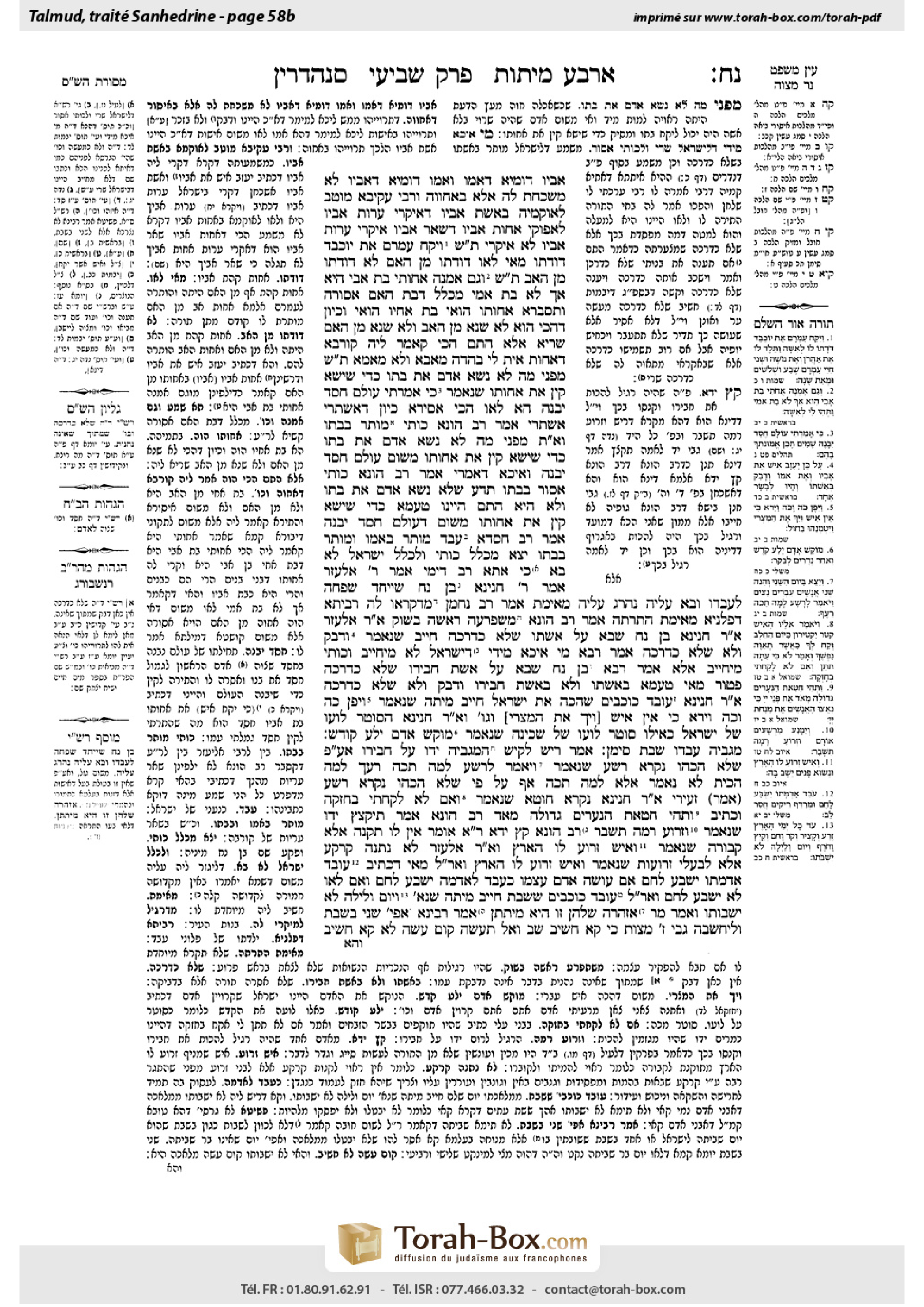
Sanhedrin 58b: Talmud study for Daf Yomi
Daf Yomi is the daily study of one Talmud folio. Explore 37 tractates with scans, Hebrew text, Sefaria English and AI-generated French translations where annotated.
Passage selection and English or AI-generated French translation are available where the scan has annotations. Daf Study is independent of Torah-Box and Sefaria.
Browse Sanhedrin · סנהדרין · All tractatesSanhedrin 58b text and translations
This page of Sanhedrin includes the Aramaic text, an English translation and an AI-generated French translation, alongside the scan above.
סנהדרין נ״ח ב · Aramaic and Hebrew text
אָבִיו דּוּמְיָא דְּאִמּוֹ, וְאִמּוֹ דּוּמְיָא דְּאָבִיו. לָא מַשְׁכַּחַתְּ לַהּ אֶלָּא בְּאַחְוָוה.
וְרַבִּי עֲקִיבָא: מוּטָב לְאוֹקְמֵיהּ בְּאֵשֶׁת אָבִיו, דְּאִיקְּרַי ״עֶרְוַת אָבִיו״, לְאַפּוֹקֵי אֲחוֹת אָבִיו, דִּ״שְׁאֵר אָבִיו״ אִיקְּרַי, ״עֶרְוַת אָבִיו״ לָא אִיקְּרַי.
תָּא שְׁמַע: ״וַיִּקַּח עַמְרָם אֶת יוֹכֶבֶד דֹּדָתוֹ״. מַאי לָאו, דּוֹדָתוֹ מִן הָאֵם?
לֹא, דּוֹדָתוֹ מִן הָאָב.
תָּא שְׁמַע: ״וְגַם אׇמְנָה אֲחֹתִי בַת אָבִי הִיא אַךְ לֹא בַת אִמִּי״ – מִכְּלָל דְּבַת הָאֵם אֲסוּרָה.
וְתִסְבְּרָא אֲחוֹתוֹ הֲוַאי? בַּת אָחִיו הֲוַאי! וְכֵיוָן דְּהָכִי הוּא, לָא שְׁנָא מִן הָאָב וְלָא שְׁנָא מִן הָאֵם – שַׁרְיָא. אֶלָּא הָתָם הָכִי קָאָמַר לֵיהּ: קוּרְבָּא דְּאָחוֹת אִית לִי בַּהֲדַהּ, מֵאַבָּא וְלָא מֵאִמָּא.
תָּא שְׁמַע: מִפְּנֵי מָה לֹא נָשָׂא אָדָם אֶת בִּתּוֹ? כְּדֵי שֶׁיִּשָּׂא קַיִן אֶת אֲחוֹתוֹ, שֶׁנֶּאֱמַר: ״כִּי אָמַרְתִּי עוֹלָם חֶסֶד יִבָּנֶה״. הָא לָאו הָכִי – אֲסִירָא.
כֵּיוָן דְּאִשְׁתְּרַי, אִשְׁתְּרַי.
אָמַר רַב הוּנָא: גּוֹי מוּתָּר בְּבִתּוֹ. וְאֵם תֹּאמַר: מִפְּנֵי מָה לֹא נָשָׂא אָדָם אֶת בִּתּוֹ? כְּדֵי שֶׁיִּשָּׂא קַיִן אֶת אֲחוֹתוֹ, מִשּׁוּם ״עוֹלָם חֶסֶד יִבָּנֶה״.
וְאִיכָּא דְּאָמְרִי: אָמַר רַב הוּנָא, גּוֹי אָסוּר בְּבִתּוֹ. תִּדַּע, שֶׁלֹּא נָשָׂא אָדָם אֶת בִּתּוֹ. וְלָא הִיא, הָתָם הַיְינוּ טַעְמָא: כְּדֵי שֶׁיִּשָּׂא קַיִן אֶת אֲחוֹתוֹ, מִשּׁוּם דְּ״עוֹלָם חֶסֶד יִבָּנֶה״.
אָמַר רַב חִסְדָּא: עֶבֶד מוּתָּר בְּאִמּוֹ, וּמוּתָּר בְּבִתּוֹ. יָצָא מִכְּלַל גּוֹי, וְלִכְלַל יִשְׂרָאֵל לֹא בָּא.
כִּי אֲתָא רַב דִּימִי, אָמַר רַבִּי אֶלְעָזָר אָמַר רַבִּי חֲנִינָא: בֶּן נֹחַ שֶׁיִּיחֵד שִׁפְחָה לְעַבְדּוֹ, וּבָא עָלֶיהָ – נֶהֱרָג עָלֶיהָ.
מֵאֵימַת? אָמַר רַב נַחְמָן: מִדְּקָרְאוּ לַהּ ״רְבִיתָא דִּפְלָנְיָא״. מֵאֵימַת הַתָּרָתָהּ? אָמַר רַב הוּנָא: מִשֶּׁפָּרְעָה רֹאשָׁהּ בַּשּׁוּק.
אָמַר רַבִּי אֶלְעָזָר אָמַר רַבִּי חֲנִינָא: בֶּן נֹחַ שֶׁבָּא עַל אִשְׁתּוֹ שֶׁלֹּא כְּדַרְכָּהּ – חַיָּיב, שֶׁנֶּאֱמַר: ״וְדָבַק״, וְלֹא שֶׁלֹּא כְּדַרְכָּהּ.
אָמַר רָבָא: מִי אִיכָּא מִידֵּי דְּיִשְׂרָאֵל לָא מִחַיַּיב, וְנׇכְרִי מִחַיַּיב?
אֶלָּא אָמַר רָבָא: בֶּן נֹחַ שֶׁבָּא עַל אֵשֶׁת חֲבֵירוֹ שֶׁלֹּא כְּדַרְכָּהּ – פָּטוּר. מַאי טַעְמָא? ״בְּאִשְׁתּוֹ״ – וְלֹא בְּאֵשֶׁת חֲבֵירוֹ; ״וְדָבַק״ – וְלָא שֶׁלֹּא כְּדַרְכָּהּ.
אָמַר רַבִּי חֲנִינָא: גּוֹי שֶׁהִכָּה אֶת יִשְׂרָאֵל חַיָּיב מִיתָה, שֶׁנֶּאֱמַר: ״וַיִּפֶן כֹּה וָכֹה וַיַּרְא כִּי אֵין אִישׁ [וַיַּךְ אֶת הַמִּצְרִי] וְגוֹ׳״.
וְאָמַר רַבִּי חֲנִינָא: הַסּוֹטֵר לוֹעוֹ שֶׁל יִשְׂרָאֵל כְּאִילּוּ סוֹטֵר לוֹעוֹ שֶׁל שְׁכִינָה, שֶׁנֶּאֱמַר: ״מוֹקֵשׁ אָדָם יָלַע קֹדֶשׁ״.
מַגְבִּיהַּ, עַבְדּוֹ, שָׁבַת – סִימָן. אָמַר רֵישׁ לָקִישׁ: הַמַּגְבִּיהַּ יָדוֹ עַל חֲבֵירוֹ, אַף עַל פִּי שֶׁלֹּא הִכָּהוּ, נִקְרָא רָשָׁע, שֶׁנֶּאֱמַר: ״וַיֹּאמֶר לָרָשָׁע לָמָּה תַכֶּה רֵעֶךָ״. ״לָמָּה הִכִּיתָ״ לֹא נֶאֱמַר, אֶלָּא ״לָמָּה תַכֶּה״ – אַף עַל פִּי שֶׁלֹּא הִכָּהוּ נִקְרָא רָשָׁע.
אָמַר זְעֵירִי אָמַר רַבִּי חֲנִינָא: נִקְרָא חוֹטֵא, שֶׁנֶּאֱמַר: ״וְאִם לֹא לָקַחְתִּי בְחׇזְקָה״, וּכְתִיב: ״וַתְּהִי חַטַּאת הַנְּעָרִים גְּדוֹלָה מְאֹד״.
רַב הוּנָא אָמַר: תִּיקָּצֵץ יָדוֹ, שֶׁנֶּאֱמַר: ״וּזְרוֹעַ רָמָה תִּשָּׁבֵר״. רַב הוּנָא קַץ יְדָא.
רַבִּי אֶלְעָזָר אוֹמֵר: אֵין לוֹ תַּקָּנָה אֶלָּא קְבוּרָה, שֶׁנֶּאֱמַר: ״וְאִישׁ זְרוֹעַ לוֹ הָאָרֶץ״.
וְאָמַר רַבִּי אֶלְעָזָר: לֹא נִתְּנָה קַרְקַע אֶלָּא לְבַעֲלֵי זְרוֹעוֹת, שֶׁנֶּאֱמַר: ״וְאִישׁ זְרוֹעַ לוֹ הָאָרֶץ״.
וְאָמַר רֵישׁ לָקִישׁ: מַאי דִּכְתִיב ״עֹבֵד אַדְמָתוֹ יִשְׂבַּע לָחֶם״? אִם עוֹשֶׂה אָדָם עַצְמוֹ כְּעֶבֶד לָאֲדָמָה – יִשְׂבַּע לֶחֶם, וְאִם לָאו – לֹא יִשְׂבַּע לֶחֶם.
וְאָמַר רֵישׁ לָקִישׁ: נׇכְרִי שֶׁשָּׁבַת חַיָּיב מִיתָה, שֶׁנֶּאֱמַר: ״וְיוֹם וָלַיְלָה לֹא יִשְׁבֹּתוּ״. וְאָמַר מָר: אַזְהָרָה שֶׁלָּהֶן זוֹ הִיא מִיתָתָן. אָמַר רָבִינָא: אֲפִילּוּ שֵׁנִי בַּשַּׁבָּת.
וְלִיחְשְׁבַהּ גַּבֵּי שֶׁבַע מִצְוֹת? כִּי קָא חָשֵׁיב – שֵׁב וְאַל תַּעֲשֶׂה, קוּם עֲשֵׂה לָא קָא חָשֵׁיב.
Sanhedrin 58b · English translation
that the term “his father” should be interpreted in a way that is similar to the term “his mother,” and “his mother” should be interpreted in a way that is similar to “his father.” You find such an interpretation only with regard to sisterhood, i.e., “his father” is referring to his father’s sister, and “his mother” is referring to his mother’s sister.
And Rabbi Akiva holds that it is preferable to interpret the term “his father” as referring to his father’s wife, who is referred to as his father’s nakedness in the verse: “You shall not uncover the nakedness of your father’s wife; it is your father’s nakedness” (Leviticus 18:8), to the exclusion of his father’s sister, who is referred to as his father’s kin in the verse: “You shall not uncover the nakedness of your father’s sister; she is your father’s kin” (Leviticus 18:12), and who is not referred to as his father’s nakedness.
Come and hear a proof for the opinion of Rabbi Akiva from the verse: “And Amram took Jochebed his aunt as a wife” (Exodus 6:20). What, was she not his maternal aunt? Presumably, Jochebed was the sister of Kohath, Amram’s father, from both of Kohath’s parents, and not from his father alone. Evidently, a descendant of Noah may marry his father’s sister.
The Gemara rejects this proof: No, she was his paternal aunt, Kohath’s half sister. Since she was not Kohath’s sister from his mother’s side, she was not forbidden to Amram.
Come and hear a proof for the opinion of Rabbi Eliezer from what Abraham said to Abimelech with regard to Sarah: “And moreover, she is my sister, the daughter of my father, but not the daughter of my mother; and so she became my wife” (Genesis 20:12). By inference, the daughter of the mother of a descendant of Noah is forbidden to him.
The Gemara rejects this proof: But how can you understand that Sarah was Abraham’s sister? She was his brother’s daughter. By tradition, it is known that Sarah was Haran’s daughter Iscah. And since that was so, there is no difference whether they were paternal relatives, and there is no difference whether they were maternal relatives; in any event she was permitted to him, even according to the halakha of Jews. Rather, this is what Abraham was saying to Abimelech there: She is related to me like a sister, as the daughter of my brother is like a sister, and our relationship is from the side of my father but not from the side of my mother.
Come and hear a proof from a baraita: For what reason did Adam not marry his daughter? So that Cain would marry his sister and they would procreate immediately, as it is stated: “For I have said: The world shall be built on kindness [ḥesed]” (Psalms 89:3). This verse alludes to the fact that at the beginning of the world’s existence it was permitted for men to marry their sisters, which was later forbidden in the verse: “And if a man shall take his sister…it is a shameful thing [ḥesed]” (Leviticus 20:17). The Gemara infers: If it had not been so, if God had not specially permitted Cain to marry his sister, she would have been forbidden to him. This is difficult according to the opinion of Rabbi Akiva, who deems it permitted for a gentile to marry his sister.
The Gemara rejects this proof: Once it was permitted for Cain to marry his sister, it was permitted for all descendants of Noah to do so, and it was forbidden only to Jews.
Rav Huna says: A gentile is permitted to marry his daughter. And if you say, for what reason did Adam not marry his daughter? It was so that Cain would marry his sister, because it is stated: “The world shall be built on kindness.”
And there are those who say that Rav Huna did not say this; rather, Rav Huna says: A gentile is prohibited from marrying his daughter. Know that this is the halakha, as Adam did not marry his daughter. The Gemara rejects this statement: But that is not so, as there, this is the reason Adam did not marry his daughter: So that Cain would marry his sister, because it is stated: “The world shall be built on kindness.”
§ Rav Ḥisda says: A Canaanite slave is permitted to marry his mother, and he is permitted to marry his daughter. This is because he has left the category of a gentile by immersing in a ritual bath for the purpose of becoming a slave to a Jew, and consequently all his previous family relationships are disregarded according to halakha; but he has not entered the category of a Jew, as evidenced by the fact that he is not obligated to observe all of the mitzvot of male Jews. Therefore, the decree of the Sages prohibiting the maternal relatives of converts does not apply to him.
When Rav Dimi came from Eretz Yisrael to Babylonia, he said that Rabbi Elazar says that Rabbi Ḥanina says: In the case of a descendant of Noah who designated a maidservant as a mate for his slave, and then he himself engaged in intercourse with her, he is executed for adultery on her account.
The Gemara asks: From when is she considered the slave’s mate? Rav Naḥman says: From the time that she is called so-and-so’s girl. The Gemara asks: From when is she released from her relationship with the slave? Rav Huna says: From the time that she exposes her head in the marketplace. Since married women would cover their hair, even among the gentiles, by exposing her hair she proves that she no longer wishes to remain with him.
Rabbi Elazar says that Rabbi Ḥanina says: A descendant of Noah who engages in intercourse with his wife in an atypical manner, i.e., anal intercourse, is liable for engaging in forbidden sexual intercourse, as it is stated: “And shall cleave to his wife” (Genesis 2:24), an expression that indicates natural intercourse, but not intercourse in an atypical manner.
Rava says: Is there any action for which a Jew is not deemed liable, but a gentile is deemed liable for performing it? A Jew is not liable for engaging in anal intercourse with his wife.
Rather, Rava says that the verse is to be understood as follows: A descendant of Noah who engages in intercourse with the wife of another man in an atypical manner is exempt. What is the reason? The verse states: “And shall cleave to his wife,” but not to the wife of another. With regard to this prohibition, the verse states: “And shall cleave,” indicating vaginal intercourse, and not intercourse in an atypical manner.
Rabbi Ḥanina says: A gentile who struck a Jew is liable to receive the death penalty, as it is stated when Moses saw an Egyptian striking a Hebrew: “And he turned this way and that way, and when he saw that there was no man, he struck the Egyptian and hid him in the sand” (Exodus 2:12).
And Rabbi Ḥanina says: One who slaps the cheek of a Jew is considered as though he slapped the cheek of the Divine Presence; as it is stated: “It is a snare [mokesh] for a man to rashly say [yala]: Holy” (Proverbs 20:25). The verse is interpreted homiletically to mean: One who strikes [nokesh] a Jew is considered as though he hurt the cheek [lo’a] of the Holy One.
The Gemara states a mnemonic for the upcoming statements of Reish Lakish: Raises, his slave, Shabbat. Reish Lakish says: One who raises his hand to strike another, even if he ultimately does not strike him, is called wicked, as it is stated: “And two men of the Hebrews were struggling with each other, and he said to the wicked one: Why should you strike your friend?” (Exodus 2:13). The phrase: Why did you strike, is not stated, but rather: “Why should you strike,” indicating that one who raised his hand to strike another, even if he ultimately did not strike him, is called wicked.
Ze’eiri says that Rabbi Ḥanina says: One who raises his hand to strike another is called a sinner; as it is stated: “And the priest’s lad would come…and would say to him, but you shall give now, and if not, I will take by force” (I Samuel 2:15–16), and it is written with regard to this behavior: “And the sin of the youths was very great” (I Samuel 2:17).
Rav Huna says: His hand should be cut off, as it is stated: “And the high arm shall be broken” (Job 38:15). If one habitually lifts his arm to strike others, it is better that it be broken. The Gemara relates that Rav Huna cut off the hand of a person who would habitually hit others.
Rabbi Elazar says: Such a violent person has no remedy but burial, as it is stated: “And as a mighty man [ve’ish zero’a], who has the earth” (Job 22:8). The expression ish zero’a literally means: A man of the arm, and the verse is interpreted homiletically to mean that one who habitually strikes others deserves to be buried.
And Rabbi Elazar states a different interpretation of that verse: The land is given only to mighty men who can protect themselves from all enemies; as it is stated: “And as a mighty man, who has the earth.”
And in connection with that statement, the Gemara notes that Reish Lakish says: What is the meaning of that which is written: “One who works [oved] his land shall have plenty of bread” (Proverbs 12:11)? If a person makes himself like a slave [ke’eved] to the land, devoting his efforts to it, he will have plenty of bread, but if not, he will not have plenty of bread.
And Reish Lakish says: A gentile who observed Shabbat is liable to receive the death penalty, as it is stated: “And day and night shall not cease” (Genesis 8:23), which literally means: And day and night they shall not rest. This is interpreted homiletically to mean that the descendants of Noah may not take a day of rest. And the Master said (57a) that their prohibition is their death penalty, i.e., the punishment for any prohibition with regard to descendants of Noah is execution. Ravina says: If a descendant of Noah observes a day of rest on any day of the week, even one not set aside for religious worship, e.g., on a Monday, he is liable.
The Gemara challenges this: But let the tanna count this prohibition among the seven Noahide mitzvot. The Gemara explains: When the tanna counts the seven mitzvot, he counts only those that require one to sit and refrain from action, i.e., those that include a prohibition against performing a certain action. He does not count mitzvot that require one to arise and take action.
Sanhedrin 58b · Traduction française (IA)
que le terme « son père » doit être interprété de manière analogue au terme « sa mère », et que « sa mère » doit être interprété de manière analogue à « son père ». On ne trouve une telle interprétation que concernant la sœur, c'est-à-dire que « son père » fait référence à la sœur de son père, et « sa mère » fait référence à la sœur de sa mère.
Et Rabbi Akiva soutient qu'il est préférable d'interpréter le terme « son père » comme faisant référence à la femme de son père, qui est désignée comme la nudité de son père dans le verset : « Tu ne découvriras pas la nudité de la femme de ton père ; c'est la nudité de ton père » (Lévitique 18:8), à l'exclusion de la sœur de son père, qui est désignée comme la parente de son père dans le verset : « Tu ne découvriras pas la nudité de la sœur de ton père ; elle est la parente de ton père » (Lévitique 18:12), et qui n'est pas désignée comme la nudité de son père.
Écoutez une preuve pour l'opinion de Rabbi Akiva à partir du verset : « Et Amram prit Jochebed, sa tante, pour femme » (Exode 6:20). Quoi, n'était-elle pas sa tante maternelle ? A priori, Jochebed était la sœur de Kohath, le père d'Amram, des deux parents de Kohath, et non seulement de son père. Évidemment, un descendant de Noé peut épouser la sœur de son père.
La Guemara rejette cette preuve : Non, elle était sa tante paternelle, la demi-sœur de Kohath. Puisqu'elle n'était pas la sœur de Kohath du côté de sa mère, elle n'était pas interdite à Amram.
Écoutez une preuve en faveur de l'opinion de Rabbi Eliezer à partir de ce qu'Abraham a dit à Abimélek à propos de Sarah : « De plus, elle est ma sœur, la fille de mon père, mais non la fille de ma mère ; et elle est devenue ma femme » (Genèse 20:12). Par inférence, la fille de la mère d'un descendant de Noé lui est interdite.
La Guemara rejette cette preuve : Mais comment pouvez-vous comprendre que Sarah était la sœur d'Abraham ? Elle était la fille de son frère. Par tradition, il est connu que Sarah était Iscah, fille de Haran. Et puisque c'était le cas, il n'y a pas de différence s'ils étaient parents du côté paternel, et il n'y a pas de différence s'ils étaient parents du côté maternel ; en tout cas, elle lui était permise, même selon la halakha des Juifs. Plutôt, c'est ce qu'Abraham disait à Abimélek là-bas : Elle est apparentée à moi comme une sœur, car la fille de mon frère est comme une sœur, et notre relation est du côté de mon père mais non du côté de ma mère.
Écoutez une preuve tirée d'une baraïta : Pour quelle raison Adam n'a-t-il pas épousé sa fille ? Afin que Caïn épouse sa sœur et qu'ils procréent immédiatement, comme il est écrit : « Car j'ai dit : Le monde sera bâti sur la bonté [ḥesed] » (Psaumes 89:3). Ce verset fait allusion au fait qu'au début de l'existence du monde, il était permis aux hommes d'épouser leurs sœurs, ce qui a été interdit plus tard dans le verset : « Et si un homme prend sa sœur… c'est une chose honteuse [ḥesed] » (Lévitique 20:17). La Guemara en déduit : Si cela n'avait pas été le cas, si Dieu n'avait pas spécialement permis à Caïn d'épouser sa sœur, elle lui aurait été interdite. Cela pose un problème selon l'opinion de Rabbi Akiva, qui considère qu'il est permis à un non-Juif d'épouser sa sœur.
La Guemara rejette cette preuve : Une fois qu'il a été permis à Caïn d'épouser sa sœur, il a été permis à tous les descendants de Noé de le faire, et cela n'a été interdit qu'aux Juifs.
Rav Huna dit : Un non-Juif est autorisé à épouser sa fille. Et si vous dites, pour quelle raison Adam n'a-t-il pas épousé sa fille ? C'était afin que Caïn épouse sa sœur, car il est écrit : « Le monde sera bâti sur la bonté ».
Et certains disent que Rav Huna n'a pas dit cela ; plutôt, Rav Huna dit : Un non-Juif est interdit d'épouser sa fille. Sachez que c'est la halakha, car Adam n'a pas épousé sa fille. La Guemara rejette cette déclaration : Mais ce n'est pas le cas, car là, la raison pour laquelle Adam n'a pas épousé sa fille est la suivante : Afin que Caïn épouse sa sœur, car il est écrit : « Le monde sera bâti sur la bonté ».
§ Rav Ḥisda dit : Un esclave cananéen est autorisé à épouser sa mère, et il est autorisé à épouser sa fille. C'est parce qu'il a quitté la catégorie de non-Juif en s'immergeant dans un bain rituel dans le but de devenir esclave d'un Juif, et en conséquence, toutes ses relations familiales antérieures sont ignorées selon la halakha ; mais il n'est pas entré dans la catégorie de Juif, comme en témoigne le fait qu'il n'est pas obligé d'observer toutes les mitsvot des Juifs mâles. Par conséquent, le décret des Sages interdisant les parents maternels des convertis ne s'applique pas à lui.
Lorsque Rav Dimi est venu d'Eretz Yisrael en Babylone, il a dit que Rabbi Elazar dit que Rabbi Ḥanina dit : Dans le cas d'un descendant de Noé qui a désigné une servante comme compagne pour son esclave, et puis il a lui-même eu des rapports sexuels avec elle, il est exécuté pour adultère à son sujet.
La Guemara demande : À partir de quand est-elle considérée comme la compagne de l'esclave ? Rav Naḥman dit : À partir du moment où elle est appelée la fille de tel. La Guemara demande : À partir de quand est-elle libérée de sa relation avec l'esclave ? Rav Huna dit : À partir du moment où elle découvre sa tête sur le marché. Puisque les femmes mariées couvraient leurs cheveux, même parmi les non-Juifs, en découvrant ses cheveux, elle prouve qu'elle ne souhaite plus rester avec lui.
Rabbi Elazar dit que Rabbi Ḥanina dit : Un descendant de Noé qui a des rapports sexuels avec sa femme d'une manière atypique, c'est-à-dire des rapports anaux, est passible de la peine pour avoir eu des rapports sexuels interdits, comme il est écrit : « Et il s'attachera à sa femme » (Genèse 2:24), une expression qui indique des rapports naturels, mais non des rapports d'une manière atypique.
Rava dit : Existe-t-il une action pour laquelle un Juif n'est pas considéré comme responsable, mais pour laquelle un non-Juif est considéré comme responsable de l'avoir commise ? Un Juif n'est pas responsable s'il a des rapports anaux avec sa femme.
Au contraire, Rava affirme que le verset doit être compris comme suit : un descendant de Noé qui a des rapports sexuels avec la femme d'un autre homme d'une manière atypique est exempt. Quelle est la raison ? Le verset énonce : « Et il s'attachera à sa femme », mais non à la femme d'un autre. Concernant cette interdiction, le verset indique : « Et il s'attachera », ce qui désigne les rapports vaginaux, et non les rapports d'une manière atypique.
Rabbi Ḥanina déclare : un non-Juif qui frappe un Juif est passible de la peine de mort, comme il est dit lorsque Moïse vit un Égyptien frapper un Hébreu : « Et il regarda à droite et à gauche, et voyant qu'il n'y avait personne, il frappa l'Égyptien et le cacha dans le sable » (Exode 2:12).
Et Rabbi Ḥanina déclare : celui qui gifle la joue d'un Juif est considéré comme s'il avait giflé la joue de la Présence Divine ; comme il est dit : « C'est un piège [mokesh] pour un homme de dire [yala] témérairement : Saint » (Proverbes 20:25). Le verset est interprété homilétiquement pour signifier : celui qui frappe [nokesh] un Juif est considéré comme s'il avait blessé la joue [lo'a] du Saint.
La Guemara énonce un mnémonique pour les déclarations suivantes de Reish Lakish : Lève, son esclave, Chabbat. Reish Lakish dit : Celui qui lève la main pour frapper un autre, même s'il ne le frappe finalement pas, est appelé méchant, comme il est dit : « Et deux hommes des Hébreux se disputaient l'un avec l'autre, et il dit au méchant : Pourquoi frappes-tu ton ami ? » (Exode 2:13). L'expression : Pourquoi as-tu frappé, n'est pas énoncée, mais plutôt : « Pourquoi frappes-tu », indiquant que celui qui a levé la main pour frapper un autre, même s'il ne l'a finalement pas frappé, est appelé méchant.
Ze'eiri dit que Rabbi Ḥanina dit : Celui qui lève la main pour frapper un autre est appelé pécheur ; comme il est dit : « Et le fils du prêtre viendrait… et lui dirait, mais tu me donneras maintenant, et si non, je prendrai de force » (I Samuel 2:15–16), et il est écrit à propos de ce comportement : « Et le péché des jeunes gens était très grand » (I Samuel 2:17).
Rav Huna dit : Sa main devrait être coupée, comme il est dit : « Et le bras puissant sera brisé » (Job 38:15). Si une personne lève habituellement le bras pour frapper les autres, il est préférable qu'il soit brisé. La Guemara rapporte que Rav Huna a coupé la main d'une personne qui frappait habituellement les autres.
Rabbi Elazar dit : Un tel homme violent n'a de remède que l'enterrement, comme il est dit : « Et comme un homme puissant [ve’ish zero’a], qui a la terre » (Job 22:8). L'expression ish zero’a signifie littéralement : Un homme du bras, et le verset est interprété homilétiquement pour signifier que celui qui frappe habituellement les autres mérite d'être enterré.
Et Rabbi Elazar énonce une interprétation différente de ce verset : La terre n'est donnée qu'aux hommes puissants qui peuvent se protéger de tous les ennemis ; comme il est dit : « Et comme un homme puissant, qui a la terre ».
Et en lien avec cette déclaration, la Guemara note que Reish Lakish dit : Quelle est la signification de ce qui est écrit : « Celui qui travaille [oved] sa terre aura abondance de pain » (Proverbes 12:11) ? Si une personne se fait comme un esclave [ke’eved] pour la terre, consacrant ses efforts à celle-ci, il aura abondance de pain, mais si non, il n'aura pas abondance de pain.
Et Reish Lakish dit : Un non-Juif qui a observé le Chabbat est passible de la peine de mort, comme il est dit : « Et le jour et la nuit ne cesseront pas » (Genèse 8:23), ce qui signifie littéralement : Et le jour et la nuit, ils ne se reposeront pas. Cela est interprété homilétiquement pour signifier que les descendants de Noé ne peuvent pas prendre un jour de repos. Et le Maître a dit (57a) que leur interdiction est leur peine de mort, c'est-à-dire que la punition pour toute interdiction concernant les descendants de Noé est l'exécution. Ravina dit : Si un descendant de Noé observe un jour de repos n'importe quel jour de la semaine, même un jour non réservé au culte religieux, par exemple un lundi, il est passible.
La Guemara conteste ceci : Mais que le tanna compte cette interdiction parmi les sept mitsvot noaïdes. La Guemara explique : Lorsque le tanna compte les sept mitsvot, il ne compte que celles qui exigent de s'asseoir et de s'abstenir d'action, c'est-à-dire celles qui incluent une interdiction de commettre une certaine action. Il ne compte pas les mitsvot qui exigent de se lever et d'agir.
Traduction française générée par IA à partir de l’édition anglaise de Sefaria. Vérifie toujours un passage avec le texte source.
Text from Sefaria: William Davidson Edition - Vocalized Aramaic (CC BY NC); William Davidson Edition - English (CC BY NC).