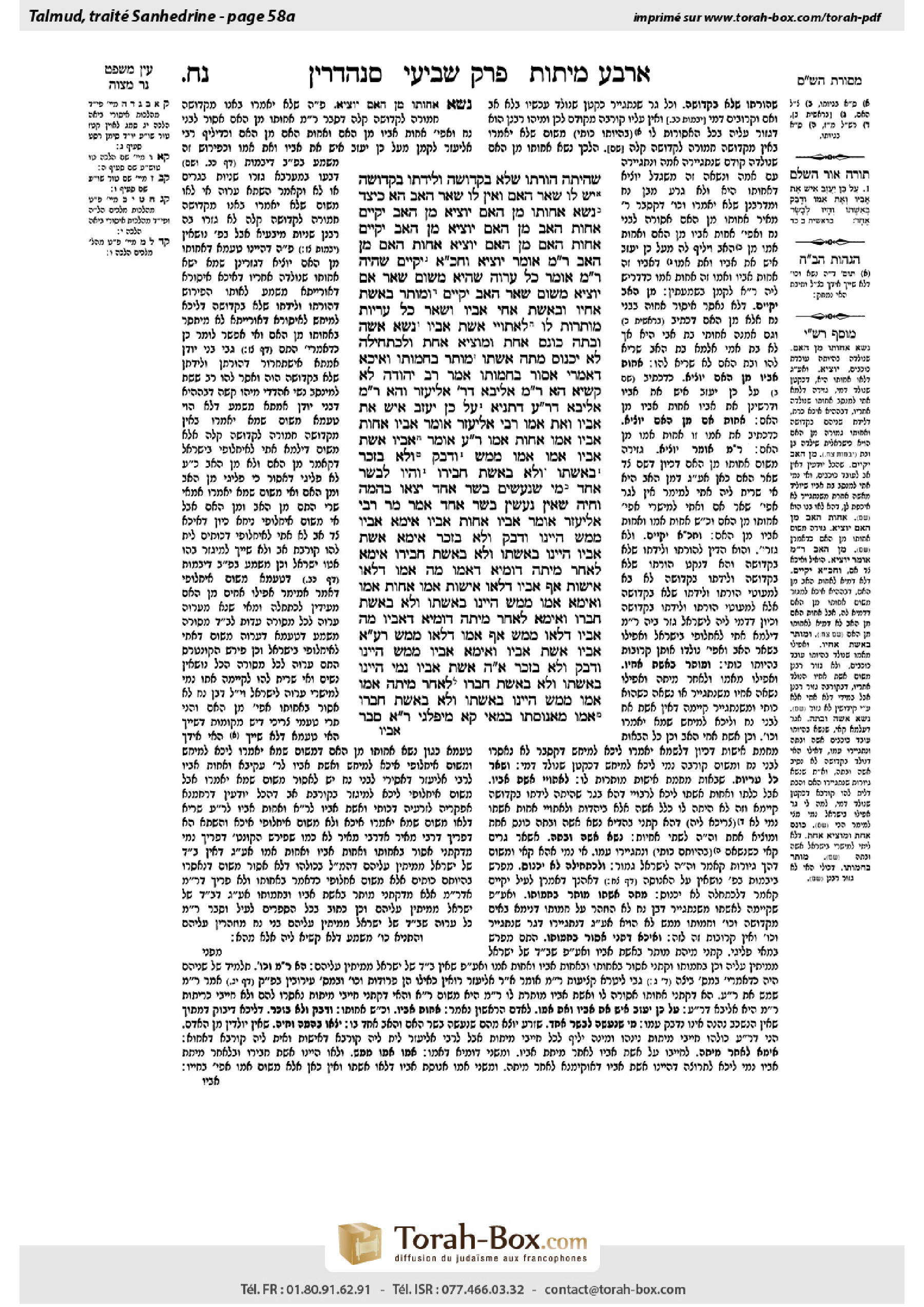
Sanhedrin 58a: Talmud study for Daf Yomi
Daf Yomi is the daily study of one Talmud folio. Explore 37 tractates with scans, Hebrew text, Sefaria English and AI-generated French translations where annotated.
Passage selection and English or AI-generated French translation are available where the scan has annotations. Daf Study is independent of Torah-Box and Sefaria.
Browse Sanhedrin · סנהדרין · All tractatesSanhedrin 58a text and translations
This page of Sanhedrin includes the Aramaic text, an English translation and an AI-generated French translation, alongside the scan above.
סנהדרין נ״ח א · Aramaic and Hebrew text
שֶׁהָיְתָה הוֹרָתוֹ שֶׁלֹּא בִּקְדוּשָּׁה, וְלֵידָתוֹ בִּקְדוּשָּׁה – יֵשׁ לוֹ שְׁאֵר הָאֵם, וְאֵין לוֹ שְׁאֵר הָאָב.
הָא כֵּיצַד? נָשָׂא אֲחוֹתוֹ מִן הָאֵם – יוֹצִיא, מִן הָאָב – יְקַיֵּים. אֲחוֹת הָאָב מִן הָאֵם – יוֹצִיא, מִן הָאָב – יְקַיֵּים.
אֲחוֹת הָאֵם מִן הָאֵם – יוֹצִיא. אֲחוֹת הָאֵם מִן הָאָב, רַבִּי מֵאִיר אוֹמֵר: יוֹצִיא, וַחֲכָמִים אוֹמְרִים: יְקַיֵּים. שֶׁהָיָה רַבִּי מֵאִיר אוֹמֵר: כׇּל עֶרְוָה שֶׁהִיא מִשּׁוּם שְׁאֵר אֵם – יוֹצִיא, מִשּׁוּם שְׁאֵר הָאָב – יְקַיֵּים.
וּמוּתָּר בְּאֵשֶׁת אָחִיו, וּבְאֵשֶׁת אֲחִי אָבִיו, וּשְׁאָר כׇּל עֲרָיוֹת מוּתָּרוֹת לוֹ. לְאֵתוֹיֵי אֵשֶׁת אָבִיו.
נָשָׂא אִשָּׁה וּבִתָּהּ, כּוֹנֵס אַחַת וּמוֹצִיא אַחַת. וּלְכַתְּחִילָּה לֹא יִכְנוֹס. מֵתָה אִשְׁתּוֹ, מוּתָּר בַּחֲמוֹתוֹ. וְאִיכָּא דְּאָמְרִי: אָסוּר בַּחֲמוֹתוֹ.
אָמַר רַב יְהוּדָה: לָא קַשְׁיָא, הָא רַבִּי מֵאִיר אַלִּיבָּא דְּרַבִּי אֱלִיעֶזֶר, וְהָא רַבִּי מֵאִיר אַלִּיבָּא דְּרַבִּי עֲקִיבָא.
דְּתַנְיָא: ״עַל כֵּן יַעֲזׇב אִישׁ אֶת אָבִיו וְאֶת אִמּוֹ״. רַבִּי אֱלִיעֶזֶר אוֹמֵר: ״אָבִיו״ – אֲחוֹת אָבִיו, ״אִמּוֹ״ – אֲחוֹת אִמּוֹ. רַבִּי עֲקִיבָא אוֹמֵר: ״אָבִיו״ – אֵשֶׁת אָבִיו, ״אִמּוֹ״ – אִמּוֹ מַמָּשׁ.
״וְדָבַק״ – וְלֹא בְּזָכָר. ״בְּאִשְׁתּוֹ״ – וְלֹא בְּאֵשֶׁת חֲבֵירוֹ. ״וְהָיוּ לְבָשָׂר אֶחָד״ – מִי שֶׁנַּעֲשִׂים בָּשָׂר אֶחָד, יָצְאוּ בְּהֵמָה וְחַיָּה שֶׁאֵין נַעֲשִׂין בָּשָׂר אֶחָד.
אָמַר מָר: רַבִּי אֱלִיעֶזֶר אוֹמֵר ״אָבִיו״ – אֲחוֹת אָבִיו. אֵימָא: אָבִיו מַמָּשׁ? הַיְינוּ ״וְדָבַק״, וְלֹא בְּזָכָר.
אֵימָא: אֵשֶׁת אָבִיו? הַיְינוּ ״בְּאִשְׁתּוֹ״ וְלֹא בְּאֵשֶׁת חֲבֵירוֹ. אֵימָא: לְאַחַר מִיתָה? דּוּמְיָא דְּאִמּוֹ: מָה אִמּוֹ דְּלָאו אִישׁוּת, אַף אָבִיו דְּלָאו אִישׁוּת.
״אִמּוֹ״ – אֲחוֹת אִמּוֹ. וְאֵימָא אִמּוֹ מַמָּשׁ? הַיְינוּ בְּאִשְׁתּוֹ וְלֹא בְּאֵשֶׁת חֲבֵירוֹ. וְאֵימָא לְאַחַר מִיתָה? דּוּמְיָא דְּאָבִיו: מָה אָבִיו דְּלָאו מַמָּשׁ, אַף אִמּוֹ דְּלָאו מַמָּשׁ.
רַבִּי עֲקִיבָא אוֹמֵר: ״אָבִיו״ – אֵשֶׁת אָבִיו. וְאֵימָא: אָבִיו מַמָּשׁ? הַיְינוּ ״וְדָבַק״ – וְלֹא בְּזָכָר. אִי הָכִי, אֵשֶׁת אָבִיו נָמֵי הַיְינוּ ״בְּאִשְׁתּוֹ״ וְלֹא בְּאֵשֶׁת חֲבֵרוֹ! לְאַחַר מִיתָה.
״אִמּוֹ״ – אִמּוֹ מַמָּשׁ. הַיְינוּ ״בְּאִשְׁתּוֹ״ וְלֹא בְּאֵשֶׁת חֲבֵרוֹ! אִמּוֹ מֵאֲנוּסָתוֹ.
בְּמַאי קָא מִיפַּלְגִי? רַבִּי אֱלִיעֶזֶר סָבַר:
Sanhedrin 58a · English translation
who was not conceived in sanctity, as his parents were still gentiles, but his birth was in sanctity, as his mother converted before his birth, he has maternal kinship, i.e., his relationship to his mother’s relatives is recognized, but he does not have paternal kinship.
How so? If he married his maternal half sister, who was born before him and converted, he must divorce her. Although by Torah law they are considered unrelated, as a convert is considered to be reborn and all his previous family relationships are disregarded according to halakha, the Sages prohibited their marriage, lest he think that as a Jew it is permitted for him to engage in behaviors that were previously forbidden to him. If she is his paternal half sister, he may maintain her as his wife, as it is permitted for a gentile to marry his paternal half sister. If he married his father’s maternal half sister, he must divorce her. If he married his father’s paternal half sister, he may maintain her as his wife.
If she is his mother’s maternal half sister, he must divorce her. If she is his mother’s paternal half sister, Rabbi Meir says he must divorce her, and the Rabbis say he may maintain her as his wife. As Rabbi Meir would say: With regard to any forbidden relative who is forbidden due to maternal kinship, whether the woman is his paternal relative, e.g., his father’s maternal half sister, or his maternal relative, he must divorce her; whereas if she is forbidden due to paternal kinship, he may maintain her as his wife.
And according to all opinions, he is permitted to marry his brother’s wife and his father’s brother’s wife, and all other relatives with whom relations are forbidden in the case of born Jew are also permitted to him. The expression: And all other relatives with whom relations are forbidden, is added to include his father’s wife, who is permitted to him if she was widowed or divorced from his father.
With regard to a gentile who married a woman and her daughter and they all converted, he may marry one but must divorce the other one; and he should not marry the second of them ab initio. If his wife, the daughter, died, he is permitted to maintain his mother-in-law as his wife. And some say that he is prohibited from maintaining his mother-in-law. In any event, Rabbi Meir clearly holds that several forbidden relationships for which a Jew is not liable to receive capital punishment, but only karet, are forbidden to descendants of Noah as well, namely, intercourse with one’s sister or one’s parent’s sister.
Rav Yehuda says: This is not difficult; this baraita cites the statement of Rabbi Meir according to the opinion of Rabbi Eliezer, and that previously mentioned baraita cites the statement of Rabbi Meir according to the opinion of Rabbi Akiva.
As it is taught in a baraita with regard to the verse: “Therefore a man shall leave his father and his mother, and shall cleave to his wife, and they shall be one flesh” (Genesis 2:24), that Rabbi Eliezer says: “His father” is referring to his father’s sister, i.e., one must abandon the possibility of marrying his father’s sister and marry someone else. “His mother” is referring to his mother’s sister. Rabbi Akiva says: “His father” is referring to his father’s wife; “his mother” is referring to his mother, literally.
“And shall cleave to his wife,” but not to a male; such a relationship is not defined as cleaving. “To his wife,” but not to the wife of another man. “And they shall be one flesh” indicates that he should marry one of those with whom he can become one flesh, i.e., they can bear children together. This excludes domesticated and undomesticated animals, with which one is prohibited from engaging in bestiality, as they do not become one flesh. All these are forbidden to the descendants of Noah.
§ The Master said in this baraita that Rabbi Eliezer says: “His father” is referring to his father’s sister. The Gemara asks: Why not say that it is referring to his father, literally, prohibiting homosexual intercourse with one’s father? The Gemara answers: This prohibition is derived from another phrase in the verse: “And shall cleave to his wife,” but not to a male; this includes his father.
The Gemara asks: Why not say that “his father” is referring to his father’s wife? The Gemara answers: This prohibition is derived from the term “to his wife,” but not to the wife of another man. The Gemara asks: Why not say that it is referring to his father’s wife after his father’s death, when she is no longer a married woman? The Gemara answers: The term “his father” is interpreted in a way that is similar to the interpretation of the term “his mother.” Just as his mother is not forbidden due to her marriage to his father, but rather due to her relationship to him, so too, the term “his father” is not referring to a relative who is forbidden to him due to her marriage.
Rabbi Eliezer says that “his mother” is referring to his mother’s sister. The Gemara asks: But why not say that it is referring to his mother, literally? The Gemara answers: This prohibition is derived from the term “to his wife,” but not to the wife of another man; and his mother is his father’s wife. The Gemara asks: But why not say that it is referring to his mother after his father’s death, when she is no longer married? The Gemara answers: The term “his mother” is interpreted in a way that is similar to the interpretation of the term “his father.” Just as the term “his father” is not interpreted literally, so too, the term “his mother” is not interpreted literally.
Rabbi Akiva says: “His father” is referring to his father’s wife. The Gemara asks: But why not say it is referring to his father, literally? The Gemara answers: That prohibition is derived from the term “and shall cleave to his wife,” but not to a male. The Gemara challenges: If so, the prohibition of his father’s wife is also derived from another term: “To his wife,” but not to the wife of another man. The Gemara explains: The term “to his wife” is referring to his father’s wife after his father’s death, when she is no longer married.
Rabbi Akiva says: “His mother” is referring to his mother, literally. The Gemara challenges: That prohibition is derived from the term “to his wife,” but not to the wife of another man. The Gemara explains: According to Rabbi Akiva, the term “his mother” is referring to his mother whom his father raped, i.e., she was never his father’s wife.
With regard to what principle do Rabbi Eliezer and Rabbi Akiva disagree? Rabbi Eliezer holds
Sanhedrin 58a · Traduction française (IA)
qui n'a pas été conçu dans la sainteté, car ses parents étaient encore des non-juifs, mais dont la naissance s'est produite dans la sainteté, car sa mère s'est convertie avant sa naissance, possède une parenté maternelle, c'est-à-dire que sa relation avec les proches de sa mère est reconnue, mais il ne possède pas de parenté paternelle.
Comment cela se présente-t-il ? S'il a épousé sa demi-sœur maternelle, qui est née avant lui et s'est convertie, il doit la répudier. Bien que, selon la loi de la Torah, ils soient considérés comme non apparentés, car un converti est considéré comme étant né à nouveau et tous ses liens familiaux antérieurs sont ignorés selon la halakha, les Sages ont interdit leur mariage, de peur qu'il ne pense que, en tant que Juif, il lui est permis de se livrer à des comportements qui lui étaient auparavant interdits. Si c'est sa demi-sœur paternelle, il peut la conserver comme épouse, car il est permis à un non-juif d'épouser sa demi-sœur paternelle. S'il a épousé la demi-sœur maternelle de son père, il doit la répudier. S'il a épousé la demi-sœur paternelle de son père, il peut la conserver comme épouse.
Si c'est la demi-sœur maternelle de sa mère, il doit la répudier. Si c'est la demi-sœur paternelle de sa mère, Rabbi Meïr dit qu'il doit la répudier, et les Rabbins disent qu'il peut la conserver comme épouse. Car Rabbi Meïr dirait : En ce qui concerne tout parent interdit qui l'est en raison de la parenté maternelle, que la femme soit son parent paternel, par exemple la demi-sœur maternelle de son père, ou son parent maternel, il doit la répudier ; alors que si elle est interdite en raison de la parenté paternelle, il peut la conserver comme épouse.
Et selon toutes les opinions, il lui est permis d'épouser la femme de son frère et la femme du frère de son père, ainsi que tous les autres parents avec qui les relations sont interdites dans le cas d'un Juif né Juif. L'expression : « Et tous les autres parents avec qui les relations sont interdites », est ajoutée pour inclure la femme de son père, qui lui est permise si elle est devenue veuve ou divorcée de son père.
En ce qui concerne un non-juif qui a épousé une femme et sa fille, et qu'ils se sont tous convertis, il peut en épouser une mais doit répudier l'autre ; et il ne doit pas épouser la seconde d'entre elles ab initio. Si son épouse, la fille, est décédée, il lui est permis de conserver sa belle-mère comme épouse. Et certains disent qu'il lui est interdit de conserver sa belle-mère. En tout cas, Rabbi Meïr soutient clairement que plusieurs relations interdites, pour lesquelles un Juif n'est pas passible de la peine capitale, mais seulement de la karet, sont également interdites aux descendants de Noé, à savoir, le rapport avec sa sœur ou la sœur de son parent.
Rav Yehouda dit : Cela ne pose pas de difficulté ; cette baraïta cite l'opinion de Rabbi Meïr selon l'avis de Rabbi Eliezer, et la baraïta mentionnée précédemment cite l'opinion de Rabbi Meïr selon l'avis de Rabbi Akiva.
En effet, il est enseigné dans une baraïta au sujet du verset : « C'est pourquoi l'homme quittera son père et sa mère, et s'attachera à sa femme, et ils seront une seule chair » (Genèse 2:24), que Rabbi Eliezer dit : « Son père » fait référence à la sœur de son père, c'est-à-dire qu'il doit renoncer à la possibilité d'épouser la sœur de son père et en épouser une autre. « Sa mère » fait référence à la sœur de sa mère. Rabbi Akiva dit : « Son père » fait référence à la femme de son père ; « sa mère » fait référence à sa mère, au sens littéral.
« Et s'attachera à sa femme », mais pas à un homme ; une telle relation n'est pas définie comme un attachement. « À sa femme », mais pas à la femme d'un autre homme. « Et ils seront une seule chair » indique qu'il doit épouser l'une de celles avec qui il peut devenir une seule chair, c'est-à-dire qu'elles peuvent avoir des enfants ensemble. Cela exclut les animaux domestiques et non domestiques, avec lesquels il est interdit de commettre l'acte bestial, car ils ne deviennent pas une seule chair. Tous ces interdits s'appliquent aux descendants de Noé.
§ Le Maître a dit dans cette baraïta que Rabbi Eliezer dit : « Son père » fait référence à la sœur de son père. La Guemara demande : Pourquoi ne pas dire que cela fait référence à son père, au sens littéral, interdisant les relations homosexuelles avec son père ? La Guemara répond : Cette interdiction est dérivée d'une autre expression du verset : « Et s'attachera à sa femme », mais pas à un homme ; cela inclut son père.
La Guemara demande : Pourquoi ne pas dire que « son père » fait référence à la femme de son père ? La Guemara répond : Cette interdiction est dérivée du terme « à sa femme », mais pas à la femme d'un autre homme. La Guemara demande : Pourquoi ne pas dire que cela fait référence à la femme de son père après la mort de son père, quand elle n'est plus une femme mariée ? La Guemara répond : Le terme « son père » est interprété de manière similaire à l'interprétation du terme « sa mère ». De même que sa mère n'est pas interdite en raison de son mariage avec son père, mais plutôt en raison de sa relation avec lui, de même, le terme « son père » ne fait pas référence à un parent qui lui est interdit en raison de son mariage.
Rabbi Eliezer dit que « sa mère » fait référence à la sœur de sa mère. La Guemara demande : Mais pourquoi ne pas dire que cela fait référence à sa mère, littéralement ? La Guemara répond : Cette interdiction est dérivée du terme « à sa femme », mais pas à la femme d'un autre homme ; et sa mère est la femme de son père. La Guemara demande : Mais pourquoi ne pas dire que cela fait référence à sa mère après la mort de son père, quand elle n'est plus mariée ? La Guemara répond : Le terme « sa mère » est interprété de manière similaire à l'interprétation du terme « son père ». De même que le terme « son père » n'est pas interprété littéralement, de même, le terme « sa mère » n'est pas interprété littéralement.
Rabbi Akiva dit : « Son père » fait référence à la femme de son père. La Guemara demande : Mais pourquoi ne pas dire qu'il fait référence à son père, au sens littéral ? La Guemara répond : Cette interdiction est dérivée du terme « et il s'attachera à sa femme », mais pas à un homme. La Guemara objecte : Si tel est le cas, l'interdiction concernant la femme de son père est également dérivée d'un autre terme : « à sa femme », mais pas à la femme d'un autre homme. La Guemara explique : Le terme « à sa femme » fait référence à la femme de son père après la mort de son père, lorsqu'elle n'est plus mariée.
Rabbi Akiva dit : « Sa mère » fait référence à sa mère, au sens littéral. La Guemara objecte : Cette interdiction est dérivée du terme « à sa femme », mais pas à la femme d'un autre homme. La Guemara explique : Selon Rabbi Akiva, le terme « sa mère » fait référence à sa mère que son père a violée, c'est-à-dire qu'elle n'a jamais été la femme de son père.
Sur quel principe Rabbi Eliezer et Rabbi Akiva sont-ils en désaccord ? Rabbi Eliezer soutient
Traduction française générée par IA à partir de l’édition anglaise de Sefaria. Vérifie toujours un passage avec le texte source.
Text from Sefaria: William Davidson Edition - Vocalized Aramaic (CC BY NC); William Davidson Edition - English (CC BY NC).