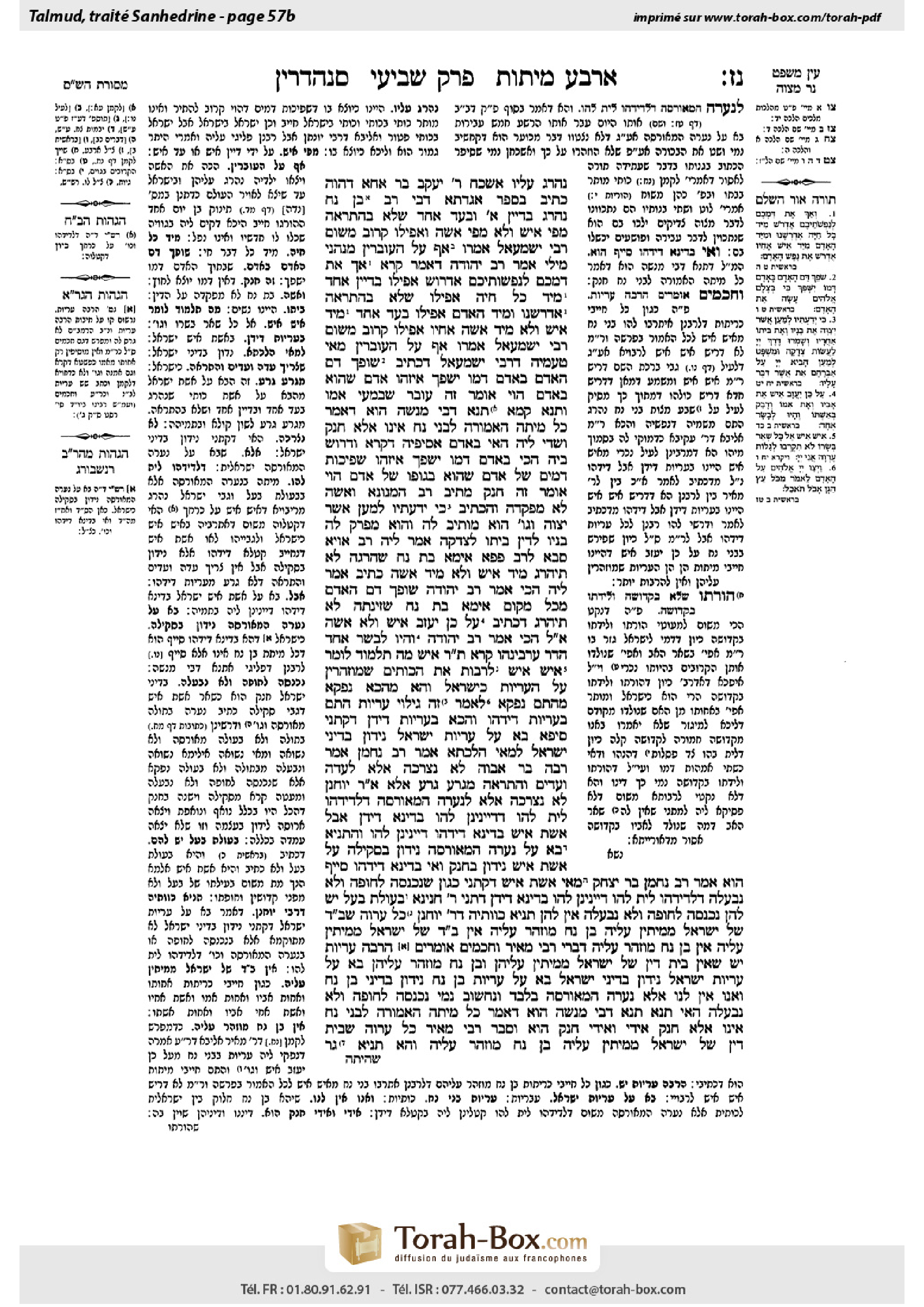
Sanhedrin 57b: Talmud study for Daf Yomi
Daf Yomi is the daily study of one Talmud folio. Explore 37 tractates with scans, Hebrew text, Sefaria English and AI-generated French translations where annotated.
Passage selection and English or AI-generated French translation are available where the scan has annotations. Daf Study is independent of Torah-Box and Sefaria.
Browse Sanhedrin · סנהדרין · All tractatesSanhedrin 57b text and translations
This page of Sanhedrin includes the Aramaic text, an English translation and an AI-generated French translation, alongside the scan above.
סנהדרין נ״ז ב · Aramaic and Hebrew text
נֶהֱרָג עָלָיו.
אַשְׁכַּח רַבִּי יַעֲקֹב בַּר אַחָא דַּהֲוָה כְּתִיב בְּסֵפֶר אַגַּדְתָּא דְּבֵי רַב: בֶּן נֹחַ נֶהֱרָג בְּדַיָּין אֶחָד, וּבְעֵד אֶחָד, שֶׁלֹּא בְּהַתְרָאָה, מִפִּי אִישׁ וְלֹא מִפִּי אִשָּׁה, וַאֲפִילּוּ קָרוֹב. מִשּׁוּם רַבִּי יִשְׁמָעֵאל אָמְרוּ: אַף עַל הָעוּבָּרִין.
מְנָהָנֵי מִילֵּי? אָמַר רַב יְהוּדָה: דְּאָמַר קְרָא, ״אַךְ אֶת דִּמְכֶם לְנַפְשֹׁתֵיכֶם אֶדְרֹשׁ״, אֲפִילּוּ בְּדַיָּין אֶחָד.
״מִיָּד כׇּל חַיָּה״, אֲפִילּוּ שֶׁלֹּא בְּהַתְרָאָה. ״אֶדְרְשֶׁנּוּ וּמִיַּד הָאָדָם״, אֲפִילּוּ בְּעֵד אֶחָד. ״מִיַּד אִישׁ״, וְלֹא מִיַּד אִשָּׁה. ״אָחִיו״, אֲפִילּוּ קָרוֹב.
מִשּׁוּם רַבִּי יִשְׁמָעֵאל אָמְרוּ: אַף עַל הָעוּבָּרִין. מַאי טַעְמֵיהּ דְּרַבִּי יִשְׁמָעֵאל? דִּכְתִיב: ״שֹׁפֵךְ דַּם הָאָדָם בָּאָדָם דָּמוֹ יִשָּׁפֵךְ״. אֵיזֶהוּ אָדָם שֶׁהוּא בָּאָדָם? הֱוֵי אוֹמֵר: זֶה עוּבָּר שֶׁבִּמְעֵי אִמּוֹ.
וְתַנָּא קַמָּא תַּנָּא דְבֵי מְנַשֶּׁה הוּא, דְּאָמַר: כׇּל מִיתָה הָאֲמוּרָה לִבְנֵי נֹחַ אֵינוֹ אֶלָּא חֶנֶק, וּשְׁדִי לֵיהּ הַאי ״בָּאָדָם״ אַסֵּיפֵיהּ דִּקְרָא, וּדְרוֹשׁ בֵּיהּ הָכִי: ״בָּאָדָם דָּמוֹ יִשָּׁפֵךְ״ – אֵיזֶהוּ שְׁפִיכוּת דָּמִים שֶׁל אָדָם שֶׁהוּא בְּגוּפוֹ שֶׁל אָדָם? הֱוֵי אוֹמֵר: זֶה חֶנֶק.
מֵתִיב רַב הַמְנוּנָא: וְאִשָּׁה לָא מִפַּקְדָה? וְהָכְתִיב: ״כִּי יְדַעְתִּיו לְמַעַן אֲשֶׁר יְצַוֶּה וְגוֹ׳״!
הוּא מוֹתֵיב לַהּ וְהוּא מְפָרֵק לַהּ: ״בָּנָיו״ – לְדִין, ״בֵּיתוֹ״ – לִצְדָקָה.
אֲמַר לֵיהּ רַב אַוְיָא סָבָא לְרַב פָּפָּא: אֵימָא בַּת נֹחַ שֶׁהָרְגָה לֹא תֵּיהָרֵג, ״מִיַּד אִישׁ״, וְלֹא ״מִיַּד אִשָּׁה״ כְּתִיב? אֲמַר לֵיהּ: הָכִי אָמַר רַב יְהוּדָה: ״שֹׁפֵךְ דַּם הָאָדָם״ – מִכׇּל מָקוֹם.
אֵימָא: בַּת נֹחַ שֶׁזִּינְּתָה לֹא תֵּיהָרֵג, דִּכְתִיב ״עַל כֵּן יַעֲזׇב אִישׁ״ וְלֹא אִשָּׁה? אֲמַר לֵיהּ: הָכִי אָמַר רַב יְהוּדָה: ״וְהָיוּ לְבָשָׂר אֶחָד״ – הֲדַר עָרְבִינְהוּ קְרָא.
תָּנוּ רַבָּנַן: ״אִישׁ״, מָה תַּלְמוּד לוֹמַר ״אִישׁ אִישׁ״? לְרַבּוֹת אֶת הַגּוֹיִים, שֶׁמּוּזְהָרִין עַל הָעֲרָיוֹת כְּיִשְׂרָאֵל.
וְהָא מֵהָכָא נָפְקָא? מֵהָתָם נָפְקָא! ״לֵאמֹר״ – זֶה גִּילּוּי עֲרָיוֹת.
הָתָם בַּעֲרָיוֹת דִּידְהוּ, וְהָכָא בַּעֲרָיוֹת דִּידַן, דְּקָתָנֵי סֵיפָא: בָּא עַל עֲרָיוֹת יִשְׂרָאֵל – נִידּוֹן בְּדִינֵי יִשְׂרָאֵל.
לְמַאי הִלְכְתָא? אָמַר רַב נַחְמָן אָמַר רַבָּה בַּר אֲבוּהּ: לֹא נִצְרְכָה אֶלָּא לָעֵדָה, וְעֵדִים, וְהַתְרָאָה.
מִגְרָע גָּרַע?
אֶלָּא אָמַר רַב יוֹחָנָן: לֹא נִצְרְכָה אֶלָּא לְנַעֲרָה הַמְאוֹרָסָה, דִּלְדִידְהוּ לֵית לְהוּ, דְּדָיְינִינַן לְהוּ בְּדִינָא דִּידַן.
אֲבָל אֵשֶׁת אִישׁ, בְּדִינָא דִּידְהוּ דָּיְינִינַן לְהוּ? וְהָתַנְיָא: בָּא עַל נַעֲרָה הַמְאוֹרָסָה – נִידּוֹן בִּסְקִילָה, עַל אֵשֶׁת אִישׁ – נִידּוֹן בְּחֶנֶק. וְאִי בְּדִינָא דִּידְהוּ, סַיִיף הוּא!
אָמַר רַב נַחְמָן בַּר יִצְחָק: מַאי אֵשֶׁת אִישׁ דְּקָתָנֵי? כְּגוֹן שֶׁנִּכְנְסָה לְחוּפָּה וְלֹא נִבְעֲלָה, דִּלְדִידְהוּ לֵית לְהוּ. דָּיְינִינַן לְהוּ בְּדִינָא דִּידַן.
דְּתָנֵי רַבִּי חֲנִינָא: בְּעוּלַת בַּעַל – יֵשׁ לָהֶן, נִכְנְסָה לְחוּפָּה וְלֹא נִבְעֲלָה – אֵין לָהֶן.
תַּנְיָא כְּוָותֵיהּ דְּרַבִּי יוֹחָנָן: כׇּל עֶרְוָה שֶׁבֵּית דִּין שֶׁל יִשְׂרָאֵל מְמִיתִין עָלֶיהָ – בֶּן נֹחַ מוּזְהָר עָלֶיהָ. אֵין בֵּית דִּין שֶׁל יִשְׂרָאֵל מְמִיתִין עָלֶיהָ – אֵין בֶּן נֹחַ מוּזְהָר עָלֶיהָ. דִּבְרֵי רַבִּי מֵאִיר. וַחֲכָמִים אוֹמְרִים: הַרְבֵּה עֲרָיוֹת יֵשׁ שֶׁאֵין בֵּית דִּין שֶׁל יִשְׂרָאֵל מְמִיתִין עֲלֵיהֶן, וּבֶן נֹחַ מוּזְהָר עֲלֵיהֶן.
בָּא עַל עֲרָיוֹת יִשְׂרָאֵל – נִידּוֹן בְּדִינֵי יִשְׂרָאֵל. בָּא עַל עֲרָיוֹת בֶּן נֹחַ – נִידּוֹן בְּדִינֵי בֶּן נֹחַ. וְאָנוּ אֵין לָנוּ אֶלָּא נַעֲרָה הַמְאוֹרָסָה בִּלְבַד.
וְנִחְשׁוֹב נָמֵי נִכְנְסָה לְחוּפָּה וְלֹא נִבְעֲלָה? הַאי תַּנָּא תַּנָּא דְבֵי מְנַשֶּׁה הוּא, דְּאָמַר: כׇּל מִיתָה הָאֲמוּרָה לִבְנֵי נֹחַ אֵינוֹ אֶלָּא חֶנֶק. אִידֵּי וְאִידֵּי חֶנֶק הוּא.
וְסָבַר רַבִּי מֵאִיר: כׇּל עֶרְוָה שֶׁבֵּית דִּין שֶׁל יִשְׂרָאֵל מְמִיתִין עָלֶיהָ, בֶּן נֹחַ מוּזְהָר עָלֶיהָ? וְהָא תַּנְיָא: גֵּר
Sanhedrin 57b · English translation
he is executed for killing him even though he acted in self-defense, and a descendant of Noah is also killed for this.
§ Rabbi Ya’akov bar Aḥa found that it was written in a book of Aggadot in the study hall of Rav: Contrary to the halakha with regard to a Jew, a descendant of Noah is executed on the basis of the verdict of even one judge, and by the testimony of even one witness, and without being given forewarning before committing the transgression. He can be judged or testified against only by the mouth of a man and not by the mouth of a woman; but even a relative may judge his case or testify against him. The Sages said in the name of Rabbi Yishmael that a descendant of Noah is executed even for killing fetuses.
The Gemara asks: From where are these matters derived? Rav Yehuda says: They are derived from that which the verse states: “And your blood of your lives I will require; at the hand of every animal I will require it; and at the hand of man, even at the hand of every man’s brother, I will require the life of man” (Genesis 9:5). It is derived from the term “I will require,” which is stated in the singular, that a descendant of Noah is executed on the basis of the verdict of even one judge.
It is derived from the phrase “at the hand of every animal” that one is executed even without forewarning, as an animal certainly cannot forewarn someone. It is derived from the phrase “I will require it; and at the hand of man,” with “I” stated in the singular, that the sentence is issued on the basis of the testimony of even one witness. It is derived from the phrase “at the hand of every man,” that the judgment and testimony must be at the hand of a man, but not at the hand of a woman. It is derived from the term “his brother” that the testimony of the witness is accepted even if he is a relative of the defendant.
It is stated in that book of Aggadot that the Sages said in the name of Rabbi Yishmael: A descendant of Noah is executed even for killing fetuses. The Gemara asks: What is the reason for the opinion of Rabbi Yishmael? The Gemara answers: It is derived from that which is written: “One who sheds the blood of a person, by a person [ba’adam] his blood shall be shed” (Genesis 9:6). The word ba’adam literally means: In a person, and is interpreted homiletically: What is a person that is in a person? You must say: This is a fetus that is in its mother’s womb. Accordingly, a descendant of Noah is liable for killing a fetus.
The Gemara comments: And the first tanna, who does not derive the halakha concerning fetuses, is the tanna of the school of Menashe, who says that all death penalties stated with regard to the descendants of Noah are referring to nothing other than strangulation. And he interprets this verse as follows: Cast, i.e., redirect, this term: “In a person,” and explain it with regard to the latter part of the verse, and interpret it homiletically like this: “In a person, his blood shall be shed.” In what manner is a person’s blood shed while it is in the person’s body, without external bleeding? You must say that this is strangulation. It is therefore derived that the execution of a descendant of Noah is by strangulation.
Rav Hamnuna raises an objection to the statement in the book of Aggadot that a descendant of Noah can be judged or testified against only by a man and not by a woman: And is a woman who is a descendant of Noah not commanded to establish courts of judgment? But isn’t it written with regard to Abraham, who at that point had the status of a descendant of Noah: “For I have known him, to the end that he may command his sons and his household after him, that they may keep the way of the Lord, to do righteousness and justice” (Genesis 18:19). The word “household” is referring to the women, indicating that they are also commanded to execute justice.
He raises the objection and he resolves it: Abraham commanded his sons to carry out justice, whereas his household, the women in his family, he commanded to give charity; the Hebrew word for righteousness [tzedek] can also mean charity [tzedaka].
Rav Avya the Elder said to Rav Pappa: Why not say that a female descendant of Noah who killed someone should not be executed; as it is written: “At the hand of every man,” and not “at the hand of every woman”? Rav Pappa said to him: This is what Rav Yehuda says: It is derived from the phrase “one who sheds the blood of a person” that one who murders is liable to be executed in any case, whether that person is male or female.
Rav Avya asked further: Why not say that a female descendant of Noah who committed adultery should not be executed, as it is written: “Therefore a man shall leave his father and his mother, and shall cleave to his wife, and they shall be one flesh” (Genesis 2:24); a man, but not a woman? Rav Pappa said to him: This is what Rav Yehuda says: At the end of the verse it states: “And they shall be one flesh.” The verse then combines men and women, indicating that the same halakha applies to both.
§ The Sages taught in a baraita with regard to the verse: “No one [ish ish] shall approach any that is kin to him, to uncover their nakedness” (Leviticus 18:6): The verse could have stated: One [ish] shall not approach. Why must the verse state “no one”? It is to include the gentiles, who are prohibited from engaging in forbidden sexual relations, as Jews are.
The Gemara asks: But is it derived from here? It is derived from there, from the verse that was already interpreted as teaching this halakha: “And the Lord God commanded the man, saying” (Genesis 2:16), this alludes to forbidden sexual relations (see 56b).
The Gemara answers: There, the verse is referring to their women, gentiles, with whom relations are forbidden. And here it is referring to our women, Jews, with whom relations are forbidden. In other words, a gentile who engages in intercourse with a married Jewish woman is liable. As it is taught in the latter clause of the baraita: If a gentile engages in intercourse with those Jewish women with whom relations are forbidden, i.e., a married Jewish woman, he is judged according to the halakhot of the Jews.
The Gemara asks: With regard to what halakha is this gentile judged according to the halakhot of the Jews? Rav Naḥman says that Rabba bar Avuh says: The statement of the baraita is necessary only to teach these halakhot: That he must be judged by a Sanhedrin, and that he is punished only if two witnesses testify concerning him, and only if he was issued a forewarning before his transgression.
The Gemara asks: Should the halakha of a gentile who engaged in intercourse with a forbidden Jewish woman be less stringent than that of a gentile who engaged in intercourse with a forbidden gentile woman, in which case these conditions do not apply?
Rather, Rabbi Yoḥanan says: The statement of the baraita is necessary only to teach the halakha in the case of a gentile who engages in intercourse with a betrothed young Jewish woman, which does not apply to gentiles. By halakha, only marriage applies to gentiles, not betrothal. Therefore, we judge them according to our halakha in that case.
The Gemara asks: And with regard to gentiles who engage in intercourse with a married Jewish woman, do we judge them according to their halakha? But isn’t it taught in a baraita: If a gentile engages in intercourse with a betrothed young Jewish woman, he is punished by stoning; if he engages in intercourse with a married Jewish woman he is punished by strangulation? The Gemara explains its question: And if they are judged according to their halakha, he would be executed by the sword.
Rav Naḥman bar Yitzḥak says: What is the meaning of the phrase: A married woman, which the tanna teaches? It is referring to a case where the woman had entered the wedding canopy but had not yet engaged in intercourse with her husband, in which case she is considered married according to the halakhot that apply to Jews but not according to the halakhot that apply to gentiles. Since with regard to gentiles, marriage has not yet taken effect, we judge them according to our halakhot. Therefore, a gentile who engages in intercourse with such a Jewish woman is executed by strangulation.
As Rabbi Ḥanina teaches: Gentiles can have the status of a married woman who has engaged in intercourse with her husband, i.e., such a woman is considered married according to their laws, but they cannot have the status of a married woman who has entered the wedding canopy but has not engaged in intercourse with her husband.
It is taught in a baraita in accordance with the opinion of Rabbi Yoḥanan: Any forbidden sexual relations for which a Jewish court administers capital punishment are prohibited to a descendant of Noah, and any forbidden sexual relations for which a Jewish court does not administer capital punishment are not prohibited to a descendant of Noah; this is the statement of Rabbi Meir. And the Rabbis say: There are many types of forbidden sexual relations for which a Jewish court does not administer capital punishment and are nevertheless prohibited to a descendant of Noah.
If a gentile engages in intercourse with those Jews with whom relations are forbidden, he is judged according to the halakhot of the Jews. If he engages in intercourse with those descendants of Noah with whom relations are forbidden, he is judged according to the halakhot of the descendants of Noah. And we have only the case of a betrothed young woman as a case where a gentile is judged according to the halakhot of the Jews, in accordance with the opinion of Rabbi Yoḥanan.
The Gemara suggests: And let the tanna also count the case of a woman who had entered the wedding canopy but had not yet engaged in intercourse with her husband. The Gemara explains: This tanna is the tanna of the school of Menashe, who says that all death penalties stated with regard to the descendants of Noah are referring to nothing other than strangulation, and since the punishment in Jewish halakha for engaging in intercourse with a married woman is also strangulation, both this punishment and that punishment are strangulation; there is no difference between the halakha for Jews and the halakha for gentiles in such a case.
With regard to the opinion of Rabbi Meir stated in the first clause of the baraita, the Gemara asks: And does Rabbi Meir hold that any forbidden sexual relations for which a Jewish court administers capital punishment are prohibited to a descendant of Noah? But isn’t it taught in a baraita: With regard to a convert
Sanhedrin 57b · Traduction française (IA)
il est exécuté pour l'avoir tué, même s'il a agi en légitime défense, et un descendant de Noé est également tué pour cela.
§ Rabbi Ya’akov bar Aḥa a trouvé qu'il était écrit dans un livre d'Aggadahs dans le hall d'étude de Rav : Contrairement à la halakha concernant un Juif, un descendant de Noé est exécuté sur la base du verdict d'un seul juge, et sur le témoignage d'un seul témoin, et sans avoir reçu d'avertissement préalable avant de commettre la transgression. Il ne peut être jugé ou être l'objet d'un témoignage que par la bouche d'un homme et non par la bouche d'une femme ; mais même un parent peut juger son affaire ou témoigner contre lui. Les Sages ont dit au nom de Rabbi Yishmael qu'un descendant de Noé est exécuté même pour le meurtre de fœtus.
La Guemara demande : D'où ces choses sont-elles dérivées ? Rav Yehuda dit : Elles sont dérivées de ce que le verset énonce : « Et votre sang de vos vies, je le réclamerai ; à la main de toute bête, je le réclamerai ; et à la main de l'homme, même à la main du frère de l'homme, je réclamerai la vie de l'homme » (Genèse 9:5). Il est dérivé du terme « je réclamerai », qui est énoncé au singulier, qu'un descendant de Noé est exécuté sur la base du verdict d'un seul juge.
Il est déduit de l'expression « à la main de toute bête » qu'on est exécuté même sans avertissement préalable, car une bête ne peut certainement pas avertir quelqu'un. Il est déduit de l'expression « Je le réclamerai ; et à la main de l'homme », où « Je » est énoncé au singulier, que la sentence est prononcée sur la base du témoignage d'un seul témoin. Il est déduit de l'expression « à la main de tout homme » que le jugement et le témoignage doivent être rendus par un homme, mais non par une femme. Il est déduit du terme « son frère » que le témoignage du témoin est accepté même s'il est un parent de l'accusé.
Il est écrit dans ce livre d'Aggadahs que les Sages ont dit au nom de Rabbi Yishmaël : Un descendant de Noé est exécuté même pour le meurtre de fœtus. La Guemara demande : Quelle est la raison de l'opinion de Rabbi Yishmaël ? La Guemara répond : Elle est déduite de ce qui est écrit : « Celui qui répand le sang d'un homme, par un homme [ba'adam] son sang sera répandu » (Genèse 9:6). Le mot ba'adam signifie littéralement : Dans un homme, et est interprété homilétiquement : Quel est l'homme qui est dans un homme ? Tu dois dire : C'est un fœtus qui est dans le ventre de sa mère. En conséquence, un descendant de Noé est responsable du meurtre d'un fœtus.
La Guemara commente : Et le premier tanna, qui ne dérive pas la halakha concernant les fœtus, est le tanna de l'école de Menashe, qui affirme que toutes les peines de mort énoncées à l'égard des descendants de Noé ne font référence à rien d'autre que la strangulation. Il interprète ce verset comme suit : « Jette », c'est-à-dire redirige, ce terme : « Dans un homme », et explique-le par rapport à la partie finale du verset, et interprète-le homilétiquement ainsi : « Dans un homme, son sang sera répandu. » De quelle manière le sang d'un homme est-il répandu alors qu'il est dans le corps de l'homme, sans saignement externe ? Tu dois dire que c'est la strangulation. Il en est donc dérivé que l'exécution d'un descendant de Noé s'effectue par strangulation.
Rav Hamnuna soulève une objection à l'énoncé dans le livre d'Aggadahs selon lequel un descendant de Noé ne peut être jugé ou être l'objet d'un témoignage que par un homme et non par une femme : Et une femme qui est un descendant de Noé n'est-elle pas commandée d'établir des tribunaux de jugement ? N'est-il pas écrit à propos d'Abraham, qui à ce moment-là avait le statut d'un descendant de Noé : « Car je l'ai connu, afin qu'il commande à ses fils et à sa maison après lui, qu'ils gardent la voie de l'Éternel, pour faire la justice et le droit » (Genèse 18:19). Le mot « maison » fait référence aux femmes, indiquant qu'elles sont également commandées d'exécuter la justice.
Il soulève l'objection et il la résout : Abraham a commandé à ses fils d'exécuter la justice, tandis qu'à sa maison, les femmes de sa famille, il a commandé de faire la charité ; le mot hébreu pour la justice [tzedek] peut aussi signifier la charité [tzedaka].
Rav Avya l'Aîné a dit à Rav Pappa : Pourquoi ne pas dire qu'une femme, descendante de Noé, qui a tué quelqu'un ne doit pas être exécutée ; car il est écrit : « À la main de tout homme », et non « à la main de toute femme » ? Rav Pappa lui a dit : C'est ce que Rav Yehuda enseigne : Il est déduit de la phrase « celui qui répand le sang d'un homme » que celui qui commet un meurtre est passible de la peine de mort dans tous les cas, que la victime soit un homme ou une femme.
Rav Avya a demandé en outre : Pourquoi ne pas dire qu'une femme, descendante de Noé, qui a commis l'adultère ne doit pas être exécutée, car il est écrit : « C'est pourquoi l'homme quittera son père et sa mère, et s'attachera à sa femme, et ils seront une seule chair » (Genèse 2:24) ; un homme, mais non une femme ? Rav Pappa lui a dit : C'est ce que Rav Yehuda enseigne : À la fin du verset, il est énoncé : « Et ils seront une seule chair. » Le verset associe alors les hommes et les femmes, indiquant que la même halakha s'applique aux deux.
§ Les Sages ont enseigné dans une baraïta concernant le verset : « Nul [ish ish] n'approchera de tout parent à lui, pour découvrir sa nudité » (Lévitique 18:6) : Le verset aurait pu énoncer : Un [ish] n'approchera pas. Pourquoi le verset doit-il énoncer « nul » ? C'est pour inclure les non-Juifs, qui sont interdits d'engager des relations sexuelles interdites, comme les Juifs.
La Guemara demande : Mais est-ce dérivé d'ici ? C'est dérivé de là, du verset qui a déjà été interprété comme enseignant cette halakha : « Et l'Éternel Dieu commanda à l'homme, disant » (Genèse 2:16), cela fait allusion aux relations sexuelles interdites (voir 56b).
La Guemara répond : Là, le verset fait référence à leurs femmes, des non-Juives, avec qui les relations sont interdites. Et ici, il fait référence à nos femmes, des Juives, avec qui les relations sont interdites. En d'autres termes, un non-Juif qui a des relations sexuelles avec une femme juive mariée est passible de peine. Comme il est enseigné dans la dernière clause de la baraïta : Si un non-Juif a des relations sexuelles avec ces femmes juives avec qui les relations sont interdites, c'est-à-dire une femme juive mariée, il est jugé selon les halakhot des Juifs.
La Guemara demande : En vertu de quelle halakha ce non-Juif est-il jugé selon les halakhot des Juifs ? Rav Naḥman dit que Rabba bar Avuh dit : L'énoncé de la baraïta est nécessaire uniquement pour enseigner ces halakhot : Qu'il doit être jugé par un Sanhédrin, et qu'il est puni seulement si deux témoins témoignent à son sujet, et seulement s'il a reçu un avertissement préalable avant sa transgression.
La Guemara demande : La halakha d'un non-Juif qui a eu des relations sexuelles avec une femme juive interdite doit-elle être moins stricte que celle d'un non-Juif qui a eu des relations sexuelles avec une femme non-juive interdite, cas dans lequel ces conditions ne s'appliquent pas ?
Plutôt, Rabbi Yoḥanan dit : L'énoncé de la baraïta est nécessaire uniquement pour enseigner la halakha dans le cas d'un non-Juif qui a des relations sexuelles avec une jeune femme juive fiancée, ce qui ne s'applique pas aux non-Juifs. Selon la halakha, seul le mariage s'applique aux non-Juifs, pas les fiançailles. Par conséquent, nous les jugeons selon notre halakha dans ce cas.
La Guemara demande : Et en ce qui concerne les non-Juifs qui ont des relations sexuelles avec une femme juive mariée, les jugeons-nous selon leur halakha ? Mais n'est-il pas enseigné dans une baraïta : Si un non-Juif a des relations sexuelles avec une jeune femme juive fiancée, il est puni par le lapidation ; s'il a des relations sexuelles avec une femme juive mariée, il est puni par strangulation ? La Guemara explique sa question : Et s'ils sont jugés selon leur halakha, il serait exécuté par l'épée.
Rav Naḥman bar Yitzḥak dit : Quelle est la signification de l'expression « une femme mariée » que le tanna enseigne ? Il s'agit d'un cas où la femme est entrée sous la tente nuptiale mais n'a pas encore eu de rapports sexuels avec son mari, auquel cas elle est considérée comme mariée selon les halakhot qui s'appliquent aux Juifs, mais pas selon les halakhot qui s'appliquent aux non-Juifs. Puisque, en ce qui concerne les non-Juifs, le mariage n'a pas encore pris effet, nous les jugeons selon nos halakhot. Par conséquent, un non-Juif qui a des rapports sexuels avec une telle femme juive est exécuté par strangulation.
Comme l'enseigne Rabbi Ḥanina : Les non-Juifs peuvent avoir le statut d'une femme mariée qui a eu des rapports sexuels avec son mari, c'est-à-dire qu'une telle femme est considérée comme mariée selon leurs lois, mais ils ne peuvent pas avoir le statut d'une femme mariée qui est entrée sous la tente nuptiale mais n'a pas eu de rapports sexuels avec son mari.
Il est enseigné dans une baraïta, conformément à l'opinion de Rabbi Yoḥanan : Toute relation sexuelle interdite pour laquelle un tribunal juif inflige la peine capitale est interdite à un descendant de Noé, et toute relation sexuelle interdite pour laquelle un tribunal juif n'inflige pas la peine capitale n'est pas interdite à un descendant de Noé ; c'est l'opinion de Rabbi Meir. Et les Sages disent : Il existe de nombreux types de relations sexuelles interdites pour lesquels un tribunal juif n'inflige pas la peine capitale et qui sont néanmoins interdits à un descendant de Noé.
Si un non-Juif a des relations sexuelles avec des Juives avec qui les relations sont interdites, il est jugé selon les halakhot des Juifs. S'il a des relations sexuelles avec des descendants de Noé avec qui les relations sont interdites, il est jugé selon les halakhot des descendants de Noé. Et nous n'avons que le cas d'une jeune femme fiancée comme cas où un non-Juif est jugé selon les halakhot des Juifs, conformément à l'opinion de Rabbi Yoḥanan.
La Guemara suggère : Et que le tanna compte également le cas d'une femme qui est entrée sous la tente nuptiale mais n'a pas encore eu de relations sexuelles avec son mari. La Guemara explique : Ce tanna est le tanna de l'école de Menashe, qui dit que toutes les peines de mort mentionnées en ce qui concerne les descendants de Noé ne font référence à rien d'autre que la strangulation, et puisque la punition selon la halakha juive pour avoir des relations sexuelles avec une femme mariée est également la strangulation, cette punition et celle-là sont toutes deux la strangulation ; il n'y a pas de différence entre la halakha pour les Juifs et la halakha pour les non-Juifs dans un tel cas.
En ce qui concerne l'opinion de Rabbi Meir énoncée dans la première clause de la baraïta, la Guemara demande : Et Rabbi Meir soutient-il que toutes les relations sexuelles interdites pour lesquelles un tribunal juif administre la peine capitale sont interdites à un descendant de Noé ? Mais n'est-il pas enseigné dans une baraïta : En ce qui concerne un converti
Traduction française générée par IA à partir de l’édition anglaise de Sefaria. Vérifie toujours un passage avec le texte source.
Text from Sefaria: William Davidson Edition - Vocalized Aramaic (CC BY NC); William Davidson Edition - English (CC BY NC).