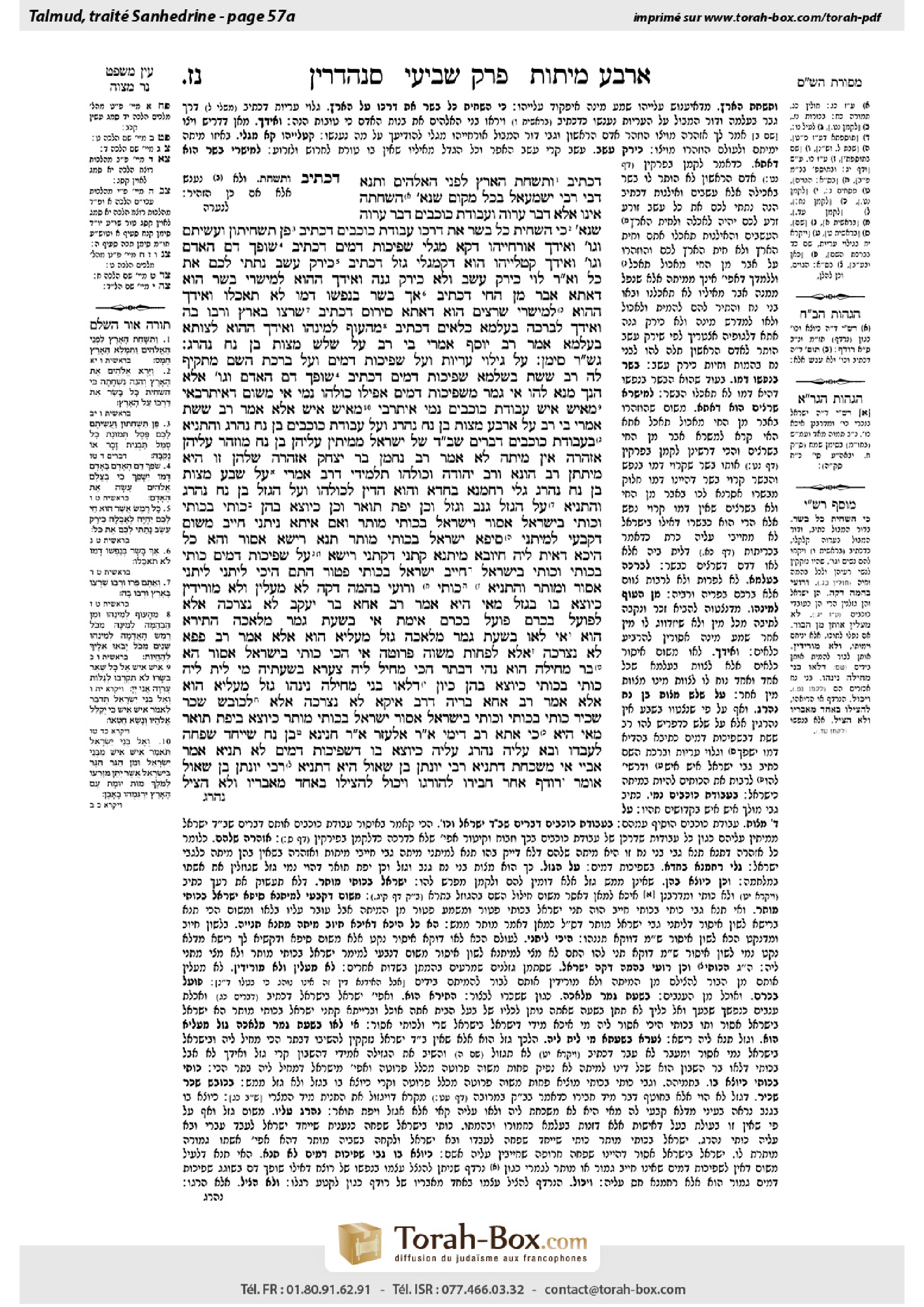
Sanhedrin 57a: Talmud study for Daf Yomi
Daf Yomi is the daily study of one Talmud folio. Explore 37 tractates with scans, Hebrew text, Sefaria English and AI-generated French translations where annotated.
Passage selection and English or AI-generated French translation are available where the scan has annotations. Daf Study is independent of Torah-Box and Sefaria.
Browse Sanhedrin · סנהדרין · All tractatesSanhedrin 57a text and translations
This page of Sanhedrin includes the Aramaic text, an English translation and an AI-generated French translation, alongside the scan above.
סנהדרין נ״ז א · Aramaic and Hebrew text
דִּכְתִיב: ״וַתִּשָּׁחֵת הָאָרֶץ לִפְנֵי הָאֱלֹהִים״. וְתָנָא דְּבֵי רַבִּי יִשְׁמָעֵאל: בְּכׇל מָקוֹם שֶׁנֶּאֱמַר הַשְׁחָתָה, אֵינוֹ אֶלָּא דְּבַר עֶרְוָה וַעֲבוֹדָה זָרָה. דָּבָר עֶרְוָה – שֶׁנֶּאֱמַר: ״כִּי הִשְׁחִית כׇּל בָּשָׂר אֶת דַּרְכּוֹ״. עֲבוֹדָה זָרָה – דִּכְתִיב: ״פֶּן תַּשְׁחִתוּן וַעֲשִׂיתֶם וְגוֹ׳״.
וְאִידָּךְ, אוֹרְחַיְיהוּ דְּקָא מְגַלֵּי.
שְׁפִיכוּת דָּמִים, דִּכְתִיב: ״שֹׁפֵךְ דַּם הָאָדָם וְגוֹ׳״. וְאִידַּךְ? קְטָלַיְיהוּ הוּא דְּקָמְגַלֵּי.
גָּזֵל, דִּכְתִיב: ״כְּיֶרֶק עֵשֶׂב נָתַתִּי לָכֶם אֶת כֹּל״. וְאָמַר רַבִּי לֵוִי: כְּיֶרֶק עֵשֶׂב, וְלֹא כְּיֶרֶק גִּנָּה. וְאִידַּךְ? הָהוּא לְמִישְׁרֵי בָּשָׂר הוּא דַּאֲתָא.
אֵבֶר מִן הַחַי, דִּכְתִיב: ״אַךְ בָּשָׂר בְּנַפְשׁוֹ דָמוֹ לֹא תֹאכֵלוּ״. וְאִידַּךְ? הָהוּא לְמִישְׁרֵי שְׁרָצִים הוּא דַּאֲתָא.
סֵירוּס, דִּכְתִיב: ״שִׁרְצוּ בָאָרֶץ וּרְבוּ בָהּ״. וְאִידַּךְ? לִבְרָכָה בְּעָלְמָא.
כִּלְאַיִם, דִּכְתִיב: ״מֵהָעוֹף לְמִינֵהוּ״. וְאִידַּךְ? הָהוּא לְצַוְתָּא בְּעָלְמָא.
אָמַר רַב יוֹסֵף: אָמְרִי בֵּי רַב, עַל שָׁלֹשׁ מִצְוֹת בֶּן נֹחַ נֶהֱרָג (גֶּשֶׁר סִימָן) – עַל גִּילּוּי עֲרָיוֹת, וְעַל שְׁפִיכוּת דָּמִים, וְעַל בִּרְכַּת הַשֵּׁם.
מַתְקֵיף לַהּ רַב שֵׁשֶׁת: בִּשְׁלָמָא שְׁפִיכוּת דָּמִים, דִּכְתִיב ״שֹׁפֵךְ דַּם הָאָדָם וְגוֹ׳״, אֶלָּא הָנָךְ מְנָא לְהוּ?
אִי גָּמַר מִשְּׁפִיכוּת דָּמִים, אֲפִילּוּ כּוּלְּהוּ נָמֵי. אִי מִשּׁוּם דְּאִיתְרַבַּאי מֵ״אִישׁ אִישׁ״, עֲבוֹדָה זָרָה נָמֵי אִיתְרַבַּי מֵ״אִישׁ אִישׁ״.
אֶלָּא אָמַר רַב שֵׁשֶׁת: אָמְרִי בֵּי רַב, עַל אַרְבַּע מִצְוֹת בֶּן נֹחַ נֶהֱרָג.
וְעַל עֲבוֹדָה זָרָה בֶּן נֹחַ נֶהֱרָג? וְהָתַנְיָא: בַּעֲבוֹדָה זָרָה, דְּבָרִים שֶׁבֵּית דִּין שֶׁל יִשְׂרָאֵל מְמִיתִין עֲלֵיהֶן – בֶּן נֹחַ מוּזְהָר עֲלֵיהֶן. אַזְהָרָה – אִין, מִיתָה – לָא! אָמַר רַב נַחְמָן בַּר יִצְחָק: אַזְהָרָה שֶׁלָּהֶן – זוֹ הִיא מִיתָתָן.
רַב הוּנָא וְרַב יְהוּדָה וְכוּלְּהוּ תַּלְמִידֵי דְּרַב אָמְרִי: עַל שֶׁבַע מִצְוֹת בֶּן נֹחַ נֶהֱרָג. גַּלִּי רַחֲמָנָא בַּחֲדָא, וְהוּא הַדִּין לְכוּלְּהוּ.
וְעַל הַגָּזֵל בֶּן נֹחַ נֶהֱרָג? וְהָתַנְיָא: עַל הַגָּזֵל, גָּנַב וְגָזַל, וְכֵן יְפַת תּוֹאַר, וְכֵן כַּיּוֹצֵא בָּהֶן – גּוֹי בְּגוֹי וְגוֹי בְּיִשְׂרָאֵל אָסוּר, וְיִשְׂרָאֵל בְּגוֹי מוּתָּר. וְאִם אִיתָא, נִיתְנֵי ״חַיָּיב״!
מִשּׁוּם דְּקָבָעֵי לְמִיתְנֵי סֵיפָא: ״יִשְׂרָאֵל בְּגוֹי מוּתָּר״, תְּנָא רֵישָׁא: ״אָסוּר״.
וְהָא כֹּל הֵיכָא דְּאִית לֵיהּ חִיּוּבָא מִיתְנָא קָתָנֵי, דְּקָתָנֵי רֵישָׁא: עַל שְׁפִיכוּת דָּמִים – גּוֹי בְּגוֹי וְגוֹי בְּיִשְׂרָאֵל חַיָּיב, יִשְׂרָאֵל בְּגוֹי פָּטוּר.
הָתָם, הֵיכִי לִיתְנֵי? לִיתְנֵי ״אָסוּר״ וּ״מוּתָּר״? וְהָתַנְיָא: גּוֹי, וְרוֹעֵי בְּהֵמָה דַּקָּה – לֹא מַעֲלִין וְלֹא מוֹרִידִין.
כַּיּוֹצֵא בּוֹ בְּגָזֵל, מַאי הִיא? אָמַר רַב אַחָא בַּר יַעֲקֹב: לֹא נִצְרְכָה אֶלָּא לְפוֹעֵל בַּכֶּרֶם.
פּוֹעֵל בַּכֶּרֶם אֵימַת? אִי בִּשְׁעַת גְּמַר מְלָאכָה – הֶתֵּירָא הוּא, אִי לָאו בִּשְׁעַת גְּמַר מְלָאכָה – גָּזֵל מְעַלְּיָא הוּא.
אֶלָּא אָמַר רַב פָּפָּא: לֹא נִצְרְכָה אֶלָּא לְפָחוֹת מִשָּׁוֶה פְּרוּטָה. אִי הָכִי, גּוֹי בְּיִשְׂרָאֵל אָסוּר? הָא בַּר מְחִילָה הוּא! נְהִי דְּבָתַר הָכִי מָחֵיל לֵיהּ, צַעֲרָא בְּשַׁעְתֵּיהּ מִי לֵית לֵיהּ?
גּוֹי בְּגוֹי כַּיּוֹצֵא בָּהֶן, כֵּיוָן דְּלָאו בְּנֵי מְחִילָה נִינְהוּ – גָּזֵל מְעַלְּיָא הוּא.
אֶלָּא, אָמַר רַב אַחָא בְּרֵיהּ דְּרַב אִיקָא: לֹא נִצְרְכָה אֶלָּא לְכוֹבֵשׁ שְׂכַר שָׂכִיר. גּוֹי בְּגוֹי וְגוֹי בְּיִשְׂרָאֵל – אָסוּר; יִשְׂרָאֵל בְּגוֹי – מוּתָּר.
כַּיּוֹצֵא בִּיפַת תּוֹאַר, מַאי הִיא? כִּי אֲתָא רַב דִּימִי, אָמַר: רַבִּי אֶלְעָזָר אָמַר רַבִּי חֲנִינָא: בֶּן נֹחַ שֶׁיִּיחֵד שִׁפְחָה לְעַבְדּוֹ וּבָא עָלֶיהָ – נֶהֱרָג עָלֶיהָ.
כַּיּוֹצֵא בּוֹ דִּשְׁפִיכוּת דָּמִים לָא תַּנְיָא. אָמַר אַבָּיֵי: אִי מַשְׁכַּחַתְּ דְּתַנְיָא, רַבִּי יוֹנָתָן בֶּן שָׁאוּל הִיא. דְּתַנְיָא, רַבִּי יוֹנָתָן בֶּן שָׁאוּל אוֹמֵר: רוֹדֵף אַחַר חֲבֵירוֹ לְהוֹרְגוֹ, וְיָכוֹל לְהַצִּילוֹ בְּאֶחָד מֵאֵבָרָיו וְלֹא הִצִּיל -
Sanhedrin 57a · English translation
as it is written: “And the earth was corrupt before God” (Genesis 6:11), presumably referring to a transgression, and the school of Rabbi Yishmael taught: Anywhere that the term corruption is stated, it is referring to nothing other than a matter of licentiousness and idol worship. The Gemara cites proofs for this claim: Corruption refers to a matter of licentiousness, as it is stated: “For all flesh had corrupted their way upon the earth” (Genesis 6:12); the word “way” alludes to sexual intercourse. And corruption also refers to idol worship, as it is written: “Lest you deal corruptly, and make you a graven image” (Deuteronomy 4:16).
The Gemara asks: And how do the other tanna’im, who do not derive from the verse “And the earth was corrupt before God” that the descendants of Noah are prohibited from engaging in idol worship and forbidden sexual relations, interpret this verse? The Gemara answers: In their opinion, the verse merely exposes the behavior of the generation of Noah.
According to the school of Menashe, the prohibition of bloodshed for the descendants of Noah is stated separately in the Torah, as it is written: “One who sheds the blood of man, by man his blood shall be shed” (Genesis 9:6). The Gemara asks: And how do the other tanna’im interpret this verse? The Gemara answers: In their opinion, the verse reveals the type of death penalty administered to the descendants of Noah, but it is not the source for the prohibition of bloodshed.
The prohibition of robbery is stated, according to the school of Menashe, as it is written: “Every moving thing that is alive shall be for food for you; like the green herbs I have given you all” (Genesis 9:3). And Rabbi Levi says: Like the green herbs that sprout all over by themselves and are ownerless, and not like the vegetation of a garden, which belongs to the garden’s owner alone. This indicates that robbery is prohibited. The Gemara asks: And how do the other tanna’im interpret this verse? The Gemara answers: In their opinion, that verse comes to permit the consumption of meat.
The prohibition against eating a limb from a living animal is stated in the Torah, as it is written: “Only flesh with its life, which is its blood, you shall not eat” (Genesis 9:4), i.e., it is prohibited to eat flesh while the animal that it comes from is still alive. And how do the other tanna’im interpret this verse? In their opinion, that verse comes to permit eating a limb from living creeping animals; this prohibition does not apply to creeping animals (see 59b).
The prohibition of castration that applies to the descendants of Noah is stated, as it is written: “And you be fruitful and multiply, swarm in the earth and multiply in it” (Genesis 9:7), indicating that nothing may be done to prevent reproduction. And the other tanna’im hold that this verse is written merely as a blessing, not as a mitzva.
The prohibition of diverse kinds that applies to the descendants of Noah is stated, as it is written: “Of the fowl after their kind and of the cattle after their kind, of every creeping thing of the ground after its kind” (Genesis 6:20), indicating that each species must be kept separate, and that crossbreeding is prohibited. And according to the other tanna’im, that verse does not indicate a mitzva; rather, the reason for keeping the species separate in Noah’s Ark was merely for the sake of companionship, as animals are most comfortable in the company of other members of their own species.
Rav Yosef says: They say in the study hall that a descendant of Noah is executed for transgressing three mitzvot, which are represented by the letters gimmel, shin, reish in a mnemonic device: For forbidden sexual relations, for bloodshed, and for blessing, i.e., cursing, the name of God.
Rav Sheshet objects to this statement: Granted, a descendant of Noah is executed for bloodshed, as it is written: “One who sheds the blood of man, by man his blood shall be shed” (Genesis 9:6). But with regard to those other prohibitions, from where do the Sages derive that a descendant of Noah who transgresses them is executed?
If they derive it from the punishment for bloodshed by means of an analogy, then descendants of Noah should be executed even if they transgressed any of the other Noahide mitzvot. If they are executed because they are included in the term “anyone” and similarly, the term “no one” stated with regard to these two prohibitions, as it is stated with regard to cursing the name of God: “Anyone who curses his God shall bear his sin” (Leviticus 24:15), and it is stated with regard to forbidden sexual relations: “No one shall approach any that is near of kin to him, to uncover their nakedness” (Leviticus 18:6), then gentiles should be executed for idol worship too, as they are included in the term “anyone” stated in that context (see Leviticus 20:2).
Rather, Rav Sheshet says that Rav Yosef’s version should be rejected, and that this is what they say in the study hall: A descendant of Noah is executed for transgressing four mitzvot; the three that were listed, and idol worship.
The Gemara asks: And is a descendant of Noah executed for idol worship? But isn’t it taught in a baraita: With regard to idol worship, matters for which a Jewish court executes the transgressor are prohibited to a descendant of Noah. The Gemara infers: Yes, there is a prohibition for a descendant of Noah, but there is no death penalty. Rav Naḥman bar Yitzḥak says: Their prohibition is their death penalty. Since the only punishment mentioned in the Torah for transgressing a Noahide mitzva is execution, any descendant of Noah who transgresses is liable to be executed.
Rav Huna, Rav Yehuda, and all of the other students of Rav say: A descendant of Noah is executed for transgressing any of the seven Noahide mitzvot; the Merciful One revealed this punishment with regard to one mitzva, the prohibition of bloodshed, and the same is true with regard to all of them.
The Gemara asks: But is a descendant of Noah executed for robbery? But isn’t it taught in a baraita: With regard to the following types of robbery: One who steals or robs, and likewise one who engages in intercourse with a married beautiful woman who was taken as a prisoner of war, and likewise all actions similar to these, if they are done by a gentile to another gentile, or by a gentile to a Jew, the action is prohibited; but if a Jew does so to a gentile, it is permitted? The Gemara explains the question: And if it is so that a gentile is liable to be executed for robbery, and it is not merely prohibited to him, let the baraita teach that he is liable to be executed.
The Gemara answers: Because the tanna wanted to teach in the latter clause that if a Jew does so to a gentile, it is permitted, he taught in the former clause that if a gentile does one of these, it is prohibited. If the baraita were to state that if a gentile does so, he is liable, it would have to state that if a Jew does so to a gentile, he is exempt, because this is the opposite of liable. That would indicate that it is actually prohibited for a Jew to do so to a gentile, and that he is merely exempt from liability, which is not the case. Therefore, the word prohibited is used with regard to a gentile. Therefore, this does not prove that a gentile is exempt from capital punishment.
The Gemara challenges: But wherever there is liability for capital punishment, this tanna teaches it; as it is taught in the first clause: With regard to bloodshed, if a gentile murders another gentile, or a gentile murders a Jew, he is liable. If a Jew murders a gentile, he is exempt. Evidently, the term liable is used in the baraita.
The Gemara answers: There, in that case, how should the tanna teach it? Should he teach it using the terms prohibited and permitted, indicating that a Jew may kill a gentile ab initio? But isn’t it taught in a baraita that with regard to a gentile, and likewise with regard to Jewish shepherds of small livestock, who were typically robbers, one may not raise them out of a pit into which they fell, and one may not lower them into a pit? In other words, one may not rescue them from danger, but neither may one kill them ab initio. With regard to robbery, the term permitted is relevant, as it is permitted for a Jew to rob a gentile.
The Gemara returns to discuss the details of the prohibition of robbery mentioned in the baraita, which included actions similar to it. The Gemara asks: With regard to robbery, to what actions similar to it is the baraita referring? Rav Aḥa bar Ya’akov says: It is necessary only to teach the halakha of a laborer working in a vineyard who eats from the fruit of the vineyard; his action is similar to robbery, and it is prohibited for a gentile to do so.
The Gemara asks: When does this laborer in a vineyard eat from the fruit? If he does so at the time of the completion of the work, i.e., while he is harvesting the fruit, it is permitted for him to do so, just as a Jew working for another Jew is allowed to do so. If it is not at the time of the completion of its work, eating the fruit is full-fledged robbery, and there is no novel element to this case.
Rather, Rav Pappa says that the mention in the baraita of actions similar to robbery is necessary only to teach the halakha of one who robs another of less than the value of one peruta. The Gemara asks: If so, why does the baraita state that it is prohibited for a gentile to do so to a Jew? Isn’t a Jew apt to forgive such a tiny debt? Why is this considered robbery? The Gemara answers: Although afterward the owner forgives him, does he not incur distress at the time of the robbery? Consequently, at the time of the robbery the robber commits a transgression and is liable to be punished for it.
The Gemara challenges: If the mention of actions similar to robbery is referring to the robbery of less than the value of one peruta, what is the novel element in the case of a gentile who robs a gentile? Since they are not apt to grant forgiveness, robbing a gentile of even a minuscule amount is considered full-fledged robbery, and not merely similar to robbery.
Rather, Rav Aḥa, son of Rav Ika, says that there is a different explanation: It is necessary only to teach the halakha of one who withholds the wages of a hired laborer; for a gentile to do so to another gentile and for a gentile to do so to a Jew is prohibited, but for a Jew to do so to a gentile is permitted. This case is less obvious than other types of robbery, as instead of taking an item from the victim, the robber withholds money that is due to the victim.
The Gemara clarifies further: What is the action that is similar to engaging in intercourse with a beautiful woman who is a prisoner of war, to which the baraita is referring? When Rav Dimi came from Eretz Yisrael to Babylonia, he said that Rabbi Elazar says that Rabbi Ḥanina says: In the case of a descendant of Noah who designated a maidservant as a mate for his slave, and then he himself engaged in intercourse with her, he is executed on her account. Although the maidservant is his property and is not the slave’s full-fledged wife, nevertheless, he is guilty of adultery.
The Gemara comments: The baraita does not teach that a descendant of Noah is liable for actions similar to bloodshed. Abaye says: If you find a baraita that teaches this, it is in accordance with the opinion of Rabbi Yonatan ben Shaul. As it is taught in a baraita that Rabbi Yonatan ben Shaul says: If a person pursues another to kill him, and the one being pursued can save himself by injuring one of the limbs of the pursuer, but he does not save himself in this manner and instead kills the pursuer,
Sanhedrin 57a · Traduction française (IA)
comme il est écrit : « Et la terre était corrompue devant Dieu » (Genèse 6,11), ce qui désigne vraisemblablement une transgression. Or, l’école de Rabbi Yishmael enseignait : partout où le terme « corruption » est employé, il ne désigne rien d’autre que la débauche et l’idolâtrie. La Guemara apporte des preuves à cette affirmation : la corruption désigne la débauche, comme il est écrit : « Car toute chair avait corrompu sa voie sur la terre » (Genèse 6,12) ; le mot « voie » fait allusion aux relations sexuelles. La corruption désigne aussi l’idolâtrie, comme il est écrit : « De peur que vous n’agissiez de façon corrompue et ne vous fassiez une statue sculptée » (Deutéronome 4,16).
La Guemara demande : comment les autres tannaïm, qui ne déduisent pas du verset « Et la terre était corrompue devant Dieu » que les descendants de Noé ont l’interdiction de pratiquer l’idolâtrie et d’avoir des relations sexuelles interdites, interprètent-ils ce verset ? La Guemara répond : selon eux, le verset ne fait que révéler le comportement de la génération de Noé.
Selon l’école de Menashé, l’interdiction du meurtre pour les descendants de Noé est énoncée séparément dans la Torah, comme il est écrit : « Celui qui verse le sang de l’homme, par l’homme son sang sera versé » (Genèse 9,6). La Guemara demande : comment les autres tannaïm interprètent-ils ce verset ? La Guemara répond : selon eux, le verset révèle le type de peine de mort infligée aux descendants de Noé, mais il ne constitue pas la source de l’interdiction du meurtre.
Selon l’école de Menashé, l’interdiction du vol est énoncée dans le verset : « Tout être vivant qui se meut sera pour vous une nourriture ; comme l’herbe verte, Je vous donne tout cela » (Genèse 9,3). Rabbi Levi dit : comme l’herbe verte qui pousse partout d’elle-même et n’appartient à personne, et non comme les plantes d’un jardin, qui appartiennent au seul propriétaire du jardin. Cela indique que le vol est interdit. La Guemara demande : comment les autres tannaïm interprètent-ils ce verset ? La Guemara répond : selon eux, ce verset vient autoriser la consommation de viande.
L’interdiction de manger un membre prélevé sur un animal vivant est énoncée dans la Torah, comme il est écrit : « Seulement, vous ne mangerez pas la chair avec son âme, c’est-à-dire son sang » (Genèse 9,4), autrement dit, il est interdit de manger de la chair tant que l’animal dont elle provient est encore vivant. Comment les autres tannaïm interprètent-ils ce verset ? Selon eux, ce verset vient autoriser la consommation d’un membre prélevé sur un être rampant vivant ; cette interdiction ne s’applique pas aux êtres rampants (voir 59b).
L’interdiction de la castration qui s’applique aux descendants de Noé est énoncée dans le verset : « Et vous, soyez féconds, multipliez-vous, pullulez sur la terre et multipliez-vous sur elle » (Genèse 9,7), ce qui indique qu’on ne peut rien faire pour empêcher la procréation. Les autres tannaïm considèrent que ce verset est simplement formulé comme une bénédiction, et non comme une mitsva.
L’interdiction des croisements qui s’applique aux descendants de Noé est énoncée dans le verset : « Les oiseaux selon leur espèce, le bétail selon son espèce, et tout être rampant du sol selon son espèce » (Genèse 6,20), ce qui indique que chaque espèce doit être tenue à l’écart des autres et que les croisements sont interdits. Selon les autres tannaïm, ce verset n’indique pas une mitsva ; les espèces devaient plutôt rester séparées dans l’arche de Noé uniquement pour leur tenir compagnie, car les animaux sont plus à l’aise avec les membres de leur propre espèce.
Rav Yossef dit : on enseigne à la maison d’étude qu’un descendant de Noé est exécuté s’il transgresse trois mitsvot, représentées par les lettres gimel, chin et rech dans un moyen mnémotechnique : les relations sexuelles interdites, le meurtre et le fait de bénir, c’est-à-dire de maudire, le nom de Dieu.
Rav Chéchet objecte à cette affirmation : il est compréhensible qu’un descendant de Noé soit exécuté pour meurtre, comme il est écrit : « Celui qui verse le sang de l’homme, par l’homme son sang sera versé » (Genèse 9,6). Mais, pour ce qui est de ces autres interdictions, d’où les Sages déduisent-ils qu’un descendant de Noé qui les transgresse est exécuté ?
S’ils le déduisent de la peine prévue pour le meurtre au moyen d’une analogie, alors les descendants de Noé devraient être exécutés même s’ils transgressent l’une quelconque des autres mitsvot noachides. S’ils sont exécutés parce qu’ils sont inclus dans le terme « quiconque », et de même dans le terme « nul », employés à propos de ces deux interdictions — comme il est écrit concernant la malédiction du nom de Dieu : « Quiconque maudit son Dieu portera sa faute » (Lévitique 24,15), et concernant les relations sexuelles interdites : « Nul ne s’approchera de sa proche parente pour découvrir sa nudité » (Lévitique 18,6) —, alors les non-Juifs devraient aussi être exécutés pour idolâtrie, puisqu’ils sont inclus dans le terme « quiconque » employé à ce propos (voir Lévitique 20,2).
Rav Chéchet dit plutôt qu’il faut rejeter la version de Rav Yossef, et que voici ce qu’on enseigne à la maison d’étude : un descendant de Noé est exécuté s’il transgresse quatre mitsvot : les trois qui ont été énumérées, ainsi que l’idolâtrie.
La Guemara demande : un descendant de Noé est-il donc exécuté pour idolâtrie ? N’est-il pas enseigné dans une baraïta : concernant l’idolâtrie, les actes pour lesquels un tribunal juif exécute le transgresseur sont interdits à un descendant de Noé. La Guemara en déduit : oui, ils lui sont interdits, mais il n’encourt pas la peine de mort. Rav Naḥman bar Yitzḥak dit : pour eux, l’interdiction constitue leur peine de mort. Puisque la seule peine mentionnée dans la Torah pour la transgression d’une mitsva noachide est l’exécution, tout descendant de Noé qui transgresse est passible d’exécution.
Rav Houna, Rav Yehouda et tous les autres élèves de Rav disent : un descendant de Noé est exécuté s’il transgresse l’une quelconque des sept mitsvot noachides ; le Miséricordieux a révélé cette peine au sujet d’une mitsva, l’interdiction du meurtre, et il en va de même pour toutes les autres.
La Guemara demande : un descendant de Noé est-il donc exécuté pour vol ? N’est-il pas enseigné dans une baraïta : concernant les formes suivantes de vol — celui qui dérobe ou vole, de même que celui qui a des relations sexuelles avec une belle femme mariée capturée comme prisonnière de guerre, et de même tous les actes semblables —, si un non-Juif les commet à l’encontre d’un autre non-Juif ou d’un Juif, l’acte est interdit ; mais si un Juif agit ainsi envers un non-Juif, c’est permis. La Guemara explique la question : s’il en est ainsi, si un non-Juif est passible d’exécution pour vol et que cet acte ne lui est pas seulement interdit, que la baraïta enseigne qu’il est passible d’exécution.
La Guemara répond : comme le tanna voulait enseigner dans la dernière partie que si un Juif agit ainsi envers un non-Juif, c’est permis, il a enseigné dans la première partie que si un non-Juif commet l’un de ces actes, c’est interdit. Si la baraïta avait indiqué que le non-Juif est passible d’exécution, elle aurait dû dire que le Juif qui agit ainsi envers un non-Juif est exempt, puisque c’est l’opposé de « passible ». Cela aurait laissé entendre qu’il est en réalité interdit à un Juif d’agir ainsi envers un non-Juif et qu’il est seulement exempt de responsabilité, ce qui n’est pas le cas. C’est pourquoi le terme « interdit » est employé au sujet d’un non-Juif. Par conséquent, cela ne prouve pas qu’un non-Juif est exempt de la peine capitale.
La Guemara objecte : pourtant, chaque fois qu’il y a passibilité de la peine capitale, ce tanna l’enseigne ainsi ; comme on l’enseigne dans la première partie : concernant le meurtre, si un non-Juif tue un autre non-Juif, ou si un non-Juif tue un Juif, il est passible. Si un Juif tue un non-Juif, il est exempt. Il est donc manifeste que le terme « passible » est employé dans la baraïta.
La Guemara répond : dans ce cas-là, comment le tanna pourrait-il l’enseigner ? Devrait-il employer les termes « interdit » et « permis », laissant entendre qu’un Juif peut tuer un non-Juif de prime abord ? Or, n’est-il pas enseigné dans une baraïta qu’on ne doit pas relever d’une fosse où il est tombé un non-Juif, ni les bergers juifs de petit bétail, qui étaient habituellement des voleurs ; et qu’on ne doit pas non plus les y précipiter ? Autrement dit, il ne faut pas les sauver du danger, mais on ne doit pas non plus les tuer de prime abord. Dans le cas du vol, le terme « permis » convient, puisqu’il est permis à un Juif de voler un non-Juif.
La Guemara revient aux détails de l’interdiction du vol mentionnée dans la baraïta, qui incluait les actes semblables. Elle demande : à quelles actions semblables au vol la baraïta fait-elle référence ? Rav Aḥa bar Yaakov dit : elle doit seulement enseigner la halakha du travailleur qui travaille dans une vigne et mange des fruits de la vigne ; son acte est semblable au vol et il est interdit à un non-Juif d’agir ainsi.
La Guemara demande : à quel moment ce travailleur dans une vigne mange-t-il des fruits ? S’il le fait au moment où le travail est achevé, c’est-à-dire pendant qu’il récolte les fruits, cela lui est permis, tout comme un Juif travaillant pour un autre Juif est autorisé à le faire. Si ce n’est pas au moment où le travail est achevé, manger les fruits constitue un véritable vol, et il n’y a là aucun élément nouveau.
Rav Pappa dit plutôt que la mention, dans la baraïta, des actes semblables au vol est nécessaire uniquement pour enseigner la halakha de celui qui vole à autrui une valeur inférieure à une perouta. La Guemara demande : dans ce cas, pourquoi la baraïta dit-elle qu’il est interdit à un non-Juif d’agir ainsi envers un Juif ? Un Juif est-il susceptible de lui pardonner une dette aussi infime ? Pourquoi cela est-il considéré comme un vol ? La Guemara répond : même si le propriétaire lui pardonne ensuite, n’éprouve-t-il pas de la détresse au moment du vol ? Par conséquent, au moment où il vole, le voleur commet une transgression et est passible d’une sanction pour cela.
La Guemara objecte : si la mention des actes semblables au vol fait référence au vol d’une valeur inférieure à une perouta, quel est l’élément nouveau dans le cas d’un non-Juif qui vole un autre non-Juif ? Puisqu’ils ne sont pas enclins à pardonner, voler à un non-Juif même une somme infime constitue un véritable vol, et non un acte simplement semblable au vol.
Rav Aḥa, fils de Rav Ika, donne plutôt une autre explication : cela doit seulement enseigner la halakha de celui qui retient le salaire d’un travailleur salarié ; il est interdit à un non-Juif d’agir ainsi envers un autre non-Juif ou envers un Juif, mais il est permis à un Juif d’agir ainsi envers un non-Juif. Ce cas est moins évident que les autres formes de vol, car au lieu de prendre un bien à la victime, le voleur retient de l’argent qui lui est dû.
La Guemara précise encore : à quelle action semblable au fait d’avoir des relations sexuelles avec une belle femme prisonnière de guerre la baraïta fait-elle référence ? Lorsque Rav Dimi vint d’Eretz Israël en Babylonie, il dit que Rabbi Elazar rapporte au nom de Rabbi Ḥanina : dans le cas d’un descendant de Noé qui a désigné une servante comme compagne pour son esclave, puis a lui-même eu des relations sexuelles avec elle, il est exécuté à cause d’elle. Bien que la servante soit sa propriété et ne soit pas véritablement l’épouse de l’esclave, il est néanmoins coupable d’adultère.
La Guemara remarque que la baraïta n’enseigne pas qu’un descendant de Noé est passible pour des actes semblables au meurtre. Abayé dit : si tu trouves une baraïta qui l’enseigne, elle est conforme à l’opinion de Rabbi Yonatan ben Shaoul. Car il est enseigné dans une baraïta que Rabbi Yonatan ben Shaoul dit : si quelqu’un poursuit une autre personne pour la tuer, et que la personne poursuivie peut se sauver en blessant l’un des membres du poursuivant, mais qu’elle ne se sauve pas de cette manière et tue plutôt le poursuivant,
Traduction française générée par IA à partir de l’édition anglaise de Sefaria. Vérifie toujours un passage avec le texte source.
Text from Sefaria: William Davidson Edition - Vocalized Aramaic (CC BY NC); William Davidson Edition - English (CC BY NC).