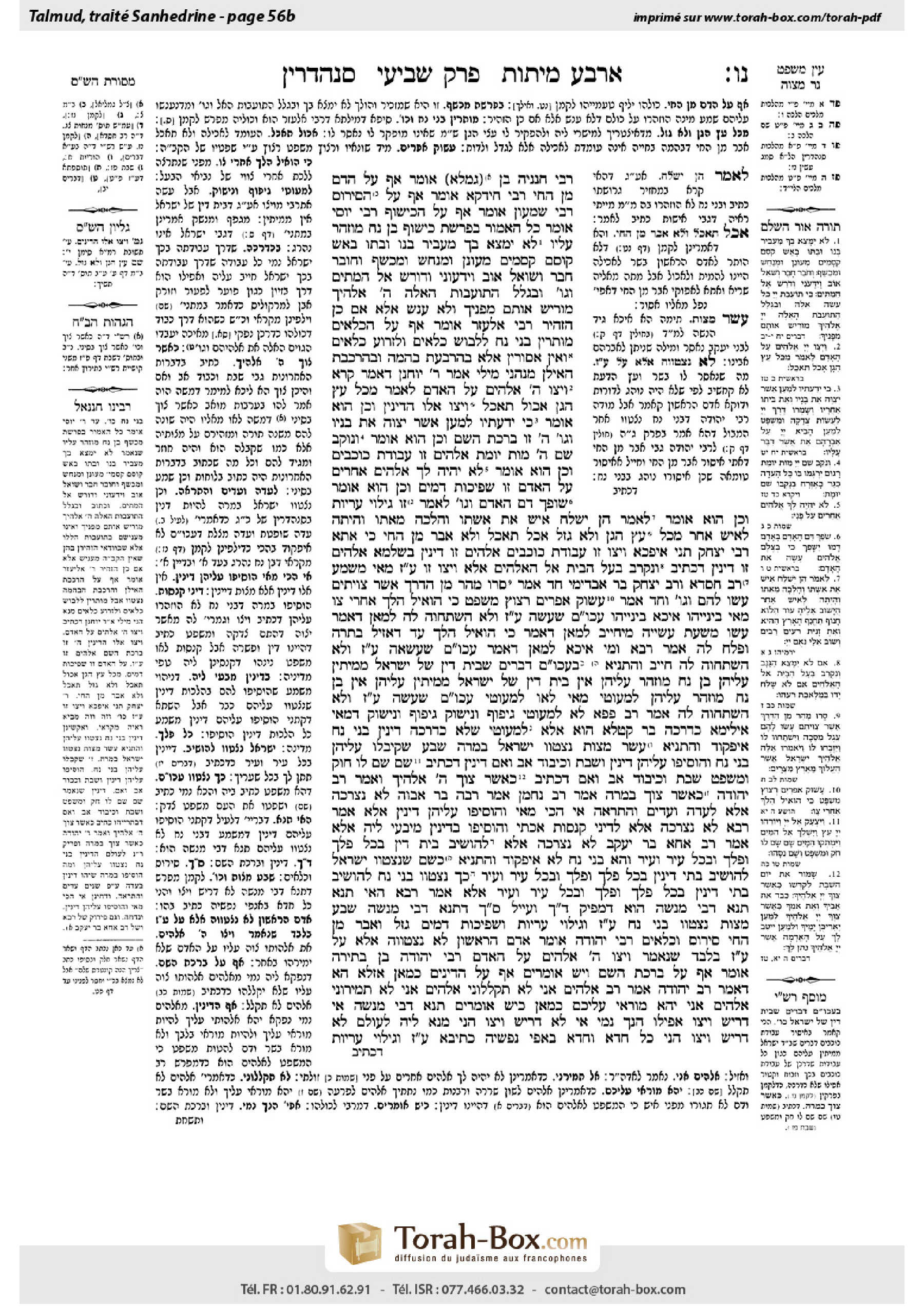
Sanhedrin 56b: Talmud study for Daf Yomi
Daf Yomi is the daily study of one Talmud folio. Explore 37 tractates with scans, Hebrew text, Sefaria English and AI-generated French translations where annotated.
Passage selection and English or AI-generated French translation are available where the scan has annotations. Daf Study is independent of Torah-Box and Sefaria.
Browse Sanhedrin · סנהדרין · All tractatesSanhedrin 56b text and translations
This page of Sanhedrin includes the Aramaic text, an English translation and an AI-generated French translation, alongside the scan above.
סנהדרין נ״ו ב · Aramaic and Hebrew text
רַבִּי חֲנַנְיָה בֶּן גַּמְלָא אוֹמֵר: אַף עַל הַדָּם מִן הַחַי. רַבִּי חִידְקָא אוֹמֵר: אַף עַל הַסֵּירוּס. רַבִּי שִׁמְעוֹן אוֹמֵר: אַף עַל הַכִּישּׁוּף.
רַבִּי יוֹסֵי אוֹמֵר: כׇּל הָאָמוּר בְּפָרָשַׁת כִּישּׁוּף – בֶּן נֹחַ מוּזְהָר עָלָיו. ״לֹא יִמָּצֵא בְךָ מַעֲבִיר בְּנוֹ וּבִתּוֹ בָּאֵשׁ קֹסֵם קְסָמִים מְעוֹנֵן וּמְנַחֵשׁ וּמְכַשֵּׁף. וְחֹבֵר חָבֶר וְשֹׁאֵל אוֹב וְיִדְּעֹנִי וְדֹרֵשׁ אֶל הַמֵּתִים וְגוֹ׳. וּבִגְלַל הַתּוֹעֵבֹת הָאֵלֶּה ה׳ אֱלֹהֶיךָ מוֹרִישׁ אוֹתָם מִפָּנֶיךָ״. וְלֹא עָנַשׁ אֶלָּא אִם כֵּן הִזְהִיר.
רַבִּי אֶלְעָזָר אוֹמֵר: אַף עַל הַכִּלְאַיִם. מוּתָּרִין בְּנֵי נֹחַ לִלְבּוֹשׁ כִּלְאַיִם וְלִזְרוֹעַ כִּלְאַיִם, וְאֵין אֲסוּרִין אֶלָּא בְּהַרְבָּעַת בְּהֵמָה וּבְהַרְכָּבַת הָאִילָן.
מְנָהָנֵי מִילֵּי? אָמַר רַבִּי יוֹחָנָן: דְּאָמַר קְרָא, ״וַיְצַו ה׳ אֱלֹהִים עַל הָאָדָם לֵאמֹר מִכֹּל עֵץ הַגָּן אָכֹל תֹּאכֵל״.
״וַיְצַו״ – אֵלּוּ הַדִּינִין, וְכֵן הוּא אוֹמֵר: ״כִּי יְדַעְתִּיו לְמַעַן אֲשֶׁר יְצַוֶּה אֶת בָּנָיו וְגוֹ׳״.
״ה׳״ – זוֹ בִּרְכַּת הַשֵּׁם, וְכֵן הוּא אוֹמֵר: ״וְנֹקֵב שֵׁם ה׳ מוֹת יוּמָת״. ״אֱלֹהִים״ – זוֹ עֲבוֹדָה זָרָה, וְכֵן הוּא אוֹמֵר: ״לֹא יִהְיֶה לְךָ אֱלֹהִים אֲחֵרִים״. ״עַל הָאָדָם״ – זוֹ שְׁפִיכוּת דָּמִים, וְכֵן הוּא אוֹמֵר: ״שֹׁפֵךְ דַּם הָאָדָם וְגוֹ׳״.
״לֵאמֹר״ – זוֹ גִּילּוּי עֲרָיוֹת, וְכֵן הוּא אוֹמֵר: ״לֵאמֹר הֵן יְשַׁלַּח אִישׁ אֶת אִשְׁתּוֹ וְהָלְכָה מֵאִתּוֹ וְהָיְתָה לְאִישׁ אַחֵר״. ״מִכֹּל עֵץ הַגָּן״ – וְלֹא גָּזֵל. ״אָכֹל תֹּאכֵל״ – וְלֹא אֵבֶר מִן הַחַי.
כִּי אֲתָא רַבִּי יִצְחָק, תָּנֵי אִיפְּכָא: ״וַיְצַו״ – זוֹ עֲבוֹדָה זָרָה, ״אֱלֹהִים״ – זוֹ דִּינִין.
בִּשְׁלָמָא ״אֱלֹהִים״ – זוֹ דִּינִין, דִּכְתִיב: ״וְנִקְרַב בַּעַל הַבַּיִת אֶל הָאֱלֹהִים״. אֶלָּא ״וַיְצַו״ – זוֹ עֲבוֹדָה זָרָה, מַאי מַשְׁמַע?
רַב חִסְדָּא וְרַב יִצְחָק בַּר אַבְדִּימִי: חַד אָמַר, ״סָרוּ מַהֵר מִן הַדֶּרֶךְ אֲשֶׁר צִוִּיתִם עָשׂוּ לָהֶם וְגוֹ׳״, וְחַד אָמַר, ״עָשׁוּק אֶפְרַיִם רְצוּץ מִשְׁפָּט כִּי הוֹאִיל הָלַךְ אַחֲרֵי צָו״.
מַאי בֵּינַיְיהוּ? אִיכָּא בֵּינַיְיהוּ: גּוֹי שֶׁעָשָׂה עֲבוֹדָה זָרָה וְלֹא הִשְׁתַּחֲוָה לָהּ. לְמַאן דְּאָמַר ״עָשׂוּ״ – מִשְּׁעַת עֲשִׂיָּיה מְחַיֵּיב. לְמַאן דְּאָמַר ״כִּי הוֹאִיל הָלַךְ״ – עַד דְּאָזֵיל בָּתְרַהּ וּפָלַח לַהּ.
אָמַר רָבָא: וּמִי אִיכָּא לְמַאן דְּאָמַר גּוֹי שֶׁעָשָׂה עֲבוֹדָה זָרָה וְלֹא הִשְׁתַּחֲוָה לָהּ – חַיָּיב? וְהָתַנְיָא: בַּעֲבוֹדָה זָרָה, דְּבָרִים שֶׁבֵּית דִּין שֶׁל יִשְׂרָאֵל מְמִיתִין עֲלֵיהֶן – בֶּן נֹחַ מוּזְהָר עֲלֵיהֶן; אֵין בֵּית דִּין שֶׁל יִשְׂרָאֵל מְמִיתִין עֲלֵיהֶן – אֵין בֶּן נֹחַ מוּזְהָר עֲלֵיהֶן. לְמַעוֹטֵי מַאי? לָאו לְמַעוֹטֵי גּוֹי שֶׁעָשָׂה עֲבוֹדָה זָרָה וְלֹא הִשְׁתַּחֲוָה לָהּ?
אָמַר רַב פָּפָּא: לָא, לְמַעוֹטֵי גִּיפּוּף וְנִישּׁוּק.
גִּיפּוּף וְנִישּׁוּק דְּמַאי? אִילֵּימָא כְּדַרְכָּהּ – בַּר קְטָלָא הוּא! אֶלָּא, לְמַעוֹטֵי שֶׁלֹּא כְּדַרְכָּהּ.
דִּינִין בְּנֵי נֹחַ אִיפְּקוּד? וְהָתַנְיָא: עֶשֶׂר מִצְוֹת נִצְטַוּוּ יִשְׂרָאֵל בְּמָרָה, שֶׁבַע שֶׁקִּיבְּלוּ עֲלֵיהֶן בְּנֵי נֹחַ, וְהוֹסִיפוּ עֲלֵיהֶן דִּינִין וְשַׁבָּת וְכִיבּוּד אָב וָאֵם.
דִּינִין, דִּכְתִיב: ״שָׁם שָׂם לוֹ חֹק וּמִשְׁפָּט״. שַׁבָּת וְכִיבּוּד אָב וָאֵם, דִּכְתִיב: ״כַּאֲשֶׁר צִוְּךָ ה׳ אֱלֹהֶיךָ״. וְאָמַר רַב יְהוּדָה: ״כַּאֲשֶׁר צִוְּךָ״ – בְּמָרָה.
אָמַר רַב נַחְמָן אָמַר רַבָּה בַּר אֲבוּהּ: לֹא נִצְרְכָה אֶלָּא לָעֵדָה, וְעֵדִים, וְהַתְרָאָה.
אִי הָכִי, מַאי ״וְהוֹסִיפוּ עֲלֵיהֶן דִּינִין״?
אֶלָּא אָמַר רָבָא: לֹא נִצְרְכָה אֶלָּא לְדִינֵי קְנָסוֹת. אַכַּתִּי, ״וְהוֹסִיפוּ בְּדִינִין״ מִיבְּעֵי לֵיהּ!
אֶלָּא אָמַר רַב אַחָא בַּר יַעֲקֹב: לֹא נִצְרְכָה אֶלָּא לְהוֹשִׁיב בֵּית דִּין בְּכׇל פֶּלֶךְ וָפֶלֶךְ, וּבְכׇל עִיר וָעִיר. וְהָא בְּנֵי נֹחַ לָא אִיפְּקוּד? וְהָתַנְיָא: כְּשֵׁם שֶׁנִּצְטַוּוּ יִשְׂרָאֵל לְהוֹשִׁיב בָּתֵּי דִינִין בְּכׇל פֶּלֶךְ וָפֶלֶךְ וּבְכׇל עִיר וָעִיר, כָּךְ נִצְטַוּוּ בְּנֵי נֹחַ לְהוֹשִׁיב בָּתֵּי דִינִין בְּכׇל פֶּלֶךְ וָפֶלֶךְ וּבְכׇל עִיר וָעִיר.
אֶלָּא אָמַר רָבָא: הַאי תַּנָּא תַּנָּא דְבֵי מְנַשֶּׁה הוּא, דְּמַפֵּיק דַּ״ךְ וְעָיֵיל סַ״ךְ.
דְּתַנָּא דְבֵי מְנַשֶּׁה: שֶׁבַע מִצְוֹת נִצְטַוּוּ בְּנֵי נֹחַ – עֲבוֹדָה זָרָה, וְגִילּוּי עֲרָיוֹת, וּשְׁפִיכוּת דָּמִים, גָּזֵל, וְאֵבֶר מִן הַחַי, סֵירוּס, וְכִלְאַיִם.
רַבִּי יְהוּדָה אוֹמֵר: אָדָם הָרִאשׁוֹן לֹא נִצְטַוָּוה אֶלָּא עַל עֲבוֹדָה זָרָה בִּלְבַד, שֶׁנֶּאֱמַר ״וַיְצַו ה׳ אֱלֹהִים עַל הָאָדָם״. רַבִּי יְהוּדָה בֶּן בְּתִירָה אוֹמֵר: אַף עַל בִּרְכַּת הַשֵּׁם. וְיֵשׁ אוֹמְרִים: אַף עַל הַדִּינִים.
כְּמַאן אָזְלָא הָא דְּאָמַר רַב יְהוּדָה אָמַר רַב: ״אֱלֹהִים אֲנִי״ – לֹא תְּקַלְּלוּנִי, ״אֱלֹהִים אֲנִי״ – לֹא תְּמִירוּנִי, ״אֱלֹהִים אֲנִי״ – יְהֵא מוֹרָאִי עֲלֵיכֶם? כְּמַאן? כְּיֵשׁ אוֹמְרִים.
וְתַנָּא דְבֵי מְנַשֶּׁה: אִי דָּרֵישׁ ״וַיְצַו״ – אֲפִילּוּ הָנָךְ נָמֵי, אִי לָא דָּרֵישׁ ״וַיְצַו״ – הָנֵי מְנָא לֵיהּ?
לְעוֹלָם לָא דָּרֵישׁ ״וַיְצַו״. הָנֵי, כֹּל חֲדָא וַחֲדָא בְּאַפֵּי נַפְשַׁהּ כְּתִיבָא: עֲבוֹדָה זָרָה וְגִילּוּי עֲרָיוֹת -
Sanhedrin 56b · English translation
Rabbi Ḥananya ben Gamla says: The descendants of Noah are also commanded concerning the prohibition against consuming the blood from a living animal. Rabbi Ḥideka says: They are also commanded concerning castration, i.e., they are prohibited to castrate any living animal. Rabbi Shimon says: They are also commanded concerning the prohibition against engaging in sorcery.
Rabbi Yosei says: With regard to every type of sorcery that is stated in the passage about sorcery, it is prohibited for a descendant of Noah to engage in it. This is derived from the verses: “When you come into the land that the Lord your God gives you, you shall not learn to do like the abominations of those nations. There shall not be found among you one who makes his son or his daughter pass through the fire, a diviner, a soothsayer, or an enchanter, or a warlock, or a charmer, or one who consults a necromancer and a sorcerer, or directs inquiries to the dead. For whoever does these things is an abomination to the Lord; and because of these abominations, the Lord your God is driving them out from before you” (Deuteronomy 18:9–12). Evidently, the Canaanites were punished for these practices; and since God would not have punished them for an action unless He first prohibited it, these practices are clearly prohibited to gentiles.
Rabbi Elazar says: The descendants of Noah were also commanded concerning the prohibition of diverse kinds. Nevertheless, it is permitted for the descendants of Noah to wear diverse kinds of wool and linen and to sow diverse kinds of seeds together, and they are prohibited only with regard to breeding diverse species of animals and grafting diverse species of trees.
§ The Gemara asks: From where are these matters, the Noahide mitzvot, derived? Rabbi Yoḥanan says: It is from that which the verse states: “And the Lord God commanded the man, saying: Of every tree of the garden you may freely eat; but from the tree of the knowledge of good and evil, you shall not eat from it, for on the day that you eat from it, you shall die” (Genesis 2:16–17).
The verse is interpreted homiletically as follows: With regard to the term “and…commanded,” these are the courts of judgment; and so it states in another verse: “For I have known him, to the end that he may command his children and his household after him, that they may keep the way of the Lord, to do righteousness and justice” (Genesis 18:19).
With regard to the term “the Lord,” this alludes to blessing the name of God; and so it states in another verse: “And he who blasphemes the name of the Lord…shall be put to death” (Leviticus 24:16). “God,” this alludes to idol worship; and so it states: “You shall have no other gods before Me” (Exodus 20:2). “The man,” this alludes to bloodshed; and so it states: “One who sheds the blood of man, by man his blood shall be shed” (Genesis 9:6).
With regard to the term “saying,” this alludes to forbidden sexual relations; and so it states: “Saying, if a man sends his wife, and she goes from him and becomes another man’s…will that land not be greatly polluted? But you have played the harlot with many lovers” (Jeremiah 3:1). “Of every tree of the garden” alludes to the fact that one may partake only of items that are permitted to him, as they belong to him, and he may not partake of stolen items. “You may freely eat” alludes to the fact that one may eat fruit, but not a limb from a living animal.
When Rav Yitzḥak came from Eretz Yisrael to Babylonia, he taught two of the expositions in the opposite order: “And…commanded,” this alludes to idol worship. “God,” this alludes to courts of judgment.
The Gemara asks: Granted, the source for the exposition: “God [Elohim],” this alludes to courts of judgment, is clear; as it is written: “Then the master of the house shall come near the judges [ha’elohim]” (Exodus 22:7). Evidently, judges are called elohim. But with regard to the exposition: “And…commanded,” this alludes to idol worship, from where is this inferred?
Rav Ḥisda and Rav Yitzḥak bar Avdimi both give answers to this question. One of them says that it is inferred from the verse: “They have turned aside quickly out of the way that I commanded them; they have made them a molten calf” (Exodus 32:8). The word “commanded” is mentioned here in the context of idol worship. And the other one says that it is inferred from the verse: “Ephraim is oppressed, crushed in justice, because he willingly went after filth [tzav]” (Hosea 5:11). The word tzav, used in this context in reference to idol worship, is the same Hebrew word used in the phrase: “And…commanded [vaytzav].”
The Gemara asks: What is the difference between these two sources? The Gemara answers: The practical difference between them is in the case of a gentile who fashioned an idol but did not bow to it, i.e., he has not yet worshipped it. According to the one who says that the proof is from the verse: “They have made them a molten calf,” he is rendered liable from the time of fashioning it. According to the one who says that the proof is from the verse: “Because he willingly went after filth,” he is not liable until he goes after it and worships it.
Rava says: And is there anyone who says that a gentile who fashioned an idol but did not bow to it is liable? But isn’t it taught in a baraita: With regard to idol worship, matters, i.e., transgressions, for which a Jewish court executes a Jew who commits one of them, are prohibited to a descendant of Noah. But with regard to transgressions for which a Jewish court does not execute a Jew who commits one of them, a descendant of Noah is not prohibited from doing them. To exclude what transgressions, i.e., to determine that they do not apply to gentiles, is this stated? Is it not to exclude the case of a gentile who fashioned an idol but did not bow to it? Since Jews are not executed for this transgression, gentiles should not be liable for this act either.
Rav Pappa says: No, it is possible that it is stated to exclude embracing and kissing the idol; neither a Jew nor a gentile who embraces or kisses an idol is liable. No proof can be brought from here with regard to a gentile who fashions an idol but does not worship it.
The Gemara asks: Embracing and kissing an idol in what manner? If we say that he did so in its standard manner of worship, i.e., that embracing and kissing is the standard method of worshipping this idol, certainly he is liable to receive the death penalty. Rather, it is stated to exclude a case where he did not do so in its standard manner of worship.
§ The Gemara asks with regard to the list of the Noahide mitzvot: Were the descendants of Noah commanded to establish courts of judgment? But isn’t it taught in a baraita: The Jewish people were commanded to observe ten mitzvot when they were in Marah: Seven that the descendants of Noah accepted upon themselves, and God added to them the following mitzvot: Judgment, and Shabbat, and honoring one’s father and mother.
The mitzva of judgment was given at Marah, as it is written with regard to Marah: “There He made for them a statute and an ordinance” (Exodus 15:25). Shabbat and honoring one’s father and mother were given at Marah, as it is written concerning them in the Ten Commandments: “Observe the day of Shabbat to keep it holy, as the Lord your God commanded you” (Deuteronomy 5:12), and similarly: “Honor your father and your mother, as the Lord your God commanded you” (Deuteronomy 5:16). The phrase “as the Lord your God commanded you” indicates that they had already been commanded to observe these mitzvot previously. And Rav Yehuda says: “As the Lord your God commanded you” in Marah. Apparently, the mitzva of establishing courts is not included in the seven Noahide mitzvot.
Rav Naḥman says that Rabba bar Avuh says: Establishing courts is a Noahide mitzva. The additional mitzva that was given in Marah was necessary only with regard to the details of the halakhot of the justice system, e.g., that a defendant in a capital case is punished only by a full panel of twenty-three judges of the Sanhedrin, and only if there are two witnesses who testify concerning him, and only if he was issued a forewarning before his transgression.
The Gemara asks: If so, and the mitzva given at Marah is a specification of the halakhot of the justice system, what is the meaning of the sentence: And God added to them: Judgment? The details of a preexisting mitzva would not be referred to as an added mitzva.
Rather, Rava says: The mitzva given at Marah was necessary only with regard to the halakhot of fines. Since these are not halakhot that pertain to the basic performance of justice, but rather concern an additional fine for the guilty party, they were not given to the descendants of Noah. The Gemara asks: According to this interpretation, the language of the baraita is still inaccurate, as it should have stated: And God added to them more halakhot of judgment.
Rather, Rav Aḥa bar Ya’akov says: It was necessary only for the additional requirement to establish a court in each and every province and in each and every city. The Gemara asks: And were the descendants of Noah not commanded with regard to this matter? But isn’t it taught in a baraita: Just as the Jewish people were commanded to establish courts in each and every province and in each and every city, so too, the descendants of Noah were commanded to establish courts in each and every province and in each and every city?
Rather, Rava says: This tanna, who holds that the mitzva of establishing courts of judgment is not included in the Noahide mitzvot, is the tanna of the school of Menashe, who removes from the list of the Noahide mitzvot two mitzvot whose mnemonic is dalet, kaf, which stands for judgment [dinim] and blessing the name of God [birkat Hashem], and inserts in their place two mitzvot whose mnemonic is samekh, kaf, standing for castration [seirus] and diverse kinds [kilayim].
As the school of Menashe taught: The descendants of Noah were commanded to observe seven mitzvot: The prohibitions of idol worship, and forbidden sexual relations, and bloodshed, and robbery, and eating a limb from a living animal, and castration, and diverse kinds.
Rabbi Yehuda says: Adam, the first man, was commanded only with regard to the prohibition of idol worship, as it is stated: “And the Lord God commanded the man” (Genesis 2:16). Rabbi Yehuda ben Beteira says: He was also commanded concerning blessing the name of God. And some say that he was also commanded concerning establishing courts of judgment.
The Gemara asks: In accordance with whose opinion is that which Rav Yehuda says that Rav says, in interpretation of the aforementioned verse: Since I am “God,” do not curse Me; since I am “God,” do not exchange Me with another god; since I am “God,” My fear shall be upon you? The Gemara answers: In accordance with whose opinion? It is in accordance with what some say, i.e., that the phrase “and the Lord God commanded the man” includes the prohibitions against cursing God’s name and idol worship, as well as the mitzva of establishing a system of law and justice, so that the fear of God will be upon the people.
The Gemara challenges: If the tanna of the school of Menashe interprets the verse “and the Lord God commanded” homiletically, even these mitzvot, cursing the name of God and establishing courts, should be included. And if he does not interpret the verse “and the Lord God commanded” homiletically, from where does he derive these seven mitzvot in his list?
The Gemara answers: Actually, he does not interpret the verse “and the Lord God commanded” homiletically, but with regard to these mitzvot in his list, each and every one of them is written separately in the Torah. The prohibitions of idol worship and forbidden sexual relations are stated,
Sanhedrin 56b · Traduction française (IA)
Rabbi Ḥananya ben Gamla dit : Les descendants de Noé sont également soumis à l’interdiction de consommer le sang d’un animal vivant. Rabbi Ḥideka dit : Ils sont également soumis à l’interdiction de castrer, c’est-à-dire qu’il leur est interdit de castrer tout animal vivant. Rabbi Shimon dit : Ils sont également soumis à l’interdiction de pratiquer la sorcellerie.
Rabbi Yosei dit : Toute forme de sorcellerie mentionnée dans le passage qui traite de la sorcellerie est interdite aux descendants de Noé. Cela se déduit des versets : « Lorsque tu arriveras dans le pays que le Seigneur ton Dieu te donne, tu n’apprendras pas à agir selon les abominations de ces nations. Qu’il ne se trouve parmi toi personne qui fasse passer son fils ou sa fille par le feu, ni devin, ni augure, ni enchanteur, ni sorcier, ni charmeur, ni personne qui consulte un nécromancien ou un sorcier, ni personne qui interroge les morts. Car quiconque agit ainsi est une abomination pour le Seigneur ; et c’est à cause de ces abominations que le Seigneur ton Dieu les chasse devant toi » (Deutéronome 18, 9-12). Il apparaît que les Cananéens furent punis pour ces pratiques ; et puisque Dieu ne les aurait pas punis pour un acte sans l’avoir d’abord interdit, ces pratiques sont manifestement interdites aux non-Juifs.
Rabbi Elazar dit : Les descendants de Noé étaient également soumis à l’interdiction des mélanges d’espèces. Néanmoins, il leur est permis de porter un mélange de laine et de lin et de semer ensemble des espèces différentes ; ils ne sont soumis à l’interdiction que lorsqu’il s’agit de croiser des espèces animales différentes et de greffer des espèces d’arbres différentes.
§ La Guemara demande : De quoi déduit-on ces règles, les mitsvot noahides ? Rabbi Yoḥanan dit : Elles se déduisent de ce que dit le verset : « Le Seigneur Dieu ordonna à l’homme, en disant : Tu peux manger de tous les arbres du jardin ; mais de l’arbre de la connaissance du bien et du mal, tu n’en mangeras pas, car le jour où tu en mangeras, tu mourras » (Genèse 2, 16-17).
Le verset est interprété de manière homilétique comme suit : Le terme « ordonna » désigne les tribunaux ; ainsi est-il dit dans un autre verset : « Car Je l’ai connu, afin qu’il ordonne à ses enfants et à sa maison après lui de garder la voie du Seigneur, en pratiquant la justice et le droit » (Genèse 18, 19).
Le terme « le Seigneur » fait allusion à la bénédiction du nom de Dieu ; ainsi est-il dit dans un autre verset : « Celui qui blasphème le nom du Seigneur […] sera mis à mort » (Lévitique 24, 16). Le terme « Dieu » fait allusion au culte des idoles ; ainsi est-il dit : « Tu n’auras pas d’autres dieux devant Moi » (Exode 20, 2). Le terme « l’homme » fait allusion à l’effusion de sang ; ainsi est-il dit : « Celui qui verse le sang de l’homme, par l’homme son sang sera versé » (Genèse 9, 6).
Le terme « en disant » fait allusion aux relations sexuelles interdites ; ainsi est-il dit : « En disant : Si un homme renvoie sa femme, qu’elle le quitte et devienne la femme d’un autre […] ce pays ne serait-il pas gravement souillé ? Or toi, tu t’es prostituée avec de nombreux amants » (Jérémie 3, 1). « De tous les arbres du jardin » fait allusion au fait qu’on ne peut consommer que ce qui nous est permis parce que cela nous appartient, et qu’on ne peut consommer des biens volés. « Tu peux manger » fait allusion au fait qu’on peut manger des fruits, mais non un membre prélevé sur un animal vivant.
Lorsque Rav Yitzḥak arriva de la terre d’Israël en Babylonie, il enseigna deux de ces interprétations dans l’ordre inverse : « ordonna » fait allusion au culte des idoles ; « Dieu » fait allusion aux tribunaux.
La Guemara demande : Certes, la source de l’interprétation selon laquelle « Dieu [Elohim] » fait allusion aux tribunaux est claire, puisqu’il est écrit : « Alors le maître de la maison s’approchera des juges [ha’elohim] » (Exode 22, 7). Il apparaît ainsi que les juges sont appelés elohim. Mais d’où déduit-on que « ordonna » fait allusion au culte des idoles ?
Rav Ḥisda et Rav Yitzḥak bar Avdimi répondent tous deux à cette question. L’un d’eux dit que cela se déduit du verset : « Ils se sont rapidement détournés de la voie que Je leur avais ordonnée ; ils se sont fait un veau de métal fondu » (Exode 32, 8). Le mot « ordonnée » est mentionné ici dans le contexte du culte des idoles. L’autre dit que cela se déduit du verset : « Éphraïm est opprimé, écrasé par le jugement, car il a volontairement suivi la souillure [tzav] » (Osée 5, 11). Le mot tzav, employé ici dans le contexte du culte des idoles, est le même mot hébreu que celui utilisé dans l’expression « ordonna [vaytzav] ».
La Guemara demande : Quelle est la différence entre ces deux sources ? La Guemara répond : La conséquence pratique de cette divergence concerne le cas d’un non-Juif qui a fabriqué une idole sans se prosterner devant elle, c’est-à-dire sans encore lui avoir rendu de culte. Selon celui qui dit que la preuve vient du verset « ils se sont fait un veau de métal fondu », il est passible dès le moment où il la fabrique. Selon celui qui dit que la preuve vient du verset « car il a volontairement suivi la souillure », il n’est passible que lorsqu’il la suit et lui rend un culte.
Rava dit : Y a-t-il vraiment quelqu’un pour dire qu’un non-Juif qui a fabriqué une idole sans se prosterner devant elle est passible ? N’est-il pas enseigné dans une baraïta : En matière de culte des idoles, les actes, c’est-à-dire les transgressions, pour lesquels un tribunal juif exécute un Juif qui en commet un sont interdits aux descendants de Noé. En revanche, les transgressions pour lesquelles un tribunal juif n’exécute pas un Juif qui en commet une ne sont pas interdites aux descendants de Noé. Quelles transgressions cette règle vient-elle exclure, c’est-à-dire déterminer qu’elles ne s’appliquent pas aux non-Juifs ? Ne vient-elle pas exclure le cas d’un non-Juif qui a fabriqué une idole sans se prosterner devant elle ? Puisque les Juifs ne sont pas exécutés pour cette transgression, les non-Juifs ne devraient pas non plus être passibles pour cet acte.
Rav Pappa dit : Non, cette règle peut venir exclure le fait d’embrasser ou de baiser une idole ; ni un Juif ni un non-Juif qui embrasse ou baise une idole n’est passible. On ne peut en tirer aucune preuve concernant un non-Juif qui fabrique une idole sans lui rendre de culte.
La Guemara demande : Dans quelles circonstances s’agit-il d’embrasser ou de baiser une idole ? Si l’on dit qu’il l’a fait selon son mode de culte habituel, c’est-à-dire que l’on adore habituellement cette idole en l’embrassant ou en la baisant, il est certainement passible de la peine de mort. Il faut donc plutôt dire que la règle vient exclure le cas où il ne l’a pas fait selon son mode de culte habituel.
§ À propos de la liste des mitsvot noahides, la Guemara demande : Les descendants de Noé ont-ils reçu l’ordre d’établir des tribunaux ? N’est-il pas enseigné dans une baraïta : Le peuple juif reçut l’ordre d’observer dix mitsvot lorsqu’il se trouvait à Marah : les sept que les descendants de Noé avaient acceptées, auxquelles Dieu ajouta les mitsvot suivantes : le droit, le Chabbat et l’honneur dû au père et à la mère.
La mitsva de justice fut donnée à Marah, comme il est écrit à propos de Marah : « Là, Il leur établit un statut et une règle » (Exode 15, 25). Le Chabbat et l’honneur dû au père et à la mère furent donnés à Marah, comme il est écrit à leur sujet dans les Dix Commandements : « Observe le jour du Chabbat pour le sanctifier, comme le Seigneur ton Dieu te l’a ordonné » (Deutéronome 5, 12), et de même : « Honore ton père et ta mère, comme le Seigneur ton Dieu te l’a ordonné » (Deutéronome 5, 16). L’expression « comme le Seigneur ton Dieu te l’a ordonné » indique qu’ils avaient déjà reçu auparavant l’ordre d’observer ces mitsvot. Rav Yehuda dit aussi : « Comme le Seigneur ton Dieu te l’a ordonné » à Marah. Il apparaît donc que la mitsva d’établir des tribunaux ne fait pas partie des sept mitsvot noahides.
Rav Naḥman dit au nom de Rabba bar Avuh : L’établissement de tribunaux est une mitsva noahide. La mitsva supplémentaire donnée à Marah était nécessaire uniquement pour préciser les détails des halakhot du système judiciaire, par exemple que l’accusé dans une affaire capitale ne soit puni que par un tribunal complet de vingt-trois juges du Sanhédrin, qu’il y ait deux témoins qui témoignent contre lui et qu’il ait reçu un avertissement avant sa transgression.
La Guemara demande : Dans ce cas, si la mitsva donnée à Marah précise les halakhot du système judiciaire, que signifie la phrase : « Et Dieu leur ajouta : le droit » ? Les détails d’une mitsva préexistante ne seraient pas désignés comme une mitsva ajoutée.
Rava dit plutôt : La mitsva donnée à Marah était nécessaire uniquement pour les halakhot relatives aux amendes. Comme celles-ci ne concernent pas l’exercice fondamental de la justice, mais imposent plutôt une amende supplémentaire au coupable, elles n’avaient pas été données aux descendants de Noé. La Guemara demande : Selon cette interprétation, la formulation de la baraïta reste inexacte, car elle aurait dû dire : « Et Dieu leur ajouta d’autres halakhot relatives au droit ».
Rav Aḥa bar Ya’akov dit plutôt : C’était nécessaire uniquement pour l’obligation supplémentaire d’établir un tribunal dans chaque province et dans chaque ville. La Guemara demande : Les descendants de Noé n’avaient-ils donc pas reçu d’ordre à ce sujet ? N’est-il pas enseigné dans une baraïta : De même que le peuple juif reçut l’ordre d’établir des tribunaux dans chaque province et dans chaque ville, de même les descendants de Noé reçurent l’ordre d’établir des tribunaux dans chaque province et dans chaque ville ?
Rava dit plutôt : Ce tanna, qui considère que la mitsva d’établir des tribunaux ne fait pas partie des mitsvot noahides, est le tanna de l’école de Menashe, qui retire de la liste des mitsvot noahides deux mitsvot dont le moyen mnémotechnique est dalet, kaf, correspondant au droit [dinim] et à la bénédiction du nom de Dieu [birkat Hashem], et leur substitue deux mitsvot dont le moyen mnémotechnique est samekh, kaf, correspondant à la castration [seirus] et aux mélanges d’espèces [kilayim].
Car l’école de Menashe enseignait : Les descendants de Noé reçurent l’ordre d’observer sept mitsvot : les interdictions du culte des idoles, des relations sexuelles interdites, de l’effusion de sang, du vol et de la consommation d’un membre prélevé sur un animal vivant, ainsi que l’interdiction de la castration et celle des mélanges d’espèces.
Rabbi Yehuda dit : Adam, le premier homme, ne reçut d’ordre que concernant l’interdiction du culte des idoles, comme il est dit : « Le Seigneur Dieu ordonna à l’homme » (Genèse 2, 16). Rabbi Yehuda ben Beteira dit : Il reçut également l’ordre de ne pas blasphémer le nom de Dieu. Certains disent qu’il reçut aussi l’ordre d’établir des tribunaux.
La Guemara demande : De quelle opinion relève ce que Rav Yehuda dit au nom de Rav, dans son interprétation du verset mentionné précédemment : Puisque Je suis « Dieu », ne Me maudis pas ; puisque Je suis « Dieu », ne Me remplace pas par un autre dieu ; puisque Je suis « Dieu », que Ma crainte soit sur vous ? La Guemara répond : De quelle opinion relève-t-il ? De celle de certains, selon qui l’expression « Le Seigneur Dieu ordonna à l’homme » comprend les interdictions de maudire le nom de Dieu et de pratiquer le culte des idoles, ainsi que la mitsva d’établir un système de droit et de justice, afin que la crainte de Dieu soit sur le peuple.
La Guemara objecte : Si le tanna de l’école de Menashe interprète de manière homilétique le verset « Le Seigneur Dieu ordonna », ces mitsvot aussi — maudire le nom de Dieu et établir des tribunaux — devraient être incluses. Et s’il n’interprète pas de manière homilétique le verset « Le Seigneur Dieu ordonna », d’où déduit-il les sept mitsvot de sa liste ?
La Guemara répond : En réalité, il n’interprète pas de manière homilétique le verset « Le Seigneur Dieu ordonna », mais chacune des mitsvot de sa liste est mentionnée séparément dans la Torah. Les interdictions du culte des idoles et des relations sexuelles interdites sont énoncées,
Traduction française générée par IA à partir de l’édition anglaise de Sefaria. Vérifie toujours un passage avec le texte source.
Text from Sefaria: William Davidson Edition - Vocalized Aramaic (CC BY NC); William Davidson Edition - English (CC BY NC).