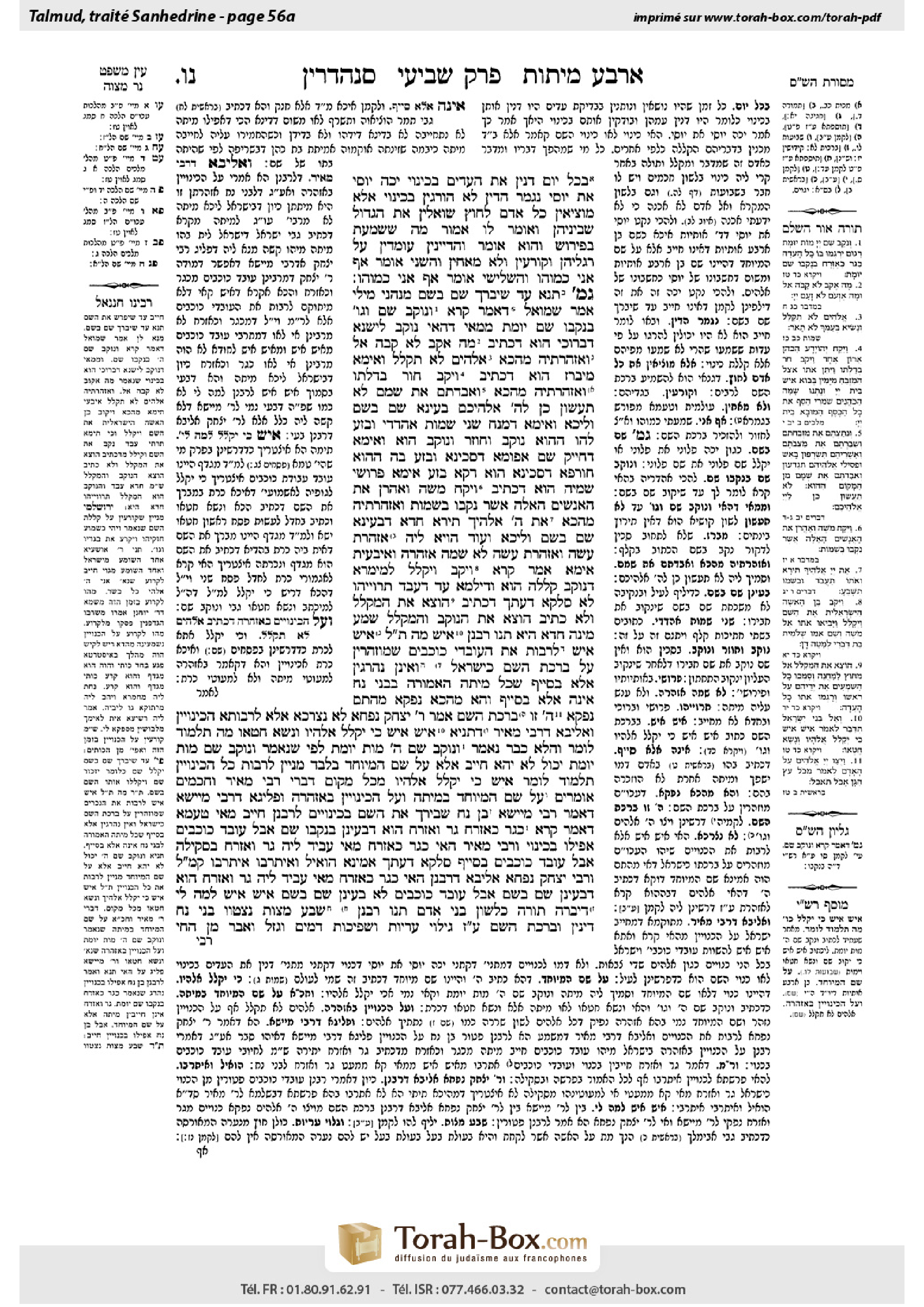
Sanhedrin 56a: Talmud study for Daf Yomi
Daf Yomi is the daily study of one Talmud folio. Explore 37 tractates with scans, Hebrew text, Sefaria English and AI-generated French translations where annotated.
Passage selection and English or AI-generated French translation are available where the scan has annotations. Daf Study is independent of Torah-Box and Sefaria.
Browse Sanhedrin · סנהדרין · All tractatesSanhedrin 56a text and translations
This page of Sanhedrin includes the Aramaic text, an English translation and an AI-generated French translation, alongside the scan above.
סנהדרין נ״ו א · Aramaic and Hebrew text
בְּכׇל יוֹם דָּנִין אֶת הָעֵדִים בְּכִינּוּי, ״יַכֶּה יוֹסִי אֶת יוֹסִי״.
נִגְמַר הַדִּין, לֹא [הָיוּ] הוֹרְגִין בְּכִינּוּי, אֶלָּא מוֹצִיאִין כׇּל אָדָם לַחוּץ. שׁוֹאֲלִין אֶת הַגָּדוֹל שֶׁבֵּינֵיהֶן וְאוֹמֵר לוֹ: ״אֱמוֹר מַה שֶׁשָּׁמַעְתָּ בְּפֵירוּשׁ״. וְהוּא אוֹמֵר, וְהַדַּיָּינִין עוֹמְדִין עַל רַגְלֵיהֶן וְקוֹרְעִין, וְלֹא מְאַחִין.
וְהַשֵּׁנִי אוֹמֵר: ״אַף אֲנִי כָּמוֹהוּ״, וְהַשְּׁלִישִׁי אוֹמֵר: ״אַף אֲנִי כָּמוֹהוּ״.
גְּמָ׳ תָּנָא: עַד שֶׁיְּבָרֵךְ שֵׁם בְּשֵׁם.
מְנָהָנֵי מִילֵּי? אָמַר שְׁמוּאֵל: דְּאָמַר קְרָא ״וְנוֹקֵב שֵׁם וְגוֹ׳ בְּנׇקְבוֹ שֵׁם יוּמָת״.
מִמַּאי דְּהַאי ״נוֹקֵב״ לִישָּׁנָא דְּבָרוֹכֵי הוּא? דִּכְתִיב: ״מָה אֶקֹּב לֹא קַבֹּה אֵל״. וְאַזְהַרְתֵּיהּ מֵהָכָא: ״אֱלֹהִים לֹא תְּקַלֵּל״.
וְאֵימָא: מִיבְרַז הוּא, דִּכְתִיב ״וַיִּקֹּב חֹר בְּדַלְתּוֹ״, וְאַזְהַרְתֵּיהּ מֵהָכָא: ״וְאִבַּדְתֶּם אֶת שְׁמָם... לֹא תַעֲשׂוּן כֵּן לַה׳ אֱלֹהֵיכֶם״?
בָּעֵינָא שֵׁם בְּשֵׁם, וְלֵיכָּא.
וְאֵימָא דְּמַנַּח שְׁנֵי שֵׁמוֹת אַהֲדָדֵי, וּבָזַע לְהוּ? הַהוּא נוֹקֵב וְחוֹזֵר וְנוֹקֵב הוּא. וְאֵימָא דְּחָיֵיק שֵׁם אַפּוּמָּא דְסַכִּינָא, וּבָזַע בַּהּ? הַהוּא חוּרְפָּא דְסַכִּינָא הוּא דְּקָא בָזַע.
אֵימָא: פָּרוֹשֵׁי שְׁמֵיהּ הוּא, דִּכְתִיב: ״וַיִּקַּח מֹשֶׁה וְאַהֲרֹן אֵת הָאֲנָשִׁים הָאֵלֶּה אֲשֶׁר נִקְּבוּ בְּשֵׁמוֹת״. וְאַזְהַרְתֵּיהּ מֵהָכָא: ״אֵת ה׳ אֱלֹהֶיךָ תִּירָא״.
חֲדָא, דְּבָעֵינָא שֵׁם בְּשֵׁם וְלֵיכָּא. וְעוֹד, הָוְיָא לֵיהּ אַזְהָרַת עֲשֵׂה, וְאַזְהָרַת עֲשֵׂה לָא שְׁמַהּ אַזְהָרָה.
וְאִיבָּעֵית אֵימָא: אָמַר קְרָא ״וַיִּקֹּב... וַיְקַלֵּל״, לְמֵימְרָא דְּנוֹקֵב קְלָלָה הוּא.
וְדִילְמָא עַד דְּעָבֵד תַּרְוַיְיהוּ? לָא סָלְקָא דַּעְתָּךְ, דִּכְתִיב: ״הוֹצֵא אֶת הַמְקַלֵּל״, וְלָא כְּתִיב: ״הוֹצֵא אֶת הַנֹּקֵב וְהַמְקַלֵּל״. שְׁמַע מִינַּהּ חֲדָא הִיא.
תָּנוּ רַבָּנַן: ״אִישׁ״ – מָה תַּלְמוּד לוֹמַר ״אִישׁ אִישׁ״? לְרַבּוֹת אֶת הַגּוֹיִם, שֶׁמּוּזְהָרִין עַל בִּרְכַּת הַשֵּׁם כְּיִשְׂרָאֵל. וְאֵינָן נֶהֱרָגִין אֶלָּא בְּסַיִיף, שֶׁכׇּל מִיתָה הָאֲמוּרָה בִּבְנֵי נֹחַ אֵינָהּ אֶלָּא בְּסַיִיף.
וְהָא מֵהָכָא נָפְקָא? מֵהָתָם נָפְקָא: ״ה׳״ – זוֹ בִּרְכַּת הַשֵּׁם.
אָמַר רַבִּי יִצְחָק נַפָּחָא: לֹא נִצְרְכָא אֶלָּא לְרַבּוֹת אֶת הַכִּינּוּיִין, וְאַלִּיבָּא דְּרַבִּי מֵאִיר.
דְּתַנְיָא: ״אִישׁ אִישׁ כִּי יְקַלֵּל אֱלֹהָיו וְנָשָׂא חֶטְאוֹ״ – מָה תַּלְמוּד לוֹמַר? וַהֲלֹא כְּבָר נֶאֱמַר: ״וְנֹקֵב שֵׁם ה׳ מוֹת יוּמָת״! לְפִי שֶׁנֶּאֱמַר ״וְנֹקֵב שֵׁם מוֹת יוּמָת״, יָכוֹל לֹא יְהֵא חַיָּיב אֶלָּא עַל שֵׁם הַמְיוּחָד בִּלְבַד? מִנַּיִין לְרַבּוֹת כָּל הַכִּינּוּיִין? תַּלְמוּד לוֹמַר: ״אִישׁ כִּי יְקַלֵּל אֱלֹהָיו״ – מִכׇּל מָקוֹם. דִּבְרֵי רַבִּי מֵאִיר.
וַחֲכָמִים אוֹמְרִים: עַל שֵׁם הַמְיוּחָד בְּמִיתָה, וְעַל הַכִּינּוּיִין בְּאַזְהָרָה.
וּפְלִיגָא דְּרַבִּי מְיָישָׁא, דְּאָמַר רַבִּי מְיָישָׁא: בֶּן נֹחַ שֶׁבֵּירַךְ אֶת הַשֵּׁם בְּכִינּוּי, לְרַבָּנַן חַיָּיב.
מַאי טַעְמָא? דְּאָמַר קְרָא: ״כַּגֵּר כָּאֶזְרָח״. גֵּר וְאֶזְרָח הוּא דְּבָעֵינַן ״בְּנׇקְבוֹ שֵׁם״, אֲבָל גּוֹי – אֲפִילּוּ בְּכִינּוּי.
וְרַבִּי מֵאִיר, הַאי ״כַּגֵּר כָּאֶזְרָח״ מַאי עָבֵיד לֵיהּ? גֵּר וְאֶזְרָח בִּסְקִילָה, אֲבָל גּוֹי בְּסַיִיף. סָלְקָא דַּעְתָּךְ אָמֵינָא: הוֹאִיל וְאִיתְרַבּוֹ, אִיתְרַבּוֹ – קָא מַשְׁמַע לַן.
וְרַבִּי יִצְחָק נַפָּחָא, אַלִּיבָּא דְּרַבָּנַן, הַאי ״כַּגֵּר כָּאֶזְרָח״ מַאי עָבֵיד לֵיהּ? גֵּר וְאֶזְרָח הוּא דְּבָעֵינַן שֵׁם בְּשֵׁם, אֲבָל גּוֹי לָא בָּעֵינַן שֵׁם בְּשֵׁם.
״אִישׁ אִישׁ״ – לְמָה לִי? דִּיבְּרָה תוֹרָה כִלְשׁוֹן בְּנֵי אָדָם.
תָּנוּ רַבָּנַן: שֶׁבַע מִצְוֹת נִצְטַוּוּ בְּנֵי נֹחַ – דִּינִין, וּבִרְכַּת הַשֵּׁם, עֲבוֹדָה זָרָה, גִּילּוּי עֲרָיוֹת, וּשְׁפִיכוּת דָּמִים, וְגָזֵל, וְאֵבֶר מִן הַחַי.
Sanhedrin 56a · English translation
On every day of a blasphemer’s trial, when the judges judge the witnesses, i.e., interrogate the witnesses, they ask the witnesses to use an appellation for the name of God, so that they do not utter a curse of God’s name. Specifically, the witnesses would say: Let Yosei smite Yosei, as the name Yosei has four letters in Hebrew, as does the Tetragrammaton.
When the judgment is over, and the court votes to deem the defendant guilty, they do not sentence him to death based on the testimony of the witnesses in which they used an appellation for the name of God, without having ever heard the exact wording of the curse. Rather, they remove all the people who are not required to be there from the court, so that the curse is not heard publicly, and the judges interrogate the eldest of the witnesses, and say to him: Say what you heard explicitly. And he says exactly what he heard. And the judges stand on their feet and make a tear in their garments, as an act of mourning for the desecration of the honor of God. And they do not ever fully stitch it back together again.
And the second witness says: I too heard as he did, but he does not repeat the curse explicitly. And the third witness, in the event that there is one, says: I too heard as he did. In this manner, the repetition of the invective sentence is limited to what is absolutely necessary.
GEMARA: The Sage taught in a baraita: A blasphemer is not liable unless he blesses, a euphemism for curses, the name of God with the name of God, e.g., by saying: Let such and such a name strike such and such a name.
The Gemara asks: From where is this matter derived? Shmuel says: It is derived from that which the verse states: “And he who blasphemes [venokev] the name of the Lord shall be put to death; all the congregation shall stone him; the convert as well as the homeborn, when he blasphemes [benokvo] the name, he shall be put to death” (Leviticus 24:16). It is derived from the repetition of the phrase “blasphemes the name” that the reference is to cursing the name of God with the name of God.
The Gemara asks: From where is it derived that this word nokev is a term for blessing, i.e., cursing? The Gemara answers that it is derived from the statement of Balaam, who was sent by Balak to curse the Jewish people: “How shall I curse [ekkov] whom God has not cursed?” (Numbers 23:8). And the prohibition against cursing God is derived from here: “You shall not curse God” (Exodus 22:27).
The Gemara asks: But say that perhaps the meaning of nokev is not cursing, but rather making a hole, as it is written: “And made a hole [vayyikkov] in its lid” (II Kings 12:10). According to this, the word nokev is referring to one who makes a hole and damages the written name of God. And the prohibition against doing so is derived from here: “And you shall destroy their name out of that place. You shall not do so to the Lord your God” (Deuteronomy 12:3–4).
The Gemara answers: It is derived from the repetition of nokev that for one to be liable, it is necessary that his transgression involve the name of God with the name of God, and such a transgression is not possible if the reference is to making a hole.
The Gemara challenges: But say that such a transgression is possible, as one can place two written names of God, one on top of the other, and tear through them at once. The Gemara explains: That would be defined as making a hole and again making a hole, not making a hole in one name by means of another name. The Gemara asks: But say that one can etch the name of God on the point of a knife and cut through another name with it. The Gemara answers: In that case, it is the point of the knife that is cutting, not the name of God.
The Gemara asks: Say that nokev means the utterance of the ineffable name of God. As it is written: “And Moses and Aaron took these men that are pointed out [nikkevu] by name” (Numbers 1:17). And the prohibition to do so is derived from here: “You shall fear the Lord, your God” (Deuteronomy 6:13).
The Gemara answers: One answer is that for one to be liable, it is necessary that his transgression involve the name of God with the name of God, and such a transgression is not possible if the reference is to uttering the ineffable name of God. Furthermore, the prohibition derived from the verse “You shall fear the Lord, your God” is a prohibition stated as a positive mitzva, and a prohibition stated as a positive mitzva is not considered a prohibition.
The Gemara presents an alternative proof that nokev is referring to cursing: And if you wish, say instead that the verse states: “And the son of the Israelite woman blasphemed [vayyikkov] the name and cursed” (Leviticus 24:11). That is to say that the meaning of nokev is to curse.
The Gemara asks: But perhaps this verse does not prove that the meaning of nokev is to curse; rather, it indicates that one is not liable to be executed unless he does both, i.e., both nokev and cursing God? The Gemara answers: This shall not enter your mind, as it is written: “Bring forth the one who cursed…and stone him” (Leviticus 24:14), and it is not written: Bring forth the nokev and one who cursed. Conclude from it that it is one act and not two.
§ The Sages taught in a baraita with regard to the verse: “Anyone who curses his God shall bear his sin” (Leviticus 24:15), that the verse could have stated: One [ish] who curses his God. Why must the verse state: “Anyone [ish ish]”? It is to include the gentiles, who are prohibited from blessing, i.e., cursing, the name of God, just like Jews are. And they are executed for this transgression by the sword alone, as all death penalties stated with regard to the descendants of Noah are by the sword alone.
The Gemara asks: But is this halakha derived from here? Rather, it is derived from there: “And the Lord God commanded the man” (Genesis 2:16), as is stated in a baraita that will soon be quoted at length: “The Lord,” this is referring to the blessing, i.e., cursing, of the name of God. This verse concerns Adam, the first man, and is therefore binding on all of humanity.
Rav Yitzḥak Nappaḥa says: The verse “anyone who curses his God” is necessary only to include gentiles who curse God using the appellations for the name of God, rather than mentioning the ineffable name, and this is in accordance with the opinion of Rabbi Meir.
As it is taught in a baraita: Why must the verse state: “Anyone who curses his God shall bear his sin”? But isn’t it already stated: “And he who blasphemes the name of the Lord shall be put to death” (Leviticus 24:16)? Rather, since it is stated: “And he who blasphemes the name of the Lord shall be put to death,” one might have thought that one will be liable only for cursing the ineffable name of God. From where is it derived that the verse includes one who curses any of the appellations as well? The verse states: “Anyone who curses his God,” to indicate that one is liable to be executed in any case. This is the statement of Rabbi Meir.
And the Rabbis say: For cursing the ineffable name of God, one is punished by death, and for cursing the appellations, one is liable to receive lashes for violating a prohibition.
The Gemara comments: And Rav Yitzḥak Nappaḥa, who holds that according to the Rabbis, gentiles are not liable for cursing appellations for the name of God, disagrees with the opinion of Rav Meyasha. As Rav Meyasha says: A descendant of Noah who blessed God by one of the appellations is liable to be executed even according to the opinion of the Rabbis.
What is the reason? It is because the verse states: “The convert as well as the homeborn, when he blasphemes the name, he shall be put to death” (Leviticus 24:16), from which it is derived that it is only in the case of a convert or a homeborn Jew that we require the condition: “When he blasphemes the name,” i.e., he is liable to be executed only if he curses the ineffable name. But a gentile is liable to be executed even due to merely cursing an appellation.
The Gemara asks: And what does Rabbi Meir do with this part of the verse: “The convert as well as the homeborn”? What does he derive from it? The Gemara answers: Rabbi Meir derives that a convert or a homeborn Jew is liable to be executed by stoning for this transgression, but a gentile is executed by the sword. This exclusion is necessary as otherwise it might enter your mind to say that since gentiles are included in the halakhot of this verse, they are included in all the halakhot of blasphemy. Therefore the verse teaches us that they are not stoned.
The Gemara asks: And what does Rav Yitzḥak Nappaḥa do with this part of the verse: “The convert as well as the homeborn,” according to the opinion of the Rabbis, since Rav Yitzḥak Nappaḥa holds that the Rabbis do not deem either a Jew or a gentile liable for cursing an appellation of God’s name? The Gemara answers: He derives that it is specifically with regard to a convert and a homeborn Jew that we require the condition that he curse a name of God by a name of God; but with regard to a gentile, we do not require that he curse a name of God by a name of God in order for him to be liable.
The Gemara asks: Why do I need the inclusive term “anyone who curses his God,” according to the opinions that do not derive from it that a gentile is liable for cursing an appellation of God’s name? The Gemara answers: No halakha is derived from it; it is not a superfluous term, as the Torah spoke in the language of people.
§ Since the halakhot of the descendants of Noah have been mentioned, a full discussion of the Noahide mitzvot is presented. The Sages taught in a baraita: The descendants of Noah, i.e., all of humanity, were commanded to observe seven mitzvot: The mitzva of establishing courts of judgment; and the prohibition against blessing, i.e., cursing, the name of God; and the prohibition of idol worship; and the prohibition against forbidden sexual relations; and the prohibition of bloodshed; and the prohibition of robbery; and the prohibition against eating a limb from a living animal.
Sanhedrin 56a · Traduction française (IA)
Chaque jour du procès d’un blasphémateur, lorsque les juges interrogent les témoins, ils leur demandent d’employer une appellation du nom de Dieu, afin qu’ils ne prononcent pas de malédiction contre le nom de Dieu. Concrètement, les témoins disent : « Que Yosse frappe Yosse », car le nom Yosse comporte quatre lettres en hébreu, comme le Tétragramme.
Lorsque le jugement est terminé et que le tribunal vote pour déclarer l’accusé coupable, il ne le condamne pas à mort sur la foi du témoignage des témoins qui ont employé une appellation du nom de Dieu, sans avoir entendu les termes exacts de la malédiction. Au contraire, on fait sortir du tribunal toutes les personnes dont la présence n’est pas nécessaire, afin que la malédiction ne soit pas entendue publiquement. Puis les juges interrogent le plus âgé des témoins et lui disent : « Dis exactement ce que tu as entendu. » Il rapporte alors mot pour mot ce qu’il a entendu. Les juges se lèvent et déchirent leurs vêtements en signe de deuil pour la profanation de l’honneur de Dieu. Ils ne recousent jamais complètement la déchirure.
Le deuxième témoin dit : « Moi aussi, j’ai entendu la même chose », mais il ne répète pas explicitement la malédiction. Le troisième témoin, s’il y en a un, dit : « Moi aussi, j’ai entendu la même chose. » Ainsi, la répétition de la phrase injurieuse est limitée au strict nécessaire.
GUEMARA : Le Sage a enseigné dans une baraïta : Un blasphémateur n’est passible de peine que s’il bénit — euphémisme pour « maudit » — le nom de Dieu au moyen du nom de Dieu, par exemple en disant : « Que tel nom frappe tel nom. »
La Guemara demande : De quoi déduit-on cette règle ? Chmouel dit : Elle se déduit de ce que dit le verset : « Celui qui blasphème [venokev] le nom du Seigneur sera mis à mort ; toute l’assemblée le lapidera ; l’étranger comme l’autochtone, lorsqu’il blasphème [benokvo] le Nom, sera mis à mort » (Lévitique 24,16). La répétition de l’expression « blasphème le Nom » enseigne qu’il s’agit de maudire le nom de Dieu au moyen du nom de Dieu.
La Guemara demande : De quoi déduit-on que le mot nokev désigne une bénédiction, c’est-à-dire une malédiction ? La Guemara répond que cela se déduit de la déclaration de Balaam, envoyé par Balak pour maudire le peuple juif : « Comment maudirais-je [ekkov] celui que Dieu n’a pas maudit ? » (Nombres 23,8). L’interdiction de maudire Dieu se déduit de ce verset : « Tu ne maudiras pas Dieu » (Exode 22,27).
La Guemara demande : Mais peut-être que nokev ne signifie pas « maudire », mais plutôt « faire un trou », comme il est écrit : « Et il fit un trou [vayyikkov] dans son couvercle » (II Rois 12,10). Selon cette interprétation, le mot nokev désigne celui qui fait un trou et endommage le nom de Dieu écrit. L’interdiction de le faire se déduit de ce verset : « Vous détruirez leur nom de cet endroit. Vous n’agirez pas ainsi envers le Seigneur votre Dieu » (Deutéronome 12,3-4).
La Guemara répond : La répétition de nokev enseigne que, pour être passible de peine, la transgression doit impliquer le nom de Dieu au moyen du nom de Dieu ; or, une telle transgression est impossible si le texte fait référence au fait de faire un trou.
La Guemara objecte : Mais peut-être une telle transgression est-elle possible : on peut superposer deux noms de Dieu écrits et les déchirer tous les deux d’un seul coup. La Guemara explique : Cela serait considéré comme « faire un trou, puis en faire un autre », et non comme faire un trou dans un nom au moyen d’un autre nom. La Guemara demande : Mais peut-être peut-on graver le nom de Dieu sur la pointe d’un couteau et s’en servir pour trancher un autre nom ? La Guemara répond : Dans ce cas, c’est la pointe du couteau qui tranche, et non le nom de Dieu.
La Guemara demande : Supposons que nokev signifie prononcer le nom ineffable de Dieu, comme il est écrit : « Moïse et Aaron prirent ces hommes désignés [nikkevu] par leur nom » (Nombres 1,17). L’interdiction de le faire se déduirait de ce verset : « Tu craindras le Seigneur, ton Dieu » (Deutéronome 6,13).
La Guemara répond : Une première réponse est que, pour être passible de peine, la transgression doit impliquer le nom de Dieu au moyen du nom de Dieu, ce qui est impossible si le texte fait référence à la prononciation du nom ineffable de Dieu. En outre, l’interdiction déduite du verset « Tu craindras le Seigneur, ton Dieu » est une interdiction formulée comme une mitsva positive, et une interdiction formulée comme une mitsva positive n’est pas considérée comme une interdiction.
La Guemara apporte une autre preuve que nokev désigne le fait de maudire : Et si tu veux, dis plutôt que le verset dit : « Le fils de la femme israélite blasphéma [vayyikkov] le Nom et le maudit » (Lévitique 24,11). Autrement dit, nokev signifie « maudire ».
La Guemara demande : Mais peut-être ce verset ne prouve-t-il pas que nokev signifie « maudire » ; il indique plutôt qu’on n’est passible de la peine de mort que si l’on fait les deux, c’est-à-dire si l’on blasphème et maudit Dieu ? La Guemara répond : Cette interprétation ne peut être retenue, car il est écrit : « Faites sortir celui qui a maudit… et lapidez-le » (Lévitique 24,14), et non : « Faites sortir celui qui a blasphémé et celui qui a maudit. » Il faut donc en conclure qu’il s’agit d’un seul acte, et non de deux.
§ Les Sages ont enseigné dans une baraïta, à propos du verset « Quiconque maudit son Dieu portera son péché » (Lévitique 24,15) : Le verset aurait pu dire : « Un homme [ish] qui maudit son Dieu. » Pourquoi dit-il « quiconque [ish ish] » ? Pour inclure les non-Juifs, à qui il est interdit de bénir — c’est-à-dire de maudire — le nom de Dieu, tout comme aux Juifs. Pour cette transgression, ils sont exécutés uniquement par le glaive, car toutes les peines de mort prévues pour les descendants de Noé sont appliquées uniquement par le glaive.
La Guemara demande : Mais cette halakha se déduit-elle de ce verset ? Elle se déduit plutôt de celui-ci : « Le Seigneur Dieu donna cet ordre à l’homme » (Genèse 2,16), comme l’enseigne une baraïta qui sera bientôt citée en détail : « Le Seigneur » fait référence à la bénédiction — c’est-à-dire à la malédiction — du nom de Dieu. Ce verset concerne Adam, le premier homme, et s’applique donc à toute l’humanité.
Rav Yits’hak Nappa’ha dit : Le verset « Quiconque maudit son Dieu » n’est nécessaire que pour inclure les non-Juifs qui maudissent Dieu en employant des appellations du nom de Dieu plutôt que le nom ineffable ; cela correspond à l’opinion de Rabbi Meïr.
Comme il est enseigné dans une baraïta : Pourquoi le verset dit-il : « Quiconque maudit son Dieu portera son péché » ? N’est-il pas déjà écrit : « Celui qui blasphème le nom du Seigneur sera mis à mort » (Lévitique 24,16) ? Or, puisque le verset dit : « Celui qui blasphème le nom du Seigneur sera mis à mort », on aurait pu penser qu’on n’est passible de peine que pour avoir maudit le nom ineffable de Dieu. De quoi déduit-on que le verset inclut aussi celui qui maudit une quelconque appellation ? Le verset dit : « Quiconque maudit son Dieu », ce qui indique qu’on est passible de la peine de mort dans tous les cas. Telle est l’opinion de Rabbi Meïr.
Les Rabbins, eux, disent : Pour avoir maudit le nom ineffable de Dieu, on est puni de mort ; pour avoir maudit les appellations, on est passible de la flagellation pour avoir enfreint une interdiction.
La Guemara fait remarquer : Rav Yits’hak Nappa’ha, qui soutient que, selon les Rabbins, les non-Juifs ne sont pas passibles de peine pour avoir maudit des appellations du nom de Dieu, est en désaccord avec l’opinion de Rav Meyasha. Car Rav Meyasha dit : Un descendant de Noé qui bénit Dieu en employant l’une des appellations est passible de la peine de mort, même selon l’opinion des Rabbins.
Pour quelle raison ? Parce que le verset dit : « L’étranger comme l’autochtone, lorsqu’il blasphème le Nom, sera mis à mort » (Lévitique 24,16). On en déduit que c’est uniquement dans le cas d’un converti ou d’un Juif de naissance que nous exigeons la condition « lorsqu’il blasphème le Nom », c’est-à-dire qu’il n’est passible de la peine de mort que s’il maudit le nom ineffable. Mais un non-Juif est passible de la peine de mort même pour avoir simplement maudit une appellation.
La Guemara demande : Et que fait Rabbi Meïr de cette partie du verset : « L’étranger comme l’autochtone » ? Qu’en déduit-il ? La Guemara répond : Rabbi Meïr en déduit qu’un converti ou un Juif de naissance est passible de la lapidation pour cette transgression, tandis qu’un non-Juif est exécuté par le glaive. Cette exclusion est nécessaire, car autrement on aurait pu penser que, puisque les non-Juifs sont inclus dans les règles de ce verset, ils sont inclus dans toutes les règles relatives au blasphème. Le verset nous enseigne donc qu’ils ne sont pas lapidés.
La Guemara demande : Et que fait Rav Yits’hak Nappa’ha de cette partie du verset, « l’étranger comme l’autochtone », selon l’opinion des Rabbins, puisque Rav Yits’hak Nappa’ha soutient que, selon les Rabbins, ni un Juif ni un non-Juif ne sont passibles de peine pour avoir maudit une appellation du nom de Dieu ? La Guemara répond : Il en déduit que c’est uniquement dans le cas d’un converti ou d’un Juif de naissance que nous exigeons qu’il maudisse un nom de Dieu au moyen d’un nom de Dieu ; dans le cas d’un non-Juif, nous n’exigeons pas qu’il maudisse un nom de Dieu au moyen d’un nom de Dieu pour qu’il soit passible de peine.
La Guemara demande : Pourquoi l’expression inclusive « quiconque maudit son Dieu » est-elle nécessaire, selon les opinions qui n’en déduisent pas qu’un non-Juif est passible de peine pour avoir maudit une appellation du nom de Dieu ? La Guemara répond : On n’en déduit aucune halakha ; cette expression n’est pas superflue, car la Torah s’est exprimée dans le langage des hommes.
§ Puisque les halakhot des descendants de Noé ont été mentionnées, une discussion complète des mitsvot noahides est présentée. Les Sages ont enseigné dans une baraïta : Les descendants de Noé, c’est-à-dire toute l’humanité, ont reçu l’ordre d’observer sept mitsvot : la mitsva d’établir des tribunaux ; l’interdiction de bénir — c’est-à-dire de maudire — le nom de Dieu ; l’interdiction du culte idolâtre ; l’interdiction des relations sexuelles prohibées ; l’interdiction du meurtre ; l’interdiction du vol ; et l’interdiction de manger un membre arraché à un animal vivant.
Traduction française générée par IA à partir de l’édition anglaise de Sefaria. Vérifie toujours un passage avec le texte source.
Text from Sefaria: William Davidson Edition - Vocalized Aramaic (CC BY NC); William Davidson Edition - English (CC BY NC).