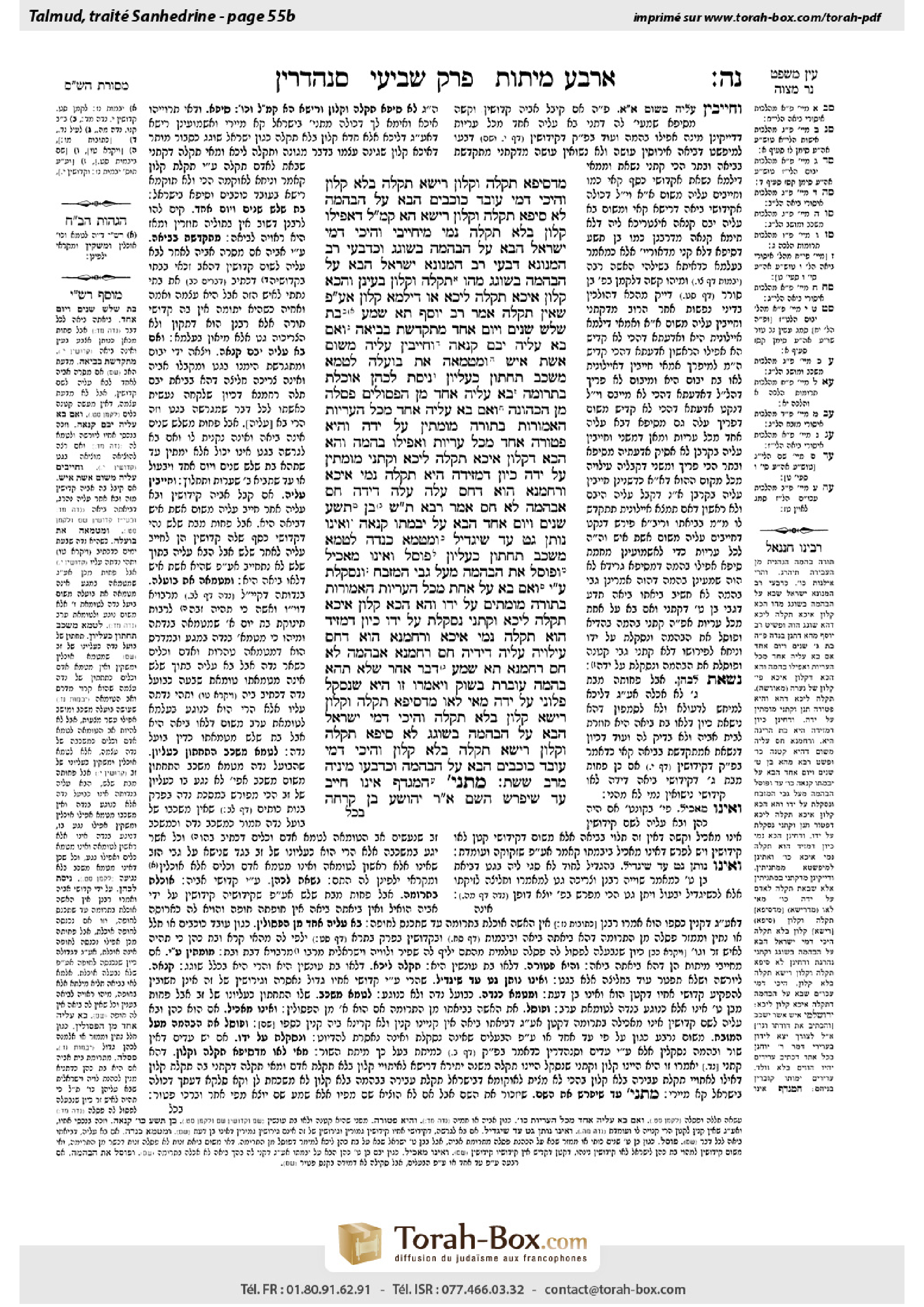
Sanhedrin 55b: Talmud study for Daf Yomi
Daf Yomi is the daily study of one Talmud folio. Explore 37 tractates with scans, Hebrew text, Sefaria English and AI-generated French translations where annotated.
Passage selection and English or AI-generated French translation are available where the scan has annotations. Daf Study is independent of Torah-Box and Sefaria.
Browse Sanhedrin · סנהדרין · All tractatesSanhedrin 55b text and translations
This page of Sanhedrin includes the Aramaic text, an English translation and an AI-generated French translation, alongside the scan above.
סנהדרין נ״ה ב · Aramaic and Hebrew text
מִדְּסֵיפָא תַּקָּלָה וְקָלוֹן, רֵישָׁא תַּקָּלָה בְּלֹא קָלוֹן. וְהֵיכִי דָּמֵי? גּוֹי הַבָּא עַל הַבְּהֵמָה.
לָא, סֵיפָא תַּקָּלָה וְקָלוֹן. רֵישָׁא הָא קָא מַשְׁמַע לַן: דַּאֲפִילּוּ קָלוֹן בְּלֹא תַּקָּלָה נָמֵי מִחַיְּיבִי. וְהֵיכִי דָּמֵי? יִשְׂרָאֵל הַבָּא עַל הַבְּהֵמָה בְּשׁוֹגֵג, וְכִדְבָעֵי רַב הַמְנוּנָא.
דְּבָעֵי רַב הַמְנוּנָא: יִשְׂרָאֵל הַבָּא עַל הַבְּהֵמָה בְּשׁוֹגֵג, מַהוּ? תַּקָּלָה וְקָלוֹן בָּעֵינַן, וְהָכָא קָלוֹן אִיכָּא, תַּקָּלָה לֵיכָּא? אוֹ דִילְמָא קָלוֹן, אַף עַל פִּי שֶׁאֵין תַּקָּלָה?
אָמַר רַב יוֹסֵף: תָּא שְׁמַע, בַּת שָׁלֹשׁ שָׁנִים וְיוֹם אֶחָד מִתְקַדֶּשֶׁת בְּבִיאָה, וְאִם בָּא עָלֶיהָ יָבָם קְנָאָהּ, וְחַיָּיבִין עָלֶיהָ מִשּׁוּם אֵשֶׁת אִישׁ.
וּמְטַמְּאָה אֶת בּוֹעֲלָהּ, לְטַמֵּא מִשְׁכָּב תַּחְתּוֹן כְּעֶלְיוֹן. נִיסֵּת לְכֹהֵן – אוֹכֶלֶת בִּתְרוּמָה. בָּא עָלֶיהָ אֶחָד מִן הַפְּסוּלִים – פְּסָלָהּ מִן הַכְּהוּנָּה.
וְאִם בָּא עָלֶיהָ אֶחָד מִכׇּל הָעֲרָיוֹת הָאֲמוּרוֹת בְּתוֹרָה, מוּמָתִין עַל יָדָהּ, וְהִיא פְּטוּרָה.
אֶחָד מִכׇּל עֲרָיוֹת, וַאֲפִילּוּ בְּהֵמָה. וְהָא הָכָא דְּקָלוֹן אִיכָּא, תַּקָּלָה לֵיכָּא, וְקָתָנֵי: מוּמָתִין עַל יָדָהּ.
כֵּיוָן דִּמְזִידָה הִיא, תַּקָּלָה נָמֵי אִיכָּא, וְרַחֲמָנָא הוּא דְּחָס עֲלַהּ. עֲלַהּ דִּידַהּ חָס, אַבְּהֵמָה לָא חָס.
אָמַר רָבָא: תָּא שְׁמַע, בֶּן תֵּשַׁע שָׁנִים וְיוֹם אֶחָד הַבָּא עַל יְבִמְתּוֹ – קְנָאָהּ, וְאֵינוֹ נוֹתֵן גֵּט עַד שֶׁיַּגְדִּיל. וּמְטַמֵּא כְּנִדָּה לְטַמֵּא מִשְׁכָּב תַּחְתּוֹן כְּעֶלְיוֹן.
פּוֹסֵל וְאֵינוֹ מַאֲכִיל, וּפוֹסֵל אֶת הַבְּהֵמָה מֵעַל גַּבֵּי הַמִּזְבֵּחַ, וְנִסְקֶלֶת עַל יָדוֹ. וְאִם בָּא עַל אַחַת מִכׇּל הָעֲרָיוֹת הָאֲמוּרוֹת בְּתוֹרָה, מוּמָתִים עַל יָדוֹ.
וְהָא הָכָא קָלוֹן אִיכָּא, תַּקָּלָה לֵיכָּא, וְקָתָנֵי: נִסְקֶלֶת עַל יָדוֹ.
כֵּיוָן דְּמֵזִיד הוּא, תַּקָּלָה נָמֵי אִיכָּא, וְרַחֲמָנָא הוּא דְּחָס עִילָּוֵיהּ. עֲלֵיהּ דִּידֵיהּ חָס רַחֲמָנָא, אַבְּהֵמָה לָא חָס רַחֲמָנָא.
תָּא שְׁמַע: דָּבָר אַחֵר, שֶׁלֹּא תְּהֵא בְּהֵמָה עוֹבֶרֶת בַּשּׁוּק וְיֹאמְרוּ: ״זוֹ הִיא שֶׁנִּסְקַל פְּלוֹנִי עַל יָדָהּ״. מַאי לָאו, מִדְּסֵיפָא תַּקָּלָה וְקָלוֹן, רֵישָׁא קָלוֹן בְּלֹא תַּקָּלָה? וְהֵיכִי דָּמֵי? יִשְׂרָאֵל הַבָּא עַל הַבְּהֵמָה בְּשׁוֹגֵג.
לָא, סֵיפָא תַּקָּלָה וְקָלוֹן, רֵישָׁא תַּקָּלָה בְּלֹא קָלוֹן. וְהֵיכִי דָּמֵי? גּוֹי הַבָּא עַל הַבְּהֵמָה, וּכְדִבְעוֹ מִינֵּיהּ מֵרַב שֵׁשֶׁת.
מַתְנִי׳ הַמְגַדֵּף אֵינוֹ חַיָּיב עַד שֶׁיְּפָרֵשׁ הַשֵּׁם. אָמַר רַבִּי יְהוֹשֻׁעַ בֶּן קׇרְחָה:
Sanhedrin 55b · English translation
evident from the fact that the latter clause of the mishna includes two reasons for the killing of the animal, namely both the calamity and the shame caused by the animal, that the first clause, the first reason stated in the mishna, is referring to a case of a calamity without shame? And what are the circumstances of a calamity without shame? It is the case of a gentile who engages in intercourse with an animal. In that case there is a calamity, as the gentile is executed, but his shame is not the concern of the Jewish court.
The Gemara rejects this proof: No. The latter clause is referring to a case of both a calamity and shame, but this first clause teaches us that even in a case where there is a circumstance of shame alone without the calamity of execution, the court is obligated to kill the animal. Although the mishna employs the term: Calamity, it is possible that this is referring to the calamity of the transgression, not the execution of the transgressor. And what are the circumstances of this case? It is a case of a Jew who unwittingly engages in intercourse with an animal, and this is just like the case about which Rav Hamnuna raises a dilemma.
As Rav Hamnuna raises a dilemma: With regard to a Jew who unwittingly engages in intercourse with an animal, what is the halakha? Is the animal stoned to death? Do we need both a calamity and shame in order to put it to death, and therefore here the animal is not killed, as there is shame, but there is no calamity of execution, or perhaps shame is enough, even if there is no calamity?
Rav Yosef says: Come and hear a resolution from a mishna (Nidda 44b): A girl who is three years and one day old whose father arranged her betrothal is betrothed with intercourse, as the legal status of intercourse with her is that of full-fledged intercourse. And in a case where the childless husband of a girl who is three years and one day old dies, if his brother, the yavam, engages in intercourse with her, he acquires her as his wife; and if she is married, a man other than her husband is liable for engaging in intercourse with her due to the prohibition of intercourse with a married woman.
The mishna continues: And if she is impure due to menstruation, she transmits impurity to one who engages in intercourse with her, who then renders all the items designated for lying beneath him impure like the items designated for lying above him. If she marries a priest, she may partake of teruma like any other wife of a priest. If she is unmarried and one of the men who are unfit for the priesthood, e.g., a mamzer or ḥalal, engages in intercourse with her, he has disqualified her from marrying into the priesthood, and if she is the daughter of a priest, she is disqualified from partaking of teruma.
The mishna continues: And if one of any of those with whom relations are forbidden, who are stated in the Torah, engaged in intercourse with her, e.g., her father or father-in-law, they are executed by the court for engaging in intercourse with her, and she is exempt because she is a minor.
The Gemara infers: One of any of those with whom relations are forbidden apparently includes even an animal. And here, there is shame but there is no calamity, as she is not executed due to her status as a minor, and yet the mishna teaches: They are executed for engaging in intercourse with her. Evidently, the animal is killed.
The Gemara rejects this proof: Since she committed this transgression intentionally, there is a calamity as well, and it is the Merciful One who has pity on her due to her young age, and exempts her from punishment. And although the Merciful One has pity on her, He does not have pity on the animal. Therefore, it cannot be proven from here that shame without a calamity is sufficient cause for the animal to be put to death, because calamity is present in this case.
Rava says: Come and hear a proof from the subsequent mishna (Nidda 45a): With regard to a boy who is nine years and one day old, whose brother died childless, and who engaged in intercourse with his yevama, his brother’s widow, the status of the intercourse is that of full-fledged intercourse and he has acquired her as his wife, but if he chooses to end the marriage, he cannot give her a bill of divorce until he reaches majority. And he becomes ritually impure like a menstruating woman after engaging in intercourse with her, and then renders all the items designated for lying beneath him impure like the items designated for lying above him.
The mishna continues: If he is disqualified from the priesthood and engages in intercourse with the daughter of a priest, he disqualifies her from partaking of teruma; but if he is a priest who marries an Israelite woman, he does not enable her to partake of teruma. And if he engages in intercourse with an animal, he disqualifies the animal from being sacrificed upon the altar, and the animal is stoned on the basis of intercourse with him. And if he engaged in intercourse with one of any of those with whom relations are forbidden, who are stated in the Torah, they are executed by the court on the basis of intercourse with him, but he is exempt.
The Gemara infers: And here, in a case where he engages in intercourse with an animal, there is shame, but there is no calamity, and yet the mishna teaches that the animal is stoned on the basis of intercourse with him, indicating that shame is sufficient for the animal to be killed.
The Gemara rejects this proof: Since he committed this transgression intentionally, there is a calamity as well, and it is the Merciful One who has pity on him due to his minority. Although the Merciful One has pity on him, the Merciful One does not have pity on the animal. Therefore, it cannot be proven from here that shame without a calamity is sufficient cause for the animal to be put to death, because calamity is present in this case.
The Gemara suggests: Come and hear a resolution from the mishna (54a): Alternatively, it is so that this animal will not pass through the marketplace, and those who see it will say: This is the animal because of which so-and-so was stoned. What, is it not evident from the fact that the latter clause of the mishna includes two reasons for the killing of the animal, namely both the calamity and the shame caused by the animal, that the first clause, the first reason stated in the mishna, is referring to a case of shame without a calamity? And what are the circumstances of shame without a calamity? It is the case of a Jew who unwittingly engages in intercourse with an animal.
The Gemara rejects this proof: No, perhaps the latter clause is referring to a case where there is both a calamity and shame, while the first clause is referring to a case where there is a calamity without shame. And what are the circumstances of a calamity without shame? It is the case of a gentile who engages in intercourse with an animal, as the students asked Rav Sheshet. The dilemma is left unresolved. No conclusive answer can be inferred from the mishna for either this dilemma or for the dilemma raised by the students of Rav Sheshet.
MISHNA: One who blasphemes, i.e., one who curses God, is not liable unless he utters the name of God and curses it. Rabbi Yehoshua ben Korḥa said:
Sanhedrin 55b · Traduction française (IA)
Cela est évident du fait que la dernière clause de la Michna inclut deux raisons pour l'abattage de l'animal, à savoir à la fois le désastre et la honte causés par l'animal, que la première clause, la première raison énoncée dans la Michna, fait référence à un cas de désastre sans honte ? Et quelles sont les circonstances d'un désastre sans honte ? Il s'agit du cas d'un non-Juif qui a des rapports sexuels avec un animal. Dans ce cas, il y a un désastre, car le non-Juif est exécuté, mais sa honte n'est pas du ressort du tribunal juif.
La Guemara rejette cette preuve : Non. La dernière clause fait référence à un cas où il y a à la fois un désastre et une honte, mais cette première clause nous enseigne que même dans un cas où il y a une circonstance de honte seule, sans le désastre de l'exécution, le tribunal est obligé d'abattre l'animal. Bien que la Michna emploie le terme : Désastre, il est possible que cela fasse référence au désastre de la transgression, et non à l'exécution du transgresseur. Et quelles sont les circonstances de ce cas ? Il s'agit d'un Juif qui a involontairement des rapports sexuels avec un animal, et cela est tout à fait comparable au cas sur lequel Rav Hamnuna soulève un dilemme.
Car Rav Hamnuna soulève un dilemme : Concernant un Juif qui a involontairement des rapports sexuels avec un animal, quelle est la halakha ? L'animal est-il lapidé à mort ? Avons-nous besoin à la fois d'un désastre et d'une honte pour le mettre à mort, et par conséquent ici l'animal n'est pas abattu, car il y a honte, mais il n'y a pas de désastre d'exécution, ou peut-être que la honte suffit, même s'il n'y a pas de désastre ?
Rav Yosef dit : Venez entendre une résolution à partir d'une Michna (Nidda 44b) : Une fille âgée de trois ans et un jour dont le père a arrangé ses fiançailles est fiancée par le rapport sexuel, car le statut juridique du rapport sexuel avec elle est celui d'un rapport sexuel pleinement à part entière. Et dans un cas où le mari sans enfant d'une fille âgée de trois ans et un jour meurt, si son frère, le yavam, a des rapports sexuels avec elle, il l'acquiert comme épouse ; et si elle est mariée, un homme autre que son mari est passible de peine pour avoir eu des rapports sexuels avec elle en raison de l'interdiction des rapports sexuels avec une femme mariée.
La Michna continue : Et si elle est impure en raison de ses règles, elle transmet l'impureté à celui qui a des rapports sexuels avec elle, qui rend alors impurs tous les objets destinés à être placés sous lui, de la même manière que les objets destinés à être placés au-dessus de lui. Si elle épouse un prêtre, elle peut consommer la terouma comme toute autre épouse d'un prêtre. Si elle est célibataire et que l'un des hommes inaptes au sacerdoce, par exemple un mamzer ou un ḥalal, a des rapports sexuels avec elle, il l'a rendue inapte à épouser dans le sacerdoce, et si elle est la fille d'un prêtre, elle est inapte à consommer la terouma.
La Michna continue : Et si l'un de ceux avec qui les relations sont interdites, qui sont énumérés dans la Torah, a eu des rapports sexuels avec elle, par exemple son père ou son beau-père, ils sont exécutés par le tribunal pour avoir eu des rapports sexuels avec elle, et elle est exemptée car elle est mineure.
La Guemara en déduit : L'un de ceux avec qui les relations sont interdites inclut apparemment même un animal. Et ici, il y a honte, mais il n'y a pas de calamité, car elle n'est pas exécutée en raison de son statut de mineure, et pourtant la Michna enseigne : Ils sont exécutés pour avoir eu des rapports sexuels avec elle. Évidemment, l'animal est abattu.
La Guemara rejette cette preuve : Puisqu'elle a commis cette transgression intentionnellement, il y a aussi une calamité, et c'est le Tout-Puissant qui a pitié d'elle en raison de son jeune âge, et l'exempte de punition. Et bien que le Tout-Puissant ait pitié d'elle, Il n'a pas pitié de l'animal. Par conséquent, il ne peut pas être prouvé ici que la honte sans calamité est une cause suffisante pour que l'animal soit mis à mort, car la calamité est présente dans ce cas.
Rava dit : Venez entendre une preuve à partir de la Michna suivante (Nidda 45a) : Concernant un garçon âgé de neuf ans et un jour, dont le frère est mort sans enfant, et qui a eu des rapports sexuels avec sa yevama, la veuve de son frère, le statut des rapports sexuels est celui de rapports sexuels pleinement à part entière et il l'a acquise comme épouse, mais s'il choisit de mettre fin au mariage, il ne peut pas lui donner un acte de divorce jusqu'à ce qu'il atteigne la majorité. Et il devient rituellement impur comme une femme en période de règles après avoir eu des rapports sexuels avec elle, et rend alors impurs tous les objets destinés à être placés sous lui, de la même manière que les objets destinés à être placés au-dessus de lui.
La Michna continue : S'il est inapte au sacerdoce et a des rapports sexuels avec la fille d'un prêtre, il la rend inapte à consommer la terouma ; mais s'il est un prêtre qui épouse une femme israélite, il ne lui permet pas de consommer la terouma. Et s'il a des rapports sexuels avec un animal, il rend l'animal inapte à être sacrifié sur l'autel, et l'animal est lapidé en raison des rapports sexuels avec lui. Et s'il a eu des rapports sexuels avec l'une de celles avec qui les relations sont interdites, comme c'est énoncé dans la Torah, elles sont exécutées par le tribunal en raison des rapports sexuels avec lui, mais il est exempté.
La Guemara en déduit : Et ici, dans un cas où il a des rapports sexuels avec un animal, il y a honte, mais il n'y a pas de calamité, et pourtant la Michna enseigne que l'animal est lapidé en raison des rapports sexuels avec lui, indiquant que la honte est suffisante pour que l'animal soit mis à mort.
La Guemara rejette cette preuve : Puisqu'il a commis cette transgression intentionnellement, il y a aussi une calamité, et c'est le Tout-Puissant qui a pitié de lui en raison de sa minorité. Bien que le Tout-Puissant ait pitié de lui, le Tout-Puissant n'a pas pitié de l'animal. Par conséquent, il ne peut pas être prouvé ici que la honte sans calamité est une cause suffisante pour que l'animal soit mis à mort, car la calamité est présente dans ce cas.
La Guemara suggère : Venez écouter une résolution tirée de la Michna (54a) : Ou bien, c'est afin que cet animal ne passe pas par le marché, et que ceux qui le verront disent : C'est l'animal à cause duquel untel a été lapidé. Quoi, n'est-il pas évident, du fait que la dernière clause de la Michna inclut deux raisons pour l'abattage de l'animal, à savoir à la fois le désastre et la honte causés par l'animal, que la première clause, la première raison énoncée dans la Michna, fait référence à un cas de honte sans désastre ? Et quelles sont les circonstances d'une honte sans désastre ? C'est le cas d'un Juif qui engage inconsciemment des rapports avec un animal.
La Guemara rejette cette preuve : Non, peut-être que la dernière clause fait référence à un cas où il y a à la fois un désastre et une honte, tandis que la première clause fait référence à un cas où il y a un désastre sans honte. Et quelles sont les circonstances d'un désastre sans honte ? C'est le cas d'un non-Juif qui engage des rapports avec un animal, comme l'ont demandé les élèves à Rav Chéchet. Le dilemme reste sans résolution. Aucune réponse concluante ne peut être déduite de la Michna, ni pour ce dilemme, ni pour le dilemme soulevé par les élèves de Rav Chéchet.
MICHNA : Celui qui blasphème, c'est-à-dire celui qui maudit Dieu, n'est pas passible de peine à moins qu'il ne prononce le nom de Dieu et ne le maudisse. Rabbi Yéhoucha ben Korha a dit :
Traduction française générée par IA à partir de l’édition anglaise de Sefaria. Vérifie toujours un passage avec le texte source.
Text from Sefaria: William Davidson Edition - Vocalized Aramaic (CC BY NC); William Davidson Edition - English (CC BY NC).