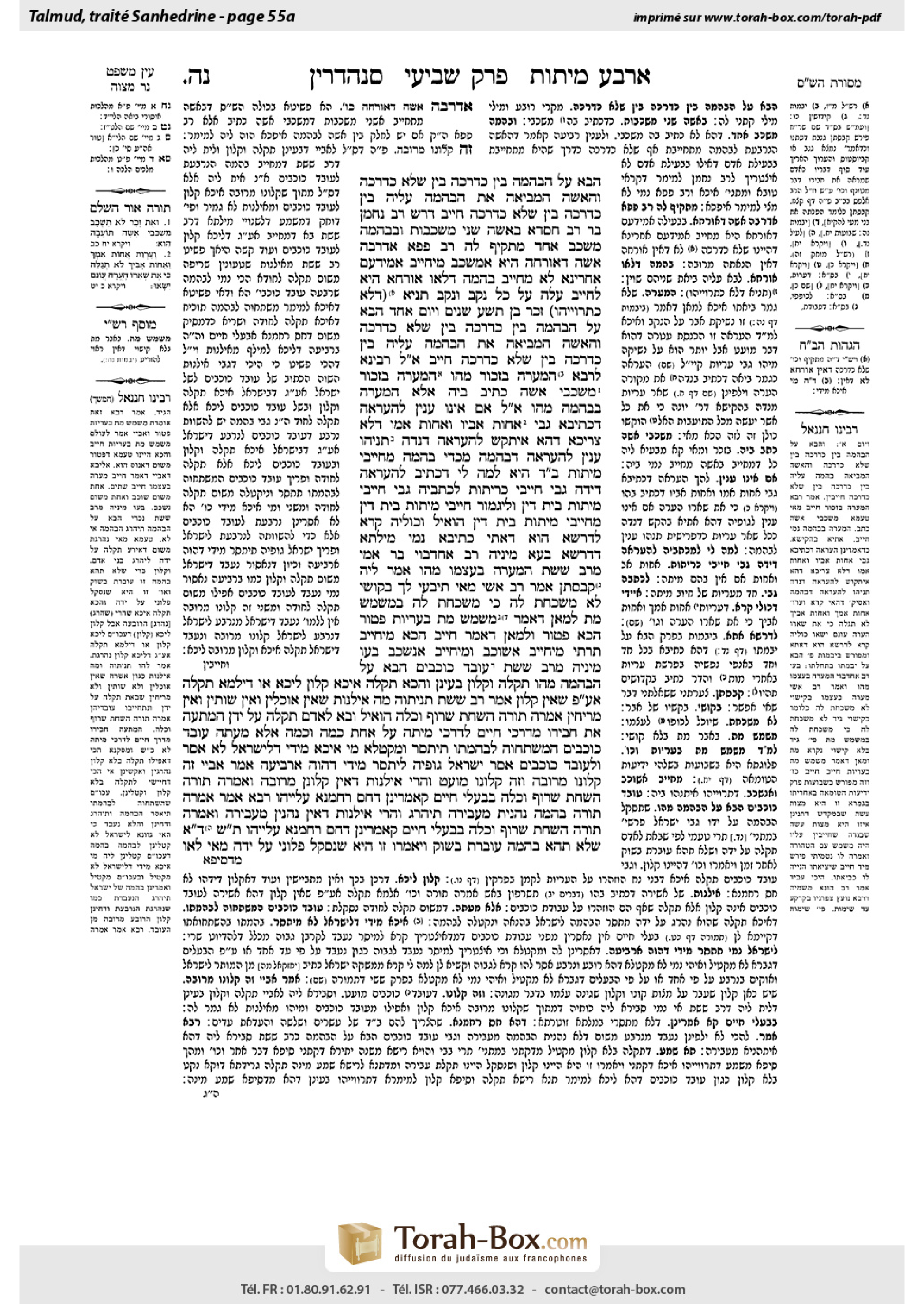
Sanhedrin 55a: Talmud study for Daf Yomi
Daf Yomi is the daily study of one Talmud folio. Explore 37 tractates with scans, Hebrew text, Sefaria English and AI-generated French translations where annotated.
Passage selection and English or AI-generated French translation are available where the scan has annotations. Daf Study is independent of Torah-Box and Sefaria.
Browse Sanhedrin · סנהדרין · All tractatesSanhedrin 55a text and translations
This page of Sanhedrin includes the Aramaic text, an English translation and an AI-generated French translation, alongside the scan above.
סנהדרין נ״ה א · Aramaic and Hebrew text
הַבָּא עַל הַבְּהֵמָה, בֵּין כְּדַרְכָּהּ בֵּין שֶׁלֹּא כְּדַרְכָּהּ, וְהָאִשָּׁה הַמְּבִיאָה אֶת הַבְּהֵמָה עָלֶיהָ, בֵּין כְּדַרְכָּהּ בֵּין שֶׁלֹּא כְּדַרְכָּהּ – חַיָּיב.
דָּרַשׁ רַב נַחְמָן בַּר רַב חִסְדָּא: בְּאִשָּׁה שְׁנֵי מִשְׁכָּבוֹת, וּבִבְהֵמָה מִשְׁכָּב אֶחָד.
מַתְקֵיף לַהּ רַב פָּפָּא: אַדְּרַבָּה, אִשָּׁה דְּאוֹרְחַהּ הִיא אַמִּשְׁכָּב מִיחַיַּיב, אַמִּידַּעַם אַחֲרִינָא לָא מִיחַיַּיב. בְּהֵמָה דְּלָאו אוֹרְחָא הִיא, לִחַיַּיב עֲלַהּ עַל כׇּל נֶקֶב וָנֶקֶב.
תַּנְיָא (דְּלָא כְּתַרְוַיְיהוּ): זָכָר בֶּן תֵּשַׁע שָׁנִים וְיוֹם אֶחָד הַבָּא עַל הַבְּהֵמָה, בֵּין כְּדַרְכָּהּ בֵּין שֶׁלֹּא כְּדַרְכָּהּ, וְהָאִשָּׁה הַמְּבִיאָה אֶת הַבְּהֵמָה עָלֶיהָ, בֵּין כְּדַרְכָּהּ בֵּין שֶׁלֹּא כְּדַרְכָּהּ – חַיָּיב.
אֲמַר לֵיהּ רָבִינָא לְרָבָא: הַמְעָרֶה בִּזְכוּר, מַהוּ?
הַמְעָרֶה בִּזְכוּר – מִשְׁכְּבֵי אִשָּׁה כְּתִיב בֵּיהּ. אֶלָּא, הַמְעָרֶה בִּבְהֵמָה, מַהוּ?
אֲמַר לֵיהּ: אִם אֵינוֹ עִנְיָן לְהַעֲרָאָה דִּכְתִיבָא גַּבֵּי אֲחוֹת אָבִיו וַאֲחוֹת אִמּוֹ, דְּלָא צְרִיכָא, דְּהָא אִיתַּקַּשׁ לְהַעֲרָאָה דְּנִדָּה – תְּנֵיהוּ עִנְיָן לְהַעֲרָאָה דִבְהֵמָה.
מִכְּדֵי, בְּהֵמָה מֵחַיָּיבֵי מִיתוֹת בֵּית דִּין הִיא, לְמָה לִי דִּכְתִיב לְהַעֲרָאָה דִּידַהּ גַּבֵּי חַיָּיבֵי כָרֵיתוֹת? לִכְתְּבֵיהּ גַּבֵּי חַיָּיבֵי מִיתוֹת בֵּית דִּין, וְלִיגְמוֹר חַיָּיבֵי מִיתוֹת בֵּית דִּין מֵחַיָּיבֵי מִיתוֹת בֵּית דִּין!
הוֹאִיל וְכוּלֵּיהּ קְרָא לִדְרָשָׁא הוּא דְּאָתֵי, כְּתִיבָא נָמֵי מִילְּתָא דִּדְרָשָׁא.
בְּעָא מִינֵּיהּ רַב אַחָדְבוּי בַּר אַמֵּי מֵרַב שֵׁשֶׁת: הַמְעָרֶה בְּעַצְמוֹ, מַהוּ? אֲמַר לֵיהּ: קְבַסְתַּן!
אָמַר רַב אָשֵׁי: מַאי תִּיבְּעֵי לָךְ? בְּקוֹשִׁי לָא מַשְׁכַּחַתְּ לַהּ, כִּי מַשְׁכַּחַתְּ לַהּ בִּמְשַׁמֵּשׁ מֵת. לְמַאן דְּאָמַר מְשַׁמֵּשׁ מֵת בַּעֲרָיוֹת פָּטוּר, הָכָא פָּטוּר. וּלְמַאן דְּאָמַר חַיָּיב, הָכָא מִיחַיַּיב תַּרְתֵּי: מִיחַיַּיב אַשּׁוֹכֵב, וּמִיחַיַּיב אַנִּשְׁכָּב.
בְּעוֹ מִינֵּיהּ מֵרַב שֵׁשֶׁת: גּוֹי הַבָּא עַל הַבְּהֵמָה מַהוּ? תַּקָּלָה וְקָלוֹן בָּעֵינַן, וְהָכָא תַּקָּלָה אִיכָּא, קָלוֹן לֵיכָּא? אוֹ דִילְמָא תַּקָּלָה, אַף עַל פִּי שֶׁאֵין קָלוֹן?
אָמַר רַב שֵׁשֶׁת: תְּנֵיתוּהָ, מָה אִילָנוֹת שֶׁאֵין אוֹכְלִין וְאֵין שׁוֹתִין וְאֵין מְרִיחִין, אָמְרָה תּוֹרָה: הַשְׁחֵת, שְׂרוֹף וְכַלֵּה, הוֹאִיל וּבָאת לְאָדָם תַּקָּלָה עַל יָדָן. הַמַּתְעֶה אֶת חֲבֵירוֹ מִדַּרְכֵי חַיִּים לְדַרְכֵי מִיתָה – עַל אַחַת כַּמָּה וְכַמָּה.
אֶלָּא מֵעַתָּה, גּוֹי הַמִּשְׁתַּחֲוֶה לִבְהֶמְתּוֹ תִּיתְּסַר וּמִקַּטְלָא? מִי אִיכָּא מִידֵּי דִּלְיִשְׂרָאֵל לָא אָסַר וּלְגוֹי אָסַר?
יִשְׂרָאֵל גּוּפֵיהּ לִיתְּסַר, מִידֵּי דְּהָוֵה אַרְבִיעָה? אָמַר אַבָּיֵי: זֶה קְלוֹנוֹ מְרוּבֶּה, וְזֶה קְלוֹנוֹ מוּעָט.
וַהֲרֵי אִילָנוֹת, דְּאֵין קְלוֹנָן מְרוּבֶּה, וְאָמְרָה תּוֹרָה: הַשְׁחֵת, שְׂרוֹף וְכַלֵּה! בְּבַעֲלֵי חַיִּים קָאָמְרִינַן, דְּחָס רַחֲמָנָא עֲלַיְיהוּ.
רָבָא אָמַר: אָמְרָה תּוֹרָה, בְּהֵמָה נֶהֱנֵית מֵעֲבֵירָה – תֵּיהָרֵג.
וַהֲרֵי אִילָנוֹת, דְּאֵין נֶהֱנִין מֵעֲבֵירָה, וְאָמְרָה תּוֹרָה: הַשְׁחֵת, שְׂרוֹף וְכַלֵּה! בְּבַעֲלֵי חַיִּים קָאָמְרִינַן, דְּחָס רַחֲמָנָא עֲלַיְיהוּ.
תָּא שְׁמַע: דָּבָר אַחֵר, שֶׁלֹּא תְּהֵא בְּהֵמָה עוֹבֶרֶת בַּשּׁוּק וְיֹאמְרוּ: ״זוֹ הִיא שֶׁנִּסְקַל פְּלוֹנִי עַל יָדָהּ.״ מַאי לָאו,
Sanhedrin 55a · English translation
or one who engages in intercourse with an animal, whether in a typical manner or in an atypical manner, i.e., anal intercourse, and similarly a woman who engages in intercourse with an animal, whether in a typical manner or in an atypical manner, is liable. This baraita sets the minimum age for the passive male at nine years and one day.
Rav Naḥman bar Rav Ḥisda taught: With regard to a woman there are two manners of lying. A woman who engages in intercourse with an animal, whether it is vaginal or anal intercourse, is liable. But with regard to a man who engages in intercourse with an animal there is only one manner of lying, i.e., vaginal intercourse.
Rav Pappa objects to this opinion: On the contrary, a woman, whose typical manner of intercourse is vaginal, is rendered liable for lying with an animal only in that manner; she is not rendered liable for something else, i.e., for engaging in anal intercourse with an animal. With regard to a man who engages in intercourse with an animal, by contrast, since it is not its typical conduct to engage in intercourse with a man, he should be rendered liable for engaging in intercourse with it through each and every orifice.
It is taught in a baraita in accordance with neither of their opinions: One who engages in homosexual intercourse with a male aged nine years and one day, or one who engages in intercourse with an animal, whether in a typical manner, or in an atypical manner, i.e., anal intercourse, and similarly, a woman who engages in intercourse with an animal, whether in a typical manner or in an atypical manner, are liable. Evidently, there is no difference between the nature of the transgression of a woman who engages in bestiality and a man who engages in bestiality in this regard.
Ravina said to Rava: With regard to one who performs the initial stage of intercourse with another male, i.e., insertion of the penis, without completing the intercourse, what is the halakha? Is he liable for engaging in homosexual intercourse?
The Gemara comments: With regard to one who performs the initial stage of intercourse with a male, what is the question? The expression “as with a woman” (Leviticus 18:22) is written with regard to him, which indicates that any act that is considered an act of intercourse with a woman is also considered an act of intercourse with a man. Rather, the question is as follows: With regard to one who performs the initial stage of intercourse with an animal, what is the halakha?
Rava said to him: In the verse: “And you shall not uncover the nakedness of your mother’s sister nor of your father’s sister; for he has made naked [he’era] his relative” (Leviticus 20:19), the word he’era alludes to the initial stage of intercourse [ha’ara]. If the word he’era is not needed for the matter of the initial stage of intercourse in the context where it is written, i.e., for the prohibition of intercourse with one’s father’s sister and one’s mother’s sister, as it is not necessary in that context since the halakha of the initial stage of intercourse with regard to all forbidden sexual relations is compared by the Torah to the halakha of the initial stage of intercourse mentioned with regard to a menstruating woman, apply it instead to the matter of the initial stage of intercourse with an animal. The superfluous expression that appears in the verse concerning one’s aunt teaches that the initial stage of intercourse is considered intercourse even with regard to an animal.
The Gemara asks: Since one who engages in intercourse with an animal is among those who are liable to receive a court-imposed death penalty, why do I need the halakha of one who performs the initial stage of intercourse with an animal to be written in a verse concerning those who are liable to receive karet, i.e., the case of one who engages in intercourse with his aunt? Let the Torah write this halakha with regard to those who are liable to receive a court-imposed death penalty, and one would then derive this halakha concerning those who are liable to receive a court-imposed death penalty from the halakha of those who are liable to receive a court-imposed death penalty, and not from the less relevant halakha of one who engages in intercourse with his aunt, who is punished with karet.
The Gemara answers: Since the entire verse about the punishment of one who engages in intercourse with the sister of his father or mother is superfluous, and comes for the sake of exposition, as this halakha is already stated in other verses (see Leviticus 18:12–13), this matter, i.e., the fact that the initial stage of intercourse is halakhically defined as intercourse, is also written in this verse for the purpose of an exposition, i.e., in order to indicate that this principle holds true with regard to bestiality as well.
Rav Aḥadevoi bar Ami asked Rav Sheshet: With regard to one who performs the initial stage of homosexual intercourse on himself, what is the halakha? Is he liable for homosexual intercourse? Rav Sheshet said to him: You disgust me with your question; such an act is not possible.
Rav Ashi said: What is your dilemma? With regard to doing so with an erect penis, you cannot find such a case. You can find it only when one performs this act of intercourse with a flaccid penis. And the halakha is subject to a dispute: According to the one who says that a man who engages in intercourse with a flaccid penis, with one of those with whom relations are forbidden, is exempt, as that is not considered intercourse, here too, when one does so to himself, he is exempt. And according to the one who says that he is liable, he is rendered liable here for transgressing two prohibitions according to Rabbi Yishmael; he is rendered liable for engaging in homosexual intercourse actively, and he is rendered liable for engaging in homosexual intercourse passively.
The students asked Rav Sheshet: With regard to a gentile who engages in intercourse with an animal, what is the halakha? Must the animal be killed? The Gemara elaborates: Do we need two reasons to kill the animal, namely that it caused a calamity and that it caused shame, and therefore here the animal is not killed, as while there is a calamity, as it caused a person to sin and be executed, there is no shame, as the Jewish court is not responsible for the shame of a gentile? Or perhaps one reason is enough, and an animal is killed because of the calamity it caused even if there is no shame?
Rav Sheshet said: You learned the answer to this question in a baraita: If with regard to trees, which neither eat nor drink nor smell, and nevertheless, if they are used in idolatrous rites, the Torah says: Destroy, burn, and demolish them (see Deuteronomy, chapters 7, 12), and the reason is since a calamity was caused to people by them, then with regard to one who leads another astray from the ways of life to the ways of death, all the more so he is liable to be destroyed. It can be derived from here that any item used for a transgression that renders one liable to be executed should be destroyed.
The Gemara challenges this ruling: If that is so, in the case of a gentile who bows down to his animal, the animal should be forbidden, i.e., it should be prohibited to derive benefit from it, and it should be killed. The Gemara answers: Is there anything that is not forbidden to a Jew, but is forbidden to a gentile? Since a Jew who bows down to an animal does not render it forbidden (see Temura 29b), a gentile who does so does not render it forbidden either.
The Gemara challenges that assumption: With regard to a Jew himself who bows down to his animal, let the animal be forbidden, just as it is in a case of bestiality, when the animal is forbidden and is killed. Abaye says: The cases are not the same. In this case, where one commits bestiality, his shame is great; but in that case, where one worships an animal, his shame is slight, and he will not be so disgraced if the animal is left alive.
The Gemara asks: But with regard to trees that are used in idolatrous rites, in which case the shame of the idol worshippers is not great, the Torah nevertheless says: Destroy, burn, and demolish them. The Gemara answers: We are speaking of living animals. The halakha is different there, as the Merciful One has pity on them. Therefore, if the shame of the person is not great, the animal is not killed.
Rava says that there is a different reason for the distinction between an animal that was worshipped and an animal with which one committed bestiality: The Torah states that because the animal enjoyed the transgression, it must be killed. This cannot be said about an animal that was worshipped.
The Gemara asks: But with regard to trees that are used in idolatrous rites, which do not enjoy the transgression, nevertheless the Torah says: Destroy, burn, and demolish. The Gemara answers: We are speaking of living animals. The halakha is different there, as the Merciful One has pity on them. Therefore, an animal is killed only if it enjoyed the transgression.
The Gemara suggests: Come and hear a resolution from the mishna to the dilemma concerning an animal with which a gentile committed bestiality: Alternatively, it is so that this animal will not pass through the marketplace, and those who see it will say: This is the animal because of which so-and-so was stoned, and its existence would shame his memory. What, is it not
Sanhedrin 55a · Traduction française (IA)
ou celui qui a des rapports sexuels avec un animal, que ce soit de manière habituelle ou de manière inhabituelle, c'est-à-dire par voie anale, et de même une femme qui a des rapports sexuels avec un animal, que ce soit de manière habituelle ou de manière inhabituelle, est passible de peine. Cette baraïta fixe l'âge minimum de l'homme passif à neuf ans et un jour.
Rav Naḥman bar Rav Ḥisda a enseigné : En ce qui concerne une femme, il existe deux manières d'avoir des rapports. Une femme qui a des rapports sexuels avec un animal, qu'il s'agisse de rapports vaginaux ou anaux, est passible de peine. Mais en ce qui concerne un homme qui a des rapports sexuels avec un animal, il n'y a qu'une seule manière d'avoir des rapports, c'est-à-dire des rapports vaginaux.
Rav Pappa objecte à cet avis : Au contraire, une femme, dont la manière habituelle d'avoir des rapports est vaginale, n'est rendue passible de peine pour avoir eu des rapports avec un animal que de cette manière ; elle n'est pas rendue passible pour autre chose, c'est-à-dire pour avoir eu des rapports anaux avec un animal. En revanche, en ce qui concerne un homme qui a des rapports sexuels avec un animal, puisque ce n'est pas le comportement habituel de l'animal d'avoir des rapports avec un homme, il devrait être rendu passible pour avoir eu des rapports avec lui par chaque orifice.
Il est enseigné dans une baraïta, conformément à l'avis d'aucun d'entre eux : Celui qui a des rapports homosexuels avec un homme âgé de neuf ans et un jour, ou celui qui a des rapports sexuels avec un animal, que ce soit de manière habituelle ou de manière inhabituelle, c'est-à-dire par voie anale, et de même, une femme qui a des rapports sexuels avec un animal, que ce soit de manière habituelle ou de manière inhabituelle, sont passibles de peine. Évidemment, il n'y a pas de différence entre la nature de la transgression d'une femme qui commet de la bestialité et celle d'un homme qui commet de la bestialité à cet égard.
Ravina dit à Rava : En ce qui concerne celui qui effectue la première étape des rapports sexuels avec un autre homme, c'est-à-dire l'insertion du pénis, sans achever les rapports, quelle est la halakha ? Est-il passible pour avoir eu des rapports homosexuels ?
La Guemara commente : En ce qui concerne celui qui effectue la première étape des rapports sexuels avec un homme, quelle est la question ? L'expression « comme avec une femme » (Lévitique 18:22) est écrite à son sujet, ce qui indique que tout acte considéré comme un acte de rapports avec une femme est également considéré comme un acte de rapports avec un homme. Plutôt, la question est la suivante : En ce qui concerne celui qui effectue la première étape des rapports sexuels avec un animal, quelle est la halakha ?
Rava lui dit : Dans le verset : « Et tu ne découvriras pas la nudité de la sœur de ta mère ni de la sœur de ton père ; car il a découvert [he'era] la nudité de son parent » (Lévitique 20:19), le mot he'era fait allusion à la première étape des rapports sexuels [ha'ara]. Si le mot he'era n'est pas nécessaire pour la question de la première étape des rapports sexuels dans le contexte où il est écrit, c'est-à-dire pour l'interdiction des rapports avec la sœur de son père et la sœur de sa mère, puisqu'il n'est pas nécessaire dans ce contexte, car la halakha de la première étape des rapports sexuels en ce qui concerne toutes les relations sexuelles interdites est comparée par la Torah à la halakha de la première étape des rapports sexuels mentionnée en ce qui concerne une femme en période menstruelle, applique-le plutôt à la question de la première étape des rapports sexuels avec un animal. L'expression superflue qui apparaît dans le verset concernant sa tante enseigne que la première étape des rapports sexuels est considérée comme des rapports même en ce qui concerne un animal.
La Guemara demande : Puisque celui qui a des rapports sexuels avec un animal est parmi ceux qui sont passibles de la peine de mort infligée par le tribunal, pourquoi ai-je besoin que la halakha de celui qui effectue la première étape des rapports sexuels avec un animal soit écrite dans un verset concernant ceux qui sont passibles de la karet, c'est-à-dire le cas de celui qui a des rapports avec sa tante ? Que la Torah écrive cette halakha en ce qui concerne ceux qui sont passibles de la peine de mort infligée par le tribunal, et l'on déduirait alors cette halakha concernant ceux qui sont passibles de la peine de mort infligée par le tribunal de la halakha de ceux qui sont passibles de la peine de mort infligée par le tribunal, et non de la halakha moins pertinente de celui qui a des rapports avec sa tante, qui est puni par la karet.
La Guemara répond : Puisque le verset entier concernant la punition de celui qui a des rapports avec la sœur de son père ou de sa mère est superflu et vient à des fins d'explication, car cette halakha est déjà énoncée dans d'autres versets (voir Lévitique 18:12-13), cette question, à savoir le fait que la phase initiale des rapports est définie halakhiquement comme des rapports, est également inscrite dans ce verset à des fins d'explication, c'est-à-dire pour indiquer que ce principe s'applique également à la bestialité.
Rav Aḥadevoi bar Ami demanda à Rav Sheshet : En ce qui concerne celui qui effectue la phase initiale des rapports homosexuels sur lui-même, quelle est la halakha ? Est-il passible pour des rapports homosexuels ? Rav Sheshet lui dit : Ta question me répugne ; un tel acte n'est pas possible.
Rav Ashi dit : Quelle est votre difficulté ? En ce qui concerne le fait de le faire avec un pénis en érection, vous ne pouvez pas trouver un tel cas. Vous ne pouvez le trouver que lorsque l'on effectue cet acte de rapports avec un pénis fléchi. Et la halakha fait l'objet d'un débat : Selon celui qui dit qu'un homme qui a des rapports avec un pénis fléchi, avec l'une de celles avec qui les relations sont interdites, est exempt, car ce n'est pas considéré comme des rapports, ici aussi, lorsque l'on le fait sur soi-même, il est exempt. Et selon celui qui dit qu'il est passible, il est rendu passible ici pour avoir transgressé deux interdictions selon Rabbi Yishmael ; il est rendu passible pour avoir eu des rapports homosexuels activement, et il est rendu passible pour avoir eu des rapports homosexuels passivement.
Les étudiants demandèrent à Rav Chéchet : Quelle est la halakha concernant un non-Juif qui commet un acte bestial avec un animal ? L'animal doit-il être abattu ? La Guemara précise : Faut-il deux raisons pour abattre l'animal, à savoir qu'il a causé un désastre et qu'il a causé une honte, et par conséquent, ici, l'animal n'est pas abattu, car s'il y a un désastre, puisqu'il a fait pécher une personne qui a été exécutée, il n'y a pas de honte, car le tribunal juif n'est pas responsable de la honte d'un non-Juif ? Ou peut-être qu'une seule raison suffit, et un animal est abattu à cause du désastre qu'il a causé, même s'il n'y a pas de honte ?
Rav Chéchet dit : Vous avez appris la réponse à cette question dans une baraïta : Si, pour ce qui est des arbres, qui ne mangent ni ne boivent ni ne sentent, et pourtant, s'ils sont utilisés dans des rites idolâtres, la Torah dit : Détruisez-les, brûlez-les et démolissez-les (voir Deutéronome, chapitres 7 et 12), et la raison en est qu'un désastre a été causé aux gens par eux, alors, pour ce qui est de celui qui égare un autre des chemins de la vie vers les chemins de la mort, a fortiori, il est passible de destruction. On peut en déduire ici que tout objet utilisé pour une transgression qui rend passible de la peine de mort doit être détruit.
La Guemara conteste ce jugement : Si c'est ainsi, dans le cas d'un non-Juif qui s'incline devant son animal, l'animal devrait être interdit, c'est-à-dire qu'il devrait être interdit d'en tirer un profit, et il devrait être abattu. La Guemara répond : Y a-t-il quelque chose qui n'est pas interdit à un Juif, mais qui est interdit à un non-Juif ? Puisqu'un Juif qui s'incline devant un animal ne le rend pas interdit (voir Temoura 29b), un non-Juif qui le fait ne le rend pas interdit non plus.
La Guemara conteste cette supposition : S'agissant d'un Juif qui s'incline devant son propre animal, que l'animal soit interdit, de même qu'en cas d'acte bestial, où l'animal est interdit et abattu. Abaye dit : Les cas ne sont pas les mêmes. Dans le cas où l'on commet un acte bestial, la honte est grande ; mais dans le cas où l'on adore un animal, la honte est légère, et la personne ne sera pas aussi déshonorée si l'animal est laissé en vie.
La Guemara demande : Mais s'agissant des arbres utilisés dans des rites idolâtres, où la honte des idolâtres n'est pas grande, la Torah ordonne pourtant : Détruisez-les, brûlez-les et démolissez-les. La Guemara répond : Nous parlons d'animaux vivants. La halakha est différente en la matière, car le Tout-Puissant a pitié d'eux. Par conséquent, si la honte de la personne n'est pas grande, l'animal n'est pas abattu.
Rava dit qu'il existe une raison différente pour la distinction entre un animal qui a été adoré et un animal avec lequel on a commis un acte bestial : La Torah énonce que, parce que l'animal a pris plaisir à la transgression, il doit être abattu. Cela ne peut pas être dit d'un animal qui a été adoré.
La Guemara demande : Mais quant aux arbres utilisés dans des rites idolâtres, qui ne prennent pas plaisir à la transgression, la Torah dit pourtant : Détruisez-les, brûlez-les et démolissez-les. La Guemara répond : Nous parlons d'animaux vivants. La halakha est différente en la matière, car le Tout-Puissant a pitié d'eux. Par conséquent, un animal n'est abattu que s'il a pris plaisir à la transgression.
La Guemara suggère : Venez entendre une résolution de la Michna concernant le dilemme au sujet d'un animal avec lequel un non-Juif a commis un acte bestial : Ou bien, c'est afin que cet animal ne passe pas par le marché, et que ceux qui le verront disent : C'est l'animal à cause duquel untel a été lapidé, et son existence déshonorerait sa mémoire. Quoi, n'est-ce pas
Traduction française générée par IA à partir de l’édition anglaise de Sefaria. Vérifie toujours un passage avec le texte source.
Text from Sefaria: William Davidson Edition - Vocalized Aramaic (CC BY NC); William Davidson Edition - English (CC BY NC).