Sanhedrin 54b: Talmud study for Daf Yomi
Daf Yomi is the daily study of one Talmud folio. Explore 37 tractates with scans, Hebrew text, Sefaria English and AI-generated French translations where annotated.
Passage selection and English or AI-generated French translation are available where the scan has annotations. Daf Study is independent of Torah-Box and Sefaria.
Browse Sanhedrin · סנהדרין · All tractatesSanhedrin 54b text and translations
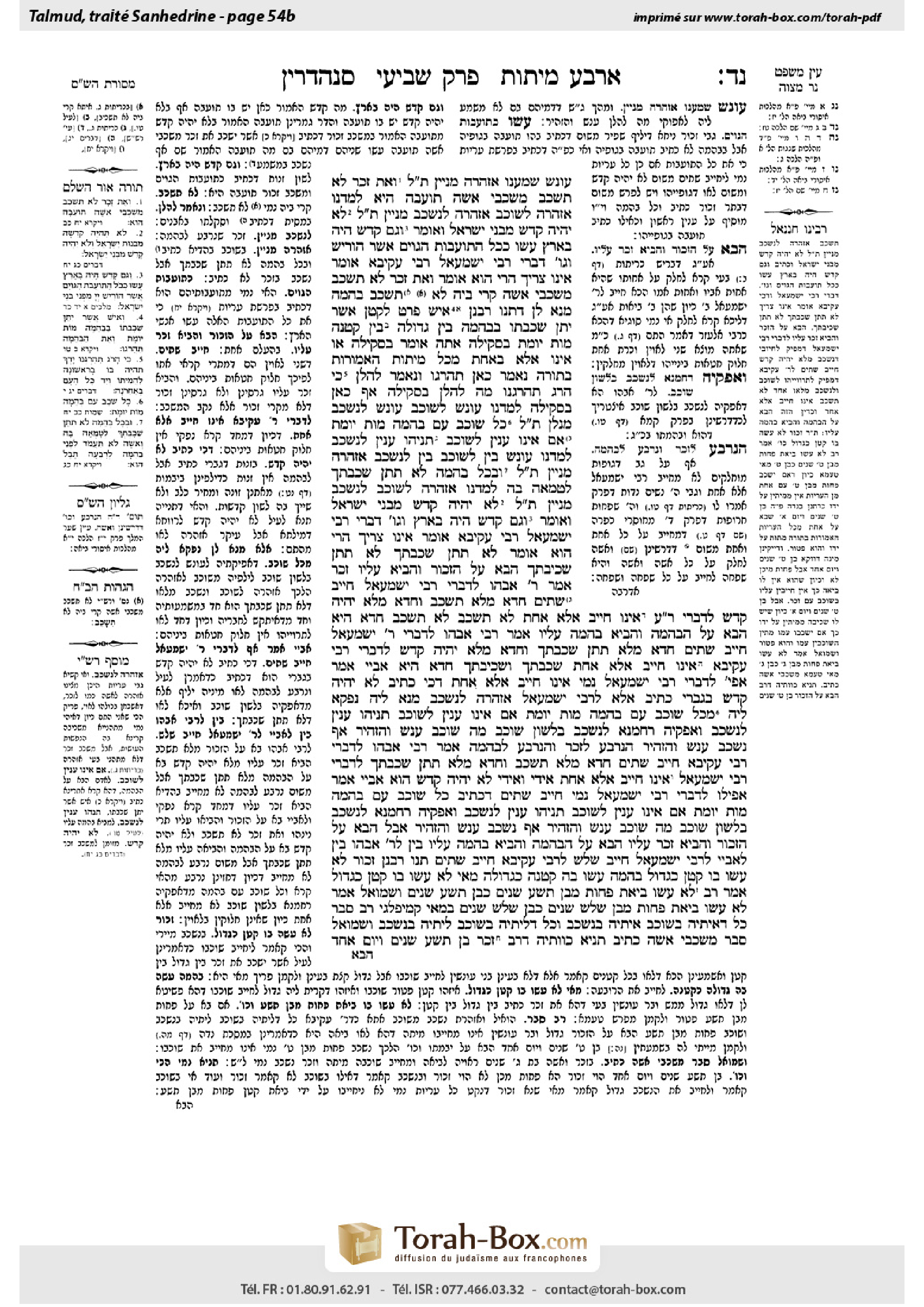
This page of Sanhedrin includes the Aramaic text, an English translation and an AI-generated French translation, alongside the scan above.
סנהדרין נ״ד ב · Aramaic and Hebrew text
עוֹנֶשׁ שָׁמַעְנוּ, אַזְהָרָה מִנַּיִין? תַּלְמוּד לוֹמַר: ״וְאֶת זָכָר לֹא תִשְׁכַּב מִשְׁכְּבֵי אִשָּׁה תּוֹעֵבָה הִיא״.
לָמַדְנוּ אַזְהָרָה לַשּׁוֹכֵב. אַזְהָרָה לַנִּשְׁכָּב מִנַּיִין? תַּלְמוּד לוֹמַר: ״לֹא יִהְיֶה קָדֵשׁ מִבְּנֵי יִשְׂרָאֵל״. וְאוֹמֵר: ״וְגַם קָדֵשׁ הָיָה בָאָרֶץ עָשׂוּ כְּכֹל הַתּוֹעֲבֹת הַגּוֹיִם אֲשֶׁר הוֹרִישׁ וְגוֹ׳״. דִּבְרֵי רַבִּי יִשְׁמָעֵאל.
רַבִּי עֲקִיבָא אוֹמֵר: אֵינוֹ צָרִיךְ, הֲרֵי הוּא אוֹמֵר ״וְאֶת זָכָר לֹא תִשְׁכַּב מִשְׁכְּבֵי אִשָּׁה״. קְרִי בֵּיהּ ״לֹא תִשָּׁכֵב״.
בְּהֵמָה מְנָא לַן? דְּתָנוּ רַבָּנַן: ״אִישׁ״ – פְּרָט לְקָטָן, ״אֲשֶׁר יִתֵּן שְׁכׇבְתּוֹ בִּבְהֵמָה״ – בֵּין גְּדוֹלָה בֵּין קְטַנָּה.
״מוֹת יוּמָת״ – בִּסְקִילָה. אַתָּה אוֹמֵר בִּסְקִילָה, אוֹ אֵינוֹ אֶלָּא בְּאַחַת מִכׇּל מִיתוֹת הָאֲמוּרוֹת בַּתּוֹרָה? נֶאֱמַר כָּאן ״תַּהֲרֹגוּ״, וְנֶאֱמַר לְהַלָּן ״כִּי הָרֹג תַּהַרְגֶנּוּ״. מָה לְהַלָּן בִּסְקִילָה, אַף כָּאן בִּסְקִילָה.
לָמַדְנוּ עוֹנֶשׁ לַשּׁוֹכֵב. עוֹנֶשׁ לַנִּשְׁכָּב מְנָלַן? תַּלְמוּד לוֹמַר: ״כׇּל שֹׁכֵב עִם בְּהֵמָה מוֹת יוּמָת״. אִם אֵינוֹ עִנְיָן לַשּׁוֹכֵב, תְּנֵיהוּ עִנְיָן לַנִּשְׁכָּב.
לָמַדְנוּ עוֹנֶשׁ בֵּין לַשּׁוֹכֵב בֵּין לַנִּשְׁכָּב. אַזְהָרָה מִנַּיִין? תַּלְמוּד לוֹמַר: ״וּבְכׇל בְּהֵמָה לֹא תִתֵּן שְׁכׇבְתְּךָ לְטׇמְאָה בָהּ״.
לָמַדְנוּ אַזְהָרָה לַשּׁוֹכֵב. לַנִּשְׁכָּב מִנַּיִין? תַּלְמוּד לוֹמַר: ״לֹא יִהְיֶה קָדֵשׁ מִבְּנֵי יִשְׂרָאֵל״, וְאוֹמֵר: ״וְגַם קָדֵשׁ הָיָה בָּאָרֶץ וְגוֹ׳״. דִּבְרֵי רַבִּי יִשְׁמָעֵאל.
רַבִּי עֲקִיבָא אוֹמֵר: אֵינוֹ צָרִיךְ, הֲרֵי הוּא אוֹמֵר ״לֹא תִתֵּן שְׁכׇבְתְּךָ״ – לֹא תִתֵּן שְׁכִיבָתְךָ.
הַבָּא עַל הַזְּכוּר, וְהֵבִיא עָלָיו זָכָר.
אָמַר רַבִּי אֲבָהוּ: לְדִבְרֵי רַבִּי יִשְׁמָעֵאל חַיָּיב שְׁתַּיִם, חֲדָא מִ״לֹּא תִשְׁכַּב״ וַחֲדָא מִ״לֹּא יִהְיֶה קָדֵשׁ״. לְדִבְרֵי רַבִּי עֲקִיבָא אֵינוֹ חַיָּיב אֶלָּא אַחַת. ״לֹא תִשְׁכַּב״ ״לֹא תִשָּׁכֵב״ חֲדָא הִיא.
הַבָּא עַל הַבְּהֵמָה וְהֵבִיא בְּהֵמָה עָלָיו, אָמַר רַבִּי אֲבָהוּ: לְדִבְרֵי רַבִּי יִשְׁמָעֵאל חַיָּיב שְׁתַּיִם, חֲדָא מִ״לֹּא תִתֵּן שְׁכׇבְתְּךָ״ וַחֲדָא מִ״לֹּא יִהְיֶה קָדֵשׁ״. לְדִבְרֵי רַבִּי עֲקִיבָא אֵינוֹ חַיָּיב אֶלָּא אַחַת, ״שְׁכׇבְתְּךָ״ וּ״שְׁכִיבָתְךָ״ חֲדָא הִיא.
אַבָּיֵי אָמַר: אֲפִילּוּ לְדִבְרֵי רַבִּי יִשְׁמָעֵאל נָמֵי אֵינוֹ חַיָּיב אֶלָּא אַחַת, דְּכִי כְתִיב ״לֹא יִהְיֶה קָדֵשׁ״ – בְּגַבְרֵי כְּתִיב.
אֶלָּא לְרַבִּי יִשְׁמָעֵאל, אַזְהָרָה לַנִּשְׁכָּב מְנָא לֵיהּ? נָפְקָא לֵיהּ מִ״כׇּל שֹׁכֵב עִם בְּהֵמָה מוֹת יוּמָת״. אִם אֵינוֹ עִנְיָן לַשּׁוֹכֵב, תְּנֵיהוּ עִנְיָן לַנִּשְׁכָּב.
וְאַפְּקֵיהּ רַחֲמָנָא לַנִּשְׁכָּב בִּלְשׁוֹן שׁוֹכֵב: מָה שׁוֹכֵב עָנַשׁ וְהִזְהִיר, אַף נִשְׁכָּב עָנַשׁ וְהִזְהִיר.
הַנִּרְבָּע לְזָכָר וְהַנִּרְבָּע לִבְהֵמָה, אָמַר רַבִּי אֲבָהוּ: לְדִבְרֵי רַבִּי עֲקִיבָא חַיָּיב שְׁתַּיִם, חֲדָא מִ״לֹּא תִשְׁכַּב״ וַחֲדָא מִ״לֹּא תִתֵּן שְׁכׇבְתְּךָ״. לְדִבְרֵי רַבִּי יִשְׁמָעֵאל אֵינוֹ חַיָּיב אֶלָּא אַחַת, אִידֵּי וְאִידִי ״לֹא יִהְיֶה קָדֵשׁ״ הוּא.
אַבָּיֵי אָמַר: אֲפִילּוּ לְדִבְרֵי רַבִּי יִשְׁמָעֵאל נָמֵי חַיָּיב שְׁתַּיִם, דִּכְתִיב ״כׇּל שֹׁכֵב עִם בְּהֵמָה מוֹת יוּמָת״. אִם אֵינוֹ עִנְיָן לַשּׁוֹכֵב, תְּנֵיהוּ עִנְיָן לַנִּשְׁכָּב. וְאַפְּקֵיהּ רַחֲמָנָא לַנִּשְׁכָּב בִּלְשׁוֹן שׁוֹכֵב: מָה שׁוֹכֵב – עָנַשׁ וְהִזְהִיר, אַף נִשְׁכָּב – עָנַשׁ וְהִזְהִיר.
אֲבָל הַבָּא עַל הַזְּכוּר, וְהֵבִיא זָכָר עָלָיו, הַבָּא עַל הַבְּהֵמָה, וְהֵבִיא בְּהֵמָה עָלָיו – בֵּין לְרַבִּי אֲבָהוּ בֵּין לְאַבָּיֵי, לְרַבִּי יִשְׁמָעֵאל חַיָּיב שָׁלֹשׁ, לְרַבִּי עֲקִיבָא חַיָּיב שְׁתַּיִם.
תָּנוּ רַבָּנַן: זְכוּר – לֹא עָשׂוּ בּוֹ קָטָן כְּגָדוֹל, בְּהֵמָה – עָשׂוּ בָּהּ קְטַנָּה כִּגְדוֹלָה.
מַאי ״לֹא עָשׂוּ בּוֹ קָטָן כְּגָדוֹל״? אָמַר רַב: לֹא עָשׂוּ בִּיאַת פָּחוֹת מִבֶּן תֵּשַׁע שָׁנִים כְּבֶן תֵּשַׁע שָׁנִים. וּשְׁמוּאֵל אָמַר: לֹא עָשׂוּ בִּיאַת פָּחוֹת מִבֶּן שָׁלֹשׁ שָׁנִים כְּבֶן שָׁלֹשׁ שָׁנִים.
בְּמַאי קָמִיפַּלְגִי? רַב סָבַר: כֹּל דְּאִיתֵיהּ בְּשׁוֹכֵב – אִיתֵיהּ בְּנִשְׁכָּב, וְכֹל דְּלֵיתֵיהּ בְּשׁוֹכֵב – לֵיתֵיהּ בְּנִשְׁכָּב.
וּשְׁמוּאֵל סָבַר: ״מִשְׁכְּבֵי אִשָּׁה״ כְּתִיב.
תַּנְיָא כְּוָותֵיהּ דְּרַב: זָכָר בֶּן תֵּשַׁע שָׁנִים וְיוֹם אֶחָד
Sanhedrin 54b · English translation
We have learned the punishment for homosexual intercourse, but from where is the prohibition derived? The verse states: “And you shall not lie with a male as with a woman; it is an abomination” (Leviticus 18:22).
We have learned from here the prohibition for the one who engages in homosexual intercourse actively. From where do we derive the prohibition for one who engages in homosexual intercourse passively? The verse states: “There shall not be a sodomite [kadesh] among the children of Israel” (Deuteronomy 23:18). And another verse, cited to clarify the meaning of the term kadesh, states: “And there were also sodomites [kadesh] in the land, they did according to all the abominations of the nations which the Lord drove out before the children of Israel” (I Kings 14:24). This is the statement of Rabbi Yishmael.
Rabbi Akiva says: It is not necessary to derive this halakha from the verse: “There shall not be a sodomite.” Rather, it says: “And you shall not lie [tishkav] with a male as with a woman.” Read into the verse: You shall not enable your being lain with [tishakhev] by a male.
§ The Gemara asks: From where do we derive that one who engages in intercourse with an animal is liable to receive capital punishment? It is as the Sages taught: “And if a man lies with an animal, he shall be put to death, and you shall kill the animal” (Leviticus 20:15). The word “man” excludes a minor boy. The phrase “lies with an animal” is referring to any animal, whether old or young.
The phrase “shall be put to death” refers to execution by stoning. Do you say that they are executed by stoning, or is it rather by one of all the other types of death penalty that are stated in the Torah? It is stated here: “You shall kill,” and it is stated there, with regard to an inciter: “But you shall kill him…and you shall stone him with stones and he shall die” (Deuteronomy 13:10–11). Just as there the verse states that an inciter is executed by stoning, so too here, one who engages in bestiality is executed by stoning.
We have learned the punishment for one who engages in bestiality actively, but from where do we derive the punishment for one who engages in bestiality passively? The verse states: “Whoever lies with an animal shall be put to death” (Exodus 22:18). If this verse is not needed for the matter of the one who actively lies with an animal, i.e., a male who sexually penetrates an animal, apply it to the matter of the one who causes an animal to lie with him, by being penetrated by the animal, i.e., any type of intercourse with an animal is punishable by death.
We have therefore learned the punishment for both one who engages in bestiality actively and one who engages in bestiality passively, but from where is the prohibition derived? The verse states: “And you shall not lie with any animal to defile yourself with it” (Leviticus 18:23).
We have learned the prohibition for one who engages in bestiality actively. From where do we derive the prohibition for one who engages in bestiality passively? The verse states: “There shall not be a kadesh among the children of Israel,” and another verse states: “And there were also kadesh in the land,” which shows that anyone who engages in intercourse in a way that is like the abominations of the nations is called a kadesh. This is the statement of Rabbi Yishmael.
Rabbi Akiva says: It is not necessary to derive the halakha prohibiting passively engaging in bestiality from this verse. Rather, it says: “You shall not lie [shekhovtekha],” which can be read as follows: You shall not enable your being lain with [shekhivatkha].
The Gemara discusses cases to which these halakhic expositions are relevant: What is the halakha of one who unwittingly engages in intercourse with a male, and unwittingly causes a male to engage in intercourse with him, within one lapse of awareness, i.e., without realizing in the interim that these behaviors are forbidden? Is he considered to have transgressed two separate prohibitions and therefore liable to bring two sin-offerings, or is he considered to have transgressed one prohibition twice and liable to bring only one sin-offering?
Rabbi Abbahu says: According to the statement of Rabbi Yishmael, he is liable for transgressing two different prohibitions: One is derived from the verse: “You shall not lie,” and the other one is derived from the verse: “There shall not be a sodomite,” which includes one who engages in homosexual intercourse passively. But according to the statement of Rabbi Akiva, he is liable for only one prohibition, as the prohibitions of “you shall not lie [tishkav]” and you shall not enable your being lain with [tishakhev] are one statement in the verse.
Similarly, with regard to one who unwittingly engages in intercourse with an animal, and then unwittingly causes an animal to engage in intercourse with him within one lapse of awareness, Rabbi Abbahu says: According to the statement of Rabbi Yishmael he is liable for transgressing two different prohibitions. One is derived from the verse: “You shall not lie,” and the other one is derived from the verse: “There shall not be a sodomite.” But according to the statement of Rabbi Akiva he is liable for only one prohibition, as the prohibitions of “you shall not lie [shekhovtekha]” and you shall not enable your being lain with [shekhivatkha] are one statement in the verse.
Abaye says: Even according to the statement of Rabbi Yishmael he is liable for only one prohibition, as when it is written: “There shall not be a sodomite,” it is written only with regard to intercourse with men, but not with regard to bestiality.
The Gemara asks: But according to Abaye, from where does Rabbi Yishmael derive the prohibition for one who engages in bestiality passively? The Gemara answers: He derives it from the verse: “Whoever lies with an animal shall be put to death.” If this verse is not needed for the matter of the one who actively lies with the animal, apply it to the matter of the one who causes the animal to lie with him.
And it is derived from the fact that the Merciful One expresses the halakha of one who engages in bestiality passively using the term for one who engages in bestiality actively: Just as with regard to one who engages in bestiality actively the Torah both punishes for this action and prohibits it, so too, with regard to one who engages in bestiality passively, the Torah both punishes for this action and prohibits it.
With regard to the case of one who was unwittingly sodomized by a male and then unwittingly was one with whom an animal copulated within one lapse of awareness, Rabbi Abbahu says that according to the statement of Rabbi Akiva he is liable for transgressing two prohibitions. One is derived from the verse: “You shall not lie with a male,” and the other one is derived from the verse: “You shall not lie with any animal.” According to the statement of Rabbi Yishmael he is liable for transgressing only one prohibition, as both this prohibition and that prohibition are derived from the verse: “There shall not be a sodomite.”
Abaye says: Even according to the statement of Rabbi Yishmael he is liable for transgressing two prohibitions, as it is written: “Whoever lies with an animal shall be put to death.” If the verse is not needed for the matter of one who engages in bestiality actively, as this prohibition is stated explicitly in the verse: “And you shall not lie with any animal” (Leviticus 18:23), apply it to the matter of one who engages in bestiality passively. And it is derived from the fact that the Merciful One expresses the halakha of one who engages in bestiality passively using the term for one who engages in bestiality actively: Just as with regard to one who engages in bestiality actively the Torah both punishes for this act and prohibits it, so too, with regard to one who engages in bestiality passively, the Torah both punishes for this act and prohibits it.
But with regard to one who unwittingly engages in intercourse with a male, and then unwittingly causes a male to engage in intercourse with him, and who unwittingly engages in intercourse with an animal, and then unwittingly causes an animal to engage in intercourse with him, performing all of these actions in one lapse of awareness, in this case, both according to Rabbi Abbahu and according to Abaye, the halakha according to the opinion of Rabbi Yishmael is that he is liable for transgressing three prohibitions; the ones mentioned above and the prohibition of: “There shall not be a sodomite,” whereas according to the opinion of Rabbi Akiva he is liable for transgressing only two prohibitions.
§ The Sages taught: With regard to intercourse with a male, the Torah does not deem a younger boy to be like an older boy; but with regard to intercourse with an animal, the Torah does deem a young animal to be like an old animal.
The Gemara asks: What does it mean that the Torah does not deem a younger boy to be like an older boy? Rav says: It means that the Torah does not deem the intercourse of one who is less than nine years old to be like the intercourse of one who is at least nine years old, as for a male’s act of intercourse to have the legal status of full-fledged intercourse the minimum age is nine years. And Shmuel says: The Torah does not deem the intercourse of a child who is less than three years old to be like that of one who is three years old.
The Gemara asks: With regard to what principle do Rav and Shmuel disagree? The Gemara answers: Rav holds that any halakha that applies to one who engages in intercourse actively applies to one who engages in intercourse passively, and any halakha that does not apply to one who engages in intercourse actively does not apply to one who engages in intercourse passively. Therefore, just as one who engages in intercourse actively is not liable if he is less than nine years old, as the intercourse of such a child does not have the halakhic status of intercourse, so too, if a child who is less than nine years old engages in homosexual intercourse passively, the one who engages in intercourse with him is not liable.
And Shmuel holds: It is written: “And you shall not lie with a male as with a woman,” indicating that the halakha of a male who engages in intercourse passively is like that of a woman; just as the intercourse of a woman has the halakhic status of intercourse from when she is three years old, the same is true with regard to a male who engages in intercourse passively. Consequently, in Shmuel’s opinion, one who engages in intercourse with a male who is older than three is liable.
It is taught in a baraita in accordance with the opinion of Rav: One who engages in homosexual intercourse with a male aged nine years and one day,
Sanhedrin 54b · Traduction française (IA)
Nous avons appris la punition pour les relations homosexuelles, mais d'où est-elle dérivée ? Le verset déclare : « Tu ne coucheras pas avec un homme comme on couche avec une femme ; c'est une abomination » (Lévitique 18:22).
Nous avons dérivé d'ici l'interdit pour celui qui engage activement des relations homosexuelles. D'où dérivons-nous l'interdit pour celui qui engage passivement des relations homosexuelles ? Le verset déclare : « Il n'y aura pas de sodomite [kadesh] parmi les enfants d'Israël » (Deutéronome 23:18). Et un autre verset, cité pour clarifier le sens du terme kadesh, déclare : « Il y avait aussi des sodomites [kadesh] dans le pays ; ils faisaient selon toutes les abominations des nations que l'Éternel chassait devant les enfants d'Israël » (I Rois 14:24). C'est l'avis de Rabbi Yishmaël.
Rabbi Akiva dit : Il n'est pas nécessaire de dériver cette halakha du verset : « Il n'y aura pas de sodomite ». Plutôt, il est écrit : « Tu ne coucheras pas [tishkav] avec un homme comme on couche avec une femme ». Lisons dans le verset : Tu ne permettras pas d'être couché [tishakhev] par un homme.
§ La Guemara demande : D'où dérivons-nous que celui qui a des relations sexuelles avec un animal est passible de la peine capitale ? C'est comme l'ont enseigné les Sages : « Et si un homme couche avec un animal, il sera mis à mort, et vous tuerez l'animal » (Lévitique 20:15). Le mot « homme » exclut un garçon mineur. L'expression « couche avec un animal » fait référence à n'importe quel animal, qu'il soit vieux ou jeune.
L'expression « sera mis à mort » fait référence à l'exécution par lapidation. Dites-vous qu'ils sont exécutés par lapidation, ou plutôt par l'un des autres types de peine capitale énoncés dans la Torah écrite ? Il est écrit ici : « Vous tuerez », et il est écrit là-bas, à propos d'un instigateur : « Mais vous le tuerez… et vous le lapiderez de pierres, et il mourra » (Deutéronome 13:10-11). De même qu'il est écrit là que l'instigateur est exécuté par lapidation, de même ici, celui qui commet de la bestialité est exécuté par lapidation.
Nous avons appris la punition pour celui qui commet activement de la bestialité, mais d'où dérivons-nous la punition pour celui qui commet passivement de la bestialité ? Le verset déclare : « Quiconque couche avec un animal sera mis à mort » (Exode 22:18). Si ce verset n'est pas nécessaire pour le cas de celui qui couche activement avec un animal, c'est-à-dire un homme qui pénètre sexuellement un animal, appliquez-le au cas de celui qui permet à un animal de coucher avec lui, en étant pénétré par l'animal, c'est-à-dire que tout type de relation avec un animal est puni de mort.
Nous avons donc appris la punition pour celui qui commet activement de la bestialité et pour celui qui commet passivement de la bestialité, mais d'où est dérivé l'interdit ? Le verset déclare : « Et tu ne coucheras pas avec tout animal pour te souiller avec lui » (Lévitique 18:23).
Nous avons appris l'interdit pour celui qui commet activement de la bestialité. D'où dérivons-nous l'interdit pour celui qui commet passivement de la bestialité ? Le verset déclare : « Il n'y aura pas de kadesh parmi les enfants d'Israël », et un autre verset déclare : « Il y avait aussi des kadesh dans le pays », ce qui montre que quiconque engage des relations d'une manière qui ressemble aux abominations des nations est appelé kadesh. C'est l'avis de Rabbi Yishmaël.
Rabbi Akiva dit : Il n'est pas nécessaire de dériver la halakha interdisant de commettre passivement de la bestialité de ce verset. Plutôt, il est écrit : « Tu ne coucheras pas [shekhovtekha] », ce qui peut être lu comme suit : Tu ne permettras pas d'être couché [shekhivatkha].
La Guemara examine les cas auxquels ces expositions halakhiques sont pertinentes : Quelle est la halakha de celui qui, sans le savoir, a des relations sexuelles avec un homme, et sans le savoir permet à un homme d'avoir des relations sexuelles avec lui, dans un même lapsus de conscience, c'est-à-dire sans réaliser entre-temps que ces comportements sont interdits ? Est-il considéré comme ayant transgressé deux interdits distincts et donc passible d'apporter deux sacrifices expiatoires, ou est-il considéré comme ayant transgressé un seul interdit deux fois et passible d'apporter un seul sacrifice expiatoire ?
Rabbi Abbahu dit : Selon l'avis de Rabbi Yishmaël, il est passible pour avoir transgressé deux interdits différents : l'un est dérivé du verset : « Tu ne coucheras pas », et l'autre est dérivé du verset : « Il n'y aura pas de sodomite », qui inclut celui qui a des relations homosexuelles passives. Mais selon l'avis de Rabbi Akiva, il n'est passible que d'un seul interdit, car les interdits de « tu ne coucheras pas [tishkav] » et de « tu ne permettras pas d'être couché [tishakhev] » sont une seule déclaration dans le verset.
De même, à propos de celui qui, sans le savoir, a des relations sexuelles avec un animal, puis sans le savoir permet à un animal d'avoir des relations sexuelles avec lui dans un même lapsus de conscience, Rabbi Abbahu dit : Selon l'avis de Rabbi Yishmaël, il est passible pour avoir transgressé deux interdits différents. L'un est dérivé du verset : « Tu ne coucheras pas », et l'autre est dérivé du verset : « Il n'y aura pas de sodomite ». Mais selon l'avis de Rabbi Akiva, il n'est passible que d'un seul interdit, car les interdits de « tu ne coucheras pas [shekhovtekha] » et de « tu ne permettras pas d'être couché [shekhivatkha] » sont une seule déclaration dans le verset.
Abaye dit : Même selon l'avis de Rabbi Yishmaël, il n'est passible que d'une seule interdiction, car lorsqu'il est écrit : « Il n'y aura pas de sodomite », cela est écrit uniquement à propos des relations avec des hommes, mais pas à propos de la bestialité.
La Guemara demande : Mais selon Abaye, d'où Rabbi Yishmaël déduit-il l'interdiction pour celui qui commet un acte de bestialité passivement ? La Guemara répond : Il le déduit du verset : « Quiconque couche avec un animal sera mis à mort. » Si ce verset n'est pas nécessaire pour le cas de celui qui couche activement avec l'animal, applique-le au cas de celui qui fait coucher l'animal avec lui.
Et il est déduit du fait que le Tout-Puissant exprime la halakha de celui qui commet un acte de bestialité passivement en utilisant le terme désignant celui qui commet un acte de bestialité activement : De même qu'en ce qui concerne celui qui commet un acte de bestialité activement, la Torah punit pour cet acte et l'interdit, de même, en ce qui concerne celui qui commet un acte de bestialité passivement, la Torah punit pour cet acte et l'interdit.
Concernant le cas de celui qui a été sodomisé involontairement par un homme, puis qui a été involontairement celui avec qui un animal a copulé, dans un même lapsus de conscience, Rabbi Abbahu dit que selon l'enseignement de Rabbi Akiva, il est passible de la transgression de deux interdits. L'un est déduit du verset : « Tu ne coucheras pas avec un homme », et l'autre est déduit du verset : « Tu ne coucheras pas avec un animal. » Selon l'enseignement de Rabbi Yishmaël, il n'est passible que de la transgression d'un seul interdit, car cet interdit et celui-là sont tous deux déduits du verset : « Il n'y aura pas de sodomite. »
Abaye dit : Même selon l'enseignement de Rabbi Yishmaël, il est passible de la transgression de deux interdits, car il est écrit : « Quiconque couche avec un animal sera mis à mort. » Si le verset n'est pas nécessaire pour le cas de celui qui commet un acte de bestialité activement, car cet interdit est explicitement énoncé dans le verset : « Et tu ne coucheras pas avec un animal » (Lévitique 18:23), applique-le au cas de celui qui commet un acte de bestialité passivement. Et il est déduit du fait que le Tout-Puissant exprime la halakha de celui qui commet un acte de bestialité passivement en utilisant le terme désignant celui qui commet un acte de bestialité activement : De même qu'en ce qui concerne celui qui commet un acte de bestialité activement, la Torah punit pour cet acte et l'interdit, de même, en ce qui concerne celui qui commet un acte de bestialité passivement, la Torah punit pour cet acte et l'interdit.
Mais en ce qui concerne celui qui commet involontairement un acte sexuel avec un homme, puis qui fait involontairement commettre un acte sexuel à un homme avec lui, et qui commet involontairement un acte sexuel avec un animal, puis qui fait involontairement commettre un acte sexuel à un animal avec lui, en accomplissant tous ces actes dans un même lapsus de conscience, dans ce cas, tant selon Rabbi Abbahu que selon Abaye, la halakha selon l'opinion de Rabbi Yishmaël est qu'il est passible de la transgression de trois interdits ; ceux mentionnés ci-dessus et l'interdit de : « Il n'y aura pas de sodomite », tandis que selon l'opinion de Rabbi Akiva, il n'est passible que de la transgression de deux interdits.
§ Les Sages ont enseigné : En ce qui concerne les rapports avec un homme, la Torah ne considère pas un garçon plus jeune comme équivalent à un garçon plus âgé ; mais en ce qui concerne les rapports avec un animal, la Torah considère un jeune animal comme équivalent à un animal âgé.
La Guemara demande : Que signifie le fait que la Torah ne considère pas un garçon plus jeune comme équivalent à un garçon plus âgé ? Rav dit : Cela signifie que la Torah ne considère pas les rapports de celui qui a moins de neuf ans comme équivalents aux rapports de celui qui a au moins neuf ans, car pour que l'acte sexuel d'un homme ait le statut juridique de rapports pleinement constitués, l'âge minimum est de neuf ans. Et Chmouël dit : La Torah ne considère pas les rapports d'un enfant de moins de trois ans comme équivalents à ceux de celui qui a trois ans.
La Guemara demande : Sur quel principe Rav et Chmouël sont-ils en désaccord ? La Guemara répond : Rav soutient que toute halakha qui s'applique à celui qui a des rapports sexuels actifs s'applique également à celui qui a des rapports sexuels passifs, et toute halakha qui ne s'applique pas à celui qui a des rapports sexuels actifs ne s'applique pas non plus à celui qui a des rapports sexuels passifs. Par conséquent, de même que celui qui a des rapports sexuels actifs n'est pas passible de peine s'il a moins de neuf ans, car les rapports d'un tel enfant n'ont pas le statut halakhique de rapports, de même, si un enfant de moins de neuf ans subit des rapports homosexuels passifs, celui qui a des rapports avec lui n'est pas passible de peine.
Et Chmouël soutient : Il est écrit : « Tu ne coucheras pas avec un homme comme avec une femme », ce qui indique que la halakha d'un homme qui a des rapports sexuels passifs est semblable à celle d'une femme ; de même que les rapports d'une femme ont le statut halakhique de rapports à partir de l'âge de trois ans, il en est de même en ce qui concerne un homme qui a des rapports sexuels passifs. En conséquence, selon l'opinion de Chmouël, celui qui a des rapports sexuels avec un homme âgé de plus de trois ans est passible de peine.
Il est enseigné dans une baraïta conformément à l'opinion de Rav : Celui qui a des rapports homosexuels avec un homme âgé de neuf ans et un jour,
Traduction française générée par IA à partir de l’édition anglaise de Sefaria. Vérifie toujours un passage avec le texte source.
Text from Sefaria: William Davidson Edition - Vocalized Aramaic (CC BY NC); William Davidson Edition - English (CC BY NC).