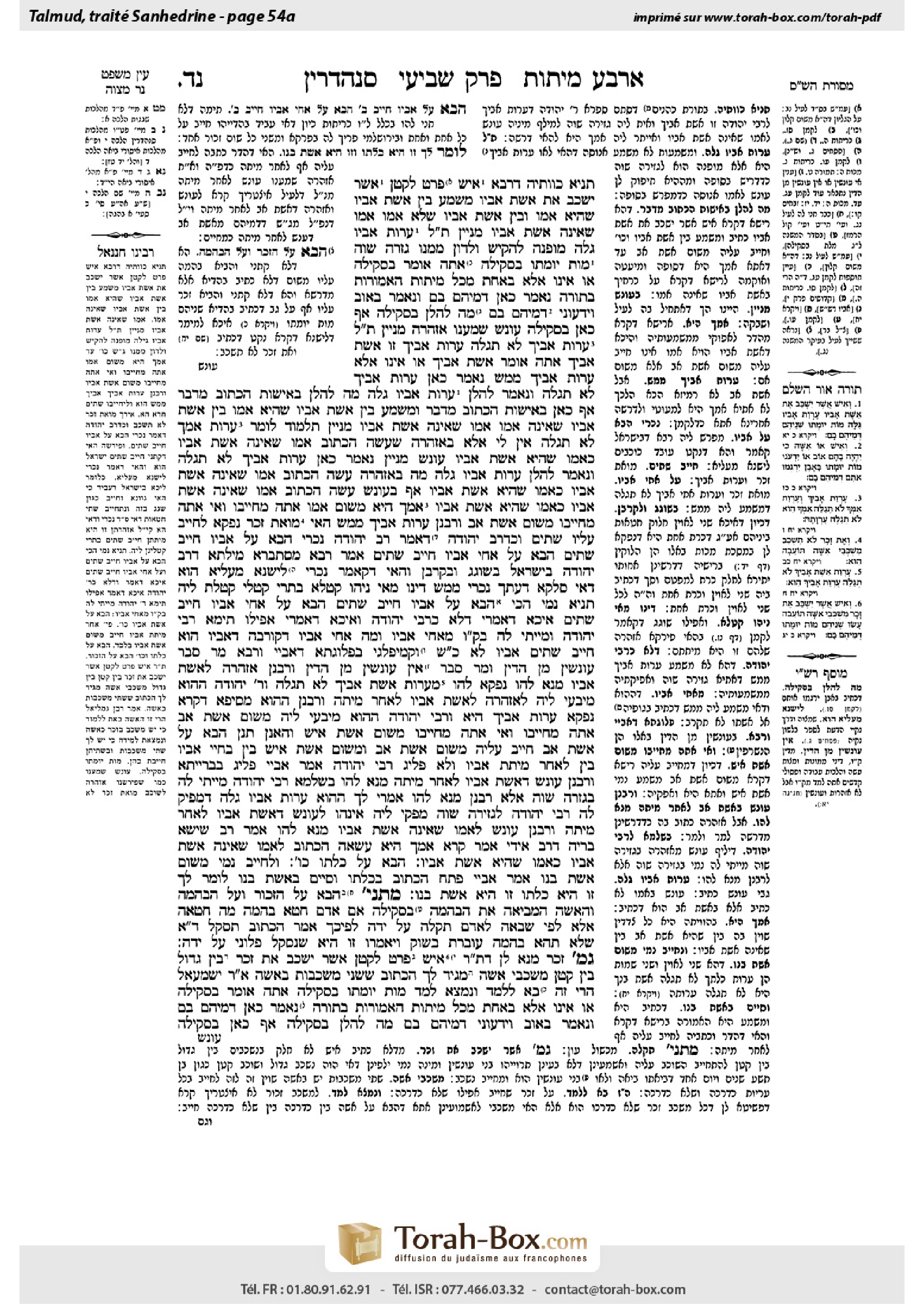
Sanhedrin 54a: Talmud study for Daf Yomi
Daf Yomi is the daily study of one Talmud folio. Explore 37 tractates with scans, Hebrew text, Sefaria English and AI-generated French translations where annotated.
Passage selection and English or AI-generated French translation are available where the scan has annotations. Daf Study is independent of Torah-Box and Sefaria.
Browse Sanhedrin · סנהדרין · All tractatesSanhedrin 54a text and translations
This page of Sanhedrin includes the Aramaic text, an English translation and an AI-generated French translation, alongside the scan above.
סנהדרין נ״ד א · Aramaic and Hebrew text
תַּנְיָא כְּוָותֵיהּ דְּרָבָא: ״אִישׁ״ – פְּרָט לְקָטָן.
״אֲשֶׁר יִשְׁכַּב אֶת אֵשֶׁת אָבִיו״ – מַשְׁמָע בֵּין אֵשֶׁת אָבִיו שֶׁהִיא אִמּוֹ, וּבֵין אֵשֶׁת אָבִיו שֶׁלֹּא אִמּוֹ. אִמּוֹ שֶׁאֵינָהּ אֵשֶׁת אָבִיו מִנַּיִין? תַּלְמוּד לוֹמַר: ״עֶרְוַת אָבִיו גִּלָּה״, מוּפְנֶה לְהַקִּישׁ וְלָדוּן מִמֶּנּוּ גְּזֵרָה שָׁוָה.
״מוֹת יוּמְתוּ״ – בִּסְקִילָה. אַתָּה אוֹמֵר בִּסְקִילָה, אוֹ אֵינוֹ אֶלָּא בְּאַחַת מִכׇּל מִיתוֹת הָאֲמוּרוֹת בַּתּוֹרָה? נֶאֱמַר כָּאן ״דְּמֵיהֶם בָּם״, וְנֶאֱמַר בְּאוֹב וְיִדְּעוֹנִי ״דְּמֵיהֶם בָּם״. מָה לְהַלָּן בִּסְקִילָה, אַף כָּאן בִּסְקִילָה.
עוֹנֶשׁ שָׁמַעְנוּ, אַזְהָרָה מִנַּיִין? תַּלְמוּד לוֹמַר: ״עֶרְוַת אָבִיךָ לֹא תְגַלֵּה״. ״עֶרְוַת אָבִיךָ״ – זוֹ אֵשֶׁת אָבִיךָ.
אַתָּה אוֹמֵר: ״אֵשֶׁת אָבִיךָ״, אוֹ אֵינוֹ אֶלָּא עֶרְוַת אָבִיךָ מַמָּשׁ? נֶאֱמַר כָּאן ״עֶרְוַת אָבִיךָ לֹא תְגַלֵּה״, וְנֶאֱמַר לְהַלָּן ״עֶרְוַת אָבִיו גִּלָּה״. מָה לְהַלָּן בְּאִישׁוּת הַכָּתוּב מְדַבֵּר, אַף כָּאן בְּאִישׁוּת הַכָּתוּב מְדַבֵּר.
וּמַשְׁמָע, בֵּין אֵשֶׁת אָבִיו שֶׁהִיא אִמּוֹ, בֵּין אֵשֶׁת אָבִיו שֶׁאֵינָהּ אִמּוֹ. אִמּוֹ שֶׁאֵינָהּ אֵשֶׁת אָבִיו מִנַּיִין? תַּלְמוּד לוֹמַר: ״עֶרְוַת אִמְּךָ לֹא תְגַלֵּה״.
אֵין לִי אֶלָּא בְּאַזְהָרָה, שֶׁעָשָׂה הַכָּתוּב אִמּוֹ שֶׁאֵינָהּ אֵשֶׁת אָבִיו כְּאִמּוֹ שֶׁהִיא אֵשֶׁת אָבִיו. עוֹנֶשׁ מִנַּיִין?
נֶאֱמַר כָּאן ״עֶרְוַת אָבִיךָ לֹא תְגַלֵּה״, וְנֶאֱמַר לְהַלָּן ״עֶרְוַת אָבִיו גִּלָּה״. מָה בְּאַזְהָרָה עָשָׂה הַכָּתוּב אִמּוֹ שֶׁאֵינָהּ אֵשֶׁת אָבִיו כְּאִמּוֹ שֶׁהִיא אֵשֶׁת אָבִיו, אַף בְּעוֹנֶשׁ עָשָׂה הַכָּתוּב אִמּוֹ שֶׁאֵינָהּ אֵשֶׁת אָבִיו כְּאִמּוֹ שֶׁהִיא אֵשֶׁת אָבִיו.
״אִמְּךָ הִיא״ – מִשּׁוּם אִמּוֹ אַתָּה מְחַיְּיבוֹ, וְאִי אַתָּה מְחַיְּיבוֹ מִשּׁוּם אֵשֶׁת אָב.
וְרַבָּנַן, ״עֶרְוַת אָבִיךָ״ – מַמָּשׁ.
הַאי מִ״וְּאֶת זָכָר״ נָפְקָא? לְחַיֵּיב עָלָיו שְׁתַּיִם.
וְכִדְרַב יְהוּדָה, דְּאָמַר רַב יְהוּדָה: נׇכְרִי הַבָּא עַל אָבִיו – חַיָּיב שְׁתַּיִם, הַבָּא עַל אֲחִי אָבִיו – חַיָּיב שְׁתַּיִם.
אָמַר רָבָא: מִסְתַּבְּרָא מִילְּתָא דְּרַב יְהוּדָה בְּיִשְׂרָאֵל בְּשׁוֹגֵג, וּבְקׇרְבָּן. וְהַאי דְּקָאָמַר נׇכְרִי – לִישָּׁנָא מְעַלְּיָא הוּא. דְּאִי סָלְקָא דַעְתָּךְ נׇכְרִי מַמָּשׁ, דִּינוֹ מַאי נִיהוּ? קְטָלָא! בִּתְרֵי קְטָלֵי קָטְלַתְּ לֵיהּ?
תַּנְיָא נָמֵי הָכִי: הַבָּא עַל אָבִיו – חַיָּיב שְׁתַּיִם, הַבָּא עַל אֲחִי אָבִיו – חַיָּיב שְׁתַּיִם.
אִיכָּא דְאָמְרִי: דְּלָא כְּרַבִּי יְהוּדָה.
וְאִיכָּא דְּאָמְרִי: אֲפִילּוּ תֵּימָא רַבִּי יְהוּדָה, וּמַיְיתֵי לַהּ בְּקַל וָחוֹמֶר מֵאֲחִי אָבִיו. וּמָה אֲחִי אָבִיו, דְּקוּרְבָה דְּאָבִיו הוּא, חַיָּיב שְׁתַּיִם – אָבִיו לֹא כׇּל שֶׁכֵּן?
וְקָמִיפַּלְגִי בִּפְלוּגְתָּא דְּאַבָּיֵי וְרָבָא. מָר סָבַר: עוֹנְשִׁין מִן הַדִּין, וּמַר סָבַר: אֵין עוֹנְשִׁין מִן הַדִּין.
וְרַבָּנַן, אַזְהָרָה לְאֵשֶׁת אָבִיו מְנָא לְהוּ? נָפְקָא לְהוּ מֵ״עֶרְוַת אֵשֶׁת אָבִיךָ לֹא תְגַלֵּה״.
וְרַבִּי יְהוּדָה, הָהוּא מִיבְּעֵי לֵיהּ לְאַזְהָרָה לְאֵשֶׁת אָבִיו לְאַחַר מִיתָה.
וְרַבָּנַן, הַהוּא מִסֵּיפָא דִּקְרָא נָפְקָא: ״עֶרְוַת אָבִיךָ הִיא״.
וְרַבִּי יְהוּדָה, הָהוּא מִיבְּעֵי לֵיהּ: מִשּׁוּם אֵשֶׁת אָב אַתָּה מְחַיְּיבוֹ, וְאִי אַתָּה מְחַיְּיבוֹ מִשּׁוּם אֵשֶׁת אִישׁ.
וְהָאֲנַן תְּנַן: הַבָּא עַל אֵשֶׁת אָב, חַיָּיב עָלֶיהָ מִשּׁוּם אֵשֶׁת אָב וּמִשּׁוּם אֵשֶׁת אִישׁ, בֵּין בְּחַיֵּי אָבִיו בֵּין לְאַחַר מִיתַת אָבִיו, וְלָא פְּלִיג רַבִּי יְהוּדָה?
אָמַר אַבָּיֵי: פְּלִיג בְּבָרַיְיתָא.
וְרַבָּנַן, עוֹנֶשׁ דְּאֵשֶׁת אָבִיו לְאַחַר מִיתָה מְנָא לְהוּ? בִּשְׁלָמָא רַבִּי יְהוּדָה מַיְיתֵי לַהּ בִּגְזֵרָה שָׁוָה, אֶלָּא רַבָּנַן מְנָא לְהוּ?
אָמְרִי לָךְ: הָהוּא ״עֶרְוַת אָבִיו גִּלָּה״ דְּמַפֵּיק לַהּ רַבִּי יְהוּדָה לִגְזֵירָה שָׁוָה, מַפְּקִי לֵיהּ אִינְהוּ לְעוֹנֶשׁ דְּאֵשֶׁת אָבִיו לְאַחַר מִיתָה.
וְרַבָּנַן, עוֹנֶשׁ לְאִמּוֹ שֶׁאֵינָהּ אֵשֶׁת אָבִיו מְנָא לְהוּ? אָמַר רַב שִׁישָׁא בְּרֵיהּ דְּרַב אִידִי: אָמַר קְרָא ״אִמְּךָ הִיא״. עֲשָׂאָהּ הַכָּתוּב לְאִמּוֹ שֶׁאֵינָהּ אֵשֶׁת אָבִיו כְּאִמּוֹ שֶׁהִיא אֵשֶׁת אָבִיו.
הַבָּא עַל כַּלָּתוֹ כּוּ׳. וְלִחַיַּיב נָמֵי מִשּׁוּם אֵשֶׁת בְּנוֹ? אָמַר אַבָּיֵי: פָּתַח הַכָּתוּב בְּכַלָּתוֹ וְסִיֵּים בְּאֵשֶׁת בְּנוֹ, לוֹמַר לָךְ זוֹ הִיא כַּלָּתוֹ זוֹ הִיא אֵשֶׁת בְּנוֹ.
מַתְנִי׳ הַבָּא עַל הַזְּכוּר, וְעַל הַבְּהֵמָה, וְהָאִשָּׁה הַמְּבִיאָה אֶת הַבְּהֵמָה – בִּסְקִילָה. אִם אָדָם חָטָא, בְּהֵמָה מֶה חָטְאָה? אֶלָּא לְפִי שֶׁבָּאָה לְאָדָם תַּקָּלָה עַל יָדָהּ, לְפִיכָךְ אָמַר הַכָּתוּב תִּסָּקֵל. דָּבָר אַחֵר: שֶׁלֹּא תְּהֵא בְּהֵמָה עוֹבֶרֶת בַּשּׁוּק וְיֹאמְרוּ ״זוֹ הִיא שֶׁנִּסְקַל פְּלוֹנִי עַל יָדָהּ״.
גְּמָ׳ זָכָר מְנָא לַן? דְּתָנוּ רַבָּנַן: ״אִישׁ״ – פְּרָט לְקָטָן, ״אֲשֶׁר יִשְׁכַּב אֶת זָכָר״ – בֵּין גָּדוֹל בֵּין קָטָן, ״מִשְׁכְּבֵי אִשָּׁה״ – מַגִּיד לְךָ הַכָּתוּב שֶׁשְּׁנֵי מִשְׁכָּבוֹת בָּאִשָּׁה.
אָמַר רַבִּי יִשְׁמָעֵאל: הֲרֵי זֶה בָּא לְלַמֵּד, וְנִמְצָא לָמֵד.
״מוֹת יוּמָתוּ״ – בִּסְקִילָה. אַתָּה אוֹמֵר בִּסְקִילָה, אוֹ אֵינוֹ אֶלָּא בְּאַחַת מִכׇּל מִיתוֹת הָאֲמוּרוֹת בַּתּוֹרָה? נֶאֱמַר כָּאן ״דְּמֵיהֶם בָּם״, וְנֶאֱמַר בְּאוֹב וְיִדְּעוֹנִי ״דְּמֵיהֶם בָּם״. מָה לְהַלָּן בִּסְקִילָה, אַף כָּאן בִּסְקִילָה.
Sanhedrin 54a · English translation
§ It is taught in a baraita in accordance with the opinion of Rava: With regard to the verse: “And the man who lies with his father’s wife, he has uncovered his father’s nakedness; both of them shall be put to death, their blood shall be upon them” (Leviticus 20:11), the term: “The man,” excludes a minor.
The phrase “who lies with his father’s wife” indicates that he is liable to receive capital punishment whether she is his father’s wife who is his mother or whether she is his father’s wife who is not his mother. From where is it derived that he is liable in a case where she is his mother who is not his father’s wife? The verse states: “He has uncovered his father’s nakedness.” Although this phrase does not relate directly to the case of one’s mother who is not his father’s wife, the halakha in this case is derived from this phrase as it is free, i.e., the phrase is superfluous in this context, and is evidently included in the verse in order to compare between the two cases and learn a verbal analogy from it, as the baraita will elaborate below.
From the phrase “both of them shall be put to death” it is derived that they are executed by stoning. The baraita asks: Do you say that that they are executed by stoning, or is it rather by one of all the other types of the death penalty that are stated in the Torah? The baraita answers: It is stated here: “Their blood shall be upon them,” and it is stated with regard to a necromancer and a sorcerer: “Their blood shall be upon them” (Leviticus 20:27). Just as there the verse states that a necromancer and a sorcerer are executed by stoning, so too here, with regard to one who engages in intercourse with his father’s wife, the transgressors are executed by stoning.
The baraita asks: We have learned the punishment for one who engages in intercourse with his father’s wife. From where is the prohibition against doing this act derived? The baraita answers: The verse states: “The nakedness of your father and the nakedness of your mother you shall not uncover” (Leviticus 18:7); the phrase “the nakedness of your father” is referring to your father’s wife.
The baraita asks: Do you say that the reference is to your father’s wife, or is it rather referring to the nakedness of your father literally, i.e., to homosexual intercourse with one’s father? The baraita answers: It is stated here: “The nakedness of your father…you shall not uncover,” and it is stated there, in the verse that describes the punishment: “And the man who lies with his father’s wife, he has uncovered his father’s nakedness” (Leviticus 20:11). Just as there, the verse is speaking of marriage, i.e., it is not referring to the father himself but to his wife, so too here, the verse is speaking of marriage, i.e., his father’s wife.
And the verse indicates that one’s father’s wife is forbidden to him whether she is his father’s wife who is his mother or whether she is his father’s wife who is not his mother. From where is it derived that she is forbidden to him in a case where she is his mother who is not his father’s wife? The verse states: “The nakedness of your mother you shall not uncover” (Leviticus 18:7).
The baraita asks: I have derived only with regard to the prohibition that the verse renders the halakha of his mother who is not his father’s wife like that of his mother who is his father’s wife. But with regard to the punishment, from where do I derive that they share the same halakha?
The baraita answers, expounding on the verbal analogy it mentioned earlier: It is stated here, in the verse that describes the prohibition: “The nakedness of your father…you shall not uncover” (Leviticus 18:7), and it is stated there, in the verse that describes the punishment: “He has uncovered his father’s nakedness” (Leviticus 20:11). It is derived from this verbal analogy that just as with regard to the prohibition, the verse renders his mother who is not his father’s wife like his mother who is his father’s wife, i.e., both are forbidden, so too, with regard to the punishment, the verse renders his mother who is not his father’s wife like his mother who is his father’s wife.
It is derived from the phrase: “She is your mother” (Leviticus 18:7), that you render him liable due to the prohibition against engaging in intercourse with his mother, but you do not render him liable due to the prohibition against engaging in intercourse with his father’s wife. The baraita ends here. Since the halakhot in the collection of baraitot where this baraita appears, Torat Kohanim, are in accordance with the opinions of Rabbi Yehuda, the baraita supports the opinion of Rava, who explains the opinion of Rabbi Yehuda in this manner.
The Gemara discusses the baraita, asking: And how do the Rabbis, who disagree with Rabbi Yehuda, interpret the phrase “the nakedness of your father”? The Gemara answers: They hold that this phrase is meant literally, i.e., that it is referring to homosexual intercourse. They do not accept the verbal analogy from which Rabbi Yehuda derives that the reference is to intercourse with one’s father’s wife.
The Gemara asks: Isn’t this prohibition against homosexual intercourse with one’s father derived from the verse: “And you shall not lie with a male as with a woman; it is an abomination” (Leviticus 18:22)? The Gemara answers: The prohibition is stated specifically with regard to one’s father in order to render him liable to bring two sin-offerings for unwittingly engaging in intercourse with his father.
And it is in accordance with the statement of Rav Yehuda, as Rav Yehuda says: A gentile who engages in intercourse with his father is liable for committing two transgressions. Likewise, one who engages in intercourse with his father’s brother is liable for committing two transgressions.
Rava says: It stands to reason that the statement of Rav Yehuda is with regard to a Jew who does this unwittingly. And the statement that he is liable for committing two transgressions concerns his liability to bring an offering, i.e., he is liable to bring two sin-offerings. And even though the fact remains that he said gentile, it is a euphemism, as he did not want to attribute such a sin to a Jew. As if it enters your mind that the reference is literally to a gentile, the statement that he is liable for committing two transgressions is meaningless; what is his punishment for such a transgression? It is death. Could you kill him twice? Rather, it must be referring to a Jew who acted unwittingly.
This halakha is also taught in a baraita: One who engages in intercourse with his father is liable for committing two transgressions. One who engages in intercourse with his father’s brother is liable for committing two transgressions, as it is stated: “You shall not uncover the nakedness of your father’s brother” (Leviticus 18:14).
Some say that this is not in accordance with the opinion of Rabbi Yehuda, as in his opinion there is no special prohibition against homosexual intercourse with one’s father. He interprets the verse: “The nakedness of your father…you shall not uncover” as referring to one’s father’s wife. Accordingly, one who engages in homosexual intercourse with his father or with his father’s brother is liable only due to the general prohibition against homosexual intercourse.
And some say: You may even say that the baraita is in accordance with the opinion of Rabbi Yehuda, and that he derives that there is a specific prohibition against homosexual intercourse with one’s father by an a fortiori inference from the prohibition concerning one’s father’s brother. And the inference is as follows: If for intercourse with one’s father’s brother, who is merely his father’s relative, one is liable for committing two transgressions, for intercourse with his father, is it not clear all the more so that he should be liable for committing two transgressions?
And the Sages who provide these two interpretations of Rabbi Yehuda’s opinion disagree with regard to the issue that is the subject of the dispute between Abaye and Rava. One Sage, he of the second interpretation, holds that one administers punishment based on an a fortiori inference. Even with regard to a prohibition that is derived a fortiori, one who transgresses it is liable. And one Sage, he of the first interpretation, holds that one does not administer punishment based on an a fortiori inference.
The Gemara asks: And with regard to the Rabbis, who disagree with the opinion of Rabbi Yehuda, from where do they derive the prohibition of intercourse with one’s father’s wife? The Gemara answers: They derive it from the verse: “The nakedness of your father’s wife you shall not uncover; it is your father’s nakedness” (Leviticus 18:8).
The Gemara asks: And what does Rabbi Yehuda derive from this verse, since he derives the prohibition from the verse: “The nakedness of your father…you shall not uncover”? The Gemara answers: That verse is necessary for the prohibition of one’s father’s wife after his father’s death; even though his father is dead, his father’s wife remains forbidden to him.
The Gemara asks: And from where do the Rabbis derive that halakha? The Gemara answers: That halakha is derived from the last clause of the verse: “It is your father’s nakedness.”
The Gemara asks: And what does Rabbi Yehuda derive from that clause? The Gemara answers: That clause is necessary to teach the halakha that if one engages in intercourse with his father’s wife, you render him liable due to the prohibition against engaging in intercourse with his father’s wife, but you do not render him liable due to the prohibition against engaging in intercourse with a married woman.
The Gemara asks: But didn’t we learn in the mishna: One who engages in intercourse with his father’s wife is liable to bring two offerings, one due to the fact that she is his father’s wife and one due to the fact that she is a married woman, and he is liable due to the former prohibition both during his father’s lifetime and after his father’s death? The Gemara notes: And Rabbi Yehuda does not dispute this. So how can it be suggested that in Rabbi Yehuda’s opinion, one who engages in intercourse with his father’s wife is not liable for engaging in intercourse with a married woman?
Abaye says: He disputes this ruling in a baraita. Although it is not mentioned in the mishna that Rabbi Yehuda disputes this ruling, it is mentioned in a different source.
The Gemara asks: And as for the Rabbis, from where do they derive the punishment for one who engages in intercourse with his father’s wife after his father’s death? Granted, according to Rabbi Yehuda, it is derived by means of a verbal analogy. But from where do the Rabbis, who do not accept the verbal analogy, derive it?
The Gemara answers: The Rabbis can say to you that it is derived as follows: With regard to that phrase, “he has uncovered his father’s nakedness,” from which Rabbi Yehuda derives a verbal analogy, they derive from it the punishment for one who engages in intercourse with his father’s wife after his father’s death.
The Gemara asks: And as for the Rabbis, from where do they derive the punishment for one who engages in intercourse with his mother who is not his father’s wife? Rav Sheisha, son of Rav Idi, says: The verse states: “She is your mother” (Leviticus 18:7). The verse renders the halakha of his mother who is not his father’s wife like that of his mother who is his father’s wife.
The mishna teaches with regard to one who engages in intercourse with his daughter-in-law that he is liable both due to the fact that she is his daughter-in-law and due to the fact that she is a married woman. The Gemara asks: And let him also be liable due to engaging in intercourse with his son’s wife, as it is stated in the verse: “You shall not uncover the nakedness of your daughter-in-law; she is your son’s wife, you shall not uncover her nakedness” (Leviticus 18:15). Abaye says: The verse begins with his daughter-in-law and ends with his son’s wife, to tell you that these are not two prohibitions; rather, his daughter-in-law [kallato] is his son’s wife. They are one and the same.
MISHNA: A man who engages in intercourse with a male or with an animal, and a woman who engages in intercourse with an animal, are executed by stoning. The animal is likewise stoned to death. The mishna asks: If the person sinned by doing this, how did the animal sin? Rather, because a calamity was caused to a person by it, therefore the verse states that it should be stoned, so that it does not cause another to sin. Alternatively, it is so that this animal will not pass through the marketplace, and those who see it will say: This is the animal because of which so-and-so was stoned, and its existence would shame his memory.
GEMARA: From where do we derive the prohibition and punishment for homosexual intercourse with a male? It is as the Sages taught in a baraita with regard to the verse: “And if a man lies with a male as with a woman, both of them have committed an abomination; they shall be put to death, their blood shall be upon them” (Leviticus 20:13): The word “man” excludes a minor boy. The phrase “lies with a male” is referring to any male, whether he is an adult man or whether he is a minor boy. The phrase “as with a woman [mishkevei isha],” referring to lying with a woman, appears in the plural. The verse teaches you that there are two manners of lying with a woman for which one who engages in intercourse with a woman forbidden to him is punished, vaginal and anal intercourse.
Rabbi Yishmael says: This phrase is written to come to teach about the punishment for homosexual intercourse, and the halakha that one is liable for anal intercourse with a woman who is forbidden to him is found to be derived from it.
The phrase “they shall be put to death” is referring to execution by stoning. Do you say that they are executed by stoning, or is it rather by one of all the other types of death penalty that are stated in the Torah? It is stated here: “Their blood shall be upon them,” and it is stated with regard to a necromancer and a sorcerer: “Their blood shall be upon them” (Leviticus 20:27). Just as there the verse states that a necromancer and a sorcerer are executed by stoning, so too here, they are executed by stoning.
Sanhedrin 54a · Traduction française (IA)
§ Il est enseigné dans une baraïta, conformément à l'opinion de Rava : Concernant le verset : « Et l'homme qui couche avec la femme de son père, il a découvert la nudité de son père ; tous deux seront mis à mort, leur sang sera sur eux » (Lévitique 20:11), le terme : « L'homme », exclut un mineur.
La phrase « qui couche avec la femme de son père » indique qu'il est passible de la peine capitale, que ce soit avec la femme de son père qui est sa mère, ou avec la femme de son père qui n'est pas sa mère. D'où est-il dérivé qu'il est passible dans le cas où elle est sa mère qui n'est pas la femme de son père ? Le verset énonce : « Il a découvert la nudité de son père. » Bien que cette phrase ne se rapporte pas directement au cas de la mère qui n'est pas la femme du père, la halakha dans ce cas est dérivée de cette phrase, car elle est libre, c'est-à-dire que la phrase est superflue dans ce contexte, et est manifestement incluse dans le verset afin d'établir une comparaison entre les deux cas et d'en tirer une analogie verbale, comme la baraïta le développera ci-dessous.
De la phrase « tous deux seront mis à mort », il est dérivé qu'ils sont exécutés par lapidation. La baraïta demande : Dites-vous qu'ils sont exécutés par lapidation, ou est-ce plutôt par l'un des autres types de peine capitale énoncés dans la Torah ? La baraïta répond : Il est énoncé ici : « Leur sang sera sur eux », et il est énoncé à propos d'un nécromancien et d'un sorcier : « Leur sang sera sur eux » (Lévitique 20:27). De même qu'ici le verset énonce qu'un nécromancien et un sorcier sont exécutés par lapidation, de même ici, à propos de celui qui a des rapports avec la femme de son père, les transgresseurs sont exécutés par lapidation.
La baraïta demande : Nous avons appris la punition pour celui qui a des rapports avec la femme de son père. D'où est dérivée l'interdiction de commettre cet acte ? La baraïta répond : Le verset énonce : « La nudité de ton père et la nudité de ta mère, tu ne les découvriras pas » (Lévitique 18:7) ; l'expression « la nudité de ton père » se réfère à la femme de ton père.
La baraïta demande : Dites-vous que la référence est à la femme de ton père, ou est-ce plutôt une référence à la nudité de ton père au sens littéral, c'est-à-dire aux rapports homosexuels avec son père ? La baraïta répond : Il est énoncé ici : « La nudité de ton père… tu ne la découvriras pas », et il est énoncé là, dans le verset qui décrit la punition : « Et l'homme qui couche avec la femme de son père, il a découvert la nudité de son père » (Lévitique 20:11). De même qu'ici le verset parle de mariage, c'est-à-dire qu'il ne se réfère pas au père lui-même mais à sa femme, de même ici le verset parle de mariage, c'est-à-dire à la femme de son père.
Et le verset indique que la femme de son père lui est interdite, qu'elle soit la femme de son père qui est sa mère, ou qu'elle soit la femme de son père qui n'est pas sa mère. D'où est-il dérivé qu'elle lui est interdite dans le cas où elle est sa mère qui n'est pas la femme de son père ? Le verset énonce : « La nudité de ta mère, tu ne la découvriras pas » (Lévitique 18:7).
La baraïta demande : J'ai dérivé uniquement en ce qui concerne l'interdiction que le verset assimile la halakha de sa mère, qui n'est pas la femme de son père, à celle de sa mère, qui est la femme de son père. Mais en ce qui concerne la punition, d'où déduis-je qu'elles partagent la même halakha ?
La baraïta répond, en exposant l'analogie verbale qu'elle a mentionnée plus tôt : Il est énoncé ici, dans le verset qui décrit l'interdiction : « La nudité de ton père… tu ne la découvriras pas » (Lévitique 18:7), et il est énoncé là, dans le verset qui décrit la punition : « Il a découvert la nudité de son père » (Lévitique 20:11). Il est déduit de cette analogie verbale que de même qu'en ce qui concerne l'interdiction, le verset assimile sa mère, qui n'est pas la femme de son père, à sa mère, qui est la femme de son père, c'est-à-dire que toutes deux sont interdites, de même, en ce qui concerne la punition, le verset assimile sa mère, qui n'est pas la femme de son père, à sa mère, qui est la femme de son père.
Il est déduit de la phrase : « Elle est ta mère » (Lévitique 18:7), que tu le rends passible en raison de l'interdiction d'avoir des rapports avec sa mère, mais tu ne le rends pas passible en raison de l'interdiction d'avoir des rapports avec la femme de son père. La baraïta s'arrête ici. Puisque les halakhot dans la collection de baraïtot où apparaît cette baraïta, Torat Kohanim, sont conformes aux opinions de Rabbi Yehuda, la baraïta soutient l'opinion de Rava, qui explique l'opinion de Rabbi Yehuda de cette manière.
La Guemara examine la baraïta et demande : Comment les Sages, qui ne sont pas d'accord avec Rabbi Yehuda, interprètent-ils l'expression « la nudité de ton père » ? La Guemara répond : Ils soutiennent que cette expression doit être comprise au sens littéral, c'est-à-dire qu'elle fait référence à la sodomie. Ils n'acceptent pas l'analogie verbale à partir de laquelle Rabbi Yehuda déduit que la référence porte sur les rapports avec la femme de son père.
La Guemara demande : Cette interdiction de la sodomie avec son père n'est-elle pas dérivée du verset : « Tu ne coucheras pas avec un mâle comme on couche avec une femme ; c'est une abomination » (Lévitique 18:22) ? La Guemara répond : L'interdiction est énoncée spécifiquement à propos de son père afin de le rendre passible d'apporter deux sacrifices expiatoires pour avoir involontairement eu des rapports avec son père.
Et cela est conforme à l'enseignement de Rav Yehuda, car Rav Yehuda dit : Un non-Juif qui a des rapports avec son père est passible de deux transgressions. De même, celui qui a des rapports avec le frère de son père est passible de deux transgressions.
Rava dit : Il va de soi que l'enseignement de Rav Yehuda concerne un Juif qui commet cet acte sans le savoir. Et l'enseignement selon lequel il est passible de deux transgressions concerne sa responsabilité d'apporter une offrande, c'est-à-dire qu'il est tenu d'apporter deux sacrifices expiatoires. Et bien que le fait demeure qu'il a dit « païen », c'est une périphrase, car il ne voulait pas attribuer un tel péché à un Juif. Comme si cela vous venait à l'esprit que la référence est littéralement à un païen, l'enseignement selon lequel il est passible de deux transgressions serait sans sens ; quelle est sa punition pour une telle transgression ? C'est la mort. Pourriez-vous le tuer deux fois ? Plutôt, cela doit se référer à un Juif qui a agi sans le savoir.
Cette halakha est également enseignée dans une baraïta : Celui qui a des relations sexuelles avec son père est passible de deux transgressions. Celui qui a des relations sexuelles avec le frère de son père est passible de deux transgressions, car il est écrit : « Tu ne découvriras pas la nudité du frère de ton père » (Lévitique 18:14).
Certains disent que cela ne concorde pas avec l'opinion de Rabbi Yehuda, car selon son avis, il n'y a pas d'interdiction spécifique concernant les relations homosexuelles avec son père. Il interprète le verset : « La nudité de ton père… tu ne la découvriras pas » comme se référant à la femme de son père. En conséquence, celui qui a des relations homosexuelles avec son père ou avec le frère de son père n'est passible que par l'interdiction générale des relations homosexuelles.
Et certains disent : Vous pouvez même dire que la baraïta est conforme à l'opinion de Rabbi Yehuda, et qu'il déduit qu'il existe une interdiction spécifique des relations homosexuelles avec son père par une inférence a fortiori à partir de l'interdiction concernant le frère de son père. Et l'inférence est la suivante : Si pour les relations avec le frère de son père, qui n'est que le parent de son père, on est passible de deux transgressions, pour les relations avec son père, n'est-il pas évident a fortiori qu'il doit être passible de deux transgressions ?
Et les Sages qui fournissent ces deux interprétations de l'opinion de Rabbi Yehuda sont en désaccord sur la question qui fait l'objet de la controverse entre Abaye et Rava. Un Sage, celui de la seconde interprétation, soutient qu'on administre la punition sur la base d'une inférence a fortiori. Même en ce qui concerne une interdiction déduite a fortiori, celui qui la transgresse est passible. Et un Sage, celui de la première interprétation, soutient qu'on n'administre pas la punition sur la base d'une inférence a fortiori.
La Guemara demande : Et en ce qui concerne les Rabbins, qui sont en désaccord avec l'opinion de Rabbi Yehuda, d'où déduisent-ils l'interdiction des relations avec la femme de son père ? La Guemara répond : Ils la déduisent du verset : « La nudité de la femme de ton père, tu ne la découvriras pas ; c'est la nudité de ton père » (Lévitique 18:8).
La Guemara demande : Et que déduit Rabbi Yehuda de ce verset, puisqu'il déduit l'interdiction du verset : « La nudité de ton père… tu ne la découvriras pas » ? La Guemara répond : Ce verset est nécessaire pour l'interdiction de la femme de son père après la mort de son père ; bien que son père soit mort, la femme de son père reste interdite pour lui.
La Guemara demande : Et d'où les Rabbins déduisent-ils cette halakha ? La Guemara répond : Cette halakha est déduite de la dernière clause du verset : « C'est la nudité de ton père ».
La Guemara demande : Et que déduit Rabbi Yehuda de cette clause ? La Guemara répond : Cette clause est nécessaire pour enseigner la halakha selon laquelle si quelqu'un a des relations avec la femme de son père, vous le rendez passible par l'interdiction des relations avec la femme de son père, mais vous ne le rendez pas passible par l'interdiction des relations avec une femme mariée.
La Guemara demande : Mais n'avons-nous pas appris dans la Michna : Celui qui a des relations sexuelles avec la femme de son père est tenu d'apporter deux offrandes, l'une en raison du fait qu'elle est la femme de son père et l'autre en raison du fait qu'elle est une femme mariée, et il est passible en vertu de la première interdiction tant pendant la vie de son père qu'après la mort de son père ? La Guemara note : Et Rabbi Yehuda ne conteste pas cela. Comment donc peut-on suggérer que, selon l'opinion de Rabbi Yehuda, celui qui a des relations sexuelles avec la femme de son père n'est pas passible pour des relations avec une femme mariée ?
Abaye dit : Il conteste cette décision dans une baraïta. Bien qu'il ne soit pas mentionné dans la Michna que Rabbi Yehuda conteste cette décision, cela est mentionné dans une autre source.
La Guemara demande : Et quant aux Rabbins, d'où déduisent-ils la punition pour celui qui a des relations sexuelles avec la femme de son père après la mort de son père ? Certes, selon Rabbi Yehuda, elle est déduite au moyen d'une analogie verbale. Mais d'où les Rabbins, qui n'acceptent pas l'analogie verbale, la déduisent-ils ?
La Guemara répond : Les Rabbins peuvent vous dire qu'elle est déduite comme suit : En ce qui concerne cette phrase, « il a découvert la nudité de son père », de laquelle Rabbi Yehuda déduit une analogie verbale, ils en déduisent la punition pour celui qui a des relations avec la femme de son père après la mort de son père.
La Guemara demande : Et en ce qui concerne les Rabbins, d'où déduisent-ils la punition pour celui qui a des relations avec sa mère qui n'est pas la femme de son père ? Rav Sheisha, fils de Rav Idi, dit : Le verset dit : « C'est ta mère » (Lévitique 18:7). Le verset assimile la halakha de sa mère qui n'est pas la femme de son père à celle de sa mère qui est la femme de son père.
La Michna enseigne, à propos de celui qui a des relations sexuelles avec sa belle-fille, qu'il est passible de peine tant en raison du fait qu'elle est sa belle-fille qu'en raison du fait qu'elle est une femme mariée. La Guemara demande : Et qu'il soit également passible de peine en raison de ses relations avec la femme de son fils, car il est écrit dans le verset : « Tu ne découvriras pas la nudité de ta belle-fille ; elle est la femme de ton fils, tu ne découvriras pas sa nudité » (Lévitique 18:15). Abaye dit : Le verset commence par sa belle-fille et se termine par la femme de son fils, pour vous faire savoir que ce ne sont pas deux interdictions distinctes ; plutôt, sa belle-fille [kallato] est la femme de son fils. Ce sont une seule et même personne.
MICHNA : Un homme qui a des relations sexuelles avec un homme ou avec un animal, et une femme qui a des relations sexuelles avec un animal, sont exécutés par lapidation. L'animal est également lapidé à mort. La Michna demande : Si la personne a péché en faisant cela, comment l'animal a-t-il péché ? Plutôt, parce qu'un malheur a été causé à une personne par lui, le verset stipule donc qu'il doit être lapidé, afin qu'il ne fasse pas pécher un autre. Ou bien, c'est afin que cet animal ne passe pas sur le marché, et que ceux qui le verront disent : C'est l'animal à cause duquel untel a été lapidé, et son existence porterait atteinte à sa mémoire.
GUEMARA : D'où déduisons-nous l'interdiction et la punition pour les relations homosexuelles avec un homme ? C'est comme l'ont enseigné les Sages dans une baraïta à propos du verset : « Et si un homme couche avec un homme comme avec une femme, tous deux ont commis une abomination ; ils seront mis à mort, leur sang sera sur eux » (Lévitique 20:13) : Le mot « homme » exclut un garçon mineur. L'expression « couche avec un homme » fait référence à tout homme, qu'il soit un homme adulte ou qu'il soit un garçon mineur. L'expression « comme avec une femme [mishkevei isha] », faisant référence à coucher avec une femme, apparaît au pluriel. Le verset vous enseigne qu'il existe deux manières de coucher avec une femme pour lesquelles celui qui a des relations sexuelles avec une femme qui lui est interdite est puni : les relations vaginales et les relations anales.
Rabbi Yishmaël dit : Cette expression est écrite pour venir enseigner la punition pour les relations homosexuelles, et la halakha selon laquelle on est passible de peine pour les relations anales avec une femme qui est interdite à l'homme est trouvée pour être dérivée de là.
L'expression « ils seront mis à mort » fait référence à l'exécution par lapidation. Dites-vous qu'ils sont exécutés par lapidation, ou est-ce plutôt par l'un des autres types de peine de mort énoncés dans la Torah ? Il est écrit ici : « Leur sang sera sur eux », et il est écrit à propos d'un nécromancien et d'un sorcier : « Leur sang sera sur eux » (Lévitique 20:27). De même qu'ici le verset stipule qu'un nécromancien et un sorcier sont exécutés par lapidation, de même ici, ils sont exécutés par lapidation.
Traduction française générée par IA à partir de l’édition anglaise de Sefaria. Vérifie toujours un passage avec le texte source.
Text from Sefaria: William Davidson Edition - Vocalized Aramaic (CC BY NC); William Davidson Edition - English (CC BY NC).