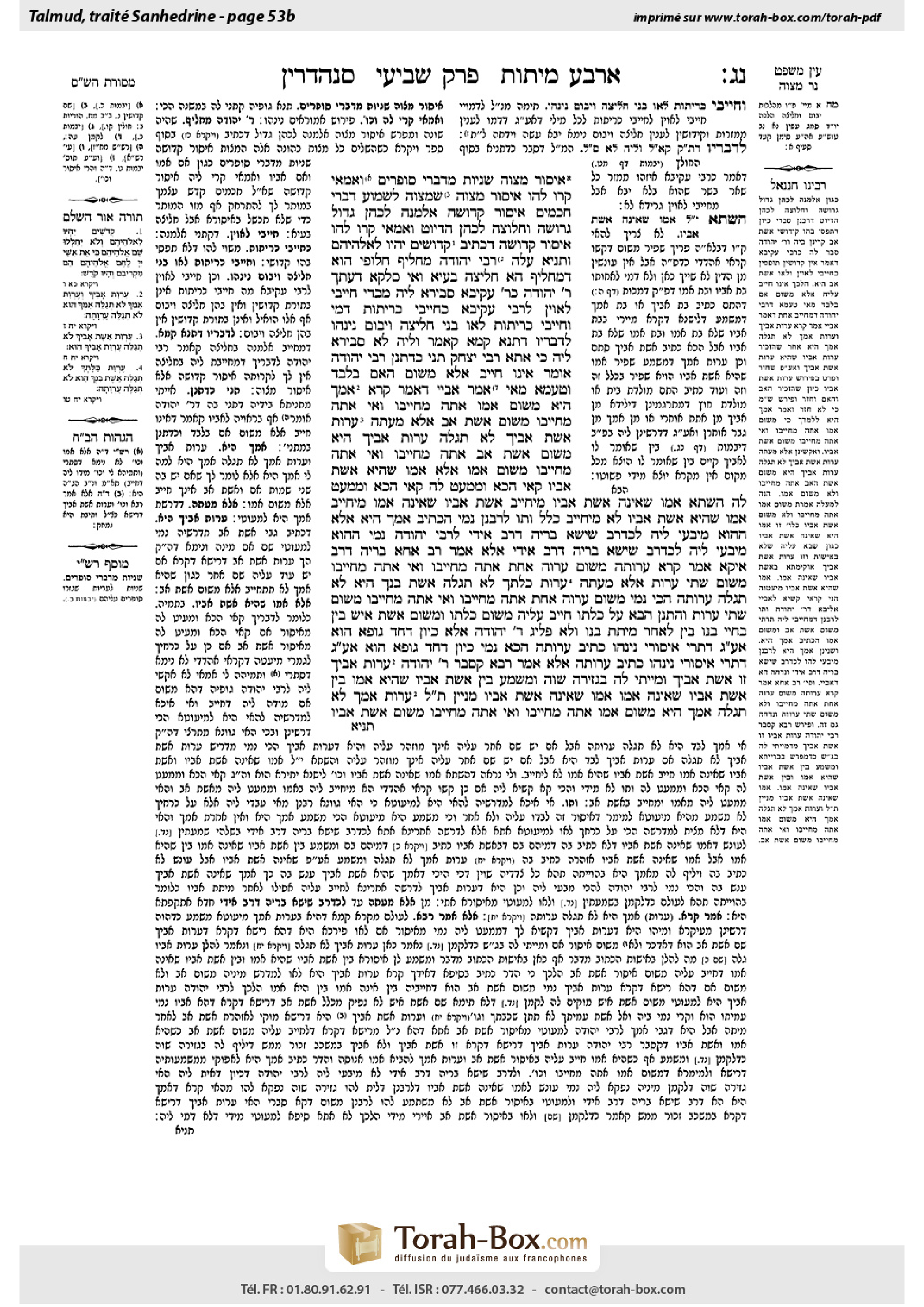
Sanhedrin 53b: Talmud study for Daf Yomi
Daf Yomi is the daily study of one Talmud folio. Explore 37 tractates with scans, Hebrew text, Sefaria English and AI-generated French translations where annotated.
Passage selection and English or AI-generated French translation are available where the scan has annotations. Daf Study is independent of Torah-Box and Sefaria.
Browse Sanhedrin · סנהדרין · All tractatesSanhedrin 53b text and translations
This page of Sanhedrin includes the Aramaic text, an English translation and an AI-generated French translation, alongside the scan above.
סנהדרין נ״ג ב · Aramaic and Hebrew text
אִיסּוּר מִצְוָה – שְׁנִיּוֹת מִדִּבְרֵי סוֹפְרִים. וְאַמַּאי קָרוּ לְהוּ אִיסּוּר מִצְוָה? שֶׁמִּצְוָה לִשְׁמוֹעַ דִּבְרֵי חֲכָמִים.
אִיסּוּר קְדוּשָּׁה – אַלְמָנָה לְכֹהֵן גָּדוֹל, גְּרוּשָׁה וַחֲלוּצָה לְכֹהֵן הֶדְיוֹט. וְאַמַּאי קָרוּ לְהוּ אִיסּוּר קְדוּשָּׁה? דִּכְתִיב: ״קְדֹשִׁים יִהְיוּ לֵאלֹהֵיהֶם״.
וְתַנְיָא עֲלַהּ: רַבִּי יְהוּדָה מַחְלִיף.
חַלּוֹפֵי הוּא דְּמַחְלֵיף, הָא חֲלִיצָה בָּעֲיָא. וְאִי סָלְקָא דַּעְתָּךְ רַבִּי יְהוּדָה כְּרַבִּי עֲקִיבָא סְבִירָא לֵיהּ, מִכְּדִי חַיָּיבֵי לָאוִין לְרַבִּי עֲקִיבָא כְּחַיָּיבֵי כָרֵיתוֹת דְּמֵי, וְחַיָּיבֵי כָרֵיתוֹת לָאו בְּנֵי חֲלִיצָה וְיִבּוּם נִינְהוּ!
לִדְבָרָיו דְּתַנָּא קַמָּא קָאָמַר, וְלֵיהּ לָא סְבִירָא לֵיהּ.
כִּי אֲתָא רַבִּי יִצְחָק, תָּנֵי כְּדִתְנַן: רַבִּי יְהוּדָה אוֹמֵר, אֵינוֹ חַיָּיב אֶלָּא מִשּׁוּם הָאֵם בִּלְבַד.
וְטַעְמָא מַאי? אָמַר אַבָּיֵי: דְּאָמַר קְרָא ״אִמְּךָ הִיא״. מִשּׁוּם אִמּוֹ אַתָּה מְחַיְּיבוֹ, וְאִי אַתָּה מְחַיְּיבוֹ מִשּׁוּם אֵשֶׁת אָב.
אֶלָּא מֵעַתָּה, ״עֶרְוַת אֵשֶׁת אָבִיךָ לֹא תְגַלֵּה עֶרְוַת אָבִיךָ הִיא״, מִשּׁוּם אֵשֶׁת אָב אַתָּה מְחַיְּיבוֹ, וְאִי אַתָּה מְחַיְּיבוֹ מִשּׁוּם אִמּוֹ?
אֶלָּא אִמּוֹ שֶׁהִיא אֵשֶׁת אָבִיו, קָאֵי הָכָא וּמְמַעֵט לַהּ, קָאֵי הָכָא וּמְמַעֵט לַהּ. הַשְׁתָּא, אִמּוֹ שֶׁאֵינָהּ אֵשֶׁת אָבִיו – מִיחַיַּיב, אֵשֶׁת אָבִיו שֶׁאֵינָהּ אִמּוֹ – מִיחַיַּיב, אִמּוֹ שֶׁהִיא אֵשֶׁת אָבִיו – לָא מִיחַיַּיב כְּלָל?
וְתוּ, לְרַבָּנַן נָמֵי, הָכְתִיב ״אִמְּךָ הִיא״? אֶלָּא, הָהוּא מִיבְּעֵי לֵיהּ לְכִדְרַב שִׁישָׁא בְּרֵיהּ דְּרַב אִידִי. לְרַבִּי יְהוּדָה נָמֵי, הָהוּא מִיבְּעֵי לֵיהּ לְכִדְרַב שִׁישָׁא בְּרֵיהּ דְּרַב אִידִי.
אֶלָּא אָמַר רַב אַחָא בְּרֵיהּ דְּרַב אִיקָא: אָמַר קְרָא ״עֶרְוָתָהּ״, מִשּׁוּם עֶרְוָה אַחַת אַתָּה מְחַיְּיבוֹ, וְאִי אַתָּה מְחַיְּיבוֹ מִשּׁוּם שְׁתֵּי עֲרָיוֹת.
אֶלָּא מֵעַתָּה: ״עֶרְוַת כַּלָּתְךָ לֹא תְגַלֵּה אֵשֶׁת בִּנְךָ הִיא לֹא תְגַלֶּה עֶרְוָתָהּ״ – הָכִי נָמֵי מִשּׁוּם עֶרְוָה אַחַת אַתָּה מְחַיְּיבוֹ וְאִי אַתָּה מְחַיְּיבוֹ מִשּׁוּם שְׁתֵּי עֲרָיוֹת?
וְהָתְנַן: הַבָּא עַל כַּלָּתוֹ חַיָּיב עָלֶיהָ מִשּׁוּם כַּלָּתוֹ וּמִשּׁוּם אֵשֶׁת אִישׁ, בֵּין בְּחַיֵּי בְנוֹ בֵּין לְאַחַר מִיתַת בְּנוֹ, וְלָא פְּלִיג רַבִּי יְהוּדָה.
אֶלָּא, כֵּיוָן דְּחַד גּוּפָא הוּא, אַף עַל גַּב דִּתְרֵי אִיסּוּרֵי נִינְהוּ, כְּתִיב ״עֶרְוָתָהּ״. הָכָא נָמֵי, כֵּיוָן דְּחַד גּוּפָא הוּא, אַף עַל גַּב דִּתְרֵי אִיסּוּרֵי נִינְהוּ, כְּתִיב ״עֶרְוָתָהּ״.
אֶלָּא אָמַר רָבָא: קָסָבַר רַבִּי יְהוּדָה ״עֶרְוַת אָבִיךָ״ – זוֹ אֵשֶׁת אָבִיךָ, וּמַיְיתֵי לַהּ בִּגְזֵירָה שָׁוָה.
וּמַשְׁמַע, בֵּין אֵשֶׁת אָבִיו שֶׁהִיא אִמּוֹ בֵּין אֵשֶׁת אָבִיו שֶׁאֵינָהּ אִמּוֹ. אִמּוֹ שֶׁאֵינָהּ אֵשֶׁת אָבִיו מִנַּיִין? תַּלְמוּד לוֹמַר: ״עֶרְוַת אִמְּךָ לֹא תְגַלֵּה אִמְּךָ הִיא״. מִשּׁוּם אִמּוֹ אַתָּה מְחַיְּיבוֹ, וְאִי אַתָּה מְחַיְּיבוֹ מִשּׁוּם אֵשֶׁת אָבִיו.
Sanhedrin 53b · English translation
The mishna explains: A prohibition resulting from a mitzva is referring to secondary forbidden relatives, e.g., one’s son’s daughter-in-law, who are forbidden by rabbinic law. The Sages instituted this prohibition in order to distance people from incest. The Gemara explains: And why do the Sages call it a prohibition resulting from a mitzva? Because it is a mitzva to listen to the words of the Sages.
The mishna continues: A prohibition stemming from sanctity is referring to the marriage of a widow to a High Priest, or to the marriage of a divorcée or of a woman who has performed ḥalitza [ḥalutza], to an ordinary priest. The Gemara explains: And why do the Sages call it a prohibition stemming from sanctity? As it is written with regard to the priests: “They shall be sanctified to their God” (Leviticus 21:6).
And it is taught in a baraita with regard to this mishna: Rabbi Yehuda switches the terms; he refers to the marriage of a divorcée or of a ḥalutza to a priest as a prohibition resulting from a mitzva, and to the marriage of secondary relatives as a prohibition stemming from sanctity.
The Gemara infers: He switches the terms but does not dispute the halakha; but even Rabbi Yehuda agrees that if a priest marries a ḥalutza and then dies, she requires ḥalitza. And if it enters your mind that Rabbi Yehuda holds in accordance with the opinion of Rabbi Akiva, this poses a difficulty; after all, those liable for violating prohibitions, according to the opinion of Rabbi Akiva, are considered like those liable to receive karet, and those liable to receive karet are not capable of performing ḥalitza and levirate marriage, as the mitzva of levirate marriage does not apply to such relationships.
The Gemara resolves the difficulty: Rabbi Yehuda does hold in accordance with the opinion of Rabbi Akiva, and as for his comment with regard to the definitions of a prohibition resulting from a mitzva and a prohibition stemming from sanctity, he merely stated his opinion in accordance with the statement of the first tanna; but he himself does not hold accordingly.
§ When Rav Yitzḥak came from Eretz Yisrael to Babylonia, he taught a baraita as we learned in the mishna: Rabbi Yehuda says: One who engages in intercourse with his mother who is also his father’s wife is liable to bring only one sin-offering, due to the fact that she is his mother, whether or not her marriage to his father was legitimate.
The Gemara asks: And what is the reason for this? Abaye says: It is because the verse states: “The nakedness of your father and the nakedness of your mother you shall not uncover: She is your mother; you shall not uncover her nakedness” (Leviticus 18:7). Rabbi Yehuda derives from this verse that you shall render him liable due to the fact that she is his mother, but you shall not render him liable to bring another sin-offering due to the fact that she is his father’s wife.
The Gemara asks: If that is so, it should be derived from the verse: “The nakedness of your father’s wife you shall not uncover; it is your father’s nakedness” (Leviticus 18:8), that you shall render him liable due to the fact that she is his father’s wife, but you shall not render him liable due to the fact that she is his mother.
But if so, with regard to one’s mother who is his father’s wife, it is found that the verse stands, i.e., is written, here, with regard to intercourse with one’s mother, and excludes liability due to the fact that she is his father’s wife, and stands there, with regard to intercourse with one’s father’s wife, and excludes liability due to the fact that she is his mother. The result now is that for his mother who is not his father’s wife he is rendered liable, and for his father’s wife who is not his mother he is rendered liable, but for his mother who is his father’s wife he is not rendered liable at all, which seems absurd.
And furthermore, according to the Rabbis too, who disagree with Rabbi Yehuda and hold that one who engages in intercourse with his mother who is married to his father is liable to bring two sin-offerings, isn’t the verse: “She is your mother,” written; i.e., how do they explain this verse? Rather, that phrase is necessary for the halakha derived from it by Rav Sheisha, son of Rav Idi, as the Gemara will soon explain (54a). Therefore, according to Rabbi Yehuda as well, that phrase is necessary for the halakha derived by Rav Sheisha, son of Rav Idi, and Rabbi Yehuda’s opinion in the mishna cannot be derived from it.
Rather, Rav Aḥa, son of Rav Ika, says that there is a different source for Rabbi Yehuda’s opinion: The verse states: “You shall not uncover her nakedness [ervatah],” in the singular form, from which it is derived that you shall render him liable for one forbidden sexual relationship [erva], but you shall not render him liable for two types of forbidden sexual relationships.
The Gemara asks: If that is so, then from the verse: “You shall not uncover the nakedness of your daughter-in-law; she is your son’s wife, you shall not uncover her nakedness” (Leviticus 18:15), should it also be derived that you shall render him liable for one forbidden sexual relationship, but you shall not render him liable for two types of forbidden sexual relationships?
But didn’t we learn in the mishna: One who engages in intercourse with his daughter-in-law is liable to bring two sin-offerings for his intercourse with her: One due to the prohibition against engaging in intercourse with one’s daughter-in-law, and one due to the prohibition against engaging in intercourse with a married woman; the former liability applies both during his son’s lifetime and after his son’s death. And Rabbi Yehuda does not dispute this halakha.
Rather, it must be explained that since the daughter-in-law has one body, although engaging in intercourse with her involves two prohibitions, the term “her nakedness [ervatah],” in the singular, is written. Here too, with regard to one’s father’s wife, since she has one body, although there are two prohibitions, the term “her nakedness [ervatah]” is written.
Rather, Rava says that there is an alternative source for Rabbi Yehuda’s opinion: Rabbi Yehuda holds that concerning the meaning of the phrase “the nakedness of your father,” this is referring to your father’s wife. And he derives this interpretation by means of a verbal analogy from the verse: “And the man who lies with his father’s wife, he has uncovered his father’s nakedness” (Leviticus 20:11).
And the Torah indicates that she is forbidden whether she is his father’s wife who is his mother or whether she is his father’s wife who is not his mother. From where is it derived that one who engages in intercourse with his mother who is not his father’s wife is liable? The verse states subsequently: “The nakedness of your mother you shall not uncover.” And from the ensuing phrase: “She is your mother,” it is derived that in a case where his mother is also his father’s wife, you shall render him liable due to the fact that she is his mother, but you shall not render him liable due to the fact that she is his father’s wife.
Sanhedrin 53b · Traduction française (IA)
La Michna explique : Une interdiction résultant d’une mitsva désigne les parentes interdites à titre secondaire, par exemple la belle-fille de son fils, qui est interdite par décret rabbinique. Les Sages ont institué cette interdiction afin d’éloigner les gens de l’inceste. La Guemara explique : Pourquoi les Sages l’appellent-ils une interdiction résultant d’une mitsva ? Parce que c’est une mitsva d’écouter les paroles des Sages.
La Michna poursuit : Une interdiction découlant de la sainteté désigne le mariage d’une veuve avec un grand prêtre, ou celui d’une divorcée ou d’une femme ayant accompli la ḥalitza [ḥalutza] avec un prêtre ordinaire. La Guemara explique : Pourquoi les Sages l’appellent-ils une interdiction découlant de la sainteté ? Car il est écrit au sujet des prêtres : « Ils seront sanctifiés pour leur Dieu » (Lévitique 21:6).
Et une baraïta enseigne au sujet de cette Michna : Rabbi Yehuda inverse les termes ; il qualifie le mariage d’une divorcée ou d’une femme ayant accompli la ḥalitza avec un prêtre d’interdiction résultant d’une mitsva, et celui de parentes interdites à titre secondaire d’interdiction découlant de la sainteté.
La Guemara en déduit : Il inverse les termes, mais ne conteste pas la halakha ; même Rabbi Yehuda convient donc que si un prêtre épouse une femme ayant accompli la ḥalitza puis meurt, elle doit accomplir la ḥalitza. Or, si l’on pensait que Rabbi Yehuda suit l’opinion de Rabbi Akiva, cela poserait une difficulté : selon Rabbi Akiva, ceux qui enfreignent ces interdictions sont considérés comme passibles de karet, et ceux qui sont passibles de karet ne peuvent ni accomplir la ḥalitza ni contracter un mariage léviratique, car la mitsva du mariage léviratique ne s’applique pas à de telles unions.
La Guemara résout la difficulté : Rabbi Yehuda suit bien l’opinion de Rabbi Akiva. Quant à sa remarque sur les définitions d’une interdiction résultant d’une mitsva et d’une interdiction découlant de la sainteté, il s’est contenté d’exprimer son avis en reprenant les termes du premier tanna ; mais lui-même ne partage pas cette position.
§ Lorsque Rav Yitzḥak vint d’Eretz Israël en Babylonie, il enseigna une baraïta, comme nous l’avons appris dans la Michna : Rabbi Yehuda dit : Celui qui a des relations avec sa mère, qui est également l’épouse de son père, n’est passible que d’un seul sacrifice expiatoire, du fait qu’elle est sa mère, que son mariage avec son père ait été valide ou non.
La Guemara demande : Quelle en est la raison ? Abaye dit : C’est parce que le verset déclare : « Tu ne découvriras pas la nudité de ton père ni la nudité de ta mère ; elle est ta mère, tu ne découvriras pas sa nudité » (Lévitique 18:7). Rabbi Yehuda déduit de ce verset qu’on le rend passible du fait qu’elle est sa mère, mais qu’on ne le rend pas passible d’un autre sacrifice expiatoire du fait qu’elle est l’épouse de son père.
La Guemara demande : Si tel est le cas, il faudrait déduire du verset : « Tu ne découvriras pas la nudité de la femme de ton père ; c’est la nudité de ton père » (Lévitique 18:8), qu’on le rend passible du fait qu’elle est l’épouse de son père, mais qu’on ne le rend pas passible du fait qu’elle est sa mère.
Mais alors, dans le cas d’une mère qui est l’épouse de son père, le verset apparaît ici, à propos des relations avec sa mère, et exclut la responsabilité du fait qu’elle est l’épouse de son père ; et il apparaît là, à propos des relations avec la femme de son père, et exclut la responsabilité du fait qu’elle est sa mère. Il en résulterait qu’il est passible pour sa mère qui n’est pas l’épouse de son père, et passible pour la femme de son père qui n’est pas sa mère, mais qu’il n’est pas du tout passible pour sa mère qui est l’épouse de son père, ce qui semble absurde.
De plus, même selon les Rabbins, qui sont en désaccord avec Rabbi Yehuda et considèrent que celui qui a des relations avec sa mère, épouse de son père, est passible de deux sacrifices expiatoires, le verset « Elle est ta mère » n’est-il pas écrit ? Autrement dit, comment expliquent-ils ce verset ? En réalité, cette expression est nécessaire pour la halakha que Rav Sheisha, fils de Rav Idi, en déduit, comme la Guemara l’expliquera bientôt (54a). Par conséquent, selon Rabbi Yehuda également, cette expression est nécessaire pour la halakha déduite par Rav Sheisha, fils de Rav Idi, et l’opinion de Rabbi Yehuda dans la Michna ne peut pas être déduite de ces mots.
En réalité, Rav Aḥa, fils de Rav Ika, dit qu’il existe une autre source à l’opinion de Rabbi Yehuda : le verset déclare : « Tu ne découvriras pas sa nudité [ervatah] », au singulier, d’où l’on déduit qu’on le rend passible pour une relation sexuelle interdite [erva], mais pas pour deux types de relations sexuelles interdites.
La Guemara demande : Si tel est le cas, faudrait-il également déduire du verset : « Tu ne découvriras pas la nudité de ta belle-fille ; elle est la femme de ton fils, tu ne découvriras pas sa nudité » (Lévitique 18:15), qu’on le rend passible pour une relation sexuelle interdite, mais pas pour deux types de relations sexuelles interdites ?
Mais n’avons-nous pas appris dans la Michna : Celui qui a des relations avec sa belle-fille est passible de deux sacrifices expiatoires pour avoir eu des relations avec elle : l’un en raison de l’interdiction d’avoir des relations avec sa belle-fille, et l’autre en raison de l’interdiction d’avoir des relations avec une femme mariée ; la première responsabilité s’applique aussi bien du vivant de son fils qu’après la mort de celui-ci. Et Rabbi Yehuda ne conteste pas cette halakha.
Il faut plutôt expliquer que, puisque la belle-fille n’a qu’un seul corps, bien que les relations avec elle impliquent deux interdictions, l’expression « sa nudité [ervatah] » est au singulier. De même ici, à propos de la femme de son père, puisqu’elle n’a qu’un seul corps, bien qu’il y ait deux interdictions, l’expression « sa nudité [ervatah] » est au singulier.
En réalité, Rava dit qu’il existe une autre source à l’opinion de Rabbi Yehuda : celui-ci considère que l’expression « la nudité de ton père » désigne la femme de ton père. Il déduit cette interprétation par analogie verbale du verset : « L’homme qui couche avec la femme de son père a découvert la nudité de son père » (Lévitique 20:11).
La Torah indique qu’elle est interdite, qu’elle soit la femme de son père et sa mère, ou la femme de son père sans être sa mère. D’où déduit-on que celui qui a des relations avec sa mère, qui n’est pas l’épouse de son père, est passible ? Le verset dit ensuite : « Tu ne découvriras pas la nudité de ta mère. » Et de l’expression qui suit, « Elle est ta mère », on déduit que lorsque sa mère est également l’épouse de son père, on le rend passible du fait qu’elle est sa mère, mais pas du fait qu’elle est l’épouse de son père.
Traduction française générée par IA à partir de l’édition anglaise de Sefaria. Vérifie toujours un passage avec le texte source.
Text from Sefaria: William Davidson Edition - Vocalized Aramaic (CC BY NC); William Davidson Edition - English (CC BY NC).