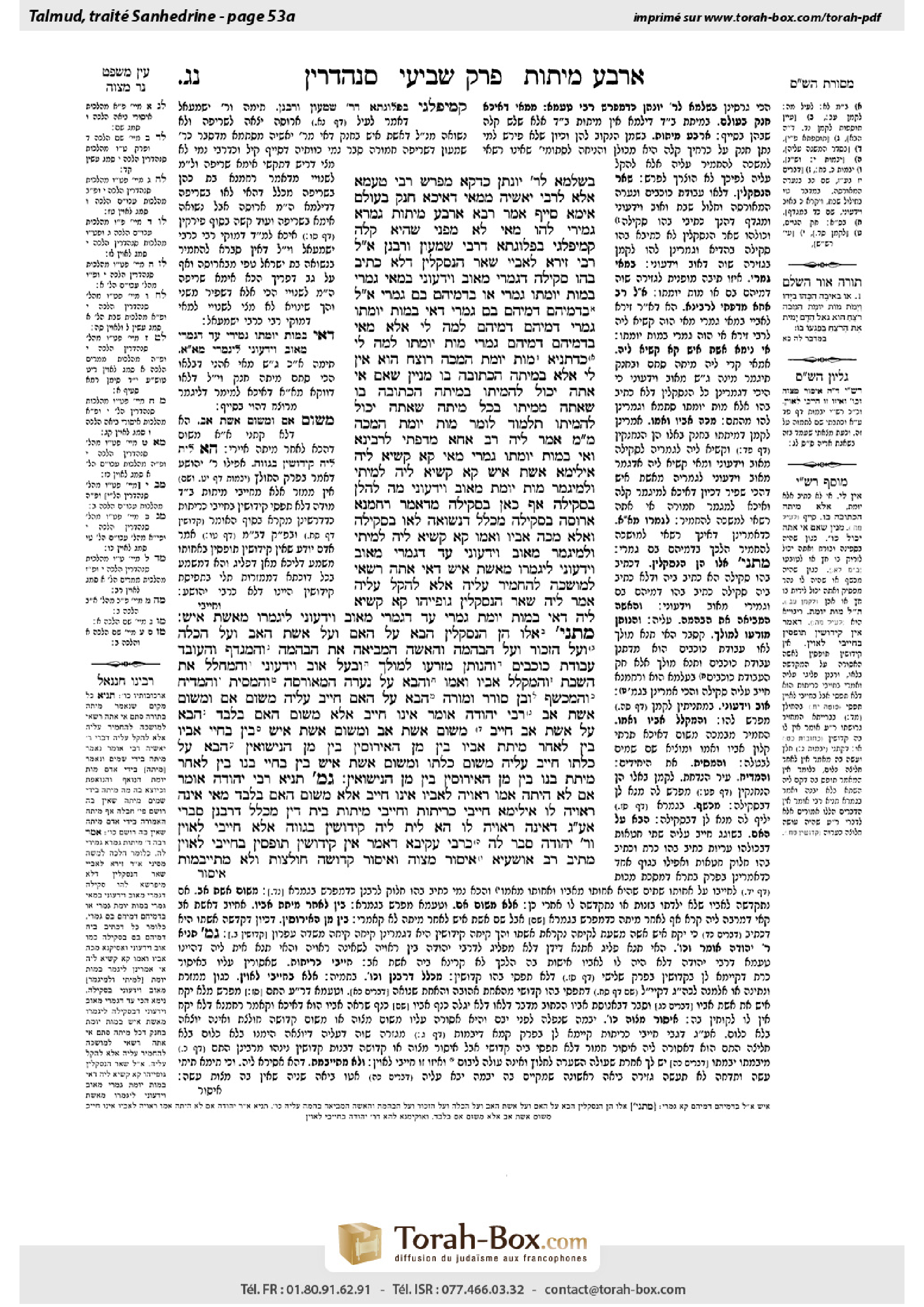
Sanhedrin 53a: Talmud study for Daf Yomi
Daf Yomi is the daily study of one Talmud folio. Explore 37 tractates with scans, Hebrew text, Sefaria English and AI-generated French translations where annotated.
Passage selection and English or AI-generated French translation are available where the scan has annotations. Daf Study is independent of Torah-Box and Sefaria.
Browse Sanhedrin · סנהדרין · All tractatesSanhedrin 53a text and translations
This page of Sanhedrin includes the Aramaic text, an English translation and an AI-generated French translation, alongside the scan above.
סנהדרין נ״ג א · Aramaic and Hebrew text
בִּשְׁלָמָא לְרַבִּי יוֹנָתָן, כִּדְקָא מְפָרֵשׁ רַבִּי טַעְמָא. אֶלָּא לְרַבִּי יֹאשִׁיָּה, מִמַּאי דְּאִיכָּא חֶנֶק בָּעוֹלָם? אֵימָא סַיִיף!
אָמַר רָבָא: אַרְבַּע מִיתוֹת גְּמָרָא גְּמִירִי לְהוּ.
מַאי ״לֹא מִפְּנֵי שֶׁהִיא קַלָּה״? קָמִיפַּלְגִי בִּפְלוּגְתָּא דְּרַבִּי שִׁמְעוֹן וְרַבָּנַן.
אֲמַר לֵיהּ רַבִּי זֵירָא לְאַבָּיֵי: שְׁאָר הַנִּסְקָלִין דְּלָא כְּתִיב בְּהוּ סְקִילָה, דְּגָמְרִי מֵאוֹב וְיִדְּעוֹנִי, בְּמַאי גָּמְרִי? בְּ״מוֹת יוּמָתוּ״ גָּמְרִי, אוֹ בִּ״דְמֵיהֶם בָּם״ גָּמְרִי?
אֲמַר לֵיהּ: בִּ״דְמֵיהֶם״ ״דְּמֵיהֶם בָּם״ גָּמְרִי, דְּאִי בְּ״מוֹת יוּמָתוּ״ גָּמְרִי, ״דְּמֵיהֶם״ ״דְּמֵיהֶם״ לְמָה לִי?
אֶלָּא מַאי, בִּ״דְמֵיהֶם״ ״דְּמֵיהֶם״ גָּמְרִי? ״מוֹת יוּמָתוּ״ לְמָה לִי?
כִּדְתַנְיָא: ״מוֹת יוּמַת הַמַּכֶּה רֹצֵחַ הוּא״ – אֵין לִי אֶלָּא בְּמִיתָה הַכְּתוּבָה בּוֹ. מִנַּיִין שֶׁאִם אִי אַתָּה יָכוֹל לַהֲמִיתוֹ בְּמִיתָה הַכְּתוּבָה בּוֹ, שֶׁאַתָּה מְמִיתוֹ בְּכׇל מִיתָה שֶׁאַתָּה יָכוֹל לַהֲמִיתוֹ? תַּלְמוּד לוֹמַר: ״מוֹת יוּמַת הַמַּכֶּה״ – מִכׇּל מָקוֹם.
אֲמַר לֵיהּ רַב אַחָא מִדִּפְתִּי לְרָבִינָא: וְאִי בְּ״מוֹת יוּמָתוּ״ גָּמְרִי, מַאי קָא קַשְׁיָא לֵיהּ?
אִילֵּימָא אֵשֶׁת אִישׁ קָא קַשְׁיָא לֵיהּ, לְמֵיתֵי וּלְמִיגְמַר ״מוֹת יוּמַת״ מֵאוֹב וְיִדְּעוֹנִי: מָה לְהַלָּן בִּסְקִילָה, אַף כָּאן בִּסְקִילָה?
מִדְּאָמַר רַחֲמָנָא אֲרוּסָה בִּסְקִילָה, מִכְּלָל דִּנְשׂוּאָה לָאו בִּסְקִילָה.
וְאֶלָּא, מַכֵּה אָבִיו וְאִמּוֹ קָא קַשְׁיָא לֵיהּ, לְמֵיתֵי וּלְמִיגְמַר מֵאוֹב וְיִדְּעוֹנִי?
עַד דְּגָמְרִי מֵאוֹב וְיִדְּעוֹנִי, לִיגְמְרוּ מֵאֵשֶׁת אִישׁ, דְּאִי אַתָּה רַשַּׁאי לְמוֹשְׁכָהּ לְהַחְמִיר עָלֶיהָ, אֶלָּא לְהָקֵל עָלֶיהָ.
אֲמַר לֵיהּ: שְׁאָר הַנִּסְקָלִין גּוּפַיְיהוּ קָא קַשְׁיָא לֵיהּ, דְּאִי בְּ״מוֹת יוּמָת״ גָּמְרִי, עַד דְּגָמְרִי מֵאוֹב וְיִדְּעוֹנִי, לִיגְמְרוּ מֵאֵשֶׁת אִישׁ!
מַתְנִי׳ אֵלּוּ הֵן הַנִּסְקָלִין: הַבָּא עַל הָאֵם, וְעַל אֵשֶׁת הָאָב, וְעַל הַכַּלָּה, וְעַל הַזְּכוּר, וְעַל הַבְּהֵמָה, וְהָאִשָּׁה הַמְּבִיאָה אֶת הַבְּהֵמָה. וְהַמְגַדֵּף, וְהָעוֹבֵד עֲבוֹדָה זָרָה, וְהַנּוֹתֵן מִזַּרְעוֹ לַמּוֹלֶךְ, וּבַעַל אוֹב וְיִדְּעוֹנִי, וְהַמְחַלֵּל אֶת הַשַּׁבָּת, וְהַמְקַלֵּל אָבִיו וְאִמּוֹ, וְהַבָּא עַל נַעֲרָה הַמְאוֹרָסָה, וְהַמֵּסִית, וְהַמֵּדִיחַ, וְהַמְכַשֵּׁף, וּבֵן סוֹרֵר וּמוֹרֶה.
הַבָּא עַל הָאֵם, חַיָּיב עָלֶיהָ מִשּׁוּם אֵם וּמִשּׁוּם אֵשֶׁת אָב. רַבִּי יְהוּדָה אוֹמֵר: אֵינוֹ חַיָּיב אֶלָּא מִשּׁוּם הָאֵם בִּלְבַד.
הַבָּא עַל אֵשֶׁת אָב, חַיָּיב מִשּׁוּם אֵשֶׁת אָב וּמִשּׁוּם אֵשֶׁת אִישׁ, בֵּין בְּחַיֵּי אָבִיו בֵּין לְאַחַר מִיתַת אָבִיו, בֵּין מִן הָאֵירוּסִין בֵּין מִן הַנִּישּׂוּאִין.
הַבָּא עַל כַּלָּתוֹ, חַיָּיב עָלֶיהָ מִשּׁוּם כַּלָּתוֹ וּמִשּׁוּם אֵשֶׁת אִישׁ, בֵּין בְּחַיֵּי בְנוֹ בֵּין לְאַחַר מִיתַת בְּנוֹ, בֵּין מִן הָאֵירוּסִין בֵּין מִן הַנִּישּׂוּאִין.
גְּמָ׳ תַּנְיָא: רַבִּי יְהוּדָה אוֹמֵר, אִם לֹא הָיְתָה אִמּוֹ רְאוּיָה לְאָבִיו, אֵינוֹ חַיָּיב אֶלָּא מִשּׁוּם הָאֵם בִּלְבַד.
מַאי ״אֵינָהּ רְאוּיָה לוֹ״? אִילֵּימָא חַיָּיבֵי כָרֵיתוֹת וְחַיָּיבֵי מִיתוֹת בֵּית דִּין, מִכְּלָל דְּרַבָּנַן סָבְרִי אַף עַל גַּב דְּאֵינָהּ רְאוּיָה לוֹ? הָא לֵית לֵיהּ קִידּוּשִׁין בְּגַוַּוהּ!
אֶלָּא: חַיָּיבֵי לָאוִין, וְרַבִּי יְהוּדָה סָבַר לַהּ כְּרַבִּי עֲקִיבָא, דְּאָמַר: אֵין קִידּוּשִׁין תּוֹפְסִין בְּחַיָּיבֵי לָאוִין.
מֵתִיב רַב אוֹשַׁעְיָא: אִיסּוּר מִצְוָה וְאִיסּוּר קְדוּשָּׁה – חוֹלְצוֹת וְלֹא מִתְיַיבְּמוֹת.
Sanhedrin 53a · English translation
Granted, according to Rabbi Yonatan it is clear the punishment for adultery is strangulation, in the manner that Rabbi Yehuda HaNasi explains the reason for his opinion. But according to Rabbi Yoshiya, from where is it derived that there is a punishment of execution by strangulation in the world, i.e., in halakha, at all? Since this type of capital punishment is not mentioned in the Torah explicitly, say that decapitation by the sword is the least severe type, as it is mentioned in the Torah.
Rava said: The four types of the death penalty are learned as a tradition. There is no question as to the types of capital punishment that exist in halakha. Rather, the question is which type of execution is meted out as punishment for which sins.
The Gemara asks: What is meant by Rabbi Yonatan’s statement: It is not because strangulation is the most lenient type of capital punishment? The Gemara answers: At the root of the matter, Rabbi Yonatan and Rabbi Yoshiya disagree with regard to the issue that is the subject of the dispute between Rabbi Shimon and the Rabbis, i.e., whether strangulation or decapitation is the least severe type of execution. Consequently, Rabbi Yonatan does not employ the reasoning that strangulation is the least severe.
§ Rabbi Zeira said to Abaye: With regard to the rest of those transgressors, other than necromancers and sorcerers, who are stoned to death, with regard to whom stoning is not explicitly written in the Torah because their punishment is derived via a verbal analogy from that of a necromancer and a sorcerer, about which the verse states: “They shall be put to death, they shall stone them with stones, their blood shall be upon them” (Leviticus 20:27); through what verbal analogy is their punishment derived? Is it derived from the phrase “they shall be put to death,” or is it derived from the phrase “their blood shall be upon them”?
Abaye said to him: It is derived from a verbal analogy between “their blood” and “their blood shall be upon them.” As, if it is derived from “they shall be put to death,” why do I need the verbal analogy between “their blood” and “their blood”? Why does this term need to be written with regard to the various halakhot?
The Gemara asks: Rather, what is more reasonable? If it is derived from the verbal analogy between “their blood” and “their blood,” the same problem arises: Why do I need the phrase “they shall be put to death”?
The Gemara answers: This expression is necessary, as another halakha is derived from it. As it is taught in a baraita: The verse with regard to a murderer states: “He that smote him shall be put to death, for he is a murderer” (Numbers 35:21). I have derived only that the murderer is put to death with the mode of execution written concerning him, i.e., by decapitation. From where do I derive that if you cannot put him to death with the mode of execution written concerning him, e.g., if the condemned man will escape if one does not kill him, that you put him to death with any mode of execution with which you can put him to death? The verse states: “He that smote him shall be put to death [mot yumat],” the doubled verb teaching that he is put to death in any case, i.e., by any mode of execution.
This exchange between Rabbi Zeira and Abaye was subsequently discussed by later amora’im. Rav Aḥa of Difti said to Ravina: And if the halakha that there are transgressors other than necromancers and sorcerers who are punished by stoning is derived from “they shall be put to death,” what is difficult according to Rabbi Zeira? It appears from Rabbi Zeira’s question that he was troubled by the possibility that this halakha is derived from the phrase “they shall be put to death.”
If we say that the case of adultery of a married woman would pose a difficulty according to Rabbi Zeira, as it is stated: “The adulterer and the adulteress shall be put to death” (Leviticus 20:10), and therefore perhaps we should derive and learn from the phrase “they shall be put to death” stated with regard to a necromancer and a sorcerer that just as there, with regard to a necromancer and a sorcerer, they are executed by stoning, so too here, with regard to adultery, the transgressors should be executed by stoning, this does not pose a difficulty.
Rav Aḥa of Difti explains why it does not pose a difficulty: From the fact that the Merciful One states that a betrothed woman who committed adultery is executed by stoning, by inference we learn that a married woman who committed adultery is not executed by stoning, but rather she is executed by a less severe type of execution. Therefore, it could not have been derived from the case of a necromancer and a sorcerer that the punishment for the adultery of a married woman is execution by stoning.
And if it is rather the case of one who wounds his father or his mother that poses a difficulty according to Rabbi Zeira, as it is stated: “And he who smites his father or his mother shall be put to death” (Exodus 21:15), and therefore perhaps we should derive and learn from the punishment of a necromancer and a sorcerer that one who wounds his father or his mother should be executed by stoning, this too does not pose a difficulty.
Rav Aḥa of Difti explains why it does not pose a difficulty: Rather than deriving the punishment of one who wounds his father or his mother from a necromancer and a sorcerer, let us derive it from adultery with a married woman, as everywhere that the death penalty is stated in the Torah without specification you may not take it to be more stringent with regard to it, i.e., to mean that the sinner should be sentenced to a severe type of execution; rather, you must take it to be more lenient with regard to it, i.e., that a lenient type of execution should be applied. Since in both the case of adultery and the case of one who wounds his parent the type of execution is evidently not stoning, why was Rabbi Zeira troubled by the possibility that the source for execution by stoning in cases other than a necromancer and a sorcerer is derived from the phrase: “They shall be put to death”?
Ravina said to Rav Aḥa of Difti: It is the halakha concerning the rest of those who are stoned, themselves, which poses a difficulty according to Rabbi Zeira. This is because if their punishment is derived from the phrase “they shall be put to death,” then rather than deriving from the case of a necromancer and a sorcerer that these transgressors are executed by the severe method of stoning, let us derive from the case of one who commits adultery with a married woman, with regard to whom “they shall be put to death” is also stated, that they should be executed by strangulation, the less severe method. He therefore verified that it is derived from the phrase “their blood shall be upon them,” that they are executed by stoning.
MISHNA: These transgressors are those who are stoned to death: One who engages in intercourse with his mother; or with his father’s wife, even if she is not his mother; or with his daughter-in-law; or with a male; or with an animal; and a woman who engages in intercourse with an animal. And one who blasphemes, and one who engages in idol worship. And one who gives of his offspring to Molekh, and a necromancer, and a sorcerer. And one who desecrates Shabbat, and one who curses his father or his mother, and one who engages in intercourse with a betrothed young woman, and an inciter who incites individuals to idol worship, and a subverter who incites an entire city to idol worship, and a warlock, and a stubborn and rebellious son.
The mishna elaborates: One who unwittingly engages in intercourse with his mother who is also his father’s wife is liable to bring two sin-offerings for his intercourse with her: One due to the prohibition against engaging in intercourse with one’s mother and one due to the prohibition against engaging in intercourse with one’s father’s wife. Rabbi Yehuda says: He is liable to bring only one sin-offering, due to the prohibition against engaging in intercourse with one’s mother.
One who unwittingly engages in intercourse with his father’s wife while his father is married to her is liable to bring two sin-offerings: One due to the prohibition against engaging in intercourse with one’s father’s wife and one due to the prohibition against engaging in intercourse with a married woman. He is liable due to the former prohibition both during his father’s lifetime and after his father’s death, and whether the relationship between the woman and his father is one of betrothal or one of marriage.
Likewise, one who unwittingly engages in intercourse with his daughter-in-law during his son’s lifetime is liable to bring two sin-offerings for his intercourse with her: One due to the prohibition against engaging in intercourse with one’s daughter-in-law, and one due to the prohibition against engaging in intercourse with a married woman. The former liability applies both during his son’s lifetime and after his son’s death, and whether the relationship between the woman and his son is one of betrothal or one of marriage.
GEMARA: With regard to one who engages in intercourse with his mother, it is taught in a baraita that Rabbi Yehuda says: If his mother was not suitable for his father, as their marriage was forbidden, he is liable only due to the prohibition against engaging in intercourse with one’s mother, and not due to the prohibition against engaging in intercourse with one’s father’s wife.
This is clarified: What does it mean that she is not suitable for him? If we say that the mother and father were liable to receive the punishment of excision from the World-to-Come [karet], or liable to receive a court-imposed death penalty for their intercourse, in which case their marriage did not take effect and therefore Rabbi Yehuda holds that in this case there is no prohibition against engaging in intercourse with one’s father’s wife, this poses a difficulty. As accordingly, by inference, in may be understood that the Rabbis hold that there is such a prohibition even if she is not suitable for him. Doesn’t everyone agree that in such a case the father has no capability of betrothal with regard to her? Even if they cohabit, she is not considered his wife.
Rather, it is clear that Rabbi Yehuda is referring to a case where the father and mother are liable for violating a prohibition for their intercourse, but they are not liable to receive karet or capital punishment. And Rabbi Yehuda in this matter holds in accordance with the opinion of Rabbi Akiva, who says that betrothal does not take effect with those women with regard to whom one is liable for violating a prohibition if one engages in intercourse with them. The Rabbis disagree with this; in their opinion, betrothal does take effect in such cases, although a prohibition is involved. Therefore, the mother is considered the father’s wife, and the son is liable for engaging in intercourse with his father’s wife as well as for engaging in intercourse with his mother.
Rav Oshaya raises an objection to this explanation, as it is stated in a mishna in tractate Yevamot (20a): If a yevama is forbidden to her yavam by a prohibition resulting from a mitzva or by a prohibition stemming from sanctity, then since in these cases the levirate bond is not fundamentally nullified, she performs ḥalitza in order to become free of the levirate bond, and due to the prohibition she does not enter into levirate marriage.
Sanhedrin 53a · Traduction française (IA)
Il est admis qu' selon Rabbi Yonatan, il est clair que la punition pour l'adultère est la strangulation, de la manière dont Rabbi Yehuda HaNasi explique la raison de son opinion. Mais selon Rabbi Yoshiya, d'où est-il dérivé qu'il existe une punition par strangulation dans le monde, c'est-à-dire en halakha, du tout ? Puisque ce type de peine capitale n'est pas mentionné explicitement dans la Torah, on pourrait dire que la décapitation par l'épée est le type le moins sévère, car elle est mentionnée dans la Torah.
Rava a dit : Les quatre types de peine capitale sont appris par tradition. Il n'y a aucune question quant aux types de peine capitale qui existent en halakha. Plutôt, la question est quel type d'exécution est infligé comme punition pour quels péchés.
La Guemara demande : Que signifie la déclaration de Rabbi Yonatan : Ce n'est pas parce que la strangulation est le type le plus clément de peine capitale ? La Guemara répond : Au fond du sujet, Rabbi Yonatan et Rabbi Yoshiya sont en désaccord quant à la question qui fait l'objet de la dispute entre Rabbi Shimon et les Sages, c'est-à-dire si la strangulation ou la décapitation est le type d'exécution le moins sévère. En conséquence, Rabbi Yonatan n'emploie pas le raisonnement selon lequel la strangulation est la moins sévère.
§ Rabbi Zeïra a dit à Abaye : Quant au reste de ces transgresseurs, autres que les nécromanciens et les sorciers, qui sont lapidés, et pour qui la lapidation n'est pas explicitement prescrite dans la Torah écrite, car leur peine est dérivée par une analogie verbale de celle du nécromancien et du sorcier, au sujet desquels le verset énonce : « Ils seront mis à mort, ils les lapideront de pierres, leur sang sera sur eux » (Lévitique 20:27) ; par quelle analogie verbale leur peine est-elle dérivée ? Est-elle dérivée de l'expression « ils seront mis à mort », ou est-elle dérivée de l'expression « leur sang sera sur eux » ?
Abaye lui a répondu : Elle est dérivée par une analogie verbale entre « leur sang » et « leur sang sera sur eux ». Car, si elle était dérivée de l'expression « ils seront mis à mort », pourquoi aurais-je besoin de l'analogie verbale entre « leur sang » et « leur sang » ? Pourquoi ce terme a-t-il besoin d'être écrit au sujet des diverses halakhot ?
La Guemara demande : Plutôt, qu'est-ce qui est plus raisonnable ? Si elle est dérivée par l'analogie verbale entre « leur sang » et « leur sang », le même problème se pose : pourquoi aurais-je besoin de l'expression « ils seront mis à mort » ?
La Guemara répond : Cette expression est nécessaire, car une autre halakha en est dérivée. Comme il est enseigné dans une baraïta : Le verset concernant un meurtrier énonce : « Celui qui l'a frappé sera mis à mort, car il est meurtrier » (Nombres 35:21). J'ai seulement déduit que le meurtrier est mis à mort par le mode d'exécution prescrit à son égard, c'est-à-dire par décapitation. D'où déduis-je que si vous ne pouvez pas le mettre à mort par le mode d'exécution prescrit à son égard, par exemple si le condamné s'échapperait si on ne le tuait pas, vous le mettez à mort par n'importe quel mode d'exécution par lequel vous pouvez le mettre à mort ? Le verset énonce : « Celui qui l'a frappé sera mis à mort [mot yumat] », le verbe redoublé enseignant qu'il est mis à mort dans tous les cas, c'est-à-dire par n'importe quel mode d'exécution.
Cet échange entre Rabbi Zeira et Abaye a ensuite été discuté par des amoraïm ultérieurs. Rav Aḥa de Difti a dit à Ravina : Et si la halakha selon laquelle il y a des transgresseurs autres que les nécromanciens et les sorciers qui sont punis par la lapidation est dérivée de « ils seront mis à mort », qu'est-ce qui est difficile selon Rabbi Zeira ? Il apparaît de la question de Rabbi Zeira qu'il était troublé par la possibilité que cette halakha soit dérivée de la phrase « ils seront mis à mort ».
Si nous disons que le cas de l'adultère d'une femme mariée poserait une difficulté selon Rabbi Zeira, car il est dit : « L'adultère et l'adultère seront mis à mort » (Lévitique 20:10), et par conséquent peut-être devrions-nous déduire et apprendre de la phrase « ils seront mis à mort » énoncée au sujet d'un nécromancien et d'un sorcier que de même qu'ici, au sujet d'un nécromancien et d'un sorcier, ils sont exécutés par lapidation, de même ici, au sujet de l'adultère, les transgresseurs devraient être exécutés par lapidation, cela ne pose pas de difficulté.
Rav Aḥa de Difti explique pourquoi cela ne pose pas de difficulté : du fait que le Tout-Puissant déclare qu'une femme fiancée qui a commis l'adultère est exécutée par lapidation, par inférence nous apprenons qu'une femme mariée qui a commis l'adultère n'est pas exécutée par lapidation, mais plutôt qu'elle est exécutée par un type d'exécution moins sévère. Par conséquent, il n'aurait pas pu être déduit du cas d'un nécromancien et d'un sorcier que la punition pour l'adultère d'une femme mariée est l'exécution par lapidation.
Et si c'est plutôt le cas de celui qui blesse son père ou sa mère qui pose une difficulté selon Rabbi Zeira, car il est dit : « Et celui qui frappe son père ou sa mère sera mis à mort » (Exode 21:15), et par conséquent peut-être devrions-nous déduire et apprendre de la punition d'un nécromancien et d'un sorcier que celui qui blesse son père ou sa mère devrait être exécuté par lapidation, cela non plus ne pose pas de difficulté.
Rav Aḥa de Difti explique pourquoi cela ne pose pas de difficulté : plutôt que de déduire la punition de celui qui blesse son père ou sa mère à partir du cas du nécromancien et du sorcier, déduisons-la à partir de l'adultère avec une femme mariée. En effet, partout où la peine de mort est énoncée dans la Torah écrite sans spécification, on ne doit pas l'interpréter de manière plus sévère, c'est-à-dire signifier que le fautif doit être condamné à un type d'exécution sévère ; au contraire, on doit l'interpréter de manière plus indulgente, c'est-à-dire qu'un type d'exécution indulgent doit être appliqué. Puisque, tant dans le cas de l'adultère que dans celui de celui qui blesse son parent, le type d'exécution n'est manifestement pas la lapidation, pourquoi Rabbi Zeira a-t-il été troublé par la possibilité que la source de la lapidation dans les cas autres que ceux du nécromancien et du sorcier soit déduite de la phrase : « Ils seront mis à mort » ?
Ravina dit à Rav Aḥa de Difti : c'est la halakha concernant le reste de ceux qui sont lapidés, eux-mêmes, qui pose une difficulté selon Rabbi Zeira. En effet, si leur punition est déduite de la phrase « ils seront mis à mort », alors, plutôt que de déduire du cas du nécromancien et du sorcier que ces transgresseurs sont exécutés par la méthode sévère du lapidement, déduisons du cas de celui qui commet l'adultère avec une femme mariée, à propos de qui il est également dit « ils seront mis à mort », qu'ils doivent être exécutés par strangulation, la méthode moins sévère. Il a donc vérifié que cela est déduit de la phrase « leur sang sera sur eux », indiquant qu'ils sont exécutés par lapidement.
MICHNA : Ces transgresseurs sont ceux qui sont lapidés à mort : Celui qui a des relations sexuelles avec sa mère ; ou avec la femme de son père, même si elle n'est pas sa mère ; ou avec sa belle-fille ; ou avec un homme ; ou avec un animal ; et une femme qui a des relations sexuelles avec un animal. Et celui qui blasphème, et celui qui se livre au culte des idoles. Et celui qui livre sa descendance à Molekh, et un nécromancien, et un sorcier. Et celui qui profane le Chabbat, et celui qui maudit son père ou sa mère, et celui qui a des relations sexuelles avec une jeune fille fiancée, et un instigateur qui incite des individus au culte des idoles, et un séducteur qui incite une ville entière au culte des idoles, et un magicien, et un fils têtu et rebelle.
La Michna précise : Celui qui, sans le savoir, a des relations sexuelles avec sa mère qui est aussi la femme de son père est tenu d'apporter deux sacrifices expiatoires pour ses relations avec elle : un en raison de l'interdiction d'avoir des relations sexuelles avec sa mère et un en raison de l'interdiction d'avoir des relations sexuelles avec la femme de son père. Rabbi Yehuda dit : Il n'est tenu d'apporter qu'un seul sacrifice expiatoire, en raison de l'interdiction d'avoir des relations sexuelles avec sa mère.
Celui qui, sans le savoir, a des relations sexuelles avec la femme de son père alors que son père est marié avec elle est tenu d'apporter deux sacrifices expiatoires : l'un en raison de l'interdiction d'avoir des relations sexuelles avec la femme de son père, et l'autre en raison de l'interdiction d'avoir des relations sexuelles avec une femme mariée. Il est tenu en raison de la première interdiction tant durant la vie de son père qu'après la mort de son père, et que la relation entre la femme et son père soit celle d'une fiançailles ou celle d'un mariage.
De même, celui qui, sans le savoir, a des relations sexuelles avec sa belle-fille durant la vie de son fils est tenu d'apporter deux sacrifices expiatoires pour ses relations avec elle : l'un en raison de l'interdiction d'avoir des relations sexuelles avec sa belle-fille, et l'autre en raison de l'interdiction d'avoir des relations sexuelles avec une femme mariée. Cette première responsabilité s'applique tant durant la vie de son fils qu'après la mort de son fils, et que la relation entre la femme et son fils soit celle d'une fiançailles ou celle d'un mariage.
Guemara : Concernant celui qui a des relations sexuelles avec sa mère, il est enseigné dans une baraïta que Rabbi Yehuda dit : Si sa mère n'était pas appropriée pour son père, car leur mariage était interdit, il n'est tenu qu'en raison de l'interdiction d'avoir des relations sexuelles avec sa mère, et non en raison de l'interdiction d'avoir des relations sexuelles avec la femme de son père.
Cela est précisé : Que signifie qu'elle n'est pas apte pour lui ? Si nous disons que le père et la mère étaient passibles de la peine de retranchement [karet] du Monde à venir, ou passibles de la peine de mort infligée par le tribunal pour leurs relations, auquel cas leur mariage n'a pas pris effet et que, par conséquent, Rabbi Yehuda soutient qu'il n'y a pas d'interdiction d'avoir des relations sexuelles avec la femme de son père dans ce cas, cela pose une difficulté. Car, par inférence, on pourrait comprendre que les Sages soutiennent qu'il y a une telle interdiction même si elle n'est pas apte pour lui. N'est-il pas admis par tous que, dans un tel cas, le père n'a pas la capacité de contracter un mariage à son égard ? Même s'ils cohabitent, elle n'est pas considérée comme sa femme.
Plutôt, il est clair que Rabbi Yehuda fait référence à un cas où le père et la mère sont passibles de la violation d'une interdiction pour leurs relations, mais ne sont pas passibles de la peine de retranchement [karet] ou de la peine de mort. Et Rabbi Yehuda, dans cette affaire, soutient conformément à l'opinion de Rabbi Akiva, qui dit que le mariage ne prend pas effet avec les femmes à l'égard desquelles on est passible de la violation d'une interdiction si l'on a des relations sexuelles avec elles. Les Sages ne sont pas d'accord avec cela ; selon leur opinion, le mariage prend effet dans de tels cas, bien qu'une interdiction soit impliquée. Par conséquent, la mère est considérée comme la femme du père, et le fils est passible de la peine pour avoir des relations sexuelles avec la femme de son père ainsi que pour avoir des relations sexuelles avec sa mère.
Rav Oshaya soulève une objection à cette explication, car il est dit dans une Michna du traité Yevamot (20a) : Si une yevama est interdite à son yavam par une interdiction résultant d'une mitsva ou par une interdiction découlant de la sainteté, alors, puisque dans ces cas le lien de la levirate n'est pas fondamentalement annulé, elle effectue la ḥalitza afin de se libérer du lien de la levirate, et, en raison de l'interdiction, elle ne contracte pas le mariage de levirate.
Traduction française générée par IA à partir de l’édition anglaise de Sefaria. Vérifie toujours un passage avec le texte source.
Text from Sefaria: William Davidson Edition - Vocalized Aramaic (CC BY NC); William Davidson Edition - English (CC BY NC).