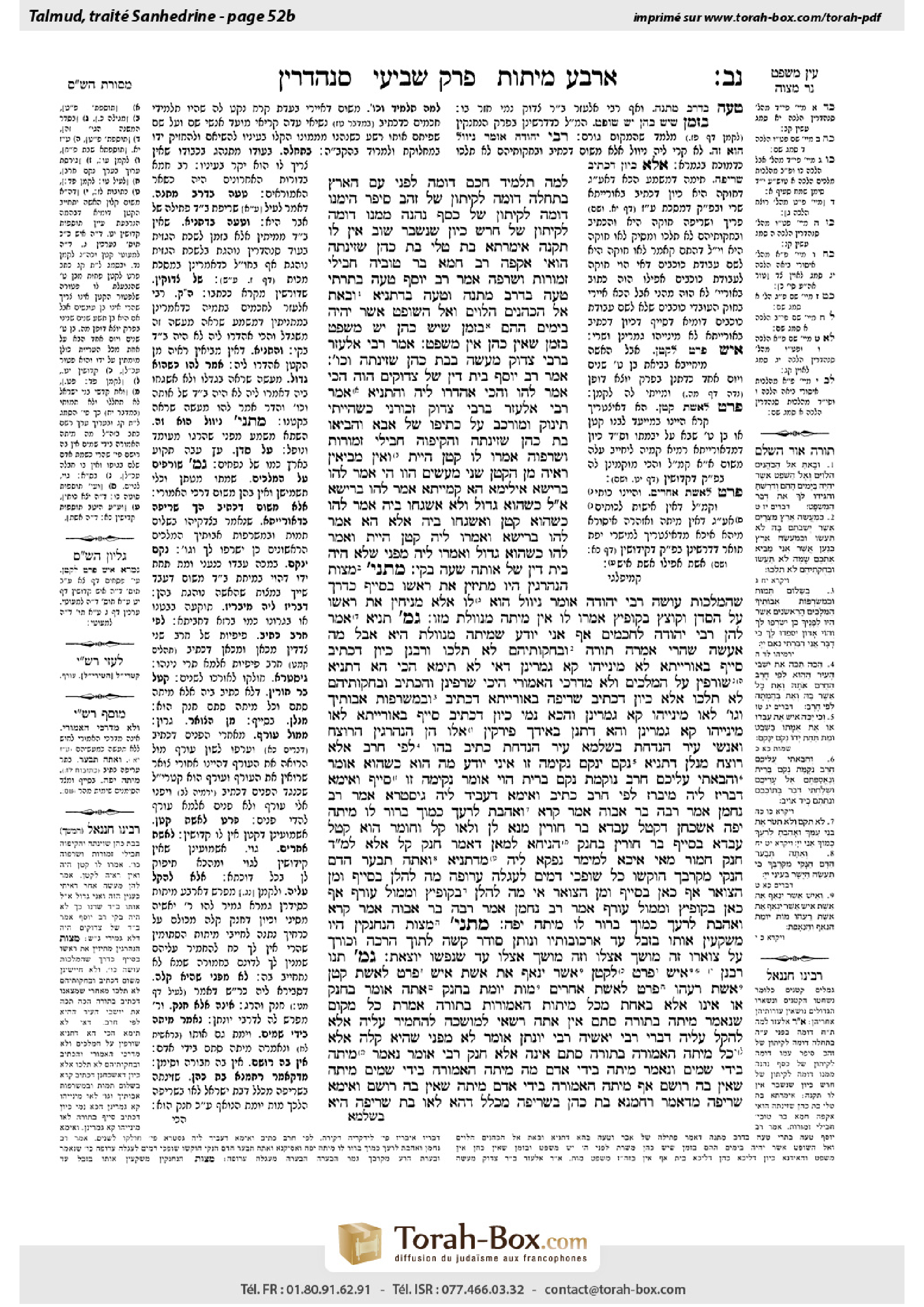
Sanhedrin 52b: Talmud study for Daf Yomi
Daf Yomi is the daily study of one Talmud folio. Explore 37 tractates with scans, Hebrew text, Sefaria English and AI-generated French translations where annotated.
Passage selection and English or AI-generated French translation are available where the scan has annotations. Daf Study is independent of Torah-Box and Sefaria.
Browse Sanhedrin · סנהדרין · All tractatesSanhedrin 52b text and translations
This page of Sanhedrin includes the Aramaic text, an English translation and an AI-generated French translation, alongside the scan above.
סנהדרין נ״ב ב · Aramaic and Hebrew text
לְמָה תַּלְמִיד חָכָם דּוֹמֶה לִפְנֵי עַם הָאָרֶץ? בַּתְּחִלָּה, דּוֹמֶה לְקִיתוֹן שֶׁל זָהָב. סִיפֵּר הֵימֶנּוּ, דּוֹמֶה לְקִיתוֹן שֶׁל כֶּסֶף. נֶהֱנָה מִמֶּנּוּ, דּוֹמֶה לְקִיתוֹן שֶׁל חֶרֶשׂ. כֵּיוָן שֶׁנִּשְׁבַּר, שׁוּב אֵין לוֹ תַּקָּנָה.
אִימַּרְתָּא בַּת טָלֵי, בַּת כֹּהֵן שֶׁזִּינְּתָה הֲוַאי. אַקְּפַהּ (רַב) חָמָא בַּר טוֹבִיָּה חֲבִילֵי זְמוֹרוֹת וְשַׂרְפַהּ.
אָמַר רַב יוֹסֵף: טְעָה בְּתַרְתֵּי, טְעָה בִּדְרַב מַתְנָה, וּטְעָה בִּדְתַנְיָא. ״וּבָאתָ אֶל הַכֹּהֲנִים הַלְוִיִּם וְאֶל הַשֹּׁפֵט אֲשֶׁר יִהְיֶה בַּיָּמִים הָהֵם״ – בִּזְמַן שֶׁיֵּשׁ כֹּהֵן יֵשׁ מִשְׁפָּט, בִּזְמַן שֶׁאֵין כֹּהֵן אֵין מִשְׁפָּט.
אָמַר רַבִּי אֶלְעָזָר בְּרַבִּי צָדוֹק: מַעֲשֶׂה בְּבַת כֹּהֵן שֶׁזִּינְּתָה וְכוּ׳. אָמַר רַב יוֹסֵף: בֵּית דִּין שֶׁל צַדּוּקִים הֲוָה.
הָכִי אֲמַר לְהוּ, וְהָכִי אַהְדַּרוּ לֵיהּ? וְהָתַנְיָא, אָמַר רַבִּי אֶלְעָזָר בְּרַבִּי צָדוֹק: זְכוּרַנִי כְּשֶׁהָיִיתִי תִּינוֹק וּמוּרְכָּב עַל כְּתֵיפוֹ שֶׁל אַבָּא, וְהֵבִיאוּ בַּת כֹּהֵן שֶׁזִּינְּתָה וְהִקִּיפוּהָ חֲבִילֵי זְמוֹרוֹת וּשְׂרָפוּהָ. אָמְרוּ לוֹ: קָטָן הָיִיתָ, וְאֵין מְבִיאִין רְאָיָה מִן הַקָּטָן. שְׁנֵי מַעֲשִׂים הֲווֹ.
הֵי אֲמַר לְהוּ בְּרֵישָׁא? אִילֵימָא הָא קַמַּיְיתָא אֲמַר לְהוּ בְּרֵישָׁא, אֲמַר לֵיהּ כְּשֶׁהוּא גָּדוֹל, וְלָא אַשְׁגַּחוּ בֵּיהּ. אֲמַר לְהוּ כְּשֶׁהוּא קָטָן, וְאַשְׁגַּחוּ בֵּיהּ?
אֶלָּא, הָא אֲמַר לְהוּ בְּרֵישָׁא, וַאֲמַרוּ לֵיהּ: קָטָן הָיִיתָ, וַאֲמַר לְהוּ כְּשֶׁהוּא גָּדוֹל, וַאֲמַרוּ לֵיהּ: מִפְּנֵי שֶׁלֹּא הָיָה בֵּית דִּין שֶׁל אוֹתָהּ שָׁעָה בָּקִי.
מַתְנִי׳ מִצְוַת הַנֶּהֱרָגִין הָיוּ מַתִּיזִין אֶת רֹאשׁוֹ בְּסַיִיף, כְּדֶרֶךְ שֶׁהַמַּלְכוּת עוֹשָׂה. רַבִּי יְהוּדָה אוֹמֵר: נִיוּוּל הוּא לוֹ, אֶלָּא מַנִּיחִין אֶת רֹאשׁוֹ עַל הַסַּדָּן וְקוֹצֵץ בְּקוֹפִיץ. אָמְרוּ לוֹ: אֵין מִיתָה מְנוֶּוּלֶת מִזּוֹ.
גְּמָ׳ תַּנְיָא, אָמַר לָהֶן רַבִּי יְהוּדָה לַחֲכָמִים: אַף אֲנִי יוֹדֵעַ שֶׁמִּיתָה מְנוּוֶּלֶת הִיא, אֲבָל מָה אֶעֱשֶׂה? שֶׁהֲרֵי אָמְרָה תּוֹרָה ״וּבְחֻקֹּתֵיהֶם לֹא תֵלֵכוּ״.
וְרַבָּנַן, כֵּיוָן דִּכְתִיב סַיִיף בְּאוֹרָיְיתָא, לָא מִינַּיְיהוּ קָא גָמְרִינַן.
דְּאִי לָא תֵּימָא הָכִי, הָא דְּתַנְיָא: שׂוֹרְפִין עַל הַמְּלָכִים, וְלֹא מִדַּרְכֵי הָאֱמוֹרִי – הֵיכִי שָׂרְפִינַן? וְהָכְתִיב: ״וּבְחֻקֹּתֵיהֶם לֹא תֵלֵכוּ״! אֶלָּא, כֵּיוָן דִּכְתִיב שְׂרֵיפָה בְּאוֹרָיְיתָא, דִּכְתִיב: ״וּבְמִשְׂרְפוֹת אֲבוֹתֶיךָ וְגוֹ׳״, לָאו מִינַּיְיהוּ קָא גָמְרִינַן. וְהָכָא נָמֵי, כֵּיוָן דִּכְתִיב סַיִיף בְּאוֹרָיְיתָא, לָאו מִינַּיְיהוּ קָא גָמְרִינַן.
וְהָא דִּתְנַן בְּאִידַּךְ פִּירְקִין: אֵלּוּ הֵן הַנֶּהֱרָגִין: הָרוֹצֵחַ, וְאַנְשֵׁי עִיר הַנִּדַּחַת. בִּשְׁלָמָא עִיר הַנִּדַּחַת – כְּתִיב בְּהוּ ״לְפִי חָרֶב״, אֶלָּא רוֹצֵחַ – מְנָלַן?
דְּתַנְיָא: ״נָקֹם יִנָּקֵם״ – נְקִימָה זוֹ אֵינִי יוֹדֵעַ מָה הִיא. כְּשֶׁהוּא אוֹמֵר: ״וְהֵבֵאתִי עֲלֵיכֶם חֶרֶב נֹקֶמֶת נְקַם בְּרִית״, הֱוֵי אוֹמֵר: נְקִימָה זוֹ סַיִיף.
וְאֵימָא: דְּבָרֵיז לֵיהּ מִיבְרָז? ״לְפִי חָרֶב״ כְּתִיב!
וְאֵימָא דְּעָבֵיד לֵיהּ גִּיסְטְרָא? אָמַר רַב נַחְמָן אָמַר רַבָּה בַּר אֲבוּהּ: אָמַר קְרָא ״וְאָהַבְתָּ לְרֵעֲךָ כָּמוֹךָ״, בְּרוֹר לוֹ מִיתָה יָפָה.
אַשְׁכְּחַן דִּקְטַל עַבְדָּא, בַּר חוֹרִין מְנָא לַן?
וְלָאו קַל וָחוֹמֶר הוּא: קְטַל עַבְדָּא בְּסַיִיף, בַּר חוֹרִין בְּחֶנֶק?
הָנִיחָא לְמַאן דְּאָמַר: חֶנֶק קַל, אֶלָּא לְמַאן דְּאָמַר: חֶנֶק חָמוּר, מַאי אִיכָּא לְמֵימַר?
נָפְקָא לֵיהּ מִדְּתַנְיָא: ״וְאַתָּה תְּבַעֵר הַדָּם הַנָּקִי מִקִּרְבֶּךָ״ – הוּקְשׁוּ כׇּל שׁוֹפְכֵי דָמִים לְעֶגְלָה עֲרוּפָה. מָה לְהַלָּן בְּסַיִיף וּמִן הַצַּוָּאר, אַף כָּאן בְּסַיִיף וּמִן הַצַּוָּאר.
אִי, מָה לְהַלָּן בְּקוֹפִיץ וּמִמּוּל עוֹרֶף, אַף כָּאן בְּקוֹפִיץ וּמִמּוּל עוֹרֶף? אָמַר רַב נַחְמָן אָמַר רַבָּה בַּר אֲבוּהּ: אָמַר קְרָא ״וְאָהַבְתָּ לְרֵעֲךָ כָּמוֹךָ״ – בְּרוֹר לוֹ מִיתָה יָפָה.
מַתְנִי׳ מִצְוַת הַנֶּחְנָקִין: הָיוּ מְשַׁקְּעִין אוֹתוֹ בְּזֶבֶל עַד אַרְכוּבּוֹתָיו, וְנוֹתֵן סוּדָר קָשָׁה לְתוֹךְ הָרַכָּה, וְכוֹרֵךְ עַל צַוָּארוֹ. זֶה מוֹשֵׁךְ אֶצְלוֹ וְזֶה מוֹשֵׁךְ אֶצְלוֹ, עַד שֶׁנַּפְשׁוֹ יוֹצֵאת.
גְּמָ׳ תָּנוּ רַבָּנַן: ״אִישׁ״ – פְּרָט לְקָטָן, ״אֲשֶׁר יִנְאַף אֶת אֵשֶׁת אִישׁ״ – פְּרָט לְאֵשֶׁת קָטָן, ״אֵשֶׁת רֵעֵהוּ״ – פְּרָט לְאֵשֶׁת אֲחֵרִים.
״מוֹת יוּמָת״ – בְּחֶנֶק. אַתָּה אוֹמֵר בְּחֶנֶק, אוֹ אֵינוֹ אֶלָּא בְּאַחַת מִכׇּל מִיתוֹת הָאֲמוּרוֹת בַּתּוֹרָה? אָמַרְתָּ: כׇּל מָקוֹם שֶׁנֶּאֱמַר מִיתָה בְּתוֹרָה סְתָם, אֵין אַתָּה רַשַּׁאי לְמוֹשְׁכָהּ לְהַחְמִיר עָלֶיהָ, אֶלָּא לְהָקֵל עָלֶיהָ. דִּבְרֵי רַבִּי יֹאשִׁיָּה.
רַבִּי יוֹנָתָן אוֹמֵר: לֹא מִפְּנֵי שֶׁהִיא קַלָּה, אֶלָּא כׇּל מִיתָה הָאֲמוּרָה בְּתוֹרָה סְתָם – אֵינָהּ אֶלָּא חֶנֶק.
רַבִּי אוֹמֵר: נֶאֱמַר מִיתָה בִּידֵי שָׁמַיִם, וְנֶאֱמַר מִיתָה בִּידֵי אָדָם. מָה מִיתָה הָאֲמוּרָה בִּידֵי שָׁמַיִם – מִיתָה שֶׁאֵין בָּהּ רוֹשֶׁם, אַף מִיתָה הָאֲמוּרָה בִּידֵי אָדָם – מִיתָה שֶׁאֵין בָּהּ רוֹשֶׁם.
וְאֵימָא שְׂרֵיפָה? מִדְּאָמַר רַחֲמָנָא בַּת כֹּהֵן בִּשְׂרֵיפָה, מִכְּלָל דְּהָא לָאו בַּת שְׂרֵיפָה הִיא.
Sanhedrin 52b · English translation
To what is a Torah scholar compared when he is standing before an ignoramus? At first, when he does not know him, the ignoramus considers him to be like a goblet [lekiton] of gold. Once he has conversed with him concerning mundane matters, he considers him to be like a goblet of silver, i.e., the stature of the Torah scholar is downgraded in the eyes of the ignoramus. Once the scholar has received benefit from the ignoramus, he considers him to be like an earthenware goblet, which once broken cannot be fixed.
The Gemara relates: Imrata bat Talei was a priest’s daughter who committed adultery. Rav Ḥama bar Toviyya surrounded her with bundles of branches and burned her.
Rav Yosef says: Rav Ḥama bar Toviyya erred with regard to two halakhot. He erred with regard to the ruling of Rav Mattana, i.e., that burning is performed using a wick of lead, and he erred with regard to that which is taught in a baraita: It is derived from the verse: “And you shall come to the priests, the Levites, and to the judge that will be in those days” (Deuteronomy 17:9), that at a time when there is a priest serving in the Temple, i.e., when the Temple is built, there is judgment of capital cases. By inference, at a time when there is no priest, there is no judgment of capital cases.
§ The mishna teaches that Rabbi Elazar, son of Rabbi Tzadok, said: An incident occurred with regard to a priest’s daughter who committed adultery, and she was executed by actual burning, and the Sages said to him that the court at that time was not proficient in halakha. Rav Yosef says: It was a court of the Sadducees, who interpreted the verse according to its straightforward meaning.
The Gemara asks: Did Rabbi Elazar ben Tzadok say that to the Sages, and did the Sages answer him in that manner? But isn’t a different version of the exchange taught in a baraita: Rabbi Elazar, son of Rabbi Tzadok, says: I remember when I was a child, and was riding on my father’s shoulders. And they brought a priest’s daughter who had committed adultery, and surrounded her with bundles of branches and burned her. The Sages said to him: You were a minor at that time and one cannot bring proof from the testimony of a minor, as perhaps you did not understand the proceedings properly. The two versions of this exchange do not accord with each other. The Gemara answers: There were two separate incidents, and Rabbi Elazar ben Tzadok testified with regard to both.
The Gemara asks: Which incident did he tell the Sages about first? If we say that first he told them about this first incident, i.e., the one that is recounted in the mishna, this is unreasonable; if he first told them about the incident that occurred when he was an adult, and they paid no attention to him, but rejected his statement by responding that the court was not proficient in halakha, would he tell them afterward about the incident that occurred when he was a small child and think that they would pay attention to him?
Rather, it is clear that he first told them about that incident, i.e., the one recounted in the baraita, and they said to him: You were a minor, and one cannot bring proof from the testimony of a minor. And then he told them about the incident that occurred when he was an adult, and they said to him: The court did so because the court at that time was not proficient in halakha.
MISHNA: The mitzva of those who are killed, i.e., the process of execution by decapitation, is carried out in the following manner: The executioners cut off his head with a sword, the way that the monarchy does when a king sentences a person to death. Rabbi Yehuda says: This manner of execution is improper, as it degrades him. Rather, they place the head of the condemned on the block, and chop it off with a cleaver [bekofitz]. The Rabbis said to him: If you are concerned about his degradation, there is no death penalty more degrading than that. It is better for him to be executed in the manner described first.
GEMARA: It is taught in a baraita (Tosefta 9:3): Rabbi Yehuda said to the Rabbis: I too, know that it is a degrading death, but what shall I do, as the Torah states: “And you shall not follow their statutes” (Leviticus 18:3), i.e., it is prohibited to adopt the practices of the gentiles.
The Gemara asks: And how do the Rabbis respond to this claim? The Gemara answers: Since decapitation by the sword is written in the Torah, it is not from the gentiles that we learn it. This is Torah law, and the custom of the gentiles is not taken into consideration. It is of no import that they have a corresponding type of execution.
As, if you do not say so, that a Jewish custom is not forbidden even if the gentiles have the same custom, then that which is taught in a baraita poses a difficulty. The baraita teaches: One burns vessels and clothes over the deaths of kings as an expression of grief, and this is not forbidden for being of the ways of the Amorites. How can we perform this burning? But isn’t it written: “And you shall not follow their statutes”? Rather, since burning items over the death of a king is written in the Torah, as it is written: “And with the burnings of your fathers, the first kings who came before you, so shall they make a burning for you” (Jeremiah 34:5), it is not from the gentiles that we learn it. And here too, since decapitation by the sword is written in the Torah, it is not from them that we learn it.
§ The Gemara asks: And with regard to that which we learned in a mishna in another chapter of this tractate (76b): These transgressors are those who are killed by decapitation: The murderer and the people of an idolatrous city, there is a difficulty. Granted, the people of an idolatrous city are executed in this manner, as it is written concerning them: “You shall smite the inhabitants of that city with the edge of the sword” (Deuteronomy 13:16). But with regard to a murderer, from where do we derive that he is executed by decapitation?
The Gemara answers that it is derived as it is taught in a baraita: It is stated in the verse: “And if a man smites his slave or his maidservant by the staff and he dies under his hand, he shall be avenged” (Exodus 21:20). Prima facie, I do not know what this vengeance is referring to. When it says: “And I will bring upon you the sword avenging the vengeance of the covenant” (Leviticus 26:25), you must say that vengeance is decapitation by the sword.
The Gemara asks: But why not say that the executioner should stab him with a sword, rather than decapitate him? The Gemara answers: It is written with regard to the people of an idolatrous city: “With the edge of the sword,” indicating that the execution should be administered with the edge of the sword and not its point.
The Gemara asks: But say that the executioner should cut him in half [gistera], down the middle of his body. The Gemara answers that Rav Naḥman says that Rabba bar Avuh says: The verse states: “And you shall love your neighbor as yourself” (Leviticus 19:18), which teaches that even with regard to a condemned prisoner, one should select a good, i.e., a compassionate, death for him. Cutting his body in half is not a compassionate manner of execution.
The Gemara asks: We have found proof that one who killed a Canaanite slave is executed by decapitation. But from where do we derive that one who kills a freeman is executed in the same manner?
The Gemara answers: But is it not inferred a fortiori? If one who killed a Canaanite slave is executed by the sword, should one who killed a freeman be executed merely by strangulation?
This Gemara rejects this answer: This works out well according to the one who says that strangulation is a more lenient type of capital punishment than decapitation. But according to the one who says that strangulation is more severe than decapitation, what can be said? It is possible that one who murdered a freeman is in fact executed by strangulation.
The Gemara answers: The mishna derives it from that which is taught in a baraita: It is derived from the verse: “And so shall you put away the innocent blood from your midst” (Deuteronomy 21:9), that all spillers of blood are compared to the heifer whose neck is broken as atonement for an unresolved murder. Just as there, the heifer is killed by the sword and at the neck, so too here, murderers are executed by the sword and at the neck.
The Gemara challenges: If so, perhaps it should be derived that just as there, the heifer is decapitated with a cleaver and at the nape of the neck, so too here, murderers should be decapitated with a cleaver and at the nape of the neck. The Gemara answers that Rav Naḥman says that Rabba bar Avuh says: The verse states: “And you shall love your neighbor as yourself” (Leviticus 19:18), which teaches that even with regard to a condemned prisoner, one should select a good, i.e., a compassionate, death for him. Although the type of capital punishment is derived from the heifer whose neck is broken, the most compassionate method of decapitation is selected.
MISHNA: The mitzva of those who are strangled is carried out in the following manner: The agents of the court submerge the condemned one in dung up to his knees so he cannot move, and one of them places a rough scarf within a soft one, and wraps it around his neck. This one, i.e., one of the witnesses, pulls the scarf toward him, and that one, the other witness, pulls it toward him, until the soul of the condemned one departs.
GEMARA: The Sages taught: The verse states: “And a man who commits adultery with another man’s wife, even he who commits adultery with his neighbor’s wife, both the adulterer and the adulteress shall be put to death” (Leviticus 20:10). The term: “A man,” is interpreted as excluding a minor boy who committed adultery before he came of age. The phrase: “Who commits adultery with another man’s wife,” is interpreted as excluding the wife of a minor boy; marriage to a minor is not considered halakhic marriage. “His neighbor’s wife” excludes the wife of another, i.e., a gentile, who is not referred to as “his neighbor.”
“Shall be put to death” means death by strangulation. Do you say that his execution is by strangulation, or is it rather by one of all the other types of death penalty stated in the Torah? You must say that it is by strangulation, as everywhere that the death penalty is stated in the Torah without specification you may not take it to be more stringent with regard to it, i.e., to mean that the sinner should be sentenced to a severe type of execution; rather, you must take it to be more lenient with regard to it, i.e., that a lenient type of execution should be applied. Consequently, the sinner is sentenced to be executed by strangulation, which is the least severe type of capital punishment. This is the statement of Rabbi Yoshiya.
The baraita continues: Rabbi Yonatan says: It is not because strangulation is the most lenient type of capital punishment; rather, there is a principle that every death penalty stated in the Torah without specification is nothing other than strangulation, whereas the other types of capital punishment must be stated explicitly in the verse.
Rabbi Yehuda HaNasi says, in accordance with the opinion of Rabbi Yonatan: Death at the hand of Heaven is stated in the Torah, and death at the hands of a person, i.e., court-imposed capital punishment, is stated in the Torah. Just as the death at the hand of Heaven that is stated in the Torah is a death that leaves no external mark, so too, the death at the hands of a person that is stated in the Torah is a death that leaves no external mark, i.e., strangulation.
The Gemara asks: But why not say that perhaps it is referring to execution by burning, which also leaves no external mark? The Gemara answers: From the fact that the Merciful One states explicitly that a priest’s daughter who committed adultery is executed by burning one can learn by inference that this other woman who committed adultery is not liable to be executed by burning, but rather by a different type of execution that does not leave a mark, i.e., strangulation.
Sanhedrin 52b · Traduction française (IA)
À quoi ressemble un érudit en Torah lorsqu’il se tient devant un ignorant ? Au début, quand celui-ci ne le connaît pas, l’ignorant le considère comme une coupe [lekiton] d’or. Après avoir conversé avec lui de sujets profanes, il le considère comme une coupe d’argent, c’est-à-dire que l’érudit en Torah perd de son prestige à ses yeux. Une fois que l’érudit a reçu un avantage de l’ignorant, celui-ci le considère comme une coupe de terre cuite qui, une fois brisée, ne peut être réparée.
La Guemara rapporte : Imrata, fille de Talei, était la fille d’un prêtre et commit un adultère. Rav Ḥama bar Toviyya l’entoura de fagots et la brûla.
Rav Yosef dit : Rav Ḥama bar Toviyya se trompa sur deux halakhot. Il se trompa au sujet de la décision de Rav Mattana, selon laquelle la combustion s’effectue au moyen d’une mèche de plomb, ainsi qu’au sujet de ce qui est enseigné dans une baraïta : on déduit du verset « Tu iras trouver les prêtres, les lévites et le juge qui sera en fonction en ces jours-là » (Deutéronome 17:9) qu’à l’époque où un prêtre officie dans le Temple, c’est-à-dire lorsque le Temple est construit, les affaires passibles de la peine capitale sont jugées. Par déduction, à l’époque où il n’y a pas de prêtre, les affaires passibles de la peine capitale ne sont pas jugées.
§ La Michna enseigne que Rabbi Elazar, fils de Rabbi Tsadok, dit : Un incident s’est produit concernant la fille d’un prêtre qui avait commis un adultère : elle fut exécutée par une véritable combustion, et les Sages lui dirent qu’à cette époque, le tribunal ne maîtrisait pas la halakha. Rav Yosef dit : Il s’agissait d’un tribunal de sadducéens, qui interprétaient le verset selon son sens littéral.
La Guemara demande : Rabbi Elazar ben Tsadok a-t-il dit cela aux Sages, et les Sages lui ont-ils répondu de cette manière ? Pourtant, une autre version de cet échange est enseignée dans une baraïta : Rabbi Elazar, fils de Rabbi Tsadok, dit : Je me souviens que, lorsque j’étais enfant, je chevauchais sur les épaules de mon père. On amena alors la fille d’un prêtre qui avait commis un adultère, on l’entoura de fagots et on la brûla. Les Sages lui dirent : Tu étais mineur à cette époque, et on ne peut pas s’appuyer sur le témoignage d’un mineur, car peut-être n’as-tu pas bien compris le déroulement des faits. Les deux versions de cet échange ne concordent pas. La Guemara répond : Il y eut deux incidents distincts, et Rabbi Elazar ben Tsadok témoigna au sujet des deux.
La Guemara demande : De quel incident parla-t-il aux Sages en premier ? Si l’on dit qu’il leur parla d’abord de ce premier incident, c’est-à-dire celui qui est rapporté dans la Michna, cela n’est pas raisonnable : s’il leur avait d’abord parlé de l’incident survenu alors qu’il était adulte et qu’ils n’y avaient pas prêté attention, rejetant son propos en répondant que le tribunal ne maîtrisait pas la halakha, leur aurait-il ensuite parlé de l’incident survenu lorsqu’il était tout petit, en pensant qu’ils lui prêteraient attention ?
Il est donc clair qu’il leur parla d’abord de cet incident, c’est-à-dire celui qui est rapporté dans la baraïta, et qu’ils lui dirent : Tu étais mineur, et on ne peut pas s’appuyer sur le témoignage d’un mineur. Puis il leur parla de l’incident survenu lorsqu’il était adulte, et ils lui dirent : Le tribunal a agi ainsi parce qu’à cette époque, il ne maîtrisait pas la halakha.
MICHNA : La mitsva concernant ceux qui sont exécutés, c’est-à-dire le procédé d’exécution par décapitation, s’accomplit de la manière suivante : les bourreaux lui tranchent la tête avec une épée, comme le fait la monarchie lorsqu’un roi condamne quelqu’un à mort. Rabbi Yehouda dit : Cette manière de l’exécuter est inadéquate, car elle l’humilie. Ils posent plutôt la tête du condamné sur le billot et la tranchent avec un couperet [bekofitz]. Les Sages lui dirent : Si tu te soucies de son humiliation, il n’existe pas de peine de mort plus humiliante que celle-là. Il vaut mieux l’exécuter de la première manière décrite.
GUEMARA : Il est enseigné dans une baraïta (Tossefta 9:3) : Rabbi Yehouda dit aux Sages : Moi aussi, je sais que c’est une mort humiliante, mais que puis-je faire ? La Torah dit : « Vous ne suivrez pas leurs pratiques » (Lévitique 18:3), c’est-à-dire qu’il est interdit d’adopter les pratiques des non-Juifs.
La Guemara demande : Et que répondent les Sages à cette objection ? La Guemara répond : Puisque la décapitation par l’épée est mentionnée dans la Torah, nous ne l’apprenons pas des non-Juifs. C’est une loi de la Torah, et l’usage des non-Juifs n’entre pas en considération. Le fait qu’ils pratiquent un type d’exécution correspondant est sans importance.
En effet, si tu ne dis pas qu’une pratique juive n’est pas interdite même lorsque les non-Juifs ont la même pratique, alors ce qui est enseigné dans une baraïta pose une difficulté. La baraïta enseigne : On brûle des objets et des vêtements à la mort des rois, en signe de deuil, et cela n’est pas interdit au titre des pratiques des Amoréens. Comment peut-on procéder à cette combustion ? N’est-il pas écrit : « Vous ne suivrez pas leurs pratiques » ? Il faut plutôt dire que, puisque la combustion d’objets à la mort d’un roi est mentionnée dans la Torah, comme il est écrit : « Comme on fit des brûlures pour tes pères, les premiers rois qui t’ont précédé, ainsi fera-t-on une brûlure pour toi » (Jérémie 34:5), nous ne l’apprenons pas des non-Juifs. Ici aussi, puisque la décapitation par l’épée est mentionnée dans la Torah, nous ne l’apprenons pas d’eux.
§ La Guemara demande : Et au sujet de ce que nous avons appris dans une Michna d’un autre chapitre de ce traité (76b) — « Ces transgresseurs sont ceux qui sont exécutés par décapitation : le meurtrier et les habitants d’une ville idolâtre » —, une difficulté se pose. Il est compréhensible que les habitants d’une ville idolâtre soient exécutés de cette manière, car il est écrit à leur sujet : « Tu frapperas les habitants de cette ville du tranchant de l’épée » (Deutéronome 13:16). Mais d’où déduit-on que le meurtrier est exécuté par décapitation ?
La Guemara répond que cela se déduit comme l’enseigne une baraïta : il est dit dans le verset : « Si un homme frappe son esclave ou sa servante avec un bâton et qu’il meure sous sa main, il sera vengé » (Exode 21:20). À première vue, je ne sais pas à quoi cette vengeance fait référence. Lorsqu’il est dit : « Je ferai venir contre vous l’épée qui vengera la vengeance de l’alliance » (Lévitique 26:25), il faut dire que la vengeance désigne la décapitation par l’épée.
La Guemara demande : Mais pourquoi ne pas dire que le bourreau doit le transpercer avec une épée au lieu de le décapiter ? La Guemara répond : Il est écrit au sujet des habitants d’une ville idolâtre : « du tranchant de l’épée », ce qui indique que l’exécution doit être effectuée avec le tranchant de l’épée, et non avec sa pointe.
La Guemara demande : Mais pourquoi ne pas dire que le bourreau doit le couper en deux [gistera], au milieu du corps ? La Guemara répond que Rav Naḥman dit au nom de Rabba bar Avuh : le verset dit : « Tu aimeras ton prochain comme toi-même » (Lévitique 19:18), ce qui enseigne que, même pour un condamné, il faut choisir une mort bonne, c’est-à-dire compatissante. Couper son corps en deux n’est pas une manière compatissante de l’exécuter.
La Guemara demande : Nous avons établi qu’on exécute par décapitation celui qui a tué un esclave cananéen. Mais d’où déduit-on que celui qui tue un homme libre est exécuté de la même manière ?
La Guemara répond : Cela ne se déduit-il pas a fortiori ? Si celui qui a tué un esclave cananéen est exécuté par l’épée, celui qui a tué un homme libre serait-il exécuté seulement par strangulation ?
La Guemara rejette cette réponse : cela convient selon celui qui dit que la strangulation est une peine capitale moins sévère que la décapitation. Mais selon celui qui dit que la strangulation est plus sévère que la décapitation, que peut-on répondre ? Il est possible que celui qui a assassiné un homme libre soit effectivement exécuté par strangulation.
La Guemara répond : La Michna le déduit de ce qui est enseigné dans une baraïta : on déduit du verset « Tu feras ainsi disparaître du milieu de toi le sang innocent » (Deutéronome 21:9) que tous ceux qui répandent le sang sont comparés à la génisse dont on brise la nuque pour expier un meurtre non élucidé. De même que, dans ce cas, la génisse est tuée par l’épée et au niveau du cou, de même ici, les meurtriers sont exécutés par l’épée et au niveau du cou.
La Guemara objecte : Si c’est ainsi, peut-être faut-il déduire que, de même que dans ce cas la génisse est décapitée avec un couperet et à la nuque, de même ici les meurtriers devraient être décapités avec un couperet et à la nuque. La Guemara répond que Rav Naḥman dit au nom de Rabba bar Avuh : le verset dit : « Tu aimeras ton prochain comme toi-même » (Lévitique 19:18), ce qui enseigne que, même pour un condamné, il faut choisir une mort bonne, c’est-à-dire compatissante. Bien que le type de peine capitale soit déduit de la génisse dont on brise la nuque, on choisit la méthode de décapitation la plus compatissante.
MICHNA : La mitsva concernant ceux qui sont étranglés s’accomplit de la manière suivante : les agents du tribunal plongent le condamné dans du fumier jusqu’aux genoux, afin qu’il ne puisse pas bouger, et l’un d’eux place une écharpe rêche à l’intérieur d’une écharpe douce, puis la lui enroule autour du cou. Celui-ci, c’est-à-dire l’un des témoins, tire l’écharpe vers lui, et celui-là, l’autre témoin, la tire vers lui, jusqu’à ce que l’âme du condamné le quitte.
GUEMARA : Les Sages ont enseigné : le verset dit : « Si un homme commet un adultère avec la femme d’un autre, si un homme commet un adultère avec la femme de son prochain, l’homme adultère et la femme adultère seront mis à mort » (Lévitique 20:10). Le terme « un homme » est interprété comme excluant un garçon mineur qui aurait commis un adultère avant d’avoir atteint la majorité. L’expression « commet un adultère avec la femme d’un autre » est interprétée comme excluant l’épouse d’un garçon mineur : le mariage avec un mineur n’est pas considéré comme un mariage selon la halakha. « La femme de son prochain » exclut l’épouse d’un autre, c’est-à-dire d’un non-Juif, qui n’est pas désigné comme « son prochain ».
« Seront mis à mort » signifie une mort par strangulation. Dis-tu que son exécution se fait par strangulation, ou bien par l’un des autres types de peine de mort mentionnés dans la Torah ? Il faut dire qu’il s’agit de la strangulation, car partout où la peine de mort est mentionnée dans la Torah sans précision, on ne peut pas l’interpréter comme une aggravation, c’est-à-dire comme signifiant que le pécheur doit être condamné à un type d’exécution sévère ; il faut plutôt l’interpréter comme un adoucissement, c’est-à-dire qu’un type d’exécution moins sévère doit être appliqué. Par conséquent, le pécheur est condamné à être exécuté par strangulation, qui est le type de peine capitale le moins sévère. Telle est l’opinion de Rabbi Yoshiya.
La baraïta poursuit : Rabbi Yonatan dit : Ce n’est pas parce que la strangulation est le type de peine capitale le moins sévère ; il existe plutôt un principe selon lequel toute peine de mort mentionnée dans la Torah sans précision désigne uniquement la strangulation, tandis que les autres types de peines capitales doivent être explicitement mentionnés dans le verset.
Rabbi Yehouda HaNassi dit, conformément à l’opinion de Rabbi Yonatan : La mort infligée par le Ciel est mentionnée dans la Torah, et la mort infligée par un homme, c’est-à-dire la peine capitale imposée par un tribunal, est mentionnée dans la Torah. De même que la mort infligée par le Ciel, mentionnée dans la Torah, est une mort qui ne laisse aucune marque extérieure, de même la mort infligée par un homme, mentionnée dans la Torah, est une mort qui ne laisse aucune marque extérieure, c’est-à-dire la strangulation.
La Guemara demande : Mais pourquoi ne pas dire qu’il s’agit peut-être d’une exécution par le feu, qui ne laisse elle aussi aucune marque extérieure ? La Guemara répond : Du fait que le Miséricordieux mentionne explicitement que la fille d’un prêtre qui a commis un adultère est exécutée par le feu, on peut déduire que cette autre femme qui a commis un adultère n’est pas passible d’une exécution par le feu, mais d’un autre type d’exécution qui ne laisse pas de marque, c’est-à-dire la strangulation.
Traduction française générée par IA à partir de l’édition anglaise de Sefaria. Vérifie toujours un passage avec le texte source.
Text from Sefaria: William Davidson Edition - Vocalized Aramaic (CC BY NC); William Davidson Edition - English (CC BY NC).