Sanhedrin 52a: Talmud study for Daf Yomi
Daf Yomi is the daily study of one Talmud folio. Explore 37 tractates with scans, Hebrew text, Sefaria English and AI-generated French translations where annotated.
Passage selection and English or AI-generated French translation are available where the scan has annotations. Daf Study is independent of Torah-Box and Sefaria.
Browse Sanhedrin · סנהדרין · All tractatesSanhedrin 52a text and translations
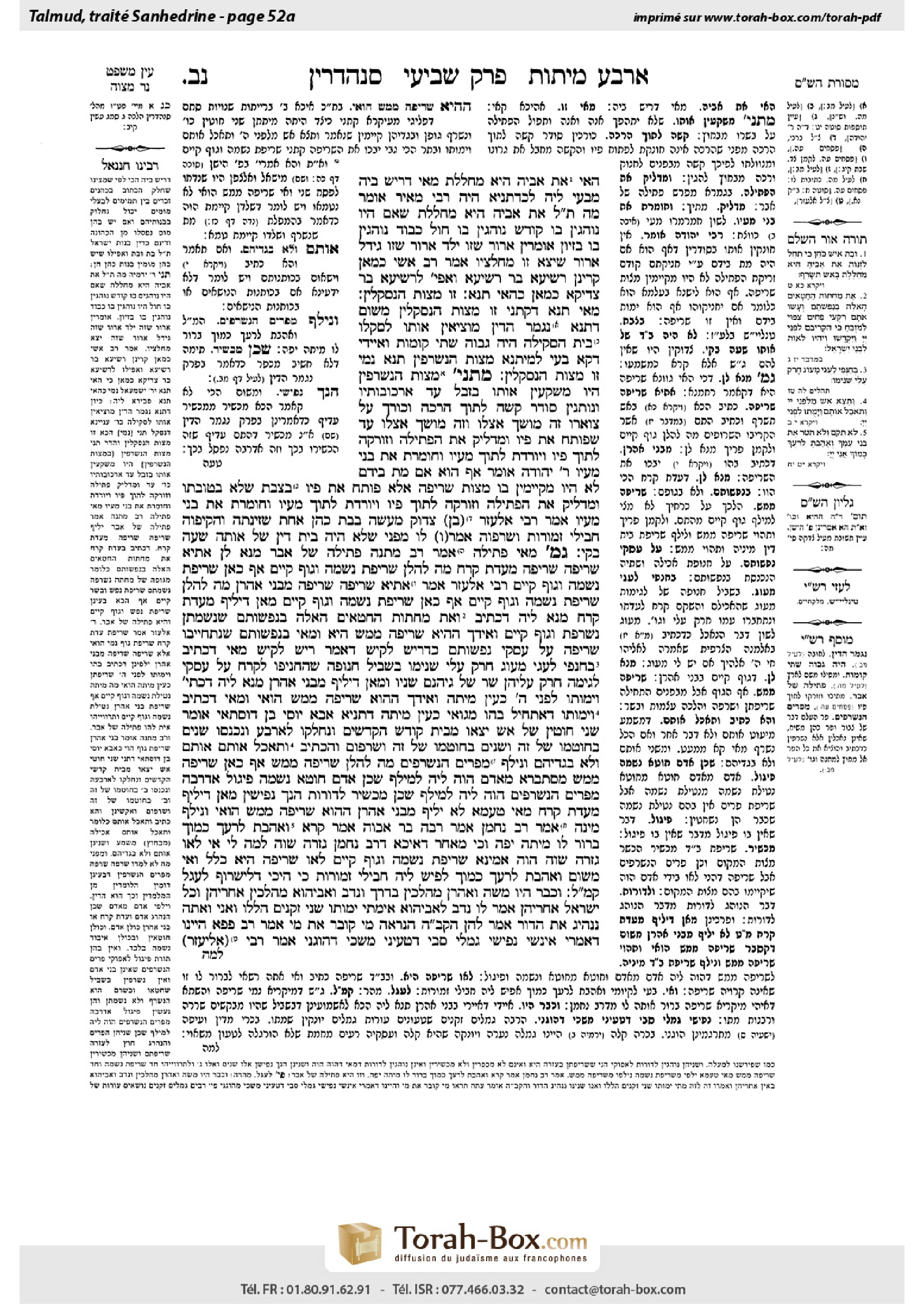
This page of Sanhedrin includes the Aramaic text, an English translation and an AI-generated French translation, alongside the scan above.
סנהדרין נ״ב א · Aramaic and Hebrew text
הַאי ״אָבִיהָ הִיא מְחַלֶּלֶת״, מַאי דָּרֵישׁ בֵּיהּ?
מִבְּעֵי לֵיהּ לְכִדְתַנְיָא: הָיָה רַבִּי מֵאִיר אוֹמֵר, מָה תַּלְמוּד לוֹמַר ״אֶת אָבִיהָ הִיא מְחַלֶּלֶת״? שֶׁאִם הָיוּ נוֹהֲגִין בּוֹ קוֹדֶשׁ – נוֹהֲגִין בּוֹ חוֹל, כָּבוֹד – נוֹהֲגִין בּוֹ בִּזָּיוֹן. אוֹמְרִין: ״אָרוּר שֶׁזּוֹ יָלַד, אָרוּר שֶׁזּוֹ גִּידֵּל, אָרוּר שֶׁיָּצָא זוֹ מֵחֲלָצָיו״.
אָמַר רַב אָשֵׁי: כְּמַאן קָרֵינַן ״רַשִּׁיעָא בַּר רַשִּׁיעָא״, וַאֲפִילּוּ לְרַשִּׁיעָא בַּר צַדִּיקָא, כְּמַאן? כְּהַאי תַּנָּא.
זוֹ מִצְוַת הַנִּסְקָלִין. מַאי תַּנָּא דְּקָתָנֵי זוֹ מִצְוַת הַנִּסְקָלִין?
מִשּׁוּם דִּתְנָא: נִגְמַר הַדִּין מוֹצִיאִין אוֹתוֹ לְסׇקְלוֹ. בֵּית הַסְּקִילָה הָיָה גָּבוֹהַּ שְׁתֵּי קוֹמוֹת. וְאַיְּידֵי דְּקָא בָעֵי לְמִיתְנֵא מִצְוַת הַנִּשְׂרָפִין, תְּנָא נָמֵי זוֹ מִצְוַת הַנִּסְקָלִין.
מַתְנִי׳ מִצְוַת הַנִּשְׂרָפִין – הָיוּ מְשַׁקְּעִין אוֹתוֹ בַּזֶּבֶל עַד אַרְכוּבּוֹתָיו, וְנוֹתְנִין סוּדָר קָשָׁה לְתוֹךְ הָרַכָּה, וְכוֹרֵךְ עַל צַוָּארוֹ. זֶה מוֹשֵׁךְ אֶצְלוֹ וְזֶה מוֹשֵׁךְ אֶצְלוֹ, עַד שֶׁפּוֹתֵחַ אֶת פִּיו. וּמַדְלִיק אֶת הַפְּתִילָה וְזוֹרְקָהּ לְתוֹךְ פִּיו, וְיוֹרֶדֶת לְתוֹךְ מֵעָיו וְחוֹמֶרֶת אֶת בְּנֵי מֵעָיו.
רַבִּי יְהוּדָה אוֹמֵר: אַף הוּא, אִם מֵת בְּיָדָם – לֹא הָיוּ מְקַיְּימִין בּוֹ מִצְוַת שְׂרֵיפָה, אֶלָּא פּוֹתֵחַ אֶת פִּיו בִּצְבָת שֶׁלֹּא בְּטוֹבָתוֹ, וּמַדְלִיק אֶת הַפְּתִילָה וְזוֹרְקָהּ לְתוֹךְ פִּיו, וְיוֹרֶדֶת לְתוֹךְ מֵעָיו וְחוֹמֶרֶת אֶת בְּנֵי מֵעָיו.
אָמַר רַבִּי אֶלְעָזָר בֶּן צָדוֹק: מַעֲשֶׂה בְּבַת כֹּהֵן אַחַת שֶׁזִּינְּתָה, וְהִקִּיפוּהָ חֲבִילֵי זְמוֹרוֹת וּשְׂרָפוּהָ. אָמְרוּ לוֹ: מִפְּנֵי שֶׁלֹּא הָיָה בֵּית דִּין שֶׁל אוֹתָהּ שָׁעָה בָּקִי.
גְּמָ׳ מַאי פְּתִילָה? אָמַר רַב מַתְנָה: פְּתִילָה שֶׁל אֲבָר.
מְנָא לַן? אָתְיָא ״שְׂרֵיפָה״ ״שְׂרֵיפָה״ מֵעֲדַת קֹרַח. מָה לְהַלָּן שְׂרֵיפַת נְשָׁמָה וְגוּף קַיָּים, אַף כָּאן שְׂרֵיפַת נְשָׁמָה וְגוּף קַיָּים.
רַבִּי אֶלְעָזָר אָמַר: אָתְיָא שְׂרֵיפָה שְׂרֵיפָה מִבְּנֵי אַהֲרֹן, מָה לְהַלָּן שְׂרֵיפַת נְשָׁמָה וְגוּף קַיָּים – אַף כָּאן שְׂרֵיפַת נְשָׁמָה וְגוּף קַיָּים.
מַאן דְּיָלֵיף מֵעֲדַת קֹרַח, מְנָא לֵיהּ? דִּכְתִיב: ״וְאֵת מַחְתּוֹת הַחַטָּאִים הָאֵלֶּה בְּנַפְשֹׁתָם״, שֶׁנִּשְׁמָתָן נִשְׂרֶפֶת וְגוּף קַיָּים.
וְאִידַּךְ: הָהִיא שְׂרֵיפָה מַמָּשׁ הִיא. וּמַאי ״בְּנַפְשֹׁתָם״? שֶׁנִּתְחַיְּיבוּ שְׂרֵיפָה עַל עִסְקֵי נַפְשׁוֹתָם.
כִּדְרֵישׁ לָקִישׁ, דְּאָמַר רֵישׁ לָקִישׁ: מַאי דִּכְתִיב ״בְּחַנְפֵי לַעֲגֵי מָעוֹג חָרֹק עָלַי שִׁנֵּימוֹ״? בִּשְׁבִיל חֲנוּפָּה שֶׁהֶחְנִיפוּ לְקֹרַח עַל עִסְקֵי לְגִימָה, חָרַק עֲלֵיהֶן שַׂר שֶׁל גֵּיהִנָּם שִׁנָּיו.
וּמַאן דְּיָלֵיף מִבְּנֵי אַהֲרֹן מְנָא לֵיהּ? דִּכְתִיב: ״וַיָּמֻתוּ לִפְנֵי ה׳״, כְּעֵין מִיתָה.
וְאִידַּךְ: הָהוּא שְׂרֵיפָה מַמָּשׁ הֲוַאי. וּמַאי דִּכְתִיב ״וַיָּמֻתוּ״? דְּאַתְחֵיל בְּהוּ מִגַּוַּאי, כְּעֵין מִיתָה. דְּתַנְיָא, אַבָּא יוֹסֵי בֶּן דּוֹסְתַּאי אוֹמֵר: שְׁנֵי חוּטִין שֶׁל אֵשׁ יָצְאוּ מִבֵּית קוֹדֶשׁ הַקֳּדָשִׁים וְנֶחְלְקוּ לְאַרְבַּע, וְנִכְנְסוּ שְׁנַיִם בְּחוֹטְמוֹ שֶׁל זֶה וּשְׁנַיִם בְּחוֹטְמוֹ שֶׁל זֶה וּשְׂרָפוּם.
וְהָכְתִיב: ״וַתֹּאכַל אוֹתָם״! אוֹתָם, וְלֹא בִּגְדֵיהֶם.
וְנֵילַף מִפָּרִים הַנִּשְׂרָפִים, מָה לְהַלָּן שְׂרֵיפָה מַמָּשׁ – אַף כָּאן שְׂרֵיפָה מַמָּשׁ?
מִסְתַּבְּרָא מֵאָדָם הֲוָה לֵיהּ לְמֵילַף, שֶׁכֵּן אָדָם, חוֹטֵא, נְשָׁמָה, פִּיגּוּל.
אַדְּרַבָּה, מִפָּרִים הַנִּשְׂרָפִים הֲוָה לֵיהּ לְמֵילַף, שֶׁכֵּן מַכְשִׁיר לְדוֹרוֹת.
הָנָךְ נְפִישִׁין.
מַאן דְּיָלֵיף מֵעֲדַת קֹרַח, מַאי טַעְמָא לָא יָלֵיף מִבְּנֵי אַהֲרֹן? הָהוּא שְׂרֵיפָה מַמָּשׁ הֲוַאי. וְנֵילַף מִינַּהּ?
אָמַר רַב נַחְמָן אָמַר רַבָּה בַּר אֲבוּהּ: אָמַר קְרָא ״וְאָהַבְתָּ לְרֵעֲךָ כָּמוֹךָ״, בְּרוֹר לוֹ מִיתָה יָפָה.
וְכִי מֵאַחַר דְּאִיכָּא דְּרַב נַחְמָן, גְּזֵירָה שָׁוָה לְמָה לִי?
אִי לָאו גְּזֵירָה שָׁוָה, הֲוָה אָמֵינָא: שְׂרֵיפַת נְשָׁמָה וְגוּף קַיָּים – לָאו שְׂרֵיפָה הִיא כְּלָל. וְאִי מִשּׁוּם ״וְאָהַבְתָּ לְרֵעֲךָ כָּמוֹךָ״, לַפֵּישׁ לֵיהּ חֲבִילֵי זְמוֹרוֹת כִּי הֵיכִי דְּלִישְׂרוֹף לַעֲגַל. קָא מַשְׁמַע לַן.
וּכְבָר הָיוּ מֹשֶׁה וְאַהֲרֹן מְהַלְּכִין בַּדֶּרֶךְ, וְנָדָב וַאֲבִיהוּא מְהַלְּכִין אַחֲרֵיהֶן, וְכׇל יִשְׂרָאֵל אַחֲרֵיהֶן. אָמַר לוֹ נָדָב לַאֲבִיהוּא: אֵימָתַי יָמוּתוּ שְׁנֵי זְקֵנִים הַלָּלוּ וַאֲנִי וְאַתָּה נַנְהִיג אֶת הַדּוֹר? אָמַר לָהֶן הַקָּדוֹשׁ בָּרוּךְ הוּא: הֲנִרְאֶה מִי קוֹבֵר אֶת מִי. אָמַר רַב פָּפָּא, הַיְינוּ דְּאָמְרִי אִינָשֵׁי: נְפִישֵׁי גַּמְלֵי סָבֵי דִּטְעִינִי מַשְׁכֵי דְהוּגְנֵי.
אָמַר רַבִּי אֱלִיעֶזֶר:
Sanhedrin 52a · English translation
what does he derive from this verse: “She profanes her father” (Leviticus 21:9), if he does not employ the term “her father” for a verbal analogy concerning a young betrothed woman who committed adultery, as Rabbi Akiva does?
The Gemara answers: He requires it for that which is taught in a baraita: Rabbi Meir would say: Why must the verse state: “She profanes her father”? To teach that if initially they would treat her father in a sacred manner, now they treat him in a profane manner. If previously they would treat him with honor, they now treat him with degradation. They say: Cursed is the one who bore this daughter, cursed is the one who raised this daughter, cursed is the one from whose loins this daughter emerged.
Rav Ashi says: In accordance with whose opinion do we call even a wicked person who is the son of a righteous person: A wicked person, the son of a wicked person? In accordance with whose opinion is it? It is in accordance with the opinion of this tanna, Rabbi Meir, who says that a sinful daughter profanes her father, and he too is treated with disgrace.
§ The mishna teaches: This describes the mitzva of those who are stoned, i.e., the process of execution by stoning. The Gemara asks: What was taught in the mishna with regard to which it teaches now: This describes the mitzva of those who are stoned?
The Gemara answers: The Mishna states this because it teaches in the previous chapter (42b): When the trial has ended in a guilty verdict and the condemned man has been sentenced to stoning, he is taken out to be stoned. And it continues (45a): The place of stoning from which the condemned party is pushed to his death is a platform twice the height of an ordinary person. And since the Mishna wants to teach in the next mishna: The mitzva of those who are burned, and it will then proceed to describe the processes involved in carrying out the other forms of execution, it also teaches in this mishna: This describes the mitzva of those who are stoned, in order to summarize what was taught up to this point.
MISHNA: The mitzva of those who are burned, i.e., the process of execution by burning, is carried out in the following manner: The executioners submerge the condemned one in dung up to his knees so he cannot move, and they place a rough scarf within a soft one, so his throat will not be wounded, and wrap these scarves around his neck. This one, i.e., one of the witnesses, pulls the scarf toward himself, and that one, the other witness, pulls it toward himself, until the condemned one is forced to open his mouth, as he is choking. And another person then lights the wick and throws it into his mouth, and it goes down into his intestines and burns his intestines and he dies.
Rabbi Yehuda says: But if this one who is condemned to death by burning accidentally died at their hands by strangulation, they have not fulfilled the mitzva of execution by burning for this person. Rather, the process is carried out in the following manner: One opens the mouth of the condemned person with prongs, against his will, and one lights the wick and throws it into his mouth, and it goes down into his intestines and burns his intestines and he dies.
Rabbi Elazar ben Tzadok said: An incident occurred with regard to a certain priest’s daughter who committed adultery, and they wrapped her in bundles of branches and burned her, contrary to the process described in the mishna. The Sages said to him: That court did not act properly; they did so because the court at that time was not proficient in halakha.
GEMARA: What kind of wick is the mishna referring to? Rav Mattana says: A wick of lead, i.e., a long, thin piece of lead in the shape of a wick, which is melted and poured down into the intestines.
From where do we derive that burning means this kind of death? It is derived from a verbal analogy between the burning that is described in the context of capital punishment (see Leviticus 21:9) and the burning described with regard to the assembly of Korah, when they were burned by God (see Numbers 17:4). Just as there, with regard to the assembly of Korah, they were killed by the burning of the soul within the body, but the body itself remained intact, so too here, the condemned one is executed by the burning of the soul, but the body remains intact. He is not executed by means of the burning of the body with wood, as in that case the body would be consumed.
Rabbi Elazar says that there is a different source for this method of burning: It is derived from a verbal analogy between the burning that is described in this context and the burning that is described with regard to the deaths of Nadav and Avihu, the sons of Aaron (see Leviticus 10:6). Just as there, Nadav and Avihu were killed by the burning of the soul, but the body remained intact, so too here, the execution is carried out by the burning of the soul, but the body remains intact.
The Gemara asks: From where does the one who derives that burning means this kind of death from the assembly of Korah derive that their bodies were not burned? The Gemara answers: He derives it from that which is written: “And the firepans of these men who have sinned with their souls” (Numbers 17:3), which indicates that only their souls were burned, but their bodies were intact.
The Gemara asks: And how does the other Sage, who does not derive that burning means this kind of death from here, interpret the deaths of the assembly of Korah? The Gemara answers: That burning was actual burning of their bodies. And what is the meaning of the term: “With their souls”? It means that they were deemed liable to be killed by burning due to matters of sustaining their souls, i.e., they sinned because Korah helped them fulfill their bodily desires, and consequently they followed him.
This latter explanation is in accordance with the statement of Reish Lakish. As Reish Lakish says: What is the meaning of that which is written: “With the flattering mockeries of spitefulness [maog] they gnash at me with their teeth” (Psalms 35:16)? It means that because of the flattery of those people who flattered Korah over matters of eating, i.e., because of the food and drink that he would give them, the minister of Gehenna gnashed his teeth over them, as they eventually sinned and fell into his hands. The word maog is interpreted homiletically here as alluding to uga, cake.
The Gemara asks: And from where does the one who derives that burning means this kind of death from the sons of Aaron derive that their bodies were not burned? The Gemara answers: He derives it from that which is written: “And fire came out from before the Lord, and devoured them, and they died before the Lord” (Leviticus 10:2). The term “and they died” indicates that it was similar to a natural death, in which the body remains intact.
The Gemara asks: And how does the other Sage, who does not derive that burning means this kind of death from here, interpret the death of the sons of Aaron? The Gemara answers: That burning was actual burning. And in that case, what is the meaning of that which is written: “And they died”? It means that the fire started from within them, and therefore it was similar to a natural death, which occurs within the person. As it is taught in a baraita: Abba Yosei ben Dostai says: Two threads of fire came out of the Holy of Holies and split into four, and two entered the nostrils of this one, and the other two entered the nostrils of that one, and the threads of fire burned them.
The Gemara asks: But isn’t it written: “And devoured them [vatokhal otam]”? The usage of the expanded term “vatokhal otam,” instead of the terser vatokhlem, indicates a limitation, i.e., only they were consumed, to the exclusion of their bodies. The Gemara answers: The verse means that the fire devoured “them,” but not their clothes.
The Gemara asks: And let us derive the correct method of execution by burning from the halakha of the bull offerings that are burned. Just as there, the reference is to actual burning, so too here, perhaps there should be actual burning.
The Gemara answers: It stands to reason that one should derive the halakha with regard to capital punishment from the death of a person, i.e., either from the assembly of Korah or the sons of Aaron, as they share common elements: They deal with a person, a sinner, and a soul that is taken through burning, i.e., the person dies as a result of the burning. Furthermore, the halakha of an offering that was sacrificed with the intent to consume it after its designated time [piggul], is not relevant in either case, whereas it is relevant to bull offerings that are burned.
The Gemara asks: On the contrary, one should derive the halakha with regard to capital punishment from the bull offerings that are burned, as both enable the fulfillment of a mitzva, whereas the deaths of the assembly of Korah and the sons of Aaron were not mitzvot. Furthermore, both of these are fixed halakhot for all future generations, whereas the deaths of the assembly of Korah and the sons of Aaron were onetime incidents.
The Gemara answers: Those elements that are shared by capital punishment and the deaths of the assembly of Korah and the sons of Aaron are more numerous than the elements that are shared by capital punishment and the bulls that are burned. Therefore, the halakha is derived from the assembly of Korah and the sons of Aaron.
The Gemara asks: With regard to the one who derives this halakha from the assembly of Korah, what is the reason he does not derive it from the sons of Aaron? Because in his opinion that was actual burning. But if this is the case, let us derive from the death of the sons of Aaron that execution by burning should be performed with actual burning; why does he derive from the assembly of Korah that hot lead should be used?
Rav Naḥman says that Rabba bar Avuh says: The verse states: “And you shall love your neighbor as yourself” (Leviticus 19:18), which teaches that even with regard to a condemned prisoner one should select a good, i.e., a compassionate, death for him. The method of burning described in the mishna is certainly faster and less painful than the burning of the entire body.
The Gemara asks: And since there is the halakha of Rav Naḥman, why do I need the verbal analogy? Even without this proof execution by burning would have been performed with hot lead, as it is a less painful form of death.
The Gemara answers: Were it not for the verbal analogy, I would say that a death that includes the burning of the soul, but the body itself remains intact, is not burning at all, and that it does not fulfill the mitzva of execution by burning. And if it is necessary to alleviate the condemned one’s pain due to the halakha of “And you shall love your neighbor as yourself” (Leviticus 19:18), let the court increase for him the bundles of branches, so that he will burn quicker. Therefore, the verbal analogy teaches us that even internal burning is regarded as burning, and once this has been established it is taken into consideration that he must be executed in the least painful way.
Apropos the deaths of Nadav and Avihu, an aggadic midrash on this subject is quoted: And it had already happened that Moses and Aaron were walking on their way, and Nadav and Avihu were walking behind them, and the entire Jewish people were walking behind them. Nadav said to Avihu: When will it happen that these two old men will die and you and I will lead the generation, as we are their heirs? The Holy One, Blessed be He, said to them: We shall see who buries whom. Rav Pappa says: This explains the adage that people say: Many are the old camels that are loaded with the skins of young camels.
Rabbi Eliezer says:
Sanhedrin 52a · Traduction française (IA)
Que déduit-il de ce verset : « Elle profane son père » (Lévitique 21:9), s'il n'emploie pas le terme « son père » pour une analogie verbale concernant une jeune fiancée qui a commis l'adultère, comme le fait Rabbi Akiva ?
La Guemara répond : Il en a besoin pour ce qui est enseigné dans une baraïta : Rabbi Meïr disait : Pourquoi le verset doit-il préciser : « Elle profane son père » ? Pour enseigner que si, initialement, ils traitaient son père avec sainteté, maintenant ils le traitent avec profanation. S'ils l'honoraient auparavant, ils le traitent maintenant avec dégradation. Ils disent : Maudit soit celui qui a engendré cette fille, maudit soit celui qui a élevé cette fille, maudit soit celui dont les reins ont fait sortir cette fille.
Rav Ashi dit : Selon l'avis de qui appelons-nous même une personne méchante qui est le fils d'une personne juste : « Un méchant, fils d'un méchant » ? Selon l'avis de qui est-ce ? C'est selon l'avis de ce tanna, Rabbi Meïr, qui dit qu'une fille pécheresse profane son père, et que lui aussi est traité avec ignominie.
§ La Michna enseigne : Voici la mitsva de ceux qui sont lapidés, c'est-à-dire le processus d'exécution par lapidation. La Guemara demande : Qu'est-ce qui a été enseigné dans la Michna, au sujet de quoi on enseigne maintenant : « Voici la mitsva de ceux qui sont lapidés » ?
La Guemara répond : La Michna l'énonce parce qu'elle enseigne dans le chapitre précédent (42b) : Lorsque le procès s'est terminé par un verdict de culpabilité et que le condamné a été condamné à la lapidation, il est emmené pour être lapidé. Et elle continue (45a) : Le lieu de lapidation, d'où le condamné est poussé à sa mort, est une plateforme deux fois la hauteur d'une personne ordinaire. Et comme la Michna veut enseigner dans la Michna suivante : « La mitsva de ceux qui sont brûlés », et qu'elle va ensuite décrire les processus impliqués dans l'exécution des autres formes de peine capitale, elle enseigne aussi dans cette Michna : « Voici la mitsva de ceux qui sont lapidés », afin de résumer ce qui a été enseigné jusqu'à ce point.
MICHNA : La mitsva de ceux qui sont brûlés, c'est-à-dire le processus d'exécution par le feu, est exécutée de la manière suivante : Les bourreaux immergent le condamné dans du fumier jusqu'aux genoux pour qu'il ne puisse pas bouger, et ils placent un mouchoir grossier dans un mouchoir doux, afin que sa gorge ne soit pas blessée, et ils enroulent ces mouchoirs autour de son cou. Celui-ci, c'est-à-dire l'un des témoins, tire le mouchoir vers lui, et celui-là, l'autre témoin, le tire vers lui, jusqu'à ce que le condamné soit forcé d'ouvrir la bouche, car il étouffe. Et une autre personne allume alors la mèche et la jette dans sa bouche, et elle descend dans ses intestins et brûle ses intestins et il meurt.
Rabbi Yehouda dit : Mais si celui qui est condamné à mort par le feu est mort accidentellement entre leurs mains par strangulation, ils n'ont pas accompli la mitsva d'exécution par le feu pour cette personne. Plutôt, le processus est exécuté de la manière suivante : On ouvre la bouche du condamné avec des fourches, contre sa volonté, et on allume la mèche et on la jette dans sa bouche, et elle descend dans ses intestins et brûle ses intestins et il meurt.
Rabbi Elazar ben Tsadok a dit : Un incident s'est produit concernant une certaine fille de prêtre qui a commis l'adultère, et ils l'ont enveloppée dans des faisceaux de branches et l'ont brûlée, contrairement au processus décrit dans la Michna. Les Sages lui ont dit : Ce tribunal n'a pas agi correctement ; ils l'ont fait parce que le tribunal de cette époque n'était pas compétent en halakha.
GUEMARA : Quel type de mèche la Michna désigne-t-elle ? Rav Mattana dit : Une mèche de plomb, c'est-à-dire une longue et fine pièce de plomb en forme de mèche, qui est fondue et versée dans les intestins.
D'où déduisons-nous que la combustion signifie ce type de mort ? Cela se déduit d'une analogie verbale entre la combustion décrite dans le contexte de la peine capitale (voir Lévitique 21:9) et la combustion décrite au sujet de l'assemblée de Korah, lorsqu'ils furent brûlés par Dieu (voir Nombres 17:4). Tout comme là, au sujet de l'assemblée de Korah, ils furent tués par la combustion de l'âme dans le corps, mais le corps lui-même resta intact, de même ici, le condamné est exécuté par la combustion de l'âme, mais le corps reste intact. Il n'est pas exécuté par la combustion du corps au moyen de bois, car dans ce cas, le corps serait consumé.
Rabbi Elazar dit qu'il existe une source différente pour cette méthode de combustion : cela se déduit d'une analogie verbale entre la combustion décrite dans ce contexte et la combustion décrite au sujet de la mort de Nadav et Avihu, fils d'Aaron (voir Lévitique 10:6). Tout comme là, Nadav et Avihu furent tués par la combustion de l'âme, mais le corps resta intact, de même ici, l'exécution est réalisée par la combustion de l'âme, mais le corps reste intact.
La Guemara demande : D'où celui qui déduit que la combustion signifie ce type de mort à partir de l'assemblée de Korah déduit-il que leurs corps ne furent pas brûlés ? La Guemara répond : Il le déduit de ce qui est écrit : « Et les brasiers de ces hommes qui ont péché par leurs âmes » (Nombres 17:3), ce qui indique que seules leurs âmes furent brûlées, mais leurs corps étaient intacts.
La Guemara demande : Et comment l'autre Sage, qui ne déduit pas de ce passage que la combustion signifie ce type de mort, interprète-t-il la mort de l'assemblée de Korah ? La Guemara répond : Cette combustion était une combustion réelle de leurs corps. Et quel est le sens de l'expression : « Avec leurs âmes » ? Cela signifie qu'ils étaient considérés comme passibles de la peine de mort par combustion en raison de questions liées au maintien de leurs âmes, c'est-à-dire qu'ils ont péché parce que Korah les a aidés à satisfaire leurs désirs corporels, et par conséquent ils l'ont suivi.
Cette dernière explication est conforme à l'enseignement de Reish Lakish. Car Reish Lakish dit : Quelle est la signification de ce qui est écrit : « Avec les moqueries flatteuses de la méchanceté [maog], ils me grincèrent les dents » (Psaumes 35:16) ? Cela signifie que, à cause de la flatterie de ces gens qui flattèrent Korah au sujet de la nourriture, c'est-à-dire à cause de la nourriture et des boissons qu'il leur donnait, le ministre de la Géhenne grincera les dents à leur égard, car ils ont fini par pécher et tomber entre ses mains. Le mot maog est interprété ici homilétiquement comme faisant allusion à uga, gâteau.
La Guemara demande : Et d'où celui qui déduit que la combustion signifie ce type de mort à partir des fils d'Aaron déduit-il que leurs corps n'ont pas été brûlés ? La Guemara répond : Il le déduit de ce qui est écrit : « Et une flamme sortit du devant de l'Éternel, et les dévora, et ils moururent devant l'Éternel » (Lévitique 10:2). L'expression « et ils moururent » indique que cela ressemblait à une mort naturelle, dans laquelle le corps reste intact.
La Guemara demande : Et comment l'autre Sage, qui ne déduit pas de là que la combustion signifie ce type de mort, interprète-t-il la mort des fils d'Aaron ? La Guemara répond : Cette combustion était une combustion réelle. Et dans ce cas, quelle est la signification de ce qui est écrit : « Et ils moururent » ? Cela signifie que le feu est parti d'eux-mêmes, et par conséquent cela ressemblait à une mort naturelle, qui survient à l'intérieur de la personne. Comme il est enseigné dans une baraïta : Abba Yosei ben Dostai dit : Deux fils de feu sortirent du Saint des Saints et se divisèrent en quatre, et deux entrèrent dans les narines de celui-ci, et les deux autres entrèrent dans les narines de celui-là, et les fils de feu les brûlèrent.
La Guemara demande : Mais n'est-il pas écrit : « Et les dévora [vatokhal otam] » ? L'usage du terme étendu « vatokhal otam », au lieu du plus bref vatokhlem, indique une limitation, c'est-à-dire que seuls eux ont été consumés, à l'exclusion de leurs corps. La Guemara répond : Le verset signifie que le feu a dévoré « eux », mais pas leurs vêtements.
La Guemara demande : Et ne devrions-nous pas déduire la méthode correcte d'exécution par combustion à partir de la halakha des taureaux qui sont brûlés ? Tout comme là-bas, il s'agit d'une combustion réelle, de même ici, peut-être devrait-il y avoir une combustion réelle.
La Guemara répond : Il va de soi qu'on devrait déduire la halakha concernant la peine capitale de la mort d'une personne, c'est-à-dire soit de l'assemblée de Korah, soit des fils d'Aaron, car ils partagent des éléments communs : ils concernent une personne, un pécheur, et une âme qui est emportée par la combustion, c'est-à-dire que la personne meurt à la suite de la combustion. De plus, la halakha d'une offrande sacrifiée avec l'intention de la consommer après son temps désigné [piggul] n'est pertinente dans aucun des deux cas, alors qu'elle est pertinente pour les taureaux qui sont brûlés.
La Guemara demande : Au contraire, on devrait déduire la halakha concernant la peine capitale des taureaux qui sont brûlés, car tous deux permettent l'accomplissement d'une mitsva, alors que les morts de l'assemblée de Korah et des fils d'Aaron n'étaient pas des mitsvot. De plus, ces deux cas sont des halakhot fixes pour toutes les générations futures, alors que les morts de l'assemblée de Korah et des fils d'Aaron étaient des incidents ponctuels.
La Guemara répond : Les éléments partagés par la peine capitale et les morts de l'assemblée de Korah et des fils d'Aaron sont plus nombreux que les éléments partagés par la peine capitale et les taureaux qui sont brûlés. Par conséquent, la halakha est déduite de l'assemblée de Korah et des fils d'Aaron.
La Guemara demande : Concernant celui qui déduit cette halakha de l'assemblée de Korah, quelle est la raison pour laquelle il ne la déduit pas des fils d'Aaron ? Parce que, selon son opinion, il s'agissait d'une combustion réelle. Mais si c'est le cas, ne devrions-nous pas déduire de la mort des fils d'Aaron que l'exécution par combustion doit être effectuée avec une combustion réelle ; pourquoi déduit-il de l'assemblée de Korah que du plomb chaud doit être utilisé ?
Rav Naḥman dit que Rabba bar Avuh dit : Le verset énonce : « Et tu aimeras ton prochain comme toi-même » (Lévitique 19:18), ce qui enseigne que même en ce qui concerne un condamné à mort, on doit lui choisir une bonne, c'est-à-dire une miséricordieuse, mort. La méthode de combustion décrite dans la Michna est certainement plus rapide et moins douloureuse que la combustion de tout le corps.
La Guemara demande : Et puisque la halakha de Rav Naḥman existe, pourquoi ai-je besoin de l'analogie verbale ? Même sans cette preuve, l'exécution par combustion aurait été effectuée avec du plomb chaud, car c'est une forme de mort moins douloureuse.
La Guemara répond : S'il n'y avait pas l'analogie verbale, je dirais qu'une mort qui inclut la combustion de l'âme, mais où le corps lui-même reste intact, n'est pas du tout une combustion, et qu'elle n'accomplit pas la mitsva d'exécution par combustion. Et s'il est nécessaire d'atténuer la douleur du condamné en raison de la halakha de « Et tu aimeras ton prochain comme toi-même » (Lévitique 19:18), que le tribunal augmente pour lui les faisceaux de branches, afin qu'il brûle plus rapidement. Par conséquent, l'analogie verbale nous enseigne que même la combustion interne est considérée comme une combustion, et une fois cela établi, il est tenu compte du fait qu'il doit être exécuté de la manière la moins douloureuse.
À propos des morts de Nadav et Avihu, un midrash aggadique sur ce sujet est cité : Et il était déjà arrivé que Moïse et Aaron marchaient sur leur chemin, et Nadav et Avihu marchaient derrière eux, et tout le peuple juif marchait derrière eux. Nadav dit à Avihu : Quand arrivera-t-il que ces deux vieillards mourront et que toi et moi dirigerons la génération, car nous sommes leurs héritiers ? Le Saint, béni soit-Il, leur dit : Nous verrons qui enterre qui. Rav Pappa dit : Cela explique le proverbe que les gens disent : Il y a beaucoup de vieux chameaux chargés des peaux de jeunes chameaux.
Rabbi Eliezer dit :
Traduction française générée par IA à partir de l’édition anglaise de Sefaria. Vérifie toujours un passage avec le texte source.
Text from Sefaria: William Davidson Edition - Vocalized Aramaic (CC BY NC); William Davidson Edition - English (CC BY NC).