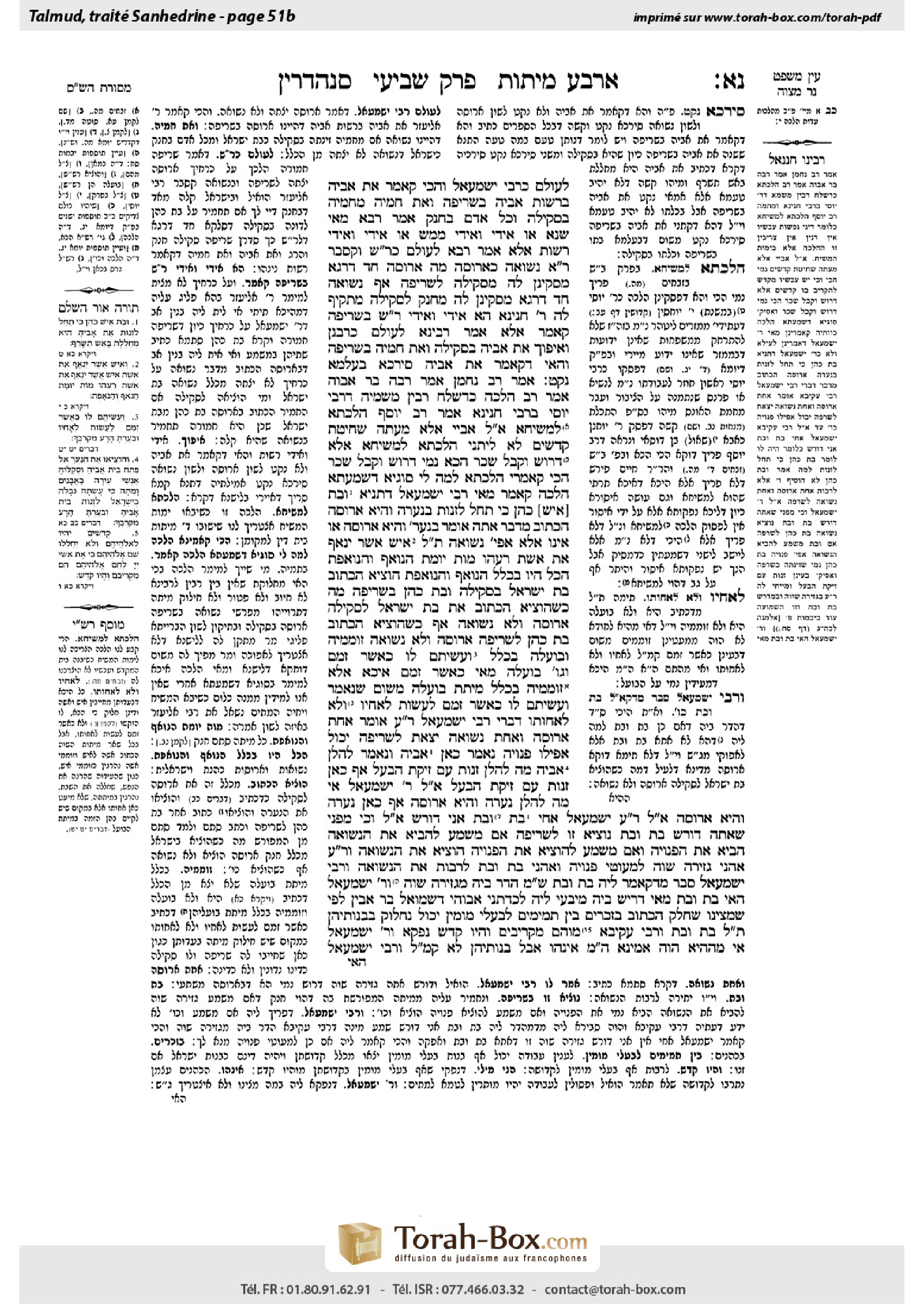
Sanhedrin 51b: Talmud study for Daf Yomi
Daf Yomi is the daily study of one Talmud folio. Explore 37 tractates with scans, Hebrew text, Sefaria English and AI-generated French translations where annotated.
Passage selection and English or AI-generated French translation are available where the scan has annotations. Daf Study is independent of Torah-Box and Sefaria.
Browse Sanhedrin · סנהדרין · All tractatesSanhedrin 51b text and translations
This page of Sanhedrin includes the Aramaic text, an English translation and an AI-generated French translation, alongside the scan above.
סנהדרין נ״א ב · Aramaic and Hebrew text
לְעוֹלָם כְּרַבִּי יִשְׁמָעֵאל, וְהָכִי קָאָמַר: אֶת אָבִיהָ – בִּרְשׁוּת אָבִיהָ, בִּשְׂרֵיפָה; וְאֶת חָמִיהָ – מֵחָמִיהָ, בִּסְקִילָה; וְכׇל אָדָם – בְּחֶנֶק.
אָמַר רָבָא: מַאי שְׁנָא? אוֹ אִידֵּי וְאִידֵּי מַמָּשׁ, אוֹ אִידֵּי וְאִידֵּי רְשׁוּת.
אֶלָּא אָמַר רָבָא: לְעוֹלָם כְּרַבִּי שִׁמְעוֹן, וְקָסָבַר רַבִּי אֱלִיעֶזֶר נְשׂוּאָה כַּאֲרוּסָה. מָה אֲרוּסָה חַד דַּרְגָּא מַסְּקִינַן לַהּ, מִסְּקִילָה לִשְׂרֵיפָה, אַף נְשׂוּאָה חַד דַּרְגָּא מַסְּקִינַן לַהּ, מֵחֶנֶק לִסְקִילָה.
מַתְקֵיף לַהּ רַבִּי חֲנִינָא: הָא אִידֵּי וְאִידֵּי רַבִּי שִׁמְעוֹן בִּשְׂרֵיפָה קָאָמַר?
אֶלָּא אָמַר רָבִינָא: לְעוֹלָם כְּרַבָּנַן, וְאֵיפוֹךְ – אֶת אָבִיהָ בִּסְקִילָה, וְאֶת חָמִיהָ בִּשְׂרֵיפָה. וְהַאי דְּקָאָמַר ״אֶת אָבִיהָ״ – סִירְכָא בְּעָלְמָא נָקֵט.
אָמַר רַב נַחְמָן, אָמַר רַבָּה בַּר אֲבוּהּ, אָמַר רַב: הֲלָכָה כְּדִשְׁלַח רָבִין מִשְּׁמֵיהּ דְּרַבִּי יוֹסֵי בְּרַבִּי חֲנִינָא. אָמַר רַב יוֹסֵף: הִלְכְתָא לִמְשִׁיחָא?
אֲמַר לֵיהּ אַבָּיֵי: אֶלָּא מֵעַתָּה, שְׁחִיטַת קֳדָשִׁים לָא לִיתְנֵי? הִלְכְתָא לִמְשִׁיחָא! אֶלָּא, דְּרוֹשׁ וְקַבֵּל שָׂכָר. הָכָא נָמֵי, דְּרוֹשׁ וְקַבֵּל שָׂכָר.
הָכִי קָאָמְרִי: הִלְכְתָא לְמָה לִי? סוּגְיָא דִּשְׁמַעְתָּא הֲלָכָה קָאָמַר.
מַאי רַבִּי יִשְׁמָעֵאל? דְּתַנְיָא: ״וּבַת [אִישׁ] כֹּהֵן כִּי תֵחֵל לִזְנוֹת״ – בְּנַעֲרָה וְהִיא אֲרוּסָה הַכָּתוּב מְדַבֵּר.
אַתָּה אוֹמֵר בְּנַעֲרָה וְהִיא אֲרוּסָה, אוֹ אֵינוֹ אֶלָּא אֲפִילּוּ נְשׂוּאָה? תַּלְמוּד לוֹמַר: ״אִישׁ אֲשֶׁר יִנְאַף אֶת אֵשֶׁת רֵעֵהוּ מוֹת יוּמַת הַנֹּאֵף וְהַנֹּאָפֶת״. הַכֹּל הָיוּ בִּכְלַל ״הַנּוֹאֵף וְהַנּוֹאֶפֶת״. הוֹצִיא הַכָּתוּב בַּת יִשְׂרָאֵל בִּסְקִילָה וּבַת כֹּהֵן בִּשְׂרֵיפָה. מָה כְּשֶׁהוֹצִיא הַכָּתוּב אֶת בַּת יִשְׂרָאֵל לִסְקִילָה – אֲרוּסָה וְלֹא נְשׂוּאָה, אַף כְּשֶׁהוֹצִיא הַכָּתוּב בַּת כֹּהֵן לִשְׂרֵיפָה – אֲרוּסָה וְלֹא נְשׂוּאָה.
זוֹמְמֶיהָ וּבוֹעֲלָהּ בִּכְלַל ״וַעֲשִׂיתֶם לוֹ כַּאֲשֶׁר זָמַם וְגוֹ׳״.
בּוֹעֲלָהּ – מַאי ״כַּאֲשֶׁר זָמַם״ אִיכָּא? אֶלָּא: זוֹמְמֶיהָ בִּכְלַל מִיתַת בּוֹעֲלָהּ.
מִשּׁוּם שֶׁנֶּאֱמַר: ״וַעֲשִׂיתֶם לוֹ כַּאֲשֶׁר זָמַם לַעֲשׂוֹת לְאָחִיו״, וְלֹא לַאֲחוֹתוֹ. דִּבְרֵי רַבִּי יִשְׁמָעֵאל.
רַבִּי עֲקִיבָא אוֹמֵר: אַחַת אֲרוּסָה וְאַחַת נְשׂוּאָה יָצָאת לִשְׂרֵיפָה. יָכוֹל אֲפִילּוּ פְּנוּיָה? נֶאֱמַר כָּאן ״אָבִיהָ״, וְנֶאֱמַר לְהַלָּן ״אָבִיהָ״. מָה לְהַלָּן זְנוּת עִם זִיקַת הַבַּעַל, אַף כָּאן זְנוּת עִם זִיקַת הַבַּעַל.
אָמַר לוֹ רַבִּי יִשְׁמָעֵאל: אִי, מָה לְהַלָּן נַעֲרָה וְהִיא אֲרוּסָה, אַף כָּאן נַעֲרָה וְהִיא אֲרוּסָה.
אָמַר לוֹ רַבִּי עֲקִיבָא: יִשְׁמָעֵאל אָחִי, ״בַּת״ ״וּבַת״ אֲנִי דּוֹרֵשׁ.
אָמַר לוֹ: וְכִי מִפְּנֵי שֶׁאַתָּה דּוֹרֵשׁ ״בַּת״ ״וּבַת״ נוֹצִיא זוֹ לִשְׂרֵיפָה? אִם מַשְׁמַע לְהָבִיא אֶת הַנְּשׂוּאָה, הָבֵיא אֶת הַפְּנוּיָה; וְאִם מַשְׁמַע לְהוֹצִיא אֶת הַפְּנוּיָה, הוֹצֵיא אֶת הַנְּשׂוּאָה.
וְרַבִּי עֲקִיבָא, אַהֲנִי גְּזֵירָה שָׁוָה לְמַעוֹטֵי פְּנוּיָה, וְאַהֲנִי ״בַּת״ ״וּבַת״ לְרַבּוֹת אֶת הַנְּשׂוּאָה.
וְרַבִּי יִשְׁמָעֵאל סָבַר: מִדְּקָאָמַר לֵיהּ ״בַּת״ ״וּבַת״, שְׁמַע מִינַּהּ הֲדַר בֵּיהּ מִגְּזֵירָה שָׁוָה.
וְרַבִּי יִשְׁמָעֵאל, הַאי ״בַּת״ ״וּבַת״ מַאי דָּרֵישׁ בֵּיהּ? מִיבְּעֵי לֵיהּ לְכִדְתָנֵי אֲבוּהּ דִּשְׁמוּאֵל בַּר אָבִין: לְפִי שֶׁמָּצִינוּ שֶׁחִלֵּק הַכָּתוּב בִּזְכָרִים בֵּין תְּמִימִים לְבַעֲלֵי מוּמִין, יָכוֹל נַחְלוֹק בִּבְנוֹתֵיהֶן? תַּלְמוּד לוֹמַר: ״בַּת״ ״וּבַת״.
וְרַבִּי עֲקִיבָא מִן ״הֵם מַקְרִיבִם וְהָיוּ קֹדֶשׁ״ נָפְקָא.
וְרַבִּי יִשְׁמָעֵאל, אִי מֵהַהִיא הֲוָה אָמֵינָא: הָנֵי מִילֵּי אִינְהוּ, אֲבָל בְּנוֹתֵיהֶן לָא. קָא מַשְׁמַע לַן.
וְרַבִּי יִשְׁמָעֵאל,
Sanhedrin 51b · English translation
Actually, Rabbi Eliezer’s statement is in accordance with the opinion of Rabbi Yishmael, and this is what he is saying: The expression: With her father, means under her father’s authority, i.e., she is still betrothed, and she is executed by burning if she commits adultery. And the expression: With her father-in-law, means that after getting married, she engages in intercourse with her father-in-law, and she is therefore executed by stoning. And if she commits adultery with any other man after getting married, she is executed by strangulation, like any other married woman.
Rava says: What is different between the wording of the two clauses of Rabbi Eliezer’s statement that allows for them to be understood differently? Either explain this one and that one literally, i.e., that she engages in intercourse with her father or father-in-law, or explain this one and that one as referring to the authority of the father or father-in-law.
Rather, Rava says: Actually, Rabbi Eliezer’s statement is in accordance with the opinion of Rabbi Shimon that burning is more severe than stoning, and Rabbi Eliezer holds that the halakha of the married daughter of a priest is comparable to that of the betrothed one. Just as with regard to the betrothed daughter of a priest we raise her punishment by one level vis-à-vis the betrothed daughter of a non-priest, from stoning to burning, so too, with regard to the married daughter of a priest, we raise her punishment by one level vis-à-vis the married daughter of a non-priest, from strangulation to stoning.
Rav Ḥanina objects to this explanation: Doesn’t Rabbi Shimon himself say that both in this case and in that case, i.e., whether she is betrothed or married, the daughter of a priest is executed by burning? His opinion cannot be interpreted contrary to his own statement.
Rather, Ravina says: Actually, Rabbi Eliezer’s statement is in accordance with the opinion of the Rabbis, that the married daughter of a priest is executed by burning and the betrothed daughter of a priest is executed by stoning. And reverse the wording of Rabbi Eliezer’s statement as follows: When she is with her father, i.e., when she is betrothed, she is executed by stoning, and when she is with her father-in-law, i.e., when she is married, she is executed by burning. And the fact that the tanna states the phrase: With her father, instead of simply stating that she is betrothed, is because he was merely drawn to the common usage, i.e., the wording of the verse, and employed it.
Rav Naḥman says that Rabba bar Avuh says that Rav says: The halakha in this matter is in accordance with the explanation that Ravin sent in the name of Rabbi Yosei, son of Rabbi Ḥanina. Rav Yosef said in response: Does one issue a halakha for the messianic period? Since the destruction of the Temple, courts do not have the authority to adjudicate capital cases (see 52b), and this authority will be restored only once the Temple is rebuilt, in the messianic period. Therefore, what is the purpose of stating the halakha in this matter when it is not currently relevant?
Abaye said to him: If that is so, let the tanna not teach all the halakhot of the slaughter of sacrificial animals, i.e., tractate Zevaḥim, as it is entirely a halakha for the messianic period. Rather, one studies these halakhot due to the principle of: Study Torah and receive reward, i.e., one is rewarded for the study of Torah regardless of its practical applicability. Here too, study Torah and receive reward.
Rav Yosef responded: This is what I meant to say: Why do I need the halakha with regard to this subject to be stated? Is a halakha stated in the discussion of Rabbi Eliezer’s statement? The statements of the amora’im are merely explanations of how to understand the wording of Rabbi Eliezer’s statement, but there is no difference between them with regard to the halakha.
§ The Gemara discusses the opinion of Rabbi Yishmael that the betrothed daughter of a priest who committed adultery is executed by burning, whereas the married daughter of a priest who committed adultery is executed by strangulation. What is the source for the opinion of Rabbi Yishmael? It is as it is taught in a baraita: With regard to the verse: “And the daughter of a priest, when she profanes herself by playing the harlot” (Leviticus 21:9), the verse is speaking of a young woman who is betrothed.
Do you say that it is referring only to a young woman who is betrothed, or that it is referring even to a married woman? The verse states: “And a man who commits adultery with another man’s wife, he who commits adultery with his neighbor’s wife, both the adulterer and the adulteress shall be put to death” (Leviticus 20:10). All adulterers were included in the category of: “The adulterer and the adulteress,” and were executed by strangulation, until the verse singled out the betrothed daughter of a non-priest for execution by stoning and the daughter of a priest for execution by burning. It is therefore derived that just as when the verse singles out the daughter of a non-priest for stoning the Torah states that the reference is to a woman who is betrothed and not married, so too, when the verse singles out the daughter of a priest for burning it is referring to a woman who is betrothed and not married.
The baraita continues: The conspiring witnesses concerning the daughter of a priest, and the paramour of the daughter of a priest, are included in the verse: “And you shall do to him as he conspired to do to his brother” (Deuteronomy 19:19).
The Gemara interjects and asks: What reason is there for the punishment of “as he conspired” to be applied with regard to her paramour? Rather, the baraita should be read: Her conspiring witnesses are included in the death penalty of her paramour, i.e., they are executed by strangulation, which they sought to impose upon her paramour. They are not executed by burning, which is the death penalty that they sought to impose upon her.
This is because it is stated: “And you shall do to him as he conspired to do to his brother,” which is interpreted to mean: “To his brother,” but not to his sister. This is the statement of Rabbi Yishmael.
Rabbi Akiva says: Both the betrothed and the married daughter of a priest are singled out for execution by burning. One might have thought that even an unmarried daughter of a priest who engaged in promiscuous intercourse should be executed by burning. This is incorrect, as here it is stated: “Her father,” and there it is stated, with regard to a betrothed woman who committed adultery: “Her father” (Deuteronomy 22:21). It is derived through a verbal analogy that just as below, the reference is to the promiscuous intercourse of one who has a bond to a husband, so too here, the reference is to the promiscuous intercourse of one who has a bond to a husband.
Rabbi Yishmael said to him: If the halakha of a priest’s daughter who committed adultery is compared to the halakha of a betrothed woman who committed adultery, then it can be inferred that just as there the reference is specifically to a young woman who is betrothed, so too here, the reference is to a young woman who is betrothed. This serves as a proof for the opinion of Rabbi Yishmael, which is that only the betrothed daughter of a priest is executed by burning.
Rabbi Akiva said to him: Yishmael, my brother, I derive it from the fact that the verse could have stated: “The daughter of a priest,” but instead states: “And the daughter of a priest,” with the conjunction “and,” that married daughters of priests are also included in this punishment.
Rabbi Yishmael said to him: And because you derive this from the difference between the term “the daughter” and the term “and the daughter,” we should take this married daughter of a priest out to be executed by burning? This derivation of yours is inconsistent, because if the conjunction “and” indicates the inclusion of the married daughter of a priest, then it should include the unmarried daughter of a priest too. And if it indicates the exclusion of an unmarried one, exclude the married one as well.
The Gemara asks: And how would Rabbi Akiva respond? The Gemara answers: According to Rabbi Akiva, the verbal analogy between the halakha of the daughter of a priest and the halakha of a betrothed woman serves to exclude the case of an unmarried daughter of a priest from execution by burning, and the distinction between the terms “the daughter” and “and the daughter” serves to include the case of a married woman.
And Rabbi Yishmael challenged Rabbi Akiva’s opinion because he thought that since Rabbi Akiva had said to him that a married woman is included due to the distinction between “the daughter” and “and the daughter,” it was possible to conclude from it that Rabbi Akiva had retracted his derivation from the verbal analogy, which would have included a married woman, and instead derived the halakha only from the conjunction “and” in the term “and the daughter.” But in fact, Rabbi Akiva combined this derivation with the verbal analogy.
The Gemara asks: And as for Rabbi Yishmael, what does he derive from this distinction between “the daughter” and “and the daughter”? The Gemara answers: He requires it for that which the father of Shmuel bar Avin taught in a baraita: Since we find that the verse differentiates with regard to male priests between unblemished priests and blemished priests, as only unblemished priests may perform the Temple service, one might have thought we should differentiate between their daughters as well, and rule that the daughter of a blemished priest should not be sentenced to execution by burning for adultery. Therefore, instead of stating: “The daughter,” the verse states: “And the daughter,” to include the daughter of a blemished priest.
The Gemara asks: And from where does Rabbi Akiva derive this? The Gemara answers: He derives it from the verse: “They shall be holy to their God, and not profane the name of their God; for the offerings of the Lord, the bread of their Lord, they offer; and they shall be holy” (Leviticus 21:6). From the phrase “And they shall be holy” it is derived that all priests are considered holy, even if they cannot bring offerings in the Temple. Consequently, there is no difference in this regard between the daughter of a blemished priest and the daughter of an unblemished priest.
The Gemara asks: And why does Rabbi Yishmael not derive this halakha from this verse? The Gemara answers: Rabbi Yishmael would say: If it were to be derived from that verse, I would say that this matter applies with regard to the priests themselves, who are considered holy even if they are blemished, but not with regard to their daughters. Therefore, the term “and the daughter” teaches us that the halakha with regard to the daughters of blemished priests is just like the halakha with regard to the daughters of unblemished priests.
The Gemara asks: And as for Rabbi Yishmael,
Sanhedrin 51b · Traduction française (IA)
En réalité, la déclaration de Rabbi Eliezer est conforme à l’opinion de Rabbi Yishmael, et voici ce qu’il dit : l’expression « auprès de son père » signifie sous l’autorité de son père, c’est-à-dire qu’elle est encore fiancée ; si elle commet un adultère, elle est exécutée par le feu. L’expression « auprès de son beau-père » signifie qu’après s’être mariée, elle a des relations avec son beau-père ; elle est donc exécutée par lapidation. Si, après s’être mariée, elle commet un adultère avec un autre homme, elle est exécutée par strangulation, comme toute autre femme mariée.
Rava dit : quelle différence, dans la formulation des deux clauses de la déclaration de Rabbi Eliezer, permet de les comprendre de façons différentes ? Il faut soit expliquer les deux littéralement, c’est-à-dire qu’elle a des relations avec son père ou son beau-père, soit expliquer les deux comme faisant référence à l’autorité du père ou du beau-père.
Rava dit plutôt : en réalité, la déclaration de Rabbi Eliezer est conforme à l’opinion de Rabbi Shimon, selon laquelle le feu est une peine plus sévère que la lapidation ; Rabbi Eliezer considère que la halakha concernant la fille mariée d’un prêtre est comparable à celle concernant la fille fiancée. De même que, pour la fille fiancée d’un prêtre, on élève la peine d’un degré par rapport à celle de la fille fiancée d’un non-prêtre, de la lapidation au feu, de même, pour la fille mariée d’un prêtre, on élève la peine d’un degré par rapport à celle de la fille mariée d’un non-prêtre, de la strangulation à la lapidation.
Rav Ḥanina objecte à cette explication : Rabbi Shimon lui-même ne dit-il pas que, dans les deux cas, c’est-à-dire qu’elle soit fiancée ou mariée, la fille d’un prêtre est exécutée par le feu ? On ne peut interpréter son opinion à l’encontre de sa propre déclaration.
Ravina dit plutôt : en réalité, la déclaration de Rabbi Eliezer est conforme à l’opinion des Rabbins : la fille mariée d’un prêtre est exécutée par le feu, et sa fille fiancée est exécutée par lapidation. Il faut inverser la formulation de la déclaration de Rabbi Eliezer comme suit : lorsqu’elle est auprès de son père, c’est-à-dire lorsqu’elle est fiancée, elle est exécutée par lapidation ; et lorsqu’elle est auprès de son beau-père, c’est-à-dire lorsqu’elle est mariée, elle est exécutée par le feu. Si le tanna emploie l’expression « auprès de son père », au lieu de dire simplement qu’elle est fiancée, c’est uniquement parce qu’il a repris la tournure courante, c’est-à-dire la formulation du verset.
Rav Naḥman dit que Rabba bar Avuh dit au nom de Rav : la halakha en la matière suit l’explication que Ravin a transmise au nom de Rabbi Yosei, fils de Rabbi Ḥanina. Rav Yosef répondit : énonce-t-on une halakha pour l’époque messianique ? Depuis la destruction du Temple, les tribunaux n’ont pas autorité pour juger les affaires passibles de la peine capitale (voir 52b), et cette autorité ne leur sera rendue qu’une fois le Temple reconstruit, à l’époque messianique. À quoi bon, par conséquent, énoncer la halakha en la matière, puisqu’elle n’est pas pertinente actuellement ?
Abaye lui dit : si c’est ainsi, que le tanna n’enseigne pas toutes les halakhot de l’abattage des animaux sacrificiels, c’est-à-dire le traité Zevaḥim, puisque celui-ci concerne entièrement des halakhot applicables à l’époque messianique. On étudie plutôt ces halakhot en vertu du principe : « Étudie la Torah et reçois une récompense », c’est-à-dire qu’on est récompensé pour l’étude de la Torah indépendamment de son application pratique. Ici aussi, étudie la Torah et reçois une récompense.
Rav Yosef répondit : voici ce que je voulais dire : pourquoi faut-il énoncer la halakha sur ce sujet ? Une halakha est-elle énoncée dans la discussion de la déclaration de Rabbi Eliezer ? Les déclarations des amoraïm ne sont que des explications de la manière de comprendre la formulation de la déclaration de Rabbi Eliezer ; il n’y a toutefois pas de différence entre elles quant à la halakha.
§ La Guemara examine l’opinion de Rabbi Yishmael selon laquelle la fille fiancée d’un prêtre qui commet un adultère est exécutée par le feu, tandis que la fille mariée d’un prêtre qui commet un adultère est exécutée par strangulation. Quelle est la source de l’opinion de Rabbi Yishmael ? C’est ce qui est enseigné dans une baraïta : concernant le verset « Si la fille d’un prêtre se déshonore en se prostituant » (Lévitique 21:9), le verset parle d’une jeune femme fiancée.
Le verset fait-il uniquement référence à une jeune femme fiancée, ou bien aussi à une femme mariée ? Le verset dit : « Si un homme commet un adultère avec la femme d’un autre homme, si un homme commet un adultère avec la femme de son prochain, l’adultère et l’adultère seront mis à mort » (Lévitique 20:10). Tous les adultères étaient inclus dans la catégorie « l’adultère et l’adultère » et étaient exécutés par strangulation, jusqu’à ce que le verset distingue la fille fiancée d’un non-prêtre, qui est exécutée par lapidation, et la fille d’un prêtre, qui est exécutée par le feu. On en déduit donc que, de même que lorsque le verset distingue la fille d’un non-prêtre pour la lapidation, la Torah précise qu’il s’agit d’une femme fiancée et non mariée, de même, lorsque le verset distingue la fille d’un prêtre pour l’exécution par le feu, il s’agit d’une femme fiancée et non mariée.
La baraïta poursuit : les témoins comploteurs contre la fille d’un prêtre et l’amant de la fille d’un prêtre sont inclus dans le verset « Vous lui ferez comme il avait comploté de faire à son frère » (Deutéronome 19:19).
La Guemara interrompt et demande : pour quelle raison appliquer à son amant la peine du « comme il avait comploté » ? Il faut plutôt lire la baraïta ainsi : ses témoins comploteurs sont passibles de la peine de mort infligée à son amant, c’est-à-dire qu’ils sont exécutés par strangulation, peine qu’ils cherchaient à faire infliger à son amant. Ils ne sont pas exécutés par le feu, peine qu’ils cherchaient à lui faire infliger.
En effet, il est dit : « Vous lui ferez comme il avait comploté de faire à son frère », ce qui est interprété ainsi : « à son frère », mais pas à sa sœur. Telle est la déclaration de Rabbi Yishmael.
Rabbi Akiva dit : la fille fiancée comme la fille mariée d’un prêtre sont toutes deux distinguées pour être exécutées par le feu. On aurait pu penser qu’une fille non mariée d’un prêtre ayant eu des relations sexuelles illicites devait elle aussi être exécutée par le feu. Ce n’est pas le cas, car ici il est dit « son père », et là, au sujet d’une femme fiancée qui a commis un adultère, il est dit « son père » (Deutéronome 22:21). On déduit par une analogie verbale que, de même que dans le passage cité plus bas, il s’agit des relations sexuelles illicites d’une femme liée à un mari, de même ici, il s’agit des relations sexuelles illicites d’une femme liée à un mari.
Rabbi Yishmael lui dit : si la halakha concernant la fille d’un prêtre qui a commis un adultère est comparée à celle concernant une femme fiancée qui a commis un adultère, on peut en déduire que, de même que dans ce cas il s’agit précisément d’une jeune femme fiancée, de même ici il s’agit d’une jeune femme fiancée. Cela prouve l’opinion de Rabbi Yishmael, selon laquelle seule la fille fiancée d’un prêtre est exécutée par le feu.
Rabbi Akiva lui dit : « Yishmael, mon frère, je le déduis du fait que le verset aurait pu dire “la fille d’un prêtre”, mais qu’il dit plutôt “et la fille d’un prêtre”, avec la conjonction “et” : les filles mariées de prêtres sont également incluses dans cette peine. »
Rabbi Yishmael lui dit : parce que tu déduis cela de la différence entre l’expression « la fille » et l’expression « et la fille », faudrait-il condamner cette fille mariée d’un prêtre à être exécutée par le feu ? Ta déduction est incohérente : si la conjonction « et » indique l’inclusion de la fille mariée d’un prêtre, elle devrait également inclure la fille non mariée d’un prêtre. Et si elle indique l’exclusion de la fille non mariée, il faut aussi exclure la fille mariée.
La Guemara demande : que répondrait Rabbi Akiva ? La Guemara répond : selon Rabbi Akiva, l’analogie verbale entre la halakha concernant la fille d’un prêtre et celle concernant une femme fiancée sert à exclure le cas d’une fille non mariée d’un prêtre de l’exécution par le feu, tandis que la distinction entre les expressions « la fille » et « et la fille » sert à inclure le cas d’une femme mariée.
Rabbi Yishmael contestait l’opinion de Rabbi Akiva parce qu’il pensait que, puisque Rabbi Akiva lui avait dit qu’une femme mariée était incluse en raison de la distinction entre « la fille » et « et la fille », on pouvait en conclure que Rabbi Akiva avait renoncé à sa déduction fondée sur l’analogie verbale, laquelle aurait inclus une femme mariée, et qu’il déduisait désormais la halakha uniquement de la conjonction « et » dans l’expression « et la fille ». En réalité, Rabbi Akiva associait cette déduction à l’analogie verbale.
La Guemara demande : et que déduit Rabbi Yishmael de cette distinction entre « la fille » et « et la fille » ? La Guemara répond : il en a besoin pour ce que le père de Shmuel bar Avin a enseigné dans une baraïta : puisque nous constatons que le verset établit une distinction, parmi les prêtres, entre les prêtres sans défaut et ceux qui ont un défaut, seuls les prêtres sans défaut pouvant accomplir le service du Temple, on aurait pu penser qu’il fallait également faire une distinction entre leurs filles et décider que la fille d’un prêtre ayant un défaut ne serait pas condamnée à être exécutée par le feu pour adultère. C’est pourquoi, au lieu de dire « la fille », le verset dit « et la fille », afin d’inclure la fille d’un prêtre ayant un défaut.
La Guemara demande : et d’où Rabbi Akiva déduit-il cela ? La Guemara répond : il le déduit du verset « Ils seront saints pour leur Dieu et ne profaneront pas le nom de leur Dieu, car ils présentent les offrandes de l’Éternel, la nourriture de leur Dieu ; ils seront saints » (Lévitique 21:6). De l’expression « ils seront saints », on déduit que tous les prêtres sont considérés comme saints, même s’ils ne peuvent pas présenter d’offrandes dans le Temple. Par conséquent, il n’y a pas de différence à cet égard entre la fille d’un prêtre ayant un défaut et la fille d’un prêtre sans défaut.
La Guemara demande : et pourquoi Rabbi Yishmael ne déduit-il pas cette halakha de ce verset ? La Guemara répond : Rabbi Yishmael dirait : si l’on devait la déduire de ce verset, je dirais que cela s’applique aux prêtres eux-mêmes, considérés comme saints même s’ils ont un défaut, mais pas à leurs filles. C’est pourquoi l’expression « et la fille » nous enseigne que la halakha concernant les filles de prêtres ayant un défaut est identique à celle concernant les filles de prêtres sans défaut.
La Guemara demande : et quant à Rabbi Yishmael,
Traduction française générée par IA à partir de l’édition anglaise de Sefaria. Vérifie toujours un passage avec le texte source.
Text from Sefaria: William Davidson Edition - Vocalized Aramaic (CC BY NC); William Davidson Edition - English (CC BY NC).