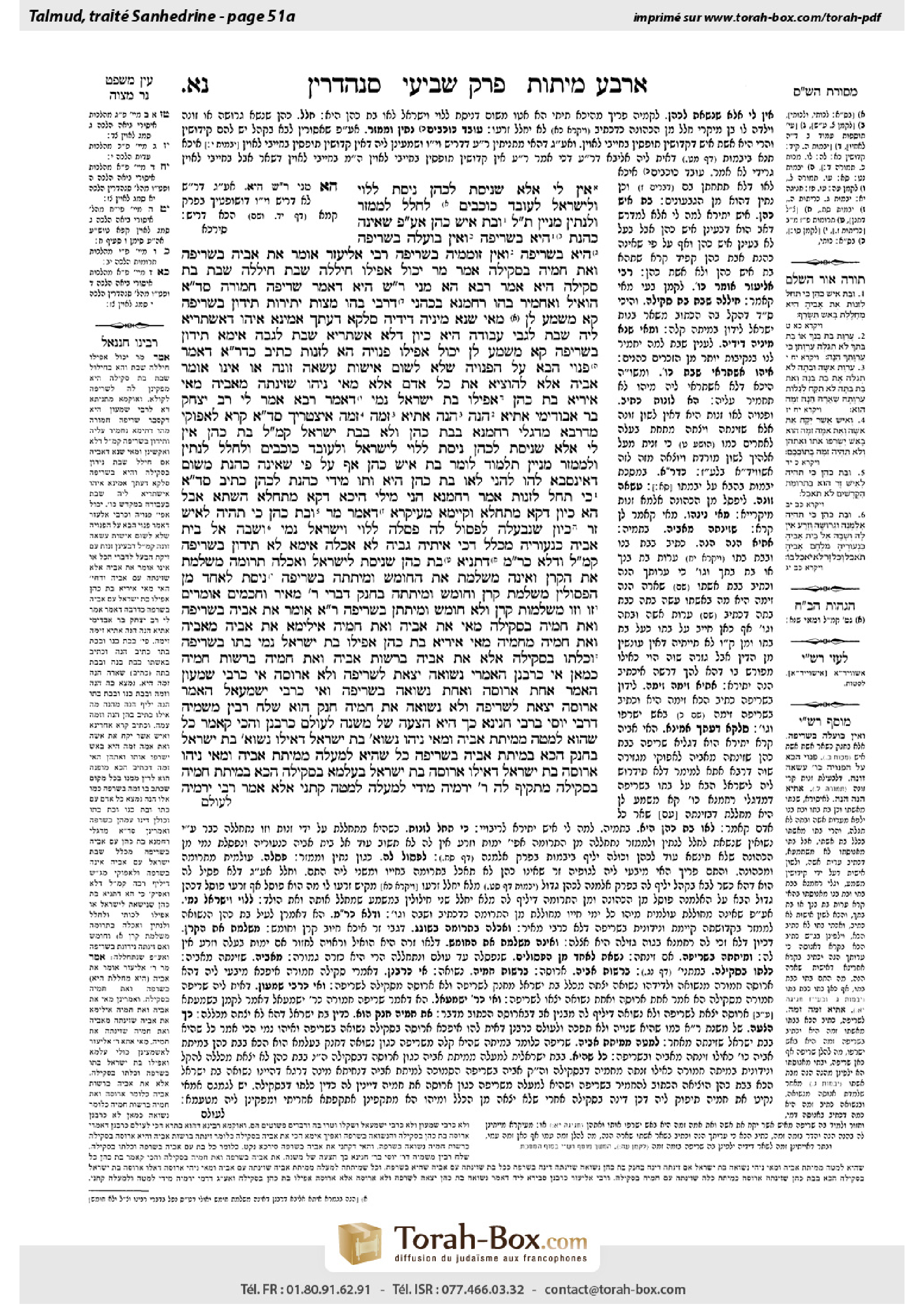
Sanhedrin 51a: Talmud study for Daf Yomi
Daf Yomi is the daily study of one Talmud folio. Explore 37 tractates with scans, Hebrew text, Sefaria English and AI-generated French translations where annotated.
Passage selection and English or AI-generated French translation are available where the scan has annotations. Daf Study is independent of Torah-Box and Sefaria.
Browse Sanhedrin · סנהדרין · All tractatesSanhedrin 51a text and translations
This page of Sanhedrin includes the Aramaic text, an English translation and an AI-generated French translation, alongside the scan above.
סנהדרין נ״א א · Aramaic and Hebrew text
אֵין לִי אֶלָּא שֶׁנִּיסֵּת לְכֹהֵן. נִיסֵּת לְלֵוִי וּלְיִשְׂרָאֵל, לְכוּתִי, לְחָלָל, לְמַמְזֵר וּלְנָתִין – מִנַּיִין? תַּלְמוּד לוֹמַר: ״וּבַת אִישׁ כֹּהֵן״, אַף עַל פִּי שֶׁאֵינָהּ כֹּהֶנֶת.
״הִיא״ בִּשְׂרֵיפָה, וְאֵין בּוֹעֲלָהּ בִּשְׂרֵיפָה. ״הִיא״ בִּשְׂרֵיפָה, וְאֵין זוֹמְמֶיהָ בִּשְׂרֵיפָה.
רַבִּי אֱלִיעֶזֶר אוֹמֵר: אֶת אָבִיהָ בִּשְׂרֵיפָה, וְאֶת חָמִיהָ בִּסְקִילָה.
אָמַר מָר: יָכוֹל אֲפִילּוּ חִילְּלָה שַׁבָּת? חִילְּלָה שַׁבָּת – בַּת סְקִילָה הִיא!
אֲמַר רָבָא: הָא מַנִּי? רַבִּי שִׁמְעוֹן הִיא, דְּאָמַר שְׂרֵיפָה חֲמוּרָה. סָלְקָא דַּעְתָּךְ אָמֵינָא: הוֹאִיל וְאַחְמֵיר בְּהוּ רַחֲמָנָא בְּכָהֲנֵי, דְּרַבִּי בְּהוּ מִצְוֹת יְתֵירוֹת – תִּידּוֹן בִּשְׂרֵיפָה! קָא מַשְׁמַע לַן.
מַאי שְׁנָא מִינֵּיהּ דִּידֵיהּ?
סָלְקָא דַּעְתָּךְ אָמֵינָא: אִיהוּ, דְּאִישְׁתַּרְיָא לֵיהּ שַׁבָּת לְגַבֵּי עֲבוֹדָה; הִיא, כֵּיוָן דְּלָא אִשְׁתַּרְיָא שַׁבָּת לְגַבַּהּ, אֵימָא תִּידּוֹן בִּשְׂרֵיפָה. קָא מַשְׁמַע לַן.
יָכוֹל אֲפִילּוּ פְּנוּיָה? הָא ״לִזְנוֹת״ כְּתִיב!
כִּדְרַבִּי אֶלְעָזָר, דְּאָמַר: פָּנוּי הַבָּא עַל הַפְּנוּיָה שֶׁלֹּא לְשׁוּם אִישׁוּת – עֲשָׂאָהּ זוֹנָה.
אוֹ אֵינוֹ אוֹמֵר ״אָבִיהָ״ אֶלָּא לְהוֹצִיא אֶת כׇּל אָדָם? אֶלָּא מַאי נִיהוּ – שֶׁזִּינְּתָה מֵאָבִיהָ? מַאי אִירְיָא בַּת כֹּהֵן? אֲפִילּוּ בַּת יִשְׂרָאֵל נָמֵי!
דְּאָמַר רָבָא: אֲמַר לִי רַב יִצְחָק בַּר אֲבוּדִימִי, אָתְיָא ״הֵנָּה״ ״הֵנָּה״.
אָתְיָא ״זִמָּה״ ״זִמָּה״.
אִיצְטְרִיךְ, סָלְקָא דַּעְתָּךְ אָמֵינָא: קְרָא לְאַפּוֹקֵי מִדְּרָבָא, מִדְּגַלִּי רַחֲמָנָא בְּבַת כֹּהֵן וְלֹא בְּבַת יִשְׂרָאֵל. קָא מַשְׁמַע לַן.
בַּת כֹּהֵן – אֵין לִי אֶלָּא שֶׁנִּיסֵּת לְכֹהֵן. נִיסֵּת לְלֵוִי, לְיִשְׂרָאֵל, וּלְכוּתִי, וּלְחַלֵּל, לְנָתִין, וּלְמַמְזֵר מִנַּיִין? תַּלְמוּד לוֹמַר: ״בַּת אִישׁ כֹּהֵן״ – אַף עַל פִּי שֶׁאֵינָהּ כֹּהֶנֶת.
מִשּׁוּם דְּאִינַּסְבָא לְהוּ לְהָנֵי, לָאו בַּת כֹּהֵן הִיא? וְתוּ, מִידֵּי ״כֹּהֶנֶת לְכֹהֵן״ כְּתִיב?
סָלְקָא דַּעְתָּךְ אָמֵינָא: כִּי ״תֵחֵל לִזְנוֹת״ אָמַר רַחֲמָנָא, הָנֵי מִילֵּי הֵיכָא דְּקָא מַתְחֲלָא הַשְׁתָּא, אֲבָל הָא, כֵּיוָן דְּקָא מַתְחֲלָא וְקָיְימָא מֵעִיקָּרָא.
דְּאָמַר מָר: ״וּבַת כֹּהֵן כִּי תִהְיֶה לְאִישׁ זָר״, כֵּיוָן שֶׁנִּבְעֲלָה לְפָסוּל לָהּ – פְּסָלָהּ.
לְלֵוִי וְיִשְׂרָאֵל נָמֵי, ״וְשָׁבָה אֶל בֵּית אָבִיהָ כִּנְעוּרֶיהָ״, מִכְּלָל דְּכִי אִיתֵיהּ גַּבֵּיהּ לָא אָכְלָה,
אֵימָא: לָא תִּידּוֹן בִּשְׂרֵיפָה. קָא מַשְׁמַע לַן.
וּדְלָא כְּרַבִּי מֵאִיר, דְּתַנְיָא: בַּת כֹּהֵן שֶׁנִּיסֵּת לְיִשְׂרָאֵל וְאָכְלָה תְּרוּמָה – מְשַׁלֶּמֶת אֶת הַקֶּרֶן וְאֵינָהּ מְשַׁלֶּמֶת אֶת הַחוֹמֶשׁ, וּמִיתָתָהּ בִּשְׂרֵיפָה.
נִיסֵּת לְאֶחָד מִן הַפְּסוּלִין – מְשַׁלֶּמֶת קֶרֶן וָחוֹמֶשׁ, וּמִיתָתָהּ בְּחֶנֶק. דִּבְרֵי רַבִּי מֵאִיר.
וַחֲכָמִים אוֹמְרִים: זוֹ וָזוֹ מְשַׁלְּמוֹת קֶרֶן וְלֹא חוֹמֶשׁ, וּמִיתָתָן בִּשְׂרֵיפָה.
רַבִּי אֱלִיעֶזֶר אוֹמֵר: אֶת אָבִיהָ – בִּשְׂרֵיפָה, וְאֶת חָמִיהָ – בִּסְקִילָה. מַאי אֶת אָבִיהָ וְאֶת חָמִיהָ?
אִילֵּימָא: אֶת אָבִיהָ – מֵאָבִיהָ, וְאֶת חָמִיהָ – מֵחָמִיהָ, מַאי אִירְיָא בַּת כֹּהֵן? אֲפִילּוּ בַּת יִשְׂרָאֵל נָמֵי! בִּתּוֹ – בִּשְׂרֵיפָה, וְכַלָּתוֹ – בִּסְקִילָה.
אֶלָּא, אֶת אָבִיהָ – בִּרְשׁוּת אָבִיהָ, וְאֶת חָמִיהָ – בִּרְשׁוּת חָמִיהָ.
כְּמַאן? אִי כְּרַבָּנַן, הָאָמְרִי: נְשׂוּאָה יָצָאת לִשְׂרֵיפָה וְלֹא אֲרוּסָה. אִי כְּרַבִּי שִׁמְעוֹן, הָאָמַר: אַחַת אֲרוּסָה וְאַחַת נְשׂוּאָה בִּשְׂרֵיפָה.
וְאִי כְּרַבִּי יִשְׁמָעֵאל, הָאָמַר: אֲרוּסָה יָצָאת לִשְׂרֵיפָה, וְלֹא נְשׂוּאָה. אֶת חָמִיהָ – חֶנֶק הוּא!
שְׁלַח רָבִין מִשְּׁמֵיהּ דְּרַבִּי יוֹסֵי בְּרַבִּי חֲנִינָא: כָּךְ הִיא הַצָּעָה שֶׁל מִשְׁנָה, לְעוֹלָם כְּרַבָּנַן, וְהָכִי קָאָמַר: כֹּל שֶׁהִוא לְמַטָּה מִמִּיתַת אָבִיהָ – וּמַאי נִיהוּ? נְשׂוּאָה בַּת יִשְׂרָאֵל. דְּאִילּוּ נְשׂוּאָה בַּת יִשְׂרָאֵל בְּחֶנֶק, הָכָא בְּמִיתַת אָבִיהָ בִּשְׂרֵיפָה.
כֹּל שֶׁהִיא לְמַעְלָה מִמִּיתַת אָבִיהָ, וּמַאי נִיהוּ? אֲרוּסָה בַּת יִשְׂרָאֵל. דְּאִילּוּ אֲרוּסָה בַּת יִשְׂרָאֵל בְּעָלְמָא בִּסְקִילָה, הָכָא בְּמִיתַת חָמִיהָ בִּסְקִילָה.
מַתְקֵיף לַהּ רַבִּי יִרְמְיָה: מִידֵּי ״לְמַעְלָה״ ״לְמַטָּה״ קָתָנֵי? אֶלָּא, אָמַר רַבִּי יִרְמְיָה:
Sanhedrin 51a · English translation
I have a source only for the case of a priest’s daughter who married a priest. From where do I derive that she is also liable to be executed by burning if she married a Levite or an Israelite, a Samaritan, a priest disqualified due to flawed lineage [ḥalal], a son born from an incestuous or adulterous relationship [mamzer], or a Gibeonite? The verse states: “And the daughter of a priest,” indicating that this halakha applies even if she is not now a priestess, having married a non-priest.
It is derived from the verse: “She shall be burned with fire,” that she is executed by burning, but her paramour is not executed by burning; his punishment is the same as that of one who engages in adulterous intercourse with the betrothed or married daughter of a non-priest. It is further derived from the word “she” that she is executed by burning, but witnesses who testified concerning her that she committed adultery and who were proven to be conspiring witnesses are not executed by burning.
The baraita concludes: Rabbi Eliezer says: If she is with her father she is executed by burning, and if she is with her father-in-law she is executed by stoning, as the Gemara will explain below.
§ After quoting this baraita, the Gemara now clarifies and discusses it. The Master said in the baraita: One might have thought that even one who desecrated Shabbat should be executed by burning. The Gemara asks: If she desecrated Shabbat she is liable to be executed by stoning, just like anyone else who desecrates Shabbat, so why would one think that because she is the daughter of a priest she should be executed by burning, a less severe type of capital punishment?
Rava says: In accordance with whose opinion is this? It is in accordance with the opinion of Rabbi Shimon, who says that burning is more severe than stoning. It might enter your mind to say that since the Merciful One treats priests more stringently, in that He gave them additional mitzvot, the daughter of a priest should be punished for desecrating Shabbat by burning, which, according to Rabbi Shimon, is more severe than stoning. Therefore, the verse teaches us that with regard to the desecration of Shabbat, the daughter of a priest receives the same punishment as the rest of the Jewish people.
The Gemara asks: In what way is she different from the priest himself? A priest who desecrates Shabbat is executed by stoning, so why would one have thought that the daughter of a priest should be punished by burning?
The Gemara answers: It might enter your mind to say that concerning the priest himself, the halakhot of Shabbat are less stringent, as acts that are forbidden on Shabbat are permitted to him with regard to the performance of the Temple service. Therefore, one might have thought that if a priest desecrates Shabbat in a manner that is forbidden to him, his punishment should not be more severe than that of a non-priest. But concerning her, the daughter of a priest, since acts that are forbidden on Shabbat are not permitted to her at all, as she does not perform the Temple service, one might say that she should be punished by burning, which is more severe. Therefore, the verse teaches us that this is not so.
The baraita teaches: One might have thought that even if she is unmarried and engages in promiscuous intercourse she should be executed by burning. The Gemara asks: Why might one think this? Isn’t it written in the verse: “When she profanes herself by playing the harlot [liznot]”? This term is referring to a sinful relationship such as adultery and not to the promiscuous intercourse of an unmarried woman.
The Gemara answers: The statement of the baraita is in accordance with the opinion of Rabbi Elazar, who says: An unmarried man who engages in intercourse with an unmarried woman, not for the purpose of marriage, has rendered her a zona, i.e., a woman who has engaged in intercourse with a man forbidden to her by the Torah. In the opinion of Rabbi Elazar, the term liznot is referring to any promiscuous intercourse.
The baraita teaches: Or perhaps one might have thought that the verse states “her father” only in order to exclude all men other than her father. The Gemara asks: Rather, what case is the verse referring to? Is it a case where she engaged in intercourse with her father? If so, why does the verse specifically mention the daughter of a priest? Even the daughter of a non-priest is executed by burning in such a case.
The Gemara answers that the prohibition of and punishment for intercourse between a father and daughter are not stated explicitly in the Torah; rather, they are derived by means of two verbal analogies. As Rava said: Rav Yitzḥak bar Avudimi said to me: This prohibition is derived by means of a verbal analogy between the word henna in the verse: “The nakedness of your son’s daughter, or of your daughter’s daughter, their nakedness you shall not uncover; for theirs [henna] is your own nakedness” (Leviticus 18:10), and the word henna in a different verse: “You shall not uncover the nakedness of a woman and her daughter; you shall not take her son’s daughter, or her daughter’s daughter, to uncover her nakedness. They [henna] are near kinswomen; it is lewdness” (Leviticus 18:17). This verbal analogy indicates that just as it is prohibited to engage in intercourse with one’s granddaughter and with one’s wife’s daughter or granddaughter, so too, it is prohibited to engage in intercourse with one’s daughter.
Furthermore, it is derived from a verbal analogy between the word “lewdness” (Leviticus 18:17) and the word “lewdness” in the verse: “And if a man take with his wife also her mother, it is lewdness; they shall be burned with fire, both he and they, so that there be no lewdness among you” (Leviticus 20:14), that one who engages in intercourse with his daughter or granddaughter is liable to be executed by burning.
Since the punishment for engaging in intercourse with one’s daughter is derived from a verbal analogy and is not stated explicitly, it was necessary for the verse to indicate that the daughter of a priest is liable to be executed by burning even if she commits adultery with a man who is not her father. Otherwise, it might enter your mind to say that the verse concerning the daughter of a priest is stated to exclude the statement of Rava in the following manner: From the fact that the Merciful One revealed this punishment explicitly with regard to the daughter of a priest and not with regard to the daughter of a non-priest, it may be derived that the punishment of burning does not apply to the daughter of a non-priest. Therefore, the verse teaches us through the expression “she profanes” that it is referring to a priest’s daughter who committed adultery with any man, and not just with her father.
The baraita teaches: From the expression “the daughter of a priest,” I have a source only for the case of a priest’s daughter who married a priest. From where is it derived that she is also liable to be executed by burning if she married a Levite, an Israelite, a Samaritan, a ḥalal, a Gibeonite, or a mamzer? The verse states: “And the daughter of a priest,” indicating that this halakha applies even if she is not now a priestess.
The Gemara asks: Because she married one of these men who are not priests, is she no longer the daughter of a priest? Why should her punishment be different in these cases? And furthermore, is it written: A priestess who married a priest? The verse refers only to the status of her father, not to that of her husband.
The Gemara answers: It might enter your mind to say that when the Merciful One states: “When she profanes herself by playing the harlot,” it indicates that this matter applies only in a case where she profanes herself now by committing adultery. But in this case, where she is married to a non-priest, since she is already profaned from the outset, from the time of her marriage, the verse does not apply to her.
The Gemara clarifies: If she is married to a man of flawed lineage, she is already profaned. As the Master said, it is derived from the verse: “And if a priest’s daughter be married to a non-priest, she shall not eat of that which is set apart from the sacred” (Leviticus 22:12), that once she engaged in intercourse with one who is unfit for her, he has disqualified her from ever partaking of teruma.
And if she is married to a Levite or an Israelite, she is also disqualified from partaking of teruma for as long as they are married; as the verse states: “But if a priest’s daughter is a widow, or divorced, and has no child, and returns to her father’s house, as in her youth, she may eat of her father’s bread” (Leviticus 22:13). By inference, while she is with her non-priest husband, she does not partake of teruma.
Evidently, the marriage of the daughter of a priest to anyone who is not a priest involves some measure of profanation, and therefore one might say that she should not be punished by burning, the punishment unique to the daughter of a priest, if she committed adultery. Therefore, the verse teaches us that the punishment of execution by burning applies to any daughter of a priest, regardless of the status of her husband.
The Gemara adds: And this baraita is not in accordance with the opinion of Rabbi Meir. As it is taught in a baraita: With regard to a priest’s daughter who married an Israelite and then unwittingly partook of teruma, she pays the principal, as she partook of teruma to which she has no rights, but she does not pay the additional one-fifth, the fine paid by a non-priest who partakes of teruma unwittingly. This is because she is not completely disqualified from the priesthood; if she were to be widowed or divorced without children, it would again be permitted for her to partake of teruma. And, as befits the daughter of a priest, if she commits adultery, her death penalty is by burning.
Rabbi Meir continues: But if she married one of the men who are unfit for her, e.g., a ḥalal, a mamzer, or a Gibeonite, and she unwittingly partook of teruma, she pays the principal and the additional one-fifth, as she is permanently disqualified from partaking of teruma. And similarly, if she commits adultery, her death penalty is by strangulation, like the daughter of a non-priest, as she is completely disqualified from the priesthood. This is the statement of Rabbi Meir.
And the Rabbis say: Both this one, who married an Israelite, and that one, who married a man of flawed lineage, pay the principal and not the additional one-fifth, as they do not entirely forfeit their priesthood, and their death penalty is by burning, in accordance with the above baraita.
The Gemara continues its analysis of the baraita, which teaches: Rabbi Eliezer says: If she is with her father she is executed by burning, and if she is with her father-in-law, she is executed by stoning. The Gemara asks: What is the meaning of the expressions: With her father, and: With her father-in-law?
If we say that with her father means she engages in intercourse with her father, and with her father-in-law means she engages in intercourse with her father-in-law, why is this halakha stated specifically with regard to the daughter of a priest? Even in the case of the daughter of a non-priest the halakha is the same; in the case of one who engages in intercourse with his daughter, they are executed by burning, and in the case of one who engages in intercourse with his daughter-in-law, they are executed by stoning.
Rather, the expression: With her father, means under her father’s authority, i.e., she is still betrothed and not married yet, and the expression: With her father-in-law, means under her father-in-law’s authority, i.e., she is married.
The Gemara asks: In accordance with whose opinion is this statement? If it is in accordance with the opinion of the Rabbis, don’t they say that the married daughter of a priest who committed adultery is singled out for execution by burning, but not one who is betrothed? If it is in accordance with the opinion of Rabbi Shimon, doesn’t he say that both the betrothed daughter of a priest and the married one are executed by burning? The opinion of Rabbi Eliezer does not accord with either of these opinions.
And if it is in accordance with the opinion of Rabbi Yishmael (see 51b), doesn’t he say that only the betrothed daughter of a priest is singled out for execution by burning, but not one who is married? In his opinion, if the daughter of a priest is under the authority of her father-in-law, i.e., if she is married, her punishment is death by strangulation, like any other married woman who committed adultery.
Ravin sent the following explanation in the name of Rabbi Yosei, son of Rabbi Ḥanina: This is the explanation [hatza’a] of this mishna, i.e., the baraita: Actually, it is in accordance with the opinion of the Rabbis. And this is what it is saying: With regard to any act of adultery whose punishment is less severe than the death penalty for one who engages in intercourse with her father, here, in the case of the daughter of a priest, she receives the death penalty of one who engages in intercourse with her father, namely, execution by burning. And what act of adultery carries a less severe punishment than intercourse with one’s father? It is the case of the married daughter of a non-priest; as the married daughter of a non-priest who committed adultery is executed by strangulation.
With regard to any act of adultery whose punishment is more severe than the death penalty for one who engages in intercourse with her father, here, in the case of the daughter of a priest, she receives the death penalty of one who engages in intercourse with her father-in-law, namely, execution by stoning. And what case is it? It is the case of the betrothed daughter of a non-priest, as in general, the betrothed daughter of a non-priest who committed adultery is executed by stoning.
Rabbi Yirmeya objects to this explanation: Does the baraita teach the words more and less? These words, central to this interpretation, are not mentioned at all. Rather, Rabbi Yirmeya says an alternative interpretation:
Sanhedrin 51a · Traduction française (IA)
Je ne dispose d'une source que pour le cas d'une fille de prêtre qui a épousé un prêtre. D'où déduis-je qu'elle est également passible de la peine de mort par le feu si elle a épousé un Lévite ou un Israélite, un Samaritain, un prêtre disqualifié en raison d'une lignée défectueuse [ḥalal], un fils né d'une relation incestueuse ou adultère [mamzer], ou un Gibeonite ? Le verset énonce : « Et la fille d'un prêtre », indiquant que cette halakha s'applique même si elle n'est plus actuellement une prêtresse, ayant épousé un non-prêtre.
Il est déduit du verset : « Elle sera brûlée au feu », qu'elle est exécutée par le feu, mais que son amant n'est pas exécuté par le feu ; sa punition est la même que celle de celui qui a des relations adultères avec la fiancée ou l'épouse d'un non-prêtre. Il est également déduit du mot « elle » qu'elle est exécutée par le feu, mais que les témoins qui ont témoigné contre elle en affirmant qu'elle a commis l'adultère et qui se sont avérés être des témoins conspirateurs ne sont pas exécutés par le feu.
La baraïta conclut : Rabbi Eliezer dit : Si elle est avec son père, elle est exécutée par le feu, et si elle est avec son beau-père, elle est exécutée par lapidation, comme la Guemara l'expliquera ci-dessous.
§ Après avoir cité cette baraïta, la Guemara l'éclaircit et en discute. Le Maître a dit dans la baraïta : On aurait pu penser que même celui qui profane le Chabbat doit être exécuté par le feu. La Guemara demande : Si elle a profané le Chabbat, elle est passible de la lapidation, comme n'importe qui d'autre qui profane le Chabbat, alors pourquoi penserait-on que, parce qu'elle est la fille d'un prêtre, elle doit être exécutée par le feu, un type de peine capitale moins sévère ?
Rava dit : Selon l'opinion de qui est-ce ? C'est selon l'opinion de Rabbi Chimon, qui dit que le feu est plus sévère que la lapidation. Il pourrait vous venir à l'esprit de dire que, puisque le Tout-Puissant traite les prêtres avec plus de rigueur, en ce qu'Il leur a accordé des mitsvot supplémentaires, la fille d'un prêtre devrait être punie pour la profanation du Chabbat par le feu, qui, selon Rabbi Chimon, est plus sévère que la lapidation. Par conséquent, le verset nous enseigne que, en ce qui concerne la profanation du Chabbat, la fille d'un prêtre reçoit la même punition que le reste du peuple juif.
La Guemara demande : En quoi diffère-t-elle du prêtre lui-même ? Un prêtre qui profane le Chabbat est exécuté par lapidation, alors pourquoi aurait-on pensé que la fille d'un prêtre devrait être punie par le feu ?
La Guemara répond : Il pourrait vous venir à l'esprit de dire que, concernant le prêtre lui-même, les halakhot du Chabbat sont moins strictes, car les actes interdits le Chabbat lui sont permis en ce qui concerne l'accomplissement du service du Temple. Par conséquent, on aurait pu penser que si un prêtre profane le Chabbat d'une manière qui lui est interdite, sa punition ne devrait pas être plus sévère que celle d'un non-prêtre. Mais concernant elle, la fille d'un prêtre, puisque les actes interdits le Chabbat ne lui sont pas du tout permis, car elle n'accomplit pas le service du Temple, on pourrait dire qu'elle devrait être punie par le feu, qui est plus sévère. Par conséquent, le verset nous enseigne que ce n'est pas le cas.
La baraïta enseigne : On aurait pu penser que même si elle est célibataire et a des relations sexuelles libres, elle devrait être exécutée par le feu. La Guemara demande : Pourquoi pourrait-on penser cela ? N'est-il pas écrit dans le verset : « Quand elle se souille en se livrant à la prostitution [liznot] » ? Ce terme fait référence à une relation pécheresse telle que l'adultère et non aux relations sexuelles libres d'une femme célibataire.
La Guemara répond : L'énoncé de la baraïta est selon l'opinion de Rabbi Elazar, qui dit : Un homme célibataire qui a des relations sexuelles avec une femme célibataire, non dans le but du mariage, l'a rendue zona, c'est-à-dire une femme qui a eu des relations sexuelles avec un homme qui lui est interdit par la Torah. Selon l'opinion de Rabbi Elazar, le terme liznot fait référence à toute relation sexuelle libre.
La baraïta enseigne : Peut-être aurait-on pu penser que le verset mentionne « son père » uniquement afin d'exclure tous les hommes autres que son père. La Guemara demande : Plutôt, à quel cas le verset fait-il référence ? S'agit-il d'un cas où elle a eu des relations sexuelles avec son père ? Si c'est le cas, pourquoi le verset mentionne-t-il spécifiquement la fille d'un Cohen ? Même la fille d'un non-Cohen est exécutée par le feu dans un tel cas.
La Guemara répond que l'interdiction et la punition des relations sexuelles entre un père et sa fille ne sont pas énoncées explicitement dans la Torah écrite ; plutôt, elles sont déduites au moyen de deux analogies verbales. Comme Rava l'a dit : Rav Yitzḥak bar Avudimi m'a dit : Cette interdiction est déduite au moyen d'une analogie verbale entre le mot henna dans le verset : « La nudité de la fille de ton fils, ou de la fille de ta fille, tu ne découvriras pas leur nudité ; car la leur [henna] est ta propre nudité » (Lévitique 18:10), et le mot henna dans un autre verset : « Tu ne découvriras pas la nudité d'une femme et de sa fille ; tu ne prendras pas la fille de son fils, ou la fille de sa fille, pour découvrir sa nudité. Elles [henna] sont parentes proches ; c'est une turpitude » (Lévitique 18:17). Cette analogie verbale indique que, de même qu'il est interdit d'avoir des relations sexuelles avec sa petite-fille et avec la fille ou la petite-fille de sa femme, de même, il est interdit d'avoir des relations sexuelles avec sa fille.
De plus, il est déduit d'une analogie verbale entre le mot « turpitude » (Lévitique 18:17) et le mot « turpitude » dans le verset : « Et si un homme prend avec sa femme aussi sa mère, c'est une turpitude ; ils seront brûlés au feu, lui et elles, afin qu'il n'y ait pas de turpitude parmi vous » (Lévitique 20:14), que celui qui a des relations sexuelles avec sa fille ou sa petite-fille est passible de la peine de mort par le feu.
Étant donné que la punition pour avoir des relations sexuelles avec sa fille est dérivée par analogie verbale et n'est pas explicitement énoncée, il était nécessaire que le verset indique que la fille d'un Cohen est passible de la peine de mort par le feu, même si elle commet l'adultère avec un homme qui n'est pas son père. Sinon, vous pourriez être amené à penser que le verset concernant la fille d'un Cohen est énoncé pour exclure l'enseignement de Rava de la manière suivante : du fait que le Tout-Puissant a révélé explicitement cette punition à l'égard de la fille d'un Cohen et non à l'égard de la fille d'un non-Cohen, on peut en déduire que la punition par le feu ne s'applique pas à la fille d'un non-Cohen. Par conséquent, le verset nous enseigne, par l'expression « elle se souille », qu'il fait référence à une fille de Cohen qui a commis l'adultère avec n'importe quel homme, et non seulement avec son père.
La baraïta enseigne : De l'expression « la fille d'un Cohen », je ne tire une source que pour le cas d'une fille de Cohen qui a épousé un Cohen. D'où est-il dérivé qu'elle est également passible de la peine de mort par le feu si elle a épousé un Lévi, un Israélite, un Samaritain, un ḥalal, un Gibeonite ou un mamzer ? Le verset énonce : « Et la fille d'un Cohen », indiquant que cette halakha s'applique même si elle n'est plus actuellement une prêtre.
La Guemara demande : Parce qu'elle a épousé l'un de ces hommes qui ne sont pas des Cohanim, n'est-elle plus la fille d'un Cohen ? Pourquoi sa punition devrait-elle être différente dans ces cas ? De plus, est-il écrit : Une prêtre qui a épousé un Cohen ? Le verset ne fait référence qu'au statut de son père, et non à celui de son mari.
La Guemara répond : Il pourrait vous venir à l'esprit de dire que lorsque le Tout-Puissant énonce : « Quand elle se souille en se livrant à la prostitution », cela indique que cette règle ne s'applique que dans le cas où elle se souille actuellement en commettant l'adultère. Mais dans le cas présent, où elle est mariée à un non-Cohen, puisqu'elle est déjà souillée dès le départ, depuis le moment de son mariage, le verset ne s'applique pas à elle.
La Guemara précise : Si elle est mariée à un homme de lignée défectueuse, elle est déjà souillée. Comme l'a dit le Maître, il est déduit du verset : « Et si la fille d'un Cohen est mariée à un non-Cohen, elle ne mangera pas de ce qui est mis à part du sacré » (Lévitique 22:12), que dès qu'elle a eu des relations sexuelles avec quelqu'un qui n'est pas apte pour elle, il l'a disqualifiée pour toujours de la consommation de la terouma.
Et si elle est mariée à un Lévi ou à un Israélite, elle est également disqualifiée de la consommation de la terouma tant qu'ils sont mariés ; comme l'énonce le verset : « Mais si la fille d'un Cohen est veuve, ou divorcée, et n'a pas d'enfant, et revient à la maison de son père, comme dans sa jeunesse, elle peut manger du pain de son père » (Lévitique 22:13). Par inférence, tant qu'elle est avec son mari non-Cohen, elle ne consomme pas de terouma.
Évidemment, le mariage de la fille d'un Cohen avec quiconque n'est pas un Cohen implique une certaine mesure de profanation, et par conséquent on pourrait dire qu'elle ne devrait pas être punie par le feu, la punition propre à la fille d'un Cohen, si elle commet l'adultère. Par conséquent, le verset nous enseigne que la peine de mort par le feu s'applique à toute fille de Cohen, quel que soit le statut de son mari.
La Guemara ajoute : Et cette baraïta n'est pas conforme à l'opinion de Rabbi Meïr. Comme il est enseigné dans une baraïta : Concernant la fille d'un Cohen qui a épousé un Israélite et qui a ensuite consommé involontairement de la terouma, elle paie le principal, car elle a consommé de la terouma à laquelle elle n'a pas droit, mais elle ne paie pas le cinquième supplémentaire, l'amende payée par un non-Cohen qui consomme de la terouma involontairement. C'est parce qu'elle n'est pas complètement disqualifiée du sacerdoce ; si elle venait à être veuve ou divorcée sans enfants, il lui serait à nouveau permis de consommer de la terouma. Et, comme il convient à la fille d'un Cohen, si elle commet l'adultère, sa peine de mort est par le feu.
Rabbi Meïr continue : Mais si elle a épousé l'un des hommes qui ne sont pas aptes pour elle, par exemple un ḥalal, un mamzer ou un Gibeonite, et qu'elle a consommé involontairement de la terouma, elle paie le principal et le cinquième supplémentaire, car elle est définitivement disqualifiée de la consommation de la terouma. Et de même, si elle commet l'adultère, sa peine de mort est par strangulation, comme la fille d'un non-Cohen, car elle est complètement disqualifiée du sacerdoce. C'est l'enseignement de Rabbi Meïr.
Et les Sages disent : Tant celle-ci, qui a épousé un Israélite, que celle-là, qui a épousé un homme de lignée défectueuse, paient le principal et non le cinquième supplémentaire, car elles ne perdent pas entièrement leur droit au sacerdoce, et leur peine de mort est par le feu, conformément à la baraïta ci-dessus.
La Guemara poursuit son analyse de la baraïta, qui enseigne : Rabbi Éliezer dit : Si elle est avec son père, elle est exécutée par le feu, et si elle est avec son beau-père, elle est exécutée par lapidation. La Guemara demande : Quel est le sens des expressions : Avec son père, et : Avec son beau-père ?
Si nous disons qu'« avec son père » signifie qu'elle a des relations sexuelles avec son père, et qu'« avec son beau-père » signifie qu'elle a des relations sexuelles avec son beau-père, pourquoi cette halakha est-elle énoncée spécifiquement à l'égard de la fille d'un Cohen ? Même dans le cas de la fille d'un non-Cohen, la halakha est la même ; dans le cas de celui qui a des relations sexuelles avec sa fille, ils sont exécutés par le feu, et dans le cas de celui qui a des relations sexuelles avec sa belle-fille, ils sont exécutés par lapidation.
Plutôt, l'expression « avec son père » signifie sous l'autorité de son père, c'est-à-dire qu'elle est encore fiancée et non encore mariée, et l'expression « avec son beau-père » signifie sous l'autorité de son beau-père, c'est-à-dire qu'elle est mariée.
La Guemara demande : Selon l'avis de qui est formulée cette déclaration ? Si c'est selon l'avis des Sages, ne disent-ils pas que la fille d'un Cohen mariée qui a commis l'adultère est désignée pour être exécutée par le feu, mais pas celle qui est fiancée ? Si c'est selon l'avis de Rabbi Chimon, ne dit-il pas que tant la fille d'un Cohen fiancée que celle qui est mariée sont exécutées par le feu ? L'avis de Rabbi Eliezer ne correspond à aucune de ces deux opinions.
Et si c'est selon l'avis de Rabbi Yichmaël (voir 51b), ne dit-il pas que seule la fille d'un Cohen fiancée est désignée pour être exécutée par le feu, mais pas celle qui est mariée ? Selon son avis, si la fille d'un Cohen est sous l'autorité de son beau-père, c'est-à-dire si elle est mariée, sa peine est la mort par strangulation, comme toute autre femme mariée qui a commis l'adultère.
Ravin a transmis la présente explication au nom de Rabbi Yose, fils de Rabbi Ḥanina : Voici l'explication [hatza'a] de cette Michna, c'est-à-dire de cette baraïta : En réalité, elle est conforme à l'avis des Sages. Et voici ce qu'elle dit : S'agissant de tout acte d'adultère dont la peine est moins sévère que la peine de mort pour celui qui a des rapports avec son père, ici, dans le cas de la fille d'un Cohen, elle reçoit la peine de mort pour celui qui a des rapports avec son père, à savoir l'exécution par le feu. Et quel acte d'adultère entraîne une peine moins sévère que les rapports avec son père ? C'est le cas de la fille d'un non-Cohen mariée ; car la fille d'un non-Cohen mariée qui a commis l'adultère est exécutée par strangulation.
S'agissant de tout acte d'adultère dont la peine est plus sévère que la peine de mort pour celui qui a des rapports avec son père, ici, dans le cas de la fille d'un Cohen, elle reçoit la peine de mort pour celui qui a des rapports avec son beau-père, à savoir l'exécution par lapidation. Et quel est ce cas ? C'est le cas de la fille d'un non-Cohen fiancée, car en général, la fille d'un non-Cohen fiancée qui a commis l'adultère est exécutée par lapidation.
Rabbi Yirmeya objecte à cette explication : La baraïta enseigne-t-elle les mots « plus » et « moins » ? Ces mots, qui sont centraux pour cette interprétation, ne sont pas mentionnés du tout. Plutôt, Rabbi Yirmeya propose une interprétation alternative :
Traduction française générée par IA à partir de l’édition anglaise de Sefaria. Vérifie toujours un passage avec le texte source.
Text from Sefaria: William Davidson Edition - Vocalized Aramaic (CC BY NC); William Davidson Edition - English (CC BY NC).