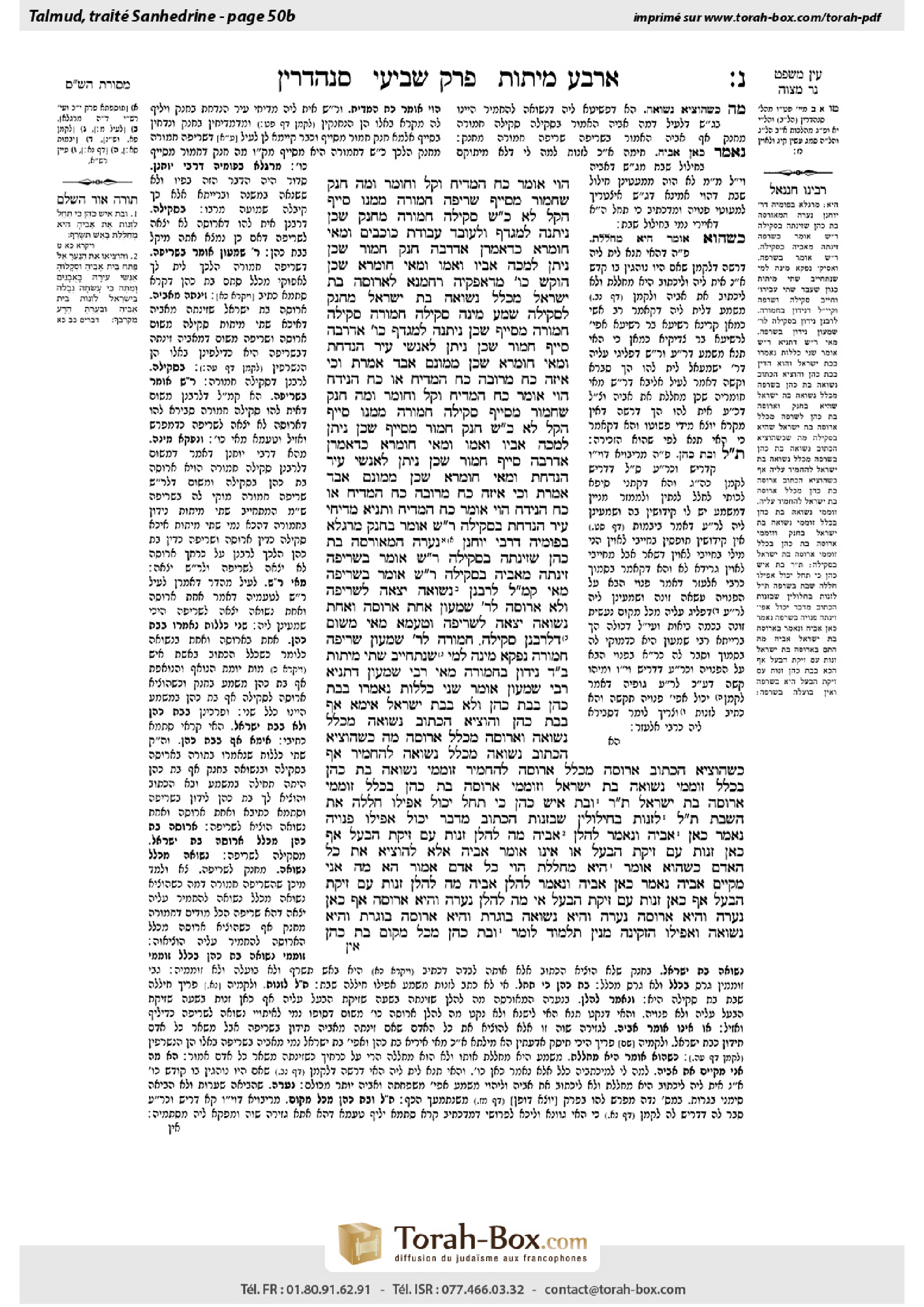
Sanhedrin 50b: Talmud study for Daf Yomi
Daf Yomi is the daily study of one Talmud folio. Explore 37 tractates with scans, Hebrew text, Sefaria English and AI-generated French translations where annotated.
Passage selection and English or AI-generated French translation are available where the scan has annotations. Daf Study is independent of Torah-Box and Sefaria.
Browse Sanhedrin · סנהדרין · All tractatesSanhedrin 50b text and translations
This page of Sanhedrin includes the Aramaic text, an English translation and an AI-generated French translation, alongside the scan above.
סנהדרין נ׳ ב · Aramaic and Hebrew text
הֱוֵי אוֹמֵר: כֹּחַ הַמַּדִּיחַ. וְקַל וָחוֹמֶר: וּמָה חֶנֶק, שֶׁחָמוּר מִסַּיִיף – שְׂרֵיפָה חֲמוּרָה מִמֶּנּוּ; סַיִיף הַקַּל – לֹא כׇּל שֶׁכֵּן?
סְקִילָה חֲמוּרָה מֵחֶנֶק, שֶׁכֵּן נִיתְּנָה לִמְגַדֵּף וּלְעוֹבֵד עֲבוֹדָה זָרָה. וּמַאי חוּמְרָא? כְּדַאֲמַרַן.
אַדְּרַבָּה: חֶנֶק חָמוּר, שֶׁכֵּן נִיתַּן לְמַכֵּה אָבִיו וְאִמּוֹ. וּמַאי חוּמְרָא? שֶׁכֵּן הוּקַּשׁ כּוּ׳.
מִדְּאַפְּקֵיהּ רַחֲמָנָא לַאֲרוּסָה בַּת יִשְׂרָאֵל מִכְּלַל נְשׂוּאָה בַּת יִשְׂרָאֵל מֵחֶנֶק לִסְקִילָה, שְׁמַע מִינַּהּ: סְקִילָה חֲמוּרָה.
סְקִילָה חֲמוּרָה מִסַּיִיף, שֶׁכֵּן נִיתְּנָה לַמְגַדֵּף כּוּ׳. אַדְּרַבָּה: סַיִיף חָמוּר שֶׁכֵּן נִיתַּן לְאַנְשֵׁי עִיר הַנִּדַּחַת. וּמַאי חוּמְרָא? שֶׁכֵּן מָמוֹנָם אָבֵד.
אָמַרְתָּ: וְכִי אֵיזֶה כֹּחַ מְרוּבֶּה, כֹּחַ הַמַּדִּיחַ אוֹ כֹּחַ הַנִּידָּח? הֱוֵי אוֹמֵר כֹּחַ הַמַּדִּיחַ. וְקַל וָחוֹמֶר: וּמָה חֶנֶק שֶׁחָמוּר מִסַּיִיף, סְקִילָה חֲמוּרָה מִמֶּנּוּ; סַיִיף הַקַּל – לֹא כׇּל שֶׁכֵּן?
חֶנֶק חָמוּר מִסַּיִיף, שֶׁכֵּן נִיתַּן לְמַכֵּה אָבִיו וְאִמּוֹ. וּמַאי חוּמְרָא? כְּדַאֲמַרַן.
אַדְּרַבָּה: סַיִיף חָמוּר שֶׁכֵּן נִיתַּן לְאַנְשֵׁי עִיר הַנִּדַּחַת. וּמַאי חוּמְרָא? שֶׁכֵּן מָמוֹנָם אָבֵד.
אָמַרְתָּ: וְכִי אֵיזֶה כֹּחַ מְרוּבֶּה, כֹּחַ הַמַּדִּיחַ אוֹ כֹּחַ הַנִּידָּח? הֱוֵי אוֹמֵר: כֹּחַ הַמַּדִּיחַ. וְתַנְיָא: מַדִּיחֵי עִיר הַנִּדַּחַת בִּסְקִילָה. רַבִּי שִׁמְעוֹן אוֹמֵר: בְּחֶנֶק.
מַרְגְּלָא בְּפוּמֵּיהּ דְּרַבִּי יוֹחָנָן: נַעֲרָה הַמְאוֹרָסָה בַּת כֹּהֵן שֶׁזִּינְּתָה – בִּסְקִילָה. רַבִּי שִׁמְעוֹן אוֹמֵר: בִּשְׂרֵיפָה. זִינְּתָה מֵאָבִיהָ – בִּסְקִילָה. רַבִּי שִׁמְעוֹן אוֹמֵר: בִּשְׂרֵיפָה.
מַאי קָא מַשְׁמַע לַן? לְרַבָּנַן – נְשׂוּאָה יָצְאָה לִשְׂרֵיפָה, וְלֹא אֲרוּסָה. לְרַבִּי שִׁמְעוֹן – אַחַת אֲרוּסָה וְאַחַת נְשׂוּאָה יָצְאָה לִשְׂרֵיפָה. וְטַעְמָא מַאי? מִשּׁוּם דִּלְרַבָּנַן סְקִילָה חֲמוּרָה, לְרַבִּי שִׁמְעוֹן שְׂרֵיפָה חֲמוּרָה.
נָפְקָא מִינַּהּ לְמִי שֶׁנִּתְחַיֵּיב שְׁתֵּי מִיתוֹת בֵּית דִּין, נִידּוֹן בַּחֲמוּרָה.
מַאי רַבִּי שִׁמְעוֹן? דְּתַנְיָא: רַבִּי שִׁמְעוֹן אוֹמֵר, שְׁנֵי כְּלָלוֹת נֶאֶמְרוּ בְּבַת כֹּהֵן.
בְּבַת כֹּהֵן, וְלֹא בְּבַת יִשְׂרָאֵל?! אֵימָא: אַף בְּבַת כֹּהֵן.
וְהוֹצִיא הַכָּתוּב נְשׂוּאָה מִכְּלַל נְשׂוּאָה, וַאֲרוּסָה מִכְּלַל אֲרוּסָה.
מָה כְּשֶׁהוֹצִיא הַכָּתוּב נְשׂוּאָה מִכְּלַל נְשׂוּאָה לְהַחְמִיר, אַף כְּשֶׁהוֹצִיא הַכָּתוּב אֲרוּסָה מִכְּלַל אֲרוּסָה לְהַחֲמִיר.
זוֹמְמֵי נְשׂוּאָה בַּת כֹּהֵן, בִּכְלַל זוֹמְמֵי נְשׂוּאָה בַּת יִשְׂרָאֵל; וְזוֹמְמֵי אֲרוּסָה בַּת כֹּהֵן, בִּכְלַל זוֹמְמֵי אֲרוּסָה בַּת יִשְׂרָאֵל.
תָּנוּ רַבָּנַן: ״וּבַת אִישׁ כֹּהֵן כִּי תֵחֵל״ – יָכוֹל אֲפִילּוּ חִלְּלָה אֶת הַשַּׁבָּת? תַּלְמוּד לוֹמַר ״לִזְנוֹת״ – בְּחִילּוּלִין שֶׁבִּזְנוּת הַכָּתוּב מְדַבֵּר.
יָכוֹל אֲפִילּוּ פְּנוּיָה? נֶאֱמַר כָּאן ״אָבִיהָ״, וְנֶאֱמַר לְהַלָּן ״אָבִיהָ״. מָה לְהַלָּן זְנוּת עִם זִיקַת הַבַּעַל, אַף כָּאן זְנוּת עִם זִיקַת הַבַּעַל.
אוֹ אֵינוֹ אוֹמֵר ״אָבִיהָ״ אֶלָּא לְהוֹצִיא אֶת כׇּל הָאָדָם? כְּשֶׁהוּא אוֹמֵר ״הִיא מְחַלֶּלֶת״, הֱוֵי כָּל אָדָם אָמוּר.
הָא מָה אֲנִי מְקַיֵּים ״אָבִיהָ״? נֶאֱמַר כָּאן ״אָבִיהָ״, וְנֶאֱמַר לְהַלָּן ״אָבִיהָ״. מָה לְהַלָּן זְנוּת עִם זִיקַת הַבַּעַל, אַף כָּאן זְנוּת עִם זִיקַת הַבַּעַל.
אִי מָה לְהַלָּן נַעֲרָה וְהִיא אֲרוּסָה, אַף כָּאן נַעֲרָה וְהִיא אֲרוּסָה? נַעֲרָה וְהִיא נְשׂוּאָה, בּוֹגֶרֶת וְהִיא אֲרוּסָה, בּוֹגֶרֶת וְהִיא נְשׂוּאָה, וַאֲפִילּוּ הִזְקִינָה – מִנַּיִן?
תַּלְמוּד לוֹמַר ״וּבַת כֹּהֵן״ – מִכׇּל מָקוֹם.
״בַּת כֹּהֵן״,
Sanhedrin 50b · English translation
You must say that the severity of the transgression of the subverter is greater. Since those who subverted the people of an idolatrous city are executed by stoning, this is evidently a more severe type of capital punishment than decapitation. And it is inferred a fortiori that if it is so that concerning strangulation, which is more severe than decapitation by the sword, nevertheless burning is more severe than it, is it not all the more so obvious that burning is more severe than decapitation by the sword, which is a more lenient type of execution compared to strangulation?
Stoning is considered more severe than strangulation, as it is meted out to one who blasphemes and to one who worships idols. And for what reason is the severity of these transgressions considered greater? As we said, it is because the transgressors undermine the fundamental tenets of Judaism.
The Gemara raises an objection: On the contrary; strangulation is more severe, as it is meted out to one who wounds his father or his mother. And for what reason is the severity of this transgression considered greater? Because the honor of one’s parents is compared to the honor of the Omnipresent.
The Gemara answers: Since the Merciful One singles out the case of the betrothed daughter of a non-priest who committed adultery from the category of a married Jewish woman who committed adultery, changing her punishment from execution by strangulation to execution by stoning, conclude from it that stoning is more severe.
Stoning is considered more severe than decapitation by the sword, as it is meted out to one who blasphemes and to one who worships idols. The Gemara raises an objection: On the contrary; decapitation by the sword is more severe, as it is meted out to the people of an idolatrous city. And for what reason is the severity of this case considered greater? Because their property is destroyed as well.
The Gemara answers that in response to this objection you should say: But the severity of which transgression is greater: The severity of the transgression of the subverter, or the severity of the transgression of the subverted? You must say that the severity of the transgression of the subverter is greater. Since those who subverted the people of an idolatrous city are executed by stoning, this punishment is evidently more severe than decapitation. And it is inferred a fortiori that if it is so that concerning strangulation, which is more severe than decapitation by the sword, nevertheless stoning is more severe than it, is it not all the more so obvious that stoning is more severe than decapitation by the sword, which is a more lenient type of execution compared to strangulation?
Strangulation is more severe than decapitation by the sword, as it is meted out to one who wounds his father or his mother. And for what reason is the severity of this transgression considered greater? As we said, because the honor of one’s parents is compared to the honor of the Omnipresent.
The Gemara raises an objection: On the contrary; decapitation by the sword is more severe, as it is meted out to the people of an idolatrous city. And for what reason is the severity of this transgression considered greater? Because their property is destroyed as well.
The Gemara answers that you should say in response to this objection: But the severity of which transgression is greater: The severity of the transgression of the subverter, or the severity of the transgression of the subverted? You must say that the severity of the transgression of the subverter is greater, and it is taught in a baraita: The subverters of an idolatrous city are executed by stoning. Rabbi Shimon says: By strangulation. Therefore, according to the opinion of Rabbi Shimon, it is clear that strangulation is a more severe type of capital punishment than decapitation.
§ Rabbi Yoḥanan was wont to say the following baraita: A betrothed young woman who is the daughter of a priest and who committed adultery is executed by stoning. Rabbi Shimon says: She is executed by burning. A betrothed young woman who is the daughter of a non-priest and who engaged in intercourse with her father is executed by stoning. Rabbi Shimon says: By burning.
The Gemara asks: What does this baraita teach us? The Gemara answers: It teaches us that according to the opinion of the Rabbis, the married daughter of a priest is singled out for burning, and not a betrothed one, who is executed by stoning. According to the opinion of Rabbi Shimon, the daughter of a priest, whether she is betrothed or married, is singled out for burning. And what is the reason for their respective opinions with regard to the punishment of the daughter of a priest? It is because according to the Rabbis stoning is more severe than burning, whereas according to Rabbi Shimon burning is more severe.
In addition to the case of the priest’s daughter who committed adultery, there is a practical difference between these two opinions, which is that one who was sentenced to two different court-imposed death penalties for two sins he committed is punished with the more severe of the two, and these tanna’im disagree as to which type of death penalty is more severe.
What is the source of the opinion of Rabbi Shimon that a priest’s betrothed daughter who committed adultery is executed by stoning? As it is taught in a baraita: Rabbi Shimon says: Two general halakhot are stated in the Torah with regard to the daughter of a priest, one rendering the betrothed daughter of a priest who committed adultery liable to be executed by stoning, and the other rendering the married daughter of a priest who committed adultery liable to be executed by strangulation.
The Gemara interrupts the baraita and asks: Are they stated only with regard to the daughter of a priest, and not with regard to the daughter of a non-priest? Aren’t these halakhot stated with regard to the daughter of a non-priest as well? Rather, emend the text and say: These two halakhot are stated with regard to the daughter of a priest as well.
The baraita continues: The verse: “And the daughter of a priest, when she profanes herself by playing the harlot, she profanes her father; she shall be burned with fire” (Leviticus 21:9), is stated with regard to both a betrothed woman and a married woman. And the verse thereby singles out the married daughter of a priest from the category of an ordinary married woman, whose punishment is execution by strangulation, and it singles out the betrothed daughter of a priest from the category of an ordinary betrothed woman, who is executed by stoning.
Therefore, just as when the verse singles out the married daughter of a priest from the category of a married woman it is to render her punishment more severe, so too, when the verse singles out the betrothed daughter of a priest from the category of a betrothed woman it is to render her punishment more severe. This indicates that burning is a more severe type of capital punishment than stoning.
The punishment for the conspiring witnesses concerning the married daughter of a priest, who testified falsely that she committed adultery, is included in the punishment for the conspiring witnesses concerning the married daughter of a non-priest, and the punishment for the conspiring witnesses concerning the betrothed daughter of a priest is included in the punishment for the conspiring witnesses concerning the betrothed daughter of a non-priest. The Torah is not more severe with them; the conspiring witnesses in the case of any married woman accused of committing adultery are strangled, and the conspiring witnesses in the case of any betrothed woman accused of committing adultery are stoned.
The Sages taught: The verse states: “And the daughter of a priest [ish kohen], when she profanes herself by playing the harlot, she profanes her father; she shall be burned with fire” (Leviticus 21:9). One might have thought that the expression “when she profanes [ki teḥel]” is referring even to one who desecrated [ḥillela] Shabbat; she too should be executed by burning. To counter this, the verse states: “By playing the harlot”; the verse is speaking of profanation through promiscuity.
One might have thought even if she is unmarried and she engaged in promiscuous intercourse she should be executed by burning. This is incorrect, as here it is stated: “Her father,” and there it is stated with regard to a betrothed woman who committed adultery: “Because she has done a depraved thing in Israel, to play the harlot in the house of her father” (Deuteronomy 22:21). Just as there, the reference is to the promiscuous intercourse of one who has a bond to a husband, so too here, the reference is to the promiscuous intercourse of one who has a bond to a husband.
Or perhaps one might have thought that the verse states “her father” only in order to exclude all men except her father, i.e., she is liable to be executed by burning only if she engaged in intercourse with her father. To counter this, when it states “she profanes,” indicating that it is she who profanes her father and not her father who profanes himself and her, all men are stated, i.e., included.
Therefore, how do I realize the meaning of the expression “she profanes her father”? What halakha does it teach? The baraita answers: Here it is stated: “Her father,” and there it is stated: “Her father.” Just as there, the reference is to the promiscuous intercourse of one who has a bond to a husband, so too here, the reference is to the promiscuous intercourse of one who has a bond to a husband.
The baraita asks: If the halakha of the priest’s daughter who committed adultery is compared, by means of a verbal analogy, to the halakha of a betrothed woman who committed adultery, then perhaps one should say that just as there the reference is specifically to a young woman, i.e., to one whose first signs of maturity appeared within the past half year, who is betrothed, so too here, in the case of the daughter of a priest, the reference is to a young woman who is betrothed. But if she is a young woman who is married, or a grown woman who is betrothed, or a grown woman who is married, or even if she grew old, and is not normally referred to as a daughter, from where is it derived that her punishment is execution by burning?
The verse states: “And the daughter of a priest,” in any case. It is derived from the conjunction “and,” represented by the letter vav, that this punishment applies to any woman who is the daughter of a priest.
The verse states: “The daughter of a priest.”
Sanhedrin 50b · Traduction française (IA)
Il faut dire que la transgression du séducteur est plus grave. Puisque ceux qui ont séduit les habitants d’une ville idolâtre sont exécutés par lapidation, cette peine capitale est manifestement plus grave que la décapitation. On en déduit a fortiori que si, même pour l’étranglement, qui est plus grave que la décapitation par l’épée, le bûcher est néanmoins plus grave, n’est-il pas évident à plus forte raison que le bûcher est plus grave que la décapitation par l’épée, qui est une peine plus légère que l’étranglement ?
La lapidation est considérée comme plus grave que l’étranglement, puisqu’elle est infligée à celui qui blasphème et à celui qui adore les idoles. Et pourquoi ces transgressions sont-elles considérées comme plus graves ? Comme nous l’avons dit, c’est parce que leurs auteurs sapent les fondements du judaïsme.
La Guemara soulève une objection : au contraire, l’étranglement est plus grave, puisqu’il est infligé à celui qui blesse son père ou sa mère. Et pourquoi cette transgression est-elle considérée comme plus grave ? Parce que l’honneur dû aux parents est comparé à l’honneur dû à l’Omniprésent.
La Guemara répond : puisque le Miséricordieux distingue le cas de la fille fiancée d’un non-prêtre qui a commis un adultère de celui d’une femme juive mariée qui a commis un adultère, en remplaçant sa peine, l’étranglement, par la lapidation, conclus-en que la lapidation est plus grave.
La lapidation est considérée comme plus grave que la décapitation par l’épée, puisqu’elle est infligée à celui qui blasphème et à celui qui adore les idoles. La Guemara soulève une objection : au contraire, la décapitation par l’épée est plus grave, puisqu’elle est infligée aux habitants d’une ville idolâtre. Et pourquoi ce cas est-il considéré comme plus grave ? Parce que leurs biens sont également détruits.
La Guemara répond qu’il faut répliquer à cette objection ainsi : quelle transgression est la plus grave, celle du séducteur ou celle des séduits ? Il faut dire que la transgression du séducteur est plus grave. Puisque ceux qui ont séduit les habitants d’une ville idolâtre sont exécutés par lapidation, cette peine est manifestement plus grave que la décapitation. On en déduit a fortiori que si, même pour l’étranglement, qui est plus grave que la décapitation par l’épée, la lapidation est néanmoins plus grave, n’est-il pas évident à plus forte raison que la lapidation est plus grave que la décapitation par l’épée, qui est une peine plus légère que l’étranglement ?
L’étranglement est plus grave que la décapitation par l’épée, puisqu’il est infligé à celui qui blesse son père ou sa mère. Et pourquoi cette transgression est-elle considérée comme plus grave ? Comme nous l’avons dit, c’est parce que l’honneur dû aux parents est comparé à l’honneur dû à l’Omniprésent.
La Guemara soulève une objection : au contraire, la décapitation par l’épée est plus grave, puisqu’elle est infligée aux habitants d’une ville idolâtre. Et pourquoi ce cas est-il considéré comme plus grave ? Parce que leurs biens sont également détruits.
La Guemara répond qu’il faut répliquer à cette objection ainsi : quelle transgression est la plus grave, celle du séducteur ou celle des séduits ? Il faut dire que la transgression du séducteur est plus grave, et une baraïta enseigne : les séducteurs d’une ville idolâtre sont exécutés par lapidation. Rabbi Shimon dit : par strangulation. Par conséquent, selon l’avis de Rabbi Shimon, il est clair que l’étranglement est une peine capitale plus grave que la décapitation.
§ Rabbi Yoḥanan avait coutume d’enseigner la baraïta suivante : une jeune femme fiancée, fille d’un prêtre, qui a commis un adultère est exécutée par lapidation. Rabbi Shimon dit : elle est exécutée par le bûcher. Une jeune femme fiancée, fille d’un non-prêtre, qui a eu des rapports sexuels avec son père est exécutée par lapidation. Rabbi Shimon dit : par le bûcher.
La Guemara demande : que nous enseigne cette baraïta ? La Guemara répond : elle nous enseigne que, selon l’avis des rabbins, seule la fille mariée d’un prêtre est distinguée pour être exécutée par le bûcher, et non la fille fiancée, qui est exécutée par lapidation. Selon l’avis de Rabbi Shimon, la fille d’un prêtre, qu’elle soit fiancée ou mariée, est distinguée pour être exécutée par le bûcher. Pourquoi leurs avis respectifs diffèrent-ils quant à la peine de la fille d’un prêtre ? Parce que, selon les rabbins, la lapidation est plus grave que le bûcher, tandis que, selon Rabbi Shimon, le bûcher est plus grave.
Outre le cas de la fille d’un prêtre qui a commis un adultère, une conséquence pratique distingue ces deux avis : celui qui a été condamné par le tribunal à deux peines capitales différentes pour deux transgressions qu’il a commises subit la plus grave des deux. Ces tannaïm sont donc en désaccord sur la peine capitale qui est la plus grave.
Quelle est la source de l’avis de Rabbi Shimon selon lequel la fille fiancée d’un prêtre qui a commis un adultère est exécutée par lapidation ? Une baraïta enseigne : Rabbi Shimon dit : deux règles générales sont énoncées dans la Torah au sujet de la fille d’un prêtre : l’une rend passible de lapidation la fille fiancée d’un prêtre qui a commis un adultère, et l’autre rend passible d’étranglement la fille mariée d’un prêtre qui a commis un adultère.
La Guemara interrompt la baraïta et demande : ces règles sont-elles énoncées uniquement au sujet de la fille d’un prêtre, et non de celle d’un non-prêtre ? Ces règles ne concernent-elles pas aussi la fille d’un non-prêtre ? Il faut plutôt corriger le texte et dire : ces deux règles sont également énoncées au sujet de la fille d’un prêtre.
La baraïta poursuit : le verset « La fille d’un prêtre qui se déshonore en se prostituant déshonore son père ; elle sera brûlée par le feu » (Lévitique 21, 9) s’applique aussi bien à une femme fiancée qu’à une femme mariée. Ainsi, le verset distingue la fille mariée d’un prêtre de la catégorie des femmes mariées ordinaires, dont la peine est l’étranglement, et la fille fiancée d’un prêtre de la catégorie des femmes fiancées ordinaires, qui sont exécutées par lapidation.
Par conséquent, de même que le verset distingue la fille mariée d’un prêtre de la catégorie des femmes mariées afin de rendre sa peine plus grave, de même, lorsqu’il distingue la fille fiancée d’un prêtre de la catégorie des femmes fiancées, c’est afin de rendre sa peine plus grave. Cela indique que le bûcher est une peine capitale plus grave que la lapidation.
La peine des témoins comploteurs dans le cas de la fille mariée d’un prêtre, qu’ils ont faussement accusée d’avoir commis un adultère, est comprise dans celle des témoins comploteurs dans le cas de la fille mariée d’un non-prêtre ; et la peine des témoins comploteurs dans le cas de la fille fiancée d’un prêtre est comprise dans celle des témoins comploteurs dans le cas de la fille fiancée d’un non-prêtre. La Torah ne leur inflige pas une peine plus sévère : les témoins comploteurs dans le cas de toute femme mariée accusée d’adultère sont étranglés, et ceux dans le cas de toute femme fiancée accusée d’adultère sont lapidés.
Les Sages ont enseigné : le verset dit : « La fille d’un prêtre [ish kohen], lorsqu’elle se déshonore en se prostituant, déshonore son père ; elle sera brûlée par le feu » (Lévitique 21, 9). On aurait pu penser que l’expression « lorsqu’elle se déshonore [ki teḥel] » désigne même celle qui a profané [ḥillela] le Chabbat ; elle aussi devrait être exécutée par le bûcher. Pour l’exclure, le verset précise : « en se prostituant » ; il s’agit d’une profanation par la débauche.
On aurait pu penser que, même si elle n’est pas mariée et qu’elle a eu des rapports sexuels de manière licencieuse, elle devrait être exécutée par le bûcher. Ce n’est pas le cas, car ici il est dit : « son père », et là, au sujet d’une femme fiancée qui a commis un adultère, il est dit : « car elle a commis une infamie en Israël, en se prostituant dans la maison de son père » (Deutéronome 22, 21). De même que là, il s’agit de rapports sexuels licencieux avec une femme liée à un mari, de même ici, il s’agit de rapports sexuels licencieux avec une femme liée à un mari.
Ou peut-être aurait-on pensé que le verset dit « son père » uniquement pour exclure tous les hommes à l’exception de son père, c’est-à-dire qu’elle n’est passible du bûcher que si elle a eu des rapports sexuels avec son père. Pour l’exclure, le verset dit « elle se déshonore », indiquant que c’est elle qui déshonore son père, et non son père qui se déshonore lui-même ainsi qu’elle ; tous les hommes sont donc inclus.
Par conséquent, comment comprendre l’expression « elle déshonore son père » ? Quelle halakha enseigne-t-elle ? La baraïta répond : ici, il est dit « son père », et là, il est dit « son père ». De même que là, il s’agit de rapports sexuels licencieux avec une femme liée à un mari, de même ici, il s’agit de rapports sexuels licencieux avec une femme liée à un mari.
La baraïta demande : si la halakha concernant la fille d’un prêtre qui a commis un adultère est comparée, au moyen d’une analogie verbale, à celle concernant une femme fiancée qui a commis un adultère, peut-être faut-il dire que, de même que là, il s’agit spécifiquement d’une jeune femme — c’est-à-dire d’une fille dont les premiers signes de maturité sont apparus au cours des six derniers mois — qui est fiancée, de même ici, dans le cas de la fille d’un prêtre, il s’agit d’une jeune femme fiancée. Mais si elle est une jeune femme mariée, ou une femme adulte fiancée, ou une femme adulte mariée, ou même si elle est devenue vieille et n’est habituellement plus appelée « fille », d’où déduit-on que sa peine est le bûcher ?
Le verset dit : « Et la fille d’un prêtre », dans tous les cas. On déduit de la conjonction « et », représentée par la lettre vav, que cette peine s’applique à toute femme qui est la fille d’un prêtre.
Le verset dit : « La fille d’un prêtre ».
Traduction française générée par IA à partir de l’édition anglaise de Sefaria. Vérifie toujours un passage avec le texte source.
Text from Sefaria: William Davidson Edition - Vocalized Aramaic (CC BY NC); William Davidson Edition - English (CC BY NC).