Sanhedrin 50a: Talmud study for Daf Yomi
Daf Yomi is the daily study of one Talmud folio. Explore 37 tractates with scans, Hebrew text, Sefaria English and AI-generated French translations where annotated.
Passage selection and English or AI-generated French translation are available where the scan has annotations. Daf Study is independent of Torah-Box and Sefaria.
Browse Sanhedrin · סנהדרין · All tractatesSanhedrin 50a text and translations
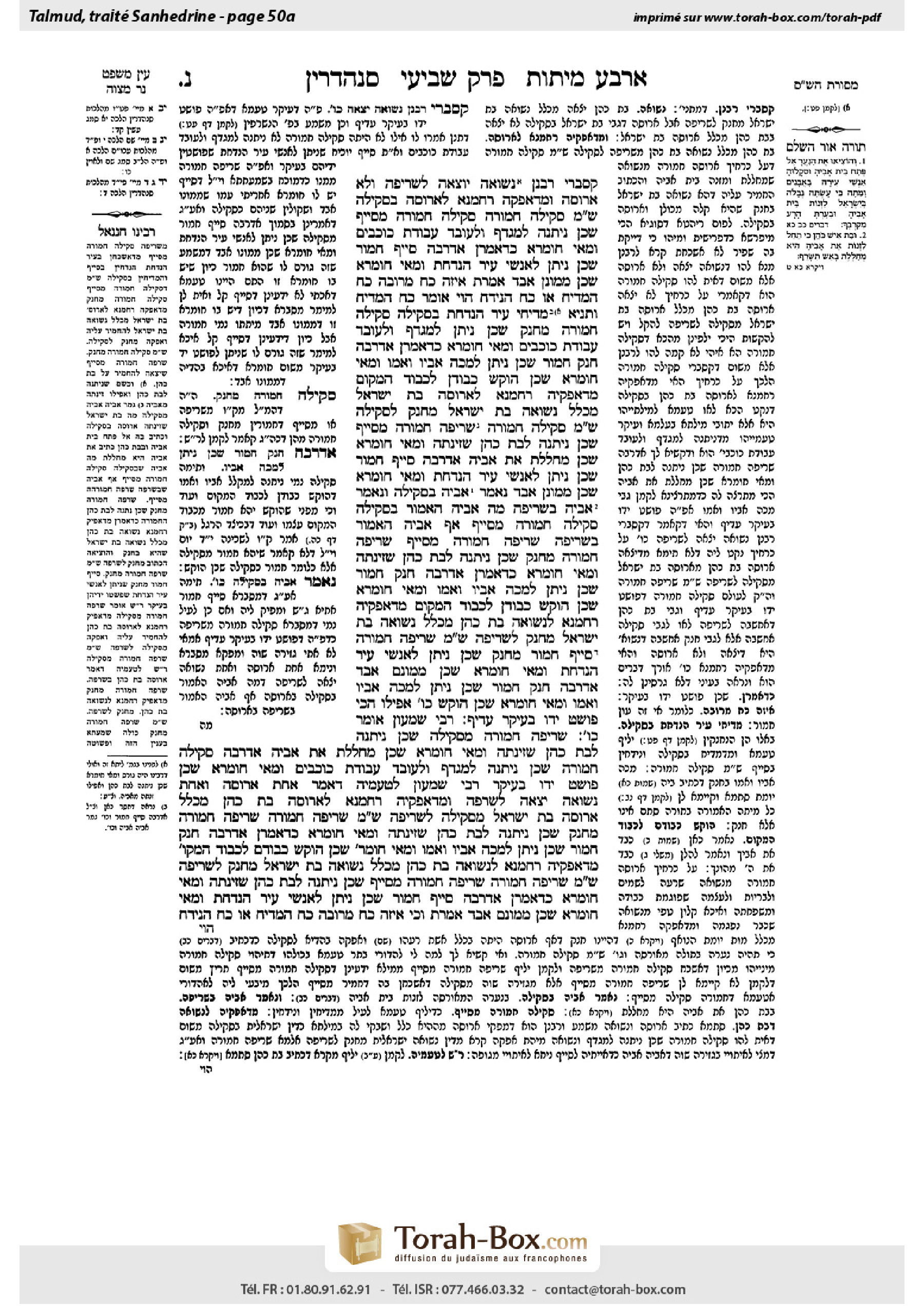
This page of Sanhedrin includes the Aramaic text, an English translation and an AI-generated French translation, alongside the scan above.
סנהדרין נ׳ א · Aramaic and Hebrew text
קָסָבְרִי רַבָּנַן: נְשׂוּאָה יוֹצְאָה לִשְׂרֵיפָה, וְלֹא אֲרוּסָה. וּמִדְּאַפְּקַהּ רַחֲמָנָא לַאֲרוּסָה בִּסְקִילָה, שְׁמַע מִינַּהּ: סְקִילָה חֲמוּרָה.
סְקִילָה חֲמוּרָה מִסַּיִיף, שֶׁכֵּן נִיתְּנָה לִמְגַדֵּף וּלְעוֹבֵד עֲבוֹדָה זָרָה. וּמַאי חוּמְרָא? כְּדַאֲמַרַן.
אַדְּרַבָּה: סַיִיף חָמוּר, שֶׁכֵּן נִיתַּן לְאַנְשֵׁי עִיר הַנִּדַּחַת. וּמַאי חוּמְרָא? שֶׁכֵּן מָמוֹנָן אָבֵד.
אָמַרְתָּ: אֵיזֶה כֹּחַ מְרוּבֶּה, כֹּחַ הַמַּדִּיחַ אוֹ כֹּחַ הַנִּידָּח? הֱוֵי אוֹמֵר: כֹּחַ הַמַּדִּיחַ. וְתַנְיָא: מַדִּיחֵי עִיר הַנִּדַּחַת – בִּסְקִילָה.
סְקִילָה חֲמוּרָה מֵחֶנֶק, שֶׁכֵּן נִיתַּן לִמְגַדֵּף וּלְעוֹבֵד עֲבוֹדָה זָרָה. וּמַאי חוּמְרָא? כְּדַאֲמַרַן.
אַדְּרַבָּה: חֶנֶק חָמוּר – שֶׁכֵּן נִיתַּן לְמַכֵּה אָבִיו וְאִמּוֹ. וּמַאי חוּמְרָא? שֶׁכֵּן הוּקַּשׁ כְּבוֹדָן לִכְבוֹד הַמָּקוֹם.
מִדְּאַפְּקֵיהּ רַחֲמָנָא לַאֲרוּסָה בַּת יִשְׂרָאֵל מִכְּלַל נְשׂוּאָה בַּת יִשְׂרָאֵל מֵחֶנֶק לִסְקִילָה, שְׁמַע מִינַּהּ: סְקִילָה חֲמוּרָה.
שְׂרֵיפָה חֲמוּרָה מִסַּיִיף, שֶׁכֵּן נִיתְּנָה לְבַת כֹּהֵן שֶׁזִּינְּתָה. וּמַאי חוּמְרָא? שֶׁכֵּן מְחַלֶּלֶת אֶת אָבִיהָ.
אַדְּרַבָּה: סַיִיף חָמוּר, שֶׁכֵּן נִיתַּן לְאַנְשֵׁי עִיר הַנִּדַּחַת. וּמַאי חוּמְרָא? שֶׁכֵּן מָמוֹנָן אָבֵד.
נֶאֱמַר ״אָבִיהָ״ בִּסְקִילָה, וְנֶאֱמַר ״אָבִיהָ״ בִּשְׂרֵיפָה. מָה ״אָבִיהָ״ הָאָמוּר בִּסְקִילָה – סְקִילָה חֲמוּרָה מִסַּיִיף, אַף ״אָבִיהָ״ הָאָמוּר בִּשְׂרֵיפָה – שְׂרֵיפָה חֲמוּרָה מִסַּיִיף.
שְׂרֵיפָה חֲמוּרָה מֵחֶנֶק, שֶׁכֵּן נִיתְּנָה לְבַת כֹּהֵן שֶׁזִּינְּתָה. וּמַאי חוּמְרָא? כְּדַאֲמַרַן.
אַדְּרַבָּה: חֶנֶק חָמוּר, שֶׁכֵּן נִיתַּן לְמַכֵּה אָבִיו וְאִמּוֹ. וּמַאי חוּמְרָא? שֶׁכֵּן הוּקַּשׁ כְּבוֹדָן לִכְבוֹד הַמָּקוֹם.
מִדְּאַפְּקֵיהּ רַחֲמָנָא לִנְשׂוּאָה בַּת כֹּהֵן מִכְּלַל נְשׂוּאָה בַּת יִשְׂרָאֵל מֵחֶנֶק לִשְׂרֵיפָה, שְׁמַע מִינַּהּ: שְׂרֵיפָה חֲמוּרָה.
סַיִיף חָמוּר מֵחֶנֶק, שֶׁכֵּן נִיתַּן לְאַנְשֵׁי עִיר הַנִּדַּחַת. וּמַאי חוּמְרָא? שֶׁכֵּן מָמוֹנָם אָבֵד.
אַדְּרַבָּה: חֶנֶק חָמוּר שֶׁכֵּן נִיתַּן לְמַכֵּה אָבִיו וְאִמּוֹ. וּמַאי חוּמְרָא? שֶׁכֵּן הוּקַּשׁ כּוּ׳.
אֲפִילּוּ הָכִי, פּוֹשֵׁט יָדוֹ בָּעִיקָּר עָדִיף.
רַבִּי שִׁמְעוֹן אוֹמֵר כּוּ׳. שְׂרֵיפָה חֲמוּרָה מִסְּקִילָה, שֶׁכֵּן נִיתְּנָה לְבַת כֹּהֵן שֶׁזִּינְּתָה. וּמַאי חוּמְרָא? שֶׁכֵּן מְחַלֶּלֶת אֶת אָבִיהָ.
אַדְּרַבָּה: סְקִילָה חֲמוּרָה, שֶׁכֵּן נִיתְּנָה לִמְגַדֵּף וּלְעוֹבֵד עֲבוֹדָה זָרָה. וּמַאי חוּמְרָא? שֶׁכֵּן פּוֹשֵׁט יָדוֹ בָּעִיקָּר.
רַבִּי שִׁמְעוֹן לְטַעְמֵיהּ, דְּאָמַר: אַחַת אֲרוּסָה וְאַחַת נְשׂוּאָה יָצְאָה לִשְׂרֵיפָה. וּמִדְּאַפְּקֵיהּ רַחֲמָנָא לַאֲרוּסָה בַּת כֹּהֵן מִכְּלַל אֲרוּסָה בַּת יִשְׂרָאֵל מִסְּקִילָה לִשְׂרֵיפָה, שְׁמַע מִינַּהּ: שְׂרֵיפָה חֲמוּרָה.
שְׂרֵיפָה חֲמוּרָה מֵחֶנֶק, שֶׁכֵּן נִיתְּנָה לְבַת כֹּהֵן שֶׁזִּינְּתָה. וּמַאי חוּמְרָא? כְּדַאֲמַרַן.
אַדְּרַבָּה: חֶנֶק חָמוּר, שֶׁכֵּן נִיתַּן לְמַכֵּה אָבִיו וְאִמּוֹ. וּמַאי חוּמְרָא? שֶׁכֵּן הוּקַּשׁ כְּבוֹדָם לִכְבוֹד הַמָּקוֹם.
מִדְּאַפְּקֵיהּ רַחֲמָנָא לִנְשׂוּאָה בַּת כֹּהֵן מִכְּלַל נְשׂוּאָה בַּת יִשְׂרָאֵל, מֵחֶנֶק לִשְׂרֵיפָה, שְׁמַע מִינַּהּ: שְׂרֵיפָה חֲמוּרָה.
שְׂרֵיפָה חֲמוּרָה מִסַּיִיף, שֶׁכֵּן נִיתְּנָה לְבַת כֹּהֵן שֶׁזִּינְּתָה. וּמַאי חוּמְרָא? כְּדַאֲמַרַן.
אַדְּרַבָּה: סַיִיף חָמוּר, שֶׁכֵּן נִיתַּן לְאַנְשֵׁי עִיר הַנִּדַּחַת. וּמַאי חוּמְרָא? שֶׁכֵּן מָמוֹנָם אָבֵד.
אָמַרְתָּ: וְכִי אֵיזֶה כֹּחַ מְרוּבֶּה, כֹּחַ הַמַּדִּיחַ אוֹ כֹּחַ הַנִּידָּח?
Sanhedrin 50a · English translation
The Gemara answers: The Rabbis hold that only the married daughter of a priest who committed adultery is singled out from all those who commit adultery, for burning, but not one who is betrothed, as a betrothed woman who committed adultery, whether or not she is the daughter of a priest, is executed by stoning. And since the Merciful One singles out a betrothed woman who is not married from all married women who commit adultery, to be executed by stoning, conclude from it that stoning is more severe than burning.
Stoning is considered more severe than decapitation by the sword, as it is meted out to one who blasphemes and to one who worships idols. And for what reason is the severity of these transgressions considered greater than others? As we said, it is because the transgressors undermine the fundamental tenets of Judaism.
The Gemara raises an objection: On the contrary; decapitation by the sword would appear to be more severe than stoning, as it is meted out to the people of an idolatrous city, who also undermine the fundamental tenets of Judaism. And for what reason is the severity of this case of an idolatrous city considered greater than others? Because the transgressors are not only executed, their property is destroyed as well.
The Gemara answers: In response to this objection, you should say: The severity of which transgression is greater: The severity of the transgression of the one who subverts the city, inciting them to sin, or the severity of the transgression of the subverted? You must say that the severity of the transgression of the subverter is greater. And it is taught in a baraita: The subverters of an idolatrous city are executed by stoning. Evidently, stoning is a more severe type of execution than decapitation.
Stoning is considered more severe than strangulation, as it is meted out to one who blasphemes and to one who worships idols. And for what reason is the severity of these transgressions considered greater? As we said, it is because the transgressors undermine the fundamental tenets of Judaism.
The Gemara raises an objection: On the contrary; strangulation is more severe, as it is meted out to one who wounds his father or his mother. And for what reason is the severity of this transgression considered greater? Because the honor of one’s parents is compared to the honor of the Omnipresent (see Kiddushin 30b).
The Gemara answers: Since the Merciful One singles out the case of a betrothed Jewish woman from the category of a married Jewish woman, changing the punishment of a betrothed Jewish woman who committed adultery from strangulation to stoning, conclude from it that stoning is more severe.
Burning is considered more severe than decapitation by the sword, as it is meted out to a priest’s daughter who committed adultery. And for what reason is the severity of this transgression considered greater than others? Because she profanes both herself and her father.
The Gemara raises an objection: On the contrary; decapitation by the sword is more severe, as it is meted out to the people of an idolatrous city. And for what reason is the severity of this case considered greater? Because the transgressors are not only executed, their property is destroyed as well.
The Gemara answers: The severity of burning is derived by means of a verbal analogy. The term “her father” is stated with regard to stoning, in the verse: “And the men of her city shall stone her with stones and she shall die, because she has done a depraved thing in Israel, to play the harlot in the house of her father” (Deuteronomy 22:21), and the term “her father” is stated with regard to burning, in the verse: “And the daughter of a priest, when she profanes herself by playing the harlot, she profanes her father; she shall be burned with fire” (Leviticus 21:9). Therefore, just as concerning the term “her father” that is stated with regard to stoning it is established that stoning is more severe than decapitation by the sword, so too, concerning the term “her father” that is stated with regard to burning, it may be established that burning is more severe than decapitation by the sword.
Burning is considered more severe than strangulation, as it is meted out to a priest’s daughter who committed adultery. And for what reason is the severity of this transgression considered greater? As we said, because she profanes both herself and her father.
The Gemara raises an objection: On the contrary; strangulation is more severe, as it is meted out to one who wounds his father or his mother. And for what reason is the severity of this transgression considered greater? Because the honor of one’s parents is compared to the honor of the Omnipresent.
The Gemara answers: Since the Merciful One singles out the case of the married daughter of a priest from the category of a married Jewish woman, changing the punishment of the married daughter of a priest who committed adultery from strangulation to burning, conclude from it that burning is more severe than strangulation.
Decapitation by the sword is considered more severe than strangulation, as it is meted out to the people of an idolatrous city. And for what reason is the severity of this case considered greater? Because their property is destroyed as well.
The Gemara raises an objection: On the contrary; strangulation is more severe, as it is meted out to one who wounds his father or his mother. And for what reason is the severity of this transgression considered greater? Because the honor of one’s parents is compared to the honor of the Omnipresent.
The Gemara answers: Nevertheless, the transgression of one who undermines the fundamental tenets of Judaism is more severe, as he defiles the honor of the Omnipresent Himself, so his punishment must certainly be the most severe.
§ The mishna teaches that Rabbi Shimon says that the order of severity is burning, stoning, strangulation, and killing. The Gemara explains the basis for his opinion. Burning is considered more severe than stoning, as burning is meted out to a priest’s daughter who committed adultery. And for what reason is the severity of this transgression considered greater than the others? Because she profanes both herself and her father.
The Gemara raises an objection: On the contrary; stoning is more severe, as it is meted out to one who blasphemes and to one who worships idols. And for what reason is the severity of these transgressions greater? Because the transgressor undermines the fundamental tenets of Judaism.
The Gemara answers: Rabbi Shimon conforms to his line of reasoning, as he says that the daughter of a priest, whether she is betrothed or married, is singled out for burning. And since the Merciful One singles out the case of the betrothed daughter of a priest from the category of a betrothed Jewish woman, changing her punishment from execution by stoning to execution by burning, conclude from it that burning is more severe than stoning, as the punishment for a priest’s daughter who committed adultery must certainly be more severe than that of the daughter of a non-priest.
The Gemara continues to explain the order of severity according to Rabbi Shimon. Burning is considered more severe than strangulation, as it is meted out to a priest’s daughter who committed adultery. And for what reason is the severity of this transgression considered greater? As we said, it is because she profanes both herself and her father.
The Gemara raises an objection: On the contrary; strangulation is more severe, as it is meted out to one who wounds his father or his mother. And for what reason is the severity of this transgression considered greater? Because the honor of one’s parents is compared to the honor of the Omnipresent.
The Gemara answers: Since the Merciful One singles out the case of the married daughter of a priest who committed adultery from the category of a married Jewish woman who committed adultery, changing her punishment from execution by strangulation to execution by burning, conclude from it that burning is more severe than strangulation.
Burning is considered more severe than decapitation by the sword, as it is meted out to a priest’s daughter who committed adultery. And for what reason is the severity of this transgression considered greater? As we said, it is because she profanes both herself and her father.
The Gemara raises an objection: On the contrary; decapitation by the sword is more severe, as it is meted out to the people of an idolatrous city. And for what reason is the severity of this case considered greater? Because their property is destroyed as well.
The Gemara answers: In response to this objection, you should say: But the severity of which transgression is greater: The severity of the transgression of the subverter, or the severity of the transgression of the subverted?
Sanhedrin 50a · Traduction française (IA)
La Guemara répond : Les Rabbins considèrent que seule la fille mariée d’un prêtre qui a commis adultère est distinguée parmi toutes celles qui commettent adultère pour être condamnée au bûcher, et non la femme fiancée ; car une femme fiancée qui commet adultère est exécutée par lapidation, qu’elle soit ou non la fille d’un prêtre. Puisque le Miséricordieux distingue la femme fiancée non mariée de toutes les femmes mariées qui commettent adultère en la condamnant à la lapidation, déduis-en que la lapidation est plus sévère que le bûcher.
La lapidation est considérée comme plus sévère que la décapitation par l’épée, puisqu’elle est infligée à celui qui blasphème et à celui qui pratique l’idolâtrie. Et pourquoi considère-t-on ces transgressions comme plus graves que les autres ? Comme nous l’avons dit, c’est parce que leurs auteurs sapent les fondements mêmes du judaïsme.
La Guemara soulève une objection : Au contraire, la décapitation par l’épée semble plus sévère que la lapidation, puisqu’elle est infligée aux habitants d’une ville idolâtre, qui sapent eux aussi les fondements mêmes du judaïsme. Et pourquoi considère-t-on le cas de cette ville idolâtre comme plus grave que les autres ? Parce que les coupables ne sont pas seulement exécutés : leurs biens sont également détruits.
La Guemara répond : À cette objection, il faut répondre ainsi : quelle transgression est la plus grave, celle de celui qui subvertit la ville en incitant ses habitants à fauter ou celle des habitants subvertis ? Il faut dire que la transgression du subversif est plus grave. Or, une baraïta enseigne que les subversifs d’une ville idolâtre sont exécutés par lapidation. Il est donc manifeste que la lapidation est un mode d’exécution plus sévère que la décapitation.
La lapidation est considérée comme plus sévère que l’étranglement, puisqu’elle est infligée à celui qui blasphème et à celui qui pratique l’idolâtrie. Et pourquoi considère-t-on ces transgressions comme plus graves ? Comme nous l’avons dit, c’est parce que leurs auteurs sapent les fondements mêmes du judaïsme.
La Guemara soulève une objection : Au contraire, l’étranglement est plus sévère, puisqu’il est infligé à celui qui blesse son père ou sa mère. Et pourquoi considère-t-on cette transgression comme plus grave ? Parce que l’honneur dû aux parents est comparé à l’honneur dû à l’Omniprésent (voir Kiddouchin 30b).
La Guemara répond : Puisque le Miséricordieux distingue le cas d’une femme juive fiancée de celui d’une femme juive mariée, faisant passer la peine de la femme juive fiancée qui a commis adultère de l’étranglement à la lapidation, déduis-en que la lapidation est plus sévère.
Le bûcher est considéré comme plus sévère que la décapitation par l’épée, puisqu’il est infligé à la fille d’un prêtre qui a commis adultère. Et pourquoi considère-t-on cette transgression comme plus grave que les autres ? Parce qu’elle profane à la fois sa propre personne et son père.
La Guemara soulève une objection : Au contraire, la décapitation par l’épée est plus sévère, puisqu’elle est infligée aux habitants d’une ville idolâtre. Et pourquoi considère-t-on ce cas comme plus grave ? Parce que les coupables ne sont pas seulement exécutés : leurs biens sont également détruits.
La sévérité du bûcher est déduite au moyen d’une analogie verbale. L’expression « son père » apparaît à propos de la lapidation dans le verset : « Les hommes de sa ville la lapideront avec des pierres, et elle mourra, car elle a commis une infamie en Israël en se prostituant dans la maison de son père » (Deutéronome 22, 21), et l’expression « son père » apparaît à propos du bûcher dans le verset : « Si la fille d’un prêtre se profane en se prostituant, elle profane son père ; elle sera brûlée par le feu » (Lévitique 21, 9). Par conséquent, de même que, pour l’expression « son père » employée à propos de la lapidation, il est établi que la lapidation est plus sévère que la décapitation par l’épée, de même, pour l’expression « son père » employée à propos du bûcher, on peut établir que le bûcher est plus sévère que la décapitation par l’épée.
Le bûcher est considéré comme plus sévère que l’étranglement, puisqu’il est infligé à la fille d’un prêtre qui a commis adultère. Et pourquoi considère-t-on cette transgression comme plus grave ? Comme nous l’avons dit, c’est parce qu’elle profane à la fois sa propre personne et son père.
La Guemara soulève une objection : Au contraire, l’étranglement est plus sévère, puisqu’il est infligé à celui qui blesse son père ou sa mère. Et pourquoi considère-t-on cette transgression comme plus grave ? Parce que l’honneur dû aux parents est comparé à l’honneur dû à l’Omniprésent.
La Guemara répond : Puisque le Miséricordieux distingue le cas de la fille mariée d’un prêtre de celui d’une femme juive mariée, faisant passer la peine de la fille mariée d’un prêtre qui a commis adultère de l’étranglement au bûcher, déduis-en que le bûcher est plus sévère que l’étranglement.
La décapitation par l’épée est considérée comme plus sévère que l’étranglement, puisqu’elle est infligée aux habitants d’une ville idolâtre. Et pourquoi considère-t-on ce cas comme plus grave ? Parce que leurs biens sont également détruits.
La Guemara soulève une objection : Au contraire, l’étranglement est plus sévère, puisqu’il est infligé à celui qui blesse son père ou sa mère. Et pourquoi considère-t-on cette transgression comme plus grave ? Parce que l’honneur dû aux parents est comparé à l’honneur dû à l’Omniprésent.
La Guemara répond : Néanmoins, la transgression de celui qui sape les fondements mêmes du judaïsme est plus grave, car il porte atteinte à l’honneur de l’Omniprésent lui-même ; sa peine doit donc certainement être la plus sévère.
§ La Michna enseigne que Rabbi Chimon dit que l’ordre des peines, de la plus sévère à la moins sévère, est le bûcher, la lapidation, l’étranglement et la mise à mort. La Guemara explique le fondement de son opinion. Le bûcher est considéré comme plus sévère que la lapidation, puisqu’il est infligé à la fille d’un prêtre qui a commis adultère. Et pourquoi considère-t-on cette transgression comme plus grave que les autres ? Parce qu’elle profane à la fois sa propre personne et son père.
La Guemara soulève une objection : Au contraire, la lapidation est plus sévère, puisqu’elle est infligée à celui qui blasphème et à celui qui pratique l’idolâtrie. Et pourquoi ces transgressions sont-elles plus graves ? Parce que leurs auteurs sapent les fondements mêmes du judaïsme.
La Guemara répond : Rabbi Chimon reste fidèle à sa ligne de pensée, car il affirme que la fille d’un prêtre, qu’elle soit fiancée ou mariée, est distinguée pour être condamnée au bûcher. Puisque le Miséricordieux distingue le cas de la fille fiancée d’un prêtre de celui d’une femme juive fiancée, faisant passer sa peine de la lapidation au bûcher, déduis-en que le bûcher est plus sévère que la lapidation, car la peine de la fille d’un prêtre qui a commis adultère doit certainement être plus sévère que celle de la fille d’un homme qui n’est pas prêtre.
La Guemara poursuit son explication de l’ordre des peines selon leur sévérité, d’après Rabbi Chimon. Le bûcher est considéré comme plus sévère que l’étranglement, puisqu’il est infligé à la fille d’un prêtre qui a commis adultère. Et pourquoi considère-t-on cette transgression comme plus grave ? Comme nous l’avons dit, c’est parce qu’elle profane à la fois sa propre personne et son père.
La Guemara soulève une objection : Au contraire, l’étranglement est plus sévère, puisqu’il est infligé à celui qui blesse son père ou sa mère. Et pourquoi considère-t-on cette transgression comme plus grave ? Parce que l’honneur dû aux parents est comparé à l’honneur dû à l’Omniprésent.
La Guemara répond : Puisque le Miséricordieux distingue le cas de la fille mariée d’un prêtre qui a commis adultère de celui d’une femme juive mariée qui a commis adultère, faisant passer sa peine de l’étranglement au bûcher, déduis-en que le bûcher est plus sévère que l’étranglement.
Le bûcher est considéré comme plus sévère que la décapitation par l’épée, puisqu’il est infligé à la fille d’un prêtre qui a commis adultère. Et pourquoi considère-t-on cette transgression comme plus grave ? Comme nous l’avons dit, c’est parce qu’elle profane à la fois sa propre personne et son père.
La Guemara soulève une objection : Au contraire, la décapitation par l’épée est plus sévère, puisqu’elle est infligée aux habitants d’une ville idolâtre. Et pourquoi considère-t-on ce cas comme plus grave ? Parce que leurs biens sont également détruits.
La Guemara répond : À cette objection, il faut répondre ainsi : mais quelle transgression est la plus grave, celle du subversif ou celle des habitants subvertis ?
Traduction française générée par IA à partir de l’édition anglaise de Sefaria. Vérifie toujours un passage avec le texte source.
Text from Sefaria: William Davidson Edition - Vocalized Aramaic (CC BY NC); William Davidson Edition - English (CC BY NC).