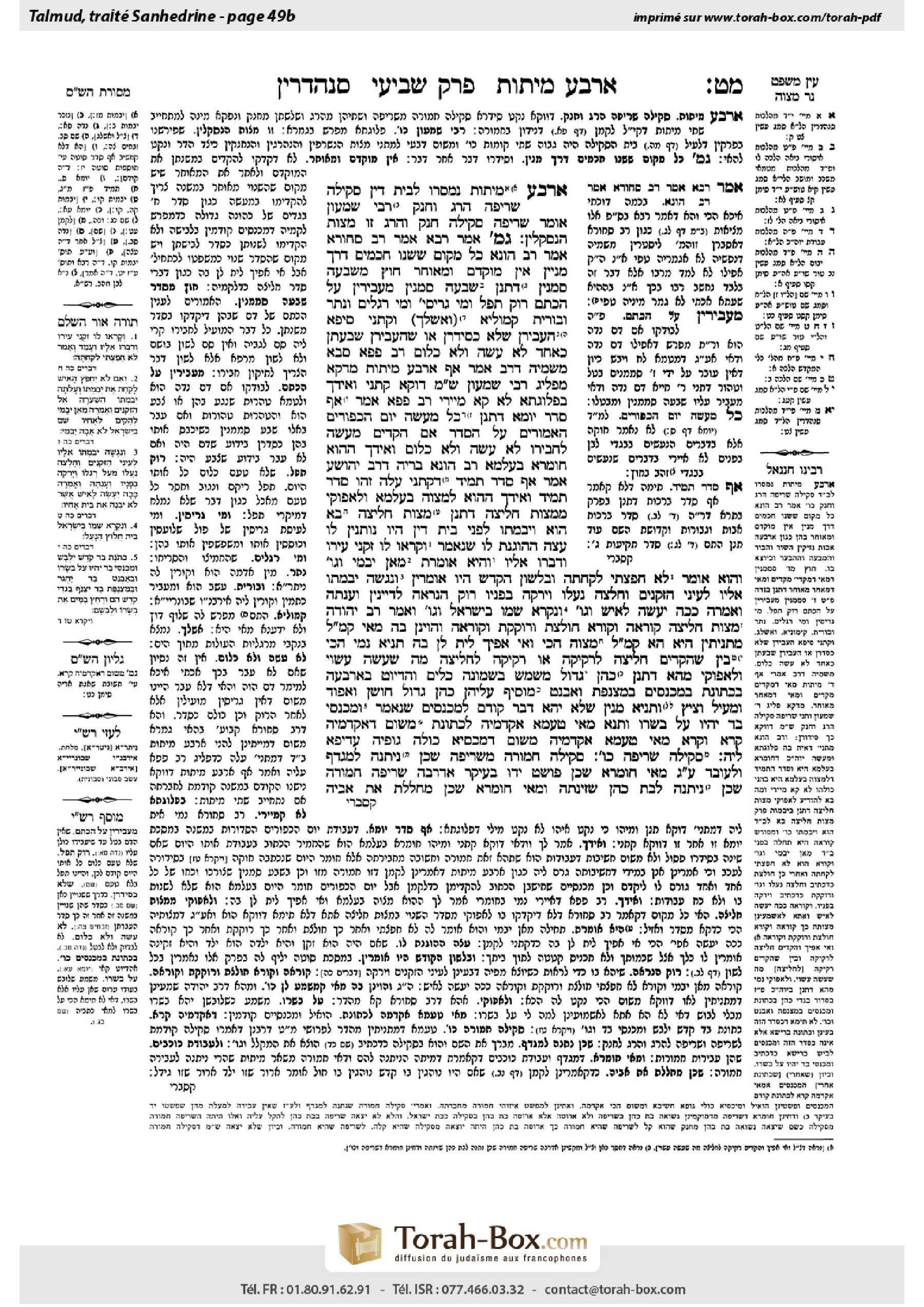
Sanhedrin 49b: Talmud study for Daf Yomi
Daf Yomi is the daily study of one Talmud folio. Explore 37 tractates with scans, Hebrew text, Sefaria English and AI-generated French translations where annotated.
Passage selection and English or AI-generated French translation are available where the scan has annotations. Daf Study is independent of Torah-Box and Sefaria.
Browse Sanhedrin · סנהדרין · All tractatesSanhedrin 49b text and translations
This page of Sanhedrin includes the Aramaic text, an English translation and an AI-generated French translation, alongside the scan above.
סנהדרין מ״ט ב · Aramaic and Hebrew text
מַתְנִי׳ אַרְבַּע מִיתוֹת נִמְסְרוּ לְבֵית דִּין: סְקִילָה, שְׂרֵיפָה, הֶרֶג, וָחֶנֶק. רַבִּי שִׁמְעוֹן אוֹמֵר: שְׂרֵיפָה, סְקִילָה, חֶנֶק, וָהֶרֶג. זוֹ מִצְוַת הַנִּסְקָלִין.
גְּמָ׳ אָמַר רָבָא אָמַר רַב סְחוֹרָא אָמַר רַב הוּנָא: כׇּל מָקוֹם שֶׁשָּׁנוּ חֲכָמִים דֶּרֶךְ מִנְיָין, אֵין מוּקְדָּם וּמְאוּחָר, חוּץ מִשִּׁבְעָה סַמָּנִין.
דִּתְנַן: שִׁבְעָה סַמָּנִין מַעֲבִירִין עַל הַכֶּתֶם – רוֹק תָּפֵל, וּמֵי גְרִיסִין, וּמֵי רַגְלַיִם, וְנֶתֶר, וּבוֹרִית, קִמוֹלְיָא, וְאַשְׁלָךְ.
וְקָתָנֵי סֵיפָא: הֶעֱבִירָן שֶׁלֹּא כְּסִידְרָן, אוֹ שֶׁהֶעֱבִירָן שִׁבְעָתָן כְּאֶחָד – לֹא עָשָׂה וְלֹא כְלוּם.
רַב פָּפָּא סָבָא מִשְּׁמֵיהּ דְּרַב אָמַר: אַף אַרְבַּע מִיתוֹת. מִדְּקָא מִפְּלִיג רַבִּי שִׁמְעוֹן, שְׁמַע מִינַּהּ דַּוְקָא קָתָנֵי. וְאִידָּךְ, בִּפְלוּגְתָּא לָא קָא מַיְירֵי.
רַב פָּפָּא אָמַר: אַף סֵדֶר יוֹמָא, דִּתְנַן: כׇּל מַעֲשֵׂה יוֹם הַכִּפּוּרִים הָאֲמוּרִים עַל הַסֵּדֶר, אִם הִקְדִּים מַעֲשֶׂה לַחֲבֵירוֹ – לֹא עָשָׂה וְלֹא כְלוּם.
וְאִידָּךְ, הָהוּא חוּמְרָא בְּעָלְמָא.
רַב הוּנָא בְּרֵיהּ דְּרַב יְהוֹשֻׁעַ אָמַר: אַף סֵדֶר תָּמִיד, דְּקָתָנֵי עֲלַהּ ״זֶהוּ סֵדֶר תָּמִיד״. וְאִידָּךְ – הָהוּא לְמִצְוָה בְּעָלְמָא.
וּלְאַפּוֹקֵי מִמִּצְוַת חֲלִיצָה, דִּתְנַן: מִצְוַת חֲלִיצָה – בָּא הוּא וִיבִמְתּוֹ לִפְנֵי בֵּית דִּין, הָיוּ נוֹתְנִין לוֹ עֵצָה הַהוֹגֶנֶת לוֹ, שֶׁנֶּאֱמַר: ״וְקָרְאוּ לוֹ זִקְנֵי עִירוֹ וְדִבְּרוּ אֵלָיו״.
וְהִיא אוֹמֶרֶת: ״מֵאֵן יְבָמִי וְגוֹ׳״, וְהוּא אוֹמֵר: ״לֹא חָפַצְתִּי לְקַחְתָּהּ״. וּבִלְשׁוֹן הַקֹּדֶשׁ הָיוּ אוֹמְרִין.
״וְנִגְּשָׁה יְבִמְתּוֹ אֵלָיו לְעֵינֵי הַזְּקֵנִים וְחָלְצָה נַעֲלוֹ וְיָרְקָה בְּפָנָיו״ – רוֹק הַנִּרְאֶה לַדַּיָּינִין. ״וְעָנְתָה וְאָמְרָה כָּכָה יֵעָשֶׂה לְאִישׁ וְגוֹ׳ וְנִקְרָא שְׁמוֹ בְּיִשְׂרָאֵל וְגוֹ׳״.
וְאָמַר רַב יְהוּדָה: מִצְוַת חֲלִיצָה – קוֹרְאָה וְקוֹרֵא, חוֹלֶצֶת וְרוֹקֶקֶת, וְקוֹרְאָה.
וְהָוֵינַן בַּהּ: מַאי קָא מַשְׁמַע לַן? מַתְנִיתִין הִיא! הָא קָא מַשְׁמַע לַן: מִצְוָה הָכִי, וְאִי אָפֵיךְ – לֵית לַן בַּהּ. תַּנְיָא נָמֵי הָכִי: בֵּין שֶׁהִקְדִּים חֲלִיצָה לִרְקִיקָה, אוֹ רְקִיקָה לַחֲלִיצָה – מַה שֶּׁעָשָׂה עָשׂוּי.
וּלְאַפּוֹקֵי מֵהָא דִּתְנַן: כֹּהֵן גָּדוֹל מְשַׁמֵּשׁ בִּשְׁמוֹנָה כֵּלִים, וְהֶדְיוֹט בְּאַרְבָּעָה. בִּכְתוֹנֶת, בְּמִכְנָסַיִם, בְּמִצְנֶפֶת, וְאַבְנֵט. מוֹסִיף עֲלֵיהֶן כֹּהֵן גָּדוֹל: חוֹשֶׁן וְאֵפוֹד וּמְעִיל וְצִיץ.
וְתַנְיָא: מִנַּיִן שֶׁלֹּא יְהֵא דָּבָר קוֹדֵם לַמִּכְנָסַיִם? שֶׁנֶּאֱמַר: ״וּמִכְנְסֵי בַד יִהְיוּ עַל בְּשָׂרוֹ״.
וְתַנָּא, מַאי טַעְמָא אַקְדְּמֵיהּ לִכְתוֹנֶת? מִשּׁוּם דְּאַקְדְּמֵיהּ קְרָא. וּקְרָא, מַאי טַעְמָא אַקְדְּמֵיהּ? מִשּׁוּם דִּמְכַסְּיָא כּוּלֵּהּ גּוּפֵיהּ, עֲדִיפָא לֵיהּ.
סְקִילָה שְׂרֵיפָה כּוּ׳. סְקִילָה חֲמוּרָה מִשְּׂרֵיפָה, שֶׁכֵּן נִיתְּנָה לִמְגַדֵּף וּלְעוֹבֵד עֲבוֹדָה זָרָה. מַאי חוּמְרָא? שֶׁכֵּן פּוֹשֵׁט יָדוֹ בָּעִיקָּר.
אַדְּרַבָּה: שְׂרֵיפָה חֲמוּרָה, שֶׁכֵּן נִיתְּנָה לְבַת כֹּהֵן שֶׁזִּינְּתָה. וּמַאי חוּמְרָא? שֶׁכֵּן מְחַלֶּלֶת אֶת אָבִיהָ.
Sanhedrin 49b · English translation
MISHNA: Four types of the death penalty were given over to the court, with which those who committed certain transgressions are executed. They are, in descending order of severity: Stoning, burning, killing by decapitation, and strangulation. Rabbi Shimon says: They are, in descending order of severity: Burning, stoning, strangulation, and killing. This execution, described in the previous chapter, is referring to the mitzva of those who are stoned, i.e., to the process of execution by stoning.
GEMARA: Rava says that Rav Seḥora says that Rav Huna says: Wherever the Sages taught a halakha by means of a list, there is no significance to the order of their list, except for in the mishna that discusses the seven abrasive substances, where the order is significant.
As we learned in a mishna (Nidda 61b): One applies seven abrasive substances to the stain found on a woman’s clothing in order to find out whether the stain is from menstrual blood, and therefore ritually impure, or whether it is another type of stain, and therefore pure. These substances are: Bland spittle, which is the spittle of someone who has not yet tasted anything in the morning; moisture of grits, which is the spittle of one who has chewed the grits of beans; urine; natron; lye [borit]; Kimolian earth [kimuleya]; and potash. If the stain disappears as a result of the application of all of these substances, the stain is considered to have been from blood.
And it is taught in the latter clause of that mishna that the order of the substances is essential, as it states: If one applied them not in the order prescribed for them, or applied all seven of them at once, he has done nothing; the laundering has not been effective.
Rav Pappa the elder says in the name of Rav: The four types of the death penalty are also taught in order. This is apparent from the fact that Rabbi Shimon disagrees with the first order; conclude from it that it is taught in an exact order. The Gemara adds: And the other Sage, Rav Huna, does not include this mishna among those in which the order is significant, as he is not speaking of mishnayot where there is a dispute with regard to the correct order.
Rav Pappa says: The order of the service in the Temple on the Day of Atonement, Yom Kippur, is also taught in its proper order, as we learned in a mishna (Yoma 60a): With regard to all actions performed in the context of the service of Yom Kippur, which are stated in the Mishna, as in the Torah, in order, the halakha is: If the High Priest performed one action before another, i.e., if he diverged from the order that is written, it is as though he has done nothing.
And the other Sage, Rav Huna, does not include this mishna because that is merely a stringency. Although a change in the order invalidates the Yom Kippur service, this is not due to the importance of some rites relative to others, but because this order was established by the Torah.
Rav Huna, son of Rav Yehoshua, says: The order of the daily offering, described in the mishna at the end of tractate Tamid (33b), is also essential; as it is taught with regard to it: This is the order of the daily offering, indicating that it should be performed in exactly that order. And the other Sage, Rav Huna, does not include this mishna, as that requirement is merely for the mitzva. In other words, it is preferable that the offering be sacrificed in that order, but it is not disqualified if one deviates from that order.
And Rav Huna’s principle excludes the mitzva of the ritual through which a man whose married brother dies childless [yavam] frees his late brother’s wife [yevama] of her levirate bonds [ḥalitza]; i.e., it teaches that the order of that ceremony is not essential. As we learned in a mishna (Yevamot 106b): The mitzva of ḥalitza is performed in this manner: The yavam and his yevama come before the court, and the judges of the court offer him advice that is appropriate for him as to whether to enter levirate marriage or to perform ḥalitza, as it is stated: “And the elders of his city shall call him and speak to him” (Deuteronomy 25:8).
And if they decide to perform ḥalitza, she says: “My brother-in-law refused to establish a name for his brother in Israel, he did not wish to consummate the levirate marriage” (Deuteronomy 25:7), and afterward he says: “I do not wish to take her” (Deuteronomy 25:8). And they would say these statements in the sacred tongue, Hebrew.
The verse states: “His yevama shall approach him, before the elders, and remove his shoe from on his foot and spit before him” (Deuteronomy 25:9). Accordingly, she removes his shoe and she spits before him a quantity of spittle that is visible to the judges. “And she shall respond and say: So shall it be done to the man who does not build his brother’s house. And his name shall be called in Israel: The house of he who had his shoe removed” (Deuteronomy 25:9–10).
And Rav Yehuda says that this is the correct order for the mitzva of ḥalitza: She recites the sentence beginning with “My brother-in-law refused” (Deuteronomy 25:7), and afterward he recites “I do not wish to take her” (Deuteronomy 25:8). Then she removes the shoe, and spits, and recites: “So shall it be done to the man who does not build his brother’s house” (Deuteronomy 25:9).
And we discussed it: What is Rav Yehuda teaching us? This is already stated in the mishna. The answer is that this is what Rav Yehuda teaches us: It is a mitzva to perform ḥalitza like this, i.e., this is the proper order, but if one switched the order we have no problem with it; the ḥalitza is still valid, as the order of the ritual is not essential. This is also taught in a baraita: Whether one performed the removal of the shoe before the spitting, or the spitting before the removal of the shoe, what she did is done, i.e., the ḥalitza is valid.
And Rav Huna’s principle also excludes that which we learned in a mishna (Yoma 71b): The High Priest serves, i.e., performs the Temple service, wearing eight garments, and the ordinary priest performs the Temple service wearing four. An ordinary priest performs the Temple service in a tunic, in trousers, in a mitre, and in a belt. The High Priest adds another four garments beyond those worn by the ordinary priest: A breastplate, and an ephod, and a robe, and a frontplate. The order listed in this mishna indicates that the tunic was put on first.
And it is taught in a baraita: From where is it derived that nothing precedes the donning of the trousers when the priest dresses? As it is stated: “He shall wear a sacred tunic of linen; and trousers of linen shall be on his flesh” (Leviticus 16:4). This indicates that the trousers come first, as they are worn directly on the flesh, proving that the list in the mishna is not in accordance with the order in which the priests dressed.
The Gemara asks: But if so, what is the reason the tanna mentions the tunic first? The Gemara answers: Because the verse mentions it first. The Gemara asks: And what is the reason the verse mentions it first? The Gemara answers: Because it covers his entire body, the Torah prefers to mention it first.
§ The mishna states the types of the death penalty in descending order of severity: Stoning, burning, killing by decapitation, and strangulation. The Gemara discusses the basis for this order. Stoning is considered more severe than burning, as stoning is meted out to one who blasphemes, i.e., one who curses God, and to one who worships idols. For what reason is the severity of these transgressions considered greater than others? Because the transgressor undermines the fundamental tenets of Judaism.
The Gemara raises an objection: On the contrary; burning is more severe than stoning, as it is meted out to a priest’s daughter who committed adultery (see Leviticus 21:9). And for what reason is the severity of this transgression considered greater than others? Because through her sin she profanes not only herself but her father as well.
Sanhedrin 49b · Traduction française (IA)
MICHNA : Quatre types de peine capitale furent confiés au tribunal pour exécuter ceux qui avaient commis certaines transgressions. Par ordre décroissant de sévérité, ce sont : la lapidation, le bûcher, la décapitation et l’étranglement. Rabbi Shimon dit : Par ordre décroissant de sévérité, ce sont : le bûcher, la lapidation, l’étranglement et la décapitation. L’exécution décrite dans le chapitre précédent concerne la mitsva de ceux qui sont lapidés, c’est-à-dire la procédure d’exécution par lapidation.
GUEMARA : Rava dit au nom de Rav Seḥora, qui dit au nom de Rav Huna : Partout où les Sages enseignent une halakha sous forme de liste, l’ordre de cette liste n’a aucune importance, sauf dans la Michna qui traite des sept substances abrasives, où l’ordre est important.
Comme nous l’avons appris dans une Michna (Nidda 61b) : On applique sept substances abrasives à la tache trouvée sur le vêtement d’une femme afin de déterminer si elle provient de sang menstruel et est donc rituellement impure, ou s’il s’agit d’un autre type de tache, auquel cas elle est pure. Ces substances sont : la salive fade, c’est-à-dire la salive de quelqu’un qui n’a encore rien goûté le matin ; l’humidité de gruau, c’est-à-dire la salive de quelqu’un qui a mâché du gruau de fèves ; l’urine ; le natron ; la lessive [borit] ; la terre de Kimolos [kimuleya] ; et la potasse. Si la tache disparaît après l’application de toutes ces substances, on considère qu’elle provenait de sang.
Et la dernière partie de cette Michna enseigne que l’ordre des substances est indispensable, puisqu’elle énonce : Si on les a appliquées dans un ordre différent de celui qui leur est prescrit, ou si on les a toutes appliquées en même temps, on n’a rien fait ; le lavage n’a pas été efficace.
Rav Pappa l’Ancien dit au nom de Rav : Les quatre types de peine capitale sont eux aussi enseignés dans un ordre précis. Cela ressort du fait que Rabbi Shimon conteste le premier ordre ; on en conclut que l’ordre indiqué est exact. La Guemara ajoute : Quant à l’autre Sage, Rav Huna, il ne compte pas cette Michna parmi celles où l’ordre est important, car il ne parle pas des michnayot qui font l’objet d’un désaccord sur l’ordre correct.
Rav Pappa dit : L’ordre du service au Temple le jour de Yom Kippour est également enseigné dans l’ordre qui convient, comme nous l’avons appris dans une Michna (Yoma 60a) : Pour toutes les actions accomplies dans le cadre du service de Yom Kippour, qui sont énoncées dans la Michna, comme dans la Torah écrite, dans l’ordre, la halakha est la suivante : si le Grand Prêtre accomplit une action avant une autre, c’est-à-dire s’il s’écarte de l’ordre écrit, c’est comme s’il n’avait rien fait.
Quant à l’autre Sage, Rav Huna, il ne compte pas cette Michna, car il s’agit simplement d’une rigueur. Bien qu’un changement d’ordre invalide le service de Yom Kippour, ce n’est pas parce que certains rites ont plus d’importance que d’autres, mais parce que cet ordre a été établi par la Torah.
Rav Huna, fils de Rav Yehoshua, dit : L’ordre de l’offrande quotidienne, décrit dans la Michna à la fin du traité Tamid (33b), est lui aussi indispensable ; car il est enseigné à son sujet : « Voici l’ordre de l’offrande quotidienne », ce qui indique qu’elle doit être accomplie exactement dans cet ordre. Quant à l’autre Sage, Rav Huna, il ne compte pas cette Michna, car cette exigence ne concerne que la mitsva. Autrement dit, il est préférable que l’offrande soit sacrifiée dans cet ordre, mais elle n’est pas invalidée si l’on s’en écarte.
Le principe de Rav Huna exclut la mitsva du rituel par lequel un homme dont le frère marié meurt sans enfant [yavam] libère la veuve de son frère [yevama] du lien de lévirat [ḥalitza] ; autrement dit, il enseigne que l’ordre de cette cérémonie n’est pas indispensable. Comme nous l’avons appris dans une Michna (Yevamot 106b) : La mitsva de la ḥalitza s’accomplit de la manière suivante : le yavam et sa yevama se présentent devant le tribunal, et les juges lui donnent le conseil qui lui convient quant à savoir s’il doit contracter le mariage léviratique ou accomplir la ḥalitza, comme il est dit : « Les anciens de sa ville l’appelleront et lui parleront » (Deutéronome 25:8).
Et s’ils décident d’accomplir la ḥalitza, elle dit : « Mon beau-frère a refusé d’établir un nom pour son frère en Israël ; il n’a pas voulu contracter le mariage léviratique » (Deutéronome 25:7), puis il dit : « Je ne veux pas la prendre » (Deutéronome 25:8). Ils prononçaient ces paroles dans la langue sacrée, l’hébreu.
Le verset dit : « Sa yevama s’approchera de lui, devant les anciens, et lui retirera sa chaussure du pied, puis crachera devant lui » (Deutéronome 25:9). En conséquence, elle lui retire sa chaussure et crache devant lui une quantité de salive visible par les juges. « Elle répondra et dira : Ainsi sera-t-il fait à l’homme qui ne bâtit pas la maison de son frère. Et son nom sera appelé en Israël : La maison de celui à qui l’on a retiré la chaussure » (Deutéronome 25:9–10).
Rav Yehuda dit que voici l’ordre correct de la mitsva de ḥalitza : elle récite la phrase commençant par « Mon beau-frère a refusé » (Deutéronome 25:7), puis il récite « Je ne veux pas la prendre » (Deutéronome 25:8). Ensuite, elle lui retire sa chaussure, crache et récite : « Ainsi sera-t-il fait à l’homme qui ne bâtit pas la maison de son frère » (Deutéronome 25:9).
Et nous avons discuté de cette déclaration : Qu’est-ce que Rav Yehuda nous enseigne ? Cela figure déjà dans la Michna. La réponse est que Rav Yehuda nous enseigne ceci : il est une mitsva d’accomplir la ḥalitza de cette manière, c’est-à-dire que tel est l’ordre correct, mais si l’on inverse l’ordre, cela ne pose pas de problème ; la ḥalitza reste valide, car l’ordre du rituel n’est pas indispensable. C’est également enseigné dans une baraïta : que l’on ait retiré la chaussure avant le crachat ou craché avant de retirer la chaussure, ce qui a été fait est fait, c’est-à-dire que la ḥalitza est valide.
Le principe de Rav Huna exclut également ce que nous avons appris dans une Michna (Yoma 71b) : Le Grand Prêtre officie, c’est-à-dire accomplit le service au Temple, avec huit vêtements, et le prêtre ordinaire accomplit le service au Temple avec quatre vêtements. Le prêtre ordinaire officie avec une tunique, un pantalon, une tiare et une ceinture. Le Grand Prêtre ajoute quatre autres vêtements à ceux portés par le prêtre ordinaire : un pectoral, un éphod, un manteau et une lame frontale. L’ordre indiqué dans cette Michna implique que la tunique était revêtue en premier.
Et une baraïta enseigne : D’où déduit-on que rien ne précède l’enfilage du pantalon lorsque le prêtre s’habille ? Comme il est dit : « Il revêtira une tunique de lin sacrée, et un pantalon de lin sera sur sa chair » (Lévitique 16:4). Cela indique que le pantalon vient en premier, puisqu’il est porté directement sur la chair, ce qui prouve que la liste de la Michna ne suit pas l’ordre dans lequel les prêtres s’habillaient.
La Guemara demande : Mais, dans ce cas, pourquoi le tanna mentionne-t-il la tunique en premier ? La Guemara répond : Parce que le verset la mentionne en premier. La Guemara demande : Et pourquoi le verset la mentionne-t-il en premier ? La Guemara répond : Parce qu’elle couvre tout son corps, la Torah préfère la mentionner en premier.
§ La Michna énonce les types de peine capitale par ordre décroissant de sévérité : la lapidation, le bûcher, la décapitation et l’étranglement. La Guemara examine le fondement de cet ordre. La lapidation est considérée comme plus sévère que le bûcher, car elle est appliquée à celui qui blasphème, c’est-à-dire celui qui maudit Dieu, et à celui qui adore des idoles. Pour quelle raison ces transgressions sont-elles considérées comme plus graves que les autres ? Parce que le transgresseur sape les fondements mêmes du judaïsme.
La Guemara soulève une objection : Au contraire, le bûcher est plus sévère que la lapidation, car il est appliqué à la fille d’un prêtre qui a commis l’adultère (voir Lévitique 21:9). Et pour quelle raison cette transgression est-elle considérée comme plus grave que les autres ? Parce que, par son péché, elle déshonore non seulement elle-même, mais aussi son père.
Traduction française générée par IA à partir de l’édition anglaise de Sefaria. Vérifie toujours un passage avec le texte source.
Text from Sefaria: William Davidson Edition - Vocalized Aramaic (CC BY NC); William Davidson Edition - English (CC BY NC).