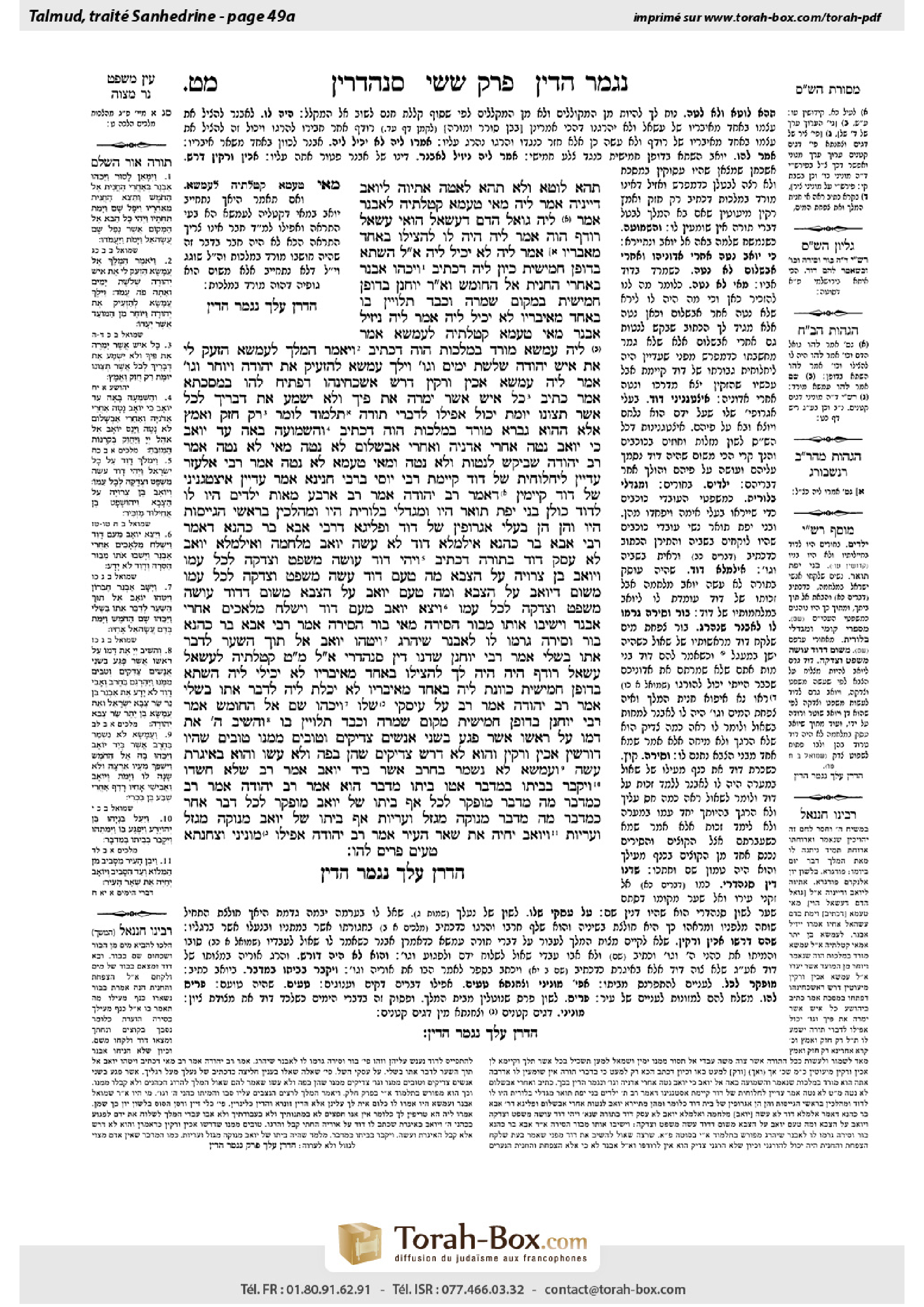
Sanhedrin 49a: Talmud study for Daf Yomi
Daf Yomi is the daily study of one Talmud folio. Explore 37 tractates with scans, Hebrew text, Sefaria English and AI-generated French translations where annotated.
Passage selection and English or AI-generated French translation are available where the scan has annotations. Daf Study is independent of Torah-Box and Sefaria.
Browse Sanhedrin · סנהדרין · All tractatesSanhedrin 49a text and translations
This page of Sanhedrin includes the Aramaic text, an English translation and an AI-generated French translation, alongside the scan above.
סנהדרין מ״ט א · Aramaic and Hebrew text
תְּהֵא לוּטָא, וְלָא תְּהֵא לָאטָא.
אַתְיוּהּ לְיוֹאָב, דַּיְּינֵיהּ. אֲמַר לֵיהּ: מַאי טַעְמָא קְטַלְתֵּיהּ לְאַבְנֵר? אֲמַר לֵיהּ: גּוֹאֵל הַדָּם דַּעֲשָׂאֵל הֲוַאי. עֲשָׂאֵל רוֹדֵף הֲוָה. אֲמַר לֵיהּ: הָיָה לוֹ לְהַצִּילוֹ בְּאֶחָד מֵאֵבָרָיו.
אֲמַר לֵיהּ: לָא יְכֵיל לֵיהּ. אֲמַר לֵיהּ: הַשְׁתָּא בְּדוֹפֶן חֲמִישִׁית כַּיוֵּן לֵיהּ, דִּכְתִיב ״וַיַּכֵּהוּ אַבְנֵר בְּאַחֲרֵי הַחֲנִית אֶל הַחֹמֶשׁ״, וְאָמַר רַבִּי יוֹחָנָן: בְּדוֹפֶן חֲמִישִׁית, בְּמָקוֹם שֶׁמָּרָה וְכָבֵד תְּלוּיִין בּוֹ. בְּאֶחָד מֵאֵבָרָיו לָא יְכֵיל לֵיהּ?
אֲמַר לֵיהּ: נֵיזִיל אַבְנֵר, מַאי טַעְמָא קְטַלְתֵּיהּ לַעֲמָשָׂא? אֲמַר לֵיהּ: עֲמָשָׂא מוֹרֵד בַּמַּלְכוּת הֲוָה, דִּכְתִיב: ״וַיֹּאמֶר הַמֶּלֶךְ לַעֲמָשָׂא הַזְעֶק לִי אֶת אִישׁ יְהוּדָה שְׁלֹשֶׁת יָמִים וְגוֹ׳ וַיֵּלֶךְ עֲמָשָׂא לְהַזְעִיק אֶת יְהוּדָה וַיּוֹחֶר וְגוֹ׳״.
אֲמַר לֵיהּ: עֲמָשָׂא ״אַכִּין״ וְ״רַקִּין״ דְּרַשׁ.
אַשְׁכְּחִינְהוּ דִּפְתִיחַ לְהוּ בְּמַסֶּכְתָּא. אֲמַר: כְּתִיב ״כׇּל אִישׁ אֲשֶׁר יַמְרֶה אֶת פִּיךָ וְלֹא יִשְׁמַע אֶת דְּבָרֶיךָ לְכֹל אֲשֶׁר תְּצַוֶּנּוּ יוּמָת״. יָכוֹל אֲפִילּוּ לְדִבְרֵי תוֹרָה? תַּלְמוּד לוֹמַר: ״רַק חֲזַק וֶאֱמָץ״.
אֶלָּא, הָהוּא גַּבְרָא מוֹרֵד בַּמַּלְכוּת הֲוָה, דִּכְתִיב: ״וְהַשְּׁמֻעָה בָּאָה עַד יוֹאָב כִּי יוֹאָב נָטָה אַחֲרֵי אֲדֹנִיָּה וְאַחֲרֵי אַבְשָׁלוֹם לֹא נָטָה״.
מַאי ״לֹא נָטָה״? אָמַר רַב יְהוּדָה: שֶׁבִּיקֵּשׁ לִנְטוֹת וְלֹא נָטָה. וּמַאי טַעְמָא לָא נָטָה? אָמַר רַבִּי אֶלְעָזָר: עֲדַיִין לִיחְלוּחִית שֶׁל דָּוִד קַיֶּימֶת.
רַבִּי יוֹסֵי בְּרַבִּי חֲנִינָא אָמַר: עֲדַיִין אִיצְטַגְנִינֵי שֶׁל דָּוִד קַיָּימִין, דְּאָמַר רַב יְהוּדָה אָמַר רַב: אַרְבַּע מֵאוֹת יְלָדִים הָיוּ לוֹ לְדָוִד, כּוּלָּן בְּנֵי יְפַת תּוֹאַר הָיוּ, וּמְגַדְּלֵי בְלוֹרִית הָיוּ, וּמְהַלְּכִין בְּרָאשֵׁי הַגְּיָיסוֹת הָיוּ, וְהֵן הֵן בַּעֲלֵי אֶגְרוֹפִין שֶׁל דָּוִד.
וּפְלִיגָא דְּרַבִּי אַבָּא בַּר כָּהֲנָא, דְּאָמַר רַבִּי אַבָּא בַּר כָּהֲנָא: אִילְמָלֵא דָּוִד לֹא עָשָׂה יוֹאָב מִלְחָמָה, וְאִילְמָלֵא יוֹאָב לֹא עָסַק דָּוִד בַּתּוֹרָה. דִּכְתִיב: ״וַיְהִי דָוִד עֹשֶׂה מִשְׁפָּט וּצְדָקָה לְכׇל עַמּוֹ וְיוֹאָב בֶּן צְרוּיָה עַל הַצָּבָא״. מָה טַעַם ״דָוִד עֹשֶׂה מִשְׁפָּט וּצְדָקָה לְכׇל עַמּוֹ״? מִשּׁוּם דְּ״יוֹאָב עַל הַצָּבָא״. וּמָה טַעַם ״יוֹאָב עַל הַצָּבָא״? מִשּׁוּם דְּ״דָוִד עֹשֶׂה מִשְׁפָּט וּצְדָקָה לְכׇל עַמּוֹ״.
״וַיֵּצֵא יוֹאָב מֵעִם דָּוִד וַיִּשְׁלַח מַלְאָכִים אַחֲרֵי אַבְנֵר וַיָּשִׁבוּ אֹתוֹ מִבּוֹר הַסִּרָה״. מַאי ״בּוֹר הַסִּירָה״? אָמַר רַבִּי אַבָּא בַּר כָּהֲנָא: בּוֹר וְסִירָה גָּרְמוּ לוֹ לְאַבְנֵר שֶׁיֵּהָרֵג.
״וַיַּטֵּהוּ יוֹאָב אֶל תּוֹךְ הַשַּׁעַר לְדַבֵּר אִתּוֹ בַּשֶּׁלִי״. אָמַר רַבִּי יוֹחָנָן: שֶׁדָּנוֹ דִּין סַנְהֶדְרִי. אֲמַר לֵיהּ: מַאי טַעְמָא קְטַלְתֵּיהּ לַעֲשָׂאֵל? עֲשָׂאֵל רוֹדֵף הָיָה. הָיָה לְךָ לְהַצִּילוֹ בְּאֶחָד מֵאֵבָרָיו! לָא יְכֵילִי לֵיהּ. הַשְׁתָּא בְּדוֹפֶן חֲמִישִׁית כַּוֵּונְתְּ לֵיהּ, בְּאֶחָד מֵאֵבָרָיו לָא יְכֵלְתְּ לֵיהּ?
״לְדַבֵּר אִתּוֹ בַּשֶּׁלִי״, אָמַר רַב יְהוּדָה אָמַר רַב: עַל עִיסְקֵי שָׁלוּ. ״וַיַּכֵּהוּ שָׁם אֶל הַחֹמֶשׁ״, אָמַר רַבִּי יוֹחָנָן: בְּדוֹפֶן חֲמִישִׁית, מָקוֹם שֶׁמָּרָה וְכָבֵד תְּלוּיִין בּוֹ.
״וְהֵשִׁיב ה׳ אֶת דָּמוֹ עַל רֹאשׁוֹ אֲשֶׁר פָּגַע בִּשְׁנֵי אֲנָשִׁים צַדִּקִים טוֹבִים מִמֶּנּוּ״. ״טוֹבִים״ – שֶׁהָיוּ דּוֹרְשִׁין ״אַכִּין״ וְ״רַקִּין״, וְהוּא לֹא דָּרַשׁ. ״צַדִּיקִים״ – שֶׁהֵן בַּפֶּה וְלֹא עָשׂוּ, וְהוּא בְּאִיגֶּרֶת עָשָׂה.
״וַעֲמָשָׂא לֹא נִשְׁמַר בַּחֶרֶב אֲשֶׁר בְּיַד יוֹאָב״. אָמַר רַב: שֶׁלֹּא חֲשָׁדוֹ.
״וַיִּקָּבֵר בְּבֵיתוֹ בַּמִּדְבָּר״. אַטּוּ בֵּיתוֹ מִדְבָּר הוּא? אָמַר רַב יְהוּדָה אָמַר רַב: כַּמִּדְבָּר, מָה מִדְבָּר מוּפְקָר לַכֹּל, אַף בֵּיתוֹ שֶׁל יוֹאָב מוּפְקָר לַכֹּל. דָּבָר אַחֵר: כַּמִּדְבָּר, מָה מִדְבָּר מְנוּקֶּה מִגָּזֵל וַעֲרָיוֹת, אַף בֵּיתוֹ שֶׁל יוֹאָב מְנוּקֶּה מִגָּזֵל וַעֲרָיוֹת. ״וְיוֹאָב יְחַיֶּה אֶת שְׁאָר הָעִיר״. אָמַר רַב יְהוּדָה: אֲפִילּוּ מוּנִינֵי וְצַחֲנָתָא טָעֵים פָּרֵיס לְהוּ.
הֲדַרַן עֲלָךְ נִגְמַר הַדִּין
Sanhedrin 49a · English translation
Be the one who is cursed and not the one who curses, as a curse eventually returns to the one who curses.
The Gemara returns to discuss the incident of Joab: They brought Joab before Solomon, who judged him. Solomon said to Joab: What is the reason that you killed Abner? Joab said to him: I was the blood redeemer of the blood of Asahel; when Abner murdered my brother Asahel I killed him, in fulfillment of my duty as his blood redeemer. Solomon said to him: But Asahel was pursuing Abner with the intention of killing him, and therefore he had the status of a pursuer. Since Abner killed Asahel in an act of self-defense, you had no right to kill him as a redeemer of Asahel’s blood. Joab said to Solomon: Abner could have saved himself by wounding Asahel in one of his limbs. Having failed to do so, he was guilty of murder, and I was therefore entitled to kill him.
Solomon said to him: Abner was not able to injure Asahel, because he was running and could not aim with precision. Joab said to Solomon: Now Abner was able to aim and hit him precisely in the fifth rib, as it is written: “And Abner smote him with the butt end of the spear in the ḥomesh” (II Samuel 2:23), and Rabbi Yoḥanan says that this means that he hit him in the fifth rib, the place where the gallbladder and liver hang. If Abner could aim with precision at the fifth rib, could he not have successfully aimed at one of Asahel’s limbs?
Solomon said to Joab: Set aside Abner, as you have presented a convincing argument that you are not liable for his death. But what is the reason you killed Amasa? Joab said to him: I killed Amasa in punishment for his having rebelled against the king, as it is written: “And the king said to Amasa: Muster to me the men of Judah within three days, and be you here present. And Amasa went to call the men of Judah, but he was later than the set time that he had assigned to him” (II Samuel 20:4–5).
Solomon said to him: Amasa was not guilty of rebelling against the king because he interpreted the words akh and rak in a restrictive manner, and in that way he limited the king’s authority.
How so? Amasa found the men of Judah starting to study a new tractate. He said to himself: It is written: “Any man who rebels against your commandment, and will not listen to your words in all that you command him, he shall be put to death” (Joshua 1:18), indicating that the king of Israel has unlimited power. Based on these words alone, one might have thought that the king must be obeyed even when that would lead to abstention from the study of the words of Torah. Therefore, that same verse states: “Only [rak] be strong and of a good courage.” The word “rak” is a restrictive term that serves to limit the king’s authority in a situation where obeying his command will minimalize the study of Torah. Consequently, Amasa was justified when he did not muster the men of Judah at the appointed time, and you had no right to kill him.
Solomon continued: Rather, the opposite is true. That man, you, Joab, rebelled against the king, as it is written: “Then tidings came to Joab, for Joab had followed after Adonijah, though he had not followed after Absalom. And Joab fled to the tent of the Lord and caught hold of the horns of the altar” (I Kings 2:28). Joab followed Adonijah, thereby rebelling against Solomon, the lawful king.
The Gemara asks: What does the verse mean to teach when it says that Joab did not follow Absalom? Rav Yehuda says: It serves to teach that Joab wanted to follow Absalom, but in practice he did not follow him. The Gemara asks: If he wanted to do so, what is the reason that Joab did not follow Absalom? Rabbi Elazar says: When Absalom rebelled against his father, David was still in full possession of his vitality, meaning he was still strong, and Joab feared him.
Rabbi Yosei, son of Rabbi Ḥanina, says: David’s stars [itztagninei], the planetary influences that determined his fortune, still stood for him. As Rav Yehuda says that Rav says: David had four hundred children in his army, and all of them were sons of beautiful women taken captive from their gentile homes during war (see Deuteronomy 21:10–14), and they grew their hair in a gentile hair style, and they would go at the head of the troops, and they were the strong-arm enforcers of the house of David, on whose loyalty David’s monarchy relied. As long as David was supported by this force, Joab was afraid to challenge him.
The Gemara notes: And those who view Joab in a negative light disagree with the opinion of Rabbi Abba bar Kahana, as Rabbi Abba bar Kahana says: Were it not for David, who studied Torah, Joab would not have been able to wage war successfully, and were it not for the military acumen of Joab, David would not have been able to study Torah. As it is written: “And David executed judgment and justice to all his people, and Joab, son of Zeruiah, was over the army” (II Samuel 8:15–16). What is the reason that David “executed judgment and justice to all his people”? He was able to do so because “Joab, son of Zeruiah, was over the army,” assisting him and fighting his battles. And what is the reason that “Joab, son of Zeruiah, was over the army”? He was able to do so because “David executed judgment and justice to all his people.”
§ The verse states: “And Joab went out from David, and sent messengers after Abner, and they brought him back from Bor Sirah” (II Samuel 3:26). The Gemara asks: What is the meaning of the name Bor Sirah? Rabbi Abba bar Kahana says: A well [bor] and a thorn [vesira] caused Abner to be killed. Abner became liable to be killed when he failed to take advantage of two opportunities to bring about a reconciliation between King Saul and David. First, when David cut off a corner of Saul’s robe after he entered a cave in order to relieve himself, and second, when David found Saul sleeping and took the jug of water and the spear from next to his head. Rather than tell Saul that David could have killed him and refrained from doing so, Abner suggested to Saul that his robe may have been torn by a thornbush and that his jug of water may have been taken by one of his own men. These two incidents are alluded to by the words bor, well, i.e., jug of water, and sira, thornbush.
The verse states: “And Joab took him aside in the gate to speak with him quietly” (II Samuel 3:27). Rabbi Yoḥanan says: Joab judged Abner according to the halakha of the Sanhedrin, which would sit in judgment by the gate of the city. How so? Joab said to Abner: What is the reason that you killed Asahel? Abner said to him: Asahel was pursuing me with the intention to kill me, and therefore he had the status of a pursuer, whom I had the right to kill in self-defense. Joab said to Abner: Even so, you could have saved yourself by wounding one of his limbs. Abner replied: I was not able to do so as I was running and could not aim with precision. Joab said to him: Now seeing that you were able to aim and hit him precisely in the fifth rib, could you not have successfully aimed at one of his limbs?
The Gemara asks: What is the meaning of “to speak with him quietly [basheli]”? Rav Yehuda says that Rav says: He took him aside to speak to him by way of deception [shalu]. As for what is stated: “And Abner smote him with the butt end of the spear in the ḥomesh” (II Samuel 2:23), Rabbi Yoḥanan says: He hit him in the fifth [ḥamishit] rib, the place where the gallbladder and liver hang.
§ The verse states that Solomon said to Benaiah, son of Jehoiada, concerning Joab: “And the Lord shall return the blood upon his own head, for he fell upon two men more righteous and better than he” (I Kings 2:32). The Gemara explains: Amasa and Abner were “better” that Joab, as they interpreted the words akh and rak in a restrictive manner that limited the king’s authority, while he did not interpret them in that way, demonstrating that they were greater than him in Torah. Amasa and Abner were also “more righteous” than Joab, as they both received oral instructions directly from Saul to slay the priests of Nov and they did not do so, whereas Joab was instructed by David in a letter to kill Uriah and he did so.
The verse states: “But Amasa took no heed of the sword in Joab’s hand” (II Samuel 20:10). Rav says: Amasa took no heed of the sword because he did not suspect that Joab was capable of murdering him.
The verse states with regard to Joab: “And he was buried in his own house, in the wilderness” (I Kings 2:34). The Gemara asks: Is that to say that Joab’s house was a wilderness? Rav Yehuda says that Rav says: Joab’s house was like the wilderness; just as the wilderness is freely open to all, so too, Joab’s house was freely open to all, as he generously opened his house to the poor and made them feel like members of the household. Alternatively, Joab’s house was like the wilderness; just as the wilderness is clean of theft and sexual immorality, as it is uninhabited, so too, Joab’s house was clean of theft and sexual immorality, owing to his righteousness. As for the verse: “And Joab kept alive the rest of the city” (I Chronicles 11:8), Rav Yehuda says: Not only would Joab feed the poor, but he would even give them treats of types of small fish so they would lack for nothing.
Sanhedrin 49a · Traduction française (IA)
Mieux vaut être celui que l’on maudit que celui qui maudit, car la malédiction finit par retomber sur celui qui maudit.
La Guemara revient sur l’épisode de Joab : on amena Joab devant Salomon, qui le jugea. Salomon lui dit : « Pourquoi as-tu tué Abner ? » Joab lui répondit : « J’étais le vengeur du sang d’Asahel ; quand Abner a tué mon frère Asahel, je l’ai tué, accomplissant ainsi mon devoir de vengeur du sang. » Salomon lui dit : « Mais Asahel poursuivait Abner avec l’intention de le tuer et avait donc le statut de poursuivant. Puisqu’Abner a tué Asahel en état de légitime défense, tu n’avais pas le droit de le tuer en tant que vengeur du sang d’Asahel. » Joab dit à Salomon : « Abner aurait pu se sauver en blessant Asahel à l’un de ses membres. Comme il ne l’a pas fait, il était coupable de meurtre et j’avais donc le droit de le tuer. »
Salomon lui dit : « Abner ne pouvait pas blesser Asahel, car il courait et ne pouvait pas viser avec précision. » Joab dit à Salomon : « Pourtant, Abner a pu viser et le frapper précisément à la cinquième côte, comme il est écrit : “Abner le frappa avec le bout de la lance au ḥomesh” (II Samuel 2:23). Rabbi Yoḥanan dit que cela signifie qu’il le frappa à la cinquième côte, à l’endroit où pendent la vésicule biliaire et le foie. S’il pouvait viser avec précision la cinquième côte, ne pouvait-il pas réussir à viser l’un des membres d’Asahel ? »
Salomon dit à Joab : « Laissons Abner de côté, puisque tu as présenté un argument convaincant montrant que tu n’es pas responsable de sa mort. Mais pourquoi as-tu tué Amasa ? » Joab lui répondit : « J’ai tué Amasa pour le punir de s’être rebellé contre le roi, comme il est écrit : “Le roi dit à Amasa : Rassemble-moi les hommes de Juda dans les trois jours, et sois toi-même ici. Amasa partit appeler les hommes de Juda, mais il dépassa le délai qui lui avait été fixé” (II Samuel 20:4–5). »
Salomon lui dit : « Amasa n’était pas coupable de s’être rebellé contre le roi, car il a interprété les mots akh et rak de manière restrictive et a ainsi limité l’autorité du roi. »
Comment cela ? Amasa trouva les hommes de Juda en train de commencer l’étude d’un nouveau traité. Il se dit : « Il est écrit : “Tout homme qui se rebelle contre ton commandement et n’écoute pas tes paroles en tout ce que tu lui ordonnes sera mis à mort” (Josué 1:18), ce qui indique que le roi d’Israël a un pouvoir illimité. Sur la seule base de ces paroles, on aurait pu penser qu’il faut obéir au roi même si cela conduit à renoncer à l’étude des paroles de la Torah. C’est pourquoi le même verset dit : “Seulement [rak], sois fort et courageux.” Le mot “rak” est une restriction qui sert à limiter l’autorité du roi dans une situation où obéir à son ordre réduirait l’étude de la Torah. Amasa était donc fondé à ne pas rassembler les hommes de Juda au moment fixé, et tu n’avais pas le droit de le tuer. »
Salomon poursuivit : « C’est plutôt le contraire qui est vrai. C’est toi, Joab, qui t’es rebellé contre le roi, comme il est écrit : “La nouvelle parvint à Joab, car Joab avait suivi Adonias, bien qu’il n’eût pas suivi Absalom. Joab s’enfuit vers la tente du Seigneur et saisit les cornes de l’autel” (I Rois 2:28). Joab a suivi Adonias, se rebellant ainsi contre Salomon, le roi légitime. »
La Guemara demande : Que nous enseigne le verset en disant que Joab n’a pas suivi Absalom ? Rav Yehouda dit : Cela enseigne que Joab voulait suivre Absalom, mais qu’en pratique il ne l’a pas suivi. La Guemara demande : S’il voulait le faire, pourquoi Joab n’a-t-il pas suivi Absalom ? Rabbi Elazar dit : Quand Absalom s’est révolté contre son père, David était encore en pleine possession de sa vigueur, c’est-à-dire qu’il était encore fort, et Joab le craignait.
Rabbi Yossei, fils de Rabbi Ḥanina, dit : Les astres [itztagninei] de David, les influences planétaires qui déterminaient sa fortune, lui étaient encore favorables. Car Rav Yehouda dit au nom de Rav : David avait dans son armée quatre cents fils, tous fils de belles femmes capturées dans leurs foyers non juifs pendant la guerre (voir Deutéronome 21:10–14). Ils portaient les cheveux selon une coiffure non juive, marchaient à la tête des troupes et formaient la force armée de la maison de David ; la monarchie de David reposait sur leur fidélité. Tant que David bénéficiait de cette force, Joab craignait de le défier.
La Guemara remarque que ceux qui portent un regard négatif sur Joab sont en désaccord avec l’opinion de Rabbi Abba bar Kahana, car Rabbi Abba bar Kahana dit : Sans David, qui étudiait la Torah, Joab n’aurait pas pu mener la guerre avec succès ; et sans les talents militaires de Joab, David n’aurait pas pu étudier la Torah. Comme il est écrit : “David rendait la justice et le droit à tout son peuple, et Joab, fils de Tserouya, commandait l’armée” (II Samuel 8:15–16). Pourquoi David “rendait-il la justice et le droit à tout son peuple” ? Il le pouvait parce que “Joab, fils de Tserouya, commandait l’armée”, l’assistant et livrant ses batailles. Et pourquoi “Joab, fils de Tserouya, commandait-il l’armée” ? Il le pouvait parce que “David rendait la justice et le droit à tout son peuple”.
§ Le verset dit : “Joab sortit de chez David et envoya des messagers à la poursuite d’Abner ; ils le ramenèrent de Bor Sirah” (II Samuel 3:26). La Guemara demande : Que signifie le nom Bor Sirah ? Rabbi Abba bar Kahana dit : Un puits [bor] et une épine [vesira] ont causé la mort d’Abner. Abner s’est rendu passible de mort en ne saisissant pas deux occasions de réconcilier le roi Saül et David. La première fois, lorsque David coupa un pan du vêtement de Saül après être entré dans une grotte pour se soulager ; la seconde, lorsque David trouva Saül endormi et prit la cruche d’eau et la lance qui se trouvaient près de sa tête. Au lieu de dire à Saül que David aurait pu le tuer mais s’en était abstenu, Abner suggéra à Saül que son vêtement avait pu être déchiré par un buisson épineux et que l’un de ses propres hommes avait pu prendre sa cruche d’eau. Les mots bor, “puits”, c’est-à-dire la cruche d’eau, et sira, “buisson épineux”, font allusion à ces deux épisodes.
Le verset dit : “Joab le prit à part à la porte pour lui parler discrètement” (II Samuel 3:27). Rabbi Yoḥanan dit : Joab jugea Abner selon la halakha du Sanhédrin, qui rendait la justice à la porte de la ville. Comment cela ? Joab dit à Abner : « Pourquoi as-tu tué Asahel ? » Abner lui répondit : « Asahel me poursuivait avec l’intention de me tuer et avait donc le statut de poursuivant, que j’avais le droit de tuer en état de légitime défense. » Joab lui dit : « Même ainsi, tu aurais pu te sauver en blessant l’un de ses membres. » Abner répondit : « Je ne le pouvais pas, car je courais et ne pouvais pas viser avec précision. » Joab lui dit : « Pourtant, puisque tu as pu viser et le frapper précisément à la cinquième côte, ne pouvais-tu pas réussir à viser l’un de ses membres ? »
La Guemara demande : Que signifie “pour lui parler discrètement [basheli]” ? Rav Yehouda dit au nom de Rav : Il le prit à part pour lui parler par ruse [shalu]. Quant à ce qui est dit : “Abner le frappa avec le bout de la lance au ḥomesh” (II Samuel 2:23), Rabbi Yoḥanan dit : Il le frappa à la cinquième [ḥamishit] côte, à l’endroit où pendent la vésicule biliaire et le foie.
§ Le verset rapporte que Salomon dit à Benaya, fils de Yehoyada, au sujet de Joab : “Le Seigneur fera retomber son sang sur sa tête, car il s’est jeté sur deux hommes plus justes et meilleurs que lui” (I Rois 2:32). La Guemara explique : Amasa et Abner étaient “meilleurs” que Joab, car ils interprétaient les mots akh et rak de manière restrictive, limitant ainsi l’autorité du roi, tandis que lui ne les interprétait pas ainsi ; cela montre qu’ils le dépassaient en Torah. Amasa et Abner étaient aussi “plus justes” que Joab : tous deux avaient reçu de Saül, de vive voix, l’ordre de tuer les prêtres de Nov, mais ils ne l’avaient pas fait, alors que Joab avait reçu de David, dans une lettre, l’ordre de tuer Urie et l’avait fait.
Le verset dit : “Mais Amasa ne prit pas garde à l’épée qui était dans la main de Joab” (II Samuel 20:10). Rav dit : Amasa ne prit pas garde à l’épée parce qu’il ne soupçonnait pas Joab de pouvoir l’assassiner.
Le verset dit au sujet de Joab : “Il fut enterré dans sa maison, au désert” (I Rois 2:34). La Guemara demande : Cela signifie-t-il que la maison de Joab était un désert ? Rav Yehouda dit au nom de Rav : La maison de Joab était comme le désert : de même que le désert est librement ouvert à tous, la maison de Joab était ouverte à tous sans restriction, car il y accueillait généreusement les pauvres et les faisait se sentir comme des membres de la maisonnée. Autre explication : la maison de Joab était comme le désert ; de même que le désert est exempt de vol et d’immoralité sexuelle, puisqu’il est inhabité, la maison de Joab était elle aussi exempte de vol et d’immoralité sexuelle, grâce à sa droiture. Quant au verset : “Joab laissa en vie le reste de la ville” (I Chroniques 11:8), Rav Yehouda dit : Joab ne se contentait pas de nourrir les pauvres ; il leur donnait même des friandises, notamment de petits poissons, afin qu’ils ne manquent de rien.
Traduction française générée par IA à partir de l’édition anglaise de Sefaria. Vérifie toujours un passage avec le texte source.
Text from Sefaria: William Davidson Edition - Vocalized Aramaic (CC BY NC); William Davidson Edition - English (CC BY NC).