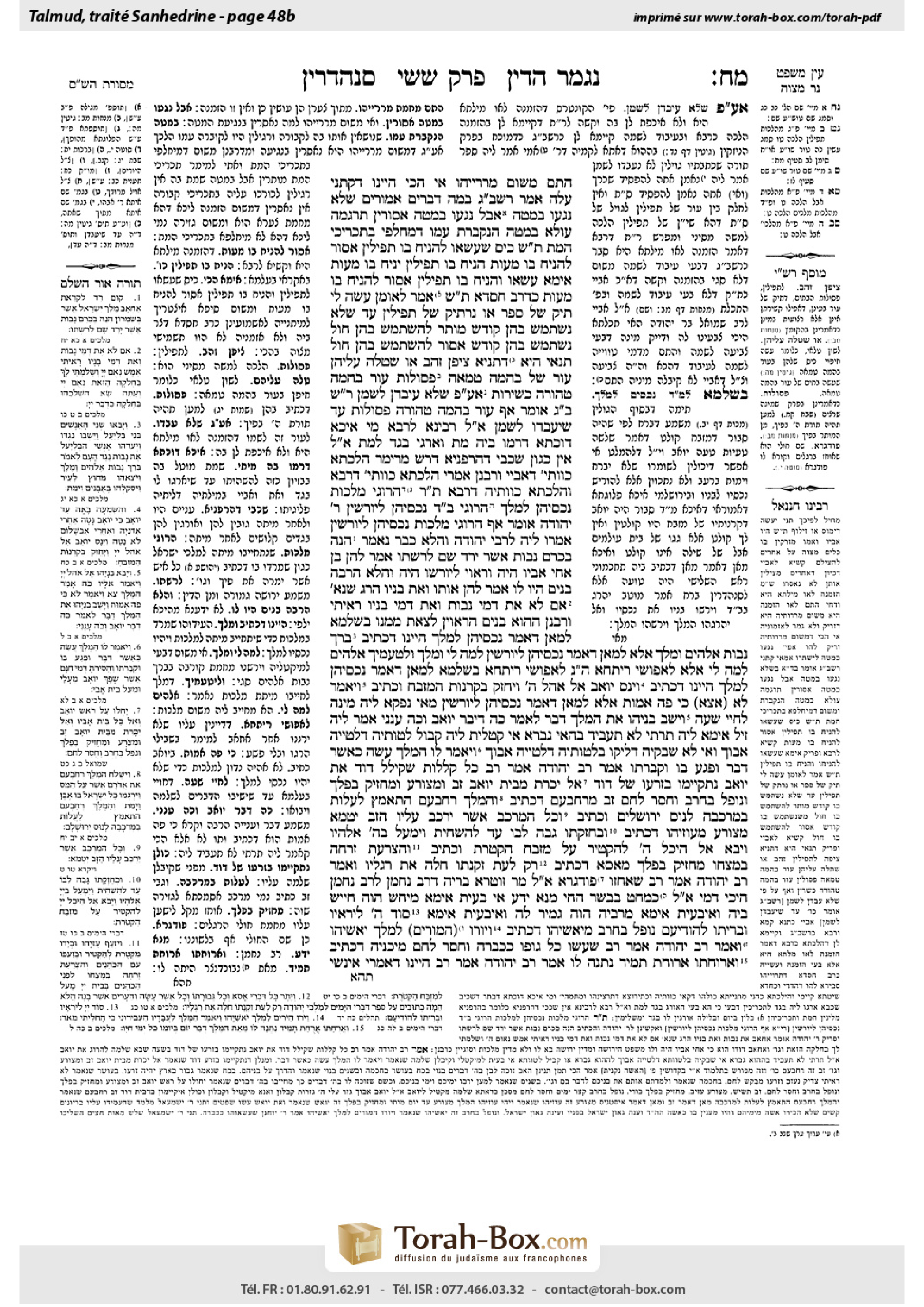
Sanhedrin 48b: Talmud study for Daf Yomi
Daf Yomi is the daily study of one Talmud folio. Explore 37 tractates with scans, Hebrew text, Sefaria English and AI-generated French translations where annotated.
Passage selection and English or AI-generated French translation are available where the scan has annotations. Daf Study is independent of Torah-Box and Sefaria.
Browse Sanhedrin · סנהדרין · All tractatesSanhedrin 48b text and translations
This page of Sanhedrin includes the Aramaic text, an English translation and an AI-generated French translation, alongside the scan above.
סנהדרין מ״ח ב · Aramaic and Hebrew text
הָתָם מִשּׁוּם מְרָרַיְיהוּ. אִי הָכִי, הַיְינוּ דְּקָתָנֵי עֲלַהּ: אָמַר רַבָּן שִׁמְעוֹן בֶּן גַּמְלִיאֵל: בַּמֶּה דְּבָרִים אֲמוּרִים? שֶׁלֹּא נָגְעוּ בַּמִּטָּה, אֲבָל נָגְעוּ בַּמִּטָּה – אֲסוּרִין.
תַּרְגְּמַהּ עוּלָּא: בְּמִטָּה הַנִּקְבֶּרֶת עִמּוֹ, דְּמִחַלְּפִי בְּתַכְרִיכִי הַמֵּת.
תָּא שְׁמַע: כִּיס שֶׁעֲשָׂאוֹ לְהַנִּיחַ בּוֹ תְּפִילִּין – אָסוּר לְהַנִּיחַ בּוֹ מָעוֹת. הִנִּיחַ בּוֹ תְּפִילִּין – יַנִּיחַ בּוֹ מָעוֹת. אֵימָא: עֲשָׂאוֹ וְהִנִּיחַ בּוֹ תְּפִילִּין – אָסוּר לְהַנִּיחַ בּוֹ מָעוֹת, כִּדְרַב חִסְדָּא.
תָּא שְׁמַע: אָמַר לְאוּמָּן ״עֲשֵׂה לִי תִּיק שֶׁל סֵפֶר״ אוֹ ״נַרְתִּיק שֶׁל תְּפִילִּין״ – עַד שֶׁלֹּא נִשְׁתַּמֵּשׁ בָּהֶן קוֹדֶשׁ, מוּתָּר לְהִשְׁתַּמֵּשׁ בָּהֶן חוֹל. נִשְׁתַּמֵּשׁ בָּהֶן קוֹדֶשׁ – אָסוּר לְהִשְׁתַּמֵּשׁ בָּהֶן חוֹל.
תַּנָּאֵי הִיא, דְּתַנְיָא: צִיפָּן זָהָב אוֹ שֶׁטָּלָה עֲלֵיהֶן עוֹר שֶׁל בְּהֵמָה טְמֵאָה – פְּסוּלוֹת. עוֹר בְּהֵמָה טְהוֹרָה – כְּשֵׁירוֹת, אַף עַל פִּי שֶׁלֹּא עִיבְּדָן לִשְׁמָן. רַבָּן שִׁמְעוֹן בֶּן גַּמְלִיאֵל אוֹמֵר: אַף עוֹר בְּהֵמָה טְהוֹרָה פְּסוּלוֹת, עַד שֶׁיְּעַבְּדוֹ לִשְׁמָן.
אֲמַר לֵיהּ רָבִינָא לְרָבָא: מִי אִיכָּא דּוּכְתָּא דְּרָמוּ בֵּיהּ מֵת, וְאָרְגִי בֶּגֶד לַמֵּת? אֲמַר לֵיהּ: אִין, כְּגוֹן שָׁכְבֵי דְּהַרְפַּנְיָא.
דְּרַשׁ מָרִימָר: הִלְכְתָא כְּוָותֵיהּ דְּאַבָּיֵי, וְרַבָּנַן אָמְרִי: הִלְכְתָא כְּוָותֵיהּ דְּרָבָא. וְהִלְכְתָא כְּוָותֵיהּ דְּרָבָא.
תָּנוּ רַבָּנַן: הֲרוּגֵי מַלְכוּת – נִכְסֵיהֶן לַמֶּלֶךְ, הֲרוּגֵי בֵּית דִּין – נִכְסֵיהֶן לַיּוֹרְשִׁין. רַבִּי יְהוּדָה אוֹמֵר: אַף הֲרוּגֵי מַלְכוּת נִכְסֵיהֶן לַיּוֹרְשִׁין. אֲמַרוּ לֵיהּ לְרַבִּי יְהוּדָה: וַהֲלֹא כְּבָר נֶאֱמַר ״הִנֵּה בְּכֶרֶם נָבוֹת אֲשֶׁר יָרַד שָׁם לְרִשְׁתּוֹ״?
אָמַר לָהֶן: בֶּן אֲחִי אָבִיו הָיָה, וְרָאוּי לְיוֹרְשׁוֹ הָיָה. וַהֲלֹא הַרְבֵּה בָּנִים הָיוּ לוֹ? אָמַר לָהֶן: אוֹתוֹ וְאֶת בָּנָיו הָרַג, שֶׁנֶּאֱמַר: ״אִם לֹא אֶת דְּמֵי נָבוֹת וְאֶת דְּמֵי בָנָיו רָאִיתִי״. וְרַבָּנַן? הַהוּא בָּנִים הָרְאוּיִין לָצֵאת מִמֶּנּוּ.
בִּשְׁלָמָא לְמַאן דְּאָמַר נִכְסֵיהֶן לַמֶּלֶךְ, הַיְינוּ דִּכְתִיב ״בֵּרַךְ נָבוֹת אֱלֹהִים וָמֶלֶךְ״. אֶלָּא לְמַאן דְּאָמַר נִכְסֵיהֶן לַיּוֹרְשִׁין, לְמָה לִי ״וָמֶלֶךְ״?
וּלְטַעְמָיךְ, אֱלֹהִים לְמָה לִי? אֶלָּא לְאַפּוֹשֵׁי רִיתְחָא. הָכִי נָמֵי, לְאַפּוֹשֵׁי רִיתְחָא.
בִּשְׁלָמָא לְמַאן דְּאָמַר: ״נִכְסֵיהֶן לַמֶּלֶךְ״, הַיְינוּ דִּכְתִיב: ״וַיָּנׇס יוֹאָב אֶל אֹהֶל ה׳ וַיַּחֲזֵק בְּקַרְנוֹת הַמִּזְבֵּחַ״, וּכְתִיב: ״וַיֹּאמֶר לֹא אֵצֵא כִּי פֹּה אָמוּת״. אֶלָּא לְמַאן דְּאָמַר: ״נִכְסֵיהֶן לַיּוֹרְשִׁין״, מַאי נָפְקָא לֵיהּ מִינַּהּ? לְחַיֵּי שָׁעָה.
״וַיָּשֶׁב בְּנָיָהוּ אֶת הַמֶּלֶךְ דָּבָר לֵאמֹר כֹּה דִבֶּר יוֹאָב וְכֹה עָנָנִי״. אֲמַר לֵיהּ: זִיל אֵימָא לֵיהּ: תַּרְתֵּי לָא תַּעֲבֵיד בְּהַאי גַּבְרָא. אִי קָטְלַתְּ לֵיהּ, קַבֵּול לָטוּתֵיהּ דְּלַטְיֵיהּ אֲבוּךְ. וְאִי לָא, שִׁבְקֵיהּ דְּלֵיקוּ בְּלָטוּתֵיהּ דְּלַטְיֵיהּ אֲבוּךְ. ״וַיֹּאמֶר לוֹ הַמֶּלֶךְ עֲשֵׂה כַּאֲשֶׁר דִּבֶּר וּפְגַע בּוֹ וּקְבַרְתּוֹ״.
אָמַר רַב יְהוּדָה אָמַר רַב: כׇּל קְלָלוֹת שֶׁקִּילֵּל דָּוִד אֶת יוֹאָב נִתְקַיְּימוּ בְּזַרְעוֹ שֶׁל דָּוִד. ״אַל יִכָּרֵת מִבֵּית יוֹאָב זָב וּמְצֹרָע וּמַחֲזִיק בַּפֶּלֶךְ וְנֹפֵל בַּחֶרֶב וַחֲסַר לָחֶם״.
״זָב״ – מֵרְחַבְעָם, דִּכְתִיב: ״וְהַמֶּלֶךְ רְחַבְעָם הִתְאַמֵּץ לַעֲלוֹת בַּמֶּרְכָּבָה לָנוּס יְרוּשָׁלִָים״, וּכְתִיב: ״וְכׇל הַמֶּרְכָּב אֲשֶׁר יִרְכַּב עָלָיו הַזָּב יִטְמָא״.
״מְצוֹרָע״ – מֵעוּזִּיָּהוּ, דִּכְתִיב: ״וּבְחֶזְקָתוֹ גָּבַהּ לִבּוֹ עַד לְהַשְׁחִית וַיִּמְעַל בַּה׳ אֱלֹהָיו וַיָּבֹא אֶל הֵיכַל ה׳ לְהַקְטִיר עַל מִזְבַּח הַקְּטֹרֶת״, וּכְתִיב: ״וְהַצָּרַעַת זָרְחָה בְמִצְחוֹ״.
״מַחֲזִיק בְּפֶלֶךְ״ – מֵאָסָא, דִּכְתִיב: ״רַק לְעֵת זִקְנָתוֹ חָלָה אֶת רַגְלָיו.״ וְאָמַר רַב יְהוּדָה אָמַר רַב: שֶׁאֲחָזוֹ פּוֹדַגְרָא. אֲמַר לֵיהּ מָר זוּטְרָא בְּרֵיהּ דְּרַב נַחְמָן לְרַב נַחְמָן: הֵיכִי דָּמֵי? אֲמַר לֵיהּ: כְּמַחַט בִּבְשַׂר הַחַי. מְנָא יָדַע? אִי בָּעֵית אֵימָא: מֵיחַשׁ הֲוָה חָיֵישׁ בֵּיהּ. וְאִיבָּעֵית אֵימָא: מֵרַבֵּיהּ הֲוָה גְּמִיר לַהּ. וְאִיבָּעֵית אֵימָא: ״סוֹד ה׳ לִירֵאָיו וּבְרִיתוֹ לְהוֹדִיעָם״.
״נוֹפֵל בַּחֶרֶב״ – מִיֹּאשִׁיָּהוּ, דִּכְתִיב: ״וַיֹּרוּ הַמּוֹרִים לַמֶּלֶךְ יֹאשִׁיָּהוּ״. וְאָמַר רַב יְהוּדָה אָמַר רַב: שֶׁעָשׂוּ כׇּל גּוּפוֹ כִּכְבָרָה.
״וַחֲסַר לֶחֶם״ – מִיכׇנְיָה, דִּכְתִיב: ״וַאֲרֻחָתוֹ אֲרֻחַת תָּמִיד נִתְּנָה לוֹ״. אָמַר רַב יְהוּדָה אָמַר רַב: הַיְינוּ דְּאָמְרִי אִינָשֵׁי:
Sanhedrin 48b · English translation
The Gemara rejects this proof: There, the parents threw the garments onto their son’s bier because of their bitterness over his death, but they did not really mean to designate the garments to be buried with him. The Gemara raises a difficulty: If so, how can one understand that which is taught with regard to this baraita: Rabban Shimon ben Gamliel said: In what case is this statement said? It is stated with regard to a case where the garments did not yet touch the bier before they were saved. But if they already touched the bier, they are forbidden. If no importance is ascribed to what is done out of bitterness, why should the garments that touched the bier be forbidden?
Ulla interpreted the baraita as referring to a case where the garments were thrown onto a bier that was to be buried together with the son, and it is possible that those garments might be mistaken for shrouds of the deceased. The Sages decreed that it is prohibited to derive benefit from such garments, lest people mistakenly think that just as they are permitted, so too, actual shrouds are permitted. There is no proof from here that mere designation is significant and that articles designated for the dead are permanently forbidden.
The Gemara suggests: Come and hear a proof in support of Abaye’s opinion from a baraita: If one fashioned a pouch in which to put phylacteries, it is prohibited to put money in it. If he put phylacteries in it, but he did not designate it beforehand for that purpose, he may still put money in it. The ruling of the first clause indicates that designation is significant. The Gemara rejects this proof: Say that the baraita should be understood as follows: If one fashioned a pouch for phylacteries and then put the phylacteries in it, it is prohibited to put money in it. This is in accordance with the ruling of Rav Ḥisda, that if one designated a cloth for the purpose of bundling phylacteries in it and then he wrapped the phylacteries in it, he may no longer use the cloth to hold money.
The Gemara suggests: Come and hear another baraita that supports the opinion of Rava: If one said to a craftsman: Fashion me a case [tik] for a Torah scroll, or: Fashion for me a bag [nartik] for phylacteries, as long as he has not yet used them for a sacred purpose, it is permitted for him to use them for a mundane purpose. But if he already used them for a sacred purpose, it is prohibited for him to use them for a mundane purpose. This indicates that mere designation is nothing until the item is actually used for the purpose for which it had been designated.
The Gemara explains: The matter of whether or not mere designation is significant is a dispute between tanna’im. As it is taught in a baraita: If one took phylacteries and coated them with gold or patched them with the hide of a non-kosher animal, they are unfit. But if one patched them with the hide of a kosher animal then they are fit, and this is so even though he did not prepare them, i.e., the hides, for their sake, i.e., for the sake of their use in a mitzva. Rabban Shimon ben Gamliel says: Even if he patched them with the hide of a kosher animal they are unfit, and they remain unfit until he prepares them for their sake. Preparing the hide for the sake of the mitzva is analogous to designating it for that purpose. The first tanna and Rabban Shimon ben Gamliel, who disagree as to whether the hide must be prepared for the sake of the mitzva, differ as to whether designation is significant.
In connection with what was stated previously, that the amora’im disagree whether one is prohibited from deriving benefit from a garment woven for the sake of a dead person, Ravina said to Rava: Is there really such a place where the deceased is first placed on a bier and only afterward do they begin to weave a garment for the deceased? Rava said to Ravina: Yes, this is practiced on behalf of, for example, the dead of Harpanya, where the people are so poor that they cannot prepare shrouds for themselves during their lifetimes.
Mareimar taught that the halakha is in accordance with the opinion of Abaye that mere designation is significant. And the Rabbis say that the halakha is in accordance with the opinion of Rava that mere designation is nothing. The Gemara concludes that the halakha is in accordance with the opinion of Rava that mere designation is nothing.
§ The Sages taught in a baraita: With regard to those executed by a Jewish king for crimes that they committed against him, their property belongs to the king. As for those executed by the court for a capital transgression, their property belongs to their heirs. Rabbi Yehuda says: Even with regard to those executed by a Jewish king, their property belongs to their heirs. The Rabbis said to Rabbi Yehuda: But isn’t it already stated: “Arise, go down to meet Ahab, king of Israel, who is in Samaria; behold he is in the vineyard of Naboth, where he is gone down there to inherit it” (I Kings 21:18)? The wording of the verse indicates that Ahab went down there by right, proving that the property of those executed by the king legally belongs to the king.
Rabbi Yehuda said to them: Ahab was Naboth’s cousin, the son of his paternal uncle, and therefore he was fit to inherit from him. Accordingly, he took possession of the property in his capacity as an heir, and not as the king. They said to him: But Naboth had many sons. Why, then, did they not inherit from him? Rabbi Yehuda said to them: Ahab executed Naboth and also his sons, as it is stated: “I have seen yesterday the blood of Naboth and the blood of his sons” (II Kings 9:26). The Gemara asks: And how do the Rabbis counter this claim? The Gemara answers: In their opinion, that verse is referring to the sons who would have issued from him had Naboth not been executed. Ahab was held accountable for the blood of Naboth and for the blood of his unborn children.
The Gemara raises a difficulty: Granted, according to the one who says that the property of those executed by the king belongs to the king, that is the reason that it is written that Jezebel arranged for witnesses to falsely testify that “Naboth cursed God and the king” (I Kings 21:13). Since Naboth cursed the king, Ahab could execute him and seize his property. But according to the one who says that the property of those executed by the king belongs to their heirs, why do I need the testimony that Naboth cursed the king? It would have sufficed for the witnesses to testify that he cursed God, in which case he would have been executed by the court, and Ahab would have taken possession of the vineyard as his heir.
The Gemara answers: And according to your reasoning, that the witnesses testified that Naboth cursed the king so that Ahab could execute him and seize his property, why do I need the additional testimony that Naboth cursed God? Rather, you must say that the witnesses were instructed to testify that Naboth cursed both God and the king in order to increase the anger of the judges by accusing him of a second offense. So too, it can be argued that according to Rabbi Yehuda’s reasoning, the witnesses testified that Naboth also cursed the king in order to increase the anger of the judges. No proof can be brought from here that the property of those executed by the king belongs to the king.
The Gemara raises another difficulty: Granted, according to the one who says that the property of those executed by the king belongs to the king, that is the reason that it is written: “And Joab fled to the tent of the Lord and caught hold of the horns of the altar” (I Kings 2:28), describing Joab’s actions after it became known that he supported Adonijah, and furthermore it is written: “And he said, I will not leave, for here I will die” (I Kings 2:30). Joab did not want to be put to death by the king because he did not want his property to pass into the king’s possession. But according to the one who says that the property of those executed by the king belongs to their heirs, what difference did taking refuge in the Sanctuary make to him? The Gemara answers: Joab fled to the sanctuary in order to live a short while longer. Consequently, there is no proof from here to either side of the dispute.
§ The Gemara continues to discuss the incident involving Joab. After Joab took refuge in the Sanctuary and King Solomon sent Benaiah, son of Jehoiada, to fall upon him, Benaiah ordered Joab to leave the sanctuary, whereupon Joab refused. The verse then states: “And Benaiah brought the king word back, saying: So said Joab, and so he answered me” (I Kings 2:30). The Gemara explains: Joab said to him: Go and say to Solomon: You cannot perform two actions to this man, i.e., to me, Joab. If you kill him, i.e., me, you and your descendants will receive the curses with which your father cursed me. And if you do not wish to receive those curses, let him go so that he may receive the curses with which your father cursed him. And the next verse states: “And the king said to him: Do as he has said, and fall upon him, and bury him.” Solomon thereby accepted his father’s curses upon himself and his descendants.
Rav Yehuda says that Rav says: All the curses with which David cursed Joab were ultimately fulfilled in David’s descendants, due to the curse that Solomon accepted upon himself. David cursed Joab: “Let the house of Joab never lack such as are afflicted with a discharge, or a leper, or that hold onto a staff, or fall by the sword, or lack bread” (II Samuel 3:29).
The Gemara clarifies: The curse of being afflicted “with a discharge,” i.e., a zav, was fulfilled among Solomon’s descendants in Rehoboam, as it is written: “And King Rehoboam made speed to get him up to his chariot [bamerkava] to flee to Jerusalem” (I Kings 12:18), and it is written: “And whatever saddle [hamerkav] he that has a discharge rides upon shall be unclean” (Leviticus 15:9). The similarity between the words merkava and merkav indicates that Rehoboam was a zav.
The curse of “a leper” was fulfilled among Solomon’s descendants in Uzziah, as it is written: “But when he was strong, his heart was lifted up to his destruction; for he transgressed against the Lord his God, and went into the Temple of the Lord to burn incense upon the altar of incense” (II Chronicles 26:16). And it is also written: “And leprosy broke out on his forehead” (II Chronicles 26:19).
The curse of those who “hold onto a staff” was fulfilled among Solomon’s descendants in Asa, as it is written concerning him: “But in the time of his old age, he was diseased in his feet” (I Kings 15:23). And Rav Yehuda says that Rav says: This means that he was seized with gout [podagra]. Mar Zutra, son of Rav Naḥman, said to Rav Naḥman: What are the circumstances and symptoms of this disease? Rav Naḥman said to him: The pain is similar to the pain of a needle piercing live flesh. The Gemara asks: How did Rav Naḥman know what gout is like? The Gemara answers: If you wish, say that he himself suffered from the disease. And if you wish, say that he learned it as a tradition from his teacher. And if you wish, say that he knew this through divine inspiration, as the verse states: “The secret of the Lord is with them that fear Him; and He will show to them His covenant” (Psalms 25:14).
The curse of those who “fall by the sword” was fulfilled among Solomon’s descendants in Josiah, as it is written: “And the archers shot at King Josiah” (II Chronicles 35:23), and Rav Yehuda says that Rav says: They shot him with so many arrows that they turned his whole body into a sieve.
The curse of those who “lack bread” was fulfilled among Solomon’s descendants in Jeconiah, as it is written concerning him: “And as for his food allowance, there was a continual food allowance given him by the king, a daily portion for every day, all the days of his life” (II Kings 25:30). Rav Yehuda says that Rav says: This explains the adage that people say:
Sanhedrin 48b · Traduction française (IA)
La Guemara rejette cette preuve : dans ce cas, les parents avaient jeté les vêtements sur la bière de leur fils sous le coup de la douleur causée par sa mort, mais ils n’avaient pas réellement l’intention de les destiner à être enterrés avec lui. La Guemara soulève une difficulté : si tel est le cas, comment comprendre ce qui est enseigné au sujet de cette baraïta ? Rabban Shimon ben Gamliel a dit : « Dans quel cas cette déclaration a-t-elle été faite ? » Elle concerne le cas où les vêtements n’avaient pas encore touché la bière avant qu’on les sauve. Mais s’ils l’avaient déjà touchée, ils sont interdits. Si l’on n’accorde aucune importance à ce qui est fait sous le coup de la douleur, pourquoi les vêtements qui ont touché la bière seraient-ils interdits ?
Oulla interpréta la baraïta comme visant le cas où les vêtements avaient été jetés sur une bière destinée à être enterrée avec le fils, et où l’on pouvait prendre ces vêtements pour les linceuls du défunt. Les Sages décrétèrent qu’il est interdit de tirer profit de tels vêtements, de peur que les gens ne pensent à tort que, de même qu’ils sont permis, les véritables linceuls le sont aussi. Il n’y a donc là aucune preuve que la simple désignation ait de l’importance et que les objets désignés pour les morts soient définitivement interdits.
La Guemara propose : « Viens et entends » une preuve à l’appui de l’opinion d’Abayé, tirée d’une baraïta : si quelqu’un a confectionné une pochette destinée à contenir des téfilines, il lui est interdit d’y mettre de l’argent. S’il y a mis des téfilines sans l’avoir désignée au préalable à cet effet, il peut encore y mettre de l’argent. La décision énoncée dans la première partie indique que la désignation a de l’importance. La Guemara rejette cette preuve : dis plutôt que la baraïta doit être comprise ainsi : si quelqu’un a confectionné une pochette pour des téfilines, puis y a mis les téfilines, il lui est interdit d’y mettre de l’argent. Cela est conforme à la décision de Rav Ḥisda : si quelqu’un a désigné un tissu pour y envelopper des téfilines, puis les y a enveloppées, il ne peut plus utiliser ce tissu pour y mettre de l’argent.
La Guemara propose : « Viens et entends » une autre baraïta à l’appui de l’opinion de Rava : si quelqu’un dit à un artisan : « Fais-moi un étui [tik] pour un rouleau de Torah écrite », ou : « Fais-moi un sac [nartik] pour des téfilines », tant qu’il ne les a pas encore utilisés à des fins sacrées, il lui est permis de les utiliser à des fins profanes. Mais s’il les a déjà utilisés à des fins sacrées, il lui est interdit de les utiliser à des fins profanes. Cela indique que la simple désignation ne suffit pas tant que l’objet n’a pas été effectivement utilisé à la fin à laquelle il était destiné.
La Guemara explique : la question de savoir si la simple désignation a de l’importance fait l’objet d’un désaccord entre tannaïm. En effet, il est enseigné dans une baraïta : si quelqu’un a pris des téfilines et les a recouvertes d’or ou réparées avec la peau d’un animal non casher, elles sont invalides. Mais s’il les a réparées avec la peau d’un animal casher, elles sont valides, même s’il n’avait pas préparé ces peaux pour leur usage, c’est-à-dire pour les employer à une mitsva. Rabban Shimon ben Gamliel dit : même s’il les a réparées avec la peau d’un animal casher, elles sont invalides et le restent jusqu’à ce qu’il prépare les peaux à cet effet. Préparer la peau en vue de la mitsva est analogue à la désigner à cet effet. Le premier tanna et Rabban Shimon ben Gamliel, qui sont en désaccord sur la nécessité de préparer la peau en vue de la mitsva, divergent sur la question de savoir si la désignation a de l’importance.
Dans le prolongement de ce qui a été dit précédemment, à savoir que les amoraïm sont en désaccord sur la question de savoir s’il est interdit de tirer profit d’un vêtement tissé pour un mort, Ravina dit à Rava : « Existe-t-il vraiment un endroit où l’on dépose d’abord le défunt sur une bière et où l’on ne commence qu’ensuite à tisser un vêtement pour lui ? » Rava lui répondit : « Oui, c’est ce qui se pratique, par exemple, pour les morts de Harpanya, où les gens sont si pauvres qu’ils ne peuvent préparer leurs linceuls de leur vivant. »
Mareimar enseignait que la halakha suit l’opinion d’Abayé, selon laquelle la simple désignation a de l’importance. Les Sages disent que la halakha suit l’opinion de Rava, selon laquelle la simple désignation n’a pas de valeur. La Guemara conclut que la halakha suit l’opinion de Rava : la simple désignation n’a pas de valeur.
§ Les Sages ont enseigné dans une baraïta : les biens de ceux qui ont été exécutés par un roi juif pour des crimes commis contre lui reviennent au roi. Quant à ceux qui ont été exécutés par le tribunal pour une transgression passible de la peine capitale, leurs biens reviennent à leurs héritiers. Rabbi Yehouda dit : même les biens de ceux qui ont été exécutés par un roi juif reviennent à leurs héritiers. Les Sages dirent à Rabbi Yehouda : « Mais n’est-il pas déjà écrit : “Lève-toi, descends à la rencontre d’Achab, roi d’Israël, qui est à Samarie ; le voici dans la vigne de Naboth, où il est descendu pour en prendre possession” (I Rois 21:18) ? » La formulation du verset indique qu’Achab s’y est rendu de plein droit, ce qui prouve que les biens de ceux qui sont exécutés par le roi lui reviennent légalement.
Rabbi Yehouda leur dit : « Achab était le cousin de Naboth, le fils de son oncle paternel ; il pouvait donc hériter de lui. Il prit ainsi possession des biens en qualité d’héritier, et non en tant que roi. » Ils lui dirent : « Mais Naboth avait de nombreux fils. Pourquoi donc n’ont-ils pas hérité de lui ? » Rabbi Yehouda leur dit : « Achab fit exécuter Naboth ainsi que ses fils, comme il est dit : “J’ai vu hier le sang de Naboth et le sang de ses fils” (II Rois 9:26). » La Guemara demande : comment les Sages réfutent-ils cet argument ? La Guemara répond : selon eux, ce verset fait référence aux fils qui seraient nés de Naboth s’il n’avait pas été exécuté. Achab fut tenu responsable du sang de Naboth et de celui de ses enfants à naître.
La Guemara soulève une difficulté : certes, selon celui qui dit que les biens de ceux qui ont été exécutés par le roi reviennent au roi, c’est pour cette raison qu’il est écrit qu’Izevel fit préparer de faux témoins afin qu’ils attestent que « Naboth a maudit Dieu et le roi » (I Rois 21:13). Puisque Naboth avait maudit le roi, Achab pouvait le faire exécuter et s’emparer de ses biens. Mais selon celui qui dit que les biens de ceux qui ont été exécutés par le roi reviennent à leurs héritiers, pourquoi fallait-il témoigner que Naboth avait maudit le roi ? Il aurait suffi que les témoins déclarent qu’il avait maudit Dieu ; il aurait alors été exécuté par le tribunal, et Achab aurait pris possession de la vigne en qualité d’héritier.
La Guemara répond : selon ton raisonnement, si les témoins ont déclaré que Naboth avait maudit le roi afin qu’Achab puisse le faire exécuter et s’emparer de ses biens, pourquoi fallait-il ajouter qu’il avait maudit Dieu ? Il faut plutôt dire que les témoins avaient reçu l’instruction d’attester que Naboth avait maudit à la fois Dieu et le roi, afin d’accroître la colère des juges en l’accusant d’une deuxième infraction. De même, on peut soutenir que, selon le raisonnement de Rabbi Yehouda, les témoins déclarèrent aussi que Naboth avait maudit le roi afin d’accroître la colère des juges. On ne peut donc rien déduire de ce récit pour prouver que les biens de ceux qui ont été exécutés par le roi reviennent au roi.
La Guemara soulève une autre difficulté : certes, selon celui qui dit que les biens de ceux qui ont été exécutés par le roi reviennent au roi, c’est pour cette raison qu’il est écrit : « Joab s’enfuit vers la tente de l’Éternel et saisit les cornes de l’autel » (I Rois 2:28), décrivant ce que fit Joab après que l’on eut appris qu’il soutenait Adonias ; et il est en outre écrit : « Il dit : “Je ne sortirai pas, car c’est ici que je mourrai” » (I Rois 2:30). Joab ne voulait pas être mis à mort par le roi, car il ne voulait pas que ses biens passent en la possession du roi. Mais selon celui qui dit que les biens de ceux qui ont été exécutés par le roi reviennent à leurs héritiers, quelle différence cela faisait-il pour lui de se réfugier dans le Sanctuaire ? La Guemara répond : Joab s’était enfui dans le Sanctuaire afin de vivre un peu plus longtemps. Il n’y a donc ici aucune preuve en faveur de l’un ou l’autre avis dans ce désaccord.
§ La Guemara poursuit son examen de l’épisode de Joab. Après que Joab se fut réfugié dans le Sanctuaire et que le roi Salomon eut envoyé Benaya, fils de Yehoyada, pour le frapper, Benaya ordonna à Joab de quitter le Sanctuaire, mais Joab refusa. Le verset rapporte alors : « Benaya rapporta au roi ces paroles : “Ainsi a parlé Joab, et ainsi m’a-t-il répondu” » (I Rois 2:30). La Guemara explique : Joab lui dit : « Va dire à Salomon : tu ne peux pas accomplir deux actions envers cet homme, c’est-à-dire moi, Joab. Si tu le tues, c’est-à-dire si tu me tues, toi et tes descendants recevrez les malédictions dont ton père m’a maudit. Et si tu ne veux pas recevoir ces malédictions, laisse-le partir afin qu’il reçoive celles dont ton père l’a maudit. » Le verset suivant dit : « Le roi lui dit : “Fais comme il l’a dit, frappe-le et enterre-le.” » Salomon accepta ainsi pour lui-même et pour ses descendants les malédictions de son père.
Rav Yehouda dit au nom de Rav : toutes les malédictions dont David avait maudit Joab finirent par s’accomplir sur les descendants de David, à cause de la malédiction que Salomon avait acceptée sur lui-même. David avait maudit Joab ainsi : « Que la maison de Joab ne manque jamais de personnes atteintes d’un écoulement, d’un lépreux, de quelqu’un qui s’appuie sur un bâton, de ceux qui tombent par l’épée ou de ceux qui manquent de pain » (II Samuel 3:29).
La Guemara précise : la malédiction d’être atteint « d’un écoulement », c’est-à-dire d’être un zav, s’accomplit parmi les descendants de Salomon en la personne de Roboam, comme il est écrit : « Le roi Roboam monta promptement dans son char [bamerkava] pour s’enfuir à Jérusalem » (I Rois 12:18), et il est aussi écrit : « Toute selle [hamerkav] sur laquelle montera celui qui a un écoulement sera impure » (Lévitique 15:9). La similitude entre les mots merkava et merkav indique que Roboam était un zav.
La malédiction du « lépreux » s’accomplit parmi les descendants de Salomon en la personne d’Ozias, comme il est écrit : « Mais lorsqu’il fut devenu puissant, son cœur s’éleva jusqu’à sa perte ; il commit une faute envers l’Éternel, son Dieu, et entra dans le Temple de l’Éternel pour brûler de l’encens sur l’autel de l’encens » (II Chroniques 26:16). Il est également écrit : « La lèpre éclata sur son front » (II Chroniques 26:19).
La malédiction visant ceux qui « s’appuient sur un bâton » s’accomplit parmi les descendants de Salomon en la personne d’Asa, comme il est écrit à son sujet : « Dans le temps de sa vieillesse, il eut une maladie aux pieds » (I Rois 15:23). Rav Yehouda dit au nom de Rav : cela signifie qu’il fut atteint de goutte [podagra]. Mar Zutra, fils de Rav Naḥman, dit à Rav Naḥman : « Quels sont les signes et les symptômes de cette maladie ? » Rav Naḥman lui répondit : « La douleur ressemble à celle d’une aiguille qui perce la chair vive. » La Guemara demande : comment Rav Naḥman savait-il ce que l’on ressent lorsqu’on souffre de la goutte ? La Guemara répond : on peut dire qu’il en avait lui-même souffert. Ou bien, on peut dire qu’il l’avait appris par tradition de son maître. Ou encore, on peut dire qu’il le savait par inspiration divine, comme le dit le verset : « Le secret de l’Éternel est pour ceux qui le craignent, et il leur fait connaître son alliance » (Psaumes 25:14).
La malédiction visant ceux qui « tombent par l’épée » s’accomplit parmi les descendants de Salomon en la personne de Josias, comme il est écrit : « Les archers tirèrent sur le roi Josias » (II Chroniques 35:23), et Rav Yehouda dit au nom de Rav : ils lui tirèrent tant de flèches qu’ils transformèrent tout son corps en tamis.
La malédiction visant ceux qui « manquent de pain » s’accomplit parmi les descendants de Salomon en la personne de Yekonia, comme il est écrit à son sujet : « Quant à sa ration de nourriture, le roi lui accordait une ration régulière, une portion quotidienne pour chaque jour, tous les jours de sa vie » (II Rois 25:30). Rav Yehouda dit au nom de Rav : cela explique le dicton que les gens ont coutume de dire :
Traduction française générée par IA à partir de l’édition anglaise de Sefaria. Vérifie toujours un passage avec le texte source.
Text from Sefaria: William Davidson Edition - Vocalized Aramaic (CC BY NC); William Davidson Edition - English (CC BY NC).