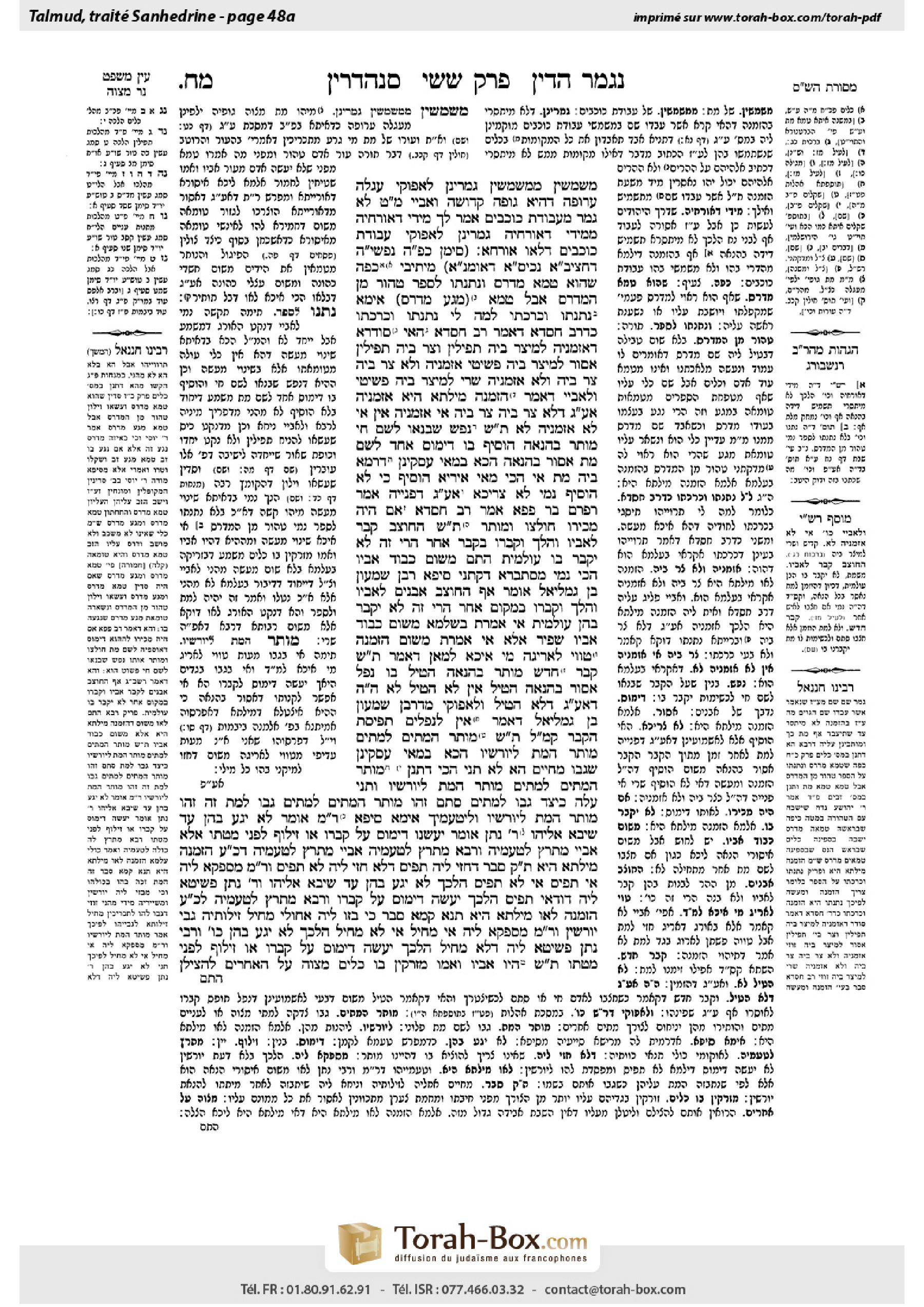
Sanhedrin 48a: Talmud study for Daf Yomi
Daf Yomi is the daily study of one Talmud folio. Explore 37 tractates with scans, Hebrew text, Sefaria English and AI-generated French translations where annotated.
Passage selection and English or AI-generated French translation are available where the scan has annotations. Daf Study is independent of Torah-Box and Sefaria.
Browse Sanhedrin · סנהדרין · All tractatesSanhedrin 48a text and translations
This page of Sanhedrin includes the Aramaic text, an English translation and an AI-generated French translation, alongside the scan above.
סנהדרין מ״ח א · Aramaic and Hebrew text
מְשַׁמְּשִׁין מִמְּשַׁמְּשִׁין גָּמְרִינַן, לְאַפּוֹקֵי עֶגְלָה עֲרוּפָה דְּהִיא גּוּפַהּ קְדוֹשָׁה.
וְאַבָּיֵי, מַאי טַעְמָא לָא גָּמַר מֵעֲבוֹדָה זָרָה? אָמַר לָךְ: מִידֵּי דְּאוֹרְחֵיהּ מִמִּידֵּי דְּאוֹרְחֵיהּ גָּמְרִינַן, לְאַפּוֹקֵי עֲבוֹדָה זָרָה דְּלָאו אוֹרְחָא.
סִימָן: כִּפָּה, נַפְשֵׁיהּ, דַּחֲצִיבָא, בְּקִבְרֵיהּ דְּיַתִּיר מֵאֲבֻהּ, בְּכִיסָא דְּאוּמָּנָא.
מֵיתִיבִי: כִּפָּה שֶׁהוּא טָמֵא מִדְרָס וּנְתָנַתּוּ לְסֵפֶר – טָהוֹר מִן הַמִּדְרָס, אֲבָל טָמֵא מַגַּע מִדְרָס. אֵימָא: נְתָנַתּוּ וּכְרָכַתּוּ.
לְמָה לִי נְתָנַתּוּ וּכְרָכַתּוּ? כִּדְרַב חִסְדָּא, דְּאָמַר רַב חִסְדָּא: הַאי סוּדָרָא דְּאַזְמְנֵיהּ לְמֵיצַר בֵּיהּ תְּפִילִּין, וְצַר בֵּיהּ תְּפִילִּין – אָסוּר לְמֵיצַר בֵּיהּ פְּשִׁיטֵי. אַזְמְנֵיהּ וְלָא צַר בֵּיהּ, צַר בֵּיהּ וְלָא אַזְמְנֵיהּ – שְׁרֵי לְמֵיצַר בֵּיהּ פְּשִׁיטֵי.
ולְאַבָּיֵי דְּאָמַר: הַזְמָנָה מִילְּתָא הִיא, אַזְמְנֵיהּ – אַף עַל גַּב דְּלָא צַר בֵּיהּ. צַר בֵּיהּ: אִי אַזְמְנֵיהּ – אִין, אִי לָא אַזְמְנֵיהּ – לָא.
תָּא שְׁמַע: נֶפֶשׁ שֶׁבְּנָאוֹ לְשֵׁם חַי – מוּתָּר בַּהֲנָאָה. הוֹסִיף בּוֹ דִּימוֹס אֶחָד לְשֵׁם מֵת – אָסוּר בַּהֲנָאָה. הָכָא בְּמַאי עָסְקִינַן? דִּרְמָא בֵּיהּ מֵת.
אִי הָכִי, מַאי אִירְיָא הוֹסִיף? כִּי לֹא הוֹסִיף נָמֵי! לָא צְרִיכָא, אַף עַל גַּב דְּפַנְּיֵיהּ.
אָמַר רַפְרָם בַּר פָּפָּא אָמַר רַב חִסְדָּא: אִם הָיָה מַכִּירוֹ, חוֹלְצוֹ וּמוּתָּר.
תָּא שְׁמַע: הַחוֹצֵב קֶבֶר לְאָבִיו, וְהָלַךְ וּקְבָרוֹ בְּקֶבֶר אַחֵר – הֲרֵי זֶה לֹא יִקָּבֵר בּוֹ עוֹלָמִית. הָתָם, מִשּׁוּם כְּבוֹד אָבִיו.
הָכִי נָמֵי מִסְתַּבְּרָא, דְּקָתָנֵי סֵיפָא: רַבָּן שִׁמְעוֹן בֶּן גַּמְלִיאֵל אוֹמֵר, אַף הַחוֹצֵב אֲבָנִים לְאָבִיו וְהָלַךְ וּקְבָרוֹ בְּמָקוֹם אַחֵר – הֲרֵי זֶה לֹא יִקָּבֵר בָּהֶן עוֹלָמִית.
אִי אָמְרַתְּ בִּשְׁלָמָא מִשּׁוּם כְּבוֹד אָבִיו – שַׁפִּיר, אֶלָּא אִי אָמְרַתְּ מִשּׁוּם הַזְמָנָה: טְוִוי לַאֲרִיגָה מִי אִיכָּא לְמַאן דְּאָמַר?
תָּא שְׁמַע: קֶבֶר חָדָשׁ מוּתָּר בַּהֲנָאָה. הֵטִיל בּוֹ נֵפֶל – אָסוּר בַּהֲנָאָה. הֵטִיל – אִין, לֹא הֵטִיל – לָא.
הוּא הַדִּין דְּאַף עַל גַּב דְּלָא הֵטִיל, וּלְאַפּוֹקֵי מִדְּרַבָּן שִׁמְעוֹן בֶּן גַּמְלִיאֵל דְּאָמַר: אֵין לִנְפָלִים תְּפִיסַת הַקֶּבֶר, קָא מַשְׁמַע לַן.
תָּא שְׁמַע: מוֹתַר הַמֵּתִים – לְמֵתִים, מוֹתַר הַמֵּת – לְיוֹרְשָׁיו. הָכָא בְּמַאי עָסְקִינַן? שֶׁגָּבוּ מֵחַיִּים.
הָא לָא תָּנֵי הָכִי, דִּתְנַן: מוֹתַר הַמֵּתִים – לְמֵתִים, מוֹתַר הַמֵּת – לְיוֹרְשָׁיו. וְתָנֵי עֲלַהּ: כֵּיצַד? גָּבוּ לְמֵתִים סְתָם – זֶהוּ מוֹתַר הַמֵּתִים לְמֵתִים, גָּבוּ לְמֵת זֶה – זֶהוּ מוֹתַר הַמֵּת לְיוֹרְשָׁיו.
וְלִיטַעְמָיךְ, אֵימָא סֵיפָא: רַבִּי מֵאִיר אוֹמֵר, לֹא יִגַּע בָּהֶן עַד שֶׁיָּבֹא אֵלִיָּהוּ. רַבִּי נָתָן אוֹמֵר: יַעֲשֶׂנּוּ דִּימוֹס עַל קִבְרוֹ אוֹ זִילּוּף לִפְנֵי מִטָּתוֹ.
אֶלָּא, אַבָּיֵי מְתָרֵץ לְטַעְמֵיהּ וְרָבָא מְתָרֵץ לְטַעְמֵיהּ. אַבָּיֵי מְתָרֵץ לְטַעְמֵיהּ: דְּכוּלֵּי עָלְמָא הַזְמָנָה מִילְּתָא הִיא. תַּנָּא קַמָּא סָבַר: דַּחֲזֵי לֵיהּ – תָּפֵיס, דְּלָא חֲזֵי לֵיהּ – לָא תָּפֵיס.
וְרַבִּי מֵאִיר מְסַפְּקָא לֵיהּ, אִי תָּפֵיס אִי לָא תָּפֵיס. הִלְכָּךְ, לֹא יִגַּע בָּהֶן עַד שֶׁיָּבֹא אֵלִיָּהוּ. וְרַבִּי נָתָן פְּשִׁיטָא לֵיהּ דְּוַדַּאי תָּפֵיס, הִלְכָּךְ יֵעָשֶׂה דִּימוֹס עַל קִבְרוֹ.
וְרָבָא מְתָרֵץ לְטַעְמֵיהּ: לְכוּלֵּי עָלְמָא הַזְמָנָה לָאו מִילְּתָא הִיא. תַּנָּא קַמָּא סָבַר: כִּי בָּזוּ לֵיהּ, אַחוֹלֵי מַחֵיל זִילוּתֵיהּ גַּבֵּי יוֹרְשִׁין.
וְרַבִּי מֵאִיר מְסַפְּקָא לֵיהּ אִי מַחֵיל אִי לָא מַחֵיל, הִלְכָּךְ לֹא יִגַּע בָּהֶן כּוּ׳. וְרַבִּי נָתָן פְּשִׁיטָא לֵיהּ דְּלָא מַחֵיל, הִלְכָּךְ יֵעָשֶׂה דִּימוֹס עַל קִבְרוֹ אוֹ זִילּוּף לִפְנֵי מִטָּתוֹ.
תָּא שְׁמַע: הָיוּ אָבִיו וְאִמּוֹ מְזָרְקִין בּוֹ כֵּלִים, מִצְוָה עַל הָאֲחֵרִים לְהַצִּילָן.
Sanhedrin 48a · English translation
We derive the halakha governing the accessories relating to a dead person, e.g., a shroud, from the halakha governing the accessories used in idol worship, e.g., the animal sacrificed to the idol. This is to the exclusion of a heifer whose neck is broken, which is itself consecrated for the ceremony taking place in the valley and is not an accessory used in that ceremony.
The Gemara asks: And Abaye, what is the reason that he did not derive the halakha by way of a verbal analogy from the halakha governing accessories used in idol worship? The Gemara answers: Abaye could have said to you that we learn the halakha governing something that involves a proper way of conduct, i.e., burying the dead, from the halakha governing something that involves a proper way of conduct, i.e., the rite relating to the heifer whose neck is broken, as these are both mitzvot by Torah law. This is to the exclusion of objects of idol worship, which do not involve a proper way of conduct.
§ The Gemara presents a mnemonic for the forthcoming series of attempted proofs concerning the dispute between Rava and Abaye: Scarf; monument; that was hewed; pouch; craftsman.
The Gemara raises an objection against Rava from a baraita discussing ritual impurity that is contracted by treading: If a scarf is ritually impure with impurity imparted by treading, e.g., after a zav sat or lay down upon it, and its owner then designated it as a cover for a Torah scroll, it is pure of the more severe level of ritual impurity, that which is imparted by treading, even without immersion, because it is no longer an object intended to be lied on or sat upon. But it is still impure with the less severe ritual impurity, that which is contracted by touching that which is treaded upon. This indicates that mere designation has halakhic significance and validity. The Gemara rejects this argument: Say that the baraita should read as follows: The owner of the scarf designated it as a cover for a Torah scroll and wrapped it around the scroll, so that there was not only designation, but an action as well.
The Gemara asks: If there was an action, why do I need for the baraita to say that the owner designated it and wrapped it? Wouldn’t wrapping alone have sufficed? The Gemara answers: The baraita is in accordance with the opinion of Rav Ḥisda, as Rav Ḥisda says: With regard to this cloth that one designated for the purpose of bundling phylacteries in it, if he already bundled phylacteries in it, then it is forbidden to bundle coins in it, as it was designated and used as an accessory of a sacred object. But if he merely designated it for that purpose but did not yet bundle phylacteries in it, or if he bundled phylacteries in it but did not previously designate it for bundling phylacteries, then it is permitted to bundle coins in it. Consequently, in the case of the scarf, it was necessary both to designate it as a cover for the Torah scroll and to actually wrap it around the scroll.
And according to Abaye, who said that designation is a significant matter, the halakha is as follows: If he designated the cloth for the purpose of bundling phylacteries in it, even if he did not bundle phylacteries in it, it is prohibited to bundle money in it. In a case where he already bundled phylacteries in it, if he designated the cloth for bundling phylacteries, yes, it is prohibited to bundle money in it; but if he did not designate it for bundling phylacteries, bundling money in the cloth is not prohibited.
The Gemara suggests: Come and hear another proof against Rava: With regard to a monument that was built as a memorial for the sake of an individual while he was still alive, one is permitted to derive benefit from it, as it is like any other construction; but if even a single row of stones was added to it for the sake of a corpse, one is prohibited from deriving benefit from it, apparently even before the deceased is buried there. This seems to indicate that mere designation is a significant matter. The Gemara answers: With what are we dealing here? We are dealing with a case where the corpse was placed under the monument, so that it became forbidden not through mere designation, but by way of an action.
The Gemara asks: If so, why does the baraita specifically mention that a row of stones was added? If the deceased was buried under the monument, one should be prohibited from deriving benefit from it even when a row of stones was not added, as the entire monument has been used for the dead. The Gemara explains: No, it is necessary for the baraita to state that a row of stones was added in order to teach us that even if the corpse was later removed from the grave, the monument remains forbidden since it had been designated for a corpse.
Rafram bar Pappa says that Rav Ḥisda says: If the corpse was later removed from the grave and one recognizes the row of stones that had been added to the monument in the dead man’s honor, he may remove that row of stones, and it is permitted to derive benefit from the rest of the construction.
The Gemara suggests: Come and hear yet another proof against Rava from a baraita: If one hewed a grave for his deceased father in one place, and then went and buried him in a different place, the son may never be buried in the grave that he had dug. This indicates that mere designation is a significant matter. The Gemara answers: There, the son may not be buried in the grave that he had dug because that would detract from the honor that he must show his father, not because the designation is significant with regard to the status of a grave in general.
The Gemara comments: So, too, it is reasonable that the son may not be buried in the grave that he had dug only because of the honor due to his father, as the latter clause of the same baraita teaches: Rabban Shimon ben Gamliel says: Even if one hewed stones for his father’s grave and then went and buried him in a different place, the son himself may never be buried in a tomb constructed from those stones.
The Gemara explains: Granted, if you say that the son may not be buried in the grave that he dug for his father because of the honor that must be shown his father, it is well understood why he can also not be buried in tomb constructed from stones that he hewed for his father’s grave. But if you say that it is because of designation, the son should be permitted to be buried in such a tomb, as is there anyone who says that spinning yarn in order to weave it into cloth for shrouds is regarded as designating an item for a dead person, resulting in a prohibition against deriving benefit from the yarn? In such a case there is certainly no prohibition, and the case of hewing stones for a tomb is analogous to a case of spinning yarn in order to weave it into cloth.
The Gemara suggests: Come and hear a proof in support of Rava from a baraita: With regard to a fresh grave that was not designated for a particular individual, one is permitted to derive benefit from it. But if even a non-viable newborn that died was cast into it, one is prohibited from deriving benefit from the grave. It may be inferred from here that if a non-viable newborn was cast into the grave, yes, one is prohibited from deriving benefit from the grave, but if it was not cast into the grave, one is not prohibited from deriving benefit from the grave, indicating that mere designation is insignificant.
The Gemara rejects this inference: The same is true even if a non-viable newborn was not cast into the grave; one is still prohibited from deriving benefit from the grave, merely by virtue of the designation. Why, then, does the baraita say that a non-viable newborn was cast into the grave? This serves to exclude the opinion of Rabban Shimon ben Gamliel, who says: A non-viable newborn does not take possession of its grave to render it forbidden even once it is buried there. To counter this opinion, the baraita teaches us that this opinion is not accepted, and a non-viable newborn is treated like any other corpse.
The Gemara suggests: Come and hear another proof in support of Rava’s opinion from a mishna (Shekalim 2:5): The money left over from the money that was collected for burying the dead must be allocated to the burial of other dead people. The money left over from the money that was collected for burying a particular dead person is given to his heirs. Evidently, money that had been designated for the sake of a dead person but was not actually used for burying him does not become forbidden, and his heirs may use it. The Gemara rejects this proof: With what are we dealing here? We are dealing with money that had been collected for the deceased during his lifetime. It was thought that a certain individual was soon to die, and money was collected to cover the costs of his burial. Since at the time the money was collected the person was alive, the money had not been designated for the sake of a dead person. Therefore, one is permitted to derive benefit from it, and it is given to the heirs of the deceased.
The Gemara raises an objection: But we were not taught this, as we learned in the mishna: The money left over from the money that was collected for burying the dead must be allocated to the burial of other dead people. The money left over from the money that was collected for burying a particular dead person is given to his heirs. And it is taught with regard to this mishna in a baraita: How so? If they collected money for the purpose of burying the dead without specification, this is the case about which they said that the money left over from the money that was collected for burying the dead must be allocated to the burial of other dead people. But if they collected money for the sake of this particular dead person, this is the case about which they said that the money left over from the money that was collected for burying a particular dead person is given to his heirs. This indicates that the mishna is discussing a case where the money was designated for one who had already died.
The Gemara answers: And according to your reasoning, say the latter clause of that same mishna, which appears to support the opinion of Abaye: Rabbi Meir says: If money was left over from the sum collected for the burial of a particular dead person, the money may not be touched until Elijah comes and resolves the uncertainty as to whether or not the money is forbidden. Rabbi Natan says: The leftover money shall be used for the laying of another row of stones over the grave of the deceased or for the sprinkling of fragrant wine before his bier as he is brought for burial. This indicates that there are certain tanna’im who maintain that mere designation is in fact significant.
Rather, Abaye can explain the entire mishna according to his line of reasoning, and Rava, too, can explain the entire mishna according to his line of reasoning. The Gemara explains: Abaye can explain the entire mishna according to his line of reasoning, as follows: According to everyone, i.e., the first tanna, Rabbi Meir, and Rabbi Natan, mere designation is a significant matter. The first tanna holds that the sum that it is fitting to spend for the burial of the particular dead person is encompassed by the prohibition, and the sum that it is not fitting to spend is not encompassed by the prohibition. Therefore, whatever money is not required for his burial is given to his heirs, as it was never included in the prohibition.
And Rabbi Meir is uncertain as to whether the sum that it is not fitting to spend for his burial is encompassed by the prohibition or is not encompassed by the prohibition. Therefore, the leftover money may not be touched until Elijah comes and clarifies the matter. And it is obvious to Rabbi Natan that all of the money collected is certainly encompassed by the prohibition, including the money that it is not fitting to spend for the deceased’s burial. Therefore, whatever money is left over should be used for the laying of another row of stones over the grave of the deceased or for the sprinkling of fragrant wine before his bier.
And Rava, too, can explain the mishna according to his line of reasoning, as follows: According to everyone, i.e., the first tanna, Rabbi Meir, and Rabbi Natan, mere designation is nothing, and so the money collected for the burial of a particular dead person does not become forbidden. And the disagreement is about an entirely different manner. The first tanna holds that even though the heirs of the deceased disgraced him by collecting money for his burial, the deceased still forgoes his disgrace for the benefit of his heirs, and therefore the leftover money is given to them.
And Rabbi Meir is uncertain as to whether the deceased forgoes his disgrace or does not forgo it. Therefore, the leftover money may not be touched until Elijah comes and clarifies the issue. And it is obvious to Rabbi Natan that the deceased does not forgo his disgrace. Therefore, whatever money is left over should be used for the laying of another row of stones over the grave of the deceased, or for the sprinkling of fragrant wine before his bier.
The Gemara suggests: Come and hear another proof in support of Rava’s opinion from a baraita: If the father and the mother of the deceased were throwing garments onto their late son’s bier so that they would be buried along with him, it is a mitzva for the others present to save those garments from being lost. This indicates that mere designation is insignificant, as were it significant, one would be prohibited to derive benefit from the garments as soon as the parents cast them onto the bier.
Sanhedrin 48a · Traduction française (IA)
Nous déduisons la halakha régissant les accessoires liés à un mort, par exemple un linceul, de celle régissant les accessoires utilisés dans le culte des idoles, par exemple l’animal sacrifié à l’idole. Cela exclut la génisse dont on brise la nuque, qui est elle-même consacrée au rite accompli dans la vallée et n’est pas un accessoire utilisé dans ce rite.
La Guemara demande : Et Abayé, pour quelle raison n’a-t-il pas déduit la halakha au moyen d’une analogie verbale à partir de celle régissant les accessoires utilisés dans le culte des idoles ? La Guemara répond : Abayé aurait pu te dire que nous déduisons la halakha concernant une pratique relevant de la conduite appropriée, c’est-à-dire l’enterrement des morts, de celle concernant une pratique relevant de la conduite appropriée, c’est-à-dire le rite de la génisse dont on brise la nuque, car il s’agit dans les deux cas de mitsvot prescrites par la Torah. Cela exclut les objets du culte des idoles, qui ne relèvent pas d’une conduite appropriée.
§ La Guemara présente un moyen mnémotechnique pour la série de tentatives de preuve qui suit concernant le désaccord entre Rava et Abayé : foulard ; monument ; taillé ; bourse ; artisan.
La Guemara soulève une objection contre Rava à partir d’une baraïta portant sur l’impureté rituelle contractée par contact avec un objet piétiné : si un foulard est rituellement impur de l’impureté transmise par piétinement, par exemple après qu’un zav s’y est assis ou étendu, et que son propriétaire le désigne ensuite comme couverture pour un rouleau de la Torah, il est pur du degré le plus sévère d’impureté rituelle, celui transmis par piétinement, même sans immersion, car il n’est plus destiné à ce qu’on s’y étende ou s’y assoie. Mais il reste impur du degré moins sévère, celui contracté par contact avec un objet piétiné. Cela indique que la simple désignation a une portée et une validité halakhiques. La Guemara rejette cet argument : dis plutôt que la baraïta doit se lire ainsi : le propriétaire du foulard l’a désigné comme couverture pour un rouleau de la Torah et l’a enroulé autour du rouleau ; il y a donc eu non seulement une désignation, mais aussi un acte.
La Guemara demande : S’il y a eu un acte, pourquoi la baraïta doit-elle dire que le propriétaire l’a désigné et l’a enroulé autour du rouleau ? Le seul fait de l’enrouler n’aurait-il pas suffi ? La Guemara répond : La baraïta suit l’opinion de Rav Ḥisda, car Rav Ḥisda dit : À propos de ce tissu qu’une personne a désigné pour y envelopper des phylactères, si elle y a déjà enveloppé des phylactères, il est interdit d’y envelopper des pièces de monnaie, car il a été désigné et utilisé comme accessoire d’un objet sacré. Mais si elle l’a seulement désigné à cette fin, sans encore y envelopper de phylactères, ou si elle y a enveloppé des phylactères sans l’avoir préalablement désigné à cette fin, il est permis d’y envelopper des pièces de monnaie. Par conséquent, dans le cas du foulard, il fallait à la fois le désigner comme couverture du rouleau de la Torah et l’enrouler effectivement autour du rouleau.
Et selon Abayé, qui a dit que la désignation a une portée significative, la halakha est la suivante : si l’on a désigné le tissu pour y envelopper des phylactères, il est interdit d’y envelopper de l’argent, même si l’on n’y a pas encore enveloppé de phylactères. Dans le cas où l’on y a déjà enveloppé des phylactères, si l’on avait désigné le tissu à cette fin, il est interdit d’y envelopper de l’argent ; mais si on ne l’avait pas désigné à cette fin, il n’est pas interdit d’y envelopper de l’argent.
La Guemara propose : Viens et entends une autre preuve contre Rava : à propos d’un monument érigé à la mémoire d’un individu de son vivant, il est permis d’en tirer profit, car il est comme toute autre construction ; mais si ne serait-ce qu’une rangée de pierres y a été ajoutée en l’honneur d’un mort, il est interdit d’en tirer profit, apparemment même avant que le défunt y soit enterré. Cela semble indiquer que la simple désignation a une portée significative. La Guemara répond : De quoi s’agit-il ici ? D’un cas où le corps a été placé sous le monument, si bien que celui-ci est devenu interdit non par simple désignation, mais par un acte.
La Guemara demande : Dans ce cas, pourquoi la baraïta mentionne-t-elle précisément l’ajout d’une rangée de pierres ? Si le défunt a été enterré sous le monument, il devrait être interdit d’en tirer profit même sans ajout d’une rangée, puisque le monument entier a servi aux morts. La Guemara explique : Non, la baraïta doit mentionner l’ajout d’une rangée pour nous enseigner que même si le corps a ensuite été retiré de la tombe, le monument demeure interdit, puisqu’il avait été désigné pour un mort.
Rafram bar Pappa dit au nom de Rav Ḥisda : si le corps a ensuite été retiré de la tombe et que l’on reconnaît la rangée de pierres ajoutée au monument en l’honneur du défunt, on peut retirer cette rangée, et il est permis de tirer profit du reste de la construction.
La Guemara propose : Viens et entends encore une preuve contre Rava à partir d’une baraïta : si quelqu’un a creusé une tombe pour son père défunt à un endroit, puis l’a enterré ailleurs, le fils ne pourra jamais être enterré dans la tombe qu’il avait creusée. Cela indique que la simple désignation a une portée significative. La Guemara répond : Dans ce cas, le fils ne peut être enterré dans la tombe qu’il avait creusée parce que cela porterait atteinte à l’honneur qu’il doit à son père, et non parce que la désignation a une portée significative quant au statut d’une tombe en général.
La Guemara fait remarquer qu’il est donc également raisonnable que le fils ne puisse être enterré dans la tombe qu’il a creusée uniquement en raison de l’honneur dû à son père, car la dernière partie de cette même baraïta enseigne : Rabban Shimon ben Gamliel dit : même si quelqu’un a taillé des pierres pour la tombe de son père, puis l’a enterré ailleurs, le fils lui-même ne pourra jamais être enterré dans un caveau construit avec ces pierres.
La Guemara explique : Si tu dis que le fils ne peut être enterré dans la tombe qu’il a creusée pour son père par respect pour celui-ci, on comprend également pourquoi il ne peut être enterré dans un caveau construit avec les pierres qu’il a taillées pour la tombe de son père. Mais si tu dis que c’est en raison de la désignation, le fils devrait être autorisé à être enterré dans un tel caveau. Qui donc prétend que filer du fil destiné à être tissé en étoffe pour des linceuls équivaut à désigner un objet pour un mort, ce qui entraînerait l’interdiction d’en tirer profit ? Dans un tel cas, il n’y a certainement pas d’interdiction, et le cas des pierres taillées pour un caveau est analogue à celui du fil destiné à être tissé en étoffe.
La Guemara propose : Viens et entends une preuve en faveur de Rava à partir d’une baraïta : il est permis de tirer profit d’une tombe neuve qui n’a pas été désignée pour une personne précise. Mais si même un nouveau-né non viable qui est mort y a été jeté, il est interdit de tirer profit de la tombe. On peut en déduire que si un nouveau-né non viable a été jeté dans la tombe, il est interdit d’en tirer profit ; mais s’il n’y a pas été jeté, il n’est pas interdit d’en tirer profit. Cela indique que la simple désignation n’a pas de portée significative.
La Guemara rejette cette déduction : il en va de même si un nouveau-né non viable n’a pas été jeté dans la tombe ; il est tout de même interdit d’en tirer profit, du seul fait de sa désignation. Pourquoi, alors, la baraïta dit-elle qu’un nouveau-né non viable y a été jeté ? C’est pour exclure l’opinion de Rabban Shimon ben Gamliel, qui dit qu’un nouveau-né non viable ne prend pas possession de sa tombe et ne la rend donc pas interdite, même une fois qu’il y a été enterré. Pour réfuter cette opinion, la baraïta nous enseigne qu’elle n’est pas retenue et qu’un nouveau-né non viable est traité comme tout autre mort.
La Guemara propose : Viens et entends une autre preuve en faveur de l’opinion de Rava à partir d’une Michna (Shekalim 2:5) : l’argent restant de la somme collectée pour l’enterrement des morts doit être affecté à l’enterrement d’autres morts. L’argent restant de la somme collectée pour l’enterrement d’un mort en particulier est donné à ses héritiers. Il ressort de là que l’argent désigné pour un mort, mais qui n’a pas effectivement servi à l’enterrer, ne devient pas interdit, et que ses héritiers peuvent l’utiliser. La Guemara rejette cette preuve : de quoi s’agit-il ici ? D’argent collecté pour le défunt de son vivant. On pensait qu’un individu allait bientôt mourir, et l’on a collecté de l’argent pour couvrir les frais de son enterrement. Puisque la personne était vivante au moment de la collecte, l’argent n’avait pas été désigné pour un mort. Il est donc permis d’en tirer profit, et il est donné aux héritiers du défunt.
La Guemara soulève une objection : Mais ce n’est pas ce qui nous a été enseigné, car nous avons appris dans la Michna : l’argent restant de la somme collectée pour l’enterrement des morts doit être affecté à l’enterrement d’autres morts. L’argent restant de la somme collectée pour l’enterrement d’un mort en particulier est donné à ses héritiers. Et à propos de cette Michna, une baraïta enseigne : Comment cela ? Si l’on a collecté de l’argent sans préciser qu’il était destiné à l’enterrement des morts, c’est le cas auquel ils se référaient lorsqu’ils ont dit que l’argent restant de la somme collectée pour l’enterrement des morts doit être affecté à l’enterrement d’autres morts. Mais si l’on a collecté de l’argent pour ce mort en particulier, c’est le cas auquel ils se référaient lorsqu’ils ont dit que l’argent restant de la somme collectée pour l’enterrement d’un mort en particulier est donné à ses héritiers. Cela indique que la Michna traite d’un cas où l’argent a été désigné pour une personne déjà décédée.
La Guemara répond : Et selon ton raisonnement, considère la dernière partie de cette même Michna, qui semble appuyer l’opinion d’Abayé : Rabbi Meïr dit : si une somme reste de l’argent collecté pour l’enterrement d’un mort en particulier, on ne doit pas toucher à cet argent jusqu’à la venue d’Élie, qui tranchera la question de savoir si cet argent est interdit ou non. Rabbi Natan dit : l’argent restant servira à poser une autre rangée de pierres sur la tombe du défunt ou à répandre du vin parfumé devant son cercueil tandis qu’on le conduit à l’enterrement. Cela indique que certains tannaïm soutiennent que la simple désignation a effectivement une portée significative.
Au contraire, Abayé peut expliquer toute la Michna selon son raisonnement, et Rava peut lui aussi expliquer toute la Michna selon le sien. La Guemara explique : Abayé peut expliquer toute la Michna selon son raisonnement comme suit : selon tous, c’est-à-dire le premier tanna, Rabbi Meïr et Rabbi Natan, la simple désignation a une portée significative. Le premier tanna considère que la somme qu’il convient de dépenser pour l’enterrement du mort en question est comprise dans l’interdiction, tandis que la somme qu’il n’est pas nécessaire de dépenser ne l’est pas. Par conséquent, tout l’argent qui n’est pas nécessaire à son enterrement est donné à ses héritiers, puisqu’il n’a jamais été inclus dans l’interdiction.
Rabbi Meïr ne sait pas si la somme qu’il n’est pas nécessaire de dépenser pour son enterrement est comprise dans l’interdiction ou non. C’est pourquoi on ne doit pas toucher à l’argent restant jusqu’à la venue d’Élie, qui clarifiera la question. Rabbi Natan, lui, considère comme évident que tout l’argent collecté est compris dans l’interdiction, y compris la somme qu’il n’est pas nécessaire de dépenser pour l’enterrement du défunt. Par conséquent, tout l’argent restant doit servir à poser une autre rangée de pierres sur la tombe du défunt ou à répandre du vin parfumé devant son cercueil.
Rava peut lui aussi expliquer la Michna selon son raisonnement comme suit : selon tous, c’est-à-dire le premier tanna, Rabbi Meïr et Rabbi Natan, la simple désignation n’a aucune portée, et l’argent collecté pour l’enterrement d’un mort en particulier ne devient donc pas interdit. Leur désaccord porte sur une tout autre question. Le premier tanna considère que, même si les héritiers du défunt lui ont fait subir un affront en collectant de l’argent pour son enterrement, le défunt renonce néanmoins à son honneur au bénéfice de ses héritiers ; l’argent restant leur est donc donné.
Rabbi Meïr ne sait pas si le défunt renonce ou non à son honneur. C’est pourquoi on ne doit pas toucher à l’argent restant jusqu’à la venue d’Élie, qui clarifiera la question. Rabbi Natan, lui, considère comme évident que le défunt ne renonce pas à son honneur. Par conséquent, tout l’argent restant doit servir à poser une autre rangée de pierres sur la tombe du défunt ou à répandre du vin parfumé devant son cercueil.
La Guemara propose : Viens et entends une autre preuve en faveur de l’opinion de Rava à partir d’une baraïta : si le père et la mère du défunt jetaient des vêtements sur le cercueil de leur fils décédé afin qu’ils soient enterrés avec lui, les personnes présentes ont la mitsva de sauver ces vêtements pour qu’ils ne soient pas perdus. Cela indique que la simple désignation n’a pas de portée significative, car si elle en avait une, il serait interdit de tirer profit des vêtements dès que les parents les ont jetés sur le cercueil.
Traduction française générée par IA à partir de l’édition anglaise de Sefaria. Vérifie toujours un passage avec le texte source.
Text from Sefaria: William Davidson Edition - Vocalized Aramaic (CC BY NC); William Davidson Edition - English (CC BY NC).