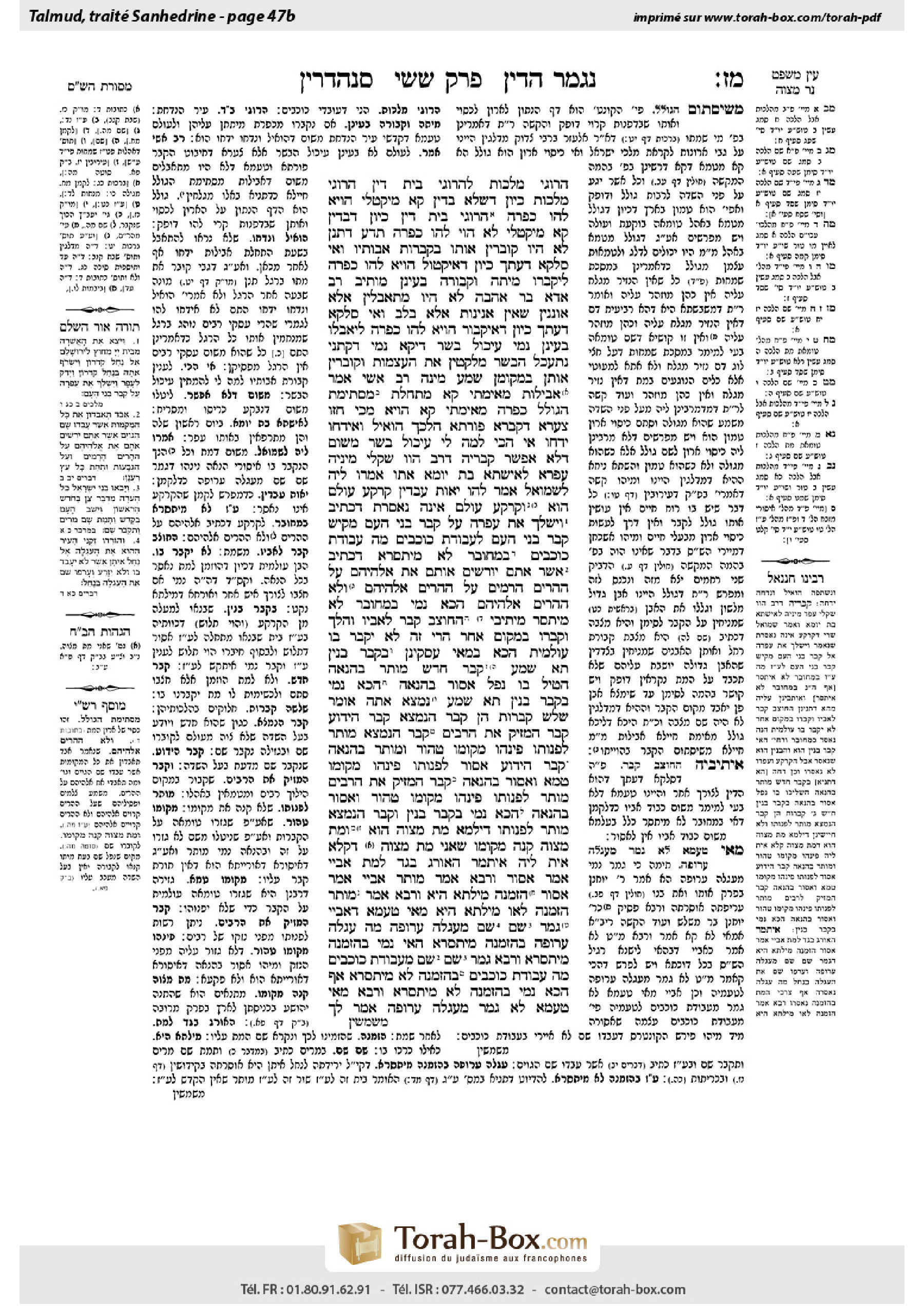
Sanhedrin 47b: Talmud study for Daf Yomi
Daf Yomi is the daily study of one Talmud folio. Explore 37 tractates with scans, Hebrew text, Sefaria English and AI-generated French translations where annotated.
Passage selection and English or AI-generated French translation are available where the scan has annotations. Daf Study is independent of Torah-Box and Sefaria.
Browse Sanhedrin · סנהדרין · All tractatesSanhedrin 47b text and translations
This page of Sanhedrin includes the Aramaic text, an English translation and an AI-generated French translation, alongside the scan above.
סנהדרין מ״ז ב · Aramaic and Hebrew text
הֲרוּגֵי מַלְכוּת לַהֲרוּגֵי בֵּית דִּין? הֲרוּגֵי מַלְכוּת, כֵּיוָן דְּשֶׁלֹּא בְּדִין קָא מִיקַּטְלִי, הָוְיָא לְהוּ כַּפָּרָה. הֲרוּגֵי בֵּית דִּין, כֵּיוָן דִּבְדִין קָא מִיקַּטְלִי, לָא הָוֵי לְהוּ כַּפָּרָה.
תֵּדַע, דִּתְנַן: לֹא הָיוּ קוֹבְרִין אוֹתוֹ בְּקִבְרוֹת אֲבוֹתָיו. וְאִי סָלְקָא דַעְתָּךְ, כֵּיוָן דְּאִיקְּטוּל הָוְיָא לְהוּ כַּפָּרָה, לִיקַּבְרוּ! מִיתָה וּקְבוּרָה בָּעֵינַן.
מוֹתֵיב רַב אַדָּא בַּר אַהֲבָה: לָא הָיוּ מִתְאַבְּלִין, אֶלָּא אוֹנְנִין, שֶׁאֵין אֲנִינוּת אֶלָּא בַּלֵּב. וְאִי סָלְקָא דַעְתָּךְ, כֵּיוָן דְּאִיקְּבוּר הָוְיָא לְהוּ כַּפָּרָה – לִיאַבְּלוּ!
בָּעֵינַן נָמֵי עִיכּוּל בָּשָׂר. דַּיְקָא נָמֵי, דְּקָתָנֵי: נִתְעַכֵּל הַבָּשָׂר – מְלַקְּטִין אֶת הָעֲצָמוֹת וְקוֹבְרִין אוֹתָן בִּמְקוֹמָן. שְׁמַע מִינַּהּ.
רַב אָשֵׁי אָמַר: אֲבֵילוּת מֵאֵימָתַי קָא מַתְחֲלָא? מִסְּתִימַת הַגּוֹלֵל. כַּפָּרָה מֵאֵימָתַי קָא הָוְיָא? מִכִּי חָזוּ צַעֲרָא דְקִבְרָא פּוּרְתָּא. הִלְכָּךְ, הוֹאִיל וְנִדְחוּ יִדָּחוּ.
אִי הָכִי, לְמָה לִי עִיכּוּל בָּשָׂר? מִשּׁוּם דְּלָא אֶפְשָׁר.
קִבְרֵיהּ דְּרַב הֲווֹ שָׁקְלִי מִינֵּיהּ עַפְרָא לְאִישָּׁתָא בַּת יוֹמָא. אֲתוֹ אֲמַרוּ לֵיהּ לִשְׁמוּאֵל. אֲמַר לְהוּ: יָאוּת עָבְדִין, קַרְקַע עוֹלָם הוּא, וְקַרְקַע עוֹלָם אֵינָהּ נֶאֱסֶרֶת, דִּכְתִיב: ״וַיַּשְׁלֵךְ אֶת עֲפָרָהּ עַל קֶבֶר בְּנֵי הָעָם״, מַקִּישׁ קֶבֶר בְּנֵי הָעָם לַעֲבוֹדָה זָרָה.
מָה עֲבוֹדָה זָרָה בִּמְחוּבָּר לָא מִיתַּסְרָא, דִּכְתִיב: ״אֲשֶׁר אַתֶּם יֹרְשִׁים אֹתָם אֶת אֱלֹהֵיהֶם עַל הֶהָרִים הָרָמִים״. עַל הֶהָרִים אֱלֹהֵיהֶם, וְלֹא הֶהָרִים אֱלֹהֵיהֶם. הָכָא נָמֵי, בִּמְחוּבָּר לָא מִיתְּסַר.
מֵיתִיבִי: הַחוֹצֵב קֶבֶר לְאָבִיו, וְהָלַךְ וּקְבָרוֹ בְּמָקוֹם אַחֵר – הֲרֵי זֶה לֹא יִקָּבֵר בּוֹ עוֹלָמִית. הָכָא בְּמַאי עָסְקִינַן? בְּקֶבֶר בִּנְיָן.
תָּא שְׁמַע: קֶבֶר חָדָשׁ מוּתָּר בַּהֲנָאָה. הֵטִיל בּוֹ נֵפֶל – אָסוּר בַּהֲנָאָה. הָכָא נָמֵי, בְּקֶבֶר בִּנְיָן.
תָּא שְׁמַע: נִמְצָא אַתָּה אוֹמֵר שָׁלֹשׁ קְבָרוֹת הֵן – קֶבֶר הַנִּמְצָא, קֶבֶר הַיָּדוּעַ, קֶבֶר הַמַּזִּיק אֶת הָרַבִּים. קֶבֶר הַנִּמְצָא – מוּתָּר לְפַנּוֹתוֹ. פִּינָּהוּ – מְקוֹמוֹ טָהוֹר וּמוּתָּר בַּהֲנָאָה.
קֶבֶר הַיָּדוּעַ, אָסוּר לְפַנּוֹתוֹ. פִּינָּהוּ – מְקוֹמוֹ טָמֵא וְאָסוּר בַּהֲנָאָה.
קֶבֶר הַמַּזִּיק אֶת הָרַבִּים, מוּתָּר לְפַנּוֹתוֹ. פִּינָּהוּ – מְקוֹמוֹ טָהוֹר וְאָסוּר בַּהֲנָאָה. הָכָא נָמֵי, בְּקֶבֶר בִּנְיָן.
וְקֶבֶר הַנִּמְצָא מוּתָּר לְפַנּוֹתוֹ? דִּילְמָא מֵת מִצְוָה הוּא, וּמֵת מִצְוָה קָנָה מְקוֹמוֹ! שָׁאנֵי מֵת מִצְוָה, דְּקָלָא אִית לֵיהּ.
אִיתְּמַר: הָאוֹרֵג בֶּגֶד לַמֵּת, אַבָּיֵי אָמַר: אָסוּר, וְרָבָא אָמַר: מוּתָּר.
אַבָּיֵי אָמַר אָסוּר – הַזְמָנָה מִלְּתָא הִיא. וְרָבָא אָמַר מוּתָּר – הַזְמָנָה לָאו מִילְּתָא הִיא.
מַאי טַעְמָא דְּאַבָּיֵי? גָּמַר ״שָׁם״ ״שָׁם״ מֵעֶגְלָה עֲרוּפָה. מָה עֶגְלָה עֲרוּפָה בְּהַזְמָנָה מִיתַּסְרָא, הַאי נָמֵי בְּהַזְמָנָה מִיתַּסְרָא.
וְרָבָא גָּמַר ״שָׁם״ ״שָׁם״ מֵעֲבוֹדָה זָרָה. מָה עֲבוֹדָה זָרָה בְּהַזְמָנָה לָא מִיתַּסְרָא, אַף הָכָא נָמֵי בְּהַזְמָנָה לָא מִיתַּסְרָא.
וְרָבָא, מַאי טַעְמָא לָא גָּמַר מֵעֶגְלָה עֲרוּפָה? אָמַר לָךְ:
Sanhedrin 47b · English translation
those referred to in the verse in Psalms who were killed by a heathen government to those inhabitants of an idolatrous city who were killed by a Jewish court? Those who were killed by a heathen government, since they were killed unjustly, achieve atonement through their deaths, even without repentance. But those who were killed by a Jewish court, since they were killed justly for their sins, do not achieve atonement unless they repent.
The Gemara adds: Know that this is true, as we have learned in the mishna: They would not bury the executed transgressor in his ancestral burial plot. And if it enters your mind to say that once the transgressors are executed by the court, they achieve atonement, let them be buried in their ancestral burial plots. The Gemara rejects this argument: An executed transgressor cannot be buried in his ancestral burial plot, because in order to achieve atonement, both death and burial are needed. But once he is buried in the graveyard set aside for the wicked, he achieves full atonement.
Rav Adda bar Ahava raised an objection to this from another ruling in the mishna: The relatives of the executed transgressor would not mourn him with the observance of the usual mourning rites, but they would grieve over his passing, since grief is felt only in the heart. And if it enters your mind to say that once the executed transgressors are buried they achieve atonement, let the relatives of the executed transgressor mourn him as well, as he has already achieved atonement.
The Gemara refutes this argument: An executed transgressor is not mourned, because in order to achieve atonement, decomposition of his flesh is also needed. Once his flesh has decayed, he has achieved full atonement. The Gemara notes that the language of the mishna is also precise, as it teaches: Once the flesh of the deceased had decomposed, they would gather his bones and bury them in their proper place in his ancestral burial plot, indicating that with the decomposition of his flesh, the executed transgressor achieves atonement, so that he may be buried alongside his righteous relatives. The Gemara affirms: Learn from the mishna that this is so.
Rav Ashi says that an alternative resolution of the objection raised by Rav Adda bar Ahava may be suggested: When does the obligation of mourning a deceased relative commence? It begins from the time of the sealing of the grave with the grave cover. And when is atonement achieved? Atonement is achieved when the deceased begins to see and experience a bit of the anguish of the grave. Consequently, since the mourning rites were set aside at the time that they should have begun, they remain permanently set aside, even after the executed transgressor has in fact achieved atonement.
The Gemara asks: If so, that the executed transgressor achieves atonement as soon as he experiences a bit of the anguish of burial, why do I need decomposition of his flesh to occur before he can be reburied in his ancestral burial plot? The Gemara answers: Because it is impossible to move a partly decomposed body in a respectful manner, and therefore they wait until the body is fully decomposed.
§ It was related that people would take dirt from the grave of Rav as a cure for a one-day fever. A number of people came and told Shmuel about this practice, thinking that perhaps the dirt should be forbidden, as one may not derive benefit from a corpse. Shmuel said to them: They are acting properly, as the dirt in the grave is natural ground, and natural ground does not become forbidden in any situation, as it is written: “And he brought out the ashera from the house of the Lord…and beat it into dust, and cast the dust of it upon the graves of the common people” (II Kings 23:6). This verse juxtaposes the graves of the common people to objects of idol worship.
This teaches that just as objects of idol worship are not forbidden when attached to the ground; the Gemara interjects by teaching the source of this halakha: As it is written: “You shall utterly destroy all the places, in which the nations whom you are to dispossess served their gods, upon the high mountains, and upon the hills, and under every leafy tree. And you shall overthrow their altars, and break their pillars, and burn their asherim with fire” (Deuteronomy 12:2–3); i.e., there is an obligation to destroy their gods that are upon the mountains, but there is no obligation to destroy the mountains that are themselves their gods, meaning that if people worshipped the mountain itself as a god, there is no need to destroy it, as anything that is attached to the ground does not become forbidden. The Gemara resumes the comparison: Here too, with regard to the prohibition against deriving benefit from a corpse, the dirt in the grave that is attached to the ground does not become forbidden.
The Gemara raises an objection against this ruling from a baraita: If one hews a grave for his deceased father in one place, and he then goes and buries him in a different place, the son may never be buried in the grave that he had dug, as it is prohibited to derive benefit from a grave that had been prepared for another. This indicates that even that which is attached to the ground can become an item from which deriving benefit is prohibited. The Gemara answers: With what are we dealing here? We are dealing not with a grave dug in the ground, but with a cave that was constructed above ground out of rocks that were hewn from the ground. In such a case all of the stones used in the construction become forbidden, as they were detached from the ground.
The Gemara suggests: Come and hear a different proof from that which was taught in a baraita: With regard to a fresh grave that was not designated for anyone in particular, one is permitted to derive benefit from it. But if even a non-viable newborn that died was cast into it, one is prohibited from deriving benefit from the grave. This indicates that even a grave that is attached to the ground can become forbidden. The Gemara answers: Here too, the reference is to a grave that was constructed above ground out of rocks that were detached from the ground.
The Gemara suggests: Come and hear a proof from another baraita: It turns out that you say that there are three types of graves, and each type is governed by different halakhot with regard to whether or not a corpse may be removed from the grave and buried elsewhere: A newly found grave, a known grave, and a grave that causes damage to the public. How so? With regard to a newly found grave, i.e., a grave in which a corpse had been buried without the permission of the property’s owner, one is permitted to remove the corpse from the grave and bury it elsewhere. After he has removed the corpse, the place of the grave is ritually pure and he is permitted to derive benefit from it.
With regard to a known grave, i.e., a grave in which a corpse had been buried with the permission of the property’s owner, it is prohibited to remove the corpse from the grave and bury it elsewhere. If one went ahead and removed the corpse, the place of the grave is ritually impure and it is prohibited to derive benefit from it.
As for a grave that causes damage to the public, e.g., a grave that was dug on a public road and causes the passersby to contract ritual impurity, one is permitted to remove the corpse from the grave and bury it elsewhere. After he has removed the corpse, the place is ritually pure, but nevertheless, it is prohibited to derive benefit from it. This indicates that even that which is attached to the ground can become forbidden, even after the corpse has been removed from the grave. The Gemara answers: Here too, the reference is to a grave that was constructed above ground.
Having cited this last baraita, the Gemara raises a question about one of its details: As for a newly found grave, is one really permitted to remove the corpse just because it was buried there without the owner’s permission? But perhaps this is a corpse with no one to bury it [met mitzva]. If the deceased has no relatives or acquaintances to bury him, everyone is obligated to assist in his burial. And the halakha is that a met mitzva acquires its place, i.e., the corpse is buried where it was found, and one is not permitted to remove it. The Gemara answers: A met mitzva is different, as it generates publicity. Were the corpse buried in the newly found grave that of a met mitzva, people would have heard about it.
§ It was stated that the amora’im disagreed about the halakha in the following case: With regard to one who weaves a garment for one who has died, what is the halakha? Abaye says: It is prohibited to derive benefit from the garment, even if it was never actually used as a shroud. And Rava says: It is permitted to derive benefit from the garment.
The Gemara explains their respective opinions. Abaye says that one is prohibited from deriving benefit from the garment, since he maintains that mere designation of an item is a significant matter, i.e., all the relevant halakhot of an item already apply once an item is designated for a specific purpose, whether or not it has been used for that purpose. Therefore, a garment woven for one who had died is forbidden as if it had already been used as a shroud. And Rava says that the garment is permitted, as he maintains that mere designation is nothing, and therefore the garment becomes prohibited only once it is actually used as a shroud.
The Gemara explains further: What is the reasoning behind the opinion of Abaye? He derives a verbal analogy between the word “there” written in the context of a grave, from the word “there” written in the context of a heifer whose neck is broken. The verse states concerning a grave: “And Miriam died there and she was buried there” (Numbers 20:1), and the verse states concerning a heifer whose neck is broken: “And the elders of that city shall bring down the heifer to a hard valley, which is neither plowed nor sown, and shall break the heifer’s neck there in the valley” (Deuteronomy 21:4). Just as it becomes prohibited to derive benefit from a heifer whose neck is broken through mere designation, i.e., as soon as the animal is designated as such, here too, it becomes prohibited to derive benefit from the items relating to a dead person through mere designation.
And Rava derives a verbal analogy between the word “there” written in the context of a grave from the word “there” written in the context of objects of idol worship. The verse states concerning objects of idol worship: “The places in which the nations…served their gods there” (Deuteronomy 12:2). Just as it does not become prohibited to derive benefit from objects of idol worship through mere designation, but only through actual ritual worship, so too, here it does not become prohibited to derive benefit from items relating to a deceased person through mere designation.
The Gemara asks: And Rava, what is the reason that he does not derive a verbal analogy from a heifer whose neck is broken? The Gemara answers: Rava could have said to you:
Sanhedrin 47b · Traduction française (IA)
Pourquoi comparer ceux que le verset des Psaumes désigne comme ayant été tués par un pouvoir étranger aux habitants d’une ville idolâtre tués par un tribunal juif ? Ceux qui ont été tués par un pouvoir étranger, puisqu’ils ont été tués injustement, obtiennent l’expiation par leur mort, même sans repentir. Mais ceux qui ont été tués par un tribunal juif, puisqu’ils ont été mis à mort à juste titre pour leurs péchés, n’obtiennent pas l’expiation à moins de se repentir.
La Guemara ajoute : sachez que c’est bien le cas, comme nous l’avons appris dans la Michna : on n’enterrait pas le transgresseur exécuté dans le tombeau de ses ancêtres. Et si l’on pouvait penser que les transgresseurs obtiennent l’expiation une fois exécutés par le tribunal, qu’on les enterre donc dans le tombeau de leurs ancêtres ! La Guemara rejette cet argument : un transgresseur exécuté ne peut être enterré dans le tombeau de ses ancêtres, car l’expiation requiert à la fois la mort et l’inhumation. Mais une fois enterré dans le cimetière réservé aux méchants, il obtient l’expiation complète.
Rav Adda bar Ahava soulève une objection à partir d’une autre règle de la Michna : les proches du transgresseur exécuté ne le pleuraient pas en observant les rites de deuil habituels, mais ils s’affligeaient de sa disparition, car l’affliction n’est ressentie que dans le cœur. Et si l’on pouvait penser que les transgresseurs exécutés obtiennent l’expiation une fois enterrés, que les proches du transgresseur exécuté le pleurent aussi, puisqu’il a déjà obtenu l’expiation !
La Guemara réfute cet argument : on ne porte pas le deuil d’un transgresseur exécuté, car l’expiation requiert également la décomposition de sa chair. Une fois sa chair décomposée, il a obtenu l’expiation complète. La Guemara note que la formulation de la Michna est elle aussi précise, puisqu’elle enseigne : une fois la chair du défunt décomposée, on recueillait ses os et on les enterrait à leur place, dans le tombeau de ses ancêtres. Cela indique que, lorsque sa chair se décompose, le transgresseur exécuté obtient l’expiation et peut ainsi être enterré auprès de ses proches justes. La Guemara confirme : apprends de la Michna qu’il en est bien ainsi.
Rav Ashi dit qu’on peut proposer une autre résolution de l’objection soulevée par Rav Adda bar Ahava : à partir de quand commence l’obligation de porter le deuil d’un proche décédé ? Elle commence au moment où l’on scelle la tombe avec sa dalle. Et quand l’expiation est-elle obtenue ? Elle l’est lorsque le défunt commence à voir et à éprouver un peu de l’angoisse de la tombe. Par conséquent, puisque les rites de deuil ont été écartés au moment où ils auraient dû commencer, ils le restent définitivement, même après que le transgresseur exécuté a effectivement obtenu l’expiation.
La Guemara demande : si tel est le cas, si le transgresseur exécuté obtient l’expiation dès qu’il éprouve un peu l’angoisse de l’inhumation, pourquoi faut-il attendre que sa chair se décompose avant de pouvoir le réinhumer dans le tombeau de ses ancêtres ? La Guemara répond : parce qu’il est impossible de déplacer un corps partiellement décomposé avec respect ; on attend donc que le corps soit entièrement décomposé.
§ Il fut rapporté que des gens prenaient de la terre sur la tombe de Rav comme remède contre une fièvre d’un jour. Plusieurs personnes vinrent rapporter cette pratique à Shmuel, pensant peut-être que cette terre devait être interdite, puisqu’il est interdit de tirer profit d’un cadavre. Shmuel leur dit : ils agissent comme il convient, car la terre de la tombe est le sol naturel, et le sol naturel ne devient interdit en aucune circonstance, comme il est écrit : « Il fit sortir l’ashéra de la maison du Seigneur… la réduisit en poussière et répandit sa poussière sur les tombes des gens du peuple » (II Rois 23, 6). Ce verset rapproche les tombes des gens du peuple des objets du culte idolâtre.
Cela enseigne que, tout comme les objets du culte idolâtre ne sont pas interdits lorsqu’ils sont attachés au sol — la Guemara interrompt son propos pour enseigner la source de cette halakha : comme il est écrit : « Vous détruirez entièrement tous les lieux où les nations que vous allez déposséder ont servi leurs dieux, sur les hautes montagnes, sur les collines et sous tout arbre touffu. Vous renverserez leurs autels, vous briserez leurs stèles et vous brûlerez leurs ashéras par le feu » (Deutéronome 12, 2-3). Autrement dit, il y a obligation de détruire leurs dieux qui se trouvent sur les montagnes, mais non de détruire les montagnes qui sont elles-mêmes leurs dieux. Cela signifie que si des gens ont adoré la montagne elle-même comme un dieu, il n’est pas nécessaire de la détruire, car ce qui est attaché au sol ne devient pas interdit. La Guemara reprend la comparaison : de même ici, concernant l’interdiction de tirer profit d’un cadavre, la terre de la tombe, qui est attachée au sol, ne devient pas interdite.
La Guemara soulève une objection à cette règle à partir d’une baraïta : si quelqu’un creuse une tombe pour son père défunt à un endroit, puis va l’enterrer à un autre endroit, le fils ne pourra jamais être enterré dans la tombe qu’il a creusée, car il est interdit de tirer profit d’une tombe qui avait été préparée pour un autre. Cela indique que même ce qui est attaché au sol peut devenir un objet dont il est interdit de tirer profit. La Guemara répond : de quoi s’agit-il ici ? Non pas d’une tombe creusée dans le sol, mais d’une cave construite au-dessus du sol avec des pierres extraites du sol. Dans un tel cas, toutes les pierres utilisées pour la construction deviennent interdites, puisqu’elles ont été détachées du sol.
La Guemara propose : viens et entends une autre preuve tirée de ce qui a été enseigné dans une baraïta : s’agissant d’une tombe neuve qui n’a été désignée pour personne en particulier, il est permis d’en tirer profit. Mais si même un nouveau-né non viable décédé y a été déposé, il est interdit d’en tirer profit. Cela indique que même une tombe attachée au sol peut devenir interdite. La Guemara répond : ici aussi, il s’agit d’une tombe construite au-dessus du sol avec des pierres qui en ont été détachées.
La Guemara propose : viens et entends une preuve tirée d’une autre baraïta : il ressort donc que l’on distingue trois sortes de tombes, chacune régie par des halakhot différentes quant à la possibilité de retirer le cadavre de la tombe pour l’enterrer ailleurs : une tombe nouvellement découverte, une tombe connue et une tombe qui cause un préjudice au public. Dans quels cas ? S’agissant d’une tombe nouvellement découverte, c’est-à-dire d’une tombe où un cadavre a été enterré sans l’autorisation du propriétaire du terrain, il est permis de retirer le cadavre de la tombe et de l’enterrer ailleurs. Une fois le cadavre retiré, l’emplacement de la tombe est rituellement pur et il est permis d’en tirer profit.
S’agissant d’une tombe connue, c’est-à-dire d’une tombe où un cadavre a été enterré avec l’autorisation du propriétaire du terrain, il est interdit de retirer le cadavre de la tombe pour l’enterrer ailleurs. Si quelqu’un l’a néanmoins retiré, l’emplacement de la tombe est rituellement impur et il est interdit d’en tirer profit.
Quant à une tombe qui cause un préjudice au public, par exemple une tombe creusée sur une voie publique et qui expose les passants à l’impureté rituelle, il est permis de retirer le cadavre de la tombe pour l’enterrer ailleurs. Une fois le cadavre retiré, l’emplacement est rituellement pur, mais il est néanmoins interdit d’en tirer profit. Cela indique que même ce qui est attaché au sol peut devenir interdit, y compris après que le cadavre a été retiré de la tombe. La Guemara répond : ici aussi, il s’agit d’une tombe construite au-dessus du sol.
Après avoir cité cette dernière baraïta, la Guemara soulève une question sur l’un de ses détails : s’agissant d’une tombe nouvellement découverte, est-il vraiment permis de retirer le cadavre simplement parce qu’il y a été enterré sans l’autorisation du propriétaire ? Mais il se peut qu’il s’agisse d’un cadavre sans personne pour l’enterrer [met mitsva]. Si le défunt n’a ni parents ni connaissances pour l’enterrer, chacun a l’obligation de participer à son inhumation. Or la halakha veut qu’un met mitsva acquière son lieu, c’est-à-dire que le cadavre soit enterré là où il a été trouvé, et qu’il soit interdit de le déplacer. La Guemara répond : le cas du met mitsva est différent, car il attire l’attention du public. Si le cadavre enterré dans la tombe nouvellement découverte avait été celui d’un met mitsva, les gens en auraient entendu parler.
§ Il fut rapporté que les amoraïm étaient en désaccord sur la halakha dans le cas suivant : quelle est la halakha concernant celui qui tisse un vêtement pour un défunt ? Abaye dit : il est interdit de tirer profit du vêtement, même s’il n’a jamais été effectivement utilisé comme linceul. Rava dit : il est permis d’en tirer profit.
La Guemara explique leurs positions respectives. Abaye dit qu’il est interdit de tirer profit du vêtement, car il considère que la simple désignation d’un objet a une portée significative : toutes les halakhot pertinentes s’appliquent à un objet dès qu’il est affecté à un usage précis, qu’il ait ou non été utilisé à cette fin. Par conséquent, un vêtement tissé pour un défunt est interdit comme s’il avait déjà servi de linceul. Rava dit que le vêtement est permis, car il considère que la simple désignation ne compte pas ; le vêtement ne devient donc interdit qu’une fois effectivement utilisé comme linceul.
La Guemara explique plus avant : quel est le raisonnement d’Abaye ? Il établit une analogie verbale entre le mot « là », employé à propos d’une tombe, et le mot « là », employé à propos d’une génisse dont la nuque est brisée. Au sujet d’une tombe, le verset dit : « Miriam mourut là et elle fut enterrée là » (Nombres 20, 1), et au sujet d’une génisse dont la nuque est brisée, le verset dit : « Les anciens de cette ville feront descendre la génisse dans une vallée accidentée, qui n’aura été ni labourée ni ensemencée, et ils briseront la nuque de la génisse là, dans la vallée » (Deutéronome 21, 4). De même qu’il est interdit de tirer profit d’une génisse dont la nuque est brisée dès sa simple désignation, c’est-à-dire dès que l’animal est désigné comme tel, de même ici, il est interdit de tirer profit des objets liés à un défunt dès leur simple désignation.
Rava établit, quant à lui, une analogie verbale entre le mot « là », employé à propos d’une tombe, et le mot « là », employé à propos des objets du culte idolâtre. Au sujet des objets du culte idolâtre, le verset dit : « Les lieux où les nations… ont servi leurs dieux là » (Deutéronome 12, 2). De même qu’il n’est interdit de tirer profit des objets du culte idolâtre qu’après leur utilisation effective dans le culte, et non par leur simple désignation, de même ici, il n’est pas interdit de tirer profit des objets liés à un défunt par leur simple désignation.
La Guemara demande : et Rava, pour quelle raison n’établit-il pas une analogie verbale à partir de la génisse dont la nuque est brisée ? La Guemara répond : Rava aurait pu te dire :
Traduction française générée par IA à partir de l’édition anglaise de Sefaria. Vérifie toujours un passage avec le texte source.
Text from Sefaria: William Davidson Edition - Vocalized Aramaic (CC BY NC); William Davidson Edition - English (CC BY NC).