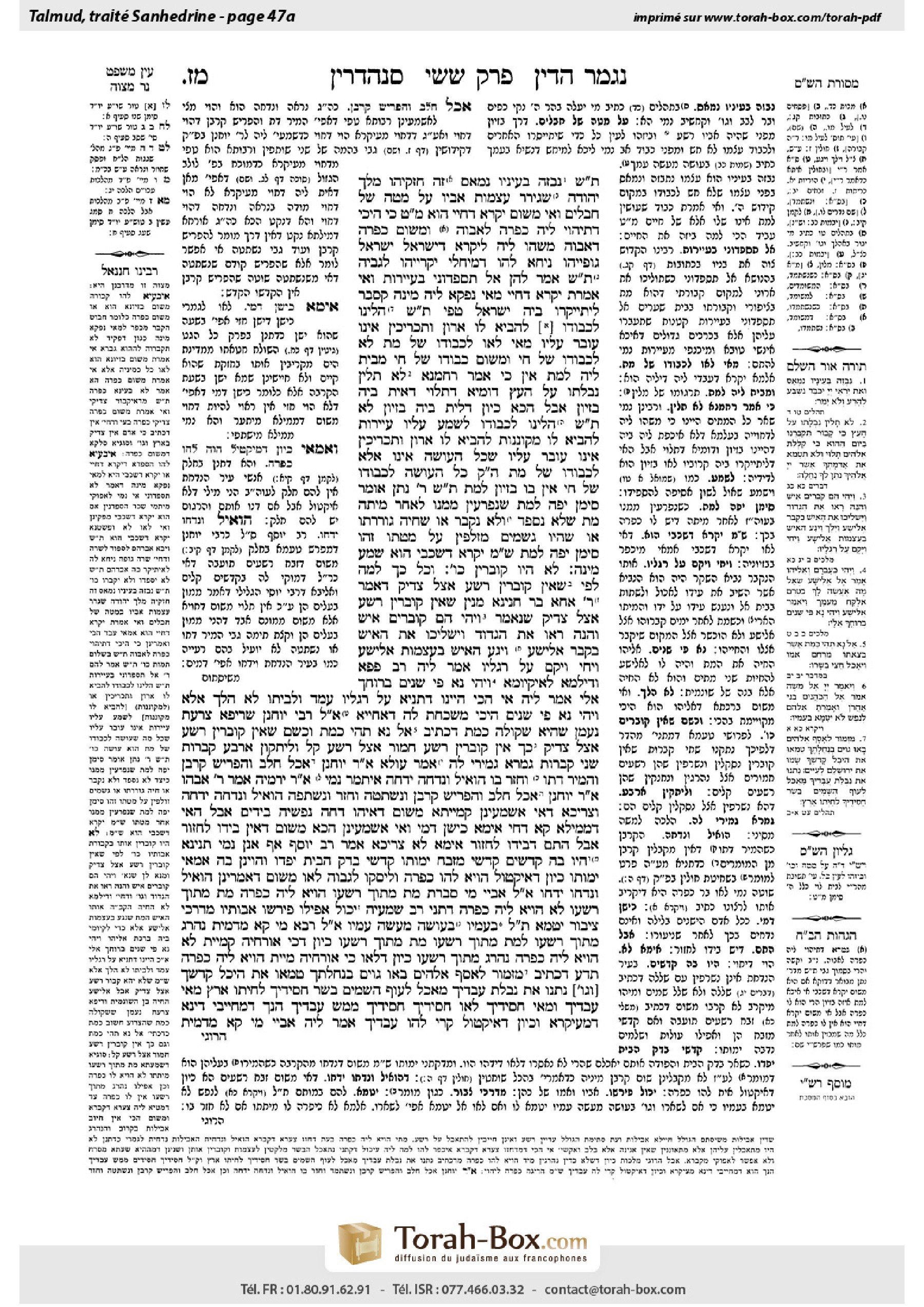
Sanhedrin 47a: Talmud study for Daf Yomi
Daf Yomi is the daily study of one Talmud folio. Explore 37 tractates with scans, Hebrew text, Sefaria English and AI-generated French translations where annotated.
Passage selection and English or AI-generated French translation are available where the scan has annotations. Daf Study is independent of Torah-Box and Sefaria.
Browse Sanhedrin · סנהדרין · All tractatesSanhedrin 47a text and translations
This page of Sanhedrin includes the Aramaic text, an English translation and an AI-generated French translation, alongside the scan above.
סנהדרין מ״ז א · Aramaic and Hebrew text
תָּא שְׁמַע: ״נִבְזֶה בְּעֵינָיו נִמְאָס״ – זֶה חִזְקִיָּהוּ מֶלֶךְ יְהוּדָה, שֶׁגֵּירַר עַצְמוֹת אָבִיו עַל מִטָּה שֶׁל חֲבָלִים. וְאִי מִשּׁוּם יְקָרָא דְחַיֵּי הוּא, מַאי טַעְמָא?
כִּי הֵיכִי דְּתִיהְוֵי לֵיהּ כַּפָּרָה לַאֲבוּהּ, וּמִשּׁוּם כַּפָּרָה דַּאֲבוּהּ מְשַׁהוּ לֵיהּ לִיקָרָא דְיִשְׂרָאֵל? יִשְׂרָאֵל גּוּפַיְיהוּ נִיחָא לְהוּ דְּמַחֲלִי יְקָרַיְיהוּ לְגַבֵּיהּ.
תָּא שְׁמַע, אָמַר לָהֶן: אַל תִּסְפְּדוּנִי בָּעֲיָירוֹת. וְאִי אָמְרַתְּ יְקָרָא דְחַיֵּי, מַאי נָפְקָא לֵיהּ מִינַּהּ? קָסָבַר: לִיתְיַיקְּרוּ בֵּיהּ יִשְׂרָאֵל טְפֵי.
תָּא שְׁמַע: הֱלִינוֹ לִכְבוֹדוֹ, לְהָבִיא לוֹ אָרוֹן וְתַכְרִיכִין – אֵינוֹ עוֹבֵר עָלָיו. מַאי לָאו לִכְבוֹדוֹ שֶׁל מֵת? לֹא, לִכְבוֹדוֹ שֶׁל חַי.
וּמִשּׁוּם כְּבוֹדוֹ שֶׁל חַי מֵבִית לֵיהּ לְמֵת? אִין, כִּי אָמַר רַחֲמָנָא: ״לֹא תָלִין נִבְלָתוֹ עַל הָעֵץ״, דּוּמְיָא דְּתָלוּי דְּאִית בֵּיהּ בִּזָּיוֹן. אֲבָל הָכָא, כֵּיוָן דְּלֵית בֵּיהּ בִּזָּיוֹן – לָא.
תָּא שְׁמַע: הֱלִינוֹ לִכְבוֹדוֹ, לְשַׁמֵּעַ עָלָיו עֲיָירוֹת, לְהָבִיא לוֹ מְקוֹנְנוֹת, לְהָבִיא לוֹ אָרוֹן וְתַכְרִיכִין – אֵינוֹ עוֹבֵר עָלָיו, שֶׁכׇּל הָעוֹשֶׂה אֵינוֹ אֶלָּא לִכְבוֹדוֹ שֶׁל מֵת. הָכִי קָאָמַר: כׇּל הָעוֹשֶׂה לִכְבוֹדוֹ שֶׁל חַי, אֵין בּוֹ בִּזָּיוֹן לַמֵּת.
תָּא שְׁמַע, רַבִּי נָתָן אוֹמֵר: סִימָן יָפֶה לַמֵּת שֶׁנִּפְרָעִין מִמֶּנּוּ לְאַחַר מִיתָה. מֵת שֶׁלֹּא נִסְפַּד וְלֹא נִקְבַּר, אוֹ שֶׁחַיָּה גּוֹרַרְתּוֹ, אוֹ שֶׁהָיוּ גְּשָׁמִים מְזַלְּפִין עַל מִטָּתוֹ – זֶהוּ סִימָן יָפֶה לַמֵּת. שְׁמַע מִינַּהּ: יְקָרָא דְשָׁכְבֵי הוּא. שְׁמַע מִינַּהּ.
לֹא הָיוּ קוֹבְרִין כּוּ׳. וְכׇל כָּךְ לָמָּה? לְפִי שֶׁאֵין קוֹבְרִין רָשָׁע אֵצֶל צַדִּיק, דְּאָמַר רַבִּי אַחָא בַּר חֲנִינָא: מִנַּיִן שֶׁאֵין קוֹבְרִין רָשָׁע אֵצֶל צַדִּיק? שֶׁנֶּאֱמַר: ״וַיְהִי הֵם קֹבְרִים אִישׁ וְהִנֵּה רָאוּ אֶת הַגְּדוּד וַיַּשְׁלִיכוּ אֶת הָאִישׁ בְּקֶבֶר אֱלִישָׁע וַיִּגַּע הָאִישׁ בְּעַצְמוֹת אֱלִישָׁע וַיְחִי וַיָּקׇם עַל רַגְלָיו״.
אֲמַר לֵיהּ רַב פָּפָּא: וְדִילְמָא לְאִיקְּיוֹמֵי ״וִיהִי נָא פִּי שְׁנַיִם בְּרוּחֲךָ אֵלָי״? אֲמַר לֵיהּ: אִי הָכִי, הַיְינוּ דְּתַנְיָא: עַל רַגְלָיו עָמַד, וּלְבֵיתוֹ לֹא הָלַךְ.
אֶלָּא ״וִיהִי נָא פִּי שְׁנַיִם״, הֵיכִי מַשְׁכַּחַתְּ לַהּ דְּאַחֲיֵיא? אֲמַר לֵיהּ רַבִּי יוֹחָנָן: שֶׁרִיפֵּא צָרַעַת נַעֲמָן, שֶׁהִיא שְׁקוּלָה כְּמֵת, דִּכְתִיב ״אַל נָא תְהִי כַּמֵּת״.
וּכְשֵׁם שֶׁאֵין קוֹבְרִין רָשָׁע אֵצֶל צַדִּיק, כָּךְ אֵין קוֹבְרִין רָשָׁע חָמוּר אֵצֶל רָשָׁע קַל. וְלִיתְקוֹן אַרְבַּע קְבָרוֹת! שְׁנֵי קְבָרוֹת גְּמָרָא גְּמִירִי לַהּ.
אָמַר עוּלָּא אָמַר רַבִּי יוֹחָנָן: אָכַל חֵלֶב וְהִפְרִישׁ קׇרְבָּן, וְהִשְׁתַּמֵּד וְחָזַר בּוֹ – הוֹאִיל וְנִדְחָה, יִדָּחֶה.
אִיתְּמַר נָמֵי, אָמַר רַבִּי יִרְמְיָה אָמַר רַבִּי אֲבָהוּ אָמַר רַבִּי יוֹחָנָן: אָכַל חֵלֶב וְהִפְרִישׁ קׇרְבָּן, וְנִשְׁתַּטָּה, וְחָזַר וְנִשְׁתַּפָּה – הוֹאִיל וְנִדְחָה, יִדָּחֶה.
וּצְרִיכָא, דְּאִי אַשְׁמְעִינַן קַמַּיְיתָא – מִשּׁוּם דְּאִיהוּ דְּחָה נַפְשֵׁיהּ בְּיָדַיִם, אֲבָל הַאי דְּמִמֵּילָא קָא דָחֵי – אֵימָא כְּיָשֵׁן דָּמֵי.
וְאִי אַשְׁמְעִינַן הָכָא, מִשּׁוּם דְּאֵין בְּיָדוֹ לַחְזוֹר, אֲבָל הָתָם דִּבְיָדוֹ לַחְזוֹר, אֵימָא לָא. צְרִיכָא.
אָמַר רַב יוֹסֵף: אַף אֲנַן נָמֵי תְּנֵינָא, הָיוּ בָּהּ קֳדָשִׁים, קׇדְשֵׁי מִזְבֵּחַ יָמוּתוּ, קׇדְשֵׁי בֶּדֶק הַבַּיִת יִפָּדוּ. וְהָוֵינַן בַּהּ: אַמַּאי יָמוּתוּ? כֵּיוָן דְּאִיקְּטוּל הָוְיָא לְהוּ כַּפָּרָה, וְלִיסְּקוּ לְגָבוֹהַּ! לָאו מִשּׁוּם דְּאָמְרִינַן: הוֹאִיל וְנִדְחוּ, יִדָּחוּ?
אֲמַר לֵיהּ אַבָּיֵי: מִי סָבְרַתְּ מֵת מִתּוֹךְ רִשְׁעוֹ הָוְיָא לֵיהּ כַּפָּרָה? מֵת מִתּוֹךְ רִשְׁעוֹ לָא הָוְיָא לֵיהּ כַּפָּרָה, דְּתָנֵי רַב שְׁמַעְיָה: יָכוֹל אֲפִילּוּ פֵּירְשׁוּ אֲבוֹתָיו מִדַּרְכֵי צִיבּוּר יִטַּמֵּא? תַּלְמוּד לוֹמַר ״בְּעַמָּיו״ – בְּעוֹשֶׂה מַעֲשֵׂה עַמָּיו.
אֲמַר לֵיהּ רָבָא: מִי קָא מְדַמֵּית נֶהֱרָג מִתּוֹךְ רִשְׁעוֹ לְמֵת מִתּוֹךְ רִשְׁעוֹ? מֵת מִתּוֹךְ רִשְׁעוֹ, כֵּיוָן דְּכִי אוֹרְחֵיהּ קָמָיֵית – לָא הָוְיָא לֵיהּ כַּפָּרָה. נֶהֱרָג מִתּוֹךְ רִשְׁעוֹ, כֵּיוָן דְּלָאו כִּי אוֹרְחֵיהּ מָיֵית – הָוְיָא לֵיהּ כַּפָּרָה.
תִּדַּע, דִּכְתִיב: מִזְמוֹר לְאָסָף אֱלֹהִים בָּאוּ גוֹיִם בְּנַחֲלָתֶךָ טִמְּאוּ אֶת הֵיכַל קׇדְשֶׁךָ [וְגוֹ׳] נָתְנוּ אֶת נִבְלַת עֲבָדֶיךָ מַאֲכָל לְעוֹף הַשָּׁמָיִם בְּשַׂר חֲסִידֶיךָ לְחַיְתוֹ אָרֶץ״. מַאי ״עֲבָדֶיךָ״ וּמַאי ״חֲסִידֶיךָ״? לָאו ״חֲסִידֶיךָ״ – חֲסִידֶיךָ מַמָּשׁ, ״עֲבָדֶיךָ״ – הָנָךְ דִּמְחַיְּיבִי דִּינָא דְּמֵעִיקָּרָא, וְכֵיוָן דְּאִיקְּטוּל קָרֵי לְהוּ ״עֲבָדֶיךָ״.
אֲמַר לֵיהּ אַבָּיֵי: מִי קָא מְדַמֵּית
Sanhedrin 47a · English translation
The Gemara suggests: Come and hear a proof from what was taught with regard to the verse: “In his eyes a vile person is despised, but he honors them that fear the Lord” (Psalms 15:4). This is referring to Hezekiah, king of Judea, who dragged the bones of his father, Ahaz, on a bier made of ropes, and he did not bury Ahaz in a manner befitting a king in order to disgrace him for his sinful conduct. And if the eulogy and other funeral rites are meant to honor the living, what is the reason that he acted this way, in a manner that brought disgrace upon himself and all of the Jewish people?
The Gemara answers: Hezekiah did this so that his father would achieve atonement for his sins through his disgrace. The Gemara asks: Can it be that for his father’s atonement they would defer the honor of all of Israel, who would have been honored by a proper eulogy for their late king? The Gemara answers: It was satisfactory to the people of Israel themselves to forgo their honor for him in order that their former king achieve atonement for his sins.
The Gemara suggests: Come and hear a proof from a baraita: Before he died, Rabbi Yehuda HaNasi said to his disciples: Do not eulogize me in the small towns that you pass as you take my body out for burial, but eulogize me only in the larger cities. And if you say that a eulogy is delivered in honor of the living, what difference does it make to him if he is eulogized also in the smaller towns? The Gemara answers: He thought that the people of Israel would be more greatly honored through him if they gathered together for the eulogies in the larger cities.
The Gemara suggests: Come and hear a proof from the mishna: If one left his deceased relative unburied overnight for the sake of his honor, e.g., in order to bring him a coffin or shrouds, he does not transgress the prohibition of “his body shall not remain all night.” What, is it not referring to the honor of the deceased? The Gemara answers: No, it is referring to the honor of the living relatives of the deceased.
The Gemara asks: But can it be that due to the honor of the living, they allow the deceased to remain unburied overnight? The Gemara answers: Yes, as when the Merciful One states: “His body shall not remain all night upon the tree, but you shall bury him that day” (Deuteronomy 21:23), it teaches that the prohibition applies only to cases similar to that of a person whose body is hung after his death, who suffers degradation when his corpse is left hanging overnight. But here, since the deceased does not suffer degradation when the funeral is delayed, as the delay is in order that the burial will be performed with greater dignity, there is no violation of the prohibition, and he may be left unburied overnight.
The Gemara suggests: Come and hear a proof from a baraita: If one left his deceased relative unburied overnight for the sake of his honor, for example, in order to assemble the people from the neighboring towns for the funeral, or to bring him professional lamenters, or to bring him a coffin or shrouds, he does not transgress the prohibition of “his body shall not remain all night,” as anyone who acts in such a manner does so only for the sake of honoring the dead. This indicates that the eulogy and other funeral rites are performed to honor the deceased. The Gemara rejects this argument: This is what the baraita is saying: Anyone who acts in such a manner for the sake of honoring the living does not transgress the prohibition, as there is no degradation of the dead.
The Gemara suggests: Come and hear a proof from a baraita: Rabbi Natan says: It is a good sign for the deceased when he is punished after his death and does not receive an honorable burial or eulogy, as his lack of honor brings him atonement for his sins. For example, if the deceased was not eulogized, or if he was not buried, or if a wild animal dragged his corpse, or if rain fell on his bier, this is a good sign for the deceased. Learn from the baraita that a eulogy is delivered for the honor of the dead, so that when he is deprived of this honor, he achieves atonement for his sins. The Gemara affirms: Learn from the baraita that this is so.
§ The mishna teaches that they would not bury the executed transgressor in his ancestral burial plot, but rather in one of two special graveyards set aside for those executed by the court. The Gemara explains: And why is all this necessary? It is necessary because a wicked man is not buried next to a righteous man. As Rav Aḥa bar Ḥanina says: From where is it derived that a wicked man is not buried next to a righteous man? As it is stated: “And it came to pass, as they were burying a man, that behold, they spied a raiding party; and they cast the man into the tomb of Elisha; and as the man came there, he touched the bones of Elisha, and he revived and stood up on his feet” (II Kings 13:21). The man, who was not righteous, was miraculously resurrected so that he would not remain buried alongside Elisha.
Rav Pappa said to Rav Aḥa bar Ḥanina: What proof is there from here? Perhaps the man was resurrected in order to fulfill Elisha’s request of Elijah: “I pray you, let a double portion of your spirit be upon me” (II Kings 2:9), as now Elisha resurrected two people, the son of the Shunammite woman and this man, as opposed to Elijah, who had resurrected only one person? Rav Aḥa bar Ḥanina said to Rav Pappa: If so, there is a difficulty, as is this a reasonable explanation in light of what is taught in a baraita: The words “and stood up on his feet” indicate that he arose, but he did not go to his home. The man did not in fact live again but for a moment, indicating that he was resurrected not in order to fulfill Elisha’s request for a double portion of Elijah’s spirit, but in order to prevent the disgrace of having a wicked man buried next to Elisha.
The Gemara asks: But if so, with regard to the verse: “I pray you, let a double portion of your spirit be upon me,” where do you find that Elisha resurrected a second person? Rabbi Yoḥanan said to him: That request was fulfilled when he cured Naaman’s leprosy (see II Kings, chapter 5), an affliction that is considered to be equivalent to death, as it is written with regard to Miriam’s leprosy: “Let her not be as one dead” (Numbers 12:12).
The mishna teaches that two graveyards were established for the burial of those executed by the court, one for those who were killed by decapitation or strangulation, and one for those who were stoned or burned. The Gemara explains: Just as a wicked man is not buried next to a righteous man, so too an extremely wicked man, i.e., one who committed a grave offense is not buried next to a less wicked man, i.e., one who committed a less severe offense. The Gemara challenges: If so, let them establish four different graveyards, one for each of the different modes of judicial execution. The Gemara answers. It is learned as a tradition that there are two graveyards for those executed by the court, and no more.
§ Ulla says that Rabbi Yoḥanan says: If one unwittingly ate forbidden fat and separated an offering for this sin, and he then became an apostate and subsequently retracted his apostasy, despite his retraction, since the offering was rejected from being sacrificed while he was an apostate, it shall remain rejected.
It was also stated that Rabbi Yirmeya says that Rabbi Abbahu says that Rabbi Yoḥanan says: If one unwittingly ate forbidden fat and separated an offering for this sin, and he then became insane, and later he regained his sanity, the animal that he had dedicated as a sin-offering may not be sacrificed. Since the offering was rejected from being sacrificed while he was insane, it shall remain rejected.
The Gemara explains: And it was necessary for Rabbi Yoḥanan to teach us this halakha in both cases. As, had he taught us only the first halakha, with regard to the apostate, I would say that only in that case is the animal rejected forever, because the owner actively rejected himself when he became an apostate. But in this case of insanity, where the owner was rejected automatically, not of his own choice, I would say that he is considered as one who is asleep, so that as soon as he regains his sanity, his offering is once again fit.
And had he taught us the halakha only in this second case of insanity, I would say that only in that case is the animal rejected forever, because it was not in the owner’s power to regain his sanity, as one who is insane cannot cure himself. But there, with regard to an apostate, who has the power to retract his apostasy, I would say that his animal is not permanently rejected. It was therefore necessary to teach us the halakha in both cases.
Rav Yosef said: We, too, learn a similar halakha in a baraita: If consecrated items were found in an idolatrous city, they are not destroyed together with the rest of the property of the city. Animals that had been consecrated to be offered on the altar must be left to die, and property that had been consecrated for Temple maintenance may be redeemed and is then desacralized. And we discussed it: Why must the animals that had been consecrated for the altar be left to die? Once the idolaters are killed, they achieve atonement, and therefore it should be possible to sacrifice their offerings to the Most High. Is it not the case that the animals must be left to die because we say: Since they were rejected when their owners engaged in idol worship, they remain rejected even after their owners achieve atonement for their sins with their death?
Abaye said to Rav Yosef: Do you maintain that one who dies in his state of wickedness without repenting achieves atonement? This is not the case, as one who dies in his state of wickedness without repenting does not achieve atonement, as Rav Shemaya taught in a baraita: The verse states with regard to the priests: “There shall none be defiled for the dead among his people, but for his kin that is near to him, for his mother, and for his father” (Leviticus 21:1–2). One might have thought that even if his father had become an apostate and separated himself from the ways of the community, his son the priest shall become ritually impure in order to bury him. Therefore, the verse states: “Among his people,” which teaches that a priest may become ritually impure only for one who performs the actions of his people, that is, one who conducts himself as a Jew. This indicates that one who dies in his wickedness without repenting does not achieve atonement.
Rava said to Abaye: Are you comparing one who was killed in his state of wickedness to one who died in his state of wickedness? An unrepentant sinner who died in his state of wickedness does not achieve atonement, since he died a natural death and there was nothing to bring about his atonement. But a transgressor who was killed in his state of wickedness achieves atonement, even without repentance, since he did not die a natural death, but rather he was executed.
Know that this is so, as it is written: “A song to Asaf. O God, nations are come into Your inheritance; they have defiled your Holy Temple; they have laid Jerusalem in heaps. The dead bodies of Your servants they have given to be food to the birds of the sky, the flesh of Your pious ones to the beasts of the earth” (Psalms 79:1–2). What is the meaning of “Your servants” and what is the meaning of “Your pious ones”? Is it not so that the term “Your pious ones” is referring to literally, Your pious ones, those who had always feared God; whereas “Your servants” is referring to those who had initially been liable to receive punishment for their sins, but once they were killed, they are called “Your servants”? This indicates that a transgressor who was executed achieves atonement even without repentance.
Abaye said to Rava: Are you comparing
Sanhedrin 47a · Traduction française (IA)
La Guemara propose : Viens et entends une preuve tirée de ce qui a été enseigné au sujet du verset : « À ses yeux, le méprisable est méprisé, mais il honore ceux qui craignent le Seigneur » (Psaumes 15:4). Ce verset fait référence à Ézéchias, roi de Judée, qui fit traîner les ossements de son père Achaz sur une civière de cordes et ne le fit pas enterrer comme il convient à un roi, afin de le couvrir de honte pour sa conduite pécheresse. Or, si l’éloge funèbre et les autres rites funéraires visent à honorer les vivants, pourquoi a-t-il agi ainsi, d’une manière qui le déshonorait lui-même ainsi que tout le peuple juif ?
La Guemara répond : Ézéchias agit ainsi pour que son père obtienne l’expiation de ses péchés par cette humiliation. La Guemara demande : Se peut-il qu’en vue de l’expiation de son père, on renonce à l’honneur de tout Israël, qui aurait été honoré par un éloge funèbre convenable pour son roi défunt ? La Guemara répond : Le peuple d’Israël lui-même accepta de renoncer à son honneur afin que son ancien roi obtienne l’expiation de ses péchés.
La Guemara propose : Viens et entends une preuve tirée d’une baraïta : Avant de mourir, Rabbi Yehuda HaNassi dit à ses disciples : « Ne faites pas mon éloge funèbre dans les petites villes que vous traverserez en emportant mon corps pour l’inhumer, mais faites-le seulement dans les grandes villes. » Or, si l’éloge funèbre est prononcé en l’honneur des vivants, quelle différence cela lui fait-il qu’on fasse aussi son éloge dans les petites villes ? La Guemara répond : Il pensait que le peuple d’Israël serait davantage honoré grâce à lui si les gens se rassemblaient dans les grandes villes pour les éloges funèbres.
La Guemara propose : Viens et entends une preuve tirée de la Michna : Si quelqu’un laisse son proche défunt sans sépulture pendant la nuit pour l’honorer, par exemple afin de lui procurer un cercueil ou des linceuls, il ne transgresse pas l’interdiction : « Son corps ne passera pas la nuit » (Deutéronome 21:23). N’est-il pas question ici de l’honneur du défunt ? La Guemara répond : Non, il s’agit de l’honneur des proches vivants du défunt.
La Guemara demande : Mais se peut-il qu’en raison de l’honneur des vivants, on laisse le défunt sans sépulture pendant la nuit ? La Guemara répond : Oui. Lorsque le Miséricordieux déclare : « Son corps ne passera pas la nuit sur le bois, mais tu l’enterreras le jour même » (Deutéronome 21:23), cela enseigne que l’interdiction ne s’applique qu’aux cas semblables à celui d’un homme pendu après sa mort, dont le cadavre subit une dégradation s’il reste suspendu pendant la nuit. Mais ici, puisque le défunt ne subit aucune dégradation lorsque les funérailles sont retardées, ce délai visant à rendre l’inhumation plus digne, il n’y a pas transgression de l’interdiction et on peut le laisser sans sépulture pendant la nuit.
La Guemara propose : Viens et entends une preuve tirée d’une baraïta : Si quelqu’un laisse son proche défunt sans sépulture pendant la nuit pour l’honorer, par exemple afin de réunir les habitants des villes voisines pour les funérailles, de faire venir des pleureurs professionnels ou de lui procurer un cercueil ou des linceuls, il ne transgresse pas l’interdiction : « Son corps ne passera pas la nuit », car quiconque agit ainsi le fait uniquement pour honorer les morts. Cela indique que l’éloge funèbre et les autres rites funéraires sont accomplis en l’honneur du défunt. La Guemara rejette cet argument : Voici ce que dit la baraïta : quiconque agit ainsi pour honorer les vivants ne transgresse pas l’interdiction, car le défunt ne subit aucune dégradation.
La Guemara propose : Viens et entends une preuve tirée d’une baraïta : Rabbi Natan dit : « C’est un bon signe pour le défunt lorsqu’il est puni après sa mort et ne reçoit ni inhumation ni éloge funèbre honorables », car la privation d’honneur lui apporte l’expiation de ses péchés. Par exemple, si le défunt n’a pas eu d’éloge funèbre, s’il n’a pas été enterré, si une bête sauvage a traîné son cadavre ou si la pluie est tombée sur sa civière, c’est un bon signe pour lui. Déduis de cette baraïta qu’un éloge funèbre est prononcé en l’honneur des morts, de sorte que le défunt obtient l’expiation de ses péchés lorsqu’il est privé de cet honneur. La Guemara confirme : Déduis de cette baraïta qu’il en est bien ainsi.
§ La Michna enseigne qu’on n’enterrait pas le transgresseur exécuté dans le tombeau de ses ancêtres, mais dans l’un des deux cimetières réservés aux personnes exécutées par le tribunal. La Guemara explique : Pourquoi tout cela est-il nécessaire ? Parce qu’un méchant n’est pas enterré à côté d’un juste. Rav Aḥa bar Ḥanina dit en effet : D’où déduit-on qu’un méchant n’est pas enterré à côté d’un juste ? Comme il est dit : « Or, comme on enterrait un homme, voici qu’on aperçut une bande de pillards ; on jeta l’homme dans le tombeau d’Élisée ; et lorsque l’homme y arriva et toucha les ossements d’Élisée, il reprit vie et se tint debout sur ses pieds » (II Rois 13:21). Cet homme, qui n’était pas juste, fut ressuscité par miracle afin qu’il ne reste pas enterré aux côtés d’Élisée.
Rav Pappa dit à Rav Aḥa bar Ḥanina : Quelle preuve tire-t-on de là ? Peut-être l’homme fut-il ressuscité afin d’accomplir la demande qu’Élisée avait adressée à Élie : « Je t’en prie, qu’une double part de ton esprit soit sur moi » (II Rois 2:9), car Élisée aurait alors ressuscité deux personnes, le fils de la femme de Chounem et cet homme, contrairement à Élie, qui n’avait ressuscité qu’une seule personne. Rav Aḥa bar Ḥanina dit à Rav Pappa : Dans ce cas, une difficulté se pose, car cette explication est-elle raisonnable au regard de ce qui est enseigné dans une baraïta ? Les mots « et se tint debout sur ses pieds » indiquent qu’il se releva, mais qu’il ne rentra pas chez lui. En réalité, l’homme ne revécut qu’un instant, ce qui indique qu’il fut ressuscité non pour accomplir la demande d’Élisée d’obtenir une double part de l’esprit d’Élie, mais afin d’éviter la dégradation que constituerait l’inhumation d’un méchant à côté d’Élisée.
La Guemara demande : Mais dans ce cas, à quel moment Élisée a-t-il ressuscité une seconde personne, conformément au verset : « Je t’en prie, qu’une double part de ton esprit soit sur moi » ? Rabbi Yoḥanan lui dit : Cette demande fut exaucée lorsqu’il guérit Naaman de sa lèpre (voir II Rois, chapitre 5), affection considérée comme équivalant à la mort, comme il est écrit au sujet de la lèpre de Myriam : « Qu’elle ne soit pas comme une morte » (Nombres 12:12).
La Michna enseigne que deux cimetières furent établis pour l’inhumation des personnes exécutées par le tribunal : l’un pour celles qui avaient été décapitées ou étranglées, l’autre pour celles qui avaient été lapidées ou brûlées. La Guemara explique : De même qu’un méchant n’est pas enterré à côté d’un juste, un méchant particulièrement coupable, c’est-à-dire quelqu’un qui a commis une faute grave, n’est pas non plus enterré à côté d’un méchant moins coupable, c’est-à-dire quelqu’un qui a commis une faute moins grave. La Guemara objecte : Dans ce cas, qu’ils établissent quatre cimetières distincts, un pour chacun des différents modes d’exécution judiciaire. La Guemara répond : La tradition enseigne qu’il y a deux cimetières pour les personnes exécutées par le tribunal, et pas davantage.
§ Oulla dit au nom de Rabbi Yoḥanan : Si quelqu’un a mangé par inadvertance du suif interdit et a mis à part une offrande pour cette faute, puis est devenu apostat avant de revenir sur son apostasie, même s’il y a ensuite renoncé, puisque l’offrande a été écartée du sacrifice alors qu’il était apostat, elle le demeure.
Il a également été enseigné que Rabbi Yirmeya dit au nom de Rabbi Abbahou, qui le dit au nom de Rabbi Yoḥanan : Si quelqu’un a mangé par inadvertance du suif interdit et a mis à part une offrande pour cette faute, puis est devenu fou avant de recouvrer la raison, l’animal qu’il avait consacré comme sacrifice expiatoire ne peut pas être offert. Puisque l’offrande a été écartée du sacrifice alors qu’il était fou, elle le demeure.
La Guemara explique : Rabbi Yoḥanan devait nous enseigner cette halakha dans les deux cas. En effet, s’il nous avait enseigné seulement la première halakha, celle de l’apostat, j’aurais dit que l’animal est écarté définitivement uniquement dans ce cas, car son propriétaire s’est lui-même écarté activement en devenant apostat. Mais dans le cas de la folie, où le propriétaire a été écarté automatiquement, sans l’avoir choisi, j’aurais dit qu’il est considéré comme endormi, de sorte que, dès qu’il recouvre la raison, son offrande redevient apte à être offerte.
Et s’il nous avait enseigné la halakha uniquement dans ce second cas, celui de la folie, j’aurais dit que l’animal est écarté définitivement uniquement dans ce cas, car le propriétaire n’avait pas le pouvoir de recouvrer la raison, puisqu’un fou ne peut pas se guérir lui-même. Mais dans le cas d’un apostat, qui peut renoncer à son apostasie, j’aurais dit que son animal n’est pas écarté définitivement. Il était donc nécessaire de nous enseigner la halakha dans les deux cas.
Rav Yossef dit : Nous apprenons nous aussi une halakha semblable dans une baraïta : Si des biens consacrés sont trouvés dans une ville idolâtre, ils ne sont pas détruits avec le reste des biens de la ville. Les animaux consacrés pour être offerts sur l’autel doivent être laissés à mourir, tandis que les biens consacrés à l’entretien du Temple peuvent être rachetés puis désacralisés. Nous avons discuté de cette règle : Pourquoi les animaux consacrés pour l’autel doivent-ils être laissés à mourir ? Une fois les idolâtres tués, ils obtiennent l’expiation de leurs péchés ; leurs offrandes devraient donc pouvoir être offertes au Très-Haut. N’est-ce pas parce que les animaux doivent être laissés à mourir que nous disons : puisqu’ils ont été écartés lorsque leurs propriétaires se sont livrés au culte des idoles, ils le demeurent même après que leurs propriétaires ont obtenu l’expiation de leurs péchés par leur mort ?
Abayé dit à Rav Yossef : Penses-tu que celui qui meurt dans son état de méchanceté sans s’être repenti obtient l’expiation de ses péchés ? Ce n’est pas le cas : celui qui meurt dans son état de méchanceté sans s’être repenti n’obtient pas l’expiation de ses péchés, comme Rav Shemaya l’a enseigné dans une baraïta : Le verset dit au sujet des prêtres : « Qu’aucun d’eux ne se rende impur pour un mort parmi son peuple, sauf pour son proche parent, pour sa mère et pour son père » (Lévitique 21:1–2). On aurait pu penser que même si son père était devenu apostat et s’était séparé des voies de la communauté, son fils prêtre devait se rendre rituellement impur afin de l’enterrer. Le verset dit donc : « parmi son peuple », ce qui enseigne qu’un prêtre ne peut se rendre rituellement impur que pour celui qui adopte la conduite de son peuple, c’est-à-dire qui se conduit en Juif. Cela indique que celui qui meurt dans son état de méchanceté sans s’être repenti n’obtient pas l’expiation de ses péchés.
Rava dit à Abayé : Comparerais-tu celui qui a été tué dans son état de méchanceté à celui qui est mort dans son état de méchanceté ? Le pécheur impénitent qui meurt dans son état de méchanceté n’obtient pas l’expiation de ses péchés, puisqu’il est mort de mort naturelle et que rien n’est venu provoquer cette expiation. Mais le transgresseur qui a été tué dans son état de méchanceté obtient l’expiation, même sans s’être repenti, puisqu’il n’est pas mort de mort naturelle, mais a été exécuté.
Sache que c’est bien ainsi, comme il est écrit : « Cantique d’Asaph. Ô Dieu, les nations ont envahi ton héritage ; elles ont profané ton saint Temple ; elles ont réduit Jérusalem en ruines. Elles ont livré les cadavres de tes serviteurs en pâture aux oiseaux du ciel, la chair de tes fidèles aux bêtes de la terre » (Psaumes 79:1–2). Que signifient « tes serviteurs » et « tes fidèles » ? N’est-ce pas que « tes fidèles » désigne littéralement tes fidèles, ceux qui ont toujours craint Dieu, tandis que « tes serviteurs » désigne ceux qui, au départ, étaient passibles d’une punition pour leurs péchés, mais qui, une fois tués, sont appelés « tes serviteurs » ? Cela indique qu’un transgresseur exécuté obtient l’expiation de ses péchés même sans s’être repenti.
Abayé dit à Rava : Comparerais-tu
Traduction française générée par IA à partir de l’édition anglaise de Sefaria. Vérifie toujours un passage avec le texte source.
Text from Sefaria: William Davidson Edition - Vocalized Aramaic (CC BY NC); William Davidson Edition - English (CC BY NC).