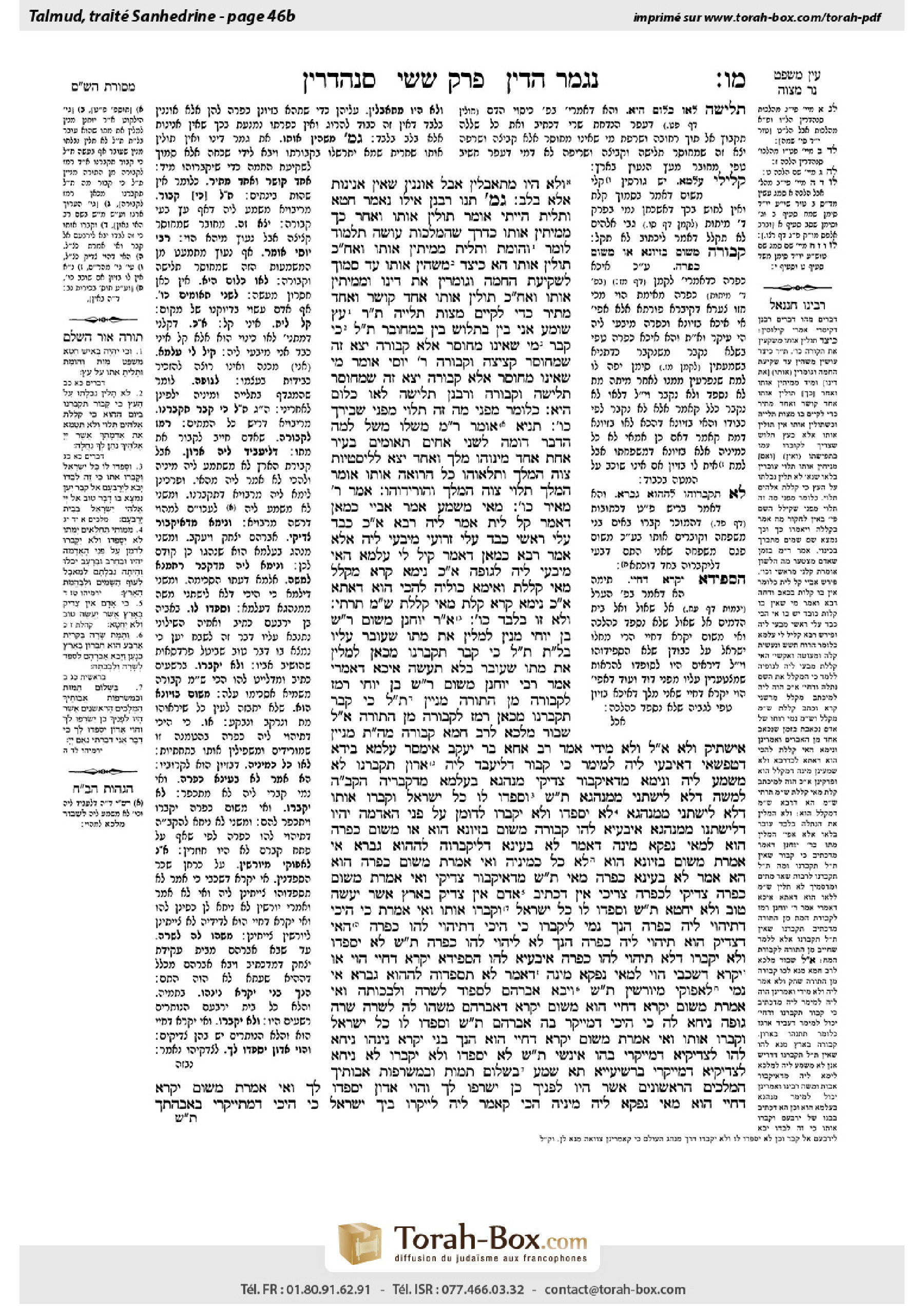
Sanhedrin 46b: Talmud study for Daf Yomi
Daf Yomi is the daily study of one Talmud folio. Explore 37 tractates with scans, Hebrew text, Sefaria English and AI-generated French translations where annotated.
Passage selection and English or AI-generated French translation are available where the scan has annotations. Daf Study is independent of Torah-Box and Sefaria.
Browse Sanhedrin · סנהדרין · All tractatesSanhedrin 46b text and translations
This page of Sanhedrin includes the Aramaic text, an English translation and an AI-generated French translation, alongside the scan above.
סנהדרין מ״ו ב · Aramaic and Hebrew text
וְלֹא הָיוּ מִתְאַבְּלִין, אֲבָל אוֹנְנִין, שֶׁאֵין אֲנִינוּת אֶלָּא בַּלֵּב.
גְּמָ׳ תָּנוּ רַבָּנַן: אִילּוּ נֶאֱמַר ״חֵטְא וְתָלִיתָ״, הָיִיתִי אוֹמֵר תּוֹלִין אוֹתוֹ וְאַחַר כָּךְ מְמִיתִין אוֹתוֹ, כְּדֶרֶךְ שֶׁהַמַּלְכוּת עוֹשָׂה. תַּלְמוּד לוֹמַר: ״וְהוּמָת וְתָלִיתָ״ – מְמִיתִין אוֹתוֹ וְאַחַר כָּךְ תּוֹלִין אוֹתוֹ. הָא כֵּיצַד? מְשַׁהִין אוֹתוֹ עַד סָמוּךְ לִשְׁקִיעַת הַחַמָּה, וְגוֹמְרִין אֶת דִּינוֹ, וּמְמִיתִין אוֹתוֹ, וְאַחַר כָּךְ תּוֹלִין אוֹתוֹ. אֶחָד קוֹשֵׁר וְאֶחָד מַתִּיר, כְּדֵי לְקַיֵּים מִצְוַת תְּלִיָּיה.
תָּנוּ רַבָּנַן: ״עֵץ״ – שׁוֹמֵעַ אֲנִי בֵּין בְּתָלוּשׁ בֵּין בִּמְחוּבָּר. תַּלְמוּד לוֹמַר ״כִּי קָבוֹר״ – מִי שֶׁאֵינוֹ מְחוּסָּר אֶלָּא קְבוּרָה, יָצָא זֶה שֶׁמְחוּסָּר קְצִיצָה וּקְבוּרָה.
רַבִּי יוֹסֵי אוֹמֵר: מִי שֶׁאֵינוֹ מְחוּסָּר אֶלָּא קְבוּרָה – יָצָא זֶה שֶׁמְחוּסָּר תְּלִישָׁה וּקְבוּרָה. וְרַבָּנַן: תְּלִישָׁה לָאו כְּלוּם הִיא.
כְּלוֹמַר: מִפְּנֵי מָה זֶה תָּלוּי? מִפְּנֵי שֶׁבֵּירַךְ כּוּ׳. תַּנְיָא, אוֹמֵר רַבִּי מֵאִיר: מָשְׁלוּ מָשָׁל, לְמָה הַדָּבָר דּוֹמֶה? לִשְׁנֵי אַחִים תְּאוֹמִים בְּעִיר אַחַת. אֶחָד מִינּוּהוּ מֶלֶךְ, וְאֶחָד יָצָא לְלִיסְטִיּוּת. צִוָּה הַמֶּלֶךְ וּתְלָאוּהוּ. כׇּל הָרוֹאֶה אוֹתוֹ אוֹמֵר: הַמֶּלֶךְ תָּלוּי. צִוָּה הַמֶּלֶךְ וְהוֹרִידוּהוּ.
אָמַר רַבִּי מֵאִיר כּוּ׳. מַאי מַשְׁמַע? אָמַר אַבָּיֵי: כְּמַאן דְּאָמַר ״קַל לֵית״. אֲמַר לֵיהּ רָבָא: אִם כֵּן, ״כָּבֵד עָלַי רֹאשִׁי״ ״כָּבֵד עָלַי זְרוֹעִי״ מִיבְּעֵי לֵיהּ! אֶלָּא אָמַר רָבָא: כְּמַאן דְּאָמַר ״קִיל לִי עָלְמָא״.
הַאי מִיבְּעֵי לֵיהּ לְגוּפֵהּ? אִם כֵּן, נֵימָא קְרָא ״מְקַלֵּל״. מַאי ״קִלְלַת״? וְאֵימָא: כּוּלֵּיהּ לְהָכִי הוּא דַּאֲתָא? אִם כֵּן, נֵימָא קְרָא ״קַלַּת״. מַאי ״קִלְלַת״? שְׁמַע מִינַּהּ תַּרְתֵּי.
וְלֹא זוֹ בִּלְבַד כּוּ׳. אָמַר רַבִּי יוֹחָנָן מִשּׁוּם רַבִּי שִׁמְעוֹן בֶּן יוֹחַי: מִנַּיִן לַמֵּלִין אֶת מֵתוֹ שֶׁעוֹבֵר עָלָיו בְּלֹא תַעֲשֶׂה? תַּלְמוּד לוֹמַר: ״כִּי קָבוֹר תִּקְבְּרֶנּוּ״. מִכָּאן לַמֵּלִין אֶת מֵתוֹ שֶׁעוֹבֵר בְּלֹא תַעֲשֶׂה.
אִיכָּא דְּאָמְרִי: אָמַר רַבִּי יוֹחָנָן מִשּׁוּם רַבִּי שִׁמְעוֹן בֶּן יוֹחַי, רֶמֶז לִקְבוּרָה מִן הַתּוֹרָה מִנַּיִין? תַּלְמוּד לוֹמַר: ״כִּי קָבוֹר תִּקְבְּרֶנּוּ״. מִכָּאן רֶמֶז לִקְבוּרָה מִן הַתּוֹרָה.
אֲמַר לֵיהּ שַׁבּוּר מַלְכָּא לְרַב חָמָא: קְבוּרָה מִן הַתּוֹרָה מִנַּיִין? אִישְׁתִּיק וְלָא אֲמַר לֵיהּ וְלָא מִידֵּי. אֲמַר רַב אַחָא בַּר יַעֲקֹב: אִימְּסַר עָלְמָא בִּידָא דְּטַפְשָׁאֵי, דְּאִיבְּעִי לֵיהּ לְמֵימַר ״כִּי קָבוֹר״.
דְּלֶיעֱבֵד לֵיהּ אָרוֹן. ״תִּקְבְּרֶנּוּ״! לָא מַשְׁמַע לֵיהּ.
וְנֵימָא: מִדְּאִיקְּבוּר צַדִּיקֵי? מִנְהֲגָא בְּעָלְמָא! מִדְּקַבְרֵיהּ הַקָּדוֹשׁ בָּרוּךְ הוּא לְמֹשֶׁה? דְּלָא לִישְׁתַּנֵּי מִמִּנְהֲגָא.
תָּא שְׁמַע: ״וְסָפְדוּ לוֹ כׇל יִשְׂרָאֵל וְקָבְרוּ אֹתוֹ״. דְּלָא לִישְׁתַּנֵּי מִמִּנְהֲגָא.
״לֹא יִסָּפְדוּ וְלֹא יִקָּבֵרוּ לְדֹמֶן עַל פְּנֵי הָאֲדָמָה יִהְיוּ״. דְּלִישְׁתַּנּוֹ מִמִּנְהֲגָא.
אִיבַּעְיָא לְהוּ: קְבוּרָה מִשּׁוּם בִּזְיוֹנָא הוּא, אוֹ מִשּׁוּם כַּפָּרָה הוּא?
לְמַאי נָפְקָא מִינַּהּ? דְּאָמַר: לָא בָּעֵינָא דְּלִיקְבְּרוּהּ לְהָהוּא גַּבְרָא. אִי אָמְרַתְּ מִשּׁוּם בִּזְיוֹנָא הוּא – לָא כֹּל כְּמִינֵּיהּ, וְאִי אָמְרַתְּ מִשּׁוּם כַּפָּרָה הוּא – הָא אָמַר: לָא בָּעֵינָא כַּפָּרָה. מַאי?
תָּא שְׁמַע: מִדְּאִיקְּבוּר צַדִּיקֵי, וְאִי אָמְרַתְּ מִשּׁוּם כַּפָּרָה – צַדִּיקֵי לְכַפָּרָה צְרִיכִי? אִין, דִּכְתִיב: ״אָדָם אֵין צַדִּיק בָּאָרֶץ אֲשֶׁר יַעֲשֶׂה טּוֹב וְלֹא יֶחֱטָא״.
תָּא שְׁמַע: ״וְסָפְדוּ לוֹ כׇל יִשְׂרָאֵל וְקָבְרוּ אֹתוֹ״. וְאִי אָמְרַתְּ, כִּי הֵיכִי דְּתֶיהֱוֵי לֵיהּ כַּפָּרָה, הָנָךְ נָמֵי לִיקַּבְרוּ כִּי הֵיכִי דְּתֶיהֱוֵי לְהוּ כַּפָּרָה? הַאי דְּצַדִּיק הוּא – תֶּיהֱוֵי לֵיהּ כַּפָּרָה, הָנָךְ – לָא לֶיהֱוֵי לְהוּ כַּפָּרָה.
תָּא שְׁמַע: ״לֹא יִסָּפְדוּ וְלֹא יִקָּבֵרוּ״, דְּלָא תֶּיהֱוֵי לְהוּ כַּפָּרָה.
אִיבַּעְיָא לְהוּ: הֶסְפֵּידָא, יְקָרָא דְּחָיֵי הָוֵי אוֹ יְקָרָא דְּשָׁכְבֵי הָוֵי? לְמַאי נָפְקָא מִינַּהּ? דְּאָמַר: לָא תִּסְפְּדוּהּ לְהָהוּא גַּבְרָא. אִי נָמֵי, לְאַפּוֹקֵי מִיּוֹרְשִׁין.
תָּא שְׁמַע: ״וַיָּבֹא אַבְרָהָם לִסְפֹּד לְשָׂרָה וְלִבְכֹּתָהּ״. וְאִי אָמְרַתְּ מִשּׁוּם יְקָרָא דְּחַיֵּי הוּא, מִשּׁוּם יְקָרָא דְּאַבְרָהָם מְשַׁהוּ לַהּ לְשָׂרָה? שָׂרָה גּוּפַהּ נִיחָא לָהּ, כִּי הֵיכִי דְּמִיַּיקַּר בַּהּ אַבְרָהָם.
תָּא שְׁמַע: ״וְסָפְדוּ לוֹ כׇל יִשְׂרָאֵל וְקָבְרוּ אֹתוֹ״. וְאִי אָמְרַתְּ מִשּׁוּם יְקָרָא דְּחַיֵּי הוּא, הָנָךְ בְּנֵי יְקָרָא נִינְהוּ? נִיחָא לְהוּ לְצַדִּיקַיָּא דְּמִיַּיקְּרִי בְּהוּ אִינָשֵׁי.
תָּא שְׁמַע: ״לֹא יִסָּפְדוּ וְלֹא יִקָּבֵרוּ״. לָא נִיחָא לְצַדִּיקַיָּא דְּמִיַּיקְּרִי בַּרְשִׁיעִיָּיא.
תָּא שְׁמַע: ״בְּשָׁלוֹם תָּמוּת וּבְמִשְׂרְפוֹת אֲבוֹתֶיךָ הַמְּלָכִים הָרִאשׁוֹנִים אֲשֶׁר הָיוּ לְפָנֶיךָ כֵּן יִשְׂרְפוּ לָךְ וְהוֹי אָדוֹן יִסְפְּדוּ לָךְ״. וְאִי אָמְרַתְּ מִשּׁוּם יְקָרָא דְּחָיֵי הוּא, מַאי נָפְקָא לֵיהּ מִינֵּיהּ? הָכִי קָאָמַר לֵיהּ: לִיַּיקְּרוּ בָּיךְ יִשְׂרָאֵל כִּי הֵיכִי דְּמִתְיַיקְּרִי בַּאֲבָהָתָךְ.
Sanhedrin 46b · English translation
And the relatives of the executed man would not mourn him with the observance of the usual mourning rites, so that his unmourned death would atone for his transgression; but they would grieve over his passing, since grief is felt only in the heart.
GEMARA: The Sages taught in a baraita: Were it stated: And if a man has committed a sin worthy of death you shall hang him on a tree, I would have said that first they hang him and only afterward they put him to death, the way the gentile government does, executing the transgressor by hanging. Therefore, the verse states: “And if a man has committed a sin worthy of death, and he is put to death, and you shall hang him on a tree” (Deuteronomy 21:22), teaching that first they put him to death, and only afterward they hang him. How so? They delay the verdict until it is near to sunset, and then they conclude his judgment, and they put him to death, and immediately afterward hang him. One ties him to the hanging post, and another immediately unties him, in order to fulfill the mitzva of hanging the corpse of the executed transgressor.
The Sages taught: From the verse: “And you shall hang him on a tree,” I would derive that the body may be hung either on a tree that has been detached from the ground or on one that is still attached to the ground. Therefore, the verse states: “His body shall not remain all night upon the tree, but you shall bury him [kavor tikberennu] that day” (Deuteronomy 21:23). Based on the doubled verb, it is derived that not only must the transgressor’s body be buried, but the tree on which it is hung must also be buried. As the verse employs the same term to instruct that both must be buried, the verse teaches that the corpse must be hung on a tree that has already been detached from the ground and is lacking only burial, just as the corpse is lacking only burial. This serves to exclude hanging the corpse on a tree that is still attached to the ground and is lacking both cutting down and burial.
Rabbi Yosei says: The tree upon which the corpse is hung is not sunk into the ground; rather, it is leaned against a wall, as the verse teaches that the tree must be lacking only burial. This serves to exclude hanging the corpse on a tree that is lacking both detachment and burial. And the Rabbis say: Detaching from the ground a tree that had already been cut down and was later sunk back into the ground is nothing, i.e., it is an insignificant act.
§ The mishna teaches: That is to say: Were the dead man’s corpse to remain hanging, reminding everyone of his transgression, people would ask: For what reason was this one hung? They would be answered: Because he blessed God, a euphemism for blasphemy, and the name of Heaven would be desecrated. It is taught in a baraita that Rabbi Meir says: The Sages told a parable: To what is this matter comparable? It is comparable to two brothers who were twins and lived in the same city. One was appointed king, while the other went out to engage in banditry. The king commanded that his brother be punished, and they hanged his twin brother for his crimes. Anyone who saw the bandit hanging would say: The king was hanged. The king, therefore, commanded that his brother be taken down, and they took the bandit down. Similarly, people are created in God’s image, and therefore God is disgraced when a corpse is hung for a transgression that the person has committed.
The mishna teaches that Rabbi Meir said that the phrase “For he that is hung is a curse [kilelat] of God” should be understood as follows: When a man suffers in the wake of his sin, the Divine Presence says: I am distressed [kallani] about My head, I am distressed about My arm. The Gemara asks: From where is this inferred? How does Rabbi Meir understand the word kilelat? Abaye says: When a man is hung after he is put to death, God is like one who said: I am not light [kal leit], meaning: My head is heavy for Me, My arm is heavy for Me. God is in distress when He has to administer punishment. Rava said to him: If so, he should have said explicitly: My head is heavy for Me, My arm is heavy for Me. Rather, Rava said: When a man is hung after he is put to death, God is like one who said: The world is light for me [kil li alma], meaning: I am light, and therefore the world is heavy for Me, and I am in distress.
The Gemara asks: This word “kilelat” is needed for what it itself teaches, namely that a blasphemer is hung after he has been stoned. How, then, can it be interpreted as alluding to God’s distress at the death of a transgressor? The Gemara answers: If so, the verse should have stated: One who curses [mekallel ]. What is the meaning of kilelat? It serves to teach the statement taught by Rabbi Meir. The Gemara asks: If so, say perhaps that the entire verse comes for this purpose, to underscore the dignity of the transgressor, who was created in God’s image, and not to teach the halakha governing a blasphemer. The Gemara responds: If so, the verse should have stated: Lightness [kilat]. What is the meaning of kilelat? Conclude two conclusions from it: Conclude that the blasphemer is hung after he has been stoned, and conclude that God is distressed at the death of a transgressor.
§ The mishna teaches that everyone, not only an executed transgressor, must be buried on the day of his death, if that is at all possible. Rabbi Yoḥanan says in the name of Rabbi Shimon bar Yoḥai: From where is it derived that one who leaves his deceased relative overnight without burying him transgresses a prohibition? The verse states: “But you shall bury him [kavor tikberennu]” (Deuteronomy 21:23), doubling the verb for emphasis. From here it is derived that one who leaves his deceased relative overnight without burying him transgresses a prohibition.
There are those who say that Rabbi Yoḥanan says in the name of Rabbi Shimon bar Yoḥai: From where in the Torah is there a hint to the mitzva of burial? The verse states: “But you shall bury him [kavor tikberennu],” doubling the verb for emphasis. From here there is a hint to the mitzva of burial in the Torah.
The Gemara relates: King Shapur, the monarch of Persia, once said to Rav Ḥama: From where in the Torah is there a hint to the mitzva of burial? What proof is there that the dead must be buried and not treated in some other manner? Rav Ḥama was silent and said nothing to him, as he could not find a suitable source. Rav Aḥa bar Ya’akov said: The world has been handed over to the foolish, as Rav Ḥama should have said to King Shapur that the mitzva of burial is derived from the verse: “But you shall bury him” (Deuteronomy 21:23).
The Gemara explains: In that case, King Shapur could have replied that the verse merely proves that a coffin should be made for the deceased so that he can be placed in it, not that the deceased should be buried in the ground, as the verse could be understood as instructing that the corpse be placed in some sort of receptacle, not in the ground. The Gemara challenges: Rav Ḥama could still have claimed that the mitzva of burial is derived from the doubled verb “you shall bury him [kavor tikberennu].” The Gemara answers: In that case, King Shapur could have replied that he does not learn anything from a doubled verb, which seems to be merely a stylistic choice and not the source of a new halakha.
The Gemara asks: But let Rav Ḥama say that the mitzva to bury the dead is derived from the fact that the righteous forefathers, Abraham, Isaac, and Jacob, were all buried. The Gemara answers: King Shapur could have said that this was merely a custom of the time, but not a mitzva. The Gemara asks: Rav Ḥama could have derived the mitzva from the fact that the Holy One, Blessed be He, buried Moses, which proves that this is the proper way to handle the dead. The Gemara answers: King Shapur could still have said that God acted in this manner in order not to deviate from the general custom, but this does not prove that burying the dead is a mitzva.
The Gemara suggests: Come and hear a proof that burying the dead is a mitzva, as the prophet Ahijah the Shilonite said about Abijah, son of Jeroboam: “And all Israel shall eulogize him and bury him” (I Kings 14:13). The Gemara answers: From here, too, there is no proof, as they may have buried Abijah in order not to deviate from the general custom of the world, and not because they were required to do so.
The Gemara proposes another proof: Jeremiah pronounced a curse upon the wicked, saying: “They shall not be eulogized, nor shall they be buried; but they shall be as dung upon the face of the earth” (Jeremiah 16:4), which proves that when no curse has been pronounced, the dead should be buried. The Gemara rejects this proof: From here, too, there is no proof that it is a mitzva to bury the dead, as Jeremiah cursed the wicked, saying that they would deviate from the general custom and not be buried. Due to all these difficulties, Rav Ḥama was unable to adduce incontrovertible proof that there is a mitzva to bury the dead.
§ A dilemma was raised before the Sages: Is burial obligatory on account of disgrace, i.e., so that the deceased should not suffer the disgrace of being left exposed as his body begins to decompose, or is it on account of atonement, i.e., so that the deceased will achieve atonement by being returned to the ground from which he was formed?
The Gemara asks: What is the practical difference that arises from knowing the reason that burial is necessary? The Gemara answers: There is a difference in a case where one said before he died: I do not want them to bury that man, i.e., myself. If you say that burial is required on account of disgrace, it is not in his power to waive his own burial, as his family shares in the disgrace. But if you say that burial is required on account of atonement, didn’t he effectively say: I do not want atonement, and with regard to himself one should be able to do as he wishes? What, then, is the halakha?
The Gemara suggests: Come and hear a proof from the fact that the righteous patriarchs, Abraham, Isaac, and Jacob, were all buried. And if you say that burial is required on account of atonement, do the righteous need atonement? The Gemara rejects this proof: Yes, even the righteous are in need of atonement, as it is written: “For there is no righteous person on earth who does good and never sins” (Ecclesiastes 7:20), and so even the righteous need atonement for the few sins that they committed over the course of their lifetimes.
The Gemara suggests: Come and hear a proof from the verse referring to Abijah, son of Jeroboam: “And all Israel shall eulogize him and bury him, for he alone of Jeroboam shall come to the grave” (I Kings 14:13). And if you say that burial is required so that the deceased should achieve atonement, these too, i.e., Jeroboam’s other sons, should also be buried so that they should achieve atonement. The Gemara rejects this argument: This son, Abijah, who was righteous, should achieve atonement through his death and burial, but these other sons, who were wicked, should not achieve atonement even in death.
The Gemara suggests: Come and hear a proof from the curse pronounced by Jeremiah upon the wicked: “They shall not be eulogized, nor shall they be buried” (Jeremiah 16:4), which indicates that it is not on account of atonement that burial is required, as were that the case the wicked are certainly in need of atonement, and therefore they should be buried. The Gemara answers: This is no proof, as Jeremiah’s intention might be that the wicked should not achieve atonement. Therefore, the question of whether burial is necessary in order to prevent disgrace or achieve atonement remains unresolved.
§ A dilemma was raised before the Sages: Is the eulogy delivered for the honor of the living relatives of the deceased, or is it delivered for the honor of the dead? The Gemara asks: What is the practical difference between the two possible reasons? The Gemara answers: There is a difference in a case where one said before he died: Do not eulogize that man, i.e., myself. If the eulogy is delivered to honor the deceased, he is able to forgo this honor, but if it is delivered to honor the living, he is not, as it is not in the power of one individual to forgo the honor of others. Alternately, the difference is with regard to whether it is possible to collect the eulogist’s fee from the heirs. If the eulogy is to honor the dead, it is possible to collect this fee from the heirs, even against their will, but if it is to honor the living, they are able to forgo this honor.
The Gemara suggests: Come and hear a proof from the verse that states: “And Abraham came to eulogize Sarah and weep over her” (Genesis 23:2), indicating that Sarah’s funeral was delayed until Abraham returned from Beersheba to Hebron to eulogize her. And if you say that a eulogy is delivered due to the honor of the living, would they have unduly delayed burying Sarah due to Abraham’s honor? The Gemara rejects this argument: It was satisfactory to Sarah herself that her funeral was delayed so that Abraham could be honored by eulogizing her. Since Sarah herself would prefer that Abraham eulogize her, there was no disgrace in waiting for Abraham to arrive.
The Gemara suggests: Come and hear a different resolution of this dilemma from the verse referring to Abijah, son of Jeroboam: “And all Israel shall eulogize him and bury him” (I Kings 14:13). And if you say that a eulogy is delivered due to the honor of the living, are these people, Jeroboam’s surviving family, worthy of this honor? The Gemara answers: It is satisfactory to the righteous when other people are honored through them. Since that is their wish, they are eulogized even if their wicked relatives are honored as a result.
The Gemara suggests: Come and hear a proof from the curse pronounced by Jeremiah upon the wicked: “They shall not be eulogized, nor shall they be buried” (Jeremiah 16:4). If you say that a eulogy is delivered due to the honor of the living, why should the wicked not be eulogized, as perhaps they are survived by righteous people who are worthy of this honor? The Gemara answers: It is not satisfactory to the righteous when they are honored through the wicked, and therefore they prefer that a eulogy not be delivered for their wicked relatives.
The Gemara suggests: Come and hear a resolution of this dilemma from what Jeremiah said to Zedekiah: “You shall die in peace; and with the burnings of your fathers, the former kings that were before you, so shall they make a burning for you; and they will eulogize you, saying: Ah, master” (Jeremiah 34:5). And if you say that a eulogy is delivered due to the honor of the living relatives of the deceased, what difference does it make to him if he is eulogized? The Gemara answers: It is possible that a eulogy is to honor the living, and this is what Jeremiah is saying to Zedekiah: Enjoy the thought that Israel shall be honored through you at your funeral just as they were honored through your ancestors at their funerals.
Sanhedrin 46b · Traduction française (IA)
Les proches du supplicié ne le pleuraient pas en observant les rites habituels du deuil, afin que sa mort, non pleurée, expie sa faute. Toutefois, ils s’affligeaient de sa disparition, car la douleur ne se ressent que dans le cœur.
GUEMARA : Les Sages ont enseigné dans une baraïta : S’il était écrit : « Si un homme a commis un péché passible de mort, vous le suspendrez à un arbre », j’aurais dit qu’on le suspend d’abord, puis qu’on le met à mort, comme le fait le pouvoir des nations, qui exécute le transgresseur par pendaison. C’est pourquoi le verset dit : « Si un homme a commis un péché passible de mort, qu’il soit mis à mort, puis que vous le suspendiez à un arbre » (Deutéronome 21,22), enseignant qu’on le met d’abord à mort, puis qu’on le suspend. Comment procède-t-on ? On retarde le verdict jusqu’à l’approche du coucher du soleil ; on prononce alors le jugement, on le met à mort et, immédiatement après, on le suspend. L’un l’attache au poteau de pendaison et un autre le détache aussitôt, afin d’accomplir la mitsva de suspendre le corps du transgresseur exécuté.
Les Sages ont enseigné : Du verset « Vous le suspendrez à un arbre », j’aurais déduit que le corps peut être suspendu à un arbre détaché du sol ou à un arbre encore enraciné. C’est pourquoi le verset dit : « Son cadavre ne passera pas la nuit sur l’arbre ; tu l’enseveliras [kavor tikberennu] ce jour-là » (Deutéronome 21,23). De la répétition du verbe, on déduit qu’il faut ensevelir non seulement le corps du transgresseur, mais aussi l’arbre auquel il est suspendu. Puisque le verset emploie le même terme pour indiquer qu’il faut ensevelir l’un et l’autre, il enseigne que le cadavre doit être suspendu à un arbre déjà détaché du sol et qui n’a plus qu’à être enseveli, tout comme le cadavre n’a plus qu’à être enseveli. Cela exclut le fait de suspendre le cadavre à un arbre encore enraciné, qu’il reste à la fois à couper et à ensevelir.
Rabbi Yossé dit : L’arbre auquel le cadavre est suspendu n’est pas enfoncé dans le sol ; il est plutôt appuyé contre un mur, car le verset enseigne que l’arbre ne doit plus qu’être enseveli. Cela exclut le fait de suspendre le cadavre à un arbre qu’il reste à la fois à détacher et à ensevelir. Quant aux Sages, ils disent : détacher du sol un arbre qui avait déjà été coupé puis qui y a été enfoncé de nouveau ne compte pas, c’est-à-dire que cet acte est insignifiant.
§ La Michna enseigne : C’est-à-dire que si le cadavre du défunt restait suspendu, rappelant à tous sa faute, les gens demanderaient : « Pourquoi celui-ci a-t-il été suspendu ? » On leur répondrait : « Parce qu’il a béni Dieu », expression euphémique pour désigner le blasphème, et le nom du Ciel serait profané. Une baraïta enseigne que Rabbi Meïr dit : Les Sages ont proposé une parabole. À quoi cette situation est-elle comparable ? À deux frères jumeaux qui vivaient dans la même ville. L’un fut nommé roi, tandis que l’autre partit se livrer au banditisme. Le roi ordonna que son frère soit puni, et l’on pendit son frère jumeau pour ses crimes. Quiconque voyait le bandit pendu disait : « Le roi a été pendu. » Le roi ordonna donc qu’on détache son frère, et l’on détacha le bandit. De même, les hommes sont créés à l’image de Dieu ; Dieu est donc déshonoré lorsqu’un cadavre est suspendu pour une faute commise par la personne.
La Michna enseigne que Rabbi Meïr a dit que l’expression « Car celui qui est pendu est une malédiction [kilelat] de Dieu » doit être comprise ainsi : lorsqu’un homme souffre à la suite de sa faute, la Présence divine dit : « Je suis affligée [kallani] dans ma tête, je suis affligée dans mon bras. » La Guemara demande : D’où cela est-il déduit ? Comment Rabbi Meïr comprend-il le mot kilelat ? Abayé dit : Lorsqu’un homme est pendu après avoir été mis à mort, Dieu est comme quelqu’un qui aurait dit : « Je ne suis pas léger [kal leit] », c’est-à-dire : « Ma tête est lourde pour moi, mon bras est lourd pour moi. » Dieu est affligé lorsqu’il doit administrer une punition. Rava lui dit : Si tel était le sens, il aurait dû dire explicitement : « Ma tête est lourde pour moi, mon bras est lourd pour moi. » Rava dit plutôt : Lorsqu’un homme est pendu après avoir été mis à mort, Dieu est comme quelqu’un qui aurait dit : « Le monde est léger pour moi [kil li alma] », c’est-à-dire : « Je suis léger, et le monde est donc lourd pour moi », et je suis affligé.
La Guemara demande : Le mot « kilelat » est nécessaire pour enseigner ce qu’il enseigne en lui-même, à savoir qu’un blasphémateur est suspendu après avoir été lapidé. Comment peut-on donc l’interpréter comme une allusion à l’affliction de Dieu devant la mort d’un transgresseur ? La Guemara répond : Si tel était le cas, le verset aurait dû dire : « Celui qui maudit [mekallel]. » Que signifie alors kilelat ? Cela sert à enseigner la déclaration de Rabbi Meïr. La Guemara demande : Si tel est le cas, peut-être le verset entier a-t-il pour but de souligner la dignité du transgresseur, qui a été créé à l’image de Dieu, et non d’enseigner la halakha concernant le blasphémateur. La Guemara répond : Si tel était le cas, le verset aurait dû dire : « Légèreté [kilat]. » Que signifie alors kilelat ? Il faut en conclure deux choses : que le blasphémateur est suspendu après avoir été lapidé, et que Dieu est affligé devant la mort d’un transgresseur.
§ La Michna enseigne que tout le monde, et pas seulement un transgresseur exécuté, doit être enseveli le jour de sa mort, si cela est possible. Rabbi Yoḥanan dit au nom de Rabbi Shimon bar Yoḥai : D’où déduit-on que celui qui laisse son proche défunt toute la nuit sans l’ensevelir transgresse un interdit ? Le verset dit : « Tu l’enseveliras [kavor tikberennu] » (Deutéronome 21,23), répétant le verbe pour insister. On en déduit que celui qui laisse son proche défunt toute la nuit sans l’ensevelir transgresse un interdit.
Certains disent que Rabbi Yoḥanan dit au nom de Rabbi Shimon bar Yoḥai : Où trouve-t-on dans la Torah une allusion à la mitsva d’ensevelir ? Le verset dit : « Tu l’enseveliras [kavor tikberennu] », répétant le verbe pour insister. On trouve ainsi dans la Torah une allusion à la mitsva d’ensevelir.
La Guemara rapporte : Le roi Shapur, souverain de Perse, dit un jour à Rav Ḥama : Où trouve-t-on dans la Torah une allusion à la mitsva d’ensevelir ? Quelle preuve a-t-on que les morts doivent être ensevelis plutôt que traités d’une autre manière ? Rav Ḥama resta silencieux et ne lui répondit pas, car il ne trouvait pas de source appropriée. Rav Aḥa bar Ya’akov dit : Le monde a été confié aux sots, car Rav Ḥama aurait dû dire au roi Shapur que la mitsva d’ensevelir est déduite du verset : « Tu l’enseveliras » (Deutéronome 21,23).
La Guemara explique : Dans ce cas, le roi Shapur aurait pu répondre que le verset prouve seulement qu’il faut faire un cercueil pour le défunt afin de l’y déposer, et non l’ensevelir en terre, puisque le verset pourrait être compris comme ordonnant de placer le cadavre dans une sorte de réceptacle, et non dans le sol. La Guemara objecte : Rav Ḥama aurait tout de même pu soutenir que la mitsva d’ensevelir est déduite de la répétition du verbe « tu l’enseveliras [kavor tikberennu] ». La Guemara répond : Dans ce cas, le roi Shapur aurait pu répliquer qu’il ne déduit rien d’un verbe répété, ce qui semble n’être qu’un choix stylistique et non la source d’une nouvelle halakha.
La Guemara demande : Mais Rav Ḥama aurait pu dire que la mitsva d’ensevelir les morts est déduite du fait que les patriarches justes, Abraham, Isaac et Jacob, ont tous été ensevelis. La Guemara répond : Le roi Shapur aurait pu dire qu’il ne s’agissait que d’une coutume de l’époque, et non d’une mitsva. La Guemara demande : Rav Ḥama aurait pu déduire la mitsva du fait que le Saint, béni soit-Il, a enseveli Moïse, ce qui prouve que c’est la manière convenable de traiter les morts. La Guemara répond : Le roi Shapur aurait tout de même pu dire que Dieu avait agi ainsi pour ne pas s’écarter de la coutume générale, mais que cela ne prouve pas qu’ensevelir les morts soit une mitsva.
La Guemara propose : Viens et entends une preuve qu’ensevelir les morts est une mitsva, car le prophète Aḥiya de Shilo a dit au sujet d’Abiya, fils de Jéroboam : « Tout Israël le pleurera et l’ensevelira » (I Rois 14,13). La Guemara répond : Là encore, il n’y a pas de preuve, car ils ont pu ensevelir Abiya pour ne pas s’écarter de la coutume générale du monde, et non parce qu’ils y étaient tenus.
La Guemara propose une autre preuve : Jérémie prononça une malédiction contre les méchants, disant : « Ils ne seront pas pleurés et ne seront pas ensevelis ; ils seront comme du fumier à la surface de la terre » (Jérémie 16,4), ce qui prouve que, lorsqu’aucune malédiction n’a été prononcée, les morts doivent être ensevelis. La Guemara rejette cette preuve : Là encore, il n’y a pas de preuve que l’ensevelissement des morts soit une mitsva, car Jérémie maudit les méchants en disant qu’ils s’écarteraient de la coutume générale et ne seraient pas ensevelis. En raison de toutes ces difficultés, Rav Ḥama ne parvint pas à apporter une preuve irréfutable qu’il existe une mitsva d’ensevelir les morts.
§ Une question fut posée aux Sages : L’ensevelissement est-il obligatoire à cause du déshonneur, c’est-à-dire afin que le défunt ne subisse pas l’humiliation d’être laissé à découvert tandis que son corps commence à se décomposer, ou en vue de l’expiation, c’est-à-dire afin que le défunt obtienne l’expiation en retournant à la terre dont il a été formé ?
La Guemara demande : Quelle différence pratique découle de la connaissance de la raison pour laquelle l’ensevelissement est nécessaire ? La Guemara répond : Il y a une différence dans le cas où quelqu’un a dit avant de mourir : « Je ne veux pas qu’on ensevelisse cet homme », c’est-à-dire moi-même. Si tu dis que l’ensevelissement est requis à cause du déshonneur, il n’a pas le pouvoir de renoncer à son propre ensevelissement, car sa famille partagerait ce déshonneur. Mais si tu dis que l’ensevelissement est requis en vue de l’expiation, n’a-t-il pas effectivement dit : « Je ne veux pas d’expiation » ? Et, en ce qui le concerne, ne devrait-on pas pouvoir le laisser agir comme il l’entend ? Quelle est donc la halakha ?
La Guemara propose : Viens et entends une preuve du fait que les patriarches justes, Abraham, Isaac et Jacob, ont tous été ensevelis. Si tu dis que l’ensevelissement est requis en vue de l’expiation, les justes ont-ils besoin d’expiation ? La Guemara rejette cette preuve : Oui, même les justes ont besoin d’expiation, comme il est écrit : « Il n’y a pas sur terre de juste qui fasse le bien et ne pèche jamais » (Ecclésiaste 7,20) ; les justes ont donc eux aussi besoin d’expiation pour les quelques fautes qu’ils ont commises au cours de leur vie.
La Guemara propose : Viens et entends une preuve du verset concernant Abiya, fils de Jéroboam : « Tout Israël le pleurera et l’ensevelira, car lui seul, parmi les descendants de Jéroboam, ira au tombeau » (I Rois 14,13). Si tu dis que l’ensevelissement est requis pour que le défunt obtienne l’expiation, les autres fils de Jéroboam auraient eux aussi dû être ensevelis afin d’obtenir l’expiation. La Guemara rejette cet argument : Ce fils, Abiya, qui était juste, devait obtenir l’expiation par sa mort et son ensevelissement, mais les autres fils, qui étaient méchants, ne devaient pas obtenir l’expiation, même après leur mort.
La Guemara propose : Viens et entends une preuve de la malédiction prononcée par Jérémie contre les méchants : « Ils ne seront pas pleurés et ne seront pas ensevelis » (Jérémie 16,4), ce qui indique que l’ensevelissement n’est pas requis en vue de l’expiation ; car, si tel était le cas, les méchants auraient certainement besoin d’expiation et devraient donc être ensevelis. La Guemara répond : Ce n’est pas une preuve, car Jérémie voulait peut-être dire que les méchants ne devraient pas obtenir l’expiation. La question de savoir si l’ensevelissement est nécessaire pour éviter le déshonneur ou pour obtenir l’expiation demeure donc sans réponse.
§ Une question fut posée aux Sages : L’éloge funèbre est-il prononcé en l’honneur des proches vivants du défunt, ou en l’honneur du défunt ? La Guemara demande : Quelle différence pratique y a-t-il entre ces deux raisons possibles ? La Guemara répond : Il y a une différence dans le cas où quelqu’un a dit avant de mourir : « Ne faites pas l’éloge de cet homme », c’est-à-dire de moi-même. Si l’éloge funèbre est prononcé en l’honneur du défunt, il peut renoncer à cet honneur ; mais s’il est prononcé en l’honneur des vivants, il ne le peut pas, car une personne ne peut pas renoncer à l’honneur d’autrui. Autre possibilité : la différence concerne la possibilité de percevoir les honoraires de l’orateur funèbre auprès des héritiers. Si l’éloge funèbre vise à honorer le défunt, il est possible de percevoir ces honoraires auprès des héritiers, même contre leur gré ; mais s’il vise à honorer les vivants, ceux-ci peuvent renoncer à cet honneur.
La Guemara propose : Viens et entends une preuve du verset qui dit : « Abraham vint pour faire l’éloge funèbre de Sarah et la pleurer » (Genèse 23,2), ce qui indique que les funérailles de Sarah furent retardées jusqu’au retour d’Abraham de Beer-Shéva à Hébron, afin qu’il fasse son éloge funèbre. Si tu dis que l’éloge funèbre est prononcé en raison de l’honneur des vivants, aurait-on retardé indûment l’ensevelissement de Sarah pour honorer Abraham ? La Guemara rejette cet argument : Sarah elle-même trouvait bon que ses funérailles soient retardées afin qu’Abraham soit honoré en faisant son éloge funèbre. Puisque Sarah aurait elle-même préféré qu’Abraham fasse son éloge, attendre son arrivée ne constituait pas un déshonneur.
La Guemara propose : Viens et entends une autre réponse à cette question à partir du verset concernant Abiya, fils de Jéroboam : « Tout Israël le pleurera et l’ensevelira » (I Rois 14,13). Si tu dis que l’éloge funèbre est prononcé en raison de l’honneur des vivants, ces personnes, la famille survivante de Jéroboam, méritent-elles cet honneur ? La Guemara répond : Les justes trouvent bon que d’autres personnes soient honorées par leur intermédiaire. Puisque c’est leur souhait, on fait leur éloge funèbre même si leurs proches méchants en sont honorés.
La Guemara propose : Viens et entends une preuve de la malédiction prononcée par Jérémie contre les méchants : « Ils ne seront pas pleurés et ne seront pas ensevelis » (Jérémie 16,4). Si tu dis que l’éloge funèbre est prononcé en raison de l’honneur des vivants, pourquoi les méchants ne seraient-ils pas pleurés ? Peut-être laissent-ils derrière eux des justes qui méritent cet honneur. La Guemara répond : Les justes ne trouvent pas bon d’être honorés par l’intermédiaire des méchants ; ils préfèrent donc qu’on ne fasse pas l’éloge funèbre de leurs proches méchants.
La Guemara propose : Viens et entends une réponse à cette question d’après les paroles que Jérémie adressa à Sédécias : « Tu mourras en paix ; et, comme on a fait des feux pour tes pères, les rois qui t’ont précédé, ainsi en fera-t-on un pour toi ; et l’on fera ton éloge en disant : “Ah, maître !” » (Jérémie 34,5). Si tu dis que l’éloge funèbre est prononcé en raison de l’honneur des proches vivants du défunt, en quoi cela lui importe-t-il qu’on fasse son éloge ? La Guemara répond : Il se peut que l’éloge funèbre vise à honorer les vivants, et voici ce que Jérémie dit à Sédécias : « Réjouis-toi à l’idée qu’Israël sera honoré par ton intermédiaire lors de tes funérailles, tout comme il l’a été par l’intermédiaire de tes ancêtres lors de leurs funérailles. »
Traduction française générée par IA à partir de l’édition anglaise de Sefaria. Vérifie toujours un passage avec le texte source.
Text from Sefaria: William Davidson Edition - Vocalized Aramaic (CC BY NC); William Davidson Edition - English (CC BY NC).