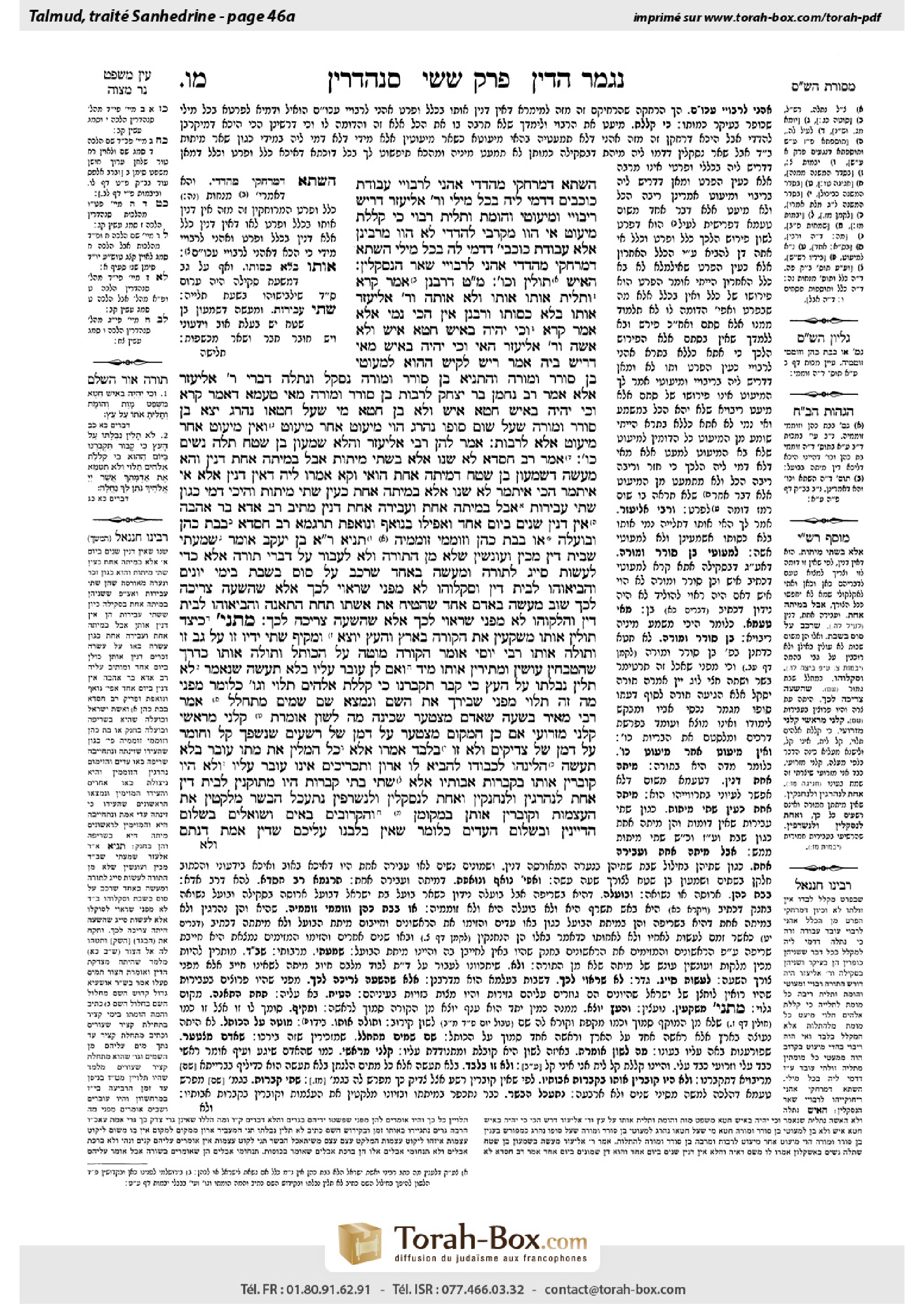
Sanhedrin 46a: Talmud study for Daf Yomi
Daf Yomi is the daily study of one Talmud folio. Explore 37 tractates with scans, Hebrew text, Sefaria English and AI-generated French translations where annotated.
Passage selection and English or AI-generated French translation are available where the scan has annotations. Daf Study is independent of Torah-Box and Sefaria.
Browse Sanhedrin · סנהדרין · All tractatesSanhedrin 46a text and translations
This page of Sanhedrin includes the Aramaic text, an English translation and an AI-generated French translation, alongside the scan above.
סנהדרין מ״ו א · Aramaic and Hebrew text
הַשְׁתָּא דִּמְרַחֲקִי מֵהֲדָדֵי, אַהֲנִי לְרַבּוֹיֵי עֲבוֹדָה זָרָה, דְּדָמֵי לֵיהּ בְּכֹל מִילֵּי.
וְרַבִּי אֱלִיעֶזֶר דָּרֵישׁ רִיבּוּיֵי וּמִיעוּטֵי, ״וְהוּמָת וְתָלִיתָ״ – רִבּוּי, ״כִּי קִלְלַת״ – מִיעוּט. אִי הֲווֹ מְקָרְבִי לַהֲדָדֵי, לָא הֲווֹ מְרַבִּינַן אֶלָּא עֲבוֹדָה זָרָה דְּדָמֵי לֵהּ בְּכֹל מִילֵּי. הַשְׁתָּא דִּמְרַחֲקִי מֵהֲדָדֵי, אַהֲנִי לְרַבּוֹיֵי שְׁאָר הַנִּסְקָלִין.
הָאִישׁ תּוֹלִין וְכוּ׳. מַאי טַעְמָא דְּרַבָּנַן? אָמַר קְרָא: ״וְתָלִיתָ אֹתוֹ״ – אוֹתוֹ, וְלֹא אוֹתָהּ. וְרַבִּי אֱלִיעֶזֶר: ״אוֹתוֹ״ – בְּלֹא כְּסוּתוֹ.
וְרַבָּנַן, אִין הָכִי נָמֵי. אֶלָּא אָמַר קְרָא: ״וְכִי יִהְיֶה בְאִישׁ חֵטְא״ – אִישׁ, וְלֹא אִשָּׁה.
וְרַבִּי אֱלִיעֶזֶר, הַאי ״וְכִי יִהְיֶה בְאִישׁ״ מַאי דָּרֵישׁ בֵּיהּ? אָמַר רֵישׁ לָקִישׁ: הָהוּא לְמַעוֹטֵי בֵּן סוֹרֵר וּמוֹרֶה. וְהָתַנְיָא: בֵּן סוֹרֵר וּמוֹרֶה נִסְקָל וְנִתְלֶה, דִּבְרֵי רַבִּי אֱלִיעֶזֶר! אֶלָּא אָמַר רַב נַחְמָן בַּר יִצְחָק: לְרַבּוֹת בֵּן סוֹרֵר וּמוֹרֶה. מַאי טַעְמָא?
דְּאָמַר קְרָא: ״וְכִי יִהְיֶה בְאִישׁ חֵטְא״ – אִישׁ, וְלֹא בֵּן. ״חֵטְא״ – מִי שֶׁעַל חֶטְאוֹ נֶהֱרָג, יָצָא בֵּן סוֹרֵר וּמוֹרֶה שֶׁעַל שׁוּם סוֹפוֹ נֶהֱרָג. הָוֵי מִיעוּט אַחַר מִיעוּט, וְאֵין מִיעוּט אַחַר מִיעוּט אֶלָּא לְרַבּוֹת.
אָמַר לָהֶן רַבִּי אֱלִיעֶזֶר: וַהֲלֹא שִׁמְעוֹן בֶּן שָׁטַח תָּלָה נָשִׁים כּוּ׳? אָמַר רַב חִסְדָּא: לֹא שָׁנוּ אֶלָּא בִּשְׁתֵּי מִיתוֹת, אֲבָל בְּמִיתָה אַחַת – דָּנִין. וְהָא מַעֲשֶׂה דְּשִׁמְעוֹן בֶּן שָׁטַח דְּמִיתָה אַחַת הֲוַאי, וְקָא אָמְרוּ לֵיהּ דְּאֵין דָּנִין!
אֶלָּא, אִי אִיתְּמַר הָכִי אִיתְּמַר: לֹא שָׁנוּ אֶלָּא בְּמִיתָה אַחַת כְּעֵין שְׁתֵּי מִיתוֹת. וְהֵיכִי דָּמֵי? כְּגוֹן שְׁתֵּי עֲבֵירוֹת. אֲבָל בְּמִיתָה אַחַת וַעֲבֵירָה אַחַת – דָּנִין.
מֵתִיב רַב אַדָּא בַּר אַהֲבָה: אֵין דָּנִין שְׁנַיִם בְּיוֹם אֶחָד, וַאֲפִילּוּ בְּנוֹאֵף וְנוֹאֶפֶת. תַּרְגְּמָא רַב חִסְדָּא: בְּבַת כֹּהֵן וּבוֹעֲלָהּ,
אוֹ בְּבַת כֹּהֵן וְזוֹמְמֵי זוֹמְמֶיהָ.
תַּנְיָא, רַבִּי אֱלִיעֶזֶר בֶּן יַעֲקֹב אוֹמֵר: שָׁמַעְתִּי שֶׁבֵּית דִּין מַכִּין וְעוֹנְשִׁין שֶׁלֹּא מִן הַתּוֹרָה, וְלֹא לַעֲבוֹר עַל דִּבְרֵי תוֹרָה, אֶלָּא כְּדֵי לַעֲשׂוֹת סְיָיג לַתּוֹרָה.
וּמַעֲשֶׂה בְּאֶחָד שֶׁרָכַב עַל סוּס בְּשַׁבָּת בִּימֵי יְוָנִים, וֶהֱבִיאוּהוּ לְבֵית דִּין וּסְקָלוּהוּ, לֹא מִפְּנֵי שֶׁרָאוּי לְכָךְ, אֶלָּא שֶׁהַשָּׁעָה צְרִיכָה לְכָךְ. שׁוּב מַעֲשֶׂה בְּאָדָם אֶחָד שֶׁהֵטִיחַ אֶת אִשְׁתּוֹ תַּחַת הַתְּאֵנָה, וֶהֱבִיאוּהוּ לְבֵית דִּין וְהִלְקוּהוּ, לֹא מִפְּנֵי שֶׁרָאוּי לְכָךְ, אֶלָּא שֶׁהַשָּׁעָה צְרִיכָה לְכָךְ.
מַתְנִי׳ כֵּיצַד תּוֹלִין אוֹתוֹ? מְשַׁקְּעִין אֶת הַקּוֹרָה בָּאָרֶץ, וְהָעֵץ יוֹצֵא וּמַקִּיף שְׁתֵּי יָדָיו זוֹ עַל גַּב זוֹ, וְתוֹלֶה אוֹתוֹ. רַבִּי יוֹסֵי אוֹמֵר: הַקּוֹרָה מוּטָּה עַל הַכּוֹתֶל, וְתוֹלֶה אוֹתוֹ כְּדֶרֶךְ שֶׁהַטַּבָּחִין עוֹשִׂין.
וּמַתִּירִין אוֹתוֹ מִיָּד, וְאִם לָן – עוֹבֵר עָלָיו בְּלֹא תַעֲשֶׂה, שֶׁנֶּאֱמַר: ״לֹא תָלִין נִבְלָתוֹ עַל הָעֵץ כִּי קָבוֹר תִּקְבְּרֶנּוּ כִּי קִלְלַת אֱלֹהִים תָּלוּי וְגוֹ׳״. כְּלוֹמַר, מִפְּנֵי מָה זֶה תָּלוּי? מִפְּנֵי שֶׁבֵּירַךְ אֶת הַשֵּׁם, וְנִמְצָא שֵׁם שָׁמַיִם מִתְחַלֵּל.
אָמַר רַבִּי מֵאִיר: בְּשָׁעָה שֶׁאָדָם מִצְטַעֵר, שְׁכִינָה מָה לָשׁוֹן אוֹמֶרֶת? ״קַלַּנִי מֵרֹאשִׁי, קַלַּנִי מִזְּרוֹעִי״. אִם כֵּן הַמָּקוֹם מִצְטַעֵר עַל דָּמָן שֶׁל רְשָׁעִים שֶׁנִּשְׁפָּךְ, קַל וְחוֹמֶר עַל דָּמָן שֶׁל צַדִּיקִים.
וְלֹא זוֹ בִּלְבַד אָמְרוּ, אֶלָּא כָּל הַמֵּלִין אֶת מֵתוֹ עוֹבֵר בְּלֹא תַעֲשֶׂה. הֱלִינוֹ לִכְבוֹדוֹ, לְהָבִיא לוֹ אָרוֹן וְתַכְרִיכִים – אֵינוֹ עוֹבֵר עָלָיו.
וְלֹא הָיוּ קוֹבְרִין אוֹתוֹ בְּקִבְרוֹת אֲבוֹתָיו, אֶלָּא שְׁתֵּי בָּתֵּי קְבָרוֹת הָיוּ מְתוּקָּנִין לְבֵית דִּין: אַחַת לַנֶּהֱרָגִין וְלַנֶּחְנָקִין, וְאַחַת לַנִּסְקָלִין וְלַנִּשְׂרָפִין. נִתְעַכֵּל הַבָּשָׂר, מְלַקְּטִין אֶת הָעֲצָמוֹת וְקוֹבְרִין אוֹתָן בִּמְקוֹמָן. וְהַקְּרוֹבִים בָּאִים וְשׁוֹאֲלִים בִּשְׁלוֹם הַדַּיָּינִין וּבִשְׁלוֹם הָעֵדִים, כְּלוֹמַר שֶׁאֵין בְּלִבֵּנוּ עֲלֵיכֶם שֶׁדִּין אֱמֶת דַּנְתֶּם.
Sanhedrin 46a · English translation
Now that the generalization and the detail are distant from each other, i.e., they are written in different verses, the verses serve to include one who was found guilty of idol worship, as he is similar to the blasphemer in all matters. He too is subject to be hung after he is executed.
And Rabbi Eliezer, by contrast, interprets the verses based on the principle of amplifications and restrictions. The phrase “And he is put to death, and you shall hang him” is an amplification. The phrase “For he that is hung is a curse of God” is a restriction. Were the amplification and the restriction right next to each other, we would apply the principle of amplifications and restrictions and include only one who is guilty of idol worship, as he is similar to the blasphemer in all ways. Now that they are distant from each other, the verses serve to include all those who are liable to be stoned to death. All of their corpses are hung after they are put to death.
§ The mishna teaches that according to the opinion of Rabbi Eliezer, the corpse of a man is hung facing the people while the corpse of a woman is hung facing the tree, whereas the Rabbis say that the corpse of a woman is not hung at all. The Gemara asks: What is the reasoning behind the opinion of the Rabbis? The Gemara answers: As the verse states: “And if a man has committed a sin worthy of death, and he is put to death, and you shall hang him on a tree” (Deuteronomy 21:22), which teaches that you shall hang him on a tree after his death, but you shall not hang her on a tree after her death. And Rabbi Eliezer would respond that the inference to be drawn from this verse is that after his death they hang him by himself, without his clothing.
The Gemara asks: And from where do the Rabbis derive that the corpse of the executed man is hung without his clothing? The Gemara answers: Yes, it is indeed so that they agree that the word “him” teaches that the corpse is hung without clothing. But the source of their ruling is the verse that states: “And if a man has committed a sin,” which indicates that a man is hung after he is put to death, but a woman is not hung after she is put to death.
The Gemara asks: And as for Rabbi Eliezer, what does he learn from this clause of the verse: “And if a man has committed a sin”? Reish Lakish says: That clause of the verse serves to exclude a stubborn and rebellious son, who, according to the opinion of Rabbi Eliezer, is not hung after he is executed, because he is not a man. The Gemara raises a difficulty: But isn’t it taught explicitly in a baraita: A stubborn and rebellious son is first stoned and afterward his corpse is hung; this is the statement of Rabbi Eliezer? Rather, Rav Naḥman bar Yitzḥak says: That part of the verse comes to include a stubborn and rebellious son, that his corpse is also hung. What is the reason for this?
The Gemara explains: As the verse states: “And if a man has committed a sin,” indicating that only the corpse of a man is hung, but not that of a child, thereby excluding a stubborn and rebellious son. And the word “sin” indicates that only the corpse of one who is put to death on account of a sin is hung, to the exclusion of a stubborn and rebellious son, who is executed not because of a sin that he has already committed but on account of what he is likely to do in the future. This is an example of a restrictive expression following a restrictive expression, as both expressions indicate that a stubborn and rebellious son is not hung after he is put to death. And there is a hermeneutical principle that a restrictive expression following a restrictive expression serves only to amplify the halakha and include additional cases. In this case, it serves to teach that the corpse of a stubborn and rebellious son is hung after he is put to death.
§ The mishna teaches that Rabbi Eliezer said to the Rabbis: Did Shimon ben Shataḥ not hang in Ashkelon women who were found guilty of witchcraft? And the Rabbis replied that no proof can be brought from there since he hanged eighty women on a single day, which clearly indicates that this was an extraordinary measure and therefore cannot serve as a precedent for normative halakha. Rav Ḥisda says: They taught that one court may not judge two capital cases on one day only when the two cases involve two different modes of execution, but when they involve only one mode of execution, the court may in fact judge them on the same day. The Gemara raises a difficulty: But the incident relating to Shimon ben Shataḥ involved only one mode of execution, as all the women were accused of witchcraft, and yet the Rabbis said to him that the court may not judge them on one day.
Rather, if a ruling was stated citing Rav Ḥisda, this is what was stated: They taught that one court may not judge two capital cases on one day only when the two cases involving one mode of execution are similar to two cases involving two different modes of execution. And what are the circumstances of such a situation? For example, when there are two different transgressions that are punishable by the same mode of execution, the court may not judge two such cases in one day. But where there is only one mode of execution and only one transgression, the court may in fact judge two cases on one day.
Rav Adda bar Ahava raises an objection from a baraita that states: The same court may not judge two people charged with capital transgressions on one day, not even an adulterer and an adulteress. This indicates that a court may not judge two cases on one day even if the two cases involve only one mode of execution and the same transgression. Rav Ḥisda interpreted the baraita as referring to a case of adultery involving the daughter of a priest and the man with whom she engaged in intercourse, as the daughter of a priest is liable to receive death by burning, while the man is liable to receive death by stoning if the woman was betrothed to another man, or strangulation if she was married to another man.
Or, the baraita is referring to a case of adultery involving the daughter of a priest and those who rendered as conspiring witnesses the witnesses who rendered as conspiring witnesses the witnesses who testified about her.
It is taught in a baraita: Rabbi Eliezer ben Ya’akov says: I heard that the court may administer lashes and capital punishment, even when not required by Torah law. And they may not administer these punishments with the intention of violating the statement of the Torah, i.e., to disregard the punishment stated in the Torah and administer another punishment; rather, they may administer these punishments to erect a fence around the Torah, so that people will fear sinning.
And an incident occurred involving one who rode a horse on Shabbat during the days of the Greeks, and they brought him to court and stoned him, not because he deserved that punishment, as riding a horse on Shabbat is forbidden only by rabbinic decree, but because the hour required it, as people had become lax in their observance of Shabbat and therefore it became necessary to impose the severe punishment for a relatively minor offense. Another incident occurred involving a man who engaged in intercourse with his wife in public under a fig tree, and they brought him to court and flogged him, not because that punishment was fitting for him, as such conduct is not forbidden by the Torah, but because the hour required it. People had become remiss in matters of modesty; therefore, stringent measures had to be taken to rectify the situation.
MISHNA: How do they hang the corpse of one who was put to death by stoning? They sink a post into the earth with a piece of wood jutting out, forming a T-shaped structure. And the court appointee then places the dead man’s two hands one upon the other, ties them, and hangs him by his hands. Rabbi Yosei says: The post is not sunk into the ground; rather, it leans against a wall, and he hangs the corpse on it the way that butchers do with meat.
The dead man hangs there for only a very short time, and then they immediately untie him. And if he was left hanging overnight, a prohibition is transgressed, as it is stated: “His body shall not remain all night upon the tree, but you shall bury him that day, for he that is hung is a curse of God” (Deuteronomy 21:23). That is to say: Were the corpse left hanging on the tree overnight, people would ask: For what reason was this one hung after he was put to death? They would be answered: Because he blessed God, a euphemism for blasphemy. And therefore the name of Heaven would be desecrated were the dead man’s corpse to remain hanging, reminding everybody of his transgression.
Rabbi Meir said: The phrase “for he that is hung is a curse [kilelat] of God” should be understood as follows: When a man suffers in the wake of his sin, what expression does the Divine Presence use? I am distressed [kallani] about My head, I am distressed about My arm, meaning, I, too, suffer when the wicked are punished. From here it is derived: If God suffers such distress over the blood of the wicked that is spilled, even though they justly deserved their punishment, it can be inferred a fortiori that He suffers distress over the blood of the righteous.
And the Sages said not only this, that an executed transgressor must be buried on the same day that he is killed, but they said that anyone who leaves his deceased relative overnight without burying him transgresses a prohibition. But if he left the deceased overnight for the sake of the deceased’s honor, e.g., to bring a coffin or shrouds for his burial, he does not transgress the prohibition against leaving him unburied overnight.
After the executed transgressor is taken down he is buried, and they would not bury him in his ancestral burial plot. Rather, two graveyards were established for the burial of those executed by the court: One for those who were killed by decapitation or strangled, and one for those who were stoned or burned. Once the flesh of the deceased had decomposed, they would gather his bones and bury them in their proper place in his ancestral burial plot. And soon after the execution, the relatives of the executed transgressor would come and inquire about the welfare of the judges and about the welfare of the witnesses, as if to say: We hold no grudges against you, as you judged a true judgment.
Sanhedrin 46a · Traduction française (IA)
À présent que la règle générale et le cas particulier sont éloignés l’un de l’autre, c’est-à-dire qu’ils figurent dans des versets différents, les versets servent à inclure celui qui a été reconnu coupable d’idolâtrie, car il ressemble au blasphémateur à tous égards. Lui aussi doit être pendu après son exécution.
Rabbi Eliezer, en revanche, interprète les versets selon le principe des termes extensifs et restrictifs. La formule « Il est mis à mort, et tu le pendras » est extensive. La formule « Car celui qui est pendu est une malédiction de Dieu » est restrictive. Si le terme extensif et le terme restrictif étaient immédiatement contigus, nous appliquerions le principe des termes extensifs et restrictifs et n’inclurions que celui qui est coupable d’idolâtrie, car il ressemble au blasphémateur à tous égards. À présent qu’ils sont éloignés l’un de l’autre, les versets servent à inclure tous ceux qui sont passibles de la lapidation. Tous leurs cadavres sont pendus après leur mise à mort.
§ La Michna enseigne que, selon Rabbi Eliezer, le cadavre d’un homme est pendu face au public, tandis que celui d’une femme est pendu face au poteau ; les Sages, eux, disent que le cadavre d’une femme n’est pas pendu du tout. La Guemara demande : Quel est le raisonnement des Sages ? La Guemara répond : Le verset dit : « Si un homme a commis un péché passible de mort, qu’il soit mis à mort et que tu le pendes à un arbre » (Deutéronome 21,22), ce qui enseigne que tu le pendras à un arbre après sa mort, mais que tu ne la pendras pas à un arbre après sa mort. Rabbi Eliezer répondrait que l’inférence à tirer de ce verset est qu’après sa mort, on le pend seul, sans ses vêtements.
La Guemara demande : Et d’où les Sages déduisent-ils que le cadavre de l’homme exécuté est pendu sans ses vêtements ? La Guemara répond : En effet, ils reconnaissent que le mot « lui » enseigne que le cadavre est pendu sans vêtements. Mais la source de leur décision est le verset qui dit : « Si un homme a commis un péché », ce qui indique qu’un homme est pendu après sa mise à mort, mais qu’une femme ne l’est pas.
La Guemara demande : Et que déduit Rabbi Eliezer de cette partie du verset : « Si un homme a commis un péché » ? Reish Lakish dit : Cette partie du verset sert à exclure le fils rebelle et réfractaire, qui, selon Rabbi Eliezer, n’est pas pendu après son exécution, car il n’est pas un homme. La Guemara soulève une difficulté : Mais n’est-il pas explicitement enseigné dans une baraïta qu’un fils rebelle et réfractaire est d’abord lapidé, puis que son cadavre est pendu ? Telle est la déclaration de Rabbi Eliezer. Rav Naḥman bar Yitzḥak dit plutôt : Cette partie du verset vient inclure le fils rebelle et réfractaire, dont le cadavre est lui aussi pendu. Pour quelle raison ?
La Guemara explique : Le verset dit : « Si un homme a commis un péché », indiquant que seul le cadavre d’un homme est pendu, mais pas celui d’un enfant, ce qui exclut le fils rebelle et réfractaire. Et le mot « péché » indique que seul est pendu le cadavre de celui qui est mis à mort pour un péché, à l’exclusion du fils rebelle et réfractaire, qui est exécuté non pour un péché qu’il a déjà commis, mais en raison de ce qu’il risque de faire à l’avenir. C’est là un exemple d’une expression restrictive suivie d’une autre expression restrictive, puisque les deux expressions indiquent que le fils rebelle et réfractaire n’est pas pendu après sa mise à mort. Or, un principe herméneutique veut qu’une expression restrictive suivie d’une autre serve uniquement à étendre la halakha et à inclure des cas supplémentaires. En l’occurrence, elle enseigne que le cadavre d’un fils rebelle et réfractaire est pendu après sa mise à mort.
§ La Michna enseigne que Rabbi Eliezer dit aux Sages : Shimon ben Shataḥ n’a-t-il pas fait pendre à Ashkelon des femmes reconnues coupables de sorcellerie ? Les Sages lui répondirent qu’on ne peut tirer aucune preuve de cet épisode, puisqu’il fit pendre quatre-vingts femmes en un seul jour ; cela montre clairement qu’il s’agissait d’une mesure exceptionnelle, qui ne peut donc servir de précédent pour la halakha. Rav Ḥisda dit : Ils ont enseigné qu’un même tribunal ne peut juger deux affaires capitales en une seule journée que lorsque les deux affaires relèvent de deux modes d’exécution différents ; mais si elles relèvent d’un seul mode d’exécution, le tribunal peut effectivement les juger le même jour. La Guemara soulève une difficulté : Mais l’épisode concernant Shimon ben Shataḥ ne relevait que d’un seul mode d’exécution, puisque toutes les femmes étaient accusées de sorcellerie, et pourtant les Sages lui ont dit que le tribunal ne pouvait pas les juger en un seul jour.
Il faut plutôt dire que, si une décision a été rapportée au nom de Rav Ḥisda, voici ce qui a été enseigné : Un même tribunal ne peut juger deux affaires capitales en une seule journée que lorsque deux affaires relevant d’un seul mode d’exécution sont comparables à deux affaires relevant de deux modes d’exécution différents. Dans quelles circonstances une telle situation se présente-t-elle ? Par exemple, lorsque deux transgressions différentes sont passibles du même mode d’exécution, le tribunal ne peut juger deux affaires de ce type en une seule journée. Mais lorsqu’il n’y a qu’un seul mode d’exécution et une seule transgression, le tribunal peut effectivement juger deux affaires en une seule journée.
Rav Adda bar Ahava soulève une objection à partir d’une baraïta qui enseigne : Un même tribunal ne peut juger deux personnes accusées de transgressions passibles de la peine capitale en une seule journée, pas même un adultère et une adultère. Cela indique qu’un tribunal ne peut juger deux affaires en une seule journée, même si elles relèvent d’un seul mode d’exécution et de la même transgression. Rav Ḥisda interprète la baraïta comme se rapportant à un cas d’adultère impliquant la fille d’un prêtre et l’homme avec lequel elle a eu des rapports, car la fille d’un prêtre est passible de la mort par le feu, tandis que l’homme est passible de la lapidation si la femme était fiancée à un autre homme, ou de l’étranglement si elle était mariée à un autre homme.
Ou bien, la baraïta se rapporte à un cas d’adultère impliquant la fille d’un prêtre et ceux qui ont fait déclarer comme témoins comploteurs les témoins qui avaient témoigné à son sujet.
Il est enseigné dans une baraïta : Rabbi Eliezer ben Ya’akov dit : « J’ai entendu que le tribunal peut infliger des coups de fouet et la peine capitale, même lorsque la Torah ne l’exige pas. Il ne peut pas infliger ces peines dans l’intention de contrevenir à la Torah, c’est-à-dire de faire fi de la peine prescrite par la Torah et d’en appliquer une autre ; il peut plutôt les infliger afin d’ériger une clôture autour de la Torah, pour que les gens craignent de pécher. »
Un épisode eut lieu au temps des Grecs : un homme monta à cheval pendant Chabbat ; on le conduisit au tribunal et on le lapida, non parce qu’il méritait cette peine — monter à cheval pendant Chabbat n’étant interdit que par décret rabbinique — mais parce que les circonstances l’exigeaient : les gens étaient devenus négligents dans l’observance du Chabbat, et il était donc devenu nécessaire d’imposer une peine sévère pour une faute relativement mineure. Un autre épisode eut lieu : un homme eut des rapports avec sa femme en public, sous un figuier ; on le conduisit au tribunal et on le flagella, non parce que cette peine était appropriée à son cas, car un tel comportement n’est pas interdit par la Torah, mais parce que les circonstances l’exigeaient. Les gens étaient devenus négligents en matière de pudeur ; il fallut donc prendre des mesures rigoureuses pour remédier à la situation.
MICHNA : Comment pend-on le cadavre de celui qui a été mis à mort par lapidation ? On enfonce dans le sol un poteau muni d’une pièce de bois saillante, formant une structure en T. Puis l’officiant du tribunal place les deux mains du mort l’une sur l’autre, les attache et le pend par les mains. Rabbi Yosei dit : On n’enfonce pas le poteau dans le sol ; il est plutôt appuyé contre un mur, et l’on y suspend le cadavre comme les bouchers suspendent la viande.
Le mort ne reste pendu que très brièvement, puis on le détache immédiatement. Le laisser pendu toute la nuit constitue une transgression, comme il est dit : « Son corps ne restera pas toute la nuit sur le bois ; tu l’enterreras le jour même, car celui qui est pendu est une malédiction de Dieu » (Deutéronome 21,23). Autrement dit, si le cadavre restait pendu à l’arbre pendant la nuit, les gens demanderaient : Pourquoi celui-ci a-t-il été pendu après sa mise à mort ? On leur répondrait : Parce qu’il a béni Dieu, euphémisme désignant le blasphème. Le Nom du Ciel serait donc profané si le cadavre du mort restait pendu, rappelant à tous sa transgression.
Rabbi Meir dit : La formule « car celui qui est pendu est une malédiction [kilelat] de Dieu » doit être comprise ainsi : Lorsqu’un homme souffre à la suite de son péché, quelle expression la Présence divine emploie-t-elle ? « Je suis affligé [kallani] dans ma tête, je suis affligé dans mon bras » ; cela signifie que moi aussi, je souffre lorsque les méchants sont punis. On en déduit que si Dieu éprouve une telle affliction devant le sang versé des méchants, bien qu’ils aient justement mérité leur châtiment, on peut en déduire a fortiori qu’Il souffre devant le sang des justes.
Les Sages ont dit non seulement qu’un transgresseur exécuté doit être enterré le jour même de sa mort, mais aussi que quiconque laisse son parent décédé toute une nuit sans l’enterrer transgresse une interdiction. Toutefois, s’il laisse le défunt sans l’enterrer pendant la nuit afin de préserver son honneur, par exemple pour apporter un cercueil ou des linceuls pour son enterrement, il ne transgresse pas l’interdiction de le laisser sans sépulture toute la nuit.
Une fois le transgresseur exécuté descendu du gibet, on l’enterre, mais pas dans le tombeau familial ancestral. On établit plutôt deux cimetières pour enterrer ceux que le tribunal a exécutés : l’un pour ceux qui ont été tués par décapitation ou étranglement, l’autre pour ceux qui ont été lapidés ou brûlés. Lorsque la chair du défunt s’était décomposée, on recueillait ses os et on les enterrait à leur place dans le tombeau familial ancestral. Peu après l’exécution, les proches du transgresseur exécuté venaient s’enquérir du bien-être des juges et des témoins, comme pour dire : « Nous ne vous en tenons pas rigueur, puisque vous avez rendu un jugement juste. »
Traduction française générée par IA à partir de l’édition anglaise de Sefaria. Vérifie toujours un passage avec le texte source.
Text from Sefaria: William Davidson Edition - Vocalized Aramaic (CC BY NC); William Davidson Edition - English (CC BY NC).