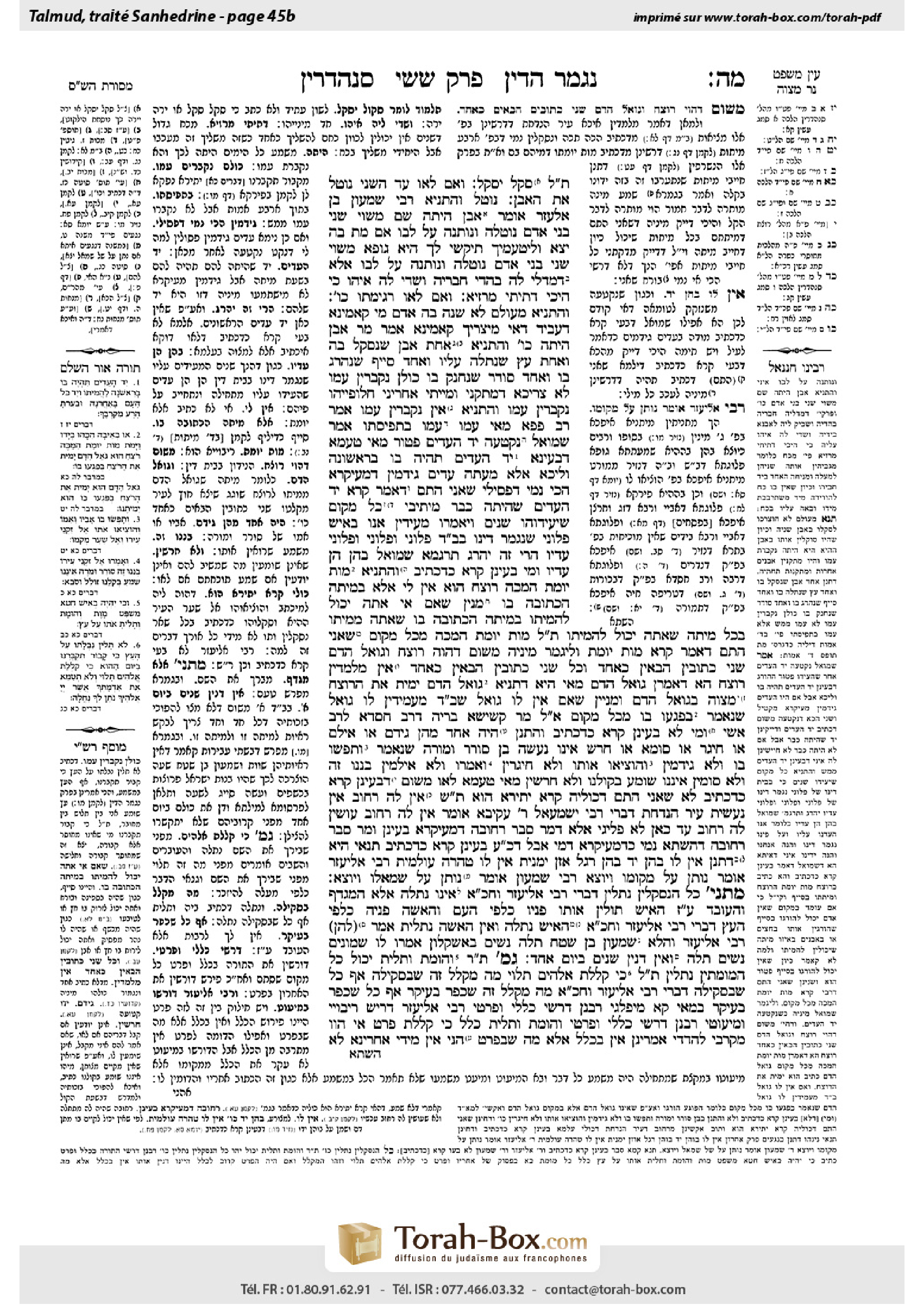
Sanhedrin 45b: Talmud study for Daf Yomi
Daf Yomi is the daily study of one Talmud folio. Explore 37 tractates with scans, Hebrew text, Sefaria English and AI-generated French translations where annotated.
Passage selection and English or AI-generated French translation are available where the scan has annotations. Daf Study is independent of Torah-Box and Sefaria.
Browse Sanhedrin · סנהדרין · All tractatesSanhedrin 45b text and translations
This page of Sanhedrin includes the Aramaic text, an English translation and an AI-generated French translation, alongside the scan above.
סנהדרין מ״ה ב · Aramaic and Hebrew text
תַּלְמוּד לוֹמַר: ״סָקוֹל יִסָּקֵל״.
וְאִם לָאו, עֵד הַשֵּׁנִי נוֹטֵל אֶת הָאֶבֶן. נוֹטֵל? וְהָתַנְיָא: רַבִּי שִׁמְעוֹן בֶּן אֶלְעָזָר אוֹמֵר, אֶבֶן הָיְתָה שָׁם מַשּׂוֹי שְׁנֵי בְּנֵי אָדָם, נוֹטְלָהּ וְנוֹתְנָהּ עַל לִבּוֹ. אִם מֵת בָּהּ – יָצָא. וְלִיטַעְמָיךְ, תִּיקְשֵׁי לָךְ הִיא גּוּפַהּ: מַשּׂוֹי שְׁנֵי בְּנֵי אָדָם, נוֹטְלָהּ וְנוֹתְנָהּ עַל לִבּוֹ?
אֶלָּא, דְּמַדְלֵי לַהּ בַּהֲדֵי חַבְרֵיהּ, וְשָׁדֵי לַהּ אִיהוּ, כִּי הֵיכִי דְּתֵיתֵי מֵרַזְיָא.
וְאִם לָאו, רְגִימָתוֹ כּוּ׳. וְהָתַנְיָא: מֵעוֹלָם לֹא שָׁנָה בָּהּ אָדָם! מִי קָאָמֵינָא דְּעָבֵיד? דְּאִי מִצְּרִיךְ קָאָמֵינָא.
אָמַר מָר: אֶבֶן הָיְתָה כּוּ׳. וְהָתַנְיָא: אַחַת אֶבֶן שֶׁנִּסְקָל בָּהּ, וְאַחַת עֵץ שֶׁנִּתְלֶה עָלָיו, וְאֶחָד סַיִיף שֶׁנֶּהֱרָג בּוֹ, וְאֶחָד סוּדָר שֶׁנֶּחְנָק בּוֹ – כּוּלָּן נִקְבָּרִין עִמּוֹ. לָא צְרִיכָא דִּמְתַקְּנִי וּמַיְיתִי אַחֲרִינֵי חִלּוּפַיְיהוּ.
נִקְבָּרִין עִמּוֹ. וְהָתַנְיָא: אֵין נִקְבָּרִין עִמּוֹ? אָמַר רַב פָּפָּא: מַאי ״עִמּוֹ״? עִמּוֹ בִּתְפִיסָתוֹ.
אָמַר שְׁמוּאֵל: נִקְטְעָה יַד הָעֵדִים – פָּטוּר. מַאי טַעְמָא? דְּבָעֵינָא ״יַד הָעֵדִים תִּהְיֶה בּוֹ בָרִאשׁוֹנָה״, וְלֵיכָּא.
אֶלָּא מֵעַתָּה, עֵדִים גִּידְמִין דְּמֵעִיקָּרָא, הָכִי נָמֵי דִּפְסִילִי? שָׁאנֵי הָתָם, דְּאָמַר קְרָא: ״יַד הָעֵדִים״, שֶׁהָיְתָה כְּבָר.
מֵיתִיבִי: כׇּל מָקוֹם שֶׁיְּעִידוּהוּ שְׁנַיִם וְיֹאמְרוּ, ״מְעִידִין אָנוּ בְּאִישׁ פְּלוֹנִי שֶׁנִּגְמַר דִּינוֹ בְּבֵית דִּין פְּלוֹנִי, וּפְלוֹנִי וּפְלוֹנִי עֵדָיו״ – הֲרֵי זֶה יֵהָרֵג. תַּרְגְּמָא שְׁמוּאֵל בְּ״הֵּן הֵן עֵדָיו״.
וּמִי בָּעֵינַן קְרָא כְּדִכְתִיב? וְהָתַנְיָא: ״מוֹת יוּמַת הַמַּכֶּה רוֹצֵחַ הוּא״ – אֵין לִי אֶלָּא בְּמִיתָה הַכְּתוּבָה בּוֹ. מִנַּיִן שֶׁאִם אִי אַתָּה יָכוֹל לַהֲמִיתוֹ בְּמִיתָה הַכְּתוּבָה בּוֹ שֶׁאַתָּה מְמִיתוֹ בְּכׇל מִיתָה שֶׁאַתָּה יָכוֹל לַהֲמִיתוֹ? תַּלְמוּד לוֹמַר: ״מוֹת יוּמַת הַמַּכֶּה״ – מִכׇּל מָקוֹם.
שָׁאנֵי הָתָם, דְּאָמַר קְרָא: ״מוֹת יוּמַת״.
וְלִיגְמַר מִינֵּיהּ? מִשּׁוּם דְּהָוֵה רוֹצֵחַ וְגוֹאֵל הַדָּם שְׁנֵי כְּתוּבִין הַבָּאִין כְּאֶחָד, וְכׇל שְׁנֵי כְּתוּבִין הַבָּאִין כְּאֶחָד אֵין מְלַמְּדִין.
רוֹצֵחַ – הָא דַּאֲמַרַן. גּוֹאֵל הַדָּם מַאי הִיא? דְּתַנְיָא: ״גֹּאֵל הַדָּם יָמִית אֶת הָרֹצֵחַ״ – מִצְוָה בְּגוֹאֵל הַדָּם. וּמִנַּיִין שֶׁאִם אֵין לוֹ גּוֹאֵל שֶׁבֵּית דִּין מַעֲמִידִין לוֹ גּוֹאֵל? שֶׁנֶּאֱמַר: ״בְּפִגְעוֹ בּוֹ״ – מִכׇּל מָקוֹם.
אֲמַר לֵיהּ מָר קַשִּׁישָׁא בְּרֵיהּ דְּרַב חִסְדָּא לְרַב אָשֵׁי: וּמִי לָא בָּעֵינַן קְרָא כְּדִכְתִיב? וְהָתְנַן: הָיָה אֶחָד מֵהֶן גִּידֵּם, אוֹ אִילֵּם, אוֹ חִיגֵּר, אוֹ סוֹמֵא, אוֹ חֵרֵשׁ – אֵינוֹ נַעֲשָׂה בֵּן סוֹרֵר וּמוֹרֶה.
שֶׁנֶּאֱמַר: ״וְתָפְשׂוּ בוֹ״ – וְלֹא גִּידְמִין, ״וְהוֹצִיאוּ אֹתוֹ״ – וְלֹא חִיגְּרִין, ״וְאָמְרוּ״ – וְלֹא אִילְּמִין, ״בְּנֵנוּ זֶה״ – וְלֹא סוֹמִין, ״אֵינֶנּוּ שֹׁמֵעַ בְּקֹלֵנוּ״ – וְלֹא חֵרְשִׁין.
מַאי טַעְמָא? לָאו מִשּׁוּם דְּבָעֵינַן קְרָא כְּדִכְתִיב? לָא, שָׁאנֵי הָתָם, דְּכוּלֵּיהּ קְרָא יַתִּירָא הוּא.
תָּא שְׁמַע: אֵין לָהּ רְחוֹב – אֵין נַעֲשֵׂית עִיר הַנִּדַּחַת, דִּבְרֵי רַבִּי יִשְׁמָעֵאל. רַבִּי עֲקִיבָא אוֹמֵר: אֵין לָהּ רְחוֹב – עוֹשִׂין לָהּ רְחוֹב.
עַד כָּאן לָא פְּלִיגִי, אֶלָּא דְּמָר סָבַר: ״רְחוֹבָהּ״ דְּמֵעִיקָּרָא בָּעִינַן, וּמָר סָבַר: רְחוֹבָהּ דְּהַשְׁתָּא נָמֵי כִּדְמֵעִיקָּרָא דָּמֵי. אֲבָל דְּכוּלֵּי עָלְמָא בָּעֵינַן קְרָא כְּדִכְתִיב.
תַּנָּאֵי הִיא, דִּתְנַן: אֵין לוֹ בֹּהֶן יָד, בֹּהֶן רֶגֶל, אֹזֶן יָמָנִית – אֵין לוֹ טׇהֳרָה עוֹלָמִית. רַבִּי אֱלִיעֶזֶר אוֹמֵר: נוֹתֵן עַל מְקוֹמוֹ וְיוֹצֵא. רַבִּי שִׁמְעוֹן אוֹמֵר: נוֹתֵן עַל שְׂמֹאלוֹ וְיוֹצֵא.
מַתְנִי׳ כׇּל הַנִּסְקָלִין נִתְלִין, דִּבְרֵי רַבִּי אֱלִיעֶזֶר. וַחֲכָמִים אוֹמְרִים: אֵינוֹ נִתְלֶה אֶלָּא הַמְגַדֵּף וְהָעוֹבֵד עֲבוֹדָה זָרָה.
הָאִישׁ תּוֹלִין אוֹתוֹ פָּנָיו כְּלַפֵּי הָעָם, וְהָאִשָּׁה פָּנֶיהָ כְּלַפֵּי הָעֵץ; דִּבְרֵי רַבִּי אֱלִיעֶזֶר. וַחֲכָמִים אוֹמְרִים: הָאִישׁ נִתְלֶה וְאֵין הָאִשָּׁה נִתְלֵית. אָמַר לָהֶן רַבִּי אֱלִיעֶזֶר: וַהֲלֹא שִׁמְעוֹן בֶּן שָׁטַח תָּלָה נָשִׁים בְּאַשְׁקְלוֹן? אָמְרוּ לוֹ: שְׁמוֹנִים נָשִׁים תָּלָה, וְאֵין דָּנִין שְׁנַיִם בְּיוֹם אֶחָד.
גְּמָ׳ תָּנוּ רַבָּנַן: ״וְהוּמָת וְתָלִיתָ״ – יָכוֹל כׇּל הַמּוּמָתִין נִתְלִין? תַּלְמוּד לוֹמַר: ״כִּי קִלְלַת אֱלֹהִים תָּלוּי״. מָה מְקַלֵּל זֶה שֶׁבִּסְקִילָה, אַף כֹּל שֶׁבִּסְקִילָה. דִּבְרֵי רַבִּי אֱלִיעֶזֶר.
וַחֲכָמִים אוֹמְרִים: מָה מְקַלֵּל זֶה שֶׁכָּפַר בָּעִיקָּר, אַף כֹּל שֶׁכָּפַר בָּעִיקָּר.
בְּמַאי קָא מִיפַּלְגִי? רַבָּנַן דָּרְשִׁי כְּלָלֵי וּפְרָטֵי, רַבִּי אֱלִיעֶזֶר דָּרֵישׁ רִיבּוּיֵי וּמִיעוּטֵי.
רַבָּנַן דָּרְשִׁי כְּלָלֵי וּפְרָטֵי: ״וְהוּמָת וְתָלִיתָ״ – כְּלָל, ״כִּי קִלְלַת״ – פְּרָט. אִי הֲווֹ מְקָרְבִי לַהֲדָדֵי, אָמְרִינַן: אֵין בַּכְּלָל אֶלָּא מַה שֶּׁבַּפְּרָט. הָנֵי – אִין, מִידֵּי אַחֲרִינָא – לָא.
Sanhedrin 45b · English translation
The verse states: “He shall be stoned [sakol yissakel ],” with the doubled verb form indicating that the halakha applies in all places and at all times.
§ The mishna teaches that if the condemned party does not die from his fall, the second witness takes the stone that had been prepared for this task and casts it on his chest. The Gemara asks: Does the witness take the stone by himself? But isn’t it taught in a baraita that Rabbi Shimon ben Elazar says: A stone was there with a weight that could be lifted only by two men. The witness takes it and places, i.e., casts, it on the condemned party’s chest. If he dies with the casting of this stone, the obligation to stone the transgressor is fulfilled. This indicates that one individual could not lift the stone by himself. The Gemara answers: And according to your reasoning, the baraita itself should pose a difficulty for you, as it first states that the stone was of a weight that could be lifted only by two men, and then it says that the witness takes it and places it on the condemned party’s chest, apparently acting alone.
Rather, both the mishna and the baraita should be explained as follows: The second witness lifts the stone together with the other witness, but then the second witness alone casts it so that it should fall with force upon the condemned party’s chest, as two people working together cannot aim their throw with precision.
The mishna teaches: And if the condemned party does not die with the first stone, then his stoning is completed by all of the Jewish people. The Gemara raises a difficulty: But isn’t it taught in a baraita: Never did a person repeat the stoning, as the condemned party always died with the first stone cast upon him? The Gemara answers: Did we say that they acted so? Rather, we said that if the condemned party did not die with the casting of the first stone and it was necessary to try again, the stoning is completed by all of the people who assembled for the execution.
The Master said in the baraita that a stone was there, indicating that a special stone was kept in the place of stoning and used time and time again for this purpose. The Gemara asks: But isn’t it taught in a baraita: The stone with which the condemned party was stoned and the tree on which his corpse was hung, or the sword with which he was killed, or the cloth with which he was strangled, all of them are buried together with him? If so, the same stone could not have been used for every execution. The Gemara answers: No, it is necessary to teach that after the stones were buried with the transgressor, they would prepare other stones and bring them to the place of stoning in their place.
The baraita teaches that all of the items used in the execution are buried together with the transgressor. The Gemara asks: But isn’t it taught in another baraita that they are not buried together with the transgressor? Rav Pappa said: What does the baraita mean when it says that these items are buried together with him? They are not actually buried together with him in the same grave; rather, they are buried within his grasp, i.e., in the area surrounding his grave.
§ Shmuel says: If the witnesses’ hands were severed after the transgressor was sentenced to be stoned, so that they can no longer stone him themselves, the transgressor is exempt from punishment and is not executed. What is the reason for this? This is because I need to fulfill what is stated in the verse: “The hand of the witnesses shall be first upon him to put him to death” (Deuteronomy 17:7), and here this is not possible.
The Gemara asks: If that is so, that the witnesses themselves must stone the transgressor or else the sentence is not carried out, if the witnesses lacked hands from the outset, when they offered their testimony, are they also disqualified? The Gemara answers: There it is different, as the verse states: “The hand of the witnesses,” indicating that the hands that were there already when the witnesses gave their testimony must throw the first stone when the transgressor is executed. If the witnesses already lacked hands at the time of their testimony, others can throw the first stone.
The Gemara raises an objection to the opinion of Shmuel from what is taught in a mishna (Makkot 7a): In any place where two witnesses testify before a court and say: We testify about so-and-so that his death sentence was issued in such and such a court, and so-and-so and so-and-so were his witnesses, he is executed, and there is no need to retry him. This seems to indicate that the transgressor is put to death even if the witnesses are not there to throw the first stone. The Gemara explains: Shmuel interpreted the mishna as referring to a case where the witnesses who testify about the transgressor’s conviction in a different court are the same witnesses who had testified against him at his original trial, and they are present to throw the first stone.
The Gemara raises another difficulty against the opinion of Shmuel: But do we really need to fulfill what is stated in the verse exactly as it is written? But isn’t it taught in a baraita: The verse with regard to a murderer states: “He that smote him shall be put to death, for he is a murderer” (Numbers 35:21)? I have derived only that the murderer is put to death with the mode of execution written concerning him, i.e., decapitation. From where do I derive that if you cannot put him to death with the mode of execution written concerning him, e.g., if he is escaping from the court, you can put him to death with any mode of execution with which you can put him to death? The verse states: “He that smote him shall be put to death [mot yumat],” where the doubled verb teaches that he is put to death in any case, by any mode of execution. Here too, the condemned party should be executed even if the witnesses cannot cast the first stone.
The Gemara answers: There, concerning a murderer, it is different, as the verse explicitly states: “He that smote him shall be put to death,” which serves to include all modes of execution.
The Gemara asks: But why not learn from this halakha a principle that can be applied in all cases of capital punishment? The Gemara responds: This case does not prove a principle, because the halakhot of the murderer and of the blood redeemer, i.e., a relative of one who was killed who takes it upon himself to redeem his relative’s death, are two verses that come as one, and the rule is that two verses that come as one do not teach a principle. In other words, if a halakha is stated in the Torah with regard to two individual cases, the halakha is understood to apply only to those cases. Had the halakha applied to all other relevant cases as well, it would not have been necessary for the Torah to teach it twice. The fact that two cases are mentioned indicates that they are the exceptions rather than the rule.
The Gemara explains: The halakha that capital punishment need not necessarily be imposed in accordance with the Torah’s specific instructions is taught with regard to two cases, that of the murderer and that of the blood redeemer. The case of a murderer is this halakha that we said. With regard to the case of a blood redeemer, what is it? As it is taught in a baraita: The verse states: “The blood redeemer shall slay the murderer when he meets him” (Numbers 35:21). This mitzva of redeeming the death caused by an unintentional killer falls on the blood redeemer, a relative of the victim. And from where is it derived that if the victim has no blood redeemer the court appoints a blood redeemer for him? As it is stated: “When he meets him,” which teaches that in any case he shall slay the murderer, whether he is a relative or a court-appointed blood redeemer.
Mar Kashisha, son of Rav Ḥisda, said to Rav Ashi: And do we not need to fulfill what is stated in the verse exactly as it is written? But didn’t we learn in a mishna (Sanhedrin 71a) with regard to a stubborn and rebellious son: If one of the boy’s parents is without a hand, or is mute, or lame, or blind, or deaf, the boy is not rendered a stubborn and rebellious son?
This halakha is derived as it is stated: “Then shall his father and his mother lay hold of him, and bring him out to the elders of his city and to the gate of his place” (Deuteronomy 21:19). This serves to teach: His father and mother “lay hold of him,” but not those without a hand who cannot grab him; “and bring him out,” but not those who are lame and cannot take him out. And it is stated: “And they shall say to the elders of his city: This our son is stubborn and rebellious; he does not obey our voice; he is a glutton and a drunkard” (Deuteronomy 21:20). This verse serves to teach: “And they shall say,” but not mute people; “this our son,” but not the blind, who cannot point to the boy; “he does not obey our voice,” but not the deaf.
What is the reason that in all these cases the boy is not rendered a stubborn and rebellious son? Is it not because we need to fulfill what is stated in the verse exactly as it is written, and this principle should hold true with regard to other verses as well? The Gemara rejects this explanation: No, there, in the case of the stubborn and rebellious son, it is different, as the entire verse is superfluous. Therefore, all of the conditions inferred from the verse must be precisely met or else the boy cannot be rendered a stubborn and rebellious son. One cannot apply this principle to other verses.
The Gemara suggests: Come and hear a proof from what is taught in a baraita with regard to an idolatrous city, the majority of whose inhabitants engaged in idol worship, about which the verse states: “And you shall gather all the spoil of it into the midst of the open place of the city, and shall burn with fire both the city and the entire plunder taken in it” (Deuteronomy 13:17): If the city does not have an open place, it is not rendered an idolatrous city; this is the statement of Rabbi Yishmael. Rabbi Akiva says: If it does not have an open place, they make an open place for it.
The Gemara explains: Rabbi Yishmael and Rabbi Akiva disagree only with regard to this detail, that one Sage, Rabbi Yishmael, holds that we need an open place that existed from the outset when the idolatry was committed, while the other Sage, Rabbi Akiva, holds that an open place that exists now is like an open place that existed from the outset. But everyone agrees that we need to fulfill what is stated in the verse exactly as it is written.
The Gemara answers: This issue is the subject of a dispute between tanna’im. As we learned in a mishna (Nega’im 14:9) concerning the purification process of a leper, during the course of which blood and oil must be applied to his right thumb, right big toe, and right ear: If the leper has no right thumb, right big toe, or right ear, he can never attain ritual purity, as he cannot fulfill the conditions of the verse. Rabbi Eliezer says: In such a case, the priest may apply the blood and oil to the place where the missing finger, toe, or ear should have been, and the leper has thereby fulfilled his obligation. Rabbi Shimon says: The priest may apply it to his left thumb, left big toe, or left ear, and the leper has thereby fulfilled his obligation. The first tanna apparently holds that the Torah’s instructions must be fulfilled exactly as they are written, while Rabbi Eliezer and Rabbi Shimon disagree and say that when this is impossible, they are dispensable.
MISHNA: The corpses of all those who are stoned are hung after their death; this is the statement of Rabbi Eliezer. And the Rabbis say: Only the corpse of the blasphemer, who has cursed God, and the corpse of the idol worshipper are hung.
The corpse of a man is hung facing the people, but the corpse of a woman, out of modesty, is hung facing the tree; this is the statement of Rabbi Eliezer. And the Rabbis say: the corpse of a man is hung, but the corpse of a woman is not hung. Rabbi Eliezer said to the Rabbis: Did Shimon ben Shataḥ not hang in Ashkelon women who were found guilty of witchcraft, proving that the corpse of a woman who is executed is also hung? They said to him: No proof can be brought from here, as he hanged eighty women on that day, and the halakha is that the same court may not judge even two people charged with capital transgressions on the same day. It is therefore clear that he was not acting in accordance with Torah law, but rather his execution of the eighty women was an extraordinary punishment necessitated by unusually pressing circumstances.
GEMARA: The mishna teaches that the corpses of all those who are killed by stoning are hung after their death. The Sages taught in a related baraita: The verse states: “And if a man has committed a sin worthy of death, and he is put to death, and you shall hang him on a tree” (Deuteronomy 21:22): One might have thought that the corpses of all those who are put to death are hung. To counter this, the verse states: “His body shall not remain all night upon the tree…for he that is hung is a curse of God” (Deuteronomy 21:23), teaching that just as the blasphemer, who is liable to be punished by stoning, is hung after his death, so too, all those who are liable to be punished by stoning are later hung, but those who are liable to be executed in other ways are not hung after their death. This is the statement of Rabbi Eliezer.
The baraita continues: And the Rabbis say: Just as the blasphemer, who denies the principle of belief in God, is hung after his death, so too, all who deny the principle of belief in God are hung after they die. But others, even if they are liable to be punished by stoning, are not hung after they are put to death.
The Gemara clarifies: With regard to what do they disagree? The Rabbis interpret the verses based on the principle of generalizations and details, one of the methods by which the Torah is interpreted. And Rabbi Eliezer interprets them based on the principle of amplifications and restrictions, a different approach to biblical exegesis.
How so? The Rabbis expound the verses based on the principle of generalizations and details. The phrase “And he is put to death, and you shall hang him” is a generalization, as no particular offense is specified. The phrase “For he that is hung is a curse of God” is a detail, as a specific transgression is mentioned. Were the generalization and the detail next to each other in the same verse, we would apply the principle of generalizations and details and say that the generalization includes only that which is stated in the detail. Therefore, this transgressor, the blasphemer, yes, his corpse is subject to being hung after he is executed, but the corpse of anyone else is not.
Sanhedrin 45b · Traduction française (IA)
Le verset dit : « Il sera lapidé [sakol yissakel] », la forme verbale redoublée indiquant que cette halakha s’applique en tout lieu et en tout temps.
§ La Michna enseigne que si le condamné ne meurt pas de sa chute, le second témoin prend la pierre préparée à cet effet et la lui lance sur la poitrine. La Guemara demande : Le témoin prend-il la pierre seul ? N’est-il pas enseigné dans une baraïta que Rabbi Shimon ben Elazar dit : « Il y avait là une pierre d’un poids tel que seuls deux hommes pouvaient la soulever. Le témoin la prend et la pose, c’est-à-dire la lance, sur la poitrine du condamné. S’il meurt sous l’effet de cette pierre, l’obligation de lapider le transgresseur est accomplie. » Cela indique qu’un seul homme ne pouvait pas soulever la pierre. La Guemara répond : Selon ton raisonnement, la baraïta elle-même devrait te poser une difficulté, puisqu’elle dit d’abord que la pierre était d’un poids tel que seuls deux hommes pouvaient la soulever, puis que le témoin la prend et la pose sur la poitrine du condamné, apparemment en agissant seul.
Il faut plutôt expliquer que la Michna et la baraïta disent toutes deux ce qui suit : le second témoin soulève la pierre avec l’autre témoin, puis la lance seul afin qu’elle tombe avec force sur la poitrine du condamné, car deux personnes ne peuvent pas viser leur lancer avec précision en agissant ensemble.
La Michna enseigne : Et si le condamné ne meurt pas sous l’effet de la première pierre, sa lapidation est achevée par tout le peuple juif. La Guemara soulève une difficulté : N’est-il pas enseigné dans une baraïta : « Jamais on ne lapidait une personne une seconde fois, car le condamné mourait toujours sous l’effet de la première pierre qu’on lui lançait » ? La Guemara répond : Avons-nous dit qu’ils agissaient ainsi ? Nous avons plutôt dit que si le condamné ne mourait pas sous l’effet du lancer de la première pierre et qu’il fallait recommencer, sa lapidation était achevée par tous ceux qui s’étaient rassemblés pour l’exécution.
Le Maître a dit dans la baraïta qu’il y avait là une pierre, ce qui indique qu’une pierre particulière était conservée au lieu de lapidation et réutilisée à cette fin. La Guemara demande : N’est-il pas enseigné dans une baraïta : « La pierre avec laquelle le condamné a été lapidé, l’arbre auquel son cadavre a été pendu, l’épée avec laquelle il a été tué ou le tissu avec lequel il a été étranglé sont tous enterrés avec lui » ? Si tel est le cas, la même pierre ne pouvait pas servir pour chaque exécution. La Guemara répond : Non, il faut enseigner qu’après avoir enterré les pierres avec le transgresseur, on en préparait d’autres et on les apportait au lieu de lapidation pour les remplacer.
La baraïta enseigne que tous les objets utilisés pour l’exécution sont enterrés avec le transgresseur. La Guemara demande : N’est-il pas enseigné dans une autre baraïta qu’ils ne sont pas enterrés avec le transgresseur ? Rav Pappa dit : Que signifie la baraïta lorsqu’elle dit que ces objets sont enterrés avec lui ? Ils ne sont pas véritablement enterrés avec lui dans la même tombe ; ils sont plutôt enterrés à sa portée, c’est-à-dire dans la zone qui entoure sa tombe.
§ Shmuel dit : Si les mains des témoins ont été coupées après que le transgresseur a été condamné à la lapidation, de sorte qu’ils ne peuvent plus le lapider eux-mêmes, le transgresseur est exempté de peine et n’est pas exécuté. Pourquoi ? Parce qu’il faut accomplir ce qui est dit dans le verset : « La main des témoins sera la première contre lui pour le faire mourir » (Deutéronome 17:7), ce qui est impossible dans ce cas.
La Guemara demande : Si tel est le cas, si les témoins eux-mêmes doivent lapider le transgresseur, faute de quoi la sentence n’est pas exécutée, les témoins sont-ils également récusés s’ils n’avaient pas de mains dès le départ, lorsqu’ils ont déposé ? La Guemara répond : Le cas est différent, car le verset dit : « La main des témoins », ce qui indique que les mains qu’ils avaient déjà lorsqu’ils ont déposé doivent lancer la première pierre au moment de l’exécution du transgresseur. Si les témoins n’avaient déjà plus de mains au moment de leur déposition, d’autres peuvent lancer la première pierre.
La Guemara soulève une objection à l’opinion de Shmuel à partir de ce qui est enseigné dans une Michna (Makkot 7a) : Dans tout cas où deux témoins se présentent devant un tribunal et disent : « Nous attestons que la sentence de mort d’untel a été prononcée par tel tribunal, et qu’untel et untel étaient ses témoins », il est exécuté et il n’est pas nécessaire de le juger à nouveau. Cela semble indiquer que le transgresseur est mis à mort même si les témoins ne sont pas présents pour lancer la première pierre. La Guemara explique : Shmuel interprète la Michna comme traitant d’un cas où les témoins qui attestent de la condamnation du transgresseur par un autre tribunal sont les mêmes que ceux qui avaient témoigné contre lui lors de son procès initial et où ils sont présents pour lancer la première pierre.
La Guemara soulève une autre difficulté contre l’opinion de Shmuel : Faut-il vraiment accomplir ce qui est dit dans le verset exactement comme il est écrit ? N’est-il pas enseigné dans une baraïta : À propos d’un meurtrier, le verset dit : « Celui qui l’a frappé sera mis à mort, car c’est un meurtrier » (Nombres 35:21). Je n’ai appris que ceci : le meurtrier est mis à mort selon le mode d’exécution indiqué à son sujet, c’est-à-dire la décapitation. D’où apprend-on que si l’on ne peut pas le mettre à mort selon le mode d’exécution indiqué à son sujet, par exemple s’il s’enfuit du tribunal, on peut le mettre à mort selon n’importe quel mode d’exécution permettant de le faire mourir ? Le verset dit : « Celui qui l’a frappé sera mis à mort [mot yumat] » ; la forme verbale redoublée enseigne qu’il est mis à mort dans tous les cas, quel que soit le mode d’exécution. Ici aussi, le condamné devrait être exécuté même si les témoins ne peuvent pas lancer la première pierre.
La Guemara répond : Le cas du meurtrier est différent, car le verset dit explicitement : « Celui qui l’a frappé sera mis à mort », ce qui inclut tous les modes d’exécution.
La Guemara demande : Pourquoi ne pas déduire de cette halakha un principe applicable à tous les cas de peine capitale ? La Guemara répond : Ce cas ne permet pas d’établir un principe, car les halakhot du meurtrier et du vengeur du sang — un parent d’une personne tuée qui entreprend de venger la mort de son proche — sont deux versets qui enseignent une même chose, et la règle veut que deux versets qui enseignent une même chose ne fondent pas un principe général. Autrement dit, si une halakha est énoncée dans la Torah au sujet de deux cas particuliers, on comprend qu’elle ne s’applique qu’à ces cas. Si elle s’appliquait aussi à tous les autres cas pertinents, il n’aurait pas été nécessaire que la Torah l’enseigne deux fois. Le fait que deux cas soient mentionnés indique qu’ils constituent des exceptions plutôt que la règle.
La Guemara explique : La halakha selon laquelle la peine capitale ne doit pas nécessairement être appliquée conformément aux instructions précises de la Torah est enseignée à propos de deux cas : celui du meurtrier et celui du vengeur du sang. Le cas du meurtrier est celui de la halakha que nous avons mentionnée. Quel est le cas du vengeur du sang ? Comme il est enseigné dans une baraïta : Le verset dit : « Le vengeur du sang mettra à mort le meurtrier lorsqu’il le rencontrera » (Nombres 35:21). Cette mitsva de venger la mort causée par un meurtrier involontaire incombe au vengeur du sang, un parent de la victime. Et d’où déduit-on que si la victime n’a pas de vengeur du sang, le tribunal lui en désigne un ? Comme il est dit : « Lorsqu’il le rencontrera », ce qui enseigne qu’en tout état de cause, il mettra à mort le meurtrier, qu’il soit un parent ou un vengeur du sang désigné par le tribunal.
Mar Kashisha, fils de Rav Ḥisda, dit à Rav Ashi : Ne faut-il pas accomplir ce qui est dit dans le verset exactement comme il est écrit ? Pourtant, n’avons-nous pas appris dans une Michna (Sanhedrin 71a), au sujet du fils rebelle et rétif : Si l’un des parents du garçon n’a pas de main, est muet, boiteux, aveugle ou sourd, le garçon n’est pas considéré comme un fils rebelle et rétif ?
Cette halakha est déduite du verset : « Alors son père et sa mère le saisiront et le conduiront aux anciens de sa ville, à la porte de son lieu » (Deutéronome 21:19). Cela enseigne : « Son père et sa mère le saisiront », mais pas ceux qui n’ont pas de main et ne peuvent le saisir ; « et le conduiront », mais pas ceux qui sont boiteux et ne peuvent le conduire. Et il est dit : « Ils diront aux anciens de sa ville : Voici notre fils, il est rebelle et rétif, il n’obéit pas à notre voix ; c’est un glouton et un ivrogne » (Deutéronome 21:20). Ce verset enseigne : « Ils diront », mais pas les muets ; « voici notre fils », mais pas les aveugles, qui ne peuvent désigner le garçon ; « il n’obéit pas à notre voix », mais pas les sourds.
Pourquoi, dans tous ces cas, le garçon n’est-il pas considéré comme un fils rebelle et rétif ? N’est-ce pas parce qu’il faut accomplir ce qui est dit dans le verset exactement comme il est écrit, et que ce principe devrait également s’appliquer à d’autres versets ? La Guemara rejette cette explication : Non, le cas du fils rebelle et rétif est différent, car tout le verset est superflu. Par conséquent, toutes les conditions déduites du verset doivent être remplies exactement, faute de quoi le garçon ne peut pas être considéré comme un fils rebelle et rétif. On ne peut pas appliquer ce principe à d’autres versets.
La Guemara propose : Viens entendre une preuve de ce qui est enseigné dans une baraïta au sujet d’une ville idolâtre, dont la majorité des habitants s’est livrée au culte des idoles, à propos de laquelle le verset dit : « Tu rassembleras tout son butin au milieu de la place publique et tu brûleras par le feu la ville et tout le butin qui s’y trouve » (Deutéronome 13:17) : Si la ville n’a pas de place publique, elle n’est pas considérée comme une ville idolâtre ; telle est l’opinion de Rabbi Yishmael. Rabbi Akiva dit : Si elle n’a pas de place publique, on lui en aménage une.
La Guemara explique : Rabbi Yishmael et Rabbi Akiva ne sont en désaccord que sur ce point : Rabbi Yishmael soutient qu’il faut une place publique qui existait déjà au moment où l’idolâtrie a été pratiquée, tandis que Rabbi Akiva soutient qu’une place publique existant maintenant équivaut à une place publique qui existait dès le départ. Mais tous conviennent qu’il faut accomplir ce qui est dit dans le verset exactement comme il est écrit.
La Guemara répond : Cette question fait l’objet d’un désaccord entre les tannaïm. En effet, nous avons appris dans une Michna (Negaïm 14:9), au sujet du processus de purification d’un lépreux, au cours duquel on doit appliquer du sang et de l’huile sur son pouce droit, son gros orteil droit et son oreille droite : Si le lépreux n’a pas de pouce droit, de gros orteil droit ou d’oreille droite, il ne peut jamais accéder à la pureté rituelle, car il ne peut pas remplir les conditions du verset. Rabbi Eliezer dit : Dans un tel cas, le prêtre peut appliquer le sang et l’huile à l’endroit où le doigt, l’orteil ou l’oreille manquant aurait dû se trouver, et le lépreux a ainsi rempli son obligation. Rabbi Shimon dit : Le prêtre peut appliquer le sang et l’huile sur son pouce gauche, son gros orteil gauche ou son oreille gauche, et le lépreux a ainsi rempli son obligation. Le premier tanna semble soutenir que les instructions de la Torah doivent être accomplies exactement comme elles sont écrites, tandis que Rabbi Eliezer et Rabbi Shimon soutiennent que, lorsque cela est impossible, elles ne sont pas indispensables.
MICHNA : Les corps de tous ceux qui sont lapidés sont pendus après leur mort ; telle est l’opinion de Rabbi Eliezer. Les Rabbins disent : Seuls les corps du blasphémateur, qui a maudit Dieu, et de l’idolâtre sont pendus.
Le corps d’un homme est pendu face au peuple, mais celui d’une femme, par pudeur, est pendu face à l’arbre ; telle est l’opinion de Rabbi Eliezer. Les Rabbins disent : Le corps d’un homme est pendu, mais celui d’une femme ne l’est pas. Rabbi Eliezer dit aux Rabbins : Shimon ben Shataḥ n’a-t-il pas pendu à Ashkelon des femmes reconnues coupables de sorcellerie, ce qui prouve que le corps d’une femme exécutée est lui aussi pendu ? Ils lui dirent : On ne peut pas en tirer de preuve, car il a pendu quatre-vingts femmes ce jour-là, alors que la halakha veut qu’un même tribunal ne juge pas, le même jour, même deux personnes accusées de transgressions passibles de la peine capitale. Il est donc clair qu’il n’agissait pas conformément à la loi de la Torah ; l’exécution des quatre-vingts femmes constituait plutôt une peine exceptionnelle, rendue nécessaire par des circonstances particulièrement pressantes.
GUEMARA : La Michna enseigne que les corps de tous ceux qui sont mis à mort par lapidation sont pendus après leur mort. Les Sages ont enseigné une baraïta à ce sujet : Le verset dit : « Si un homme a commis un péché passible de mort, qu’il soit mis à mort et que tu le pendes à un arbre » (Deutéronome 21:22). On aurait pu penser que les corps de tous ceux qui sont mis à mort sont pendus. Pour écarter cette possibilité, le verset dit : « Son corps ne passera pas la nuit sur l’arbre… car celui qui est pendu est une malédiction pour Dieu » (Deutéronome 21:23). Cela enseigne que, de même que le blasphémateur, passible de lapidation, est pendu après sa mort, de même tous ceux qui sont passibles de lapidation sont ensuite pendus ; mais ceux qui sont passibles d’autres modes d’exécution ne sont pas pendus après leur mort. Telle est l’opinion de Rabbi Eliezer.
La baraïta poursuit : Les Rabbins disent : De même que le blasphémateur, qui nie le principe de la foi en Dieu, est pendu après sa mort, de même tous ceux qui nient le principe de la foi en Dieu sont pendus après leur mort. Mais les autres, même s’ils sont passibles de lapidation, ne sont pas pendus après leur mise à mort.
La Guemara précise : Sur quoi portent leurs divergences ? Les Rabbins interprètent les versets selon le principe des généralisations et des précisions, l’une des méthodes d’interprétation de la Torah. Rabbi Eliezer les interprète selon le principe des amplifications et des restrictions, une autre méthode d’exégèse biblique.
Comment cela ? Les Rabbins interprètent les versets selon le principe des généralisations et des précisions. L’expression « qu’il soit mis à mort et que tu le pendes » est une généralisation, car aucune infraction particulière n’y est précisée. L’expression « car celui qui est pendu est une malédiction pour Dieu » est une précision, car une transgression particulière y est mentionnée. Si la généralisation et la précision se trouvaient côte à côte dans le même verset, nous appliquerions ce principe et dirions que la généralisation n’inclut que ce qui est indiqué dans la précision. Par conséquent, ce transgresseur — le blasphémateur — oui, son corps est susceptible d’être pendu après son exécution ; mais le corps de tout autre ne l’est pas.
Traduction française générée par IA à partir de l’édition anglaise de Sefaria. Vérifie toujours un passage avec le texte source.
Text from Sefaria: William Davidson Edition - Vocalized Aramaic (CC BY NC); William Davidson Edition - English (CC BY NC).