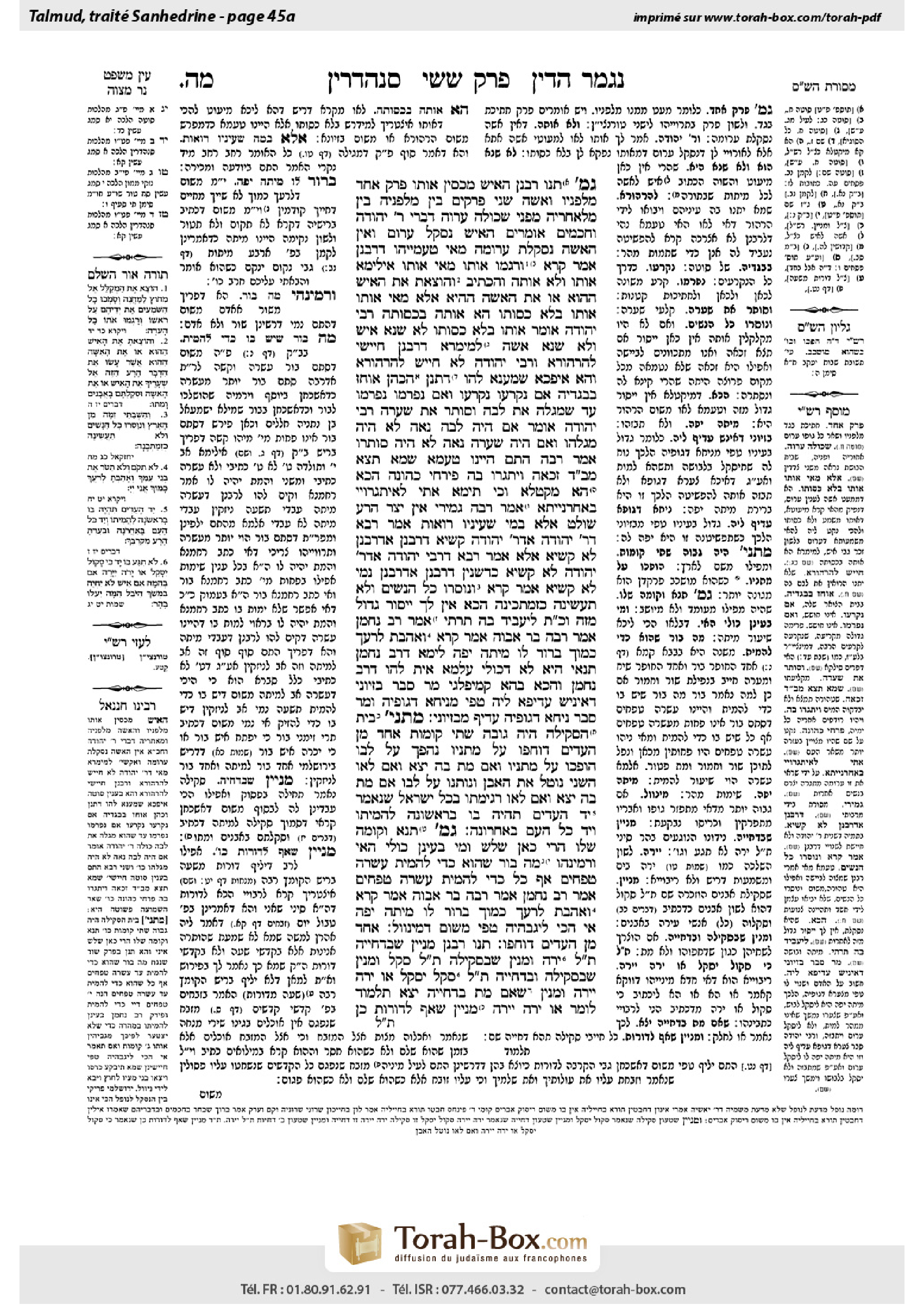
Sanhedrin 45a: Talmud study for Daf Yomi
Daf Yomi is the daily study of one Talmud folio. Explore 37 tractates with scans, Hebrew text, Sefaria English and AI-generated French translations where annotated.
Passage selection and English or AI-generated French translation are available where the scan has annotations. Daf Study is independent of Torah-Box and Sefaria.
Browse Sanhedrin · סנהדרין · All tractatesSanhedrin 45a text and translations
This page of Sanhedrin includes the Aramaic text, an English translation and an AI-generated French translation, alongside the scan above.
סנהדרין מ״ה א · Aramaic and Hebrew text
גְּמָ׳ תָּנוּ רַבָּנַן: הָאִישׁ מְכַסִּין אוֹתוֹ פֶּרֶק אֶחָד מִלְּפָנָיו, וְאִשָּׁה שְׁנֵי פְּרָקִים – בֵּין מִלְּפָנֶיהָ בֵּין מִלְּאַחֲרֶיהָ, מִפְּנֵי שֶׁכּוּלָּהּ עֶרְוָה. דִּבְרֵי רַבִּי יְהוּדָה. וַחֲכָמִים אוֹמְרִים: הָאִישׁ נִסְקָל עָרוֹם, וְאֵין הָאִשָּׁה נִסְקֶלֶת עֲרוּמָּה.
מַאי טַעְמַיְיהוּ דְּרַבָּנַן? אָמַר קְרָא: ״וְרָגְמוּ אֹתוֹ״. מַאי ״אוֹתוֹ״?
אִילֵּימָא אוֹתוֹ וְלֹא אוֹתָהּ, וְהָכְתִיב: ״וְהוֹצֵאתָ אֶת הָאִישׁ הַהוּא אוֹ אֶת הָאִשָּׁה הָהִיא״? אֶלָּא מַאי ״אוֹתוֹ״? אוֹתוֹ בְּלֹא כְּסוּתוֹ, הָא אוֹתָהּ בִּכְסוּתָהּ. רַבִּי יְהוּדָה אוֹמֵר: אוֹתוֹ בְּלֹא כְּסוּתוֹ, לָא שְׁנָא אִישׁ וְלָא שְׁנָא אִשָּׁה.
לְמֵימְרָא דְּרַבָּנַן חָיְישִׁי לְהִרְהוּרָא, וְרַבִּי יְהוּדָה לָא חָיֵישׁ לְהִרְהוּרָא? וְהָא אִיפְּכָא שְׁמַעְנָא לְהוּ, דִּתְנַן: הַכֹּהֵן אוֹחֵז בִּבְגָדֶיהָ – אִם נִקְרְעוּ נִקְרְעוּ, וְאִם נִפְרְמוּ נִפְרְמוּ, עַד שֶׁמְּגַלֶּה אֶת לִבָּהּ וְסוֹתֵר אֶת שְׂעָרָהּ. רַבִּי יְהוּדָה אוֹמֵר: אִם הָיָה לִבָּהּ נָאֶה לֹא הָיָה מְגַלֵּהוּ, וְאִם הָיָה שְׂעָרָהּ נָאֶה לֹא הָיָה סוֹתְרוֹ.
אָמַר רַבָּה: הָתָם הַיְינוּ טַעְמָא, שֶׁמָּא תֵּצֵא מִבֵּית דִּין זַכָּאָה וְיִתְגָּרוּ בָּהּ פִּירְחֵי כְּהוּנָּה. הָכָא הָא מִקַּטְלָא. וְכִי תֵּימָא: אָתֵי לְאִיתְגָּרוֹיֵי בְּאַחְרָנְיָיתָא? אָמַר רַבָּה: גְּמִירִי, אֵין יֵצֶר הָרָע שׁוֹלֵט אֶלָּא בְּמִי שֶׁעֵינָיו רוֹאוֹת.
אָמַר רָבָא: דְּרַבִּי יְהוּדָה אַדְּרַבִּי יְהוּדָה קַשְׁיָא, דְּרַבָּנַן אַדְּרַבָּנַן לָא קַשְׁיָא? אֶלָּא אָמַר רָבָא: דְּרַבִּי יְהוּדָה אַדְּרַבִּי יְהוּדָה לָא קַשְׁיָא, כִּדְשַׁנִּין.
דְּרַבָּנַן אַדְּרַבָּנַן נָמֵי לָא קַשְׁיָא. אָמַר קְרָא: ״וְנִוַּסְּרוּ כׇּל הַנָּשִׁים וְלֹא תַעֲשֶׂינָה כְּזִמַּתְכֶנָה״. הָכָא, אֵין לְךָ יִיסּוּר גָּדוֹל מִזֶּה.
וְכִי תֵּימָא: לֶיעְבֵּיד בַּהּ תַּרְתֵּי? אָמַר רַב נַחְמָן אָמַר רַבָּה בַּר אֲבוּהּ: אָמַר קְרָא ״וְאָהַבְתָּ לְרֵעֲךָ כָּמוֹךָ״ – בְּרוֹר לוֹ מִיתָה יָפָה.
לֵימָא: דְּרַב נַחְמָן תַּנָּאֵי הִיא? לָא, דְּכוּלֵּי עָלְמָא אִית לְהוּ דְּרַב נַחְמָן, וְהָכָא בְּהָא קָמִיפַּלְגִי: מָר סָבַר בִּזְיוֹנֵי דְאִינִישׁ עֲדִיף לֵיהּ טְפֵי מִנְּיָחָא דְגוּפֵיהּ, וּמָר סָבַר נְיָחָא דְגוּפֵיהּ עֲדִיף מִבִּזְיוֹנֵיהּ.
מַתְנִי׳ בֵּית הַסְּקִילָה הָיָה גָּבוֹהַּ שְׁתֵּי קוֹמוֹת. אֶחָד מִן הָעֵדִים דּוֹחֲפוֹ עַל מׇתְנָיו. נֶהְפַּךְ עַל לִבּוֹ, הוֹפְכוֹ עַל מׇתְנָיו. וְאִם מֵת בָּהּ – יָצָא.
וְאִם לָאו, הַשֵּׁנִי נוֹטֵל אֶת הָאֶבֶן וְנוֹתְנוֹ עַל לִבּוֹ. אִם מֵת בָּהּ – יָצָא, וְאִם לָאו – רְגִימָתוֹ בְּכׇל יִשְׂרָאֵל, שֶׁנֶּאֱמַר: ״יַד הָעֵדִים תִּהְיֶה בּוֹ בָרִאשׁוֹנָה לַהֲמִיתוֹ וְיַד כׇּל הָעָם בָּאַחֲרוֹנָה״.
גְּמָ׳ תָּנָא: וְקוֹמָה שֶׁלּוֹ, הֲרֵי כָּאן שָׁלֹשׁ. וּמִי בָּעֵינַן כּוּלֵּי הַאי? וּרְמִינְהוּ: מָה בּוֹר שֶׁהוּא כְּדֵי לְהָמִית – עֲשָׂרָה טְפָחִים, אַף כֹּל כְּדֵי לְהָמִית – עֲשָׂרָה טְפָחִים.
אָמַר רַב נַחְמָן אָמַר רַבָּה בַּר אֲבוּהּ: אָמַר קְרָא ״וְאָהַבְתָּ לְרֵעֲךָ כָּמוֹךָ״, בְּרוֹר לוֹ מִיתָה יָפָה. אִי הָכִי, לַיגְבְּהֵיהּ טְפֵי! מִשּׁוּם דְּמִינַּוַּל.
אֶחָד מִן הָעֵדִים דּוֹחֲפוֹ. תָּנוּ רַבָּנַן: מִנַּיִין שֶׁבִּדְחִיָּיה? תַּלְמוּד לוֹמַר ״יָרֹה״. וּמִנַּיִן שֶׁבִּסְקִילָה? תַּלְמוּד לוֹמַר ״סָקוֹל״.
וּמִנַּיִן שֶׁבִּסְקִילָה וּבִדְחִיָּיה? תַּלְמוּד לוֹמַר: ״סָקוֹל יִסָּקֵל אוֹ יָרֹה יִיָּרֶה״. וּמִנַּיִן שֶׁאִם מֵת בִּדְחִיָּיה יָצָא? תַּלְמוּד לוֹמַר: ״אוֹ יָרֹה יִיָּרֶה״. מִנַּיִין שֶׁאַף לְדוֹרוֹת כֵּן?
Sanhedrin 45a · English translation
GEMARA: The mishna teaches that a man is stoned naked but a woman is not stoned naked. With regard to this matter the Sages taught a related baraita: They cover a man’s genitals with one piece of cloth in the front, and a woman is covered with two pieces of cloth, both in the front and in the back, because all of that area is nakedness, which may not be viewed. This is the statement of Rabbi Yehuda. But the Rabbis say: A man is stoned naked, but a woman is not stoned naked.
The Gemara asks: What is the reasoning behind the opinion of the Rabbis, who say that a man is stoned naked, but a woman is not? The Gemara answers: The verse states: “And all the congregation shall stone him” (Leviticus 24:14). What does the verse intend to teach when it emphasizes that they stone “him”?
If we say that this serves to teach that they stone only him, the man, but not her, i.e., women are not punished with stoning, there is a difficulty. As isn’t it written explicitly: “And you shall bring forth that man or that woman…and stone them with stones until they die” (Deuteronomy 17:5)? Rather, what does the verse mean to teach when it stresses that they stone “him”? If he is a man, they stone just him, without his clothes, but if the condemned party is a woman, they stone her with her clothing. Rabbi Yehuda says: The emphasis on the word “him” teaches that they stone him alone, i.e., without his clothes, but as is the case with all other punishments stated in the Torah, there is no difference for a man and no difference for a woman, meaning the same halakha applies to both men and women.
The Gemara asks: Is this to say that the Rabbis are concerned that the sight of a naked woman will arouse sexual thoughts among the onlookers, and Rabbi Yehuda is not concerned about such sexual thoughts? But didn’t we hear them say just the opposite, as we learned in a mishna (Sota 7a) with regard to a sota, a woman suspected of adultery by her husband, and who was made to undergo the ordeal of the bitter waters: And the priest grabs hold of her clothing and pulls it, without concern about what happens to it. If the clothes are torn, they are torn; if the stitches come apart, they come apart. And he pulls her clothing until he reveals her heart, i.e., her chest. And then he unbraids her hair. Rabbi Yehuda says: If her heart was attractive he would not reveal it, and if her hair was attractive he would not unbraid it. This seems to indicate that it is Rabbi Yehuda who is concerned about the sexual thoughts of the onlookers.
Rabba said: There, in the case of a sota, this is the reason that Rabbi Yehuda says that the priest does not reveal the woman’s chest or unbraid her hair: Perhaps the sota will leave the court having been proven innocent, and the young priests in the Temple who saw her partially naked will become provoked by the sight of her. Here, in the case of a woman who is stoned, she is killed by being stoned, and there is no concern about the onlookers’ becoming provoked after her death. The Gemara comments: And if you would say that the fact that she is killed is irrelevant to their having sexual thoughts because the onlookers will be provoked with regard to other women, this is not a concern, as Rabba says: It is learned as a tradition that the evil inclination controls only that which one’s eyes see.
Rava says: Is the contradiction between one statement of Rabbi Yehuda and the other statement of Rabbi Yehuda difficult, while the contradiction between one statement of the Rabbis and the other statement of the Rabbis is not difficult? There is also an apparent contradiction between the two rulings of the Rabbis, as with regard to a sota, they are not concerned about sexual thoughts, but with regard to a woman who is stoned they are concerned. Rather, Rava says: The contradiction between one statement of Rabbi Yehuda and the other statement of Rabbi Yehuda is not difficult, as we answered above.
Rava continues: The contradiction between one ruling of the Rabbis and the other ruling of the Rabbis is not difficult either. With regard to a sota, the verse states that other women should be warned: “Thus will I cause lewdness to cease out of the land, that all women may be chastened not to do like your lewdness” (Ezekiel 23:48). In order to serve as an example and warning to other women, a woman suspected of adultery must undergo public disgrace, and therefore the concern about the sexual thoughts that her partially naked body might arouse is disregarded. Here, with regard to stoning, you have no chastening greater than seeing this stoning itself.
And if you would say that two forms of chastening, both stoning and humiliation, should be done to her, Rav Naḥman says that Rabba bar Avuh says: The verse states: “You shall love your neighbor as yourself” (Leviticus 19:18), teaching that even with regard to a condemned prisoner, select a good, i.e., a compassionate, death for him. Therefore, when putting a woman to death by stoning, she should not be humiliated in the process.
The Gemara suggests: Let us say that whether one rules in accordance with the statement of Rav Naḥman is a dispute between tanna’im, and according to Rabbi Yehuda there is no mitzva to select a compassionate death. The Gemara refutes this: No, it may be that everyone agrees with the opinion of Rav Naḥman, and here they disagree about this: One Sage, i.e., the Rabbis, holds: Minimizing one’s degradation is better for him than seeing to his physical comfort, i.e., than minimizing his physical pain. Therefore, the Rabbis view the more compassionate death as one without degradation, even if wearing clothes will increase the pain of the one being executed, as the clothes will absorb the blow and prolong his death. And one Sage, Rabbi Yehuda, holds that one’s physical comfort is better for him than minimizing his degradation, and therefore the one being executed prefers to be stoned unclothed, without any chance of the clothing prolonging his death, even though this increases his degradation.
MISHNA: The place of stoning from which the condemned man is pushed to his death is a platform twice the height of an ordinary person. He is made to stand at the edge of the platform, and then one of the witnesses who testified against him pushes him down by the hips, so that he falls face up onto the ground. If he turned over onto his chest, with his face downward, the witness turns him over onto his hips. And if he dies through this fall to the ground, the obligation to stone the transgressor is fulfilled.
And if the condemned man does not die from his fall, the second witness takes the stone that has been prepared for this task and places, i.e., casts, it on his chest. And if he dies with the casting of this first stone, the obligation to stone the transgressor is fulfilled. And if he does not die with the casting of this stone, then his stoning is completed by all of the Jewish people, i.e., by all the people who assembled for the execution, as it is stated: “The hand of the witnesses shall be first upon him to put him to death, and afterward the hand of all the people” (Deuteronomy 17:7).
GEMARA: A tanna taught in a baraita: Adding together the height of the platform, which is twice the height of an ordinary person, and the condemned man’s own height, it turns out that there is a height here three times the height of an ordinary person. The Gemara asks: Do we really need all that height to kill him? The Gemara raises a contradiction to the baraita from what was taught in a mishna (Bava Kamma 50b) when discussing the halakhot of damage caused by a pit: Why does the Torah specify a pit when one is liable for the damage caused by any type of excavation that he digs into the ground? This teaches that just as a pit that is of sufficient depth to cause one’s death from falling into it is at least ten handbreadths deep, so too, any other excavations that are of sufficient depth to cause one’s death may be no less than ten handbreadths. If a fall of ten handbreadths is sufficient to kill a person, why must the platform from which the condemned man is pushed be twice the height of an ordinary person?
Rav Naḥman says that Rabba bar Avuh says: The verse states: “You shall love your neighbor as yourself” (Leviticus 19:18), teaching that even with regard to a condemned man, select a good, i.e., a compassionate, death for him. Therefore, even though the one being executed is likely to die from a fall from a lesser height, a platform is built that is twice the height of an ordinary person in order to ensure a quick and relatively painless death. The Gemara challenges: If so, they should raise the platform even higher. The Gemara answers: This is not done, because if the condemned man were pushed from a higher platform, he would become seriously disfigured, and this would no longer be considered a compassionate form of death.
§ The mishna teaches that one of the witnesses who had testified against the condemned party pushes him off the platform. Concerning this halakha the Sages taught in a baraita: From where is it derived that the punishment of stoning can be fulfilled by pushing the condemned party from a high place, so that he dies from his fall? The verse states with regard to those who crossed the boundaries that were set up around Mount Sinai and touched the mountain: “Take heed to yourselves, that you not go up into the mountain, or touch the border of it; whoever touches the mountain shall be put to death; no hand shall touch him, but he shall be stoned or shall be thrown down” (Exodus 19:12–13). And from where is it derived that this punishment can be fulfilled with actual stoning? The verse states: “He shall be stoned.”
And from where is it derived that this punishment is sometimes fulfilled both by stoning and by pushing, i.e., if the transgressor did not die from his fall, he is then stoned? The verse states: “He shall be stoned or shall be thrown down.” And from where is it derived that if the condemned man died from the pushing, the obligation to stone him has been fulfilled, and there is no further need to actually stone him? The verse states: “Or shall be thrown down,” with the term “or” indicating that only one of the two options must be fulfilled. And from where is it derived that this is the halakha not only at Mount Sinai, but even with regard to future generations?
Sanhedrin 45a · Traduction française (IA)
GUEMARA : La Michna enseigne qu'un homme est lapidé nu, mais qu'une femme n'est pas lapidée nue. À ce sujet, les Sages ont enseigné une baraïta connexe : On couvre les organes génitaux d'un homme avec un seul morceau de tissu à l'avant, et une femme est couverte avec deux morceaux de tissu, à l'avant comme à l'arrière, car toute cette zone est une nudité qui ne doit pas être vue. C'est l'opinion de Rabbi Yehuda. Mais les Rabbins disent : Un homme est lapidé nu, mais une femme n'est pas lapidée nue.
La Guemara demande : Quel est le raisonnement derrière l'opinion des Rabbins, qui disent qu'un homme est lapidé nu, mais qu'une femme ne l'est pas ? La Guemara répond : Le verset déclare : « Et toute l'assemblée le lapidera » (Lévitique 24:14). Que le verset veut-il enseigner lorsqu'il insiste sur le fait qu'ils lapident « lui » ?
Si nous disons que cela sert à enseigner qu'ils lapident seulement lui, l'homme, mais pas elle, c'est-à-dire que les femmes ne sont pas punies par le lapidement, il y a une difficulté. N'est-il pas écrit explicitement : « Et vous ferez sortir cet homme ou cette femme... et vous les lapiderez de pierres jusqu'à ce qu'ils meurent » (Deutéronome 17:5) ? Plutôt, que le verset veut-il enseigner lorsqu'il insiste sur le fait qu'ils lapident « lui » ? S'il s'agit d'un homme, ils lapident seulement lui, sans ses vêtements, mais si la partie condamnée est une femme, ils la lapident avec ses vêtements. Rabbi Yehuda dit : L'insistance sur le mot « lui » enseigne qu'ils le lapident seul, c'est-à-dire sans ses vêtements, mais comme c'est le cas pour toutes les autres peines énoncées dans la Torah, il n'y a pas de différence pour un homme et pas de différence pour une femme, signifiant que la même halakha s'applique aux hommes et aux femmes.
La Guemara demande : Est-ce à dire que les Rabbins sont préoccupés par le fait que la vue d'une femme nue éveillera des pensées sexuelles chez les spectateurs, et que Rabbi Yehuda n'est pas préoccupé par de telles pensées ? Mais n'avons-nous pas entendu dire exactement le contraire, comme nous l'avons appris dans une Michna (Sota 7a) concernant une sota, une femme suspectée d'adultère par son mari, et qui est soumise à l'épreuve des eaux amères : Et le prêtre saisit ses vêtements et les tire, sans se soucier de ce qui leur arrive. Si les vêtements sont déchirés, ils sont déchirés ; si les coutures se défaisent, elles se défaisent. Et il tire ses vêtements jusqu'à ce qu'il révèle son cœur, c'est-à-dire sa poitrine. Et puis il défait sa tresse. Rabbi Yehuda dit : Si son cœur était attrayant, il ne le révélerait pas, et si ses cheveux étaient attrayants, il ne les défaitrait pas. Cela semble indiquer que c'est Rabbi Yehuda qui est préoccupé par les pensées sexuelles des spectateurs.
Rabba a dit : Là, dans le cas d'une sota, c'est la raison pour laquelle Rabbi Yehuda dit que le prêtre ne révèle pas la poitrine de la femme ni ne défait ses cheveux : Peut-être que la sota quittera le tribunal après avoir été déclarée innocente, et les jeunes prêtres du Temple qui l'ont vue partiellement nue seront excités par la vue de celle-ci. Ici, dans le cas d'une femme qui est lapidée, elle est tuée par le lapidement, et il n'y a pas de préoccupation quant à l'excitation des spectateurs après sa mort. La Guemara commente : Et si vous diriez que le fait qu'elle soit tuée est sans rapport avec leurs pensées sexuelles parce que les spectateurs seront excités par rapport à d'autres femmes, ce n'est pas une préoccupation, comme Rabba le dit : Il est appris par tradition que l'inclination au mal ne contrôle que ce que les yeux voient.
Rava dit : Est-il difficile de résoudre la contradiction entre un énoncé de Rabbi Yehuda et un autre énoncé de Rabbi Yehuda, alors que la contradiction entre un énoncé des Rabbins et un autre énoncé des Rabbins ne pose pas de difficulté ? Or, il existe également une contradiction apparente entre les deux décisions des Rabbins : en ce qui concerne la sota, ils ne tiennent pas compte des pensées sexuelles, mais en ce qui concerne une femme lapidée, ils y tiennent compte. En réalité, Rava dit : La contradiction entre un énoncé de Rabbi Yehuda et un autre énoncé de Rabbi Yehuda ne pose pas de difficulté, comme nous l'avons répondu ci-dessus.
Rava poursuit : La contradiction entre une décision des Rabbins et une autre décision des Rabbins ne pose pas non plus de difficulté. En ce qui concerne la sota, le verset indique que d'autres femmes doivent être averties : « Ainsi, je ferai cesser la débauche du pays, afin que toutes les femmes soient châtiées et ne fassent pas comme votre débauche » (Ézéchiel 23:48). Afin de servir d'exemple et d'avertissement pour les autres femmes, une femme suspectée d'adultère doit subir un déshonneur public, et par conséquent, la préoccupation quant aux pensées sexuelles que son corps partiellement nu pourrait éveiller est écartée. En revanche, en ce qui concerne le lapidement, vous n'avez pas de châtiment plus grand que de voir ce lapidement lui-même.
Et si vous disiez que deux formes de châtiment, à la fois le lapidement et l'humiliation, doivent lui être infligés, Rav Naḥman dit que Rabba bar Avuh dit : Le verset déclare : « Tu aimeras ton prochain comme toi-même » (Lévitique 19:18), enseignant que même en ce qui concerne un condamné à mort, on doit lui choisir une bonne mort, c'est-à-dire une mort miséricordieuse. Par conséquent, lorsqu'on met une femme à mort par lapidement, elle ne doit pas être humiliée dans le processus.
La Guemara propose : Disons que la question de savoir si l'on tranche conformément à l'avis de Rav Naḥman fait l'objet d'un désaccord entre les tannaïm, et que selon Rabbi Yehuda, il n'y a pas de mitsva de choisir une mort miséricordieuse. La Guemara réfute cette hypothèse : Non, il se peut que tous soient d'accord avec l'opinion de Rav Naḥman, et qu'ici ils ne désaccordent que sur ce point : Un Sage, à savoir les Rabbins, soutient : Minimiser son déshonneur est préférable pour lui que de veiller à son confort physique, c'est-à-dire que de minimiser sa douleur physique. Par conséquent, les Rabbins considèrent la mort plus miséricordieuse comme celle qui évite le déshonneur, même si le port de vêtements augmente la douleur de celui qui est exécuté, car les vêtements amortissent le choc et prolongent sa mort. Et un Sage, Rabbi Yehuda, soutient que le confort physique est préférable pour lui que la minimisation du déshonneur, et par conséquent, celui qui est exécuté préfère être lapidé nu, sans aucun risque que les vêtements prolongent sa mort, même si cela accroît son déshonneur.
MICHNA : Le lieu du lapidation, d'où le condamné est poussé vers la mort, est une plateforme deux fois plus haute qu'une personne ordinaire. On le fait se tenir au bord de la plateforme, puis l'un des témoins qui ont témoigné contre lui le pousse par les hanches, de sorte qu'il tombe la face en l'air sur le sol. S'il se retourne sur la poitrine, la face vers le bas, le témoin le retourne sur les hanches. Et s'il meurt de cette chute au sol, l'obligation de lapider le transgresseur est accomplie.
Et si le condamné ne meurt pas de sa chute, le second témoin prend la pierre qui a été préparée pour cette tâche et la place, c'est-à-dire la jette, sur sa poitrine. Et s'il meurt de la projection de cette première pierre, l'obligation de lapider le transgresseur est accomplie. Et s'il ne meurt pas de la projection de cette pierre, alors son lapidation est achevée par tout le peuple juif, c'est-à-dire par tous les gens qui se sont rassemblés pour l'exécution, comme il est écrit : « La main des témoins sera la première sur lui pour le faire mourir, et ensuite la main de tout le peuple » (Deutéronome 17:7).
GUEMARA : Un tanna a enseigné dans une baraïta : En additionnant la hauteur de la plateforme, qui est deux fois la hauteur d'une personne ordinaire, et la hauteur du condamné lui-même, il s'avère qu'il y a ici une hauteur trois fois supérieure à celle d'une personne ordinaire. La Guemara demande : Avons-nous vraiment besoin de toute cette hauteur pour le tuer ? La Guemara soulève une contradiction à la baraïta à partir de ce qui a été enseigné dans une Michna (Bava Kamma 50b) lors de la discussion des halakhot des dommages causés par un puits : Pourquoi la Torah spécifie-t-elle un puits alors qu'on est responsable des dommages causés par tout type de fouille qu'il creuse dans le sol ? Cela enseigne que de même qu'un puits d'une profondeur suffisante pour causer la mort par la chute y est d'au moins dix palmes de profondeur, de même, toute autre fouille d'une profondeur suffisante pour causer la mort ne peut être inférieure à dix palmes. Si une chute de dix palmes est suffisante pour tuer une personne, pourquoi la plateforme d'où le condamné est poussé doit-elle être deux fois la hauteur d'une personne ordinaire ?
Rav Naḥman dit que Rabba bar Avuh dit : Le verset déclare : « Tu aimeras ton prochain comme toi-même » (Lévitique 19:18), enseignant que même en ce qui concerne un condamné, on choisit pour lui une bonne, c'est-à-dire une miséricordieuse, mort. Par conséquent, bien que celui qui est exécuté soit susceptible de mourir d'une chute d'une moindre hauteur, une plateforme est construite deux fois plus haute qu'une personne ordinaire afin d'assurer une mort rapide et relativement indolore. La Guemara objecte : Si c'est ainsi, ils devraient élever la plateforme encore plus haut. La Guemara répond : Cela n'est pas fait, car si le condamné était poussé d'une plateforme plus haute, il serait sérieusement défiguré, et cela ne serait plus considéré comme une forme de mort miséricordieuse.
§ La Michna enseigne que l'un des témoins qui ont témoigné contre le condamné le pousse de la plateforme. Concernant cette halakha, les Sages ont enseigné dans une baraïta : D'où est-il dérivé que la punition du lapidation peut être accomplie en poussant le condamné d'un lieu élevé, de sorte qu'il meurt de sa chute ? Le verset déclare à propos de ceux qui ont franchi les limites qui ont été établies autour du mont Sinaï et ont touché la montagne : « Prenez garde à vous, que vous ne montiez pas sur la montagne, ou que vous ne touchiez pas sa limite ; quiconque touchera la montagne sera mis à mort ; aucune main ne le touchera, mais il sera lapidé ou jeté en bas » (Exode 19:12-13). Et d'où est-il dérivé que cette punition peut être accomplie par un lapidation réel ? Le verset déclare : « Il sera lapidé ».
Et d’où est-il dérivé que cette punition est parfois exécutée à la fois par lapidation et par précipitation, c’est-à-dire que si le transgresseur ne meurt pas de sa chute, il est alors lapidé ? Le verset déclare : « Il sera lapidé ou précipité ». Et d’où est-il dérivé que si le condamné meurt de la précipitation, l’obligation de le lapider a été accomplie, et qu’il n’y a plus besoin de le lapider réellement ? Le verset déclare : « Ou précipité », le terme « ou » indiquant que seule l’une des deux options doit être accomplie. Et d’où est-il dérivé que c’est la halakha non seulement au mont Sinaï, mais même en ce qui concerne les générations futures ?
Traduction française générée par IA à partir de l’édition anglaise de Sefaria. Vérifie toujours un passage avec le texte source.
Text from Sefaria: William Davidson Edition - Vocalized Aramaic (CC BY NC); William Davidson Edition - English (CC BY NC).