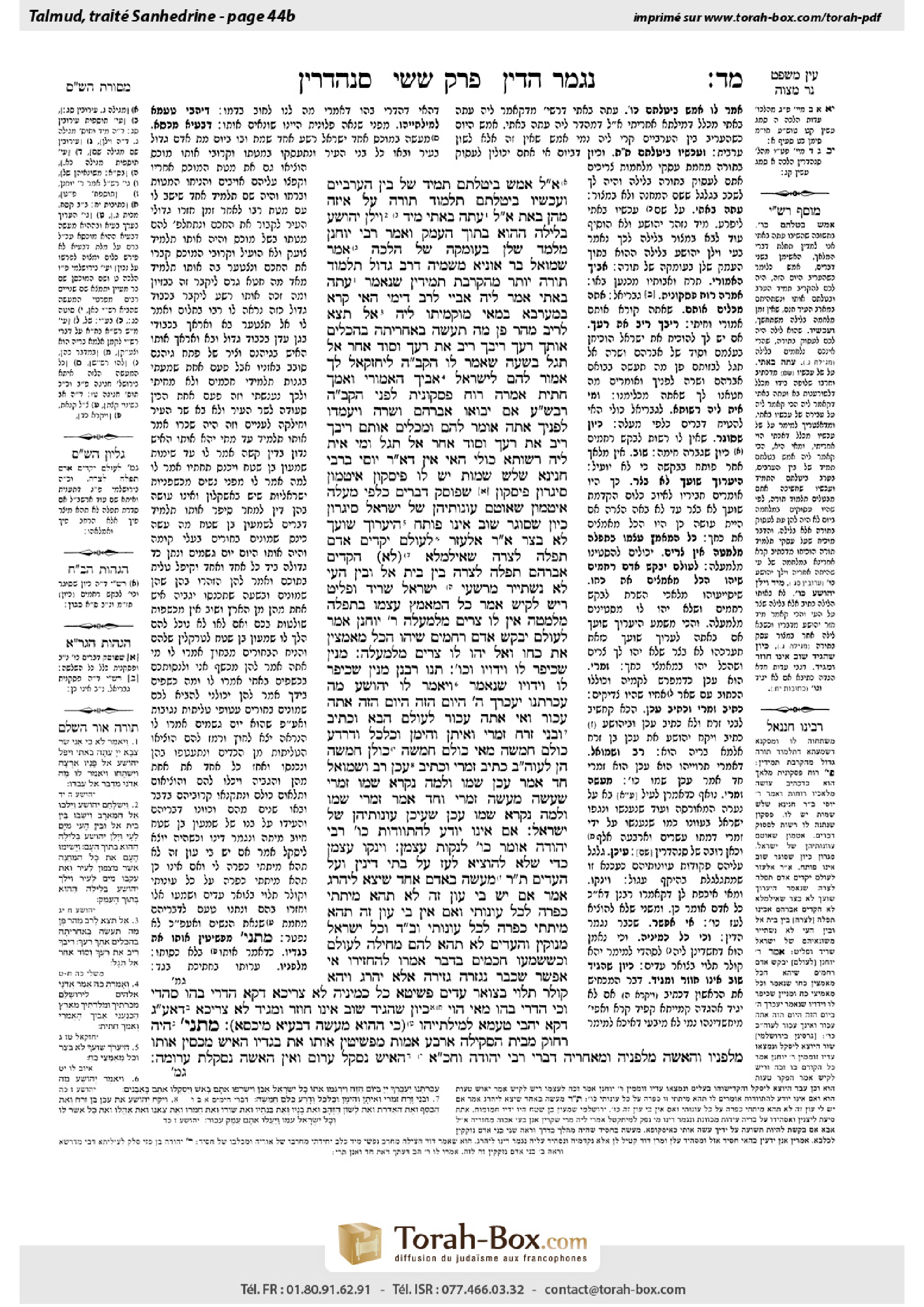
Sanhedrin 44b: Talmud study for Daf Yomi
Daf Yomi is the daily study of one Talmud folio. Explore 37 tractates with scans, Hebrew text, Sefaria English and AI-generated French translations where annotated.
Passage selection and English or AI-generated French translation are available where the scan has annotations. Daf Study is independent of Torah-Box and Sefaria.
Browse Sanhedrin · סנהדרין · All tractatesSanhedrin 44b text and translations
This page of Sanhedrin includes the Aramaic text, an English translation and an AI-generated French translation, alongside the scan above.
סנהדרין מ״ד ב · Aramaic and Hebrew text
אֲמַר לֵיהּ: אֶמֶשׁ בִּיטַּלְתֶּם תָּמִיד שֶׁל בֵּין הָעַרְבַּיִם, וְעַכְשָׁיו בִּיטַּלְתֶּם תַּלְמוּד תּוֹרָה. עַל אֵיזֶה מֵהֶן בָּאתָ? אֲמַר לֵיהּ: ״עַתָּה בָּאתִי״.
מִיָּד ״וַיָּלֶן יְהוֹשֻׁעַ בַּלַּיְלָה הַהוּא בְּתוֹךְ הָעֵמֶק״, וְאָמַר רַבִּי יוֹחָנָן: מְלַמֵּד שֶׁלָּן בְּעוּמְקָהּ שֶׁל הֲלָכָה.
אָמַר שְׁמוּאֵל בַּר אִינְיָא מִשְּׁמֵיהּ דְּרַב: גָּדוֹל תַּלְמוּד תּוֹרָה יוֹתֵר מֵהַקְרָבַת תְּמִידִין, שֶׁנֶּאֱמַר: ״עַתָּה בָאתִי״.
אֲמַר לֵיהּ אַבָּיֵי לְרַב דִּימִי: הַאי קְרָא בְּמַעְרְבָא בְּמַאי מוֹקְמִיתוּ לֵיהּ: ״אַל תֵּצֵא לָרִיב מַהֵר פֶּן מַה תַּעֲשֶׂה בְּאַחֲרִיתָהּ בְּהַכְלִים אֹתְךָ רֵעֶךָ. רִיבְךָ רִיב אֶת רֵעֶךָ וְסוֹד אַחֵר אַל תְּגָל״?
בְּשָׁעָה שֶׁאָמַר לוֹ הַקָּדוֹשׁ בָּרוּךְ הוּא לִיחֶזְקֵאל: לֵךְ אֱמוֹר לָהֶם לְיִשְׂרָאֵל ״אָבִיךְ הָאֱמֹרִי וְאִמֵּךְ חִתִּית״, אָמְרָה רוּחַ פִּסְקוֹנִית לִפְנֵי הַקָּדוֹשׁ בָּרוּךְ הוּא: רִבּוֹנוֹ שֶׁל עוֹלָם, אִם יָבוֹאוּ אַבְרָהָם וְשָׂרָה וְיַעַמְדוּ לְפָנֶיךָ, אַתָּה אוֹמֵר לָהֶם וּמַכְלִים אוֹתָם? ״רִיבְךָ רִיב אֶת רֵעֶךָ וְסוֹד אַחֵר אַל תְּגָל״!
וּמִי אִית לֵיהּ רְשׁוּתָא כּוּלֵּי הַאי? אִין, דְּאָמַר רַבִּי יוֹסֵי בְּרַבִּי חֲנִינָא: שָׁלֹשׁ שֵׁמוֹת יֵשׁ לוֹ – פִּיסְקוֹן, אִיטְמוֹן, סִיגְרוֹן. פִּיסְקוֹן – שֶׁפּוֹסֵק דְּבָרִים כְּלַפֵּי מַעְלָה, אִיטְמוֹן – שֶׁאוֹטֵם עֲוֹנוֹתֵיהֶן שֶׁל יִשְׂרָאֵל, סִיגְרוֹן – כֵּיוָן שֶׁסּוֹגֵר שׁוּב אֵינוֹ פּוֹתֵחַ.
״הֲיַעֲרֹךְ שׁוּעֲךָ לֹא בְצָר״, אָמַר רַבִּי אֶלְעָזָר: לְעוֹלָם יַקְדִּים אָדָם תְּפִלָּה לַצָּרָה, שֶׁאִילְמָלֵא לֹא הִקְדִּים אַבְרָהָם תְּפִלָּה לַצָּרָה בֵּין בֵּית אֵל וּבֵין הָעַי, לֹא נִשְׁתַּיֵּיר מִשּׂוֹנְאֵיהֶן שֶׁל יִשְׂרָאֵל שָׂרִיד וּפָלִיט. רֵישׁ לָקִישׁ אָמַר: כׇּל הַמְאַמֵּץ עַצְמוֹ בִּתְפִלָּה מִלְּמַטָּה, אֵין לוֹ צָרִים מִלְּמַעְלָה. רַבִּי יוֹחָנָן אָמַר: לְעוֹלָם יְבַקֵּשׁ אָדָם רַחֲמִים שֶׁיְּהוּ הַכֹּל מְאַמְּצִין אֶת כֹּחוֹ, וְאַל יְהוּ לוֹ צָרִים מִלְּמַעְלָה.
מִנַּיִן שֶׁכִּיפֵּר לוֹ וִידּוּיוֹ וְכוּ׳? תָּנוּ רַבָּנַן: מִנַּיִן שֶׁכִּיפֵּר לוֹ וִידּוּיוֹ? שֶׁנֶּאֱמַר: ״וַיֹּאמֶר לוֹ יְהוֹשֻׁעַ מֶה עֲכַרְתָּנוּ יַעְכֳּרְךָ ה׳ הַיּוֹם הַזֶּה״. הַיּוֹם הַזֶּה אַתָּה עָכוּר, וְאִי אַתָּה עָכוּר לָעוֹלָם הַבָּא. וּכְתִיב: ״וּבְנֵי זֶרַח זִמְרִי וְאֵיתָן וְהֵימָן וְכַלְכֹּל וְדַרְדַּע כֻּלָּם חֲמִשָּׁה״. מַאי ״כּוּלָּם חֲמִשָּׁה״? כּוּלָּן חֲמִשָּׁה הֵן לָעוֹלָם הַבָּא.
כְּתִיב ״זִמְרִי״, וּכְתִיב ״עָכָן״. רַב וּשְׁמוּאֵל: חַד אָמַר, עָכָן שְׁמוֹ, וְלָמָּה נִקְרָא שְׁמוֹ זִמְרִי? שֶׁעָשָׂה מַעֲשֵׂה זִמְרִי. וְחַד אָמַר, זִמְרִי שְׁמוֹ, וְלָמָּה נִקְרָא שְׁמוֹ עָכָן? שֶׁעִיכֵּן עֲוֹנוֹתֵיהֶן שֶׁל יִשְׂרָאֵל.
אִם אֵינוֹ יוֹדֵעַ לְהִתְוַודּוֹת כּוּ׳. רַבִּי יְהוּדָה אוֹמֵר כּוּ׳. לְנַקּוֹת עַצְמָן, וִינַקּוּ עַצְמָן! כְּדֵי שֶׁלֹּא לְהוֹצִיא לַעַז עַל בָּתֵּי דִינִין וְעַל הָעֵדִים.
תָּנוּ רַבָּנַן: מַעֲשֶׂה בְּאָדָם אֶחָד שֶׁיָּצָא לֵיהָרֵג. אָמַר: אִם יֵשׁ בִּי עָוֹן זֶה, לֹא תְּהֵא מִיתָתִי כַּפָּרָה לְכׇל עֲוֹנוֹתַי. וְאִם אֵין בִּי עָוֹן זֶה, תְּהֵא מִיתָתִי כַּפָּרָה לְכׇל עֲוֹנוֹתַי, וּבֵית דִּין וְכׇל יִשְׂרָאֵל מְנוּקִּין, וְהָעֵדִים לֹא תְּהֵא לָהֶם מְחִילָה לְעוֹלָם. וּכְשֶׁשָּׁמְעוּ חֲכָמִים בַּדָּבָר, אָמְרוּ: לְהַחְזִירוֹ אִי אֶפְשָׁר, שֶׁכְּבָר נִגְזְרָה גְּזֵירָה. אֶלָּא יֵהָרֵג, וִיהֵא קוֹלָר תָּלוּי בְּצַוַּאר עֵדִים.
פְּשִׁיטָא, כֹּל כְּמִינֵּיהּ? לָא צְרִיכָא דְּקָא הָדְרִי בְּהוּ סָהֲדִי.
וְכִי הָדְרִי בְּהוּ, מַאי הָוֵי? כֵּיוָן שֶׁהִגִּיד, שׁוּב אֵינוֹ חוֹזֵר וּמַגִּיד! לָא צְרִיכָא, דְּאַף עַל גַּב דְּקָא יָהֲבִי טַעְמָא לְמִילְּתַיְיהוּ, כִּי הָהוּא מַעֲשֶׂה דְּבַעְיָא מֹכְסָא.
מַתְנִי׳ הָיָה רָחוֹק מִבֵּית הַסְּקִילָה אַרְבַּע אַמּוֹת, מַפְשִׁיטִין אוֹתוֹ אֶת בְּגָדָיו. הָאִישׁ מְכַסִּין אוֹתוֹ מִלְּפָנָיו, וְהָאִשָּׁה מִלְּפָנֶיהָ וּמֵאַחֲרֶיהָ, דִּבְרֵי רַבִּי יְהוּדָה. וַחֲכָמִים אוֹמְרִים: הָאִישׁ נִסְקָל עָרוֹם, וְאֵין הָאִשָּׁה נִסְקֶלֶת עֲרוּמָּה.
Sanhedrin 44b · English translation
The Gemara understands the words of the angel that Joshua encountered as a rebuke for some offense Joshua committed: The angel said to Joshua: Yesterday, in the afternoon, you neglected sacrificing the daily afternoon offering because you were engaged in warfare, and now, when it is dark, you neglected Torah study. Joshua asked him: For which of these sins have you come to reprove me? The angel said to him: “I have now come,” i.e., the fact that I did not come before, but waited until now, when it is dark, indicates that the sin of neglecting Torah study is the more severe one.
Joshua immediately acted to rectify the matter by deciding that he must devote more time to Torah study, as it is stated: “And Joshua lodged that night” (Joshua 8:9) “into the midst of the valley [ha’emek]” (Joshua 8:13). And Rabbi Yoḥanan says: This teaches that he lodged all night in the depth [be’omekah] of halakha, thereby atoning for his previous neglect of Torah study.
Shmuel bar Unya says in the name of Rav: Torah study is greater than the sacrificing of the daily offerings, as it is stated: “I have now come,” demonstrating that the neglect of Torah study is a more serious offense than the neglect of the daily offerings.
§ Abaye said to Rav Dimi, who descended to Babylonia from Eretz Yisrael: How do you explain this verse in the West, Eretz Yisrael: “Do not proceed hastily to litigation, lest you know not what to do in the end of it, when your neighbor has put you to shame. Debate your cause with your neighbor, and do not reveal the secret of another” (Proverbs 25:8–9)?
Rav Dimi explained as follows: At the time that the Holy One, Blessed be He, said to Ezekiel: Go say to Israel: “Your father was an Amorite and your mother a Hittite” (Ezekiel 16:3), the spirit Paskonit, which is another name for the angel Gabriel, said before the Holy One, Blessed be He: Master of the Universe, were the patriarch Abraham and the matriarch Sarah to come now and stand before You, would you speak to them in such a manner and put them to shame? Is it not stated: “Debate your cause with your neighbor, and do not reveal the secret of another”?
The Gemara asks: But does the angel Gabriel have so much authority that he can reprove God in such a manner? The Gemara answers: Yes, as Rabbi Yosei, son of Rabbi Ḥanina, says: He, the angel Gabriel, has three names: Piskon, Itmon, and Sigron. He is called Piskon because he splits [sheposek] words and argues with God on High. He is called Itmon because he conceals [she’otem] the sins of the Jewish people. And he is called Sigron because once he closes [shesoger] his arguments on behalf of the Jewish people, no one reopens the discussion.
The verse states: “Had you prepared your prayers, before your troubles came” (Job 36:19). Rabbi Elazar says: A person should always offer up prayer before trouble actually arrives, as had the patriarch Abraham not anticipated the trouble at Ai with the prayer he offered between Bethel and Ai, there would have been no remnant or refugee remaining among the enemies of Israel, a euphemism for Israel itself, as Israel suffered a defeat at Ai from which there is ordinarily no recovery. Reish Lakish says: The verse should be understood as follows: Anyone who concentrates himself and his energy in prayer in the world below will have no enemies in Heaven above causing him trouble. Rabbi Yoḥanan says: The verse should be understood in a slightly different manner: A person should always pray for mercy that all heavenly beings should strengthen his power of prayer, and that he should have no enemies causing him trouble in Heaven above.
§ The mishna teaches: From where is it derived that Achan’s confession achieved atonement for him? The Sages taught likewise in a baraita: From where is it derived that Achan’s confession achieved atonement for him? As it is stated: “And Joshua said: Why have you brought trouble on us? The Lord shall trouble you this day” (Joshua 7:25). Joshua said to Achan: On this day of your judgment you are troubled, but you will not be troubled in the World-to-Come. And elsewhere it is written: “And the sons of Zerah were Zimri and Ethan and Heman and Calcol and Dara, five of them in all” (I Chronicles 2:6). What do the words “five of them in all” serve to teach? All five sons are destined to receive a share in the World-to-Come. According to the Sages, Zimri is Achan, son of Zerah, as will be explained. Since Achan has a share in the World-to-Come, his confession must have achieved atonement for him.
In one place, among the five sons of Zerah, it is written: “Zimri,” without any mention of Achan (I Chronicles 2:6), and in another place it is written: “And Joshua took Achan, son of Zerah” (Joshua 7:24). Rav and Shmuel both say that Zimri and Achan are one and the same, but they disagree about his real name. One of them says: His real name was Achan. Why then was he called Zimri? He was called Zimri because he acted like Zimri, i.e., just as Zimri engaged in sexual intercourse with a Midianite woman, Achan engaged in intercourse with a betrothed young woman. And the other one says: His real name was Zimri. Why then was he called Achan? He was called Achan because he acted like a snake [she’iken] and caused the punishment of the sins of the Jewish people.
§ The mishna teaches that if the condemned man does not know how to confess, they say to him: Say simply: Let my death be an atonement for all my sins. Rabbi Yehuda says that if he knows that he was wrongfully convicted, he should say: Let my death be an atonement for all my sins except for this sin. The Sages counter that if such a confession is acceptable, anyone who is sentenced to execution would state it to clear himself in the eyes of the public. The Gemara challenges: Let them clear themselves. Why should the court intervene if the condemned man wishes to proclaim his innocence? The Gemara answers: They intervene so as not to cast aspersions on the courts and on the witnesses who testified against him.
The Sages taught: An incident occurred involving a person who was being taken out to be executed after having been convicted by the court. He said: If I committed this sin for which I am being executed, let my death not be an atonement for all my sins; but if I did not commit this sin for which I am being put to death, let my death be an atonement for all my sins. And the court that convicted me and all the people of Israel are clear of responsibility, but the witnesses who testified falsely against me will never be forgiven. And when the Sages heard this, they said: It is impossible to bring him back to court and reconsider the verdict, as the decree has already been decreed. Rather, he shall be executed, and the chain of responsibility for his wrongful execution hangs around the necks of the witnesses.
The Gemara asks: Isn’t it obvious that he should be executed? Is it in his power to have his sentence overturned just because he says he is innocent? The Gemara answers: No, it is necessary to state that the condemned man is executed even when the witnesses retracted their testimony.
The Gemara asks: Even if the witnesses retracted their testimony, what of it? It is still clear that the condemned man is to be executed, as the halakha is that once a witness has stated his testimony, he may not then state a revision of that testimony. In other words, a witness’s retraction of his testimony has no validity. The Gemara answers: No, it is necessary to state that the condemned man is executed even when the witnesses retracted their testimony and gave an explanation for having lied in their initial statement. This is like that incident involving Ba’aya the tax collector, where it was discovered that witnesses had falsely accused the son of Rabbi Shimon ben Shataḥ in revenge for the son’s having sentenced to death for sorcery the witnesses’ relatives.
MISHNA: When the condemned man is at a distance of four cubits from the place of stoning, they take off his clothes. They cover a man’s genitals in the front, and a woman is covered both in the front and in the back; this is the statement of Rabbi Yehuda. But the Rabbis say: A man is stoned naked, i.e., wearing only that cloth covering, but a woman is not stoned naked, but is stoned while clothed.
Sanhedrin 44b · Traduction française (IA)
La Guemara comprend les paroles de l’ange rencontré par Josué comme un reproche pour une faute que Josué avait commise. L’ange lui dit : « Hier, dans l’après-midi, tu as négligé d’offrir le sacrifice quotidien de l’après-midi parce que tu étais occupé à faire la guerre, et maintenant, alors qu’il fait nuit, tu as négligé l’étude de la Torah. » Josué lui demanda : « Pour laquelle de ces fautes es-tu venu me réprimander ? » L’ange lui répondit : « Je suis venu maintenant », c’est-à-dire que le fait de ne pas être venu plus tôt, mais d’avoir attendu qu’il fasse nuit, indique que la faute consistant à négliger l’étude de la Torah est la plus grave.
Josué agit immédiatement pour réparer la situation, décidant qu’il devait consacrer davantage de temps à l’étude de la Torah, comme il est dit : « Et Josué passa cette nuit » (Josué 8,9), « au milieu de la vallée [ha’emek] » (Josué 8,13). Rabbi Yoḥanan dit que cela enseigne qu’il passa toute la nuit dans les profondeurs [be’omekah] de la halakha, expiant ainsi sa négligence antérieure de l’étude de la Torah.
Shmuel bar Unya dit au nom de Rav : l’étude de la Torah est supérieure à l’offrande des sacrifices quotidiens, comme le montre l’expression « Je suis venu maintenant », qui indique que négliger l’étude de la Torah est une faute plus grave que négliger les sacrifices quotidiens.
§ Abaye dit à Rav Dimi, qui était descendu d’Eretz Israël en Babylonie : Comment explique-t-on dans l’Ouest, c’est-à-dire en Eretz Israël, ce verset : « Ne te hâte pas d’aller en justice, de peur que tu ne saches que faire à la fin, lorsque ton prochain t’aura couvert de honte. Défends ta cause auprès de ton prochain, mais ne révèle pas le secret d’autrui » (Proverbes 25,8-9) ?
Rav Dimi expliqua ainsi : Au moment où le Saint, béni soit-Il, dit à Ézéchiel : « Va dire à Israël : “Ton père était un Amorite et ta mère une Hittite” » (Ézéchiel 16,3), l’esprit Paskonit, autre nom de l’ange Gabriel, dit devant le Saint, béni soit-Il : « Maître de l’Univers, si le patriarche Abraham et la matriarche Sarah venaient maintenant se tenir devant Toi, leur parlerais-Tu de cette manière et les couvrirais-Tu de honte ? N’est-il pas dit : “Défends ta cause auprès de ton prochain, mais ne révèle pas le secret d’autrui” ? »
La Guemara demande : Mais l’ange Gabriel a-t-il une autorité suffisante pour réprimander Dieu de cette manière ? La Guemara répond : Oui, car Rabbi Yosei, fils de Rabbi Ḥanina, dit que l’ange Gabriel a trois noms : Piskon, Itmon et Sigron. Il est appelé Piskon parce qu’il tranche [sheposek] les paroles et conteste Dieu dans les hauteurs. Il est appelé Itmon parce qu’il dissimule [she’otem] les péchés du peuple juif. Et il est appelé Sigron parce qu’une fois qu’il clôt [shesoger] ses arguments en faveur du peuple juif, personne ne rouvre le débat.
Le verset dit : « Si tu avais préparé tes prières avant que ne surviennent tes épreuves » (Job 36,19). Rabbi Elazar dit : Une personne doit toujours prier avant que l’épreuve ne survienne. En effet, si le patriarche Abraham n’avait pas anticipé l’épreuve d’Aï par la prière qu’il avait offerte entre Béthel et Aï, il ne serait resté aucun survivant ni aucun fugitif parmi les ennemis d’Israël — euphémisme désignant Israël lui-même — car Israël essuya à Aï une défaite dont on ne se relève généralement pas. Reish Lakish dit que le verset doit être compris ainsi : quiconque concentre son attention et son énergie dans la prière ici-bas n’aura aucun ennemi dans les Cieux d’en haut pour lui causer des difficultés. Rabbi Yoḥanan dit que le verset doit être compris d’une manière légèrement différente : une personne doit toujours implorer la miséricorde afin que tous les êtres célestes renforcent sa capacité à prier et qu’elle n’ait aucun ennemi dans les Cieux d’en haut pour lui causer des difficultés.
§ La Michna enseigne : D’où apprend-on que la confession d’Akan lui a valu l’expiation ? Les Sages enseignent également dans une baraïta : D’où apprend-on que la confession d’Akan lui a valu l’expiation ? Du verset : « Josué dit : Pourquoi nous as-tu attiré le malheur ? Que l’Éternel t’attire le malheur en ce jour » (Josué 7,25). Josué dit à Akan : « En ce jour de ton jugement, tu es frappé par le malheur, mais tu ne le seras pas dans le Monde à venir. » Et ailleurs, il est écrit : « Les fils de Zérah furent Zimri, Étan, Héman, Kalkol et Dara, cinq en tout » (I Chroniques 2,6). Que nous apprend l’expression « cinq en tout » ? Que les cinq fils sont destinés à recevoir une part dans le Monde à venir. Selon les Sages, Zimri est Akan, fils de Zérah, comme cela sera expliqué. Puisqu’Akan a une part dans le Monde à venir, sa confession doit lui avoir valu l’expiation.
À un endroit, parmi les cinq fils de Zérah, il est écrit « Zimri », sans aucune mention d’Akan (I Chroniques 2,6), tandis qu’à un autre endroit, il est écrit : « Josué prit Akan, fils de Zérah » (Josué 7,24). Rav et Shmuel disent tous deux que Zimri et Akan sont une seule et même personne, mais ils ne s’accordent pas sur son véritable nom. L’un dit que son véritable nom était Akan. Pourquoi donc était-il appelé Zimri ? Parce qu’il a agi comme Zimri : de même que Zimri a eu des rapports sexuels avec une femme madianite, Akan a eu des rapports avec une jeune femme fiancée. L’autre dit que son véritable nom était Zimri. Pourquoi donc était-il appelé Akan ? Parce qu’il a agi comme un serpent [she’iken] et a entraîné le châtiment consécutif aux péchés du peuple juif.
§ La Michna enseigne que si le condamné ne sait pas comment se confesser, on lui dit de dire simplement : « Que ma mort expie toutes mes fautes. » Rabbi Yehuda dit que s’il sait qu’il a été condamné à tort, il doit dire : « Que ma mort expie toutes mes fautes, à l’exception de cette faute. » Les Sages objectent que, si une telle confession est recevable, toute personne condamnée à mort la prononcera pour se disculper aux yeux du public. La Guemara objecte : Qu’ils se disculpent donc. Pourquoi le tribunal devrait-il intervenir si le condamné souhaite proclamer son innocence ? La Guemara répond qu’il intervient afin de ne pas jeter le discrédit sur les tribunaux et sur les témoins qui ont témoigné contre lui.
Les Sages enseignent : Un homme qui avait été condamné par le tribunal était conduit à l’exécution. Il dit : « Si j’ai commis cette faute pour laquelle je suis exécuté, que ma mort n’expie pas toutes mes fautes ; mais si je n’ai pas commis cette faute pour laquelle je suis mis à mort, que ma mort expie toutes mes fautes. Le tribunal qui m’a condamné et tout le peuple d’Israël sont dégagés de toute responsabilité, mais les témoins qui ont témoigné faussement contre moi ne seront jamais pardonnés. » Lorsque les Sages entendirent cela, ils dirent : « Il est impossible de le ramener devant le tribunal et de réexaminer le verdict, car la sentence a déjà été prononcée. Il sera donc exécuté, et la responsabilité de son exécution injuste pèsera sur les témoins. »
La Guemara demande : N’est-il pas évident qu’il doit être exécuté ? Est-il en son pouvoir de faire annuler sa sentence simplement en affirmant son innocence ? La Guemara répond : Non, il est nécessaire de préciser que le condamné est exécuté même lorsque les témoins se sont rétractés.
La Guemara demande : Même si les témoins se sont rétractés, qu’est-ce que cela change ? Il est toujours clair que le condamné doit être exécuté, car la halakha veut qu’une fois qu’un témoin a déposé, il ne peut ensuite modifier sa déposition. Autrement dit, la rétractation d’un témoin n’a aucune validité. La Guemara répond : Non, il est nécessaire de préciser que le condamné est exécuté même lorsque les témoins se sont rétractés et ont expliqué pourquoi ils avaient menti dans leur déclaration initiale. C’est comparable à l’incident concernant Ba’aya, le collecteur d’impôts : on découvrit que des témoins avaient faussement accusé le fils de Rabbi Shimon ben Shataḥ par vengeance, parce que celui-ci avait condamné à mort pour sorcellerie des proches des témoins.
MICHNA : Lorsque le condamné se trouve à quatre coudées du lieu de la lapidation, on lui enlève ses vêtements. On couvre les parties génitales d’un homme par-devant ; une femme est couverte à la fois par-devant et par-derrière. Telle est l’opinion de Rabbi Yehuda. Mais les Sages disent : Un homme est lapidé nu, c’est-à-dire qu’il ne porte que cette étoffe couvrante, tandis qu’une femme n’est pas lapidée nue, mais vêtue.
Traduction française générée par IA à partir de l’édition anglaise de Sefaria. Vérifie toujours un passage avec le texte source.
Text from Sefaria: William Davidson Edition - Vocalized Aramaic (CC BY NC); William Davidson Edition - English (CC BY NC).