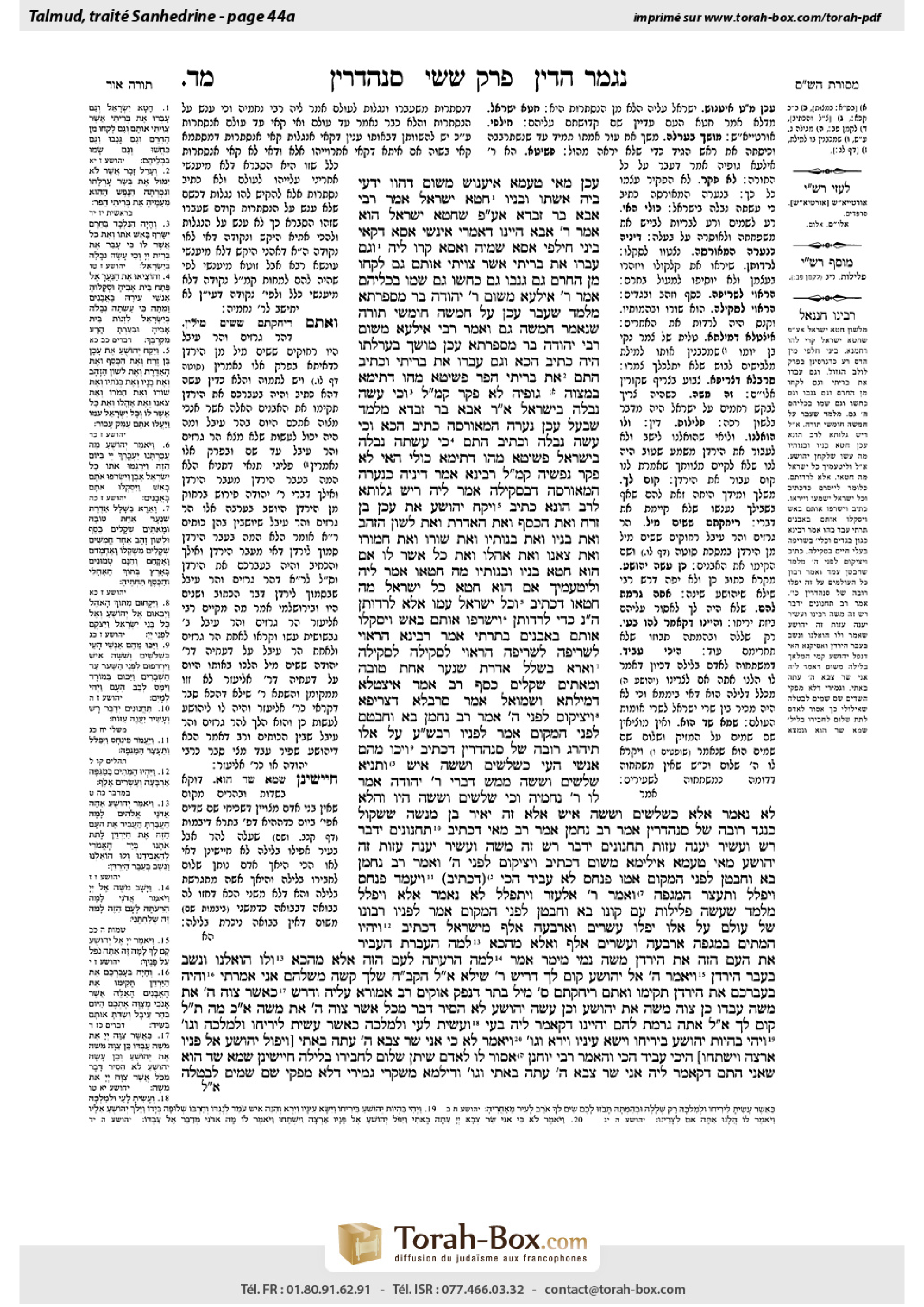
Sanhedrin 44a: Talmud study for Daf Yomi
Daf Yomi is the daily study of one Talmud folio. Explore 37 tractates with scans, Hebrew text, Sefaria English and AI-generated French translations where annotated.
Passage selection and English or AI-generated French translation are available where the scan has annotations. Daf Study is independent of Torah-Box and Sefaria.
Browse Sanhedrin · סנהדרין · All tractatesSanhedrin 44a text and translations
This page of Sanhedrin includes the Aramaic text, an English translation and an AI-generated French translation, alongside the scan above.
סנהדרין מ״ד א · Aramaic and Hebrew text
עָכָן, מַאי טַעְמָא אִיעֲנוּשׁ? מִשּׁוּם דַּהֲווֹ יָדְעִי בֵּיהּ אִשְׁתּוֹ וּבָנָיו.
״חָטָא יִשְׂרָאֵל״. אָמַר רַבִּי אַבָּא בַּר זַבְדָּא: אַף עַל פִּי שֶׁחָטָא, יִשְׂרָאֵל הוּא. אָמַר רַבִּי אַבָּא: הַיְינוּ דְּאָמְרִי אִינָשֵׁי: אָסָא דְּקָאֵי בֵּינֵי חִלְפֵי, אָסָא שְׁמֵיהּ, וְאָסָא קָרוּ לֵיהּ.
״וְגַם עָבְרוּ אֶת בְּרִיתִי אֲשֶׁר צִוִּיתִי אוֹתָם גַּם לָקְחוּ מִן הַחֵרֶם גַּם גָּנְבוּ גַּם כִּחֲשׁוּ גַּם שָׂמוּ בִּכְלֵיהֶם״. אָמַר רַבִּי אִילְעָא מִשּׁוּם רַבִּי יְהוּדָה בַּר מַסְפַּרְתָּא: מְלַמֵּד שֶׁעָבַר עָכָן עַל חֲמִשָּׁה חוּמְשֵׁי תוֹרָה, שֶׁנֶּאֱמַר חֲמִשָּׁה ״גַּם״.
וְאָמַר רַבִּי אִילְעָא מִשּׁוּם רַבִּי יְהוּדָה בַּר מַסְפַּרְתָּא: עָכָן מוֹשֵׁךְ בְּעׇרְלָתוֹ הָיָה. כְּתִיב הָכָא ״וְגַם עָבְרוּ אֶת בְּרִיתִי״, וּכְתִיב הָתָם ״אֶת בְּרִיתִי הֵפַר״.
פְּשִׁיטָא! מַהוּ דְּתֵימָא: בְּמִצְוָה גּוּפֵיהּ לָא פְּקַר? קָא מַשְׁמַע לַן.
וְכִי עָשָׂה נְבָלָה בְּיִשְׂרָאֵל. אָמַר רַבִּי אַבָּא בַּר זַבְדָּא: מְלַמֵּד שֶׁבָּעַל עָכָן נַעֲרָה הַמְאוֹרָסָה. כְּתִיב הָכָא ״וְכִי עָשָׂה נְבָלָה״, וּכְתִיב הָתָם ״כִּי עָשְׂתָה נְבָלָה בְּיִשְׂרָאֵל״.
פְּשִׁיטָא! מַהוּ דְּתֵימָא כּוּלֵּי הַאי לָא פְּקַר נַפְשֵׁיהּ, קָא מַשְׁמַע לַן. רָבִינָא אָמַר: דִּינֵיהּ כְּנַעֲרָה הַמְאוֹרָסָה, דְּבִסְקִילָה.
אֲמַר לֵיהּ רֵישׁ גָּלוּתָא לְרַב הוּנָא: כְּתִיב: ״וַיִּקַּח יְהוֹשֻׁעַ אֶת עָכָן בֶּן זֶרַח וְאֶת הַכֶּסֶף וְאֶת הָאַדֶּרֶת וְאֶת לְשׁוֹן הַזָּהָב וְאֶת בָּנָיו וְאֶת בְּנֹתָיו וְאֶת שׁוֹרוֹ וְאֶת חֲמֹרוֹ וְאֶת צֹאנוֹ וְאֶת אׇהֳלוֹ וְאֶת כׇּל אֲשֶׁר לוֹ״. אִם הוּא חָטָא, בָּנָיו וּבְנוֹתָיו מֶה חָטְאוּ?
אֲמַר לֵיהּ: וְלִיטַעְמָיךְ, אִם הוּא חָטָא – כָּל יִשְׂרָאֵל מֶה חָטְאוּ? דִּכְתִיב: ״וְכׇל יִשְׂרָאֵל עִמּוֹ״. אֶלָּא לִרְדּוֹתָן. הָכִי נָמֵי, כְּדֵי לִרְדּוֹתָן.
״וַיִּשְׂרְפוּ אֹתָם בָּאֵשׁ וַיִּסְקְלוּ אֹתָם בָּאֲבָנִים״. בְּתַרְתֵּי? אָמַר רָבִינָא: הָרָאוּי לִשְׂרֵיפָה – לִשְׂרֵיפָה, הָרָאוּי לִסְקִילָה – לִסְקִילָה.
״וָאֵרֶא בַשָּׁלָל אַדֶּרֶת שִׁנְעָר אַחַת טוֹבָה וּמָאתַיִם שְׁקָלִים כֶּסֶף״. רַב אָמַר: אִיצְטְלָא דְּמֵילָתָא, וּשְׁמוּאֵל אָמַר: סַרְבָּלָא דִּצְרִיפָא.
״וַיַּצִּיקוּם לִפְנֵי ה׳״. אָמַר רַב נַחְמָן: בָּא וַחֲבָטָם לִפְנֵי הַמָּקוֹם. אָמַר לְפָנָיו: רִבּוֹנוֹ שֶׁל עוֹלָם, עַל אֵלּוּ תֵּיהָרֵג רוּבָּהּ שֶׁל סַנְהֶדְרִין? דִּכְתִיב: ״וַיַּכּוּ מֵהֶם אַנְשֵׁי הָעַי כִּשְׁלֹשִׁים וְשִׁשָּׁה אִישׁ״. וְתַנְיָא: שְׁלֹשִׁים וְשִׁשָּׁה מַמָּשׁ, דִּבְרֵי רַבִּי יְהוּדָה. אָמַר לוֹ רַבִּי נְחֶמְיָה: וְכִי שְׁלֹשִׁים וְשִׁשָּׁה הָיוּ? וַהֲלֹא לֹא נֶאֱמַר אֶלָּא ״כִּשְׁלֹשִׁים וְשִׁשָּׁה אִישׁ״! אֶלָּא זֶה יָאִיר בֶּן מְנַשֶּׁה שֶׁשָּׁקוּל כְּנֶגֶד רוּבָּהּ שֶׁל סַנְהֶדְרִין.
אָמַר רַב נַחְמָן אָמַר רַב: מַאי דִּכְתִיב ״תַּחֲנוּנִים יְדַבֶּר רָשׁ וְעָשִׁיר יַעֲנֶה עַזּוֹת״? ״תַּחֲנוּנִים יְדַבֵּר רָשׁ״ – זֶה מֹשֶׁה, ״וְעָשִׁיר יַעֲנֶה עַזּוֹת״ – זֶה יְהוֹשֻׁעַ.
מַאי טַעְמָא? אִילֵּימָא מִשּׁוּם דִּכְתִיב ״וַיַּצִּיקוּם לִפְנֵי ה׳״, וְאָמַר רַב נַחְמָן: בָּא וַחֲבָטָן לִפְנֵי הַמָּקוֹם. אַטּוּ פִּנְחָס לָא עֲבַד הָכִי? דִּכְתִיב: ״וַיַּעֲמֹד פִּינְחָס וַיְפַלֵּל וַתֵּעָצַר הַמַּגֵּפָה״, וְאָמַר רַבִּי אֶלְעָזָר: ״וַיִּתְפַּלֵּל״ לֹא נֶאֱמַר אֶלָּא ״וַיְפַלֵּל״, מְלַמֵּד שֶׁעָשָׂה פְּלִילוּת עִם קוֹנוֹ. בָּא וַחֲבָטָן לִפְנֵי הַמָּקוֹם, אָמַר לְפָנָיו: רִבּוֹנוֹ שֶׁל עוֹלָם, עַל אֵלּוּ יִפְּלוּ עֶשְׂרִים וְאַרְבָּעָה אֶלֶף מִיִּשְׂרָאֵל? דִּכְתִיב: ״וְיִהְיוּ הַמֵּתִים בַּמַּגֵּפָה אַרְבָּעָה וְעֶשְׂרִים אָלֶף״.
וְאֶלָּא מֵהָכָא: ״לָמָּה הֵעֲבַרְתָּ הַעֲבִיר אֶת הָעָם הַזֶּה אֶת הַיַּרְדֵּן״. מֹשֶׁה נָמֵי מֵימָר אֲמַר: ״לְמָה הֲרֵעֹתָה לָעָם הַזֶּה״. אֶלָּא מֵהָכָא: ״וְלוּ הוֹאַלְנוּ וַנֵּשֶׁב בְּעֵבֶר הַיַּרְדֵּן״.
״וַיֹּאמֶר ה׳ אֶל יְהוֹשֻׁעַ קוּם לָךְ״. דָּרֵישׁ רַבִּי שֵׁילָא: אָמַר לֵיהּ הַקָּדוֹשׁ בָּרוּךְ הוּא: שֶׁלְּךָ קָשָׁה מִשֶּׁלָּהֶם. אֲנִי אָמַרְתִּי ״וְהָיָה בְּעׇבְרְכֶם אֶת הַיַּרְדֵּן תָּקִימוּ״, וְאַתֶּם רִיחַקְתֶּם שִׁשִּׁים מִיל.
בָּתַר דִּנְפַק, אוֹקֵים רַב אָמוֹרָא עֲלֵיהּ וּדְרַשׁ: ״כַּאֲשֶׁר צִוָּה ה׳ אֶת מֹשֶׁה עַבְדּוֹ כֵּן צִוָּה מֹשֶׁה אֶת יְהוֹשֻׁעַ וְכֵן עָשָׂה יְהוֹשֻׁעַ לֹא הֵסִיר דָּבָר מִכׇּל אֲשֶׁר צִוָּה ה׳ אֶת מֹשֶׁה״.
אִם כֵּן, מָה תַּלְמוּד לוֹמַר ״קוּם לָךְ״? אָמַר לוֹ: אַתָּה גָּרַמְתָּ לָהֶם. וְהַיְינוּ דְּקָאָמַר לֵיהּ בְּעַי: ״וְעָשִׂיתָ לָעַי וּלְמַלְכָּהּ כַּאֲשֶׁר עָשִׂיתָ לִירִיחוֹ וּלְמַלְכָּהּ וְגוֹ׳״.
״וַיְהִי בִּהְיוֹת יְהוֹשֻׁעַ בִּירִיחוֹ וַיִּשָּׂא עֵינָיו וַיַּרְא וְגוֹ׳ וַיֹּאמֶר לֹא כִּי אֲנִי שַׂר צְבָא ה׳ עַתָּה בָאתִי [וַיִּפֹּל יְהוֹשֻׁעַ אֶל פָּנָיו אַרְצָה וַיִּשְׁתָּחוּ]״. הֵיכִי עָבֵיד הָכִי? וְהָאָמַר רַבִּי יוֹחָנָן: אָסוּר לוֹ לְאָדָם שֶׁיִּתֵּן שָׁלוֹם לַחֲבֵירוֹ בַּלַּיְלָה, חָיְישִׁינַן שֶׁמָּא שֵׁד הוּא!
שָׁאנֵי הָתָם, דְּקָאָמַר לֵיהּ: ״אֲנִי שַׂר צְבָא ה׳ עַתָּה בָאתִי וְגוֹ׳״. וְדִילְמָא מְשַׁקְּרִי? גְּמִירִי דְּלָא מַפְּקִי שֵׁם שָׁמַיִם לְבַטָּלָה.
Sanhedrin 44a · English translation
what is the reason that in the case of Achan they were punished? The Gemara answers: Achan’s offense was not a hidden matter because his wife and children knew about it, and they did not protest.
§ When God explained to Joshua the reason for the Jewish people’s defeat at the city of Ai, He said: “Israel has sinned” (Joshua 7:11). Rabbi Abba bar Zavda says: From here it may be inferred that even when the Jewish people have sinned, they are still called “Israel.” Rabbi Abba says: This is in accordance with the adage that people say: Even when a myrtle is found among thorns, its name is myrtle and people call it myrtle.
The verse in Joshua continues: “They have also transgressed My covenant which I commanded them, and they have also taken of the dedicated property, and also stolen, and also dissembled, and also put it among their own goods.” Rabbi Ile’a says in the name of Rabbi Yehuda bar Masparta: This teaches that Achan also transgressed all five books of the Torah, as the word “also” is stated here five times.
And Rabbi Ile’a says further in the name of Rabbi Yehuda bar Masparta: Achan, in addition to his other evil actions, would stretch his remaining foreskin in order to conceal the fact that he was circumcised. An allusion to this offense is found in the wording of this verse. Here, with regard to Achan, it is written: “They have also transgressed My covenant,” and there, with regard to circumcision, it is written: “He has violated My covenant” (Genesis 17:14).
The Gemara asks: Isn’t it obvious that he concealed his circumcision, as Rabbi Ile’a said that he transgressed all five books of the Torah? The Gemara answers: Lest you say that while Achan transgressed all five books of the Torah, with regard to a mitzva relating to his own body, such as circumcision, he did not act irreverently, Rabbi Ile’a teaches us that he sinned concerning this mitzva as well.
With regard to Achan, the verse states: “And because he has committed a wanton deed in Israel” (Joshua 7:15). Rabbi Abba bar Zavda says: This teaches that Achan engaged in sexual intercourse with a betrothed young woman. This offense is also alluded to by the wording of the verse. Here, with regard to Achan, it is written: “And because he has committed a wanton deed,” and there, with regard to a betrothed young woman who committed adultery, it is written: “Because she has committed a wanton deed in Israel, to play the harlot in her father’s house” (Deuteronomy 22:21).
The Gemara asks: Isn’t this obvious, as Achan transgressed the entire Torah? The Gemara similarly answers: Lest you say that he did not act irreverently to such an extent, Rabbi Abba bar Zavda teaches us that he paid no heed even to this prohibition. Ravina said: This verbal analogy does not teach what Achan’s offense was; rather, it teaches that his punishment was like that of a betrothed young woman who committed adultery, for which she is executed by stoning.
§ The Exilarch said to Rav Huna: It is written: “And Joshua took Achan, son of Zerah, and the silver, and the mantle, and the wedge of gold, and his sons, and his daughters, and his oxen, and his asses, and his sheep, and his tent, and all that he had, and all Israel with him…and all Israel stoned him with stones; and they burned them with fire, and stoned them with stones” (Joshua 7:24–25). If Achan sinned, so that he was liable to be stoned, did his sons and daughters also sin, that they too should be stoned?
Rav Huna said to the Exilarch: And according to your reasoning that Achan’s family was also punished, if Achan sinned, did all of Israel sin? As it is written: “And all Israel with him.” Rather, Joshua took all of the people to the Valley of Achor not to stone them, but to chastise them and strike fear into their hearts by making them witness the stoning. So too, he took Achan’s household there in order to chastise them.
With regard to Achan’s punishment, the verse states: “And they burned them with fire, and stoned them with stones.” The Gemara asks: Did they punish him with two punishments? Ravina says: That which was fit for burning, e.g., an item of clothing, was taken out for burning, and that which was fit for stoning, e.g., an animal, was taken out for stoning.
§ In his confession, Achan states: “And I saw among the spoil a fine mantle of Shinar, and two hundred shekels of silver” (Joshua 7:21). Rav says: A mantle of Shinar is a cloak [itztela] of choice wool [demeilta], and Shmuel says: It is a garment [sarbela] dyed with alum.
With regard to the spoils that Achan took for himself, the verse states: “And they laid them out before the Lord” (Joshua 7:23). Rav Naḥman says: Joshua came and cast down the spoils before God. Joshua said to Him: Master of the Universe, was it because of these small items that the majority of the Sanhedrin were killed? As it is written: “And the men of Ai smote of them about thirty-six men” (Joshua 7:5), and it is taught in a baraita: Thirty-six men, literally, were killed; this is the statement of Rabbi Yehuda. Rabbi Neḥemya said to Rabbi Yehuda: But were they precisely thirty-six men? Didn’t it state only: “About thirty-six men”? Rather, this is a reference to Yair, son of Manasseh, who was killed, and who was himself equivalent in importance to the majority of the Sanhedrin, i.e., thirty-six men.
Rav Naḥman says that Rav says: What is the meaning of that which is written: “The poor man speaks entreaties, but the rich man answers with impudence” (Proverbs 18:23)? “The poor man speaks entreaties”; this is a reference to Moses, who addressed God in a tone of supplication and appeasement. “But the rich man answers with impudence”; this is a reference to Joshua, who spoke to God in a belligerent manner.
The Gemara asks: What is the reason that Joshua is considered to have answered God with impudence? If we say that it is because it is written: “And he laid them out before the Lord,” and Rav Naḥman says that this means that Joshua came and cast the spoils down before God as part of his argument, this is difficult: Is that to say that Pinehas did not act the same way in the incident involving Zimri and Cozbi? As it is written: “Then stood up Pinehas, and executed judgment [vayefallel], and the plague was stayed” (Psalms 106:30), and Rabbi Elazar says: And he prayed [vayitpallel], is not stated; rather, “and he executed judgment [vayefallel]” is stated, which teaches that he entered into a judgment together with his Creator. How so? He came and cast Zimri and Cozbi down before God, and said to Him: Master of the Universe, was it because of these sinners that twenty-four thousand members of the Jewish people fell? As it is written: “And those that died by the plague were twenty-four thousand” (Numbers 25:9).
Rather, Joshua’s belligerence is seen from this verse: “Why have You brought this people over the Jordan” (Joshua 7:7), as if he were complaining about God’s treatment of Israel. This too is difficult, as Moses also said a similar statement: “Why have You dealt ill with this people? Why is it that You have sent me?” (Exodus 5:22). Rather, Joshua’s belligerence is seen from here, from the continuation of the previously cited verse in Joshua: “Would that we had been content and had remained in the Transjordan” (Joshua 7:7).
§ With regard to the verse that states: “And the Lord said to Joshua: Get you up; why do you lie this way on your face?” (Joshua 7:10), Rabbi Sheila taught in a public lecture: The Holy One, Blessed be He, said to Joshua: Your own sin is even worse than that of the other Jews who sinned, as I said to the Jewish people: “And it shall be when you have gone over the Jordan, that you shall set up these stones” (Deuteronomy 27:4), and you have already distanced yourselves sixty mil from the Jordan River, and you have yet to fulfill the mitzva.
After Rav Sheila finished his lecture and went out, Rav, who had been present but remained silent, placed an interpreter alongside him, who would repeat his lecture in a loud voice so that the public could hear it, and he taught: The verse states: “As the Lord commanded Moses His servant, so did Moses command Joshua, and so did Joshua; he left nothing undone of all that the Lord had commanded Moses” (Joshua 11:15). This indicates that Joshua could not have been guilty of a grave offense such as delaying in setting up the stones.
If so, what is the meaning when the verse states: “Get you up,” hinting that Joshua was in fact responsible for some transgression? The matter should be understood as follows: God said to Joshua: You caused the Jewish people to sin, as had you not dedicated all the spoils of Jericho to the Tabernacle treasury, the entire incident of Achan taking the spoils improperly would not have occurred. And this is what God said to him at Ai: “And you shall do to Ai and her king as you did to Jericho and her king; only its spoil and its cattle shall you take for a prey to yourselves” (Joshua 8:2), instructing Joshua that the Jewish people should keep the spoils.
The verse states: “And it came to pass when Joshua was by Jericho that he lifted up his eyes and looked, and, behold, a man stood over against him with his sword drawn in his hand: And Joshua went to him and said to him, Are you for us or for our adversaries? And he said: No, but I am captain of the host of the Lord; I have now come. And Joshua fell on his face to the earth, and bowed down” (Joshua 5:13–14). The Gemara asks: How could Joshua do so, bowing down to a stranger at night? But doesn’t Rabbi Yoḥanan say: It is prohibited for a person to greet another whom he does not recognize at night, as we are concerned that perhaps the one he doesn’t recognize is a demon? Why was Joshua not concerned about this possibility?
The Gemara answers: It is different there, as the stranger said to Joshua: “I am captain of the host of the Lord; I have now come.” The Gemara asks: But perhaps he was in fact a demon and he was lying? The Gemara answers: It is learned as a tradition that demons do not utter the name of Heaven in vain, and since this figure mentioned the name of Heaven, he must have been speaking the truth.
Sanhedrin 44a · Traduction française (IA)
Quelle est donc la raison pour laquelle ils furent punis dans le cas d’Akan ? La Guemara répond : la faute d’Akan n’était pas cachée, car sa femme et ses enfants la connaissaient et n’ont pas protesté.
§ Lorsque Dieu expliqua à Josué la raison de la défaite du peuple juif devant la ville d’Aï, Il dit : « Israël a péché » (Josué 7:11). Rabbi Abba bar Zavda dit : On peut en déduire que, même lorsqu’ils ont péché, les membres du peuple juif sont encore appelés « Israël ». Rabbi Abba dit : Cela correspond au dicton populaire : même lorsqu’un myrte se trouve parmi des épines, son nom reste myrte et les gens l’appellent myrte.
Le verset de Josué poursuit : « Ils ont aussi transgressé mon alliance que je leur avais ordonné de respecter ; ils ont aussi pris des biens consacrés, ils ont aussi volé, ils ont aussi dissimulé leur acte et ils les ont aussi mis parmi leurs propres biens. » Rabbi Ile’a dit au nom de Rabbi Yehuda bar Masparta : Cela enseigne qu’Akan a également transgressé les cinq livres de la Torah, car le mot « aussi » apparaît ici cinq fois.
Rabbi Ile’a dit encore au nom de Rabbi Yehuda bar Masparta : En plus de ses autres actes mauvais, Akan étirait son prépuce restant afin de dissimuler qu’il était circoncis. Le libellé du verset fait allusion à cette faute. Ici, au sujet d’Akan, il est écrit : « Ils ont aussi transgressé mon alliance » ; et là, au sujet de la circoncision, il est écrit : « Il a violé mon alliance » (Genèse 17:14).
La Guemara demande : N’est-il pas évident qu’il dissimulait sa circoncision, puisque Rabbi Ile’a a dit qu’il avait transgressé les cinq livres de la Torah ? La Guemara répond : De peur que tu ne dises que, bien qu’Akan ait transgressé les cinq livres de la Torah, il n’a pas agi avec irrévérence envers une mitsva qui concerne son propre corps, comme la circoncision, Rabbi Ile’a nous enseigne qu’il a également péché à l’égard de cette mitsva.
Au sujet d’Akan, le verset dit : « Parce qu’il a commis un acte infâme en Israël » (Josué 7:15). Rabbi Abba bar Zavda dit : Cela enseigne qu’Akan a eu des relations sexuelles avec une jeune femme fiancée. Le libellé du verset fait également allusion à cette faute. Ici, au sujet d’Akan, il est écrit : « Parce qu’il a commis un acte infâme » ; et là, au sujet d’une jeune femme fiancée qui a commis l’adultère, il est écrit : « Parce qu’elle a commis un acte infâme en Israël, en se prostituant dans la maison de son père » (Deutéronome 22:21).
La Guemara demande : N’est-ce pas évident, puisqu’Akan a transgressé toute la Torah ? La Guemara répond de même : De peur que tu ne dises qu’il n’a pas agi avec une telle irrévérence, Rabbi Abba bar Zavda nous enseigne qu’il n’a même pas tenu compte de cette interdiction. Ravina dit : Cette analogie verbale n’enseigne pas quelle était la faute d’Akan ; elle enseigne plutôt que son châtiment fut semblable à celui d’une jeune femme fiancée qui a commis l’adultère et qui est exécutée par lapidation.
§ L’exilarque dit à Rav Huna : Il est écrit : « Josué prit Akan, fils de Zérah, l’argent, le manteau, le lingot d’or, ses fils, ses filles, ses bœufs, ses ânes, ses moutons, sa tente et tout ce qu’il avait, ainsi que tout Israël avec lui… et tout Israël le lapida ; ils les brûlèrent par le feu et les lapidèrent » (Josué 7:24–25). Si Akan a péché et était donc passible de lapidation, ses fils et ses filles ont-ils eux aussi péché, pour qu’ils soient également lapidés ?
Rav Huna dit à l’exilarque : Selon ton raisonnement, si la famille d’Akan a également été punie, alors, si Akan a péché, tout Israël a-t-il péché ? Car il est écrit : « et tout Israël avec lui ». En réalité, Josué a conduit tout le peuple dans la vallée d’Akor, non pour le lapider, mais pour le réprimander et lui inspirer de la crainte en lui faisant assister à la lapidation. De même, il y a conduit la famille d’Akan afin de la réprimander.
Au sujet du châtiment d’Akan, le verset dit : « Ils les brûlèrent par le feu et les lapidèrent. » La Guemara demande : Lui infligèrent-ils deux châtiments ? Ravina dit : Ce qui devait être brûlé, par exemple un vêtement, fut emporté pour être brûlé ; et ce qui devait être lapidé, par exemple un animal, fut emporté pour être lapidé.
Dans sa confession, Akan déclare : « J’ai vu parmi le butin un beau manteau de Shinéar et deux cents sicles d’argent » (Josué 7:21). Rav dit : Un manteau de Shinéar est un manteau [itztela] en laine de qualité [demeilta] ; et Shmuel dit : C’est un vêtement [sarbela] teint à l’alun.
Au sujet du butin qu’Akan s’était approprié, le verset dit : « Ils les déposèrent devant le Seigneur » (Josué 7:23). Rav Naḥman dit : Josué vint et jeta le butin devant Dieu. Josué Lui dit : « Maître de l’Univers, est-ce à cause de ces quelques objets que la majorité des membres du Sanhédrin a été tuée ? » Car il est écrit : « Les hommes d’Aï en frappèrent environ trente-six » (Josué 7:5), et il est enseigné dans une baraïta : trente-six hommes, au sens littéral, furent tués ; telle est l’opinion de Rabbi Yehuda. Rabbi Neḥemya dit à Rabbi Yehuda : Mais étaient-ils exactement trente-six hommes ? Le verset ne dit-il pas seulement : « environ trente-six hommes » ? Il s’agit plutôt de Yaïr, fils de Manassé, qui fut tué et qui, à lui seul, équivalait en importance à la majorité du Sanhédrin, c’est-à-dire à trente-six hommes.
Rav Naḥman dit au nom de Rav : Quel est le sens de ce qui est écrit : « Le pauvre parle en suppliant, mais le riche répond avec insolence » (Proverbes 18:23) ? « Le pauvre parle en suppliant » fait référence à Moïse, qui s’adressa à Dieu sur un ton de supplication et d’apaisement. « Mais le riche répond avec insolence » fait référence à Josué, qui parla à Dieu sur un ton belliqueux.
La Guemara demande : Pourquoi considère-t-on que Josué a répondu à Dieu avec insolence ? Si l’on dit que c’est parce qu’il est écrit : « Et il les déposa devant le Seigneur », et que Rav Naḥman dit que cela signifie que Josué vint jeter le butin devant Dieu dans le cadre de son argumentation, cela pose une difficulté : Pinehas ne s’est-il donc pas comporté de la même manière lors de l’épisode de Zimri et Kozbi ? Car il est écrit : « Alors Pinehas se leva et exécuta le jugement [vayefallel], et le fléau fut arrêté » (Psaumes 106:30), et Rabbi Elazar dit : Il n’est pas écrit « et il pria [vayitpallel] », mais plutôt « et il exécuta le jugement [vayefallel] », ce qui enseigne qu’il engagea un procès avec son Créateur. Comment cela ? Il vint et jeta Zimri et Kozbi devant Dieu, et Lui dit : « Maître de l’Univers, est-ce à cause de ces pécheurs que vingt-quatre mille membres du peuple juif sont tombés ? » Car il est écrit : « Ceux qui moururent du fléau furent vingt-quatre mille » (Nombres 25:9).
L’insolence de Josué ressort plutôt du verset : « Pourquoi as-Tu fait passer ce peuple au-delà du Jourdain ? » (Josué 7:7), comme s’il se plaignait de la manière dont Dieu traitait Israël. Cela pose également une difficulté, car Moïse a lui aussi prononcé une phrase semblable : « Pourquoi as-Tu fait du mal à ce peuple ? Pourquoi m’as-Tu envoyé ? » (Exode 5:22). L’insolence de Josué ressort plutôt de la suite du verset de Josué cité précédemment : « Si seulement nous étions restés de l’autre côté du Jourdain » (Josué 7:7).
§ À propos du verset qui dit : « Le Seigneur dit à Josué : Lève-toi ! Pourquoi restes-tu ainsi prosterné, le visage contre terre ? » (Josué 7:10), Rabbi Sheila enseigna dans un discours public : Le Saint, béni soit-Il, dit à Josué : Ta propre faute est encore plus grave que celle des autres Juifs qui ont péché, car J’ai dit au peuple juif : « Quand vous aurez passé le Jourdain, vous dresserez ces pierres » (Deutéronome 27:4), et vous vous êtes déjà éloignés de soixante mil du fleuve Jourdain sans encore avoir accompli la mitsva.
Après que Rav Sheila eut terminé son discours et fut sorti, Rav, qui avait assisté à celui-ci mais était resté silencieux, plaça à ses côtés un interprète, qui répétait son enseignement à voix haute afin que le public puisse l’entendre, et il enseigna : Le verset dit : « Comme le Seigneur l’avait ordonné à Moïse, son serviteur, ainsi Moïse l’ordonna à Josué, et Josué fit de même ; il ne laissa rien inaccompli de tout ce que le Seigneur avait ordonné à Moïse » (Josué 11:15). Cela indique que Josué ne pouvait pas avoir commis une faute grave telle que le retard dans l’érection des pierres.
Si tel est le cas, que signifie le verset : « Lève-toi », qui laisse entendre que Josué était effectivement responsable d’une transgression ? Voici comment il faut comprendre les choses : Dieu dit à Josué : Tu as causé le péché du peuple juif, car si tu n’avais pas consacré tous les biens de Jéricho au trésor du Tabernacle, tout l’épisode où Akan s’est emparé indûment du butin ne se serait pas produit. Et c’est ce que Dieu lui dit à Aï : « Tu feras à Aï et à son roi comme tu as fait à Jéricho et à son roi ; toutefois, vous pourrez prendre pour vous le butin et le bétail » (Josué 8:2), indiquant à Josué que le peuple juif devait garder le butin.
Le verset dit : « Or, comme Josué se trouvait près de Jéricho, il leva les yeux et regarda ; voici qu’un homme se tenait devant lui, l’épée dégainée à la main. Josué s’approcha de lui et lui dit : Es-tu des nôtres ou de nos adversaires ? Il répondit : Non, mais je suis le chef de l’armée du Seigneur ; je viens d’arriver. Josué tomba le visage contre terre et se prosterna » (Josué 5:13–14). La Guemara demande : Comment Josué a-t-il pu faire cela, se prosternant devant un inconnu pendant la nuit ? Rabbi Yoḥanan ne dit-il pas qu’il est interdit à quelqu’un de saluer la nuit une personne qu’il ne reconnaît pas, car on craint que cet inconnu soit peut-être un démon ? Pourquoi Josué n’a-t-il pas craint cette éventualité ?
La Guemara répond : Le cas est différent, car l’inconnu dit à Josué : « Je suis le chef de l’armée du Seigneur ; je viens d’arriver. » La Guemara demande : Mais peut-être était-ce en réalité un démon, et mentait-il ? La Guemara répond : Il est admis par tradition que les démons ne prononcent pas le nom du Ciel en vain ; puisque cette figure a mentionné le nom du Ciel, elle devait donc dire la vérité.
Traduction française générée par IA à partir de l’édition anglaise de Sefaria. Vérifie toujours un passage avec le texte source.
Text from Sefaria: William Davidson Edition - Vocalized Aramaic (CC BY NC); William Davidson Edition - English (CC BY NC).