Sanhedrin 43b: Talmud study for Daf Yomi
Daf Yomi is the daily study of one Talmud folio. Explore 37 tractates with scans, Hebrew text, Sefaria English and AI-generated French translations where annotated.
Passage selection and English or AI-generated French translation are available where the scan has annotations. Daf Study is independent of Torah-Box and Sefaria.
Browse Sanhedrin · סנהדרין · All tractatesSanhedrin 43b text and translations
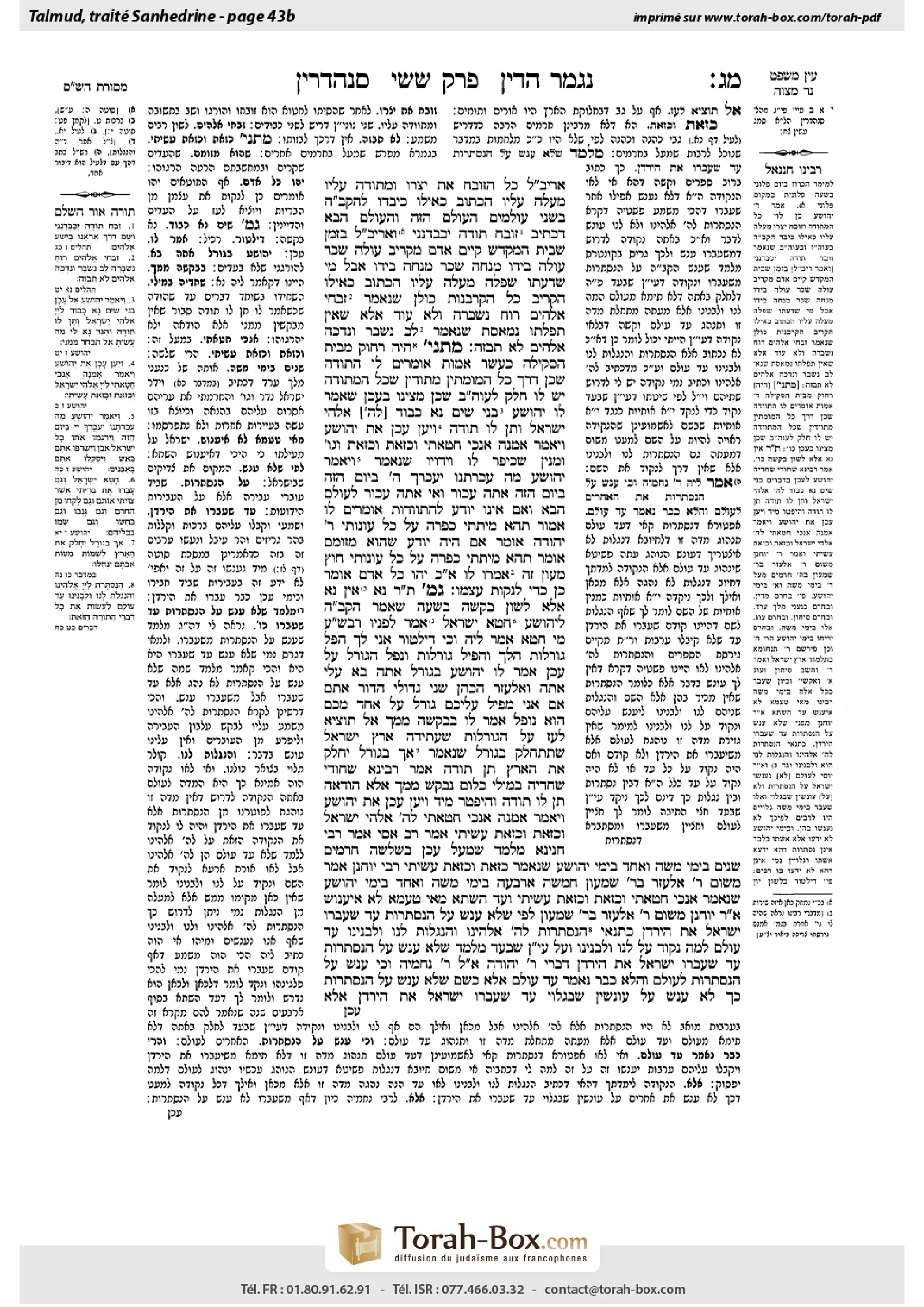
This page of Sanhedrin includes the Aramaic text, an English translation and an AI-generated French translation, alongside the scan above.
סנהדרין מ״ג ב · Aramaic and Hebrew text
אָמַר רַבִּי יְהוֹשֻׁעַ בֶּן לֵוִי: כׇּל הַזּוֹבֵחַ אֶת יִצְרוֹ וּמִתְוַדֶּה עָלָיו, מַעֲלֶה עָלָיו הַכָּתוּב כְּאִילּוּ כִּיבְּדוֹ לְהַקָּדוֹשׁ בָּרוּךְ הוּא בִּשְׁנֵי עוֹלָמִים – הָעוֹלָם הַזֶּה וְהָעוֹלָם הַבָּא, דִּכְתִיב: ״זֹבֵחַ תּוֹדָה יְכַבְּדָנְנִי״.
וְאָמַר רַבִּי יְהוֹשֻׁעַ בֶּן לֵוִי: בִּזְמַן שֶׁבֵּית הַמִּקְדָּשׁ קַיָּים, אָדָם מַקְרִיב עוֹלָה – שְׂכַר עוֹלָה בְּיָדוֹ, מִנְחָה – שְׂכַר מִנְחָה בְּיָדוֹ. אֲבָל מִי שֶׁדַּעְתּוֹ שְׁפָלָה, מַעֲלֶה עָלָיו הַכָּתוּב כְּאִילּוּ הִקְרִיב כׇּל הַקָּרְבָּנוֹת כּוּלָּן, שֶׁנֶּאֱמַר: ״זִבְחֵי אֱלֹהִים רוּחַ נִשְׁבָּרָה״. וְלֹא עוֹד, אֶלָּא שֶׁאֵין תְּפִלָּתוֹ נִמְאֶסֶת, שֶׁנֶּאֱמַר: ״לֵב נִשְׁבָּר וְנִדְכֶּה אֱלֹהִים לֹא תִבְזֶה״.
מַתְנִי׳ הָיָה רָחוֹק מִבֵּית הַסְּקִילָה כְּעֶשֶׂר אַמּוֹת, אוֹמְרִים לוֹ: ״הִתְוַדֵּה״, שֶׁכֵּן דֶּרֶךְ כׇּל הַמּוּמָתִין מִתְוַדִּין. שֶׁכׇּל הַמִּתְוַדֶּה יֵשׁ לוֹ חֵלֶק לָעוֹלָם הַבָּא, שֶׁכֵּן מָצִינוּ בְּעָכָן שֶׁאָמַר לוֹ יְהוֹשֻׁעַ: ״בְּנִי שִׂים נָא כָבוֹד לַה׳ אֱלֹהֵי יִשְׂרָאֵל וְתֶן לוֹ תוֹדָה״. ״וַיַּעַן עָכָן אֶת יְהוֹשֻׁעַ וַיֹּאמַר אׇמְנָה אָנֹכִי חָטָאתִי וְכָזֹאת וְכָזֹאת וְגוֹ׳״. וּמִנַּיִן שֶׁכִּיפֵּר לוֹ וִידּוּיוֹ? שֶׁנֶּאֱמַר: ״וַיֹּאמֶר יְהוֹשֻׁעַ מֶה עֲכַרְתָּנוּ יַעְכֳּרְךָ ה׳ בַּיּוֹם הַזֶּה״. בְּיוֹם הַזֶּה אַתָּה עָכוּר, וְאִי אַתָּה עָכוּר לָעוֹלָם הַבָּא.
וְאִם אֵינוֹ יוֹדֵעַ לְהִתְוַודּוֹת, אוֹמְרִים לוֹ, אֱמוֹר: ״תְּהֵא מִיתָתִי כַּפָּרָה עַל כׇּל עֲוֹנוֹתַי״. רַבִּי יְהוּדָה אוֹמֵר: אִם הָיָה יוֹדֵעַ שֶׁהוּא מְזוּמָּם, אוֹמֵר: ״תְּהֵא מִיתָתִי כַּפָּרָה עַל כׇּל עֲוֹנוֹתַי חוּץ מֵעָוֹן זֶה״. אָמְרוּ לוֹ: אִם כֵּן, יְהוּ כׇּל אָדָם אוֹמְרִין כֵּן כְּדֵי לְנַקּוֹת עַצְמָן.
גְּמָ׳ תָּנוּ רַבָּנַן: ״נָא״ – אֵין ״נָא״ אֶלָּא לְשׁוֹן בַּקָּשָׁה.
בְּשָׁעָה שֶׁאָמַר הַקָּדוֹשׁ בָּרוּךְ הוּא לִיהוֹשֻׁעַ: ״חָטָא יִשְׂרָאֵל״, אָמַר לְפָנָיו: רִבּוֹנוֹ שֶׁל עוֹלָם, מִי חָטָא? אֲמַר לֵיהּ: וְכִי דֵּילָטוֹר אֲנִי? לֵךְ הַפֵּל גּוֹרָלוֹת. הָלַךְ וְהִפִּיל גּוֹרָלוֹת, וְנָפַל הַגּוֹרָל עַל עָכָן. אָמַר לוֹ: יְהוֹשֻׁעַ, בְּגוֹרָל אַתָּה בָּא עָלַי? אַתָּה וְאֶלְעָזָר הַכֹּהֵן שְׁנֵי גְּדוֹלֵי הַדּוֹר אַתֶּם. אִם אֲנִי מַפִּיל עֲלֵיכֶם גּוֹרָל, עַל אֶחָד מִכֶּם הוּא נוֹפֵל. אָמַר לוֹ: בְּבַקָּשָׁה מִמְּךָ, אַל תּוֹצִיא לַעַז עַל הַגּוֹרָלוֹת, שֶׁעֲתִידָה אֶרֶץ יִשְׂרָאֵל שֶׁתִּתְחַלֵּק בְּגוֹרָל, שֶׁנֶּאֱמַר: ״אַךְ בְּגוֹרָל יֵחָלֵק אֶת הָאָרֶץ״.
״תֵּן תּוֹדָה״. אָמַר רָבִינָא, שַׁחוֹדֵי שַׁחֲדֵיהּ בְּמִילֵּי: כְּלוּם נְבַקֵּשׁ מִמְּךָ אֶלָּא הוֹדָאָה? תֵּן לוֹ תּוֹדָה וְהִיפָּטֵר. מִיָּד: ״וַיַּעַן עָכָן אֶת יְהוֹשֻׁעַ וַיֹּאמַר אׇמְנָה אָנֹכִי חָטָאתִי לַה׳ אֱלֹהֵי יִשְׂרָאֵל וְכָזֹאת וְכָזֹאת עָשִׂיתִי״.
אָמַר רַב אַסִּי אָמַר רַבִּי חֲנִינָא: מְלַמֵּד שֶׁמָּעַל עָכָן בִּשְׁלֹשָׁה חֲרָמִים, שְׁנַיִם בִּימֵי מֹשֶׁה וְאֶחָד בִּימֵי יְהוֹשֻׁעַ, שֶׁנֶּאֱמַר: ״כָּזֹאת וְכָזֹאת עָשִׂיתִי״. רַבִּי יוֹחָנָן אָמַר מִשּׁוּם רַבִּי אֶלְעָזָר בְּרַבִּי שִׁמְעוֹן: חֲמִשָּׁה, אַרְבָּעָה בִּימֵי מֹשֶׁה וְאֶחָד בִּימֵי יְהוֹשֻׁעַ, שֶׁנֶּאֱמַר: ״אָנֹכִי חָטָאתִי וְכָזֹאת וְכָזֹאת עָשִׂיתִי״.
וְעַד הַשְׁתָּא, מַאי טַעְמָא לָא אִיעֲנוּשׁ? אָמַר רַבִּי יוֹחָנָן מִשּׁוּם רַבִּי אֶלְעָזָר בְּרַבִּי שִׁמְעוֹן: לְפִי שֶׁלֹּא עָנַשׁ עַל הַנִּסְתָּרוֹת עַד שֶׁעָבְרוּ יִשְׂרָאֵל אֶת הַיַּרְדֵּן.
כְּתַנָּאֵי: ״הַנִּסְתָּרֹת לַה׳ אֱלֹהֵינוּ וְהַנִּגְלֹת לָנוּ וּלְבָנֵינוּ עַד עוֹלָם״. לָמָּה נָקוּד עַל ״לָנוּ וּלְבָנֵינוּ״ וְעַל עַיִן שֶׁבְּ״עַד״? מְלַמֵּד שֶׁלֹּא עָנַשׁ עַל הַנִּסְתָּרוֹת עַד שֶׁעָבְרוּ יִשְׂרָאֵל אֶת הַיַּרְדֵּן, דִּבְרֵי רַבִּי יְהוּדָה.
אָמַר לוֹ רַבִּי נְחֶמְיָה: וְכִי עָנַשׁ עַל הַנִּסְתָּרוֹת לְעוֹלָם? וַהֲלֹא כְּבָר נֶאֱמַר ״עַד עוֹלָם״! אֶלָּא, כְּשֵׁם שֶׁלֹּא עָנַשׁ עַל הַנִּסְתָּרוֹת, כָּךְ לֹא עָנַשׁ עַל עוֹנָשִׁין שֶׁבַּגָּלוּי עַד שֶׁעָבְרוּ יִשְׂרָאֵל אֶת הַיַּרְדֵּן. אֶלָּא
Sanhedrin 43b · English translation
§ Apropos the last verse cited in this baraita, Rabbi Yehoshua ben Levi says: With regard to anyone who slaughters his evil inclination after it has tempted him to sin, if he repents and confesses his sin, the verse ascribes him credit as though he had honored the Holy One, Blessed be He, in two worlds, this world and the World-to-Come, as it is written: “Whoever slaughters a thanks-offering [toda] honors Me [yekhabdaneni]” (Psalms 50:23), which can also be read as: Whoever slaughters his evil inclination and confesses [mitvadeh] honors Me, and the two instances of the letter nun in the word yekhabdaneni allude to the two worlds.
And Rabbi Yehoshua ben Levi also says: When the Temple is standing, if a person sacrifices a burnt-offering, he has the reward given for bringing a burnt-offering, and if he sacrifices a meal-offering, he has the reward given for bringing a meal-offering. But as for one whose spirit is humble, the verse ascribes him credit for his prayer as though he has sacrificed all the offerings, as it is stated: “The offerings of God are a broken spirit” (Psalms 51:19), which teaches that a broken spirit is equivalent to the offerings to God, in the plural. And moreover, his prayer is not rejected, as it is stated in the continuation of that verse: “A broken and contrite heart, God, You will not despise.”
MISHNA: When the condemned man is at a distance of about ten cubits from the place of stoning, they say to him: Confess your transgressions, as the way of all who are being executed is to confess. As whoever confesses and regrets his transgressions has a portion in the World-to-Come. For so we find with regard to Achan, that Joshua said to him: “My son, please give glory to the Lord, God of Israel, and make confession to Him” (Joshua 7:19). And the next verse states: “And Achan answered Joshua, and said: Indeed I have sinned against the Lord, God of Israel, and like this and like that have I done.” And from where is it derived that Achan’s confession achieved atonement for him? It is derived from here, as it is stated: “And Joshua said: Why have you brought trouble on us? The Lord shall trouble you this day” (Joshua 7:25). Joshua said to Achan as follows: On this day of your judgment you are troubled, but you will not be troubled in the World-to-Come.
And if the condemned man does not know how to confess, either from ignorance or out of confusion, they say to him: Say simply: Let my death be an atonement for all my sins. Rabbi Yehuda says: If the condemned man knows that he was convicted by the testimony of conspiring witnesses, but in fact he is innocent, he says: Let my death be an atonement for all my sins except for this sin. The Sages who disagreed with Rabbi Yehuda said to him: If so, every person who is being executed will say that, to clear himself in the eyes of the public. Therefore, if the condemned man does not make such a statement on his own, the court does not suggest it to him as an alternative.
GEMARA: Since the mishna referred to Achan’s sin, the Gemara cites several statements concerning that incident. The Sages taught in a baraita: Joshua said to Achan: “Please [na] give glory to the Lord, God of Israel, and make confession to Him.” The word “na” is nothing other than an expression of supplication. Why would Joshua employ an expression of supplication when approaching Achan?
The baraita explains: When the Holy One, Blessed be He, said to Joshua: “Israel has sinned” (Joshua 7:11), Joshua said to Him: Master of the Universe, who is the one who has sinned? God said to him: Am I an informer [deilator]? Go cast lots and find out for yourself. Joshua then went and cast lots, and the lot fell upon Achan. Achan said to him: Joshua, do you come to execute me merely based on a lot, without any corroborating evidence? You and Elazar the priest are the two most distinguished leaders of the generation, but if I cast a lot upon the two of you, it will perforce fall upon one of you. What then can you prove from a lottery? Joshua said to him: I ask of you, do not spread slander about the lots, as Eretz Yisrael will one day be divided by lots, as it is stated: “Nevertheless, the land shall be divided by lot” (Numbers 26:55). Due to you the results of that lottery may be challenged. Therefore, Joshua used the word “na,” pleading with Achan to confess.
Joshua said to Achan: “Please give glory to the Lord, God of Israel, and make confession to Him.” Ravina says: Joshua won over Achan with his words, saying: Do we ask anything of you but a confession? Make confession to Him and be discharged. Thinking that if he confessed, he would be pardoned, Achan immediately responded: “And Achan answered Joshua, and said: Indeed I have sinned against the Lord, God of Israel, and like this and like that have I done” (Joshua 7:20).
With regard to the words “And like this and like that have I done,” Rav Asi says that Rabbi Ḥanina says: This teaches that Achan misused consecrated property from three dedications, i.e., three groups of property that had been dedicated to the Lord. Two were during wars waged in the days of Moses, and one was in the days of Joshua, as it is stated: “And like this and like that have I done,” indicating that he had already committed similar offenses twice before committing the offense in Jericho. Rabbi Yoḥanan says in the name of Rabbi Elazar, son of Rabbi Shimon: Achan misused property from five dedications, four during wars waged in the days of Moses, and one in the days of Joshua, as it is stated: “I have sinned against the Lord, God of Israel, and like this and like that have I done,” with each “and” alluding to an additional prior offense.
The Gemara asks: If so, what is the reason that the Jewish people were not punished on Achan’s account until now? Rabbi Yoḥanan says in the name of Rabbi Elazar, son of Rabbi Shimon: Because God did not punish the nation as a whole for hidden sins committed by individuals until the Jewish people crossed the Jordan River.
The Gemara notes that this is subject to a dispute between tanna’im. The verse states: “The hidden matters belong to the Lord our God, but those matters that are revealed belong to us and to our children forever [ad olam], that we may do all the words of this Torah” (Deuteronomy 29:28). Why in a Torah scroll are there dots over each of the letters in the words “to us and to our children” and over the letter ayin in the word “forever [ad]”? The dots, which function like erasures that weaken the force of the words, teach that God did not punish the nation for hidden sins until the Jewish people crossed the Jordan River. This is the statement of Rabbi Yehuda.
Rabbi Neḥemya said to him: And does God ever punish the nation as a whole for hidden sins committed by individuals? But isn’t it already stated: “The hidden matters belong to the Lord our God…forever,” indicating that the Jewish people will never be collectively held responsible for the secret sins of individuals? Rather, the dots over the words teach that just as God did not ever punish the nation as a whole for hidden sins committed by individuals, so too, He did not punish the entire nation for sins committed publicly by individuals until the Jewish people crossed the Jordan River. The Gemara asks: But if so,
Sanhedrin 43b · Traduction française (IA)
§ À propos du dernier verset cité dans cette baraïta, Rabbi Yehoshua ben Levi dit : Quiconque abat son mauvais penchant après que celui-ci l’a incité à fauter, puis se repent et confesse sa faute, se voit attribuer par le verset le mérite d’avoir honoré le Saint, béni soit-Il, dans deux mondes : celui-ci et le Monde futur. En effet, il est écrit : « Celui qui offre un sacrifice de reconnaissance [toda] M’honore [yekhabdaneni] » (Psaumes 50:23), ce qui peut aussi se lire ainsi : « Celui qui abat son mauvais penchant et confesse [mitvadeh] M’honore. » Les deux lettres noun du mot yekhabdaneni font allusion aux deux mondes.
Rabbi Yehoshua ben Levi dit également : Lorsque le Temple est debout, si quelqu’un offre un holocauste, il reçoit la récompense accordée pour l’offrande d’un holocauste ; s’il offre une offrande végétale, il reçoit la récompense accordée pour l’offrande d’une offrande végétale. Mais le verset attribue à la prière de celui qui a l’esprit humble le mérite d’avoir offert tous les sacrifices, comme il est dit : « Les sacrifices de Dieu sont un esprit brisé » (Psaumes 51:19), ce qui enseigne qu’un esprit brisé équivaut aux sacrifices offerts à Dieu, au pluriel. De plus, sa prière n’est pas rejetée, comme le dit la suite de ce verset : « Un cœur brisé et contrit, ô Dieu, Tu ne le mépriseras pas. »
MICHNA : Lorsque le condamné se trouve à une distance d’environ dix coudées du lieu de la lapidation, on lui dit : « Confesse tes transgressions », car tous ceux qui sont exécutés ont coutume de se confesser. En effet, quiconque se confesse et regrette ses transgressions a une part dans le Monde futur. Ainsi, nous trouvons au sujet d’Achan que Josué lui dit : « Mon fils, je t’en prie, rends gloire au Seigneur, Dieu d’Israël, et confesse-toi devant Lui » (Josué 7:19). Le verset suivant dit : « Achan répondit à Josué et dit : En vérité, j’ai péché contre le Seigneur, Dieu d’Israël, et j’ai fait telle et telle chose. » D’où apprend-on que la confession d’Achan lui a obtenu l’expiation ? On l’apprend d’ici, comme il est dit : « Josué dit : Pourquoi nous as-tu attiré le malheur ? Le Seigneur t’attirera le malheur aujourd’hui » (Josué 7:25). Josué dit à Achan : En ce jour de ton jugement, tu subis un malheur, mais tu n’en subiras pas dans le Monde futur.
Si le condamné ne sait pas comment se confesser, soit par ignorance, soit parce qu’il est troublé, on lui dit : « Dis simplement : Que ma mort serve d’expiation pour tous mes péchés. » Rabbi Yehuda dit : Si le condamné sait qu’il a été reconnu coupable sur le témoignage de témoins conspirateurs, alors qu’il est en réalité innocent, il dit : « Que ma mort serve d’expiation pour tous mes péchés, à l’exception de ce péché. » Les Sages qui n’étaient pas d’accord avec Rabbi Yehuda lui dirent : Dans ce cas, toute personne exécutée dira cela afin de se disculper aux yeux du public. Par conséquent, si le condamné ne fait pas spontanément une telle déclaration, le tribunal ne la lui suggère pas comme solution de rechange.
GUEMARA : Puisque la Michna a mentionné le péché d’Achan, la Guemara cite plusieurs enseignements concernant cet épisode. Les Sages ont enseigné dans une baraïta : Josué dit à Achan : « Je t’en prie [na], rends gloire au Seigneur, Dieu d’Israël, et confesse-toi devant Lui. » Le mot « na » n’exprime rien d’autre qu’une supplication. Pourquoi Josué employa-t-il une formule de supplication en s’adressant à Achan ?
La baraïta explique : Lorsque le Saint, béni soit-Il, dit à Josué : « Israël a péché » (Josué 7:11), Josué Lui demanda : « Maître de l’univers, qui a péché ? » Dieu lui répondit : « Suis-Je un délateur [deilator] ? Va tirer au sort et découvre-le toi-même. » Josué alla alors tirer au sort, et le sort désigna Achan. Achan lui dit : « Josué, vas-tu me faire exécuter sur la seule base d’un tirage au sort, sans aucune preuve à l’appui ? Toi et Éléazar le prêtre êtes les deux dirigeants les plus éminents de la génération ; pourtant, si je tirais au sort entre vous deux, le sort tomberait nécessairement sur l’un de vous. Que peux-tu donc prouver par un tirage au sort ? » Josué lui dit : « Je t’en prie, ne calomnie pas les tirages au sort, car un jour, le pays d’Israël sera réparti par tirage au sort, comme il est dit : “Néanmoins, le pays sera réparti par tirage au sort” » (Nombres 26:55). À cause de toi, on pourrait contester le résultat de ce tirage au sort. C’est pourquoi Josué employa le mot « na », suppliant Achan de se confesser.
Josué dit à Achan : « Je t’en prie, rends gloire au Seigneur, Dieu d’Israël, et confesse-toi devant Lui. » Ravina dit : Josué convainquit Achan par ses paroles, en lui disant : « Que te demandons-nous d’autre qu’une confession ? Confesse-toi devant Lui et tu seras libéré. » Pensant que s’il se confessait, il serait gracié, Achan répondit aussitôt : « Achan répondit à Josué et dit : En vérité, j’ai péché contre le Seigneur, Dieu d’Israël, et j’ai fait telle et telle chose » (Josué 7:20).
Au sujet des mots « et j’ai fait telle et telle chose », Rav Asi dit au nom de Rabbi Ḥanina : Cela enseigne qu’Achan détourna des biens consacrés provenant de trois consécrations, c’est-à-dire de trois groupes de biens consacrés au Seigneur. Deux eurent lieu pendant les guerres menées à l’époque de Moïse, et une à l’époque de Josué, comme il est dit : « et j’ai fait telle et telle chose », ce qui indique qu’il avait déjà commis deux infractions semblables avant celle de Jéricho. Rabbi Yoḥanan dit au nom de Rabbi Elazar, fils de Rabbi Shimon : Achan détourna des biens provenant de cinq consécrations, quatre pendant les guerres menées à l’époque de Moïse et une à l’époque de Josué, comme il est dit : « J’ai péché contre le Seigneur, Dieu d’Israël, et j’ai fait telle et telle chose », chaque « et » faisant allusion à une infraction antérieure supplémentaire.
La Guemara demande : Dans ce cas, pourquoi le peuple juif ne fut-il pas puni à cause d’Achan jusque-là ? Rabbi Yoḥanan dit au nom de Rabbi Elazar, fils de Rabbi Shimon : Parce que Dieu ne punit pas la nation dans son ensemble pour les péchés cachés commis par des individus avant que le peuple juif ait traversé le Jourdain.
La Guemara relève que ce point fait l’objet d’un désaccord entre des tannaïm. Le verset dit : « Les choses cachées appartiennent au Seigneur notre Dieu, mais les choses révélées nous appartiennent, à nous et à nos enfants, pour toujours [ad olam], afin que nous accomplissions toutes les paroles de cette Torah » (Deutéronome 29:28). Pourquoi, dans un rouleau de Torah, des points sont-ils placés au-dessus de chacune des lettres des mots « à nous et à nos enfants », ainsi qu’au-dessus de la lettre ayin du mot « pour toujours [ad] » ? Ces points, qui agissent comme des effacements affaiblissant la portée des mots, enseignent que Dieu ne punit pas la nation pour les péchés cachés avant que le peuple juif ait traversé le Jourdain. Telle est l’opinion de Rabbi Yehuda.
Rabbi Neḥemya lui dit : Dieu punit-Il jamais la nation dans son ensemble pour les péchés cachés commis par des individus ? Pourtant, n’est-il pas déjà dit : « Les choses cachées appartiennent au Seigneur notre Dieu… pour toujours », ce qui indique que le peuple juif ne sera jamais tenu collectivement responsable des péchés secrets commis par des individus ? Les points placés au-dessus des mots enseignent plutôt que, de même que Dieu n’a jamais puni la nation dans son ensemble pour les péchés cachés commis par des individus, de même Il n’a pas puni toute la nation pour les péchés commis publiquement par des individus avant que le peuple juif ait traversé le Jourdain. La Guemara demande : Mais dans ce cas,
Traduction française générée par IA à partir de l’édition anglaise de Sefaria. Vérifie toujours un passage avec le texte source.
Text from Sefaria: William Davidson Edition - Vocalized Aramaic (CC BY NC); William Davidson Edition - English (CC BY NC).